Key Facts: Anker SOLIX vs Jackery
- Capacity Discrepancy: The Anker SOLIX S2000 is a heavy-duty 2,010Wh home backup system, while the Jackery Explorer 300 is a highly portable 292Wh emergency companion.
- Lifespan Leader: Anker's S2000 offers an industry-leading 10,000-cycle LFP battery life (approx. 15 years), compared to the Jackery's still-impressive 4,000-cycle LFP lifespan.
- Appliance Capability: The Anker SOLIX S2000 can run 99% of home appliances, including full-size refrigerators (up to 35 hours) and medical equipment. The Jackery Explorer 300 is built for low-draw communication gear, laptops, and CPAP machines.
- Portability Factor: At 7.5 lbs, the Jackery is ideal for rapid evacuation and mobile survival kits. The Anker weighs 35.7 lbs, making it best suited for sheltering in place.
The Battle for Emergency Power: Anker SOLIX vs Jackery
When a severe storm, cyberattack, or grid failure knocks out your electricity, your survival strategy depends on how you manage power. Communication, medical devices, refrigeration, and light are non-negotiable in a crisis. Choosing the right portable power station can mean the difference between a managed inconvenience and a full-blown emergency.
In this head-to-head comparison of anker solix vs jackery, we look at two very different classes of emergency power. We compare the heavy-duty Anker SOLIX S2000, built for sheltering in place and running heavy appliances, against the ultra-portable Jackery Explorer 300, designed for mobile survival, communications, and light-duty backup. Both utilize stable Lithium Iron Phosphate (LiFePO4) chemistry, but they serve completely different roles in a disaster preparedness plan.
Product A: Anker SOLIX S2000
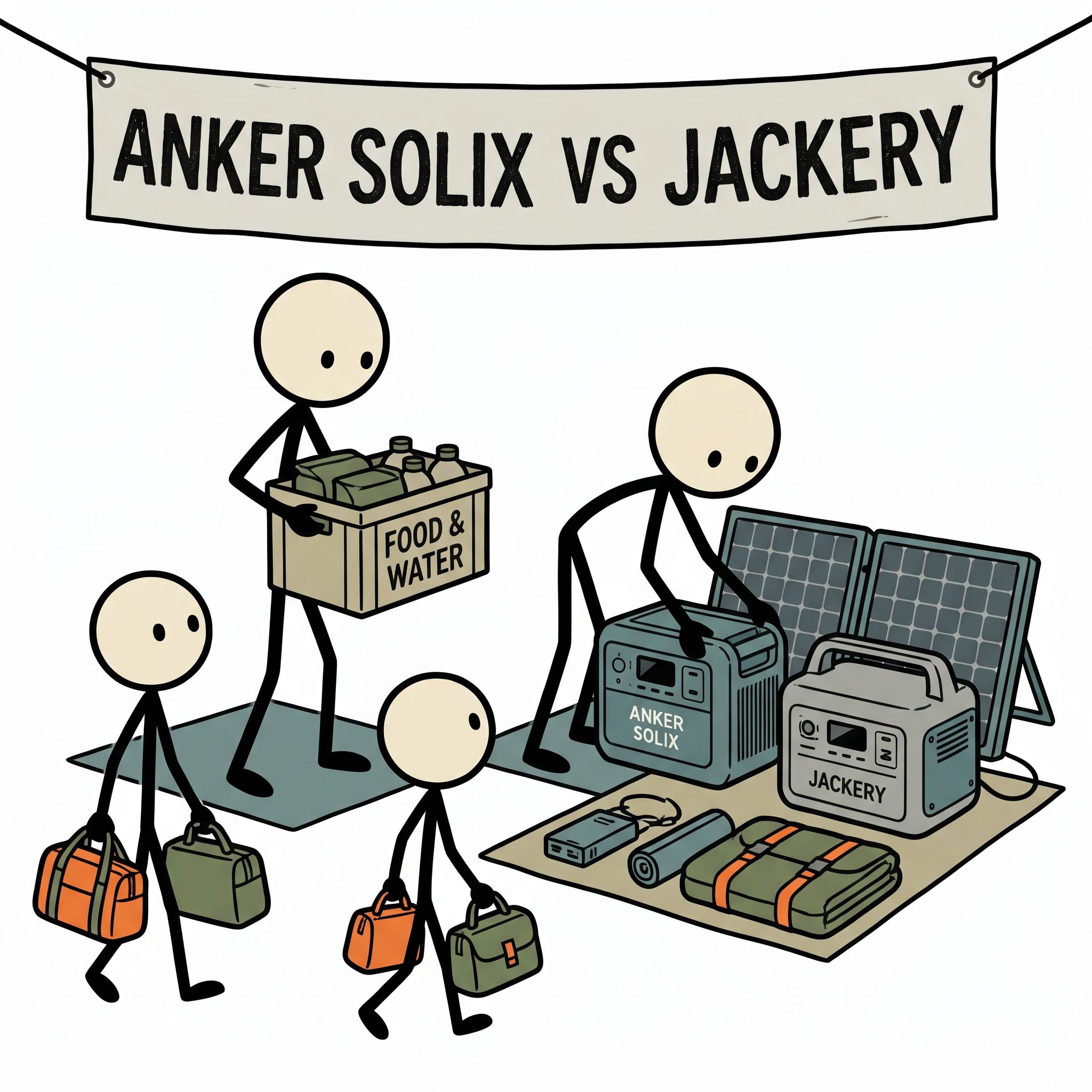
The Anker SOLIX S2000 is engineered for serious, long-term emergency preparedness. Boasting a massive 2,010Wh capacity and a continuous output of 1,500W (with a 3,000W peak surge), this unit is built to keep your household running when the grid goes dark. Its standout feature is its efficiency; with an ultra-low 6W idle power draw, it can run a standard home refrigerator for up to 35 hours on a single charge.
Anker has integrated 314Ah LFP cells into this unit, delivering an unprecedented 10,000 charge cycles before reaching 70% capacity. This translates to roughly 15 years of daily use, making it one of the most durable investments you can make for home defense. Despite its high capacity, it remains relatively compact, weighing only 35.7 lbs, which is 25% lighter than the industry average for 2kWh power stations.
For off-grid survival, the S2000 supports 6 recharging methods, including a 400W solar input. This allows you to harvest free energy from the sun during long-term grid down scenarios, ensuring you never run out of power.
Buying Option: Anker SOLIX S2000 Portable Power Station on Amazon
Product B: Jackery Explorer 300
If your emergency plan involves rapid evacuation, bugging out, or maintaining a lightweight mobile command center, the Jackery Explorer 300 is a stellar choice. Weighing just 7.5 lbs, this ultra-lightweight power station delivers 292Wh of capacity with a 300W continuous output (600W peak surge). It is designed to be grabbed at a moment's notice and packed alongside your emergency go-bag essentials guide.
The Explorer 300 has been upgraded with premium LiFePO4 chemistry, offering over 4,000 charge cycles (more than 11 years of reliable service). It is equipped with dual AC outlets, a fast-charging 100W USB-C PD port, and a 120W car port, allowing you to power up to 6 devices simultaneously. It serves as an excellent power source for emergency radios, satellite phones, laptops, and portable CPAP machines for off-grid sleeping.
Recharging is fast and efficient. When paired with a 100W solar panel, it can reach an 80% charge in under 3 hours, making it highly sustainable for mobile, off-grid survival scenarios.
Buying Option: Jackery Explorer 300 Portable Power Station on Amazon
Head-to-Head Analysis for Emergency Preparedness
1. Home Appliance Backup vs. Mobile Survival
The choice between these two units depends entirely on your survival strategy. If you plan to shelter in place, the Anker SOLIX S2000 is the clear winner. It can handle high-draw appliances like full-size refrigerators, medical equipment, sump pumps, and microwave ovens. The Jackery Explorer 300 cannot run these heavy loads. However, if you must evacuate on foot or in a packed vehicle, the Jackery's 7.5-pound frame is infinitely more practical than the Anker's 35.7-pound chassis.
2. Battery Lifespan and Reliability
In a long-term disaster, you need equipment that will not fail after a few years of storage. Both brands use safe, stable LiFePO4 chemistry, which is highly resistant to thermal runaway. However, Anker's S2000 takes durability to the extreme with 10,000 charge cycles. This is more than double the Jackery's 4,000 cycles, making the Anker a superior multi-decade investment for emergency backup.
3. Solar Off-Grid Sustainability
During extended blackouts, recharging your power station via solar is critical. The Anker SOLIX S2000 accepts up to 400W of solar input, allowing you to fully replenish its massive reservoir in a single day of good sunlight. The Jackery Explorer 300 accepts up to 100W of solar input. While the Jackery charges faster due to its smaller capacity, it harvests far less total energy, limiting your daily power budget during an extended grid-down scenario.
The Verdict: Which is Best for Your Emergency Kit?
For comprehensive emergency preparedness, the Anker SOLIX S2000 is the definitive winner. Its ability to keep food cold, run medical devices, and provide substantial power for days makes it an indispensable asset for home defense and sheltering in place.
However, a well-rounded emergency plan should include tiered layers of power. The Jackery Explorer 300 is the perfect secondary unit. It belongs in your vehicle or bug-out bag to handle communication, navigation, and light-duty portable charging without weighing you down. If your budget is tight and your primary concern is keeping phones, radios, and flashlights running, the Jackery offers exceptional value and reliability.
Frequently Asked Questions
Can the Jackery Explorer 300 run a full-size refrigerator during a power outage?
No. The Jackery Explorer 300 has a continuous output limit of 300W and a capacity of 292Wh. Full-size refrigerators typically require high startup surge power (often over 1,000W) and continuous power that would deplete the Jackery in less than an hour. For refrigerator backup, the Anker SOLIX S2000 is designed to run a fridge for up to 35 hours.
What makes the Anker SOLIX S2000 battery last so long?
The Anker SOLIX S2000 utilizes advanced 314Ah LiFePO4 (LFP) cells. This chemistry, combined with Anker's thermal management, allows the unit to achieve up to 10,000 charge cycles before dropping to 70% capacity, translating to an estimated 15-year operational lifespan.
Is the Jackery Explorer 300 suitable for a bug-out bag?
Yes. Weighing only 7.5 lbs, the Jackery Explorer 300 is highly portable and fits easily into a vehicle-based bug-out kit or emergency pack. It is ideal for keeping emergency radios, smartphones, laptops, and flashlights charged on the move.
How fast can you recharge these power stations using solar panels?
The Anker SOLIX S2000 supports up to 400W of solar input, allowing it to charge efficiently in off-grid scenarios. The Jackery Explorer 300 supports up to 100W solar input, which can charge the unit to 80% in about 2.8 hours under optimal sunlight.
Can I use these power stations indoors during an emergency?
Yes, both the Anker SOLIX and Jackery Explorer are completely safe for indoor use. Unlike gas-powered generators, they do not emit toxic carbon monoxide fumes, run silently, and require no fuel storage.
Emergency Preparedness Resources
To learn more about building a resilient emergency power plan, consult these official disaster preparedness resources: