Key Facts: Emergency Communication Systems Compared
- Radio Ecosystems: The Baofeng UV-5R is an open-platform Amateur (Ham) radio, while the Midland MXT275 is a dedicated GMRS (General Mobile Radio Service) mobile transceiver.
- Licensing Barriers: Ham radio requires passing a technical written exam for each user. GMRS requires a simple online registration fee that covers your entire immediate family.
- Power Differential: The Midland MXT275 outputs 15 watts of power - three times the transmission strength of the 5-watt handheld Baofeng UV-5R.
- Deployment Scenarios: The Baofeng is designed for individual bug-out bags and tactical portability. The Midland MXT275 is optimized as a vehicle-mounted mobile station or a home-base command center.
The Reality of Grid-Down Communications
When cell towers fail, power grids collapse, or natural disasters strike, your smartphone becomes a useless piece of glass. For emergency preparedness, establishing a localized radio network is not optional - it is a fundamental survival requirement. However, the debate between baofeng vs midland radio platforms often confuses beginners and experienced preppers alike.
The confusion stems from comparing two entirely different radio services: Amateur Radio (Ham) and General Mobile Radio Service (GMRS). Below, we break down the capabilities of the ultra-affordable Baofeng UV-5R and the rugged, vehicle-ready Midland MXT275 to help you choose the right tool for your survival plan.
Product A: Baofeng UV-5R Ham Radio
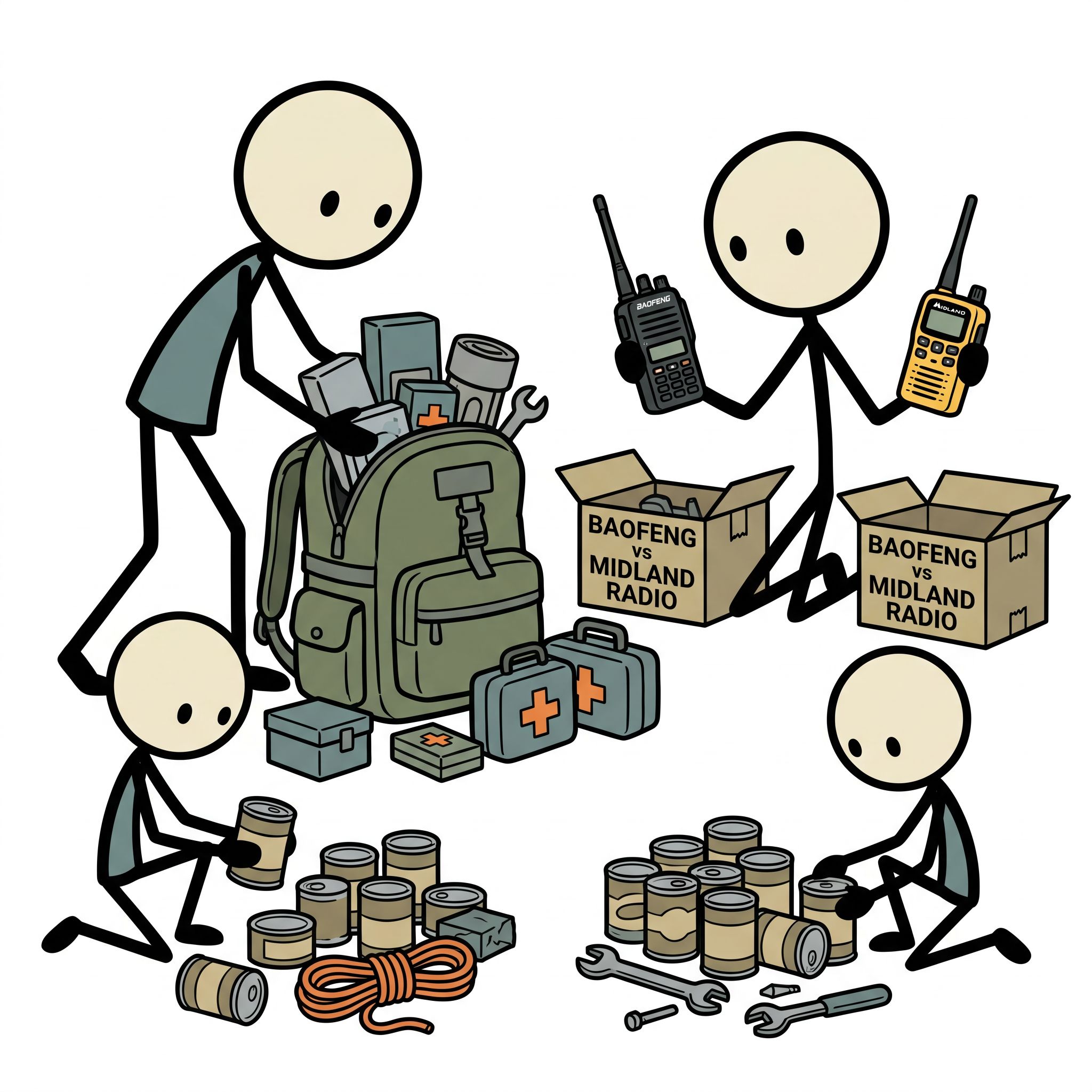
The Baofeng UV-5R is legendary in the survival community. It is a dual-band handheld transceiver (HT) that operates on VHF (144-148MHz) and UHF (420-450MHz) amateur bands. Its primary appeal is its incredibly low price point and absolute versatility.
Key Emergency Features
- Dual-Band Monitoring: Allows you to monitor two different frequencies simultaneously (e.g., a local emergency net and a tactical team channel).
- Manual Keypad Programming: Unlike many commercial radios, you can program frequencies directly into the device in the field without needing a computer.
- CHIRP Support: Easily program hundreds of local repeaters, search-and-rescue frequencies, and weather channels using free open-source software.
- Massive Accessory Ecosystem: From extended batteries and tactical folding antennas to battery eliminators, the UV-5R has more aftermarket support than any other radio on earth.
Preparedness Pros & Cons
Pros: Extremely cheap, allowing you to buy backups for your entire group; highly portable; can listen to a massive range of frequencies, including local police/fire (if unencrypted) and NOAA weather broadcasts.
Cons: Steep learning curve; fragile plastic construction; legally requires an FCC Technician class license to transmit; stock antenna is highly inefficient and must be upgraded for serious emergency use.
Product B: Midland MXT275 MicroMobile GMRS
The Midland MXT275 is a 15-watt GMRS mobile radio designed to be mounted inside a bug-out vehicle, overland rig, or set up as a home base station. It represents a plug-and-play approach to high-power emergency communications.
Key Emergency Features
- 15-Watt Transmitter: Provides significantly more punch than a handheld unit, pushing signals through dense foliage, hills, and urban obstacles.
- Fully Integrated Handheld Mic: All controls, channel selectors, and the display screen are built directly into the microphone unit, allowing the main radio body to be tucked away under a seat or dashboard.
- NOAA Weather Scan & Alerts: Instantly accesses local weather broadcasts and features an active alert system to warn you of incoming severe weather.
- USB-C Charging Port: Located on the front of the unit, allowing you to charge support gear, flashlights, or handheld radios directly from the main unit.
Preparedness Pros & Cons
Pros: Extremely easy for non-technical family members to use; GMRS license covers your entire family without an exam; high power output provides reliable vehicle-to-vehicle or vehicle-to-home comms; rugged metal chassis.
Cons: Expensive compared to handhelds; not portable (requires a 12V battery power source); limited to GMRS frequencies (cannot access amateur bands or local emergency service frequencies).
Head-to-Head Comparison for Survival Scenarios
1. Licensing and Family Coordination
In a disaster, you need to communicate with your family. If your group consists of non-technical members, the Midland MXT275 is the clear winner. A single GMRS license costs around $35, requires no test, and covers your spouse, kids, parents, and siblings for 10 years. Everyone can legally practice on the air immediately. The Baofeng UV-5R requires every single person to pass a 35-question FCC exam to transmit legally, which is a major hurdle for family adoption.
2. Power and Range
Power equals performance when obstacles get in the way. The Baofeng UV-5R maxes out at 4 to 5 watts of power. Combined with a small handheld antenna, range is often limited to 1 to 2 miles in typical terrain. The Midland MXT275 boasts 15 watts of power and utilizes an external magnetic-mount antenna on your vehicle's roof. This metal ground plane dramatically increases range, allowing for clear communications over 10 to 20 miles in flat terrain, and even further when accessing local GMRS repeaters.
3. Portability vs. Infrastructure
If you are forced to bug out on foot, the Baofeng UV-5R is the undisputed champion. It slips into a pocket or plate carrier, weighs ounces, and runs on internal batteries. The Midland MXT275 is a mobile unit; it has no internal battery and must be wired to a 12V vehicle battery or a portable solar generator setup. It is designed to be the anchor of your communications plan, not a mobile scouting tool.
4. Frequency Flexibility
The Baofeng UV-5R is a wide-open receiver. You can program it to monitor local amateur repeaters, simplex channels, GMRS, FRS, MURS, and marine bands. For intelligence gathering (COMINT) during an emergency, having a Baofeng scanner in your kit is invaluable. The Midland is locked strictly to GMRS channels and NOAA weather bands, offering zero flexibility outside of those pre-programmed frequencies.
The Verdict: Which Belongs in Your Prep Kit?
For a robust emergency communications plan, these radios should actually complement each other rather than compete. However, if you must choose one to start:
Choose the Baofeng UV-5R if: You are on a strict budget, are willing to study and pass your FCC Technician license exam, want a highly portable bug-out bag radio, and want the ability to monitor a wide spectrum of emergency frequencies.
Choose the Midland MXT275 if: You want a reliable, high-power communication system for your bug-out vehicle, need a system that your entire family can use legally and easily without taking exams, and want plug-and-play reliability out of the box.
Frequently Asked Questions
Do I need a license to use a Baofeng UV-5R or Midland MXT275?
Yes, both require FCC licenses for legal transmission in the United States. The Baofeng UV-5R requires an Amateur Radio (Ham) license, which involves passing a written exam. The Midland MXT275 requires a GMRS license, which requires paying a fee to the FCC but does not require an exam. GMRS licenses cover your entire immediate family.
Can a Baofeng UV-5R talk to a Midland GMRS radio?
Technically, the Baofeng UV-5R can be programmed to receive GMRS frequencies. However, transmitting on GMRS frequencies using a Baofeng UV-5R is not FCC-compliant because the UV-5R is not certified under FCC Part 95 rules. For emergency-only, life-or-death scenarios, rules may be bypassed, but for regular training, you should use designated, type-certified radios.
What is the real-world range of the Midland MXT275 compared to the Baofeng UV-5R?
The Midland MXT275 operates at 15 watts of power and utilizes an external magnetic mount antenna, allowing it to easily achieve 10 to 20 miles of range in open areas or vehicle-to-vehicle setups. The Baofeng UV-5R operates at 4 to 5 watts with a small rubber duck antenna, typically yielding 1 to 3 miles of range in wooded or urban areas, though this can be extended with a tactical whip antenna or line-of-sight elevation.
Can I charge the Baofeng UV-5R using solar power during an outage?
Yes. While the stock cradle requires AC power, you can purchase aftermarket USB charging cables, 12V car adapter battery eliminators, or USB-C compatible battery packs for the Baofeng UV-5R. This makes it highly adaptable to portable solar panels and power stations.
Is GMRS better than Ham radio for family emergency preparedness?
GMRS is generally better for family coordination because a single GMRS license covers your spouse, children, parents, and siblings, and the radios are plug-and-play. Ham radio is superior for individual preppers who want to communicate over hundreds of miles via repeaters, digital modes, or HF frequencies, but it requires everyone in your group to study for and pass their own license exams.