⚡ Key Facts
- According to the National Oceanic and Atmospheric Administration (NOAA), the U.S. has experienced multi-year "megadroughts" that have severely depleted major reservoirs like Lake Mead and Lake Powell to historically low levels.
- The Federal Emergency Management Agency (FEMA) recommends storing a minimum of one gallon of water per person per day, but for a multi-week drought scenario, true self-reliance requires planning for 3 to 5 gallons per person daily for hydration and basic hygiene.
- The U.S. Geological Survey (USGS) notes that prolonged droughts significantly lower the water table, placing over 13 million American households that rely on private wells at direct risk of sudden well failure.
- Greywater reuse can reduce indoor household water consumption by up to 50%, according to the Environmental Protection Agency (EPA), providing a critical buffer during mandatory municipal water restrictions.
- A 1,000-square-foot roof can capture approximately 600 gallons of water from just one inch of rainfall, making rainwater harvesting a cornerstone of long-term drought resilience.
In 2018, the city of Cape Town, South Africa, stood on the precipice of "Day Zero"—the day municipal taps were projected to run completely dry. Through extreme conservation measures, the city narrowly averted catastrophe. Today, communities across the American West, the Mediterranean, and Australia are facing similar realities. Drought is no longer just a seasonal dry spell; it is an evolving, long-term environmental shift. When a multi-week dry period stretches into a multi-month or even multi-year crisis, the infrastructure we rely on begins to buckle. Municipal reservoirs evaporate, water pressure drops, and private wells pull up nothing but mud and air. See go-bag essentials checklist for a practical checklist.
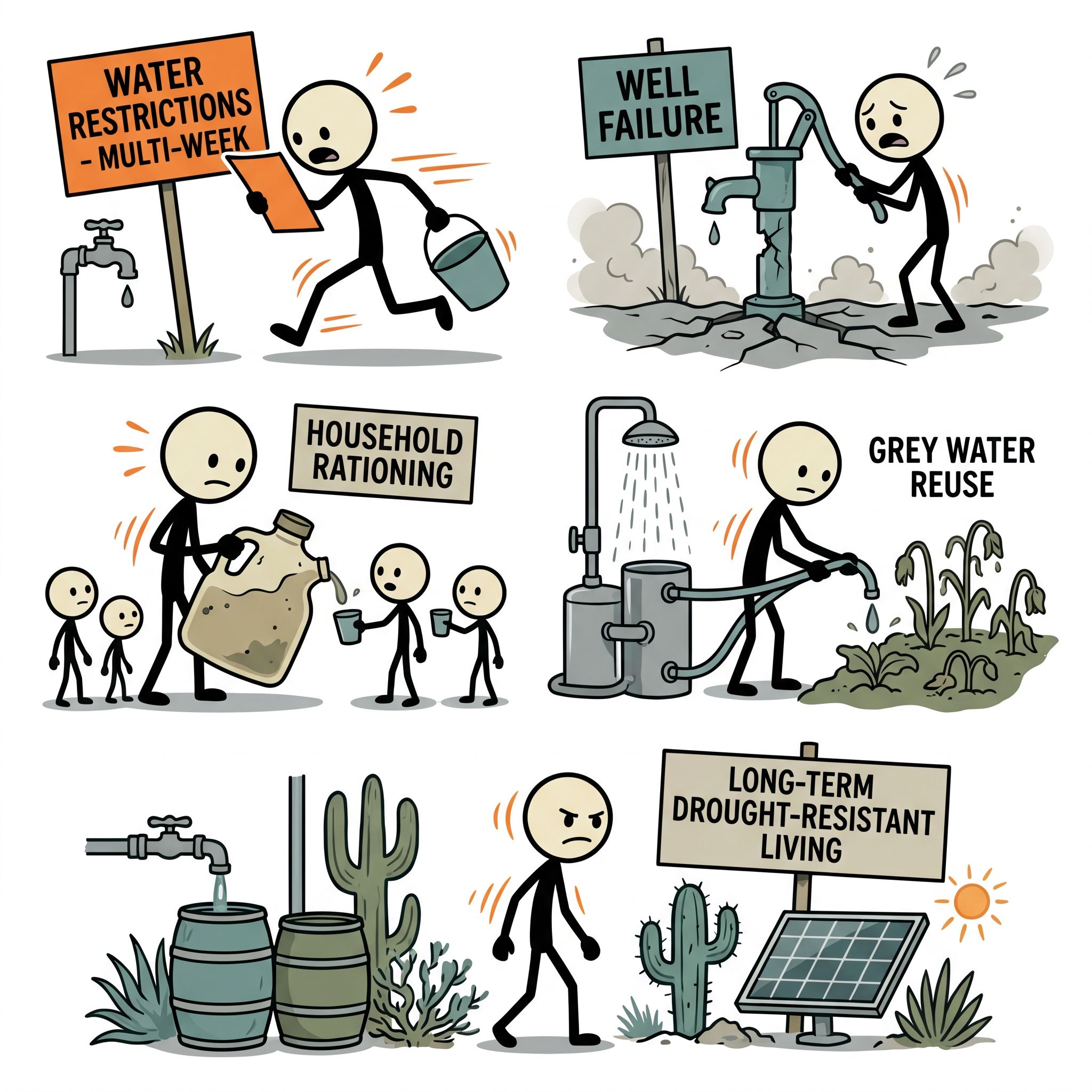
Facing a long-term water shortage requires a fundamental shift in how we view, consume, and recycle our most precious resource. True drought preparedness is not about hoarding thousands of plastic water bottles in a garage. It is about building resilient systems, mastering consumption habits, and adapting your living environment to thrive on a fraction of the water you currently use. Whether you are connected to a fragile municipal grid or rely on a private well tapping into a shrinking aquifer, the time to prepare is before the taps sputter and run dry. See supply planning calculator for a practical checklist.
This comprehensive guide will walk you through the realities of multi-week and multi-month drought scenarios. We will explore how to navigate severe municipal restrictions, what to do when a private well fails, the mechanics of strict household water rationing, safe greywater reuse, and how to ultimately transition toward a fully drought resistant homestead. By taking proactive steps today, you can ensure your family remains safe, hydrated, and self-reliant when the rain stops falling. See daily water needs calculator for a practical checklist.
Understanding the Threat: Multi-Week vs. Multi-Month Droughts
Drought is uniquely insidious. Unlike a hurricane or an earthquake, a drought does not announce its arrival with a sudden, violent event. It is a creeping disaster. The U.S. Drought Monitor classifies droughts into five categories, ranging from Abnormally Dry (D0) to Exceptional Drought (D4). By the time a region hits the D3 or D4 threshold, the impacts on daily life are profound and unavoidable. See family emergency plan for a practical checklist.
A multi-week drought typically triggers the first waves of civic response. You will see voluntary conservation requests, bans on watering lawns during daylight hours, and public awareness campaigns. Surface water levels drop, but deep aquifers and large reservoirs usually hold enough reserves to maintain standard municipal pressure. During this phase, the primary goal of drought preparedness is to audit your usage and verify your emergency storage systems. See survival scenarios library for a practical checklist.
A multi-month drought, however, escalates into a true water conservation emergency. Agricultural allocations are slashed, leading to localized emergency food storage guide chain disruptions and price spikes. Municipalities move from voluntary guidelines to mandatory restrictions, enforced by heavy fines or flow-restrictor installations on residential meters. For those on private wells, a multi-month drought is a countdown. As the water table drops below the depth of standard well pumps, thousands of households can lose their primary water source overnight. See Protocol Survival app for a practical checklist.
The Ripple Effects of a Long-Term Water Shortage
The consequences of a prolonged drought extend far beyond dry faucets. As water levels in municipal pipes drop, the loss of positive pressure allows groundwater and contaminants to seep into the system. This frequently triggers widespread, prolonged boil water advisories. The Centers for Disease Control and Prevention (CDC) warns that compromised water infrastructure during droughts significantly increases the risk of gastrointestinal illnesses.
Furthermore, dry conditions drastically elevate the risk of wildfires. A drought resistant homestead must account not only for water scarcity but also for the increased threat of fire. Dry vegetation, combined with depleted municipal fire hydrants, creates a perilous scenario for suburban and rural communities alike. Preparing for a drought means preparing for the cascading emergencies that inevitably follow in its wake.
Navigating Municipal Water Restrictions
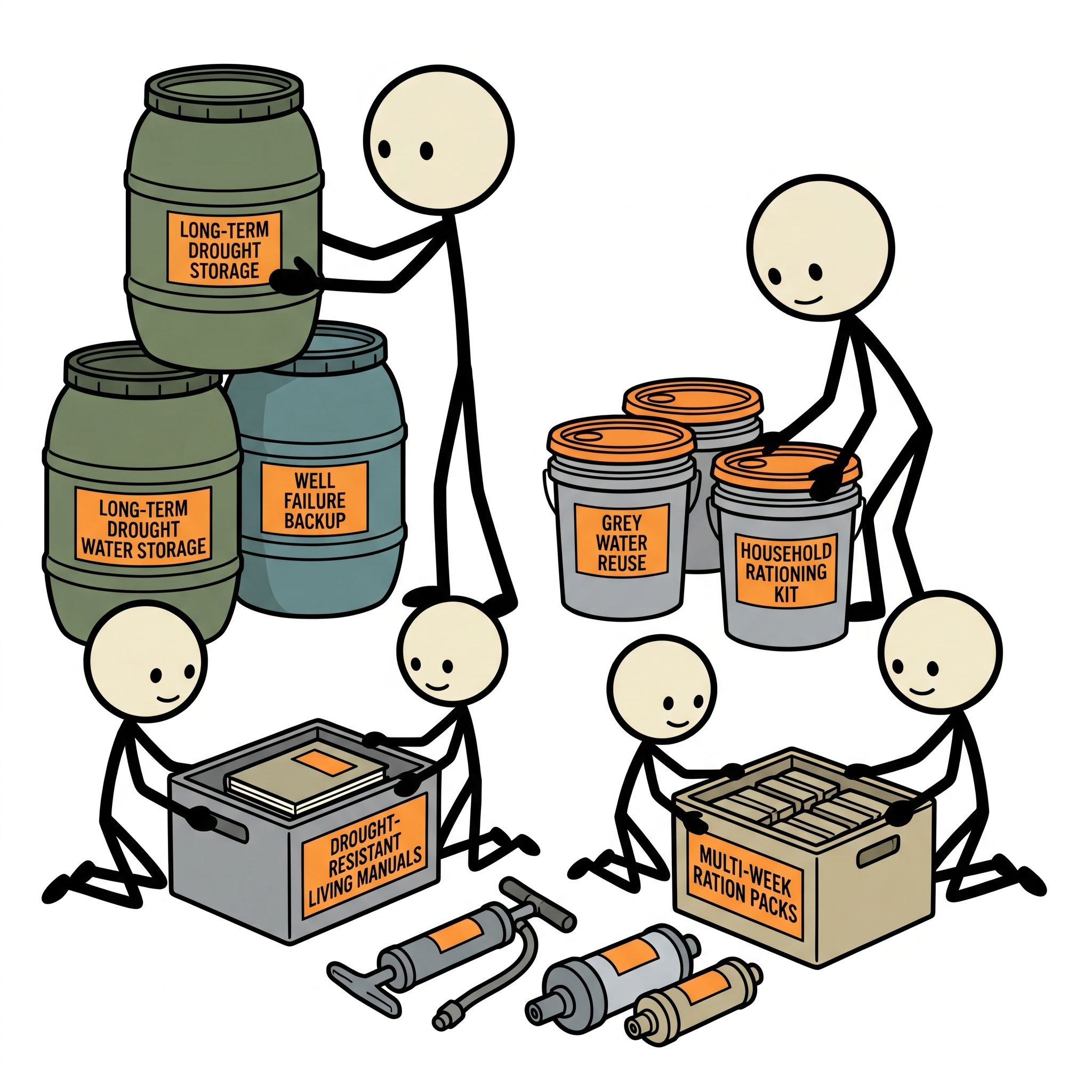
When a municipality faces critically low reservoir levels, local governments will implement tiered water use restrictions. Understanding these tiers and adapting your household before they are enforced is a critical component of drought preparedness. Waiting until mandatory rationing is declared will leave you scrambling to adjust your lifestyle under the threat of utility shut-offs.
Most municipal restriction plans follow a predictable escalation. Phase 1 usually involves voluntary reductions, asking residents to cut usage by 10% to 15%. Phase 2 introduces mandatory restrictions on outdoor water use, banning car washing, pressure washing, and limiting irrigation to specific days. Phase 3 is a severe water conservation emergency, banning all outdoor water use and implementing strict indoor per-capita quotas.
Adapting to Phase 3 Mandatory Quotas
During a severe municipal shortage, your household may be restricted to as little as 40 to 50 gallons per person per day—a drastic cut from the American average of 80 to 100 gallons. To meet these quotas without sacrificing hygiene, you must systematically eliminate water waste.
- Install High-Efficiency Fixtures: Replace standard showerheads (which use 2.5 gallons per minute) with ultra-low-flow aerators (1.25 GPM or less). Install dual-flush conversion kits on all toilets.
- Audit for Silent Leaks: A running toilet can waste up to 200 gallons a day. Use food coloring in the toilet tank to check for silent flapper leaks, and monitor your water meter overnight to detect hidden pipe leaks.
- Change Consumption Habits: Turn off the tap while brushing teeth, shaving, or scrubbing dishes. Implement "navy showers"—turning the water on only to get wet, turning it off to lather, and turning it back on to rinse.
If the drought worsens, municipalities may implement rolling water blackouts, shutting off supply to certain neighborhoods for hours or days at a time. To prepare for this, you must have localized, in-home storage. High-capacity water bobs (heavy-duty plastic bladders that fit in your bathtub) can store up to 100 gallons of municipal water safely, providing a crucial buffer during rolling shut-offs.
The Private Well Crisis: When the Well Runs Dry
For the millions of Americans living off the municipal grid, a long-term water shortage presents a unique and terrifying challenge: well failure. Private wells draw from underground aquifers. When rainfall ceases for months, these aquifers are not recharged. As neighboring farms, industries, and homes continue to pump, the static water level drops rapidly.
Well failure rarely happens without warning. The USGS notes that early signs of a dropping water table include a change in water taste or smell, increased sediment or cloudiness in your tap water, and sputtering faucets caused by air entering the pump. If your pump begins to run continuously without building pressure, it is struggling to pull water and is at risk of burning out.
Mitigating Well Failure
If you notice the warning signs of a dropping water table, immediate action is required to protect your equipment and secure your Water Calculator.
- Lower the Pump: If your well is deep enough but the pump is set too high, a well technician may be able to lower the submersible pump deeper into the water column.
- Install a Storage Cistern: A low-yield well can be managed by installing a large above-ground storage tank (1,000 to 5,000 gallons). The well pump can be set to slowly fill the tank at a low flow rate overnight, while a secondary booster pump pressurizes the water from the tank into your home.
- Deepen the Well: In a multi-year drought, the only permanent solution may be drilling the well deeper to tap into a lower, more stable aquifer. This is a highly expensive endeavor, making proactive conservation crucial.
If your well completely fails, your property immediately transitions into an off-grid Survival Scenarios. You will become reliant on hauled water. Purchasing a food-grade IBC tote (Intermediate Bulk Container) allows you to transport 275 gallons of water in the bed of a heavy-duty pickup truck from a municipal fill station or a neighbor with a functioning, high-yield well.
The Art of Household Water Rationing
When the taps run dry or municipal quotas become draconian, strict household water rationing must be implemented. Rationing is not just about drinking less; it is a holistic approach to managing hydration, sanitation, and food preparation under extreme constraints. FEMA and the Red Cross advise that an absolute minimum of one gallon of water per person per day is required for survival (half for drinking, half for basic hygiene and food prep).
However, in a multi-week scenario, living on one gallon a day is physically and psychologically taxing. A more sustainable emergency rationing goal is 3 to 5 gallons per person per day. To achieve this, you must establish a strict hierarchy of water use within the home, prioritizing health and sanitation above all else.
Establishing the Rationing Hierarchy
Water must be allocated based on absolute necessity. The hierarchy of water use during a severe emergency should be strictly enforced by the head of the household.
- Tier 1: Hydration and Medical Needs. Drinking water is non-negotiable. Dehydration impairs cognitive function and physical strength. Never ration drinking water to the point of dehydration; instead, ration the water used for other tasks.
- Tier 2: Food Preparation. Choose meals that require minimal water to cook. Avoid boiling pasta or rice, which absorbs and wastes water. Rely on canned goods, dehydrated foods that only require a small amount of boiling water, or grilling.
- Tier 3: Personal Hygiene. Daily showers are a luxury of the past. Switch to sponge baths using less than a quart of warm water. Keep antibacterial wipes and hand sanitizer readily available to maintain hand hygiene without using the tap.
- Tier 4: Sanitation and Cleaning. Flushing toilets uses massive amounts of water. Implement the "if it's yellow, let it mellow" rule, or transition entirely to a bucket-style emergency composting toilet using sawdust or peat moss to eliminate flush-water entirely.
The Three-Basin Dishwashing Method
Washing dishes under a running tap wastes gallons of water per minute. During a household water rationing protocol, adopt the three-basin method utilized by the military and off-grid campers. Use three small plastic tubs. Fill the first with a small amount of hot, soapy water for scrubbing. Fill the second with clean water for a primary rinse. Fill the third with water and a few drops of unscented household bleach for a sanitizing rinse. This method allows you to clean an entire day's worth of dishes using less than two gallons of water.
Greywater Reuse: Maximizing Every Drop
In a long-term water shortage, using drinking-quality water to flush toilets or water a garden is an unsustainable luxury. Greywater reuse is the practice of capturing gently used water from sinks, showers, and washing machines, and repurposing it for secondary tasks. The EPA strongly supports greywater reuse as a vital tool for water conservation, noting it can drastically reduce a household's reliance on fresh water.
It is critical to distinguish between greywater and blackwater. Blackwater is water that has come into contact with human waste (from toilets or washing diapers). Blackwater contains dangerous pathogens and must be routed to a septic system or sewer. Greywater, however, is relatively clean and can be safely reused if handled correctly.
Implementing Safe Greywater Systems
Setting up a greywater system can range from simple, manual methods to complex plumbing retrofits. During a sudden emergency, manual collection is the fastest solution. Place buckets in the shower to catch the cold water that flows while you wait for it to heat up. Keep a basin in the kitchen sink to catch the water used to rinse vegetables. This captured water can immediately be used to flush toilets by pouring it directly into the toilet bowl.
For a more permanent drought preparedness strategy, consider a "Laundry-to-Landscape" (L2L) system. Washing machines pump out 15 to 40 gallons of water per load. By installing a simple diverter valve on the washing machine discharge hose, you can route this greywater directly outside to irrigate trees and deep-rooted shrubs.
Greywater Chemistry and Safety
If you plan to use greywater on your property, you must change the chemical products you use in your home. Standard laundry detergents and soaps contain high levels of sodium, boron, and chlorine bleach. Over time, these chemicals will build up in your soil, causing "salt burn" and killing your plants. Transition to biocompatible, biodegradable soaps that are specifically designed for greywater systems. Liquid soaps are generally safer than powdered detergents, which often use sodium as a filler.
Furthermore, the CDC advises that greywater should never be stored for more than 24 hours. Even relatively clean greywater contains microscopic organic matter (skin cells, food particles). If left sitting in a tank, bacteria will rapidly multiply, turning the greywater septic and foul-smelling. Greywater must be routed directly to its end-use destination.
Securing Alternative Water Sources During Long-Term Water Shortages
When municipal supplies are unreliable and private wells are failing, a resilient household must look to alternative methods of water acquisition. Diversifying your water portfolio is the ultimate insurance policy against a long-term water shortage. Nature provides several avenues for water collection, provided you have the right infrastructure and purification tools in place.
Rainwater Harvesting
Rainwater harvesting is the most efficient way to secure large volumes of off-grid water. The math is highly favorable: one inch of rain falling on a 1,000-square-foot roof yields roughly 600 gallons of catchable water. Even in drought-stricken regions, the occasional seasonal storm can provide enough water to sustain a family for months if properly captured.
A robust rainwater system requires gutters, leaf guards, a "first-flush diverter" (which discards the first few gallons of dirty water that washes off the roof), and large, opaque storage cisterns to prevent algae growth. It is important to note that rainwater collected from a roof is not inherently safe to drink. It can contain bird droppings, heavy metals from roofing materials, and environmental pollutants. All harvested rainwater intended for human consumption must be aggressively filtered (using sub-micron ceramic or hollow-fiber filters) and purified (via boiling, chlorination, or UV light).
Atmospheric Water Generation and Dew Collection
In coastal areas or regions with high humidity but low rainfall, atmospheric water generators (AWGs) can pull moisture directly from the air. These devices act like heavy-duty dehumidifiers, condensing water vapor into drinkable liquid. While highly effective, AWGs require significant electrical power, making them dependent on a robust solar generator or grid power.
For a low-tech alternative, dew collection can provide emergency hydration. Suspending large, clean plastic tarps over a basin overnight allows condensation to form and drip into a collection bucket. While the yield is low (often just a few cups per tarp), in a dire survival scenario, this passive collection method can be life-saving.
Sourcing from Natural Bodies of Water
If you live near a creek, pond, or river, these sources can be utilized during a drought. However, as water levels drop, the concentration of pollutants, agricultural runoff, and harmful bacteria in these bodies of water increases dramatically. Stagnant water is a breeding ground for pathogens. If you must source water from the wild, always draw from moving water if possible, and implement a strict multi-stage purification process: pre-filter through cloth to remove sediment, run through a high-quality survival filter (like a Berkey or LifeStraw Family), and finally, treat with chemical purifiers or boil vigorously for at least one minute.
Building a Drought Resistant Homestead
Surviving a drought is one thing; thriving in a drier climate requires a fundamental redesign of your living space. Building a drought resistant homestead means working with nature rather than fighting it. It involves reshaping your landscape to capture, hold, and maximize every drop of moisture that falls on your property.
Xeriscaping and Soil Management
The traditional American lawn is an ecological liability during a long-term water shortage, requiring thousands of gallons of water a month simply to stay green. Xeriscaping is the practice of landscaping with slow-growing, drought-tolerant plants that are native to your specific climate zone. By replacing thirsty turf grass with succulents, native wildflowers, and deep-rooted perennials, you can eliminate the need for outdoor irrigation entirely.
Healthy soil acts as a massive underground sponge. Tilling destroys the soil's structure and accelerates evaporation. Instead, adopt no-till gardening methods and apply thick layers of organic mulch (wood chips, straw, or leaves) over all exposed soil. Mulch acts as a protective blanket, lowering soil temperatures and drastically reducing water loss through evaporation.
Permaculture Principles: Swales and Hugelkultur
Permaculture offers brilliant strategies for passive water harvesting. Swales are shallow, level trenches dug along the contour of a slope. When it rains, water rushes down the slope, fills the swale, and slowly percolates deep into the soil, rather than running off the property. Planting trees on the downhill berm of a swale ensures their roots have access to this deep, stored moisture for months after a rain event.
Hugelkultur is another excellent drought preparedness technique. It involves burying large, rotting logs under mounds of soil and planting directly into the mound. As the wood slowly decomposes, it acts like a massive internal sponge, soaking up rainwater and slowly releasing it to the plant roots during dry spells. A well-established hugelkultur bed can go weeks or even months without manual watering.
Upgrading Household Infrastructure
A truly drought resistant homestead must also address indoor infrastructure. Beyond low-flow fixtures, consider transitioning to a composting toilet system. Modern composting toilets (such as those made by Nature's Head or Sun-Mar) are odorless, hygienic, and completely sever the link between human waste disposal and clean water consumption. By eliminating the flush toilet, a family of four can save tens of thousands of gallons of water per year.
Additionally, centralizing your hot water system or installing point-of-use tankless water heaters prevents the massive waste of water that occurs while waiting for a shower to heat up. Every upgrade you make to your home's infrastructure builds a buffer, giving you more time and more resources when the next multi-month drought strikes.
Conclusion
Facing a multi-week or multi-month drought is a formidable challenge, but it is one that can be managed with foresight, discipline, and the right infrastructure. By understanding the phased realities of water conservation emergencies, protecting your well systems, mastering the art of household water rationing, and safely utilizing greywater, you take control of your family's survival. Building a drought resistant homestead is not an overnight project; it is a continuous process of adaptation and respect for the resources we have. Start auditing your water usage today, invest in robust storage and filtration, and transform your property into a resilient oasis. When the dry seasons lengthen and the water tables drop, your proactive preparation will ensure that your home remains a safe, hydrated, and thriving sanctuary.
Frequently Asked Questions
How much water does a household actually use vs. the survival minimum?
The average American uses 80-100 gallons per person per day. The survival minimum is 1 gallon per day. A reasonable rationed target during a shortage is 5 gallons per day: 1 for drinking, 1 for cooking, 1 for hygiene, and 2 for sanitation.
What household water can I reuse safely?
Grey water (sink, shower, laundry) can be safely reused for toilet flushing and garden irrigation. Cooking water from vegetables retains nutrients good for plants. Never reuse toilet flush water or any water contaminated with chemicals or medical waste.
How does a private well change drought preparedness?
Wells depend on groundwater levels — extended drought can cause well failure as the water table drops. Have your well tested annually. Know the signs of diminishing well performance (air in lines, reduced pressure, discolored water) and identify a backup water source.
Sources & Further Reading
- EPA WaterSense Drought Preparedness
- USDA Natural Resources Conservation Drought Guidance
- CDC Water Conservation