⚡ Key Facts
- FEMA and Red Cross Recommendations: Official federal guidance mandates that households maintain a minimum two-week emergency food supply and water reserve to withstand regional grid collapses, natural disasters, and logistics disruptions.
- Cost Discrepancy: Commercial freeze-dried survival buckets average between $4.50 and $9.00 per 1,000 calories, whereas an equivalent shelf-stable grocery list costs approximately $0.85 to $1.60 per 1,000 calories at local supermarkets.
- Dietary Shock Mitigation: The Centers for Disease Control and Prevention (CDC) identifies gastrointestinal distress as one of the most common non-traumatic complaints in disaster zones, an issue exacerbated by sudden shifts to highly processed, sodium-dense commercial survival rations.
- The Grid Vulnerability Window: According to National Oceanic and Atmospheric Administration (NOAA) historical tracking, major severe weather events create regional supply chain interruptions that isolate suburban and rural communities for an average of 72 hours to 10 days.
When Winter Storm Uri incapacitated the Texas electrical grid in February 2021, supermarket inventory evaporated across impacted counties within four hours. The modern retail grocery model relies entirely on "just-in-time" logistics, maintaining barely three days of stock under standard demand conditions. When catastrophic weather or infrastructure failures emerge, panic-buying instantly collapses local distribution networks. For most households, the instinctive response is to panic-order hyper-expensive freeze-dried survival food kits or do nothing at all under the assumption that preparedness is financially out of reach. In reality, building an authoritative, nutritionally complete two-week emergency food reserve does not require specialized military rations or industrial plastic pails. By utilizing calculated, everyday shelf-stable items sourced from standard grocery store aisles, any household can construct a resilient short term food storage reserve that is cheaper, healthier, and significantly more functional during an acute domestic crisis. For the practical checklist side, use the community emergency preparedness guide.
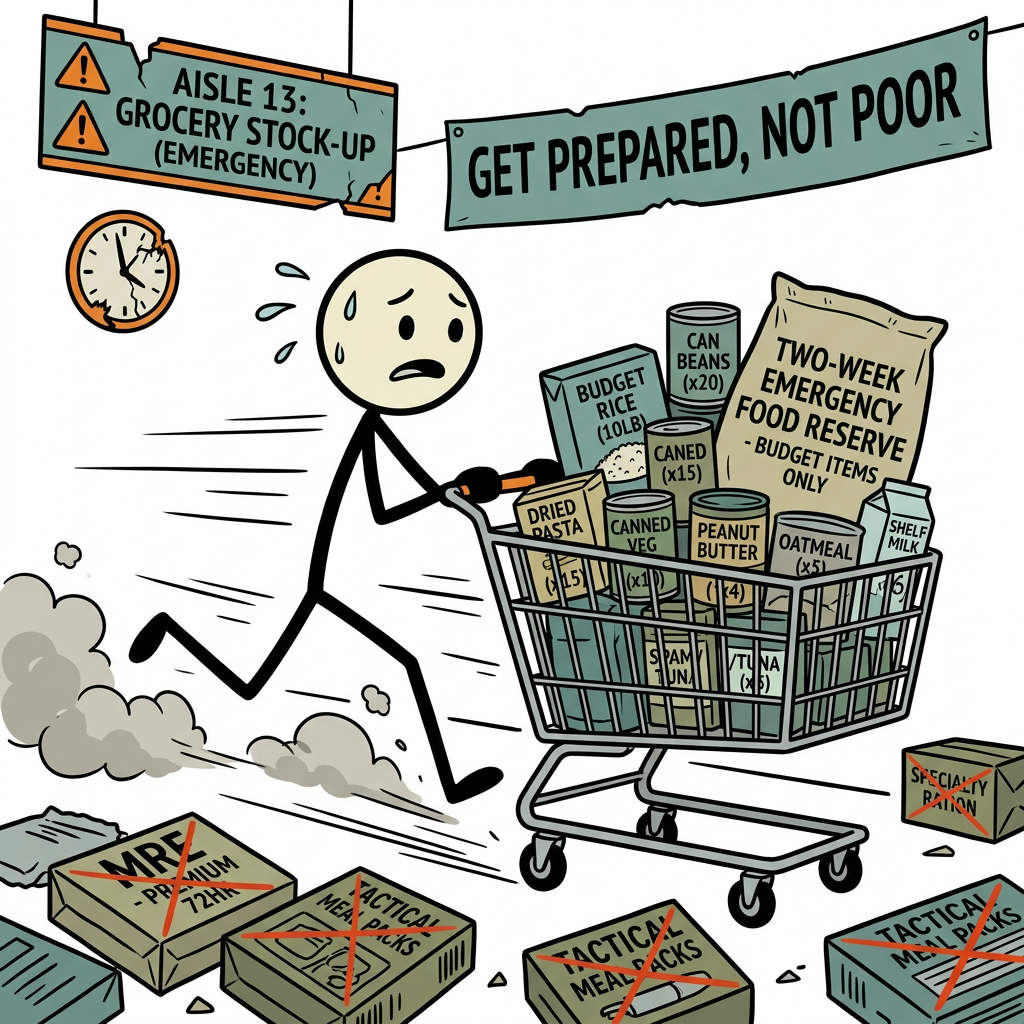
The Freeze-Dried Myth: Why Everyday Groceries Outperform Specialty Rations
The survival manufacturing industry has built a multi-million-dollar marketing apparatus around high-sodium, multi-decade "survival pails." While 25-year freeze-dried meals offer convenience for ultra-long-term planning, relying on them exclusively for a practical two-week emergency emergency food storage guide is fundamentally flawed. Commercial buckets are exceptionally expensive per usable calorie, commonly packaging inexpensive fillers like white rice, sugary drink mixes, and low-protein cornstarch-thickened soups to inflate their advertised "serving" counts. A pail claiming to contain "120 servings" often delivers fewer than 1,200 calories per day to an adult, well below the physiological baselines established by the United States Department of Agriculture (USDA).
Beyond the excessive financial markup, commercial rations introduce significant physiological friction. A sudden, complete dietary pivot during an already high-stress incident triggers acute digestive distress, including sodium bloating, cramping, and systemic metabolic sluggishness. When emergency events occur, your body requires nutritional consistency rather than experimental freeze-dried chemistry. Sourcing your short term food storage directly from standard retail shelves preserves dietary familiarity, ensuring adults, young children, and elderly relatives consume foods their digestive systems process without friction.
Standard grocery items also provide superior culinary versatility. Instead of consuming a single, homogenous reconstituted stew pouch, supermarket components allow you to adjust fats, acids, and proteins based on direct caloric and emotional needs. The primary operational objective in an emergency is to preserve normalcy; familiar comfort meals assembled from standard canned and dry goods achieve this psychological anchor far better than dehydrated novelty meals ever could.
Nutritional Architecture: Caloric Targets and Macronutrient Balance
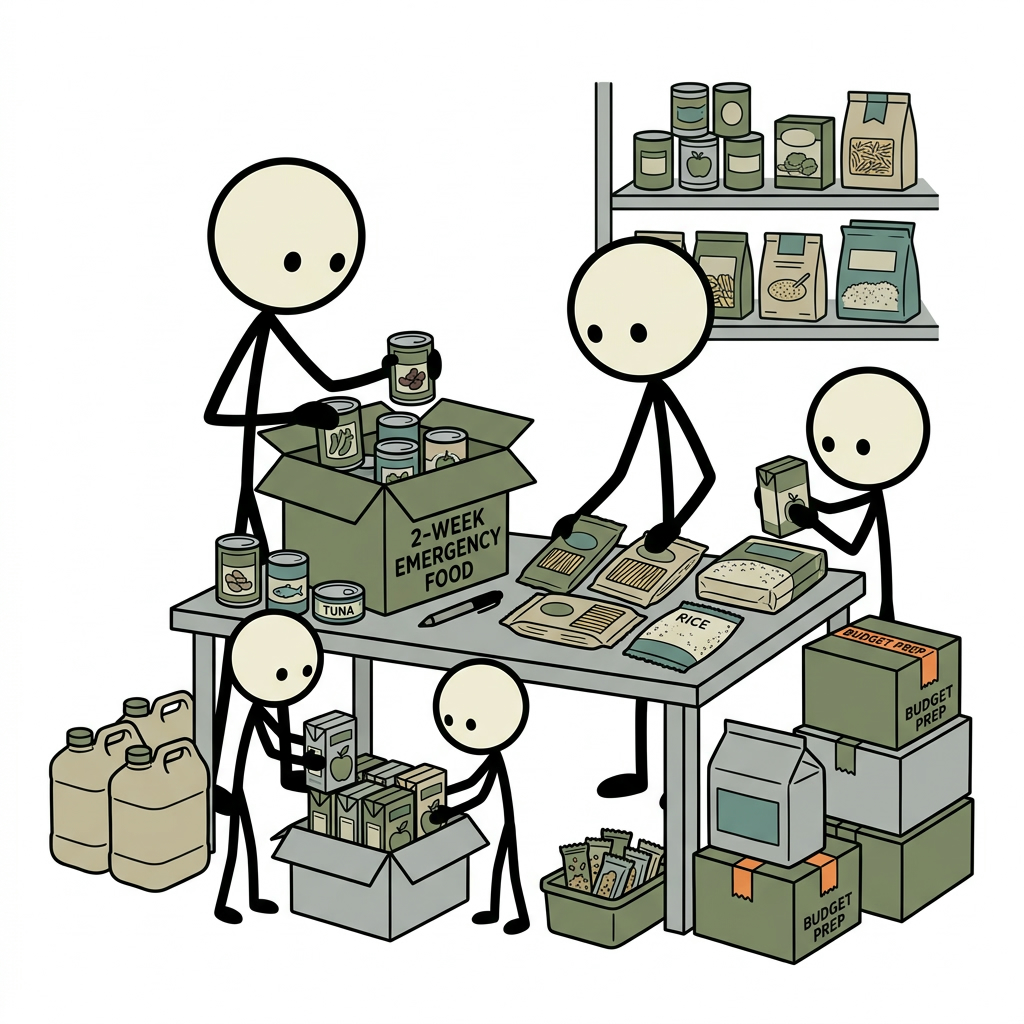
Designing an emergency food pantry list requires understanding human energy expenditure during crises. Under sheltering-in-place conditions without functional climate control, your baseline metabolic rate increases. You may be hauling water, clearing debris, managing stress, or battling extreme ambient temperatures. According to baseline standards from FEMA and the Department of Health and Human Services, a standard planning metric requires a minimum of 2,000 to 2,500 balanced calories per adult per day, with children requiring between 1,400 and 1,800 calories depending on age.
A functional survival food pantry checklist must not rely purely on carbohydrates. While simple sugars and refined starches provide immediate energy, a diet lacking balanced macronutrients precipitates rapid insulin spikes, lethargy, muscle fatigue, and poor cognitive function under stress. Your two-week nutritional architecture should aim for a targeted distribution: 50% to 55% complex carbohydrates for sustained energy, 15% to 20% bioavailable proteins to mitigate muscle wasting and maintain immune function, and 25% to 30% healthy fats to preserve hormone regulation and maximize caloric density per cubic inch of storage space.
Equally critical is monitoring dietary sodium and fiber. Many low-grade canned goods contain excessive sodium levels. When water infrastructure is broken, excessive sodium intake dramatically accelerates physiological dehydration, rapidly burning through your finite potable water reserves. Concurrently, an absence of dietary fiber can cause severe digestive complications. Balancing sodium-dense canned broths and meats with low-sodium beans, parboiled rice, rolled oats, and canned fruits creates metabolic equilibrium when access to medical systems is compromised.
The Complete Two-Week Shelf-Stable Grocery List
The following categorization breaks down an optimized two-week emergency food supply designed for one adult for 14 days (approximately 28,000 to 32,000 total kilocalories). Multiply these baseline quantities uniformly by the number of individuals within your immediate household.
Complex Carbohydrates and Base Starches
Carbohydrates are the foundational fuel for any acute crisis scenario. They are cheap, dense, shelf-stable, and easily combined with diverse proteins and fats.
- Parboiled (Converted) White Rice: 5 lbs (approx. 8,200 calories). Parboiled rice has a significantly longer shelf life than brown rice (which contains volatile oils that go rancid within 6–12 months) and cooks in roughly half the fuel-consuming cook time of regular long-grain white rice.
- Rolled Old-Fashioned Oats: 3 lbs (approx. 5,100 calories). Oats provide complex fiber, beta-glucan for satiety, and can be consumed raw or soaked in cold water without spending cooking fuel.
- Quick-Cooking or Enriched Pasta: 3 lbs (approx. 4,800 calories). Dense energy storage that requires standard boiling; select angel hair, elbows, or small shells that cook through in under six minutes to save fuel.
- Dehydrated Potato Flakes: 1.5 lbs (approx. 2,400 calories). Instant potatoes require nothing more than warm or ambient water to hydrate, making them an exceptional no-cook fallback carb source.
- Whole Grain Crackers or Hard Sea Biscuits: 2 boxes / approx. 1.5 lbs (approx. 3,000 calories). Ready-to-eat carbohydrates that serve as a direct bread replacement with zero preparation required.
Shelf-Stable Proteins and Legumes
Preserving muscle recovery and cognitive clarity requires clean, accessible proteins. Do not rely entirely on dry beans for a two-week event, as raw dry beans require hours of fuel-heavy simmering.
- Canned Tuna, Salmon, or Mackerel in Olive Oil: 8 cans / 5 oz each (approx. 2,000 calories total). Choosing fish canned in olive oil rather than spring water nearly doubles the total caloric yield while delivering essential Omega-3 fatty acids.
- Canned Chicken Breast: 6 cans / 12.5 oz each (approx. 2,100 calories). Highly versatile, thoroughly cooked, and packed in usable broth that provides moisture for rehydrating starches.
- Canned Beans (Black, Pinto, Chickpeas): 10 cans / 15 oz each (approx. 3,500 calories). Pre-cooked, shelf-stable legumes that can be consumed directly from the can without applying heat.
- Dry Red Split Lentils: 2 lbs (approx. 3,100 calories). Unlike dense navy or kidney beans, split red lentils break down and cook thoroughly in just 12 to 15 minutes, conserving finite cooking gas.
- Canned Beef Stew, Chili, or Hearty Soups: 6 cans / 18 oz each (approx. 2,400 calories). High-density, comforting protein sources that function as standalone meals requiring minimal heating.
Calorie-Dense Fats and Oils
Dietary fats are the most calorie-dense nutrients available, yielding nine calories per gram compared to four calories per gram for proteins and carbohydrates. They are non-negotiable for compact, low-cost preparedness reserves.
- Natural or Conventional Peanut Butter (or Seed Butter): 2 large jars / 32 oz each (approx. 11,500 calories). Peanut butter is an undisputed nutritional powerhouse in emergency logistics: hyper-dense, rich in healthy fats and proteins, entirely shelf-stable, and ready to consume instantly.
- Extra Virgin Olive Oil or Refined Coconut Oil: 1 bottle / 16.9 oz (approx. 4,000 calories). A simple tablespoon added to a bowl of rice or beans increases the meal by 120 clean calories and dramatically improves satiety and palatability.
- Raw or Roasted Unsalted Mixed Nuts and Seeds: 1.5 lbs (approx. 4,200 calories). Almonds, walnuts, sunflower seeds, and pumpkin seeds provide critical trace minerals and stable, non-cooking calories.
Fruits, Vegetables, and Micronutrient Anchors
Scurvy and acute micronutrient depletion are historically well-documented in extended emergencies. Canned produce provides psychological freshness, dietary moisture, and essential vitamins.
- Canned Vegetables (Green Beans, Corn, Peas, Diced Tomatoes): 10 cans / 15 oz each (approx. 1,000 calories). Prioritize vegetables packed in water; the liquid medium within the can should never be discarded—it functions as cooking liquid for dry starches.
- Canned Fruit in 100% Juice (Peaches, Pears, Pineapple): 8 cans / 15 oz each (approx. 1,600 calories). Provides critical vitamin C, immediate natural carbohydrates, and moral-boosting sweetness without relying on refined candy.
- Unsweetened Applesauce or Fruit Puree: 4 jars/pouches / 24 oz each (approx. 800 calories). Easily digested dietary pectin and fiber that soothe sensitive or unsettled stomachs under physical stress.
Comfort Foods, Electrolytes, and Palatability Extenders
A Survival Scenarios is not the time to endure culinary deprivation. The physiological phenomenon known as "food fatigue" can cause individuals—particularly children—to experience appetite suppression despite acute caloric deficits.
- Iodized Salt: 1 container / 26 oz. Fundamental for cellular fluid maintenance and essential seasoning; completely non-perishable if kept bone-dry.
- Direct Seasonings: Black pepper, garlic powder, ground cumin, red chili flakes, and soy sauce. The ability to radically change the flavor profile of base rice and beans prevents psychological fatigue.
- Honey or Pure Maple Syrup: 1 jar / 16 oz (approx. 1,400 calories). Pure honey is naturally antimicrobial, does not spoil, and provides immediate energy along with soothing properties for throat irritations.
- Electrolyte Replacement Powder Packets: 14 single-serve packets. When clean water must be carefully budgeted, ensuring cellular absorption with optimized sodium-potassium blends prevents heat illness or dehydration-induced migraines.
- Ground Coffee, Black Tea Bags, or Dark Chocolate: Mental clarity and physical routines are stabilized through familiar morning rituals. Caffeine withdrawal symptoms (such as debilitating vascular headaches) can incapacitate an adult when situational awareness is needed most.
Water Logistics: The Critical Link Between Storage and Nutrition
Food storage is fundamentally useless without a parallel water strategy. The Federal Emergency Management Agency (FEMA) and the CDC universally prescribe a minimum of one gallon of Water Calculator per day. However, this base metric is designed strictly for biological survival and baseline hygiene. When maintaining an emergency food pantry list that relies on dry components like rice, pasta, and lentils, this baseline must be adjusted upward.
Dry carbohydrates actively absorb stored water during thermal preparation. Rehydrating one pound of white rice consumes nearly a full quart of water that is permanently drawn out of your immediate reserves. If your emergency storage is limited strictly to 14 gallons of drinking water per person for a two-week event, cooking dry staples will deplete your hydration supplies prematurely.
To establish true water independence alongside your shelf-stable grocery list, use a tiered water planning formula:
- Tier 1: Direct Hydration: 1.0 gallon per person per day (14 gallons per adult). Dedicated purely to direct fluid consumption.
- Tier 2: Culinary Rehydration: 0.5 gallons per person per day (7 gallons per adult). Dedicated to boiling, rehydrating, and reconstituting dry foodstuffs.
- Tier 3: Sanitation and Cleanliness: 0.5 gallons per person per day (7 gallons per adult). Dedicated to washing cookware and baseline hand hygiene to prevent foodborne illness.
The total realistic water reserve for a robust two-week family emergency plan is 28 gallons per adult. Store this supply in food-grade, high-density polyethylene (HDPE) containers treated with standardized purification drops, or rotate through commercial sealed 2.5-gallon spring water jugs stored off concrete floors away from direct sunlight.
The Phased Acquisition Plan: Building Your Pantry for Under $25 a Week
Attempting to secure a two-week emergency food supply in a single transaction can strain household budgets. A systematic, phased acquisition strategy allows you to build an airtight short term food storage reserve incrementally over 30 to 60 days by simply altering your weekly grocery spend by $20 to $25.
Begin by conducting an inventory of what your household already consumes. Never purchase items on sale simply because they are cheap if your family consistently avoids eating them under normal conditions. Preparedness is fundamentally an exercise in accelerated household logistics, not eccentric stockpiling.
| Phase | Focus Category | Target Items | Estimated Cost |
|---|---|---|---|
| Week 1 | Foundation Starches | 5 lbs parboiled rice, 3 lbs rolled oats, 3 lbs pasta | $18 – $22 |
| Week 2 | Dense Proteins | 8 cans tuna in oil, 6 cans chunk chicken breast | $20 – $25 |
| Week 3 | Legumes & Canned Vegetables | 10 cans black/pinto beans, 10 cans assorted vegetables | $18 – $24 |
| Week 4 | High-Calorie Fats & Fruits | 2 jars peanut butter, 1 bottle olive oil, 8 cans fruit | $22 – $26 |
| Week 5 | Comfort, Hydration & Seasonings | Salt, spices, honey, crackers, electrolyte packs | $15 – $20 |
By the end of the fifth week, your household will possess an expertly structured, non-perishable survival food pantry checklist containing over 30,000 balanced kilocalories—assembled for roughly $100 to $115 total, without ever entering a specialized survival outlet.
Environmental Defense: Temperature, Pest Mitigation, and FIFO Rotation
Purchasing the right shelf-stable grocery list is only half the battle; maintaining environmental control over your reserve preserves your capital investment. Food degradation is accelerated by four primary environmental vectors: heat, oxygen, moisture, and light.
The USDA notes that for every 18°F (10°C) increase above room temperature (68°F / 20°C), the shelf life of non-perishable canned and dry goods is effectively halved. Storing your two-week reserve in an uninsulated garage, outdoor shed, or damp crawlspace will degrade fragile micronutrients and cause vegetable oils to go rancid rapidly. Your supplies should be housed in an interior closet, beneath bed frames, or within dedicated lower kitchen cabinets where temperature swings remain moderated.
Pest prevention requires secondary barriers. While commercial cans are impervious to rodents and weevils, boxed pasta, crackers, and bagged grains are highly vulnerable. Do not leave starches in thin commercial cardboard or store-grade cellophane bags. Place these dry staples inside heavy-duty, food-grade plastic storage totes featuring gasket-sealed lids. This single adjustment prevents moisture intrusion and provides an impenetrable physical barrier against common domestic pantry pests like Indian meal moths and beetles.
Finally, deploy the standard commercial FIFO system: First In, First Out. When you return from routine grocery shopping, place newly purchased items at the back of your pantry shelf and shift older inventory forward into your regular meal rotation. By continuously cycling your canned black beans, tuna, and pasta through ordinary weeknight dinners, your emergency food reserve remains perpetually fresh, eliminating wasted expenditures on spoiled or expired food.
Thermal Strategy: Minimal-Fuel Preparation and Off-Grid Cooking
A classic planning blind spot is assuming your primary cooking appliances will work during an emergency. An extended grid failure instantly disables microwave ovens, electric stoves, and induction ranges. Natural gas stoves may continue operating briefly, but municipal pressure drops often follow large-scale seismic events or winter freezes.
A resilient short term food storage protocol must incorporate an independent, off-grid cooking mechanism along with an explicit fuel management plan. Safe options for off-grid thermal prep include:
- Butane or Propane Countertop Stoves: Single-burner butane/propane stoves (commonly used in catering) cost under $35. A standard 8 oz butane canister provides approximately 1.5 to 2 hours of continuous high heat, sufficient to prepare meals for several days if heat is managed efficiently.
- Backpacking Canister Stoves: Highly efficient, ultralight units powered by isobutane/propane mixes that boil two cups of water in under three minutes.
- Outdoor Charcoal or Propane Grills: Excellent secondary heat sources, with one critical rule: never operate outdoor grills indoors due to the rapid accumulation of lethal carbon monoxide.
To preserve finite fuel stores during a crisis, utilize minimal-fuel cooking techniques. The "thermal retention method" is particularly effective for grains and pasta: bring your water to a rolling boil, add the dry starch, cover the pot tightly with an insulated lid, and immediately kill the flame. Wrap the entire pot in a thick wool blanket or heavy towel to trap the heat. The captured residual thermal energy will cook the starches thoroughly over 20 to 30 minutes without burning another drop of cooking fuel.
Additionally, prioritize "no-cook" integrations. Your survival food pantry checklist should be strategically structured so that at least 40% of your total calories can be consumed completely cold right out of their packaging. Peanut butter, crackers, canned tuna, and canned beans require zero fuel expenditure, ensuring that if you run out of cooking gas, your household remains calorically secure.
Sample 14-Day Nutritional Deployment Framework
The following deployment framework illustrates how ordinary supermarket shelf staples transform into satisfying, balanced daily meals for an adult during a prolonged shelter-in-place scenario.
Day Type A: Hot Prep (Fuel Available)
- Breakfast: 1 cup rolled oats cooked in water, stirred with 2 tablespoons peanut butter and 1 tablespoon honey. (Approx. 450 calories)
- Lunch: 1 can chunk light tuna in olive oil flaked over whole grain crackers, paired with 1 can diced peaches in juice. (Approx. 520 calories)
- Dinner: 1 cup cooked parboiled rice mixed with 1/2 can black beans, 1/3 can chicken breast, 1 tablespoon olive oil, seasoned with cumin and salt. (Approx. 680 calories)
- Snack: Handful of mixed nuts and 1 square dark chocolate. (Approx. 350 calories)
- Daily Caloric Total: ~2,000 calories
Day Type B: Low/No-Fuel Prep (Conserving Gas Reserves)
- Breakfast: Overnight cold-soaked oats (soaked in ambient water) mixed with applesauce and a dash of cinnamon. (Approx. 380 calories)
- Lunch: 3 tablespoons peanut butter spread over sea biscuits or crackers, paired with an individual applesauce cup. (Approx. 540 calories)
- Dinner: Cold bean and chicken salad: 1/2 can drained pinto beans, 1/2 can chicken breast, 1/3 can sweet corn, tossed with 1 tablespoon olive oil, vinegar, and garlic salt. (Approx. 610 calories)
- Snack: Trail mix (peanuts, raisins, sunflower seeds) plus 1 single-serve electrolyte drink. (Approx. 470 calories)
- Daily Caloric Total: ~2,000 calories
This alternating operational model ensures family members avoid palatability fatigue while offering flexibility based on available fuel, potable water supplies, and seasonal temperatures.
Resilience Built on Everyday Foundations
True emergency preparedness is not defined by tactical branding, expensive survival catalogs, or fear-based spending. It is a systematic process of self-reliance rooted in ordinary household planning. Natural disasters, severe storms, and supply chain disruptions are difficult to predict, but your domestic response to them does not have to be chaotic or cost-prohibitive. By assembling a structured two-week emergency food supply utilizing accessible, familiar items from your local supermarket, you secure your household's baseline safety, preserve physical and mental stamina, and protect your financial resources. Begin your methodical acquisition this week: purchase an extra bag of rice, a few cans of protein, and an extra jug of water. Real self-reliance is built one grocery trip at a time.
Frequently Asked Questions
How much water do I need to store alongside a two-week food supply?
Store at least one gallon of water per person per day (half for drinking and half for basic sanitation and food preparation), which equals 14 gallons per person for a two-week supply.
What types of foods are best for a two-week emergency pantry?
Prioritize shelf-stable, nutrient-dense foods requiring little to no cooking or added water, such as canned meats, tuna, beans, canned fruits and vegetables, nut butters, whole-grain crackers, and ready-to-eat meals.
How many daily calories should I budget per person?
Plan for approximately 2,000 to 2,500 calories per adult per day, adjusting upward for physically demanding conditions or cold weather and tailoring for children, elderly family members, or specific dietary needs.
What is the best way to store emergency pantry items to prevent spoilage?
Keep supplies in a cool, dark, and dry environment between 50°F and 70°F, elevated off concrete floors and sealed in pest-proof containers to protect against humidity, rodents, and insects.
How often should I rotate emergency food pantry supplies?
Review and rotate your pantry every six to twelve months using a first-in, first-out (FIFO) system, consuming items nearing expiration and immediately restocking with fresh goods.