Key Facts: Midland ER310 vs Kaito KA500
- Battery Chemistry Matters: The Midland ER310 features a modern 2600 mAh Lithium-ion battery that holds a charge for months. The Kaito KA500 relies on an older 600 mAh NiMH battery pack, which suffers from faster self-discharge.
- Frequency Coverage: The Kaito KA500 includes shortwave (SW) bands, making it excellent for monitoring international broadcasts. The Midland ER310 focuses strictly on high-sensitivity AM/FM and NOAA weather bands.
- Emergency Lighting: The Midland ER310 features an ultra-bright 130-lumen Cree LED flashlight with an SOS strobe, whereas the Kaito KA500 offers a multi-functional reading lamp alongside a standard flashlight.
- Tuning Systems: The ER310 uses a precise digital LCD screen with automatic scanning, while the KA500 utilizes an analog dial with a signal strength indicator.
The Role of an Emergency Radio in Survival
When the power grid fails, communication is your most valuable asset. Whether you are facing a hurricane, a severe winter storm, or a long-term grid-down scenario, a dependable emergency radio keeps you connected to critical civil defense broadcasts. In this head-to-head comparison, we analyze the midland er310 vs kaito ka500 to help you determine which unit deserves a permanent spot in your Go-Bag Builder or home emergency kit.
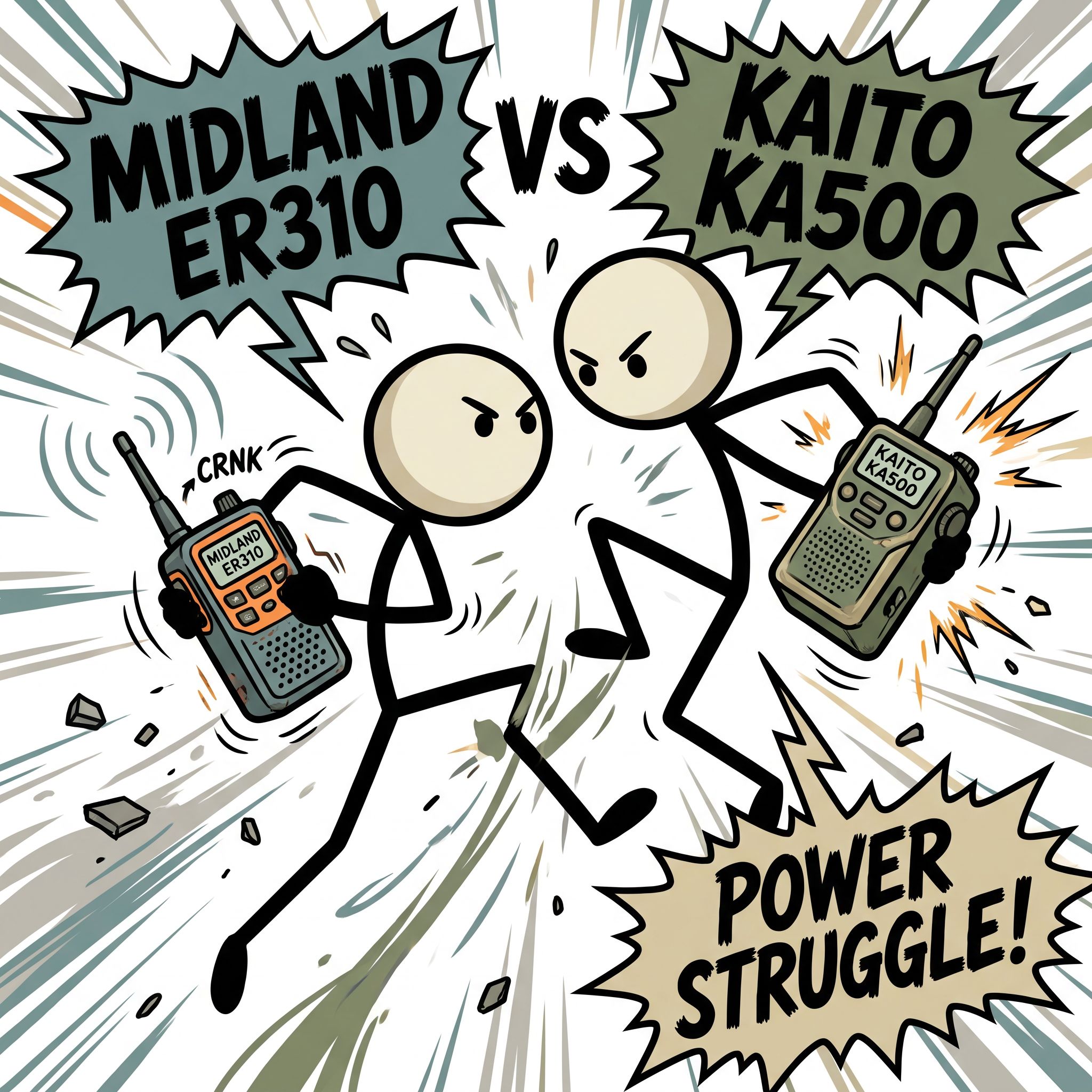
Both of these units are highly respected in the preparedness community, but they approach emergency communications from different angles. One prioritizes modern battery efficiency and digital precision, while the other focuses on versatile power inputs and global shortwave monitoring.
Product A: Midland ER310 Emergency Radio

The Midland ER310 is a rugged, digital emergency radio designed for rapid deployment during severe weather events. Its standout feature is its 2600 mAh rechargeable Lithium-ion battery, which provides up to 32 hours of continuous radio use and serves as a highly efficient power bank for mobile devices.
Midland has optimized the ER310 for high-stress scenarios. It features a digital LCD display that makes finding precise frequencies effortless, an ultrasonic dog whistle to assist search-and-rescue teams, and an extremely bright 130-lumen Cree LED flashlight. The hand crank mechanism is highly efficient, converting physical effort into usable power quickly and reliably.
Product B: Kaito KA500 Emergency Radio
The Kaito KA500 is a versatile, analog-tuned emergency radio that has been a staple of survival kits for over a decade. It is famous for its 6-way power versatility, allowing you to run the device via hand crank, solar panel, AA batteries, a built-in NiMH rechargeable pack, USB, or an AC wall adapter.
For preppers who want to monitor global communications, the KA500 includes two shortwave (SW) bands in addition to standard AM, FM, and NOAA weather frequencies. It also features a flip-up 5-LED reading lamp located on the back of the solar panel, making it an excellent localized light source for shelters and blacked-out rooms.
Head-to-Head Comparison: Key Survival Metrics
1. Battery Performance and Power Retention
In a long-term Survival Scenarios, battery chemistry is critical. The Midland ER310 utilizes a Lithium-ion (Li-ion) battery. Li-ion batteries have a very low self-discharge rate, meaning you can store the ER310 in your emergency gear for months, and it will still retain the majority of its charge. Furthermore, the 2600 mAh capacity is large enough to provide a meaningful charge to modern smartphones.
The Kaito KA500 uses a Nickel-Metal Hydride (NiMH) battery pack with a much smaller 600 mAh capacity. NiMH batteries self-discharge relatively quickly when left idle. If you do not actively maintain and charge the KA500 every few months, you may find the internal battery completely drained when an emergency strikes. While the Kaito offers more ways to input power, the Midland's superior battery chemistry makes it more reliable for long-term storage.
2. Tuning and Frequency Reception
The Midland ER310 features digital tuning with an LCD screen. This allows you to program pre-set channels and easily scan for the strongest NOAA weather alert signals. In high-stress situations, digital tuning eliminates the guesswork of finding a clear station.
The Kaito KA500 uses an analog tuning dial. While some survivalists prefer analog because it lacks complex microprocessors that could be vulnerable to electromagnetic interference, it can be more difficult to fine-tune to exact frequencies during a storm. However, the Kaito gains a massive advantage by offering shortwave bands, allowing you to listen to international broadcasts if local AM/FM transmitters are knocked offline.
3. Emergency Lighting and Signaling
When the lights go out, your radio often doubles as your primary flashlight. The Midland ER310 features a powerful 130-lumen Cree LED light that can be adjusted to high or low settings, or set to flash an SOS Morse code signal. It also includes an ultrasonic dog whistle, which can help search-and-rescue K9 units locate you in a collapse or wilderness emergency.
The Kaito KA500 focuses on ambient lighting. It features a standard, low-lumen LED flashlight on the side, a red SOS beacon, and a highly useful 5-LED reading light under the solar panel. While the Kaito is excellent for illuminating a tent or reading a map, it cannot match the long-distance beam and signaling power of the Midland's Cree LED.
Frequently Asked Questions
Can both radios charge modern smartphones?
Yes, but the Midland ER310 is far more effective. Its 2600 mAh Li-ion battery delivers a stronger current, whereas the Kaito KA500's 600 mAh NiMH battery is better suited for emergency trickle charging or basic text messages.
Does the Midland ER310 receive shortwave radio?
No, the Midland ER310 only receives AM, FM, and NOAA weather bands. If you require shortwave (SW) frequencies for global broadcasts, the Kaito KA500 is the better choice.
Can I use standard AA batteries in both units?
Yes, both the Midland ER310 and the Kaito KA500 have compartments for AA batteries, allowing you to run them on disposable alkaline batteries if the rechargeable packs die.
How long does the battery last on standby?
The Midland ER310 uses a lithium-ion battery which retains its charge for months on a shelf. The Kaito KA500 uses a NiMH battery pack, which experiences faster self-discharge and should be topped off every 2 to 3 months.
Are these radios waterproof?
Neither radio is fully waterproof or submersible. However, both feature water-resistant designs that can handle light rain and splashes during severe weather events.