⚡ Key Facts
- Neighbors are the true first responders: According to the Federal Emergency Management Agency (FEMA), in major disasters, nearly 80% of immediate rescues are performed by neighbors, not professional emergency services.
- Social cohesion saves lives: The Centers for Disease Control and Prevention (CDC) reports that communities with strong social ties and established local networks experience significantly lower mortality rates during extreme weather events.
- Preparedness is a shared gap: American Red Cross data indicates that while 80% of Americans live in counties that have experienced a weather disaster, barely half have a functional family emergency plan in place.
- Shared resources multiply survival odds: Establishing a formalized network allows a single city block to pool critical resources—like generators, water filtration, and medical supplies—reducing individual financial burden by up to 60%.
- Professional integration works: Neighborhoods with organized Community Emergency Response Team (CERT) training recover from catastrophic events up to three times faster than unorganized areas.
When the grid goes down, the roads become impassable, and official emergency services are overwhelmed, the reality of survival looks very different from what Hollywood portrays. The pop-culture myth of the "lone wolf" survivalist—barricaded in a bunker with years of supplies—is not only unrealistic, but it is also a mathematically flawed strategy for long-term resilience. In the chaotic aftermath of a major earthquake, hurricane, or prolonged power outage, the people living right next door to you will become your most critical lifeline. See Family and Community Resilience (Spanish) for additional options. See Family and Community Resilience (Spanish) for additional options.
During catastrophic events like Hurricane Katrina, Superstorm Sandy, and the historic Texas winter freezes, professional first responders were stretched beyond capacity. 911 calls went unanswered, and ambulances could not navigate flooded or frozen streets. In these critical moments, it was local residents who waded into floodwaters, shared generator power, and provided life-saving first aid to their neighbors. Survival is, fundamentally, a team sport.
This post explains why local community alliances are the bedrock of true resilience. More importantly, it provides you with actionable, step-by-step instructions for creating a neighborhood preparedness network from the ground up. Whether you live in a dense urban apartment complex, a suburban subdivision, or a rural farming community, organizing a local alliance is the single most effective step you can take to protect your family and your property.
The Myth of Isolation vs. The Reality of Resilience
There is a pervasive misconception in modern preparedness culture that secrecy and isolation are the ultimate defenses. While operational security (OPSEC) is important, complete isolation is a massive vulnerability. No single household can stay awake 24 hours a day to provide security, possess every necessary medical and mechanical skill, and stockpile enough resources to weather a prolonged crisis indefinitely.
Effective survival community building shifts the focus from individual hoarding to collective capacity. When you build an alliance, you are not just sharing supplies; you are sharing the physical and psychological burden of a crisis. A well-organized group can delegate tasks, establish rotating watch schedules, and provide emotional support, which is critical for preventing fatigue and despair.
FEMA’s National Household Survey consistently highlights that communities with pre-existing relationships recover faster and suffer fewer casualties. When neighbors know each other, they know who needs help. They know which house has the elderly resident who requires oxygen, which neighbor is a registered nurse, and who has the chainsaw needed to clear the road. This localized knowledge is something no federal agency can deploy from a distance.
Why a Local Survival Network is Your Best Asset
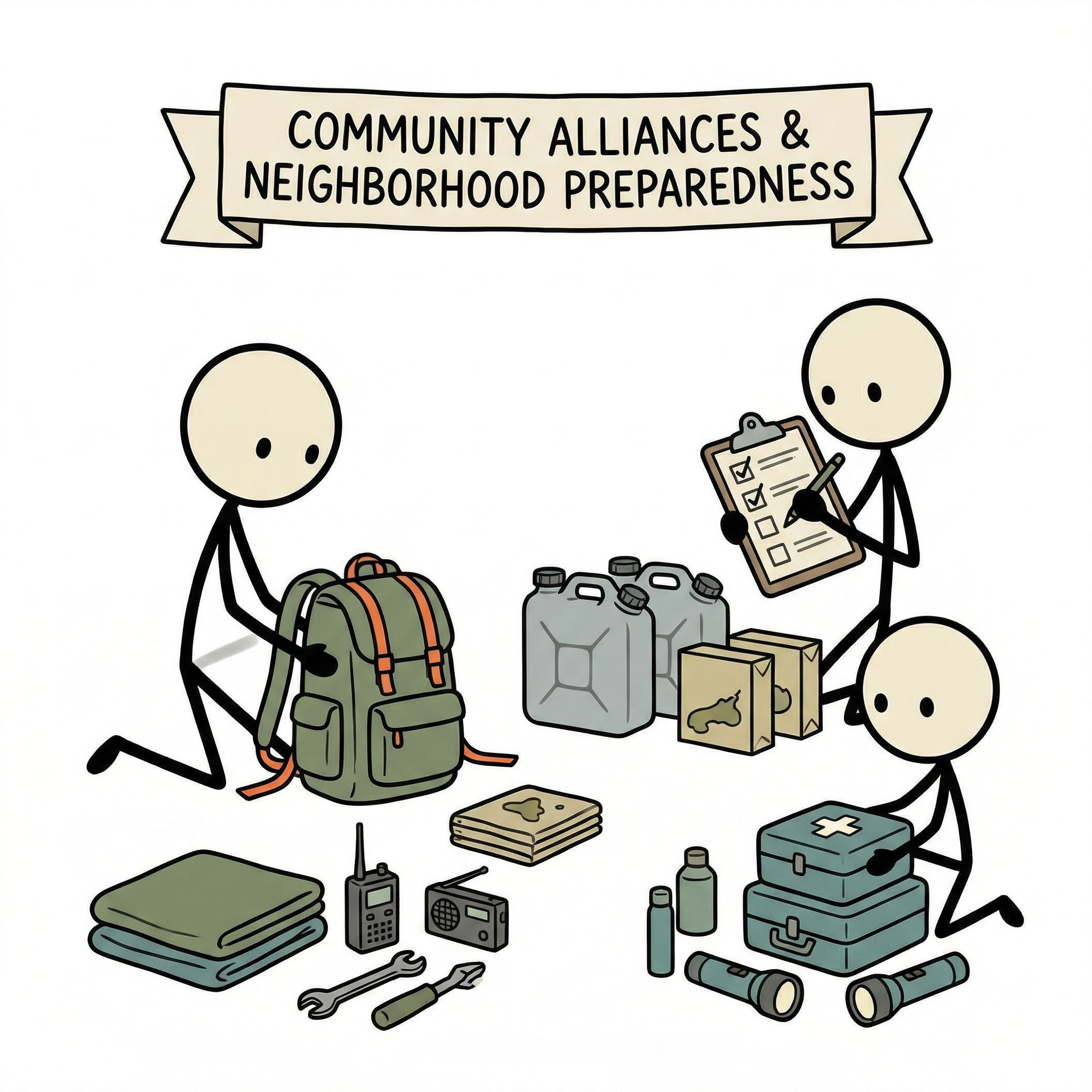
Before diving into the logistics of organizing your neighborhood, it is vital to understand exactly why a local survival network outperforms individual preparedness. The advantages fall into three distinct categories: speed, resource multiplication, and specialized skill access.
The "Golden Hour" and Speed of Response
In emergency medicine, the "Golden Hour" refers to the critical window of time immediately following a traumatic injury where medical intervention is most effective. During a major disaster, professional paramedics may be days away. Your neighbor, however, is sixty seconds away. A neighborhood alliance ensures that immediate life-saving actions—like applying a tourniquet, extinguishing a small structural fire, or shutting off a ruptured gas line—happen immediately.
Resource Multiplication
Prepping is expensive. Buying high-capacity solar generators, commercial-grade water filtration systems, and bulk emergency food storage guide requires significant financial investment. By organizing an emergency preparedness group, you can coordinate purchases and avoid redundancies. If the house on the corner has a heavy-duty wood chipper and a massive stockpile of firewood, your household can focus on investing in a robust first-aid trauma kit or a high-powered HAM radio setup. You effectively multiply your access to gear without multiplying your budget. For a quick definition, see ham radio.
Access to Specialized Skills
You might be an expert marksman and a master gardener, but do you know how to safely wire a generator to a home’s breaker panel? Can you stitch a deep laceration? Do you know how to safely purify contaminated floodwater? Your neighborhood is likely teeming with latent skills. Plumbers, nurses, mechanics, military veterans, and teachers all possess knowledge that becomes invaluable during a crisis. A community alliance unlocks this hidden reservoir of human capital.
Step 1: Assessing Your Neighborhood's Baseline Risk
Before you approach your neighbors, you need to understand exactly what you are preparing for. A neighborhood in coastal Florida faces vastly different threats than a subdivision in the wildfire-prone hills of California. You must define the specific risks that threaten your immediate survival scenarios geography.
Start by consulting official government databases. Use the United States Geological Survey (USGS) website to identify local seismic fault lines and landslide risks. Check the National Oceanic and Atmospheric Administration (NOAA) for historical data on severe weather patterns, tornadoes, and hurricanes. Finally, pull up FEMA’s flood map service to see if your street sits in a 100-year flood zone.
Once you have the macro-level data, conduct a micro-level neighborhood walk-through. Look for localized hazards that an agency map won't show. Are there massive, dead trees leaning over power lines? Does the storm drainage system at the end of the street constantly back up during heavy rain? Are there unreinforced masonry walls that could collapse in an earthquake? Documenting these specific, localized threats will give you concrete talking points when you eventually approach your neighbors.
Step 2: Breaking the Ice and Starting the Conversation
The most intimidating part of survival community building is often the very first step: knocking on a neighbor's door. Approaching strangers with talk of grid failures and natural disasters can easily make you sound like an alarmist. The key is to keep the conversation grounded, practical, and focused on recent, relatable events.
The Rule of Three
Do not try to organize the entire neighborhood at once. Start with the "Rule of Three." Identify three neighbors you already have a cordial relationship with—perhaps the person you wave to while walking the dog, or the family you chat with over the fence. Invite them over for a low-pressure environment, like a weekend barbecue or a morning coffee.
Framing the Conversation
Avoid using hyper-tactical jargon or doomsday scenarios. Instead, frame the discussion around common-sense readiness and recent local events. You might say, "Did you see how long it took for the power to come back on during that storm last month? I was thinking it might be smart for a few of us on this street to coordinate, just in case we get hit with a worse one this winter."
This approach is empowering, not fear-mongering. It normalizes preparedness and makes it a shared civic responsibility rather than an eccentric hobby. Once you have a core group of three or four interested households, you have the foundation of your local survival network.
Step 3: Conducting a Skills and Vulnerability Audit
Once your core group is established, the next phase is to map out the human terrain of your neighborhood. This requires conducting an inventory of both the assets your community possesses and the vulnerabilities that need to be protected. This must be done with tact and respect for privacy.
Identifying Community Assets
Create a simple, voluntary questionnaire for your emergency preparedness group. Ask members to list any professional or hobbyist skills that could be useful in an emergency. Key categories to look for include:
- Medical: Doctors, nurses, EMTs, veterinarians, or anyone with current CPR/First Aid certification.
- Mechanical/Engineering: Plumbers, electricians, auto mechanics, and carpenters.
- Security/Tactical: Active or retired military, law enforcement, or individuals with extensive wilderness survival training.
- Logistics/Caregiving: Teachers, daycare workers, or chefs who excel at organizing people, managing inventory, and preparing large-scale meals.
Mapping Vulnerabilities
Equally important to knowing your strengths is identifying your neighborhood's vulnerabilities. The CDC stresses the importance of protecting vulnerable populations during disasters. You need to know who on your street will require immediate assistance if the power fails or an evacuation is ordered.
Identify households with elderly residents who have limited mobility. Note anyone who relies on life-sustaining, power-dependent medical equipment, such as oxygen concentrators, CPAP machines, or refrigerated medications like insulin. Furthermore, identify households with infants or individuals with severe disabilities. When a crisis strikes, your network’s first priority should be checking on these specific addresses.
Step 4: Establishing a Neighborhood Preparedness Network Communication Plan
Communication is the central nervous system of any emergency response. When a major disaster occurs, cell phone towers are often the first infrastructure to fail. They either lose power, sustain physical damage, or become completely overloaded by call volume. Your neighborhood must have an off-grid communication protocol.
The PACE Methodology
Adopt the military’s PACE methodology for your communication plan: Primary, Alternate, Contingency, and Emergency. This ensures you have layered backups if one method fails.
- Primary: Standard cell phones and group text messaging apps. (Use this for minor, localized issues or pre-disaster coordination).
- Alternate: Two-way radios. Equip participating households with FRS (Family Radio Service) or GMRS (General Mobile Radio Service) walkie-talkies. Assign a specific, agreed-upon channel for your neighborhood, and establish a designated "check-in" time (e.g., top of every hour) during an emergency.
- Contingency: HAM Radio. Ideally, at least one or two members of your network should study for and obtain their amateur radio licenses. HAM radio operators can communicate with emergency services and gather information from outside the disaster zone when all local infrastructure is destroyed.
- Emergency: Physical runners and analog signals. If all electronics fail, designate a physical rally point in the neighborhood—like a specific driveway or a community clubhouse. Use a physical bulletin board to post updates, resource requests, and safety bulletins.
Step 5: Pooling Resources for Community Disaster Prep
With communication established, it is time to address physical supplies. While every household should maintain its own baseline emergency kit (water, non-perishable food, flashlights), a community disaster prep strategy involves organizing shared, heavy-duty resources.
Water and Sanitation
Water is the most urgent priority. While individuals can store bottled water, a neighborhood network should pool funds to purchase high-capacity gravity water filters (capable of purifying thousands of gallons) and heavy-duty Water Calculator barrels. Additionally, coordinate sanitation supplies. If municipal water pressure drops, toilets will not flush. Stockpiling heavy-duty trash bags, lime, and portable camp toilets will prevent a localized public health crisis from raw sewage.
Power and Fuel
Not everyone needs a $2,000 inverter generator. Instead, coordinate so that one household maintains a large generator to power medical devices and freezers, while others stockpile stabilized fuel in safe, approved containers. Share the load. If one neighbor has a large solar array and battery bank, designate their home as the neighborhood charging station for power tools, radios, and rechargeable flashlights.
Medical Caches
While individual first aid kits are necessary for minor cuts and scrapes, your network should invest in a community trauma bag. This should include bulk supplies of pressure dressings, tourniquets, splints, burn gel, and over-the-counter medications. Store this cache at the home of the most qualified medical professional in your group.
Step 6: Developing Standard Operating Procedures (SOPs)
Having supplies and radios is useless if people do not know what to do when chaos erupts. Your local survival network needs simple, easily understood Standard Operating Procedures (SOPs) for various scenarios.
Immediate Post-Disaster Protocol
Establish a rule that immediately following a major event (like an earthquake or a hurricane passing), every able-bodied member conducts a rapid damage assessment of their own property. Once their family is secure, they should check in on the radio network or report to the designated physical rally point. From there, teams of two should be dispatched to check on the previously identified vulnerable households.
Neighborhood Security
In prolonged grid-down scenarios, security can become a concern. Law enforcement may be entirely absent. Your SOP should include protocols for organizing a neighborhood watch. This does not mean forming a heavily armed militia; it means establishing visible, rotating shifts of neighbors walking the street with flashlights and radios to deter opportunistic theft and monitor for secondary hazards like gas leaks or smoldering fires.
Evacuation Triggers
Sometimes, sheltering in place is a fatal mistake. Your group must define clear "triggers" for when it is time to abandon the neighborhood. This could be an approaching wildfire crossing a specific highway, or floodwaters breaching a local levee. Plan primary and secondary evacuation routes, and establish a system for carpooling so that neighbors without reliable transportation are not left behind.
Step 7: Training and Integrating with Official Channels
A neighborhood preparedness network should never operate in a vacuum. The ultimate goal is to become a resilient, self-sustaining unit that can hold the line until professional help arrives, and then seamlessly integrate with those professionals.
CERT and Red Cross Training
Encourage members of your alliance to undergo formal training. FEMA’s Community Emergency Response Team (CERT) program is free, widely available, and specifically designed to teach civilians how to manage utilities, extinguish small fires, and perform light search and rescue. Similarly, hosting an American Red Cross instructor to teach a neighborhood-wide CPR and basic First Aid class is an excellent way to build skills while strengthening social bonds.
Liaising with Local Authorities
Once your network is established, introduce yourselves to your local firehouse and police precinct. Let them know that your neighborhood has a communication plan, a list of vulnerable residents, and trained individuals. During a massive disaster, incident commanders are desperate for organized, reliable information. If they know your neighborhood has a designated point of contact and is actively managing its own minor issues, they can triage their professional resources more effectively.
Overcoming Common Roadblocks and Maintaining Momentum
Building a local alliance is a marathon, not a sprint. You will inevitably face roadblocks, the most common being apathy and privacy concerns. Not every neighbor will want to participate, and some may view your efforts with suspicion.
Do not force the issue. Respect boundaries. If a neighbor declines to join the emergency preparedness group, simply let them know the door is always open. Focus your energy on the willing. A well-organized core group of five households is vastly more effective than a disorganized, reluctant group of twenty.
To prevent the group from losing momentum over time, avoid making every meeting a heavy, disaster-focused lecture. Integrate your preparedness efforts into normal social activities. Test your two-way radios during a neighborhood block party. Review your evacuation routes over a potluck dinner. Rotate the responsibility of hosting meetings so no single person experiences organizer burnout. The stronger your social ties become during the good times, the more unbreakable your alliance will be during the worst times.
Empowering Your Community for the Future
Disasters are inevitable, but tragedy is not. The difference between a community that crumbles under the weight of a crisis and one that emerges stronger lies entirely in the preparation done before the storm hits. By taking the initiative to organize a neighborhood preparedness network, you are doing much more than stockpiling water and mapping out evacuation routes. You are actively weaving a safety net of human connection, shared skills, and mutual trust.
Do not wait for a hurricane warning to be issued or for the power grid to fail before you learn your neighbors' names. Start small. Knock on a door, start a conversation, and take that first crucial step toward survival community building today. When official resources are exhausted and the outside world goes dark, the alliance you build right on your own street will be the ultimate key to your survival and recovery.
Frequently Asked Questions
Why is a neighborhood preparedness network important?
A neighborhood network provides immediate assistance, pools resources, and enhances security before official emergency responders can arrive during a crisis.
How do I start a conversation about emergency preparedness with my neighbors?
Start by introducing yourself, mentioning a recent local weather event or news story, and asking if they have thought about neighborhood safety and mutual aid.
What skills should we look for when building a neighborhood survival network?
Look for neighbors with medical training, carpentry, plumbing, electrical skills, gardening experience, and amateur radio (HAM) operation capabilities.
How can we organize our neighborhood's emergency resources?
Create a secure, shared contact list and a resource inventory detailing who has items like generators, chainsaws, or extra medical supplies willing to be shared.
What is a neighborhood rally point?
A rally point is a pre-designated, safe location where neighbors agree to meet immediately following a disaster to account for everyone and coordinate response efforts.
Sources & Further Reading
Related resource: Family & Community Resilience Course.
Related resource: Community Emergency Preparedness Guide.