⚡ Key Facts
- The 7/10 Rule of Radiation: According to the Federal Emergency Management Agency (FEMA), fallout radiation decays rapidly. For every sevenfold increase in time after the initial blast, radiation levels decrease by a factor of ten.
- Decontamination is Highly Effective: The Centers for Disease Control and Prevention (CDC) states that carefully removing your outer layer of clothing can eliminate up to 90% of radioactive material from your person.
- Shielding is Your Best Defense: Dense materials are required to block gamma radiation. Ten inches of concrete, two feet of packed earth, or three feet of water provide roughly the same protective barrier.
- Time is of the Essence: Following a detonation, you typically have 10 to 15 minutes before the heaviest, most dangerous radioactive fallout begins to reach the ground level, making immediate sheltering critical.
- The Core Protocol: The official unified guidance from the Department of Homeland Security (DHS) and FEMA is simple and life-saving: "Get Inside, Stay Inside, Stay Tuned."
For households that want to rehearse the whole sequence instead of stopping at a checklist, the course Surviving a Radiation Emergency: The First 72 Hours turns shelter selection, fallout timing, decontamination, and family communication into a step-by-step drill.
Quick Answer: What Should You Do in the First 24 Hours After Nuclear Fallout?
If a nuclear explosion or fallout warning occurs, the first rule is simple: get inside, stay inside, and stay tuned. Move into the deepest interior room or basement you can reach, put as much building material between your family and outside fallout as possible, and avoid going outdoors unless there is an immediate life-safety reason.
This guide turns the Ready.gov and CDC first-24-hour guidance into a household checklist: shelter selection, decontamination, water and food staging, information monitoring, and when it may be safer to stay put instead of evacuating.
Use the Supply Calculator to size shelter-in-place supplies, then pair this article with the Emergency Preparedness Guide and Power Outage Scenario because fallout incidents often disrupt communication, power, and normal services.
The concept of a nuclear detonation is often relegated to the realm of unthinkable apocalyptic fiction. However, emergency management professionals and scientists agree that surviving such an event is not only possible but highly probable for those located outside the immediate blast zone-provided they know exactly what to do. The difference between becoming a casualty and emerging safely relies entirely on your radiation emergency preparedness and your actions during the most crucial window of time: the first 24 hours. This comprehensive nuclear fallout survival guide is designed to strip away the panic and replace it with authoritative, actionable, and scientifically backed protocols to help you and your family survive a nuclear attack.
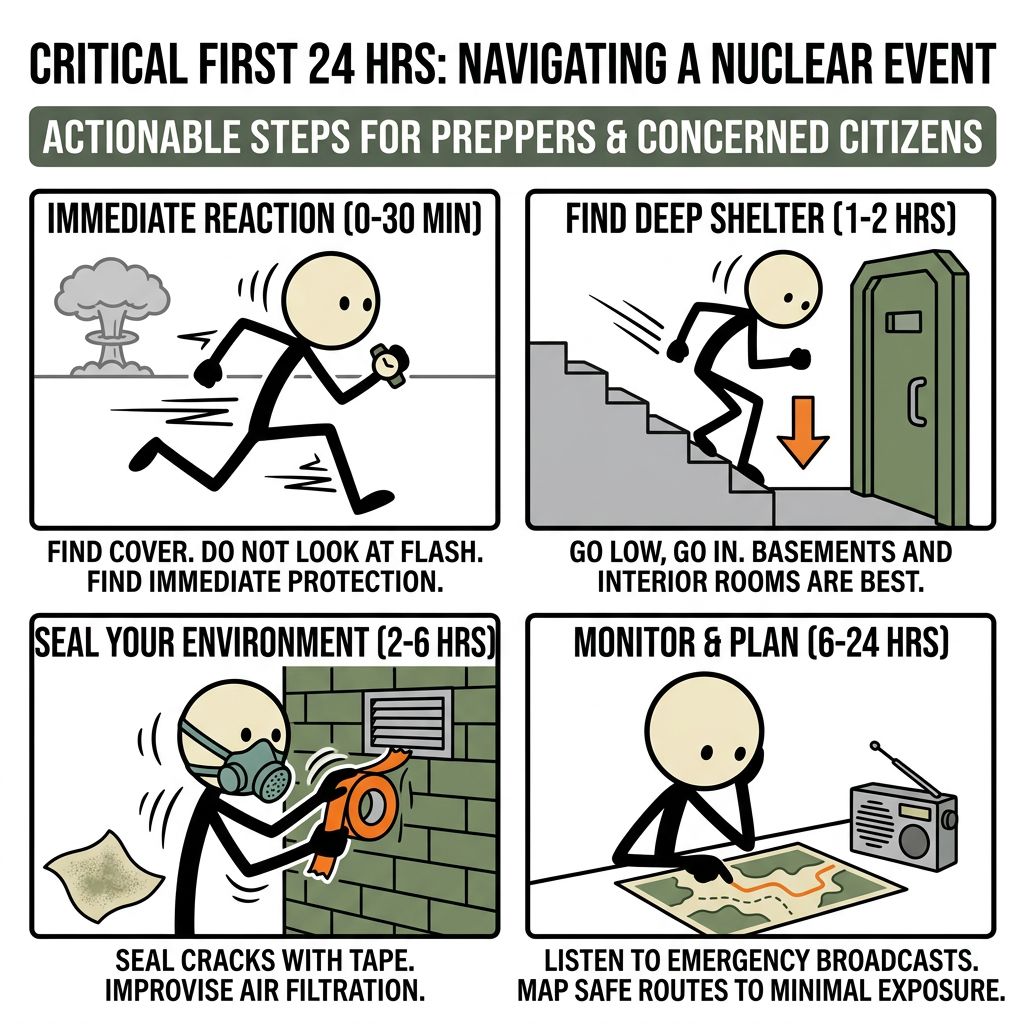
When a nuclear device detonates, the primary threats are the intense flash of light, the thermal pulse, the concussive blast wave, and finally, the residual radiation known as fallout. While the initial blast causes immediate physical destruction, it is the invisible threat of fallout that dictates your survival strategy for the hours and days that follow. Fallout consists of vaporized dirt, debris, and radioactive isotopes that are drawn up into the mushroom cloud, cooled, and then return to earth like a silent, deadly snowfall. Navigating the first 24 hours nuclear blast timeframe requires a strict adherence to the principles of Time, Distance, and Shielding. By understanding these mechanics, you empower yourself to make rapid, life-saving decisions when every second counts.
Nuclear Fallout First 24 Hours Checklist
- Minutes 0-15: Drop, cover, protect your eyes, and move away from windows once the blast wave passes.
- Minutes 15-60: Get inside the nearest solid building. A basement or central room is better than a vehicle or lightweight structure.
- Hours 1-2: Turn off fans pulling outdoor air inside, close exterior openings, and choose one shelter room.
- Hours 2-4: Remove outer clothing if exposed outside, bag it, shower with soap and water if available, and avoid conditioner.
- Hours 4-24: Ration information, water, food, medication, lighting, sanitation, and battery power. Do not leave just because outside looks normal.
Phase 1: Surviving the Initial Detonation (Minutes 0-15)
If you are within a few miles of a detonation but outside ground zero, your first indication of an attack will not be a sound, but an impossibly bright flash of light. This light can cause temporary or permanent flash blindness, even from miles away. Your immediate reaction in the seconds following this flash will dictate your physical survival against the incoming shockwave.
The "Drop and Cover" Protocol
The speed of light is exponentially faster than the speed of sound. Depending on your distance from the blast, the shockwave may take anywhere from a few seconds to over a minute to reach you. Do not look at the flash. The moment you perceive it, you must immediately drop to the ground, face down, and tuck your hands under your body to protect them from thermal burns and flying debris. Keep your mouth slightly open; this helps equalize the sudden, immense pressure changes that will occur when the blast wave hits, protecting your eardrums from rupturing.
If you are indoors, dive under a sturdy desk, heavy table, or alongside a solid interior wall. Stay far away from windows. The overpressure from the blast wave will shatter glass for miles, turning ordinary windows into lethal, high-velocity projectiles. Remain in your protective posture until the primary shockwave has passed, and continue to hold your position for at least another minute to account for the secondary, negative-pressure wave that rushes back toward the detonation site.
The Race Against Fallout
Once the blast waves have subsided, your immediate priority shifts to avoiding the incoming radioactive fallout. You have a very brief window-typically 10 to 15 minutes-before the heaviest and most lethal particles begin to descend. This is not the time to search for family members across town, attempt to drive out of the city, or stare at the mushroom cloud. Your singular objective is to find the most robust nuclear fallout shelter available within your immediate vicinity.
Phase 2: Securing a Nuclear Fallout Shelter (Hours 1-2)
A designated, purpose-built bunker is ideal, but in a real-world scenario, you will likely need to improvise using the structures around you. The goal is to put as much mass and distance between yourself and the radioactive particles settling on the roof and the ground outside. FEMA's directive to "Get Inside, Stay Inside" is based on the physics of radiation attenuation.
Identifying the Best Protection
Not all buildings offer the same level of protection. You are looking for structures with a high Protection Factor (PF). A PF of 40 means that a person inside the shelter will receive 1/40th (or 2.5%) of the radiation dose they would receive if they were standing unprotected outside. To survive a nuclear attack, you should seek a shelter with a PF of at least 40, though a PF of 200 or higher is ideal.
- Deep Underground (Best): Subways, deep basement parking garages, and subterranean utility tunnels offer excellent protection, often providing a PF of 1000 or more due to the massive amount of earth and concrete surrounding them.
- Large Commercial Buildings (Good): The central core of a large, multi-story concrete or brick office building is a highly effective shelter. Move to the center of the building, staying away from the roof and the exterior walls. If the building has 10 stories, the 5th or 6th floor center is ideal, as it maximizes distance from fallout on the roof and fallout on the street.
- Residential Basements (Fair to Good): A typical home basement can serve as a viable nuclear fallout shelter. Move to the corner of the basement that is most deeply submerged underground. You can increase the PF by piling dense materials-such as books, heavy furniture, bags of soil, or water containers-against the walls and above you.
- Wood-Frame Houses without Basements (Poor): The first floor of a standard wood-frame home offers very little protection (often a PF of 10 or less). If this is your only option, move to an interior, windowless room, such as a central bathroom or closet, and build a makeshift inner shelter using mattresses, heavy furniture, and books.
Securing the Perimeter
Once inside your chosen shelter, you must immediately secure the environment against the infiltration of radioactive dust. Turn off all heating, ventilation, and air conditioning (HVAC) systems. Close all fireplace dampers. Shut all doors and windows tightly. If you have duct tape and plastic sheeting readily available, use them to seal the gaps around doors, windows, and ventilation grates. However, do not expend critical time searching for these materials if the fallout is already arriving; the primary goal is mass and distance, not a perfect hermetic seal.
Phase 3: Critical Decontamination (Hours 2-4)
If you were outside during the detonation or while the fallout was descending, you must assume that you are contaminated with radioactive particles. These particles emit alpha, beta, and gamma radiation. While alpha and beta particles have poor penetrating power and are easily stopped by clothing or skin, they are highly dangerous if inhaled, ingested, or allowed to remain on the skin for prolonged periods, leading to severe beta burns. Gamma radiation is highly penetrating and requires the mass discussed in the sheltering section to block.
The CDC Decontamination Protocol
Decontamination is a straightforward but meticulous process. By following these steps outlined by the CDC, you drastically reduce your radiation exposure and prevent the contamination of your shelter.
- Step 1: Remove Outer Clothing. Before entering the core of your shelter, carefully peel off your outer layers of clothing. Do not pull shirts over your head if possible; cut them off to prevent radioactive dust from falling into your eyes, nose, or mouth. Place the contaminated clothing into a plastic bag, seal it tightly, and place it as far away from your shelter area as possible. This single action removes up to 90% of the contamination.
- Step 2: Wash Your Body. If you have access to running water, take a warm (not hot) shower. Hot water opens your pores, which could allow microscopic radioactive particles to enter your skin. Use copious amounts of soap and water to gently wash your skin. Do not scrub harshly, as breaking the skin will allow radiation to enter your bloodstream.
- Step 3: Wash Your Hair Safely. Wash your hair with standard shampoo or soap. Do not use hair conditioner. Conditioners contain cationic surfactants and polymers designed to bind to the hair shaft. In a fallout scenario, these compounds will act like glue, permanently binding radioactive particles to your hair.
- Step 4: Alternative Cleaning. If running water is unavailable, use moist wipes, a clean wet cloth, or a damp paper towel to wipe down all exposed skin. Pay special attention to your face, hands, ears, and eyelashes. Place the used wipes in a sealed plastic bag with your contaminated clothing.
- Step 5: Put on Clean Clothes. Once you are thoroughly decontaminated, dress in clean, uncontaminated clothing that was stored in a drawer or closet prior to the event.
If you are sheltering with pets that were outside, they must also be decontaminated. Wear gloves and a mask if possible, and wash them thoroughly with soap and water, keeping them away from the core shelter area until they are clean.
Phase 4: Understanding the Threat and the 7/10 Rule (Hours 4-12)
As you settle into your nuclear fallout shelter, the psychological weight of the situation will likely set in. It is crucial during this phase to rely on data and science rather than fear. Understanding how radiation behaves is a cornerstone of radiation emergency preparedness.
The Physics of Fallout Decay
Radioactive fallout is exceptionally dangerous, but it is also highly unstable, meaning it expends its energy very quickly. This rapid expenditure of energy is measured by the 7/10 Rule of radiation decay. This rule states that for every sevenfold increase in time after the detonation, the radiation intensity drops by a factor of 10.
To put this into actionable context:
- 1 Hour Post-Blast: Radiation levels are at their absolute peak (baseline 100%).
- 7 Hours Post-Blast: Radiation levels have dropped to just 10% of their peak intensity.
- 49 Hours Post-Blast (7 x 7): Radiation levels have plummeted to 1% of their peak intensity.
- 343 Hours Post-Blast (approx. 2 weeks): Radiation levels are at 0.1% of their peak.
This mathematical reality underscores exactly why the first 24 hours nuclear blast timeframe is the most critical. By remaining steadfastly inside your shelter during this period, you are avoiding the absolute worst of the exposure. Attempting to evacuate or move during these early hours exposes you to lethal doses of radiation that will be vastly diminished just a day or two later.
Time, Distance, and Shielding
These three principles are the holy trinity of a nuclear fallout survival guide. You are utilizing Time by waiting out the rapid decay of the isotopes. You are utilizing Distance by moving to the center of a building, away from the radioactive dust on the exterior. You are utilizing Shielding by placing dense mass (concrete, earth, water) between yourself and the gamma rays emitted by the fallout.
Phase 5: Sustaining Life Inside the Shelter (Hours 12-24)
As you progress through the first 24 hours, managing your biological needs without compromising your radiological safety becomes the primary focus. You will need to consume water and food, manage waste, and gather information.
Safe Food and Water Consumption
A common misconception is that radiation "infects" everything it touches, rendering all food and water permanently toxic. This is scientifically inaccurate. Radiation is not a virus; it is energy and particulate matter. The danger lies in ingesting or inhaling the physical radioactive particles (the dust itself).
Therefore, any food or water that was sealed inside a container before the fallout arrived is perfectly safe to consume. The radiation penetrating the container does not make the food inside radioactive. According to the Environmental Protection Agency (EPA) and the FDA, you can safely consume:
- Water stored in sealed plastic bottles, jugs, or bladders.
- Canned goods, boxed foods, and items sealed in plastic packaging.
- Food stored inside a refrigerator or freezer, provided the appliance was closed when the fallout arrived (the appliance itself acts as a sealed container).
Crucial Step: Before opening any sealed container, you must carefully wipe down the outside of the can, box, or bottle with a damp cloth to remove any microscopic fallout dust that may have settled on it. You do not want to accidentally transfer radioactive dust from the outside of the can into the food as you open it.
Do not consume tap water until official authorities have declared the municipal Water Calculator safe. Surface water reservoirs may become heavily contaminated by falling ash, and it takes time for treatment plants to assess and filter the supply. Do not consume any unpackaged food that was left out in the open, and absolutely do not consume produce from a garden that has been exposed to fallout.
The Role of Potassium Iodide (KI)
If your radiation emergency preparedness kit includes iodine tablets (KI) tablets, it is vital to understand their specific, limited use. KI is not a magic "anti-radiation" pill. It serves one singular purpose: it floods your thyroid gland with stable, non-radioactive iodine, preventing the gland from absorbing radioactive iodine-131, which is a common byproduct of nuclear fission.
Taking KI protects the thyroid from cancer, but it offers zero protection to the rest of your body against external gamma radiation or the internal ingestion of other dangerous isotopes like Cesium-137 or Strontium-90. You should only take KI if instructed to do so by public health officials, as taking it unnecessarily can cause severe allergic reactions and thyroid dysfunction. Follow the FDA dosing guidelines exactly, paying special attention to the reduced dosages required for children and infants.
Managing Sanitation
If you are sheltering in a basement or an interior room without plumbing, you must manage human waste safely to prevent the outbreak of bacterial diseases like cholera or dysentery. Use a heavy-duty bucket lined with a thick plastic garbage bag. After each use, cover the waste with a layer of kitty litter, sawdust, or a diluted bleach solution to control odors and kill pathogens. Ensure the bucket is kept tightly covered when not in use.
Phase 6: Communication, Intelligence, and Psychological Resilience
Information is a critical survival commodity. The detonation of a nuclear device, particularly if detonated at a high altitude, will likely generate an Electromagnetic Pulse (EMP). An EMP is a massive burst of electromagnetic energy that can overload and destroy unprotected solid-state electronics, the power grid, and cellular networks over a vast geographic area.
Establishing Information Lifelines
Do not expect your smartphone to work. Cellular towers will likely be destroyed, disabled by the EMP, or completely overwhelmed by traffic. Your primary lifeline to the outside world will be a battery-operated or hand-crank NOAA weather radio or a standard AM/FM radio.
To protect your radio from an EMP, it should be stored in a faraday cage prior to an event. A simple, improvised Faraday cage can be made by wrapping the radio in several layers of non-conductive material (like cardboard or bubble wrap) and then tightly wrapping it in multiple layers of heavy-duty aluminum foil, ensuring there are no gaps. Alternatively, storing the wrapped radio inside a metal galvanized trash can with a tight-fitting lid is highly effective.
Once inside your shelter, turn on your radio and listen for broadcasts from the Emergency Alert System (EAS), FEMA, or local authorities. They will provide critical updates on:
- The location of ground zero and the trajectory of the fallout plume.
- Current radiation levels in your specific sector.
- Locations of safe civilian gathering points and medical triage centers.
- The official "All-Clear" signal or mandatory evacuation orders.
Maintaining Psychological Control
The psychological toll of surviving a nuclear blast and weathering the subsequent fallout cannot be overstated. The first 24 hours will be fraught with anxiety, isolation, and fear of the unknown. Managing your mental state is just as important as managing your physical exposure.
Establish a routine within your shelter. Assign tasks to family members, regardless of how small, to give them a sense of purpose and control. Monitor your radio at designated times rather than obsessively listening to static. Keep children occupied with books, games, or stories. Maintain a calm, authoritative demeanor; panic is contagious, but so is focused resolve. Remind yourself and your family of the science: every hour that passes, the radiation outside is decaying rapidly. The simple act of waiting is actively contributing to your survival.
Beyond the 24-Hour Mark: The Path Forward
As you cross the 24-hour threshold, the immediate, acute danger of the initial fallout will have significantly diminished due to the 7/10 rule. However, this does not mean it is safe to simply walk outside and resume normal life. The environment remains hazardous, and long-term survival strategies must now be implemented.
Do not leave your nuclear fallout shelter until official channels explicitly broadcast that it is safe to do so, or until they provide specific, routed evacuation instructions. If an evacuation is ordered, you will need to protect your respiratory system from resuspended radioactive dust. Wear an N95 or P100 respirator mask. If these are unavailable, tightly bind a dense cotton cloth or a damp bandana over your nose and mouth. Cover as much exposed skin as possible by wearing long sleeves, pants, gloves, and boots. When moving through contaminated areas, avoid kicking up dust, stay on paved surfaces whenever possible, and do not eat, drink, or touch your face until you have reached a designated clean zone and undergone formal decontamination by hazardous materials teams.
Surviving a nuclear attack is an incredibly daunting prospect, but it is not an insurmountable one. The catastrophic imagery often associated with these events obscures the scientific reality that the human body, when properly shielded and informed, can endure. By mastering the principles of Time, Distance, and Shielding, understanding the critical nature of the first 24 hours, and executing a disciplined plan, you transform yourself from a helpless victim into a capable survivor. True radiation emergency preparedness is not about giving in to fear; it is about embracing knowledge, taking decisive action, and ensuring that when the unthinkable happens, you are ready to face it.
Next Step
Run the Supply Calculator for your household, then stage water, food, medication, radio, lighting, plastic bags, and sanitation supplies inside your best shelter room.
Frequently Asked Questions
How long should you stay inside after nuclear fallout?
Plan to stay inside for at least the first 24 hours unless officials tell you otherwise or the building is unsafe. Fallout radiation is highest soon after arrival and drops significantly over time, so the first day indoors is the most important protection window.
What should a nuclear fallout shelter supply list include?
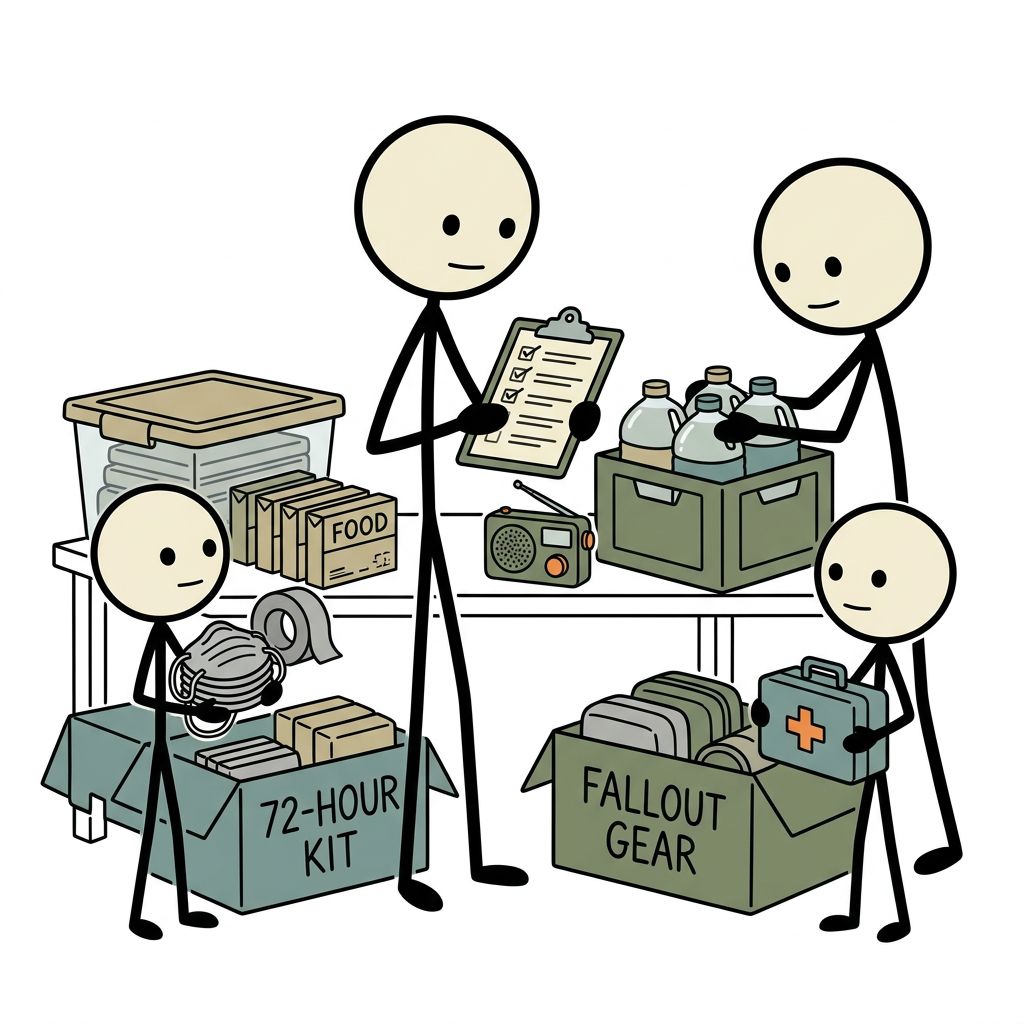
At minimum, stage drinking water, shelf-stable food, medications, battery radio, flashlights, spare batteries, first aid, sanitation bags, wipes, tape, plastic sheeting, phone power banks, and a printed contact plan in your shelter area.
What does Ready.gov say about the first 24 hours after a nuclear explosion?
Ready.gov emphasizes getting inside, staying inside, and staying tuned. The practical household version is to enter the nearest solid building, move to the basement or middle, avoid windows, remove contaminated outer clothing, and follow official alerts.
How do you reduce contamination risk at home?
Stay indoors, keep fallout dust out, remove outer clothing if you were outside, bag contaminated clothing, shower with soap and water, avoid touching your face, and keep pets or gear that were outside away from clean living areas until they can be cleaned.
Should you evacuate right after a nuclear fallout warning?
Usually no. Driving through fallout can expose you to more radiation than staying in a solid building. Evacuate only if your building is unsafe or officials provide a specific evacuation route and timing.
Sources & Further Reading
Related resource: Nuclear Fallout: First 24 Hours Guide.