⚡ Key Facts
- Time, Distance, and Shielding: According to the Centers for Disease Control and Prevention (CDC), these three principles are the foundational pillars of minimizing radiation exposure in any radiological emergency.
- Targeted Protection: Potassium iodide (KI) pills only protect the thyroid gland from radioactive iodine; they do not offer full-body protection against other radioactive isotopes.
- Rapid Decontamination: The Environmental Protection Agency (EPA) states that simply removing your outer layer of clothing can eliminate up to 90% of radioactive material from your person.
- Safe Sheltering: The Federal Emergency Management Agency (FEMA) recommends sheltering in a basement or the center of a dense building, which can provide a Protection Factor (PF) of 10 to 200+, drastically reducing exposure.
- Predictable Decay: Fallout radiation decays rapidly. The "7:10 Rule" dictates that for every sevenfold increase in time after detonation, radiation levels drop by a factor of ten.
If you are building a full household protocol around KI tablets, decontamination, and shelter timing, use Surviving a Radiation Emergency: The First 72 Hours as the practical training path for the decisions that happen before, during, and after exposure warnings.
When discussing a radiological emergency—whether an industrial nuclear power plant accident, a localized dirty bomb, or a broader nuclear detonation—the immediate psychological response is often overwhelming fear. However, surviving a radiological event is not a matter of luck; it is a matter of applied science and decisive action. The reality is that if you survive the initial incident, your long-term survival depends entirely on the steps you take in the following hours and days. By understanding the physics of radiation and implementing proven safety protocols, you can drastically reduce your risk and protect your family. See family emergency plan for household communication and reunification decisions.
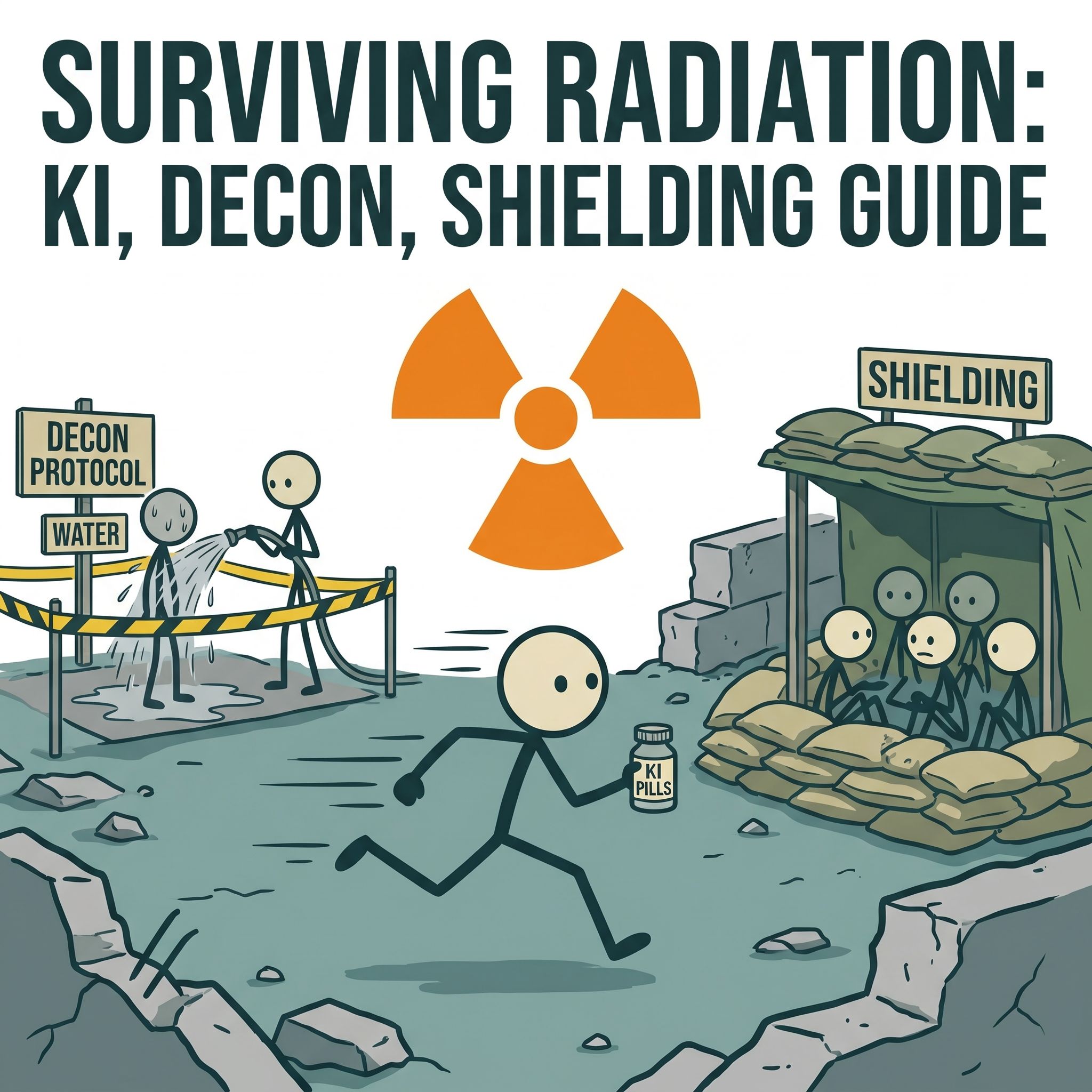
The key to radiation exposure survival lies in demystifying the threat. Radiation is an invisible hazard, but it behaves according to strict physical laws. It can be blocked, it can be washed off, and it decays over time. Government agencies like FEMA, the CDC, and the EPA have spent decades studying these behaviors to develop actionable, life-saving strategies for the public. Preparedness requires moving past cinematic doomsday myths and focusing on practical, science-based methodologies. See water calculator to estimate drinking and decontamination water needs. For a quick definition, see hypothermia.
This comprehensive guide will break down the exact protocols required to navigate a radiological crisis. We will explore the precise biological function of potassium iodide pills, the physics of nuclear fallout protection, step-by-step radiation decontamination procedures, and how to build a resilient emergency preparedness strategy. By the end of this guide, you will possess the knowledge necessary to face a radiological emergency with confidence and authority. See go-bag essentials guide to verify shelter-in-place and evacuation basics. For a quick definition, see iodine tablets.
The Physics of Survival: Understanding Radiation
To effectively protect yourself from radiation, you must first understand what it is and how it interacts with the human body. In a radiological emergency, you are primarily dealing with ionizing radiation. This type of radiation carries enough energy to detach electrons from atoms or molecules, potentially damaging cellular DNA. However, not all radiation is created equal. There are three primary types of ionizing radiation you must understand to implement effective shielding and decontamination strategies. See supply calculator to size food and sanitation stocks by household size.
Alpha, Beta, and Gamma Radiation
Alpha particles are heavy and carry a strong positive charge, but they lack penetrating power. According to the CDC, alpha particles can be stopped by a simple sheet of paper or the dead outer layer of human skin. They are not a significant external threat. However, they are incredibly dangerous if internalized through inhalation, ingestion, or open wounds, making respiratory protection and food safety paramount.
Beta particles are smaller, faster electrons that can penetrate the outer layer of skin, potentially causing "beta burns." While more penetrating than alpha particles, beta radiation can still be stopped by relatively thin materials, such as a layer of clothing, a sheet of plastic, or a few millimeters of aluminum. Like alpha particles, they pose a severe internal hazard if ingested or inhaled.
Gamma rays (and X-rays) are high-energy electromagnetic waves. They are the most penetrating and dangerous form of external radiation in a fallout scenario. Gamma radiation can easily pass through the human body, damaging internal organs and tissue. Stopping gamma rays requires dense, heavy materials like thick concrete, packed earth, water, or lead. When we discuss shielding and Protection Factors, we are primarily focusing on mitigating gamma radiation.
The Golden Rule: Time, Distance, and Shielding
Every official radiological emergency protocol, from the World Health Organization (WHO) to the Department of Homeland Security, relies on three fundamental principles: Time, Distance, and Shielding.
Time: Limiting your time exposed to a radioactive source directly limits your total dose. In a fallout scenario, time is also on your side due to radioactive decay. The longer you stay sheltered, the safer the outside environment becomes.
Distance: The intensity of radiation decreases rapidly as you move away from the source, governed by the inverse-square law. Doubling your distance from a radiation source drops your exposure to one-quarter of the original dose. Evacuation, when safe and instructed by authorities, utilizes this principle.
Shielding: When distance is not an option, you must put dense mass between yourself and the radiation source. The heavier and denser the material, the better it absorbs gamma rays before they can reach your body.
Potassium Iodide Pills: Fact vs. Fiction
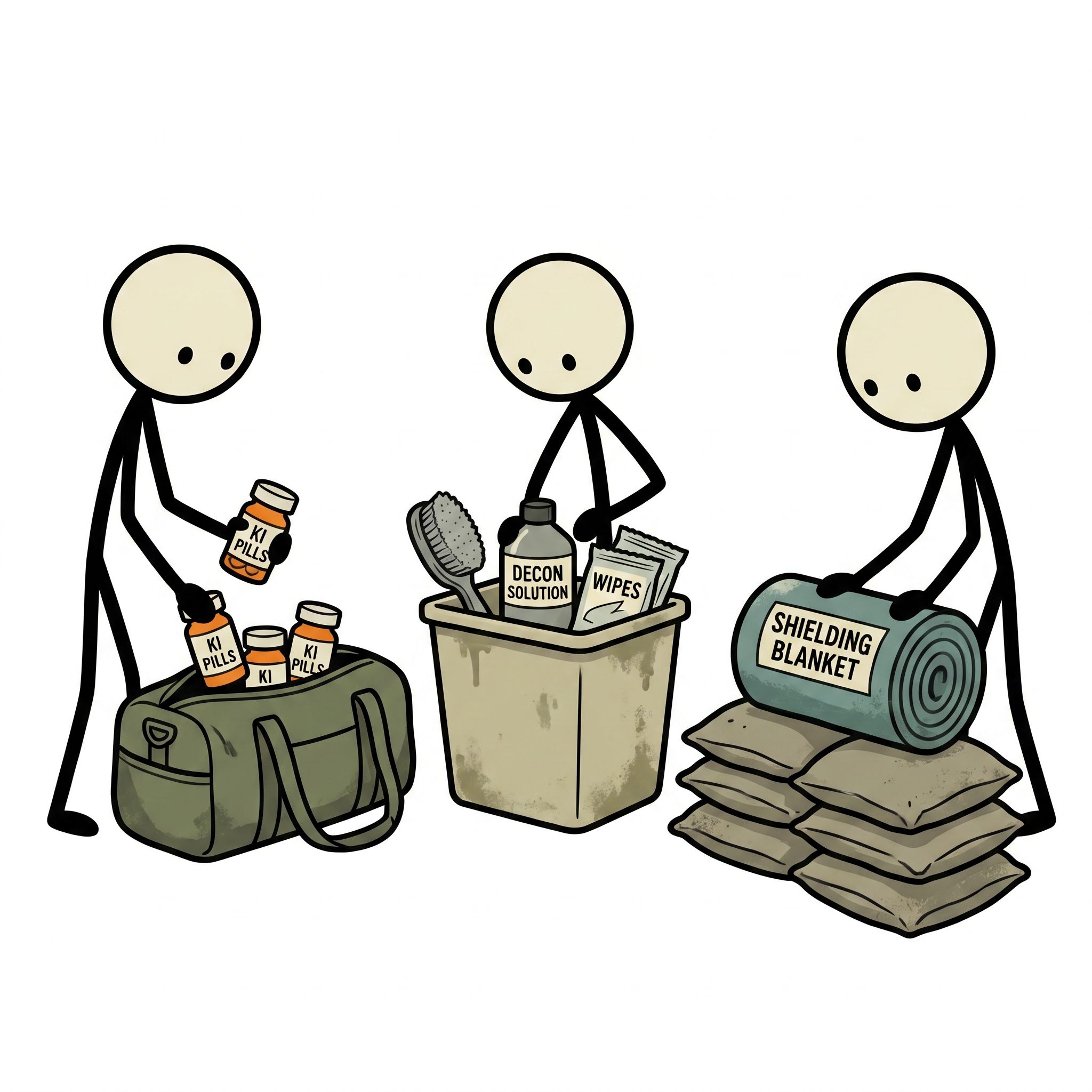
Perhaps no preparedness item is more misunderstood than potassium iodide. Often marketed as "anti-radiation pills," potassium iodide pills are a critical component of a radiological medical kit, but they are not a magic shield against all forms of radiation. Understanding their specific medical application is vital for radiation exposure survival.
How Potassium Iodide (KI) Works
During a nuclear power plant accident or a nuclear detonation, one of the most abundant and dangerous radioactive isotopes released is radioactive iodine (I-131). The human body cannot distinguish between stable, safe iodine and radioactive iodine. If you inhale or ingest I-131, your thyroid gland will rapidly absorb it, leading to a high risk of thyroid cancer, particularly in children and infants.
Potassium iodide (KI) works by flooding the thyroid gland with a massive dose of stable, safe iodine. Because the thyroid can only hold a certain amount of iodine at one time, the KI saturates the gland. If radioactive iodine is subsequently introduced to the body, the thyroid is "full" and cannot absorb it. The radioactive iodine is then safely excreted through the kidneys and urine within a few days.
However, the FDA and CDC are incredibly clear on its limitations: KI only protects the thyroid. It does not protect other organs, it does not reverse radiation damage that has already occurred, and it offers zero protection against other dangerous isotopes like Cesium-137 or Strontium-90. It is a targeted, specific countermeasure, not a cure-all.
Proper Dosage and Administration
Timing is critical when administering potassium iodide. KI should only be taken when explicitly directed by public health officials or emergency management authorities. Taking it prematurely can waste its 24-hour window of maximum efficacy, and taking it unnecessarily can lead to adverse health effects, such as allergic reactions or thyroid dysfunction.
The FDA has established strict dosage guidelines based on age and weight. For adults and children over 18 years old (including pregnant and breastfeeding women), the standard dose is 130 milligrams (mg). Children over 3 years to 18 years old should receive 65 mg. Infants over 1 month to 3 years require 32 mg, and newborns from birth to 1 month need only 16 mg.
A single dose provides approximately 24 hours of protection. You should not take multiple doses in a single day, as this will not offer more protection and increases the risk of side effects. Authorities will issue updates if a prolonged threat requires subsequent daily doses, though typically, the 24-hour window is used to facilitate safe evacuation or allow the I-131 plume to pass.
Nuclear Fallout Protection and Effective Shielding
If a nuclear detonation occurs, the immediate blast and thermal radiation are devastating, but localized. The secondary threat—nuclear fallout—can cover thousands of square miles and affect millions of people. Fallout consists of vaporized dirt, debris, and structural material that has been irradiated, drawn up into the mushroom cloud, and then drops back to earth like microscopic, radioactive sand.
Effective nuclear fallout protection requires putting as much mass and distance between you and the settling radioactive dust as possible. FEMA’s official directive for a fallout scenario is simple but absolute: "Get Inside, Stay Inside, Stay Tuned."
Understanding Protection Factors (PF)
family emergency planners use a metric called the Protection Factor (PF) to measure how well a structure shields against gamma radiation. A PF of 1 indicates no protection (standing in an open field). A PF of 10 means you are receiving 1/10th (or 10%) of the outside radiation. A PF of 200 means you are receiving 1/200th (or 0.5%) of the outside radiation.
The interior of a standard wood-frame house on the ground floor offers a PF of roughly 5. This is insufficient for heavy fallout. Moving to the center of a large commercial concrete building can offer a PF of 50 or more. A residential subterranean basement with earth packed against the walls generally provides a PF of 40 to 200, depending on the depth and overhead structural materials. Your goal is to identify and prepare the highest PF location available to you before an emergency strikes.
The Physics of Shielding Materials
To understand how to improvise shielding within your shelter, you must understand the concept of Halving Thickness (Half-Value Layer). This is the thickness of a specific material required to cut the intensity of gamma radiation in half. By stacking multiple layers, you exponentially decrease your exposure.
According to radiological physics, it takes approximately 0.4 inches of lead to halve gamma radiation. If you don't have lead, you can use other dense materials. It takes about 2.4 inches of solid concrete, 3.6 inches of packed earth or sand, 7.2 inches of water, or 11 inches of solid wood to achieve the same halving effect.
If you are sheltering in a basement, you can increase your protection by pushing heavy furniture against the walls, stacking sandbags or books over basement windows, and creating an inner "fort" using mattresses and dense materials. Every inch of mass counts when you are building a barrier against gamma rays.
The 24-Hour Rule and The 7:10 Principle of Decay
The most intense and dangerous period of a fallout event is the first 24 hours. Fallout is highly radioactive immediately after a blast, but it burns through its energy very quickly. This rapid decay is governed by the "7:10 Rule of Thumb."
The 7:10 rule states that for every sevenfold increase in time after the initial blast, the radiation intensity drops by a factor of ten. For example, if the radiation level outside is a lethal 1,000 Roentgens per hour (R/hr) at 1 hour post-detonation, it will drop to 100 R/hr at 7 hours. At 49 hours (7 x 7), it will drop to 10 R/hr. At 343 hours (roughly two weeks), it will drop to 1 R/hr.
This scientific reality dictates your survival strategy. You must remain in your heavily shielded shelter for at least the first 24 to 48 hours without exception. Leaving your shelter during the initial peak can result in a lethal dose of radiation in minutes. By understanding this decay curve, you can mentally prepare for the duration of your confinement and wait for the environment to become survivable.
Executing a Radiation Decontamination Protocol
If you were outdoors when a radiological event occurred, or if you were forced to travel through a contaminated area to reach shelter, you must assume you are covered in radioactive fallout. Bringing this radioactive dust into your shelter compromises your safe space and subjects you to continuous exposure. Executing a strict radiation decontamination protocol is a non-negotiable survival skill.
Step 1: Containment and Clothing Removal
Decontamination begins before you fully enter your clean shelter space. If possible, establish a transition zone—like a mudroom, an attached garage, or a covered porch. According to the EPA, carefully removing your outer layer of clothing can remove up to 90% of the radioactive material contaminating you.
The removal process must be deliberate. Do not pull shirts over your head, as this can brush radioactive dust into your eyes, nose, and mouth. Instead, cut shirts off if necessary, or roll them downward and outward, trapping the dust inside the folds. Remove your shoes and pants with the same caution. Place all contaminated clothing, shoes, and gear into a heavy-duty plastic trash bag. Seal the bag tightly, place it inside a second bag, and leave it outside or in the designated transition zone, far away from your living space.
Step 2: The Washing Protocol
Once you have removed the contaminated clothing, you must wash your body to remove the remaining 10% of fallout particles. If you have access to running water, take a warm shower. Do not use scalding hot water, as this opens your pores and can allow microscopic radioactive particles to enter your skin. Conversely, freezing cold water will close your pores but trap particles that are already present.
Use copious amounts of gentle soap and water. Wash thoroughly, but do not scrub aggressively. Scrubbing can cause micro-abrasions in the skin, allowing radiation to enter your bloodstream. Wash your hair with standard shampoo, but pay close attention to this vital CDC warning: Do not use hair conditioner.
Hair conditioners contain cationic surfactants and polymers designed to bind to the protein in your hair. If you use conditioner, it will act like a glue, permanently binding microscopic radioactive particles to your hair shafts. Use only shampoo or basic soap.
Step 3: Localized Cleaning and Final Checks
If running water is unavailable due to grid failure, you can perform a localized decontamination using a sink, a bucket of stored water, or even wet wipes. Focus on the parts of your body that were exposed to the air: your hands, face, neck, and arms. Use a damp cloth to wipe your face gently, closing your eyes and mouth.
Pay special attention to your body's entry points. Blow your nose gently to expel any inhaled dust. Use a clean, damp cloth to wipe your eyelashes, eyelids, and the outer areas of your ears. If you have a saline solution, flush your eyes to ensure no particles are trapped. Once you are clean, put on fresh, uncontaminated clothing stored inside your shelter.
Building Your Emergency Preparedness Radiation Kit
Surviving a radiological emergency requires specific tools that go beyond a standard hurricane or earthquake kit. Because you will be sealed inside a shelter for days or potentially weeks, your emergency preparedness radiation kit must be built to sustain life in an isolated, potentially grid-down environment.
Respiratory Protection and PPE
While sheltering, your primary goal is to prevent internal contamination. Standard surgical masks or cloth face coverings are insufficient against microscopic fallout dust. Your kit must include NIOSH-approved N95 or P100 particulate respirators. These masks are designed to filter out 95% to 99.9% of airborne particles, effectively blocking radioactive alpha and beta dust from entering your lungs.
Additionally, stock heavy-duty nitrile gloves, disposable Tyvek suits or ponchos, and duct tape. Duct tape and heavy plastic sheeting (at least 6 mil thick) are crucial for sealing windows, doors, and ventilation shafts in your shelter to prevent airborne fallout from drifting inside during the initial hours of the crisis.
Information and Communication
In a nuclear event, the electromagnetic pulse (EMP) or physical destruction of infrastructure may knock out cellular networks, internet access, and television broadcasts. Your only lifeline to the outside world will be radio. FEMA stresses that staying tuned to official broadcasts is critical for knowing when it is safe to exit your shelter.
You must have a NOAA Weather Radio with Specific Area Message Encoding (SAME) technology, capable of receiving Emergency Alert System (EAS) broadcasts. Ensure the radio is powered by a hand-crank, solar panels, or a robust stockpile of fresh batteries. Do not rely solely on rechargeable devices that require grid power.
Sanitation and Waste Management
If you are sheltering in a basement for two weeks, plumbing may fail, or it may be unsafe to leave the shelter to use a bathroom. Poor sanitation can lead to dysentery and bacterial infections, which can be just as deadly as radiation in a post-disaster environment. Your kit must include a twin-bucket emergency toilet system, heavy-duty contractor bags, sawdust or kitty litter (for odor and moisture control), and ample hand sanitizer and surface disinfectants.
Food and Water Safety During a Radiological Event
Securing a safe supply of food and water is critical for radiation exposure survival. Radiation does not make food or water inherently "radioactive" just by being near it, but if fallout dust physically lands on or inside your food and water, consuming it will cause severe internal radiation poisoning.
Safe Water Sourcing
Surface water—such as lakes, rivers, and open reservoirs—will be heavily contaminated by falling radioactive debris immediately following an event. Do not drink from these sources. Boiling water kills bacteria and pathogens, but it does absolutely nothing to remove radiation. In fact, boiling contaminated water simply evaporates the water, leaving a higher concentration of radioactive isotopes behind.
The only definitively safe water is water that was stored inside sealed containers prior to the event. Bottled water, water stored in sealed rain barrels inside a garage, and water currently resting inside your home's water heater tank or plumbing pipes are safe to consume. According to the CDC, even if the outside of a water bottle is covered in radioactive dust, you can safely drink the water inside by carefully wiping down the exterior with a damp cloth before opening it.
Safe Food Consumption
The same rules apply to food. Any food that is stored in sealed containers—such as canned goods, jars, MREs (Meals Ready-to-Eat), or vacuum-sealed pouches—is perfectly safe to eat. The metal, glass, or thick plastic acts as a barrier against fallout dust. Just as with water bottles, you must carefully wipe down the outside of the can or package with a damp cloth before opening it to ensure no dust falls into the food.
Food stored inside your refrigerator or freezer is also safe to eat, provided the doors were kept closed during the fallout phase. The appliance itself acts as a physical shield. However, any unpackaged food left out on countertops, and certainly any fruits or vegetables growing in an outdoor garden, must be considered contaminated and should be strictly avoided.
Conclusion
The prospect of a radiological or nuclear emergency is undeniably daunting, but history and science have proven that survival is highly achievable for those who are prepared. By stripping away the fiction and focusing on the physics of radiation, you reclaim control over your safety. Understanding the principles of Time, Distance, and Shielding provides a tactical framework for your actions, while possessing the right supplies—from potassium iodide pills to N95 respirators—ensures you can execute your plan effectively.
Remember that radiation exposure survival is a methodical process. It requires the discipline to shelter in place, the meticulousness to execute proper radiation decontamination, and the patience to wait out the rapid decay of fallout. By integrating these science-based protocols into your emergency preparedness strategy, you transform yourself from a potential victim into a capable, resilient survivor, ready to protect yourself and your loved ones against the unseen threats of a radiological crisis.
Frequently Asked Questions
What do Potassium Iodide (KI) pills actually do?
KI pills protect the thyroid gland from radioactive iodine by filling it with non-radioactive iodine. They do not protect against other radioactive substances or external radiation exposure.
When should I take Potassium Iodide (KI)?
You should only take KI pills when explicitly instructed to do so by public health officials or emergency management authorities, as taking them unnecessarily can cause health risks.
What is the most effective way to decontaminate myself after radiation exposure?
Remove your outer layer of clothing, seal it in a plastic bag, and take a warm shower using plenty of soap and water. Do not use hair conditioner, as it can bind radioactive particles to your hair.
How does shielding protect against radiation?
Shielding involves putting heavy, dense materials between you and the radiation source. Thick walls of concrete, brick, or earth are highly effective at blocking harmful radiation.
Should I boil water to remove radiation?
No, boiling water does not remove radioactive material. You should rely on bottled water or water stored in sealed containers until authorities confirm the tap water is safe.
Sources & Further Reading
- https://www.ready.gov/nuclear-explosion
- https://www.fema.gov/emergency-managers/national-preparedness/radiation
- https://www.redcross.org/get-help/how-to-prepare-for-emergencies/types-of-emergencies/radiation-emergency.html
- https://www.cdc.gov/nceh/radiation/emergencies/ki.htm
- https://www.energy.gov/ehss/radiation-protection
Related resource: Nuclear Fallout: First 24 Hours Guide.