⚡ Key Facts
- The Federal Emergency Management Agency (FEMA) explicitly recommends keeping small-denomination cash in your emergency kit, as ATMs and credit card readers will fail immediately during power outages.
- According to the United States Geological Survey (USGS), silver is highly susceptible to supply chain shocks, with over half of all mined silver consumed by industrial applications rather than investment.
- Data from the National Oceanic and Atmospheric Administration (NOAA) indicates a rising frequency of billion-dollar weather disasters, increasing the statistical likelihood of regional grid-down scenarios where digital currency becomes useless.
- During prolonged economic instability, recognized physical assets become the primary medium of exchange; pre-1965 US silver coins ("junk silver") are widely considered the most practical fractional metal for emergency bartering.
- The American Red Cross emphasizes that local disaster resilience relies on immediate access to resources, making physical fiat currency vital for the first 72 hours before alternative economies take shape.
Imagine waking up to a silent house. The power is out, the cellular networks are congested, and your banking app refuses to load. You drive to the local grocery store to stock up on last-minute supplies, only to find a hand-written sign taped to the dark automatic doors: "Cash Only. Systems Down." In our hyper-connected, digital-first world, the illusion of wealth is tied to pixels on a screen. When the grid fails or the economic system buckles, those pixels vanish, leaving only tangible assets to dictate your purchasing power. Learn more in the go-bag essentials guide.
The debate between stockpiling precious metals and holding physical fiat currency is a cornerstone of modern survival planning. Some advocate exclusively for gold and silver, citing the historical inevitability of fiat currency collapse. Others argue that physical cash is the only universally accepted medium of exchange during a sudden disaster. The reality is far more nuanced. True resilience requires understanding the specific utility of different assets across various stages of a crisis. Learn more in the go-bag builder tool.
This comprehensive analysis explores the real-world utility and exchange value of precious metals versus fiat currency. By examining historical precedents, agency data, and the psychology of disaster economics, we will outline a strategic approach to economic collapse preparedness that ensures you maintain purchasing power, no matter what happens to the grid or the global markets. Learn more in the supply calculator.
The Illusion of Digital Wealth in a Grid-Down Scenario
We currently live in an era where the vast majority of global wealth exists only as digital ledger entries. Direct deposits, credit cards, digital wallets, and cryptocurrency rely entirely on a fragile, interconnected web of power grids, internet service providers, and banking servers. When this infrastructure is compromised, your digital wealth is effectively frozen. Learn more in the water calculator.
Data from the National Oceanic and Atmospheric Administration (NOAA) consistently tracks the rising frequency of severe, billion-dollar weather events. From hurricanes in the Southeast to unprecedented winter storms in Texas, these events routinely sever power to millions of residents for days or even weeks. During these localized, short-term disasters, the vulnerability of a cashless society is immediately exposed. Learn more in the survival scenarios.
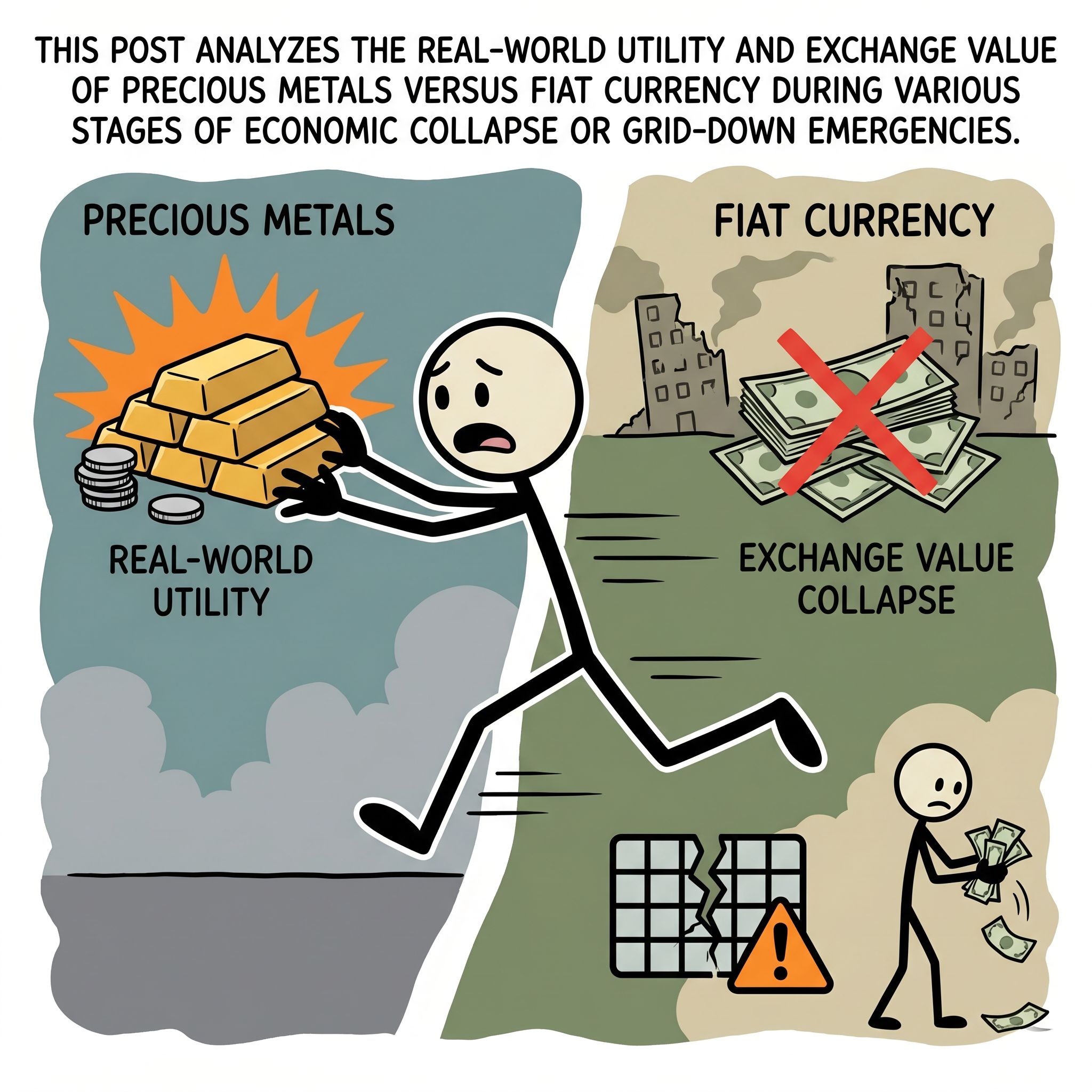
Why Having Cash During Grid Down is Non-Negotiable
In the immediate aftermath of a power failure, physical fiat currency is undisputed. The Federal Emergency Management Agency (FEMA) explicitly advises Americans to include cash in their emergency supply kits. This is because electronic payment systems, ATMs, and point-of-sale registers become instantly inoperable without electricity. Learn more in the emergency food storage guide.
Having cash during grid down scenarios allows you to purchase last-minute necessities like fuel, firewood, or perishable food from merchants who are operating off the grid. However, the denomination of your cash is critical. In a crisis, merchants will not be able to break large bills. If you try to buy a ten-dollar bag of ice with a hundred-dollar bill, you will likely be forced to overpay or walk away empty-handed.
Preparedness experts recommend maintaining a stash of small denominations—primarily ones, fives, tens, and twenties. This ensures you can make exact-change transactions. The American Red Cross echoes this sentiment, noting that community resilience in the first 72 hours of a disaster is heavily dependent on the ability to procure local resources quickly and efficiently.
The Role of Fiat Currency During Economic Instability
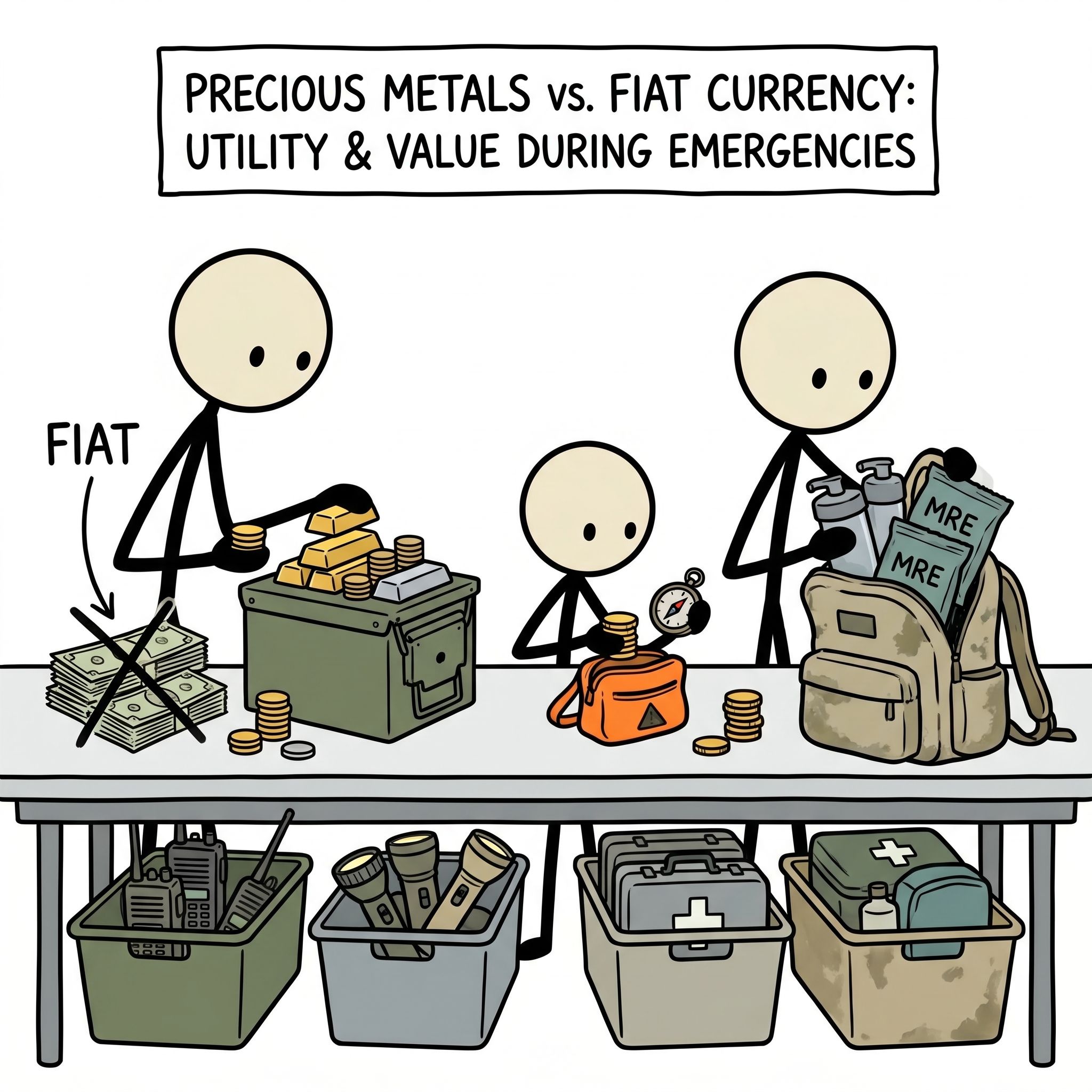
While cash is king during a localized power outage, its utility becomes questionable during a systemic economic crisis. Fiat currency—money that is not backed by a physical commodity like gold or silver—derives its value solely from the trust of the people and the stability of the issuing government. When that trust erodes, the value of the currency plummets.
The Threat of Hyperinflation
Economic collapse preparedness requires an understanding of hyperinflation. History is replete with examples of fiat currencies failing catastrophically. From the Weimar Republic in the 1920s to modern-day crises in Zimbabwe, Venezuela, and Lebanon, we have seen how rapidly paper money can lose its purchasing power. In these scenarios, the printing presses run non-stop to cover insurmountable national debt, diluting the value of the currency already in circulation.
During the early stages of hyperinflation, physical cash still circulates, but prices skyrocket hourly. People rush to spend their paychecks immediately upon receiving them, converting depreciating paper into tangible goods as quickly as possible. If your entire emergency fund is held in fiat currency under the mattress, a severe inflationary event could reduce your life savings to the purchasing power of a few loaves of bread.
This is the critical paradox of fiat currency: it is absolutely essential for navigating short-term, localized grid failures, but it is a massive liability during a prolonged, systemic economic collapse. To hedge against this vulnerability, individuals must look to assets that possess intrinsic value.
Precious Metals: The Ultimate Wealth Insurance
For thousands of years, humans have recognized the intrinsic value of precious metals. Unlike fiat currency, gold and silver cannot be printed into oblivion by central banks. They require massive expenditures of energy, labor, and capital to extract from the earth. This inherent scarcity makes gold and silver for SHTF (Shit Hits The Fan) scenarios the ultimate form of financial insurance.
The Intrinsic Value of Gold and Silver
The United States Geological Survey (USGS) provides vital data on the global supply and demand of precious metals. According to the USGS, silver is not just a monetary metal; it is a critical industrial commodity. Over half of all silver mined annually is consumed by industries producing solar panels, electronics, medical devices, and electric vehicles. This dual demand—both as an industrial necessity and a monetary safe haven—provides a unique floor to its value.
Gold, on the other hand, is primarily held as a store of wealth by central banks and private investors. It boasts an incredibly high value-to-weight ratio. A single ounce of gold, roughly the size of a half-dollar coin, can store thousands of dollars in purchasing power. This makes gold exceptionally efficient for preserving large amounts of wealth and transporting it if relocation becomes necessary.
Gold vs. Silver: Which is Better for Preparedness?
When building a survival currency portfolio, it is vital to understand the different roles gold and silver play. They are not interchangeable in a crisis scenario.
Gold is for Wealth Preservation: Because of its high value, gold is not practical for daily transactions. You cannot easily shave off a piece of a gold coin to buy a gallon of milk or a box of ammunition. Gold is best utilized as a mechanism to carry your life savings through a collapse, allowing you to purchase large assets—like land, vehicles, or a home—on the other side of the crisis.
Silver is for Transactional Utility: Silver is the true workhorse of emergency bartering. Its lower value per ounce makes it highly divisible and ideal for smaller, everyday purchases. In a localized or national economic collapse, silver coins will quickly become the preferred medium of exchange for food, fuel, and medical supplies.
Analyzing the Stages of Collapse and Currency Utility
To truly master economic collapse preparedness, you must map the utility of your assets against the timeline of a disaster. The value of cash, metals, and tangible goods will fluctuate wildly depending on the severity and duration of the event. We can break this down into three distinct stages.
Stage 1: Short-Term Grid Down (0 to 72 Hours)
In the initial phase of a crisis—whether caused by a hurricane, a cyberattack, or a localized grid failure—confusion reigns. The general public is largely unaware of the severity or duration of the event. During this window, normalcy bias is strong. People expect the lights to come back on tomorrow.
Currency Utility in Stage 1:
- Fiat Cash: Supreme. Merchants, neighbors, and service providers still implicitly trust the national currency. Small bills are critical for securing last-minute supplies from stores operating on backup generators or cash-only honor systems.
- Precious Metals: Virtually useless. If you try to hand a gas station attendant a silver eagle for a tank of gas during a standard power outage, they will likely refuse it or severely undervalue it because they do not understand its worth.
- Barter Goods: Low utility. People are not yet desperate enough to trade essential items.
Stage 2: Medium-Term Disruption (Weeks to Months)
If the crisis persists beyond a few weeks, the paradigm shifts. This stage could be triggered by a prolonged national grid failure, severe supply chain disruptions, or the onset of rapid inflation. Store shelves sit empty. The realization sets in that the government cannot immediately restore order. Trust in institutions begins to fracture.
Currency Utility in Stage 2:
- Fiat Cash: Declining rapidly. If inflation is the cause of the crisis, cash loses purchasing power daily. If the grid is down, cash may still be accepted locally, but merchants will start demanding exorbitant amounts of it as goods become scarce.
- Precious Metals: Rising utility. As trust in paper money wanes, individuals seek tangible value. Silver coins begin to circulate in underground or grey markets. Gold remains hidden, as the environment is too unstable for large transactions.
- Barter Goods: High utility. Tangible necessities—such as water filters, shelf-stable food, batteries, and fuel—become primary currencies.
Stage 3: Total System Failure (Long-Term SHTF)
In a true, long-term systemic collapse, the national currency has failed completely, or the grid has been down for months, rendering digital banking permanently obsolete. Society has fractured into localized communities. The rule of law is severely compromised, and a new economy must be built from the ground up.
Currency Utility in Stage 3:
- Fiat Cash: Worthless. Paper money is relegated to tinder for fires or insulation. It holds zero purchasing power because the government that issued it is no longer functioning or trusted.
- Precious Metals: The recognized standard. Gold and silver for SHTF become the foundational pillars of the new economy. Silver is used for daily trade, while gold is used to settle large debts or purchase property.
- Barter Goods: Supreme. The ultimate survival currency is a tangible good that sustains human life or improves living conditions.
The Mechanics of Emergency Bartering
When fiat currency fails, trade reverts to the oldest economic system in human history: bartering. However, direct bartering (trading a chicken for a bag of flour) suffers from a major economic hurdle known as the "coincidence of wants." If you have a chicken, but the person with the flour wants a pair of boots, no trade can occur. This is where a recognized survival currency bridges the gap.
Fractional Silver and "Junk Silver"
For emergency bartering, the absolute best precious metal asset you can own is commonly referred to as "junk silver." This term is a misnomer; there is nothing junk about it. It refers to pre-1965 United States dimes, quarters, and half-dollars. Before 1965, these common coins were minted with 90% pure silver.
Junk silver is the ultimate preparedness asset for several reasons. First, it is highly recognizable. Even in a post-collapse society, most people recognize an old American quarter. Second, it is already fractionalized. A single pre-1965 silver dime contains roughly 0.0715 ounces of silver. In a severe crisis, one silver dime could represent a day's wage or the cost of a hearty meal. This allows you to make small, precise transactions without overpaying.
When purchasing silver specifically for bartering, avoid high-premium numismatic (collectible) coins. In a Survival Scenarios, no one cares about the rarity or the mint mark of a coin; they only care about the metal content. Stick to standard 90% junk silver bags or 1-ounce silver rounds from reputable private mints.
Tangible Goods as Survival Currency
While precious metals are fantastic stores of value, you cannot eat silver, and gold will not cure an infection. A robust economic collapse preparedness plan recognizes that tangible, consumable goods are often more valuable than metals during the darkest days of a crisis.
The Centers for Disease Control and Prevention (CDC) consistently highlights the critical nature of sanitation and hygiene during disasters. When municipal water treatment facilities fail, waterborne illnesses skyrocket. Therefore, items that provide clean water and sanitation become incredibly high-value barter assets.
Consider stockpiling the following items to serve as alternative survival currencies:
- Water Purification: Lifestraws, water filtration cartridges, and water purification tablets will be worth their weight in silver.
- Hygiene Supplies: Soap, bleach, feminine hygiene products, and heavy-duty trash bags are vital for disease prevention.
- Medical Supplies: Antibiotics (acquired legally through preparedness medical services), trauma dressings, antiseptics, and over-the-counter pain relievers will command premium trade value.
- Vices and Comforts: Historically, during times of extreme stress, items like coffee, liquor, and tobacco become highly sought-after secondary currencies.
- Ammunition: In a grid-down scenario where security is paramount, common caliber ammunition (like 9mm, 5.56, and 12-gauge) will be universally accepted in trade.
The Psychology of Wealth in a Collapse
An often-overlooked aspect of emergency bartering is the psychological shift that occurs during a disaster. In our modern society, wealth is flaunted. In a collapse scenario, displaying wealth is a dangerous liability. Operational Security (OPSEC) becomes just as important as the assets you hold.
If you attempt to barter with a one-ounce gold coin for a week's worth of groceries, you are not just making a transaction; you are signaling to the other party that you possess significant wealth. In a desperate environment, this makes you a target for theft or home invasion.
This is another reason why having cash during grid down events and utilizing junk silver later on is so strategic. Pulling a few worn silver dimes or crumpled five-dollar bills from your pocket does not broadcast immense wealth. It allows you to blend in, appearing as just another individual trying to scrape by, thereby protecting your larger stockpile hidden safely at home.
Building a Resilient Financial Preparedness Plan
True financial resilience is not found in a single asset class. It is found in a diversified portfolio that accounts for the varying stages of a crisis. Relying solely on your digital bank account is reckless, but converting your entire life savings into gold coins is equally impractical.
Diversification is Your Best Defense
To effectively insulate yourself from both short-term grid failures and long-term economic collapse, your tangible wealth should be layered. A solid baseline strategy includes the following tiers:
Tier 1: The Fiat Buffer
Keep a minimum of $500 to $1,000 in physical cash in a fireproof safe at home. Break this down into small denominations ($1, $5, $10, and $20 bills). This is your immediate lifeline for the first 72 hours of a localized grid-down event, allowing you to buy fuel, food, and emergency repairs when credit card machines are dark.
Tier 2: The Consumable Bank
Invest in deep pantry storage. Extra food, water filters, medical supplies, and batteries serve a dual purpose. First, they ensure your family survives without needing to venture out into a chaotic environment. Second, any surplus acts as a high-value survival currency for emergency bartering. Buying an extra bag of rice today is essentially locking in its value against future inflation.
Tier 3: Fractional Silver
Acquire a reasonable stockpile of 90% junk silver coins or 1-ounce silver rounds. This is your medium-of-exchange for a prolonged crisis. Aim to have enough fractional silver to cover several months of basic living expenses (food, fuel, security) in a localized barter economy.
Tier 4: Wealth Preservation Gold
For those with substantial savings, physical gold bullion (such as American Gold Eagles or Canadian Maple Leafs) provides a secure way to store large amounts of wealth outside the digital banking system. This is your insurance policy against hyperinflation, ensuring you have the capital to rebuild or relocate when the dust settles.
Securing Your Tangible Assets
Transitioning your wealth from digital ledgers to physical assets introduces a new challenge: physical security. When you hold cash, gold, and silver for SHTF, you become your own bank. You must take the security of these assets as seriously as a bank would.
Never store all of your precious metals or cash in a single location. A home fire or a targeted burglary could wipe out your entire preparedness portfolio in minutes. Utilize high-quality, heavy-duty TL-15 or TL-30 rated safes bolted directly to your foundation. Consider utilizing covert diversion safes for smaller amounts of cash and barter silver that you might need to access quickly.
For larger quantities of precious metals, "midnight gardening" (burying sealed PVC pipes containing metals deep in your property) remains a time-tested method of securing wealth against confiscation or severe home invasions. If you choose this route, ensure the metals are vacuum-sealed with desiccants to prevent moisture damage, and never rely on your memory alone for the location—use precise, encrypted coordinates shared only with a trusted spouse or heir.
Navigating the Future of Crisis Economics
The systems that govern our modern lives are incredibly efficient, but they are undeniably fragile. A localized weather disaster can plunge a city into darkness, instantly erasing the utility of digital money. A reckless monetary policy can erode the purchasing power of a national currency, destroying decades of saved labor. In either scenario, the unprepared are left at the mercy of overwhelmed government agencies and chaotic supply chains.
Understanding the distinct roles of fiat currency, precious metals, and tangible goods allows you to step outside this fragile system. By keeping cash during grid down events, you ensure immediate mobility and access to resources. By stockpiling gold and silver for SHTF, you protect your long-term purchasing power against the ravages of inflation and systemic collapse. And by mastering the mechanics of emergency bartering, you position yourself not just to survive a crisis, but to thrive within a newly formed community economy.
Financial preparedness is not about predicting the end of the world; it is about acknowledging the historical reality that systems fail. By taking proactive steps today to diversify your wealth into tangible, proven assets, you reclaim control over your future. You build a fortress of resilience that no power outage, market crash, or economic collapse can easily breach. The ultimate goal of preparedness is peace of mind, and there is profound peace in knowing that your family's ability to secure what they need rests firmly in your own hands.
Frequently Asked Questions
Will cash still work if the power grid goes down?
Yes, physical cash is universally accepted during short-term power outages when electronic payment systems, credit card readers, and ATMs are offline. Small denominations are recommended.
Should I stockpile gold and silver for emergencies?
Precious metals can store long-term wealth during severe economic instability or hyperinflation, but they are difficult to use for daily transactions and bartering in immediate, short-term disasters.
How much cash should I keep in my emergency kit?
Emergency management agencies recommend keeping enough cash in small bills ($1, $5, $10, $20) in a waterproof container to cover essential supplies, fuel, and lodging for at least three to five days.
What items become valuable for bartering during a systemic breakdown?
In a severe system collapse, practical survival supplies like water filters, non-perishable food, first aid kits, batteries, medication, and hygiene products often hold more immediate trade value than currency or precious metals.
Are credit cards completely useless in a disaster?
Not always. If local power and communication lines remain intact, or once they are restored, credit cards will function. However, you should never rely on them as your sole emergency payment method.