⚡ Key Facts
- The Fitness Gap: According to the Centers for Disease Control and Prevention (CDC), only about 28% of Americans meet the basic combined guidelines for aerobic and muscle-strengthening activities, leaving a vast majority physically unprepared for sudden physical exertion during a crisis.
- Evacuation Realities: The Federal Emergency Management Agency (FEMA) emphasizes that during severe localized disasters, vehicular routes often become impassable, requiring individuals to evacuate on foot carrying essential survival gear for distances of 5 to 15 miles or more.
- Injury Vulnerability: The American Red Cross reports that musculoskeletal injuries—specifically sprains, strains, and lower back injuries—are among the most common medical issues treated in the immediate aftermath of natural disasters due to individuals performing unaccustomed physical labor.
- The Load-Bearing Toll: Studies in physiological ergonomics show that carrying a standard 40-pound "Go-Bag Builder" increases caloric expenditure by up to 40% and drastically alters gait biomechanics, highlighting the need for specific load-bearing training.
- Stress Inoculation: Routine, high-intensity physical training significantly lowers baseline cortisol levels and regulates the body's acute adrenaline response, allowing for clearer cognitive function and decision-making during high-stress emergencies.
Imagine a scenario where the grid unexpectedly fails, or a sudden natural disaster forces an immediate evacuation. The United States Geological Survey (USGS) issues a severe seismic warning, or the National Oceanic and Atmospheric Administration (NOAA) tracks a rapidly intensifying hurricane heading directly for your coastal town. The roads are gridlocked, fuel is scarce, and the only way out is on foot. You have meticulously packed your 72-hour kit guide, your water filtration systems are primed, and your emergency communications are dialed in. But as you strap that 45-pound pack to your back and look at the five-mile trek to the nearest extraction point, a critical question arises: Is your body as prepared as your gear?

For decades, the prepping community has focused heavily on stockpiling supplies, mastering bushcraft, and acquiring top-tier equipment. However, the ultimate survival tool—the one you can never lose, leave behind, or have stolen—is your own physical body. True resilience requires a shift from aesthetic, gym-focused workouts to a comprehensive survival fitness protocol. Your physical capability will dictate whether you become an asset to your family or a liability during a crisis. This guide provides a definitive, practical approach to building the strength, endurance, and mobility required to navigate high-stress emergency situations with confidence and capability.
The Reality of Survival Fitness
Survival fitness is fundamentally different from traditional gym fitness. You are not training to run a marathon in lightweight shoes on flat asphalt, nor are you training to isolate your biceps for a bodybuilding stage. You are training for unpredictable, chaotic, and physically demanding environments. You are training to carry a heavy load over uneven terrain, sprint short distances to escape immediate danger, lift heavy debris to free a trapped loved one, and maintain the stamina to repeat these actions on minimal sleep and restricted calories.
The core objective of a prepper fitness routine is functional utility. FEMA’s National Household Survey on Disaster Preparedness consistently shows that while many Americans gather supplies, very few actively train their bodies to utilize those supplies under duress. When a crisis strikes, the body experiences a massive adrenaline dump. Heart rates skyrocket, fine motor skills degrade, and tunnel vision sets in. If your cardiovascular system is weak, this adrenaline dump can lead to rapid exhaustion, panic, and poor decision-making. By intentionally subjecting your body to rigorous, functional training, you inoculate yourself against this physiological shock, ensuring your mind remains sharp when it matters most.
The Three Pillars of a Prepper Fitness Routine
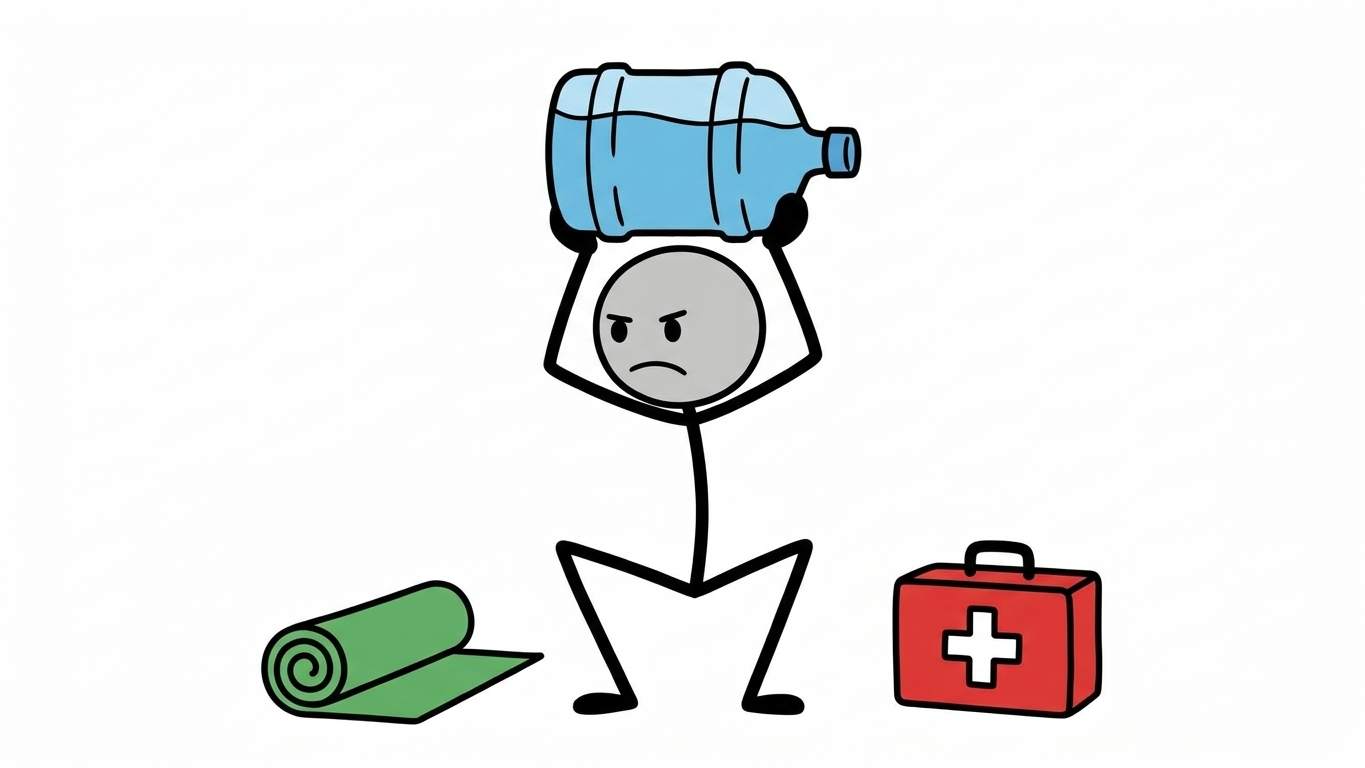
To build a body capable of surviving and thriving in an emergency, your training must be balanced across three essential pillars: Cardiovascular Endurance, Functional Strength, and Mobility. Neglecting any one of these pillars creates a dangerous vulnerability in your overall preparedness.
1. Cardiovascular Endurance: The Engine of Survival
Endurance is your ability to keep moving when the world falls apart. Whether you are navigating through a flooded neighborhood—a scenario frequently highlighted by NOAA during severe weather events—or hiking away from a wildfire zone, your heart and lungs are your primary engine. Survival endurance is broken down into two distinct categories:
- Aerobic Base (Zone 2 Cardio): This is the foundation of your stamina. It is the ability to sustain a moderate level of exertion for hours on end without tapping into your anaerobic energy reserves. Think of a long, steady march with your survival pack. Building this base requires long-duration, low-intensity activities like brisk walking, light jogging, or cycling.
- Anaerobic Capacity (High-Intensity Intervals): Emergencies are rarely a steady pace. You may need to sprint across an exposed area, rapidly climb multiple flights of stairs, or engage in a brief, intense physical struggle. Anaerobic training involves short bursts of maximum effort followed by brief recovery periods. This trains your body to clear lactic acid quickly and recover rapidly from extreme exertion.
2. Functional Strength: Real-World Power
Functional strength for survival is about moving heavy objects through space safely and efficiently. In a disaster, you will not be using perfectly balanced barbells; you will be moving awkward, uneven loads. You might need to clear a fallen tree branch, carry an injured family member, or lift a heavy generator into the back of a truck. This requires core stability, grip strength, and the ability to generate power from your hips and legs.
3. Mobility and Durability: Injury Prevention
The CDC notes that musculoskeletal injuries are rampant in post-disaster cleanup and evacuation scenarios. A sprained ankle or a blown-out lower back transforms a manageable evacuation into a life-threatening crisis. Mobility is the ability of your joints to move actively through their full range of motion. Durability is the strengthening of your tendons, ligaments, and connective tissues to withstand the sudden twists, impacts, and awkward landings that occur when navigating debris-strewn or uneven terrain.
Functional Strength for Survival: The Primal Movements
To build genuine functional strength for survival, you must abandon isolation machines and focus on the five primal movement patterns. These are the biomechanical foundations of human movement, directly translating to the physical demands of an emergency.
The Hinge
The hip hinge is the most powerful movement the human body can produce. It involves bending at the hips while keeping the spine completely neutral. In a Survival Scenarios, hinging is required to pick up heavy supplies from the ground, lift debris, or drag an injured person to safety. The primary muscles engaged are the glutes, hamstrings, and lower back.
- Key Exercises: Deadlifts (using barbells, sandbags, or heavy water jugs), kettlebell swings, and good mornings.
- Survival Application: Safely lifting a 50-pound sack of rice or clearing a heavy beam off a blocked doorway without rupturing a spinal disc.
The Squat
Squatting is essential for lowering your center of gravity, generating upward force, and resting in a stable position without sitting on cold or wet ground. A strong squat ensures your knees and quads can handle the repetitive impact of descending steep terrain while carrying a heavy pack.
- Key Exercises: Goblet squats, front squats, and Bulgarian split squats.
- Survival Application: Lifting a heavy object from a low position, navigating under fallen obstacles, or carrying a person using a fireman's carry.
The Push
Pushing movements are vital for defending yourself, moving obstacles away from your body, or pushing a stalled vehicle. You must train both horizontal pushing (pushing straight out) and vertical pushing (pushing overhead).
- Key Exercises: Push-ups, overhead presses, and dips.
- Survival Application: Pushing a stuck door open, lifting supplies onto a high shelf, or fending off a physical threat.
The Pull
Pulling strength is arguably more critical than pushing strength in a survival context, yet it is often neglected. Pulling is required to climb over walls, pull yourself up steep embankments, or drag heavy loads toward you. It heavily involves the back, biceps, and crucial grip strength.
- Key Exercises: Pull-ups, bodyweight rows, and heavy dumbbell rows.
- Survival Application: Hoisting yourself over a fence during an evacuation, pulling a rope to secure a tarp, or dragging a sled of supplies.
The Carry (Loaded Mobility)
The ability to pick up something heavy and walk with it is the ultimate expression of survival fitness. Carrying builds total-body tension, incredible core strength, and crush-grip capabilities.
- Key Exercises: Farmer’s walks, sandbag bear-hug carries, and suitcase carries.
- Survival Application: Carrying two heavy Jerry cans of water from a source back to your shelter, or moving heavy medical kits across rough terrain.
Bug Out Bag Exercises: The Art of Rucking
If there is one mandatory element in your emergency preparedness workout, it is rucking. Rucking is simply walking with a loaded backpack. It is the military standard for building resilient, capable personnel, and it is the exact physical action you will perform if forced to evacuate on foot. Integrating specific bug out bag exercises into your routine bridges the gap between theoretical fitness and practical survival.
When you place 30 to 50 pounds on your back, everything changes. Your center of gravity shifts, your core must engage constantly to keep you upright, and the impact forces on your ankles, knees, and hips increase dramatically. If you wait until an actual emergency to put your fully loaded bug out bag on your back, you will likely suffer from severe blistering, muscle cramping, and joint pain within the first few miles.
How to Implement Rucking Safely
Do not start by throwing 50 pounds into a pack and attempting a five-mile hike. Tendons and ligaments take much longer to adapt to stress than muscles do. Rushing the process invites stress fractures and severe joint inflammation.
- Phase 1: The Baseline. Begin with a sturdy backpack and load it with 10% to 15% of your body weight. (If you weigh 180 lbs, start with 18-25 lbs). Wrap weights in towels to keep them high and stable against your spine. Walk on flat, paved surfaces for 1 to 2 miles, focusing on maintaining an upright posture and a brisk, steady pace.
- Phase 2: Progressive Overload. Once you can comfortably ruck 2 miles with 15% of your body weight without soreness the next day, begin increasing the distance by 10% each week. Alternatively, increase the weight by 5 pounds. Never increase both weight and distance in the same week.
- Phase 3: Terrain Adaptation. Survival scenarios rarely happen on flat pavement. Once you have built a baseline, take your ruck off-road. Hike on dirt trails, gravel paths, and uneven grassy areas. This micro-adjusts your ankles and knees, building the lateral stability required to prevent sprains when navigating post-disaster debris.
To maximize your bug out bag exercises, periodically stop during your ruck and perform functional movements while wearing the pack. Try doing a set of 10 squats or walking lunges with your pack on. This simulates the necessity of maneuvering under obstacles or taking cover while fully geared up.
The Emergency Preparedness Workout Plans
Knowledge without application is useless. To build true capability, you must follow a structured emergency preparedness workout. Below are two distinct templates designed to integrate seamlessly into a prepper's lifestyle, regardless of their current fitness level. These routines require minimal equipment, focusing instead on body weight, sandbags, and your actual survival gear.
Level 1: The Foundation (Beginner)
This plan is for individuals who have been sedentary or are just beginning their fitness journey. The goal is to build an aerobic base, strengthen connective tissues, and introduce basic functional movements without causing excessive fatigue or injury.
- Monday: Functional Strength Basics.
3 sets of 10 Bodyweight Squats.
3 sets of 8-10 Push-ups (use a wall or an elevated surface if needed).
3 sets of 15-second Plank holds.
3 sets of 10 Glute Bridges (Hinge pattern). - Tuesday: Aerobic Base.
30 to 45 minutes of brisk, uninterrupted walking. The pace should be fast enough to elevate your heart rate, but you should still be able to hold a conversation. - Wednesday: Active Recovery & Mobility.
15 minutes of full-body stretching, focusing on hips, hamstrings, and shoulders. Practice balancing on one foot for 30 seconds at a time to build ankle stability. - Thursday: Pulling & Carrying.
3 sets of 10 Bodyweight Rows (using a sturdy table or TRX straps).
3 sets of Farmer’s Walks (carry two heavy dumbbells or water jugs for 40 yards).
3 sets of 10 Lunges (5 per leg). - Friday: Bug Out Bag Introduction.
Load a backpack with 10-15 pounds. Walk at a brisk pace for 1.5 to 2 miles. Focus on posture—do not let the weight pull your shoulders forward. - Saturday & Sunday: Rest and Skill Building.
Allow your body to recover. Use this time to practice non-physical survival skills, such as map reading, knot tying, or inventorying your supplies.
Level 2: The Operator (Intermediate/Advanced)
This plan is for individuals who already have a baseline of fitness and want to forge high-level functional strength for survival. It incorporates heavier loads, intense anaerobic conditioning, and realistic environmental stressors.
- Monday: Heavy Primal Strength.
4 sets of 5-8 Sandbag or Barbell Deadlifts.
4 sets of 8-10 Overhead Presses (using dumbbells or a sandbag).
4 sets of maximum Pull-ups.
Finisher: 3 sets of 50-yard heavy Farmer's Walks. - Tuesday: High-Intensity Interval Training (HIIT).
Find a steep hill or a long flight of stairs. Sprint up at 90% maximum effort for 20-30 seconds. Walk down slowly to recover. Repeat 8 to 10 times. This simulates the anaerobic demand of escaping an immediate threat. - Wednesday: Mobility & Durability.
30 minutes of deep tissue foam rolling, yoga, or dynamic stretching. Focus on opening the hips and increasing thoracic spine mobility, which becomes stiff from carrying heavy packs. - Thursday: Unilateral Strength & Core.
4 sets of 8 Bulgarian Split Squats per leg (holding weight).
4 sets of 10 Sandbag over-the-shoulder tosses (simulating moving heavy debris).
4 sets of 45-second weighted planks. - Friday: The Stress Ruck.
Load your actual bug out bag with its full survival weight (typically 30-45 lbs). Ruck for 3 to 5 miles on uneven, off-road terrain. Every 1 mile, drop the pack and immediately perform 20 push-ups and 20 squats, then put the pack back on and continue. This trains your body to perform work even when fatigued from load-bearing. - Saturday: Endurance Sustainment.
60 to 90 minutes of Zone 2 cardio (light jogging, cycling, or swimming). This flushes lactic acid from the week's intense workouts while continuing to build your cardiovascular engine. - Sunday: Rest and Recovery.
Environmental Conditioning: Training for the Real World
Emergencies do not wait for a sunny, 72-degree day. Natural disasters often bring extreme weather conditions. If your prepper fitness routine only takes place inside a climate-controlled gym, you are missing a critical component of survival readiness: environmental conditioning.
The human body must acclimate to extreme temperatures to function efficiently. The National Weather Service (NWS) frequently issues warnings regarding heat exhaustion and hypothermia during power grid failures. By safely exposing yourself to these elements during training, you force your body to adapt.
- Heat Acclimatization: Training safely in warmer temperatures improves your body's sweating efficiency and expands blood plasma volume. If you live in a hot climate, gradually move some of your endurance training to the warmer parts of the day. Hydration and electrolyte management become paramount here. Learning how much water your body actually requires during physical exertion in the heat is a vital piece of survival intelligence.
- Cold Exposure: Exercising in the cold teaches you how to manage your clothing layers. Sweating heavily in freezing temperatures is dangerous; if you stop moving, that sweat will freeze, leading to rapid hypothermia. Training in the cold teaches you the "bold to start, cold to start" principle—starting your movement slightly chilly so you don't overheat and sweat through your base layers once your heart rate rises.
- Wet Weather Training: Do not cancel your ruck just because it is raining. Walking in wet clothing and wet boots is a miserable experience, but it is highly likely during a flood evacuation or severe storm. Training in the rain teaches you how to protect your gear, manage foot care to prevent trench foot, and builds immense mental fortitude.
Nutrition, Hydration, and Recovery for the Prepper
You cannot separate survival fitness from survival nutrition. The physical demands of an emergency will rapidly deplete your body's glycogen stores. Understanding how to fuel your body for performance is just as important as the workouts themselves.
During a high-stress evacuation, your caloric burn will skyrocket. A 180-pound person rucking with a 40-pound pack over rough terrain can easily burn 500 to 700 calories per hour. If you are evacuating for 8 hours, that is a massive caloric deficit. Your emergency fitness routine should include testing the foods you have packed in your bug out bag. Do not wait until an emergency to discover that the high-calorie survival bars you packed cause severe gastrointestinal distress when consumed during intense physical exertion.
Hydration is equally critical. The USGS and FEMA advise a minimum of one gallon of Water Calculator per day for basic survival, but during intense physical exertion, your requirements can easily double. Train yourself to drink water systematically. Furthermore, pure water is not enough during heavy exertion; you must replenish electrolytes (sodium, potassium, magnesium) to prevent debilitating muscle cramps.
Finally, prioritize recovery. In a survival scenario, sleep will be scarce and stress will be high. The time to build a resilient immune system and heal micro-tears in your muscles is now. Prioritize 7 to 8 hours of quality sleep per night, practice stress-reduction techniques, and treat your rest days with the same discipline as your training days.
Mental Toughness: The Ultimate Byproduct
Perhaps the most profound benefit of adopting a rigorous emergency preparedness workout is the development of mental toughness. Physical training is, at its core, voluntary suffering. When you force yourself to complete that last mile of a heavy ruck in the rain, or push through the burning sensation of a high-intensity interval, you are building a reservoir of grit.
In a true survival situation, panic is your deadliest enemy. Panic causes hyperventilation, irrational decision-making, and the rapid depletion of energy. By consistently exposing yourself to controlled physical stress through functional strength for survival, you train your central nervous system to remain calm under pressure. You learn to control your breathing, focus on the immediate task at hand, and keep moving forward despite discomfort.
Your body is your primary vehicle for survival. The gear in your basement, the freeze-dried food in your pantry, and the carefully mapped evacuation routes are entirely dependent on your physical ability to execute the plan. By committing to a practical, functional fitness routine, you transform yourself from a passive collector of supplies into a highly capable, resilient asset. You are no longer just preparing for an emergency; you are forging a body and mind that can conquer it. Start today, start light, stay consistent, and build the physical foundation that will carry you through whatever the future holds.
Frequently Asked Questions
What is survival fitness?
Survival fitness focuses on functional strength, cardiovascular endurance, and mobility required to perform physically demanding tasks during an emergency, such as carrying heavy gear or walking long distances.
How much cardio should I do for emergency preparedness?
Aim for at least 150 minutes of moderate aerobic activity per week, incorporating activities like rucking or trail running to simulate real-world evacuation scenarios.
What are the best exercises for survival fitness?
Compound, functional movements like squats, deadlifts, push-ups, pull-ups, and loaded carries are best for building the practical strength needed in a crisis.
Do I need special equipment to train for emergencies?
No. Bodyweight exercises and practicing walking with your actual bug-out bag are highly effective methods that require no specialized gym equipment.
How does physical fitness impact mental resilience in a crisis?
Regular physical training reduces baseline stress, improves decision-making under pressure, and builds the stamina needed to remain calm during prolonged emergencies.
Sources & Further Reading
Related resource: Survival Psychology Course.