Introduction: The Reality of Water Security in a Crisis
When a natural disaster strikes, municipal water systems are often the first infrastructure components to fail. Whether due to power grid collapse, physical damage to treatment plants, or biological contamination from flooding, access to clean tap water can vanish in an instant. While storing physical water is a cornerstone of family preparedness, physical storage has its limits. A typical family of four requires a significant volume of water just to survive a few weeks, making long-term storage space-consuming and heavy. To understand your family's exact daily water needs for drinking, sanitation, and cooking, you can use our interactive water calculator. To supplement your physical water reserves, you must have a reliable method for purifying water harvested from alternative sources, such as rainwater, swimming pools, streams, or lakes. While physical filtration systems are highly popular, chemical water purification tablets serve as an indispensable, lightweight, and highly reliable backup or primary treatment method. This guide will provide a comprehensive, practical analysis of emergency water purification tablets, comparing the three primary chemical agents: iodine, chlorine dioxide, and sodium hypochlorite. We will explore their shelf life, operational advantages, limitations, and how to integrate them into your family's emergency plan.Key Takeaways for Families
- Chlorine dioxide is the gold standard for chemical purification because it kills all major pathogens, including highly resistant Cryptosporidium oocysts, without leaving a harsh chemical taste.
- The shelf life of purification methods varies drastically; liquid sodium hypochlorite bleach degrades within six months, while individually sealed chlorine dioxide tablets remain potent for up to five years.
- Understanding when tablets beat filters (such as in freezing temperatures or when dealing with viral threats) is critical for selecting the right tool for the scenario.
- Conversely, knowing when filters beat tablets (such as in highly turbid, muddy water or when immediate hydration is required) prevents dangerous purification failures.
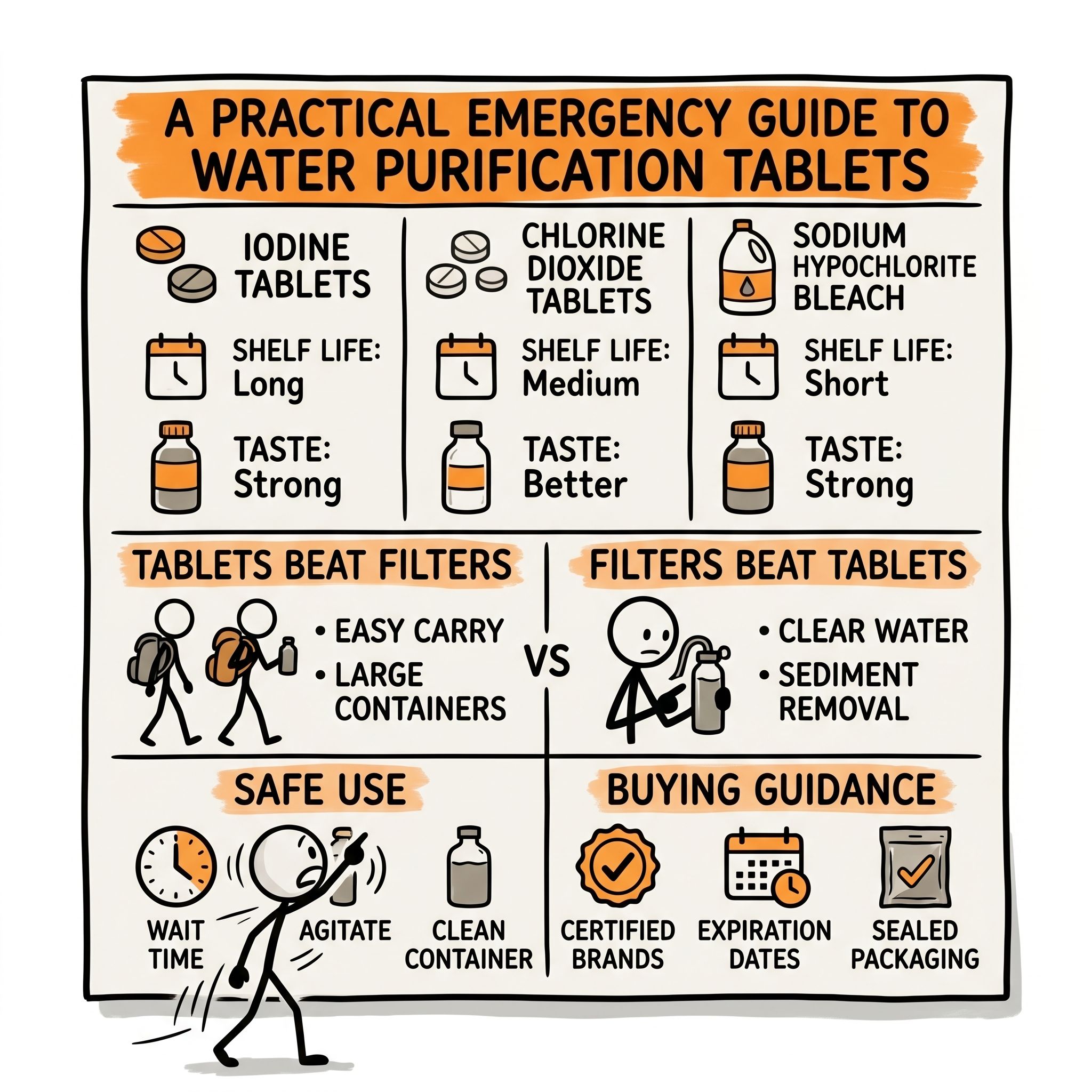
The Chemistry of Clean Water: Comparing the Big Three
Chemical disinfectants work by disrupting the cellular membranes, enzymatic pathways, or genetic material of micro-organisms. However, not all chemical treatments are created equal. Each chemical agent has unique properties, efficacy profiles, and safety considerations that dictate how and when they should be used in a family emergency.Iodine: The Traditional Trail Companion
For decades, iodine was the standard chemical disinfectant for backpackers and military personnel. Typically sold as small tablets containing tetraglycine hydroperiodide, iodine is highly effective against bacteria and viruses. It also kills Giardia cysts when given sufficient contact time. However, iodine has several distinct drawbacks for family use. First, it imparts a strong, medicinal, dark-amber color and a harsh taste to the water. While this taste can be neutralized using secondary sodium thiosulfate tablets, it requires an extra step and additional supplies. Second, iodine is not effective against Cryptosporidium, a common waterborne parasite protected by a tough outer shell. Most importantly, iodine poses health risks for certain individuals. Prolonged use of iodine treated water can interfere with thyroid function. It is generally recommended for short-term emergency use only (typically under three weeks) and should be avoided by pregnant women, infants, individuals with known thyroid conditions, or those with hypersensitivity to iodine.Chlorine Dioxide: The Gold Standard of Chemical Treatment
Chlorine dioxide is a highly powerful oxidant that has largely replaced iodine in modern emergency preparedness kits. Unlike chlorine or iodine, chlorine dioxide does not sanitize by chlorination; instead, it kills pathogens through a rapid electron-transfer process that destroys the organism's cell walls and proteins. The primary advantage of chlorine dioxide is its complete biocidal spectrum. It is highly effective against bacteria, viruses, Giardia, and, crucially, Cryptosporidium. It also improves the taste and odor of treated water rather than degrading it, often neutralizing musty or swampy smells. The primary limitation of chlorine dioxide is its required contact time. While it kills bacteria and viruses within 15 to 30 minutes, inactivating highly resistant Cryptosporidium oocysts in cold or dirty water can take up to four hours. Additionally, chlorine dioxide tablets are typically more expensive than iodine or basic chlorine options.Sodium Hypochlorite: The Household Utility
Sodium hypochlorite is the active ingredient in standard, unscented household liquid bleach. It is a chlorine-based disinfectant that is highly effective at destroying bacteria and viruses by oxidizing cellular components. In emergency preparedness, sodium hypochlorite is valued for its extreme accessibility and low cost. While liquid sodium hypochlorite is highly effective for bulk water treatment at home, it has notable limitations. It is highly corrosive, requires precise measurement to avoid chemical poisoning, and is less effective against protozoan cysts like Giardia and Cryptosporidium unless used in high concentrations that render the water unpalatable. Furthermore, sodium hypochlorite is highly sensitive to environmental factors like light and heat, which directly impacts its stability. For portable or long-term storage kits, sodium dichloroisocyanurate (NaDCC) tablets are often used as a dry, stable alternative that releases free chlorine when dissolved in water, offering a more stable and user-friendly variation of chlorine-based treatment.Shelf Life and Storage Realities
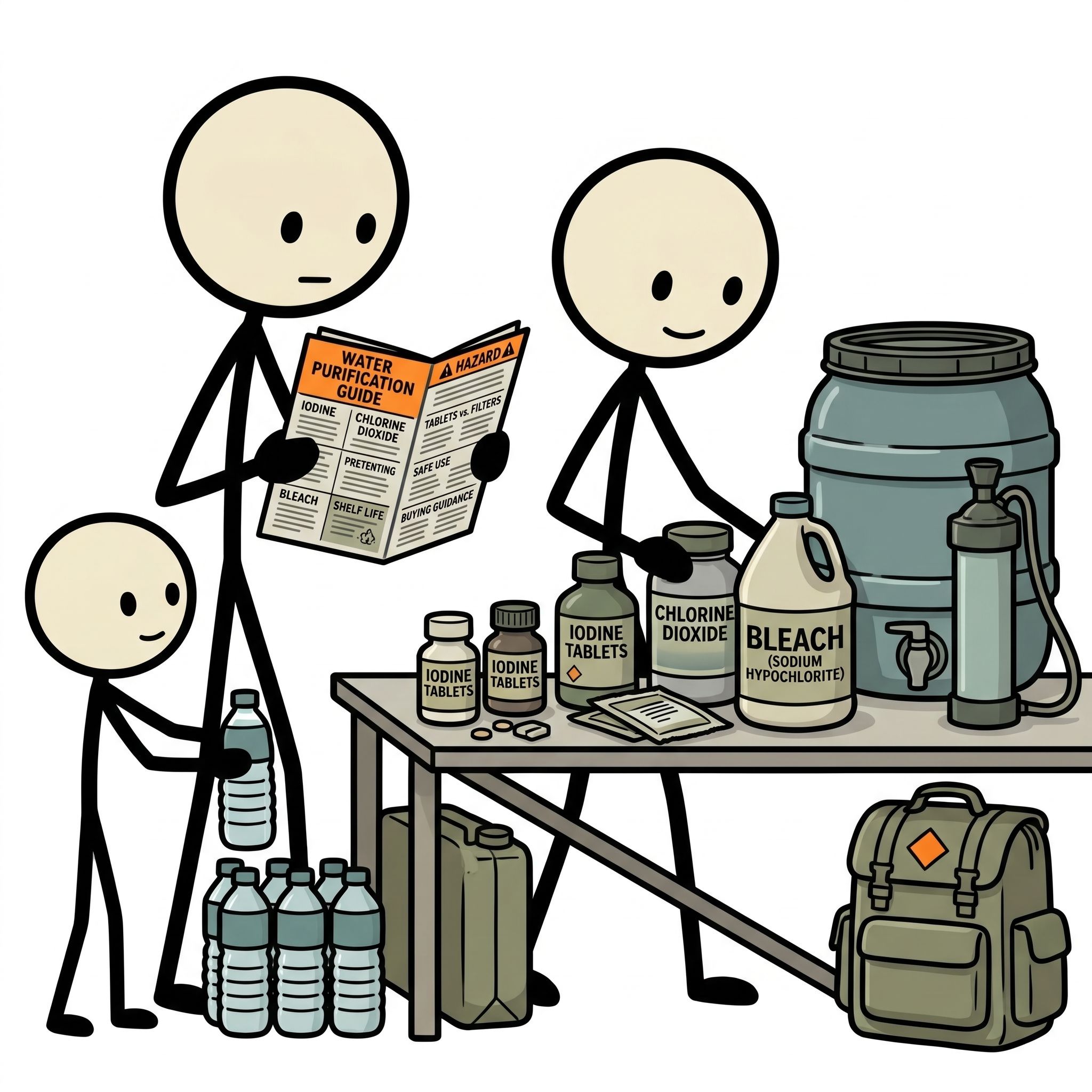
| Purification Agent | Typical Shelf Life | Form Factor | Sensitivity Factors |
|---|---|---|---|
| Iodine (Tetraglycine Hydroperiodide) | 4 to 5 years (unopened); 1 year (opened) | Tablets in glass bottles | Highly sensitive to moisture and air once the seal is broken. Tablets will turn grey or brown and lose potency. |
| Chlorine Dioxide | 4 to 5 years | Individually sealed foil strip tablets | Highly stable in individual foil packaging. Sensitive to direct sunlight and extreme heat once unpacked. |
| Sodium Hypochlorite (Liquid Bleach) | 6 months to 1 year | Liquid in plastic jugs | Degrades rapidly. Can lose up to 50% of its active chlorine content within six months of manufacture, especially in warm environments. |
| Sodium Dichloroisocyanurate (NaDCC) | 3 to 5 years | Individually sealed or tubed tablets | Very stable in dry conditions. Rapidly releases chlorine when exposed to water. |
The Great Battle: Tablets vs. Physical Filters
A common question among those preparing for emergencies is whether they should rely on chemical tablets or physical filtration systems. The reality is that both technologies have distinct operational profiles. A resilient family preparedness plan should utilize both, understanding the specific scenarios where one technology outperforms the other.When Tablets Beat Filters
There are several critical scenarios where chemical purification tablets are vastly superior to physical filters:- Freezing Temperatures: Physical filters, particularly hollow-fiber membrane filters, are highly vulnerable to freezing. If water remains inside a filter membrane and freezes, the ice expands, cracking the microscopic fibers. This damage is often invisible to the naked eye, meaning a compromised filter will allow pathogens to pass directly into your drinking water. Tablets are completely unaffected by sub-zero temperatures and can be safely stored in a vehicle or unheated cabin during winter.
- Viral Contamination: Most standard, portable survival filters have a pore size of 0.1 microns. While this is small enough to strain out bacteria and protozoa, it is too large to stop viruses, which typically range from 0.02 to 0.09 microns. In urban flooding, sewage backups, or international travel scenarios where viral pathogens like Norovirus, Rotavirus, or Hepatitis A are present, chemical tablets are necessary to neutralize these microscopic threats.
- Weight, Space, and Portability: A single sheet of chlorine dioxide tablets weighs less than an ounce and can purify up to 30 liters of water. It fits easily into a pocket, a first-aid kit, or a child's small school emergency pack. Physical filters, even compact ones, are bulkier, heavier, and require hoses, pumps, or gravity bags that take up valuable space in a bug-out bag.
- Zero Mechanical Maintenance: Physical filters can clog, require backflushing, and have moving parts, seals, and gaskets that can wear out or break under stress. Tablets require no mechanical operation; you simply drop them into the water and wait.
When Filters Beat Tablets
Despite the convenience of chemical treatment, there are equally critical scenarios where physical filters are the superior choice:- High Turbidity and Sediment: Chemical tablets do not remove suspended solids, dirt, mud, silt, or organic debris. If you treat muddy water with a tablet, you will end up with warm, chemically sterile mud. Furthermore, high organic matter in turbid water binds to chemical disinfectants, drastically reducing their sanitizing power and requiring higher doses or longer wait times. Physical filters physically strain out these particles, leaving clear, palatable water. To explore high-quality physical filtration options, consult our comprehensive best survival water filters guide.
- Immediate Hydration Needs: Chemical purification is a game of patience. While bacteria may die quickly, neutralizing protozoan cysts can take anywhere from 30 minutes to 4 hours. If a family member is suffering from severe dehydration, waiting hours for water to become safe is a significant risk. Physical filters provide clean, drinkable water instantly.
- Chemical Sensitivity and Taste Fatigue: Drinking chemically treated water over a prolonged period can lead to taste fatigue, particularly in young children who may refuse to drink enough water, risking dehydration. Additionally, long-term consumption of chlorine or iodine can irritate the gastrointestinal tract. Physical filtration removes pathogens mechanically without altering the chemical composition of the water, preserving its natural taste.
- Removal of Non-Biological Contaminants: Chemical tablets are completely ineffective against chemical pollutants, heavy metals, pesticides, microplastics, and industrial runoff. Physical filters equipped with activated carbon or advanced chemical adsorption media can reduce these toxic substances, which are highly common in urban disaster zones.
A Step-by-Step Guide to Safe Family Water Treatment
Using water purification tablets may seem as simple as dropping a pill into a bottle, but executing the process incorrectly can lead to accidental exposure to pathogens. Follow this systematic, step-by-step protocol to ensure your family's treated water is safe to consume.Step 1: Source and Clarify
Always seek out the cleanest water source available. Avoid water with visible chemical sheens, foam, or heavy industrial odors. Once collected, you must remove as much suspended sediment as possible. If the water is turbid, allow it to settle in a large bucket for several hours so the dirt sinks to the bottom. Alternatively, pour the water through a clean cloth, bandana, coffee filter, or improvised sand filter to strain out the largest particles. Clarifying the water ensures the chemical disinfectant can target pathogens rather than getting bound up by organic dirt.Step 2: Assess Temperature and Volume
Measure the volume of water you are treating to ensure accurate dosing. Over-dosing can lead to chemical irritation, while under-dosing will fail to kill pathogens. Note the temperature of the water. Chemical reactions occur much slower in cold water. If you are treating water sourced from a frozen lake or a cold mountain stream, you must adjust your contact time. For chlorine dioxide, cold water treatment can require doubling the standard wait time to ensure complete pathogen inactivation.Step 3: Apply the Disinfectant
Add the appropriate number of tablets according to the manufacturer's instructions for your specific water volume. Secure the cap of your container loosely.Step 4: The Threads Splash Technique
This is a critical, often overlooked step in water treatment. After dropping the tablet into the container, wait a few minutes for it to begin dissolving, then shake the container vigorously. With the cap still slightly loose, tip the container upside down or squeeze it so that a small amount of chemically treated water leaks out around the threads of the bottle neck and cap. This ensures that any pathogens trapped in the threads of the bottle, where your mouth will touch, are exposed to the disinfectant. Tighten the cap securely.Step 5: Wait (Contact Time)
Store the container out of direct sunlight while the chemical reaction occurs. Adhere strictly to the required contact times:- Bacteria and Viruses: 15 to 30 minutes.
- Giardia: 30 to 60 minutes.
- Cryptosporidium (if using Chlorine Dioxide): 4 hours (especially in cold or slightly turbid water).
Step 6: Neutralize and Consume
If you are using iodine and wish to improve the flavor, add your taste-neutralizing tablets (sodium thiosulfate) only after the full contact time has elapsed. If you add the neutralizing agent too early, you will stop the disinfection process before all pathogens are killed. Once neutralized, or once the contact time for chlorine dioxide is complete, the water is safe for your family to drink.Integrating Tablets into Your Family's Disaster Plan
To build a truly resilient emergency water plan, your family should not rely on a single tool. Instead, implement a redundant, multi-layered approach that combines physical storage, physical filtration, and chemical treatment. First, establish your baseline water reserves. For comprehensive instructions on how to calculate, store, and maintain physical water reserves alongside food supplies, read our detailed water and food storage guide. Physical storage provides immediate, high-quality water for the initial days of a crisis. Second, equip your home and mobile kits with a hybrid purification setup. A highly effective strategy is to combine physical filtration with chemical tablets. For example, you can use a physical gravity filter to remove sediment, bacteria, and protozoa from a local stream, and then treat that filtered water with a low dose of chlorine dioxide or sodium hypochlorite to eliminate any potential viral contamination. This hybrid method gives you the best of both worlds: clear, clean-tasting water that is completely sterile. Third, distribute your water purification assets across different locations:- Home Emergency Kit: Store a 1-gallon jug of unscented liquid sodium hypochlorite bleach (rotated every six months) for bulk water treatment, along with a high-capacity physical gravity filter. Keep a box of chlorine dioxide tablets as a backup in case the primary filter breaks.
- Family Bug-Out Bags: Place two strips of individually sealed chlorine dioxide tablets in every family member's bag. Because they are lightweight and have a long shelf life, they provide guaranteed water security without adding physical burden.
- Vehicle Kits: Keep chlorine dioxide tablets in your glove compartment or emergency roadside kit. Avoid storing liquid bleach or iodine bottles in vehicles, as the extreme heat of a parked car can cause liquid bleach to degrade rapidly and plastic bottles to leak.
Buying Guidance: What to Look For
When purchasing water purification tablets for your family, avoid generic or unbranded chemical products. Look for products that are EPA-registered or certified to NSF/ANSI Standard 60 (for drinking water treatment chemicals). This ensures that the tablets contain the exact chemical concentration specified and are free from harmful industrial contaminants. Prioritize individually foil-wrapped tablets over loose tablets in plastic bottles. Foil packaging protects each individual tablet from light, oxygen, and moisture until the moment of use. If you purchase tablets in a bottle, remember that once the seal is broken, the clock begins ticking on their shelf life, and they should be replaced within a year. Finally, calculate your family's quantitative needs. If you plan for a 14-day shelter-in-place scenario for a family of four, and each person requires 1 gallon (approximately 3.78 liters) of water per day for drinking and basic sanitation, you will need to treat approximately 150 to 200 liters of water. Ensure you have enough tablets on hand to treat at least double this volume to account for waste, cooking needs, and potential delays in utility restoration. By understanding the unique properties of iodine, chlorine dioxide, and sodium hypochlorite, and by recognizing how to leverage the strengths of both chemical tablets and physical filters, you can ensure that your family remains safe, hydrated, and resilient in any emergency.Frequently Asked Questions
Are water purification tablets better than filters?
They are better for lightweight backup, suspected viral contamination, and long storage, but filters are better for removing sediment, protozoa, and improving taste before treatment.
Which tablets should I keep in an emergency kit?
Chlorine dioxide tablets are usually the best all-around choice because they cover bacteria, viruses, and protozoa with fewer taste issues than iodine.
Can household bleach purify water?
Unscented household bleach with sodium hypochlorite can disinfect clear water when dosed correctly, but it has limited shelf life and should be rotated.
Do iodine tablets kill Cryptosporidium?
Iodine is not reliable against Cryptosporidium, especially in cold or cloudy water. Chlorine dioxide or boiling is safer for that risk.
Should I filter water before using tablets?
Yes, if water is cloudy. Filtering or settling first removes sediment so chemical disinfectants can work more reliably.