The Foundation of Survival: Why Water Storage is Your First Priority
In any crisis, from localized infrastructure failures to regional grid collapses, water is your most urgent requirement. While the human body can survive for weeks without food, it will begin to fail within days without adequate hydration. Modern municipal water systems are highly complex and vulnerable to cyberattacks, physical damage, contamination, and power outages. When the taps run dry, you must have a reliable, pre-secured supply of potable water immediately available within your home.
Securing this resource requires more than simply buying a few cases of disposable plastic bottles from the local supermarket. True emergency preparedness demands a systematic approach to water storage. This involves selecting the right containers, calculating your household's specific volume requirements, understanding the environmental risks of different storage locations, and establishing a disciplined maintenance routine. This guide provides a practical, source-backed analysis of the five primary emergency water storage options to help you build a resilient household water reserve.
- The absolute baseline for emergency water storage is one gallon per person per day, but realistic household sizing should account for sanitation, cooking, and climate variables.
- Garages pose severe environmental risks to water storage, including rapid plastic degradation from heat, chemical contamination from concrete contact, and structural failure from freezing.
- Container selection must align with your living situation: portable jerry cans and stackable containers suit apartments, while fixed water barrels and IBC totes require ground-floor, reinforced structural support.
- Water does not expire, but the containers holding it do. Regular rotation, proper sanitization, and chemical treatment are mandatory to prevent bacterial growth and chemical leaching.
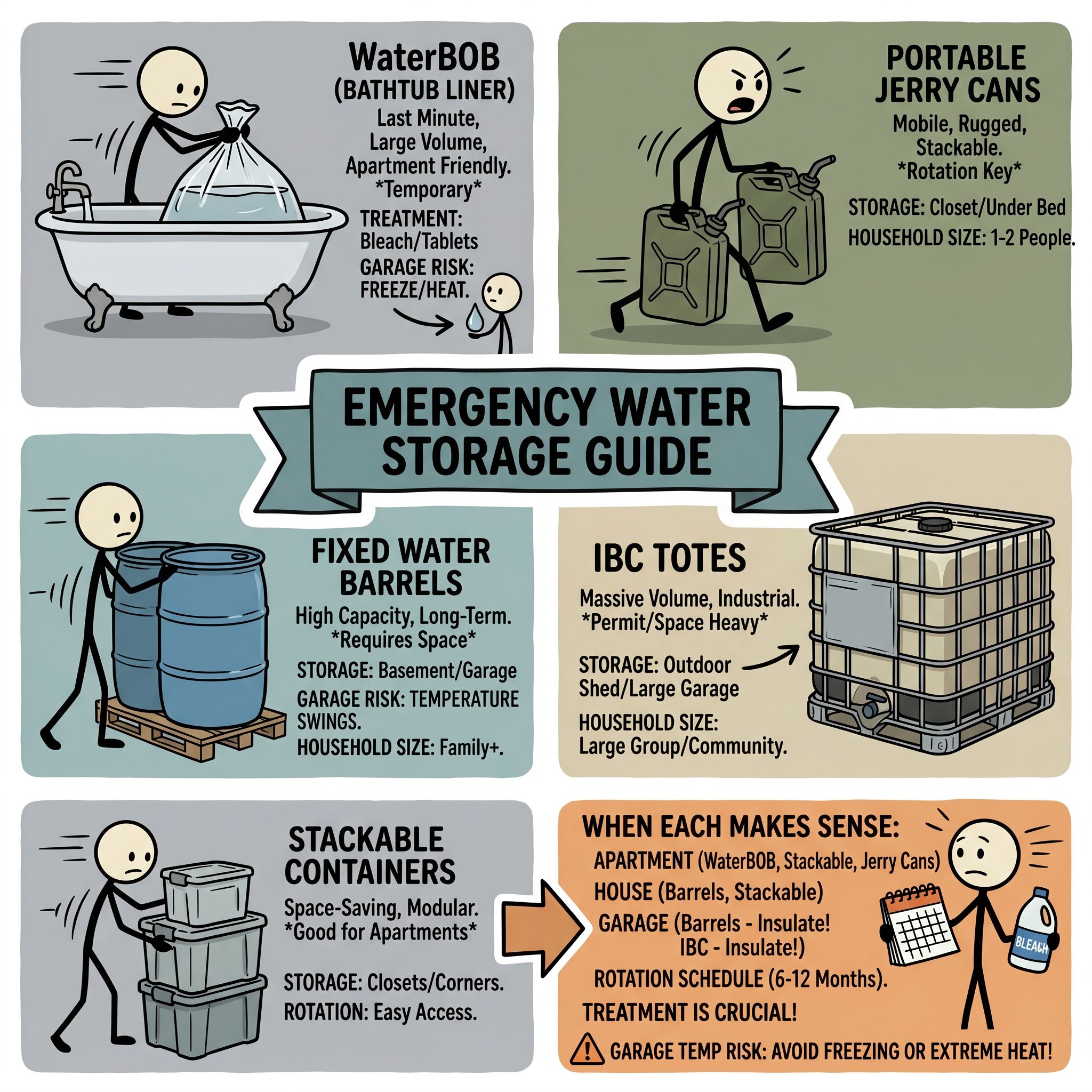
Determining Your Needs: Household Sizing and Sizing Logic
Before purchasing any storage containers, you must calculate your household's exact water requirements. The standard emergency planning recommendation is one gallon of water per person per day. This baseline is split roughly into one-half gallon for drinking and one-half gallon for basic food preparation and hygiene. However, this is a survival minimum, not a comfort standard.
To establish a realistic volume, you must consider several variables that increase daily consumption. Individuals in hot or humid climates, nursing mothers, children, and those with underlying medical conditions will require significantly more than the baseline gallon. Furthermore, basic sanitation - such as washing hands, brushing teeth, and cleaning eating utensils - quickly consumes water reserves. If you have pets, you must also factor in their needs: a medium-sized dog requires about one ounce of water per pound of body weight daily, while cats require about two to four ounces. For a comprehensive look at balancing your nutritional and hydration reserves, refer to our water and food storage guide.
To determine your target storage volume, use the following sizing logic:
- The 3-Day Short-Term Reserve: Designed for localized utility interruptions or minor storm events. Multiply your total household members (including pets) by 1.5 gallons per day. For a family of four, this equals 18 gallons.
- The 14-Day Medium-Term Reserve: Designed for regional disasters, supply chain disruptions, or prolonged grid outages. Multiply your household members by 1.5 gallons per day. For a family of four, this requires 84 gallons of stored water.
- The 30-Day Long-Term Reserve: Designed for severe, systemic crises. At this scale, conservation measures must be paired with robust storage. A family of four will require at least 180 to 240 gallons of water.
For an automated, precise calculation tailored to your family's specific demographics, pet ownership, and climate conditions, utilize our interactive water calculator. Accurate household sizing ensures you do not under-prepare or over-purchase containers that exceed your physical storage capacity.
The Five Main Emergency Water Storage Containers Compared
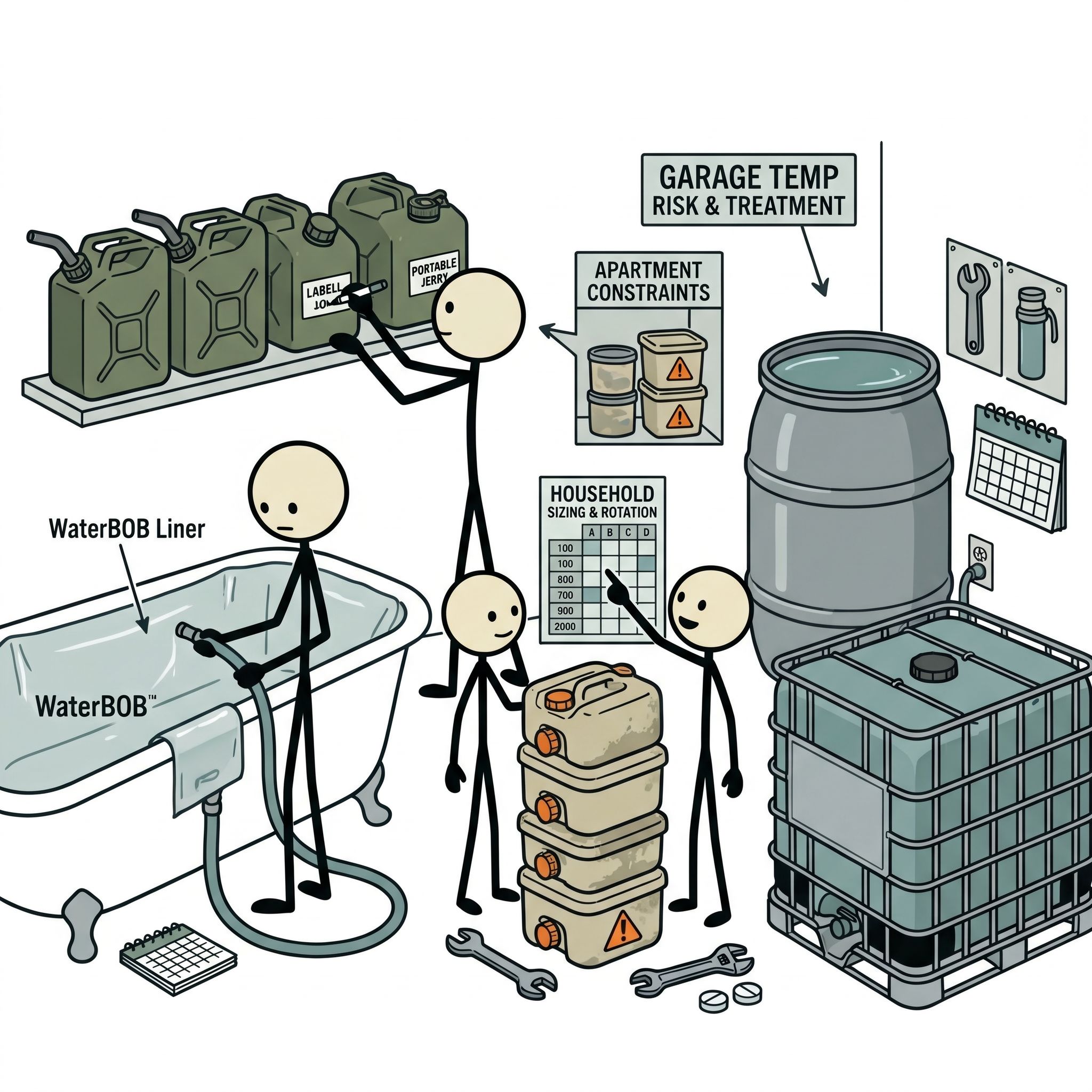
No single water container is perfect for every scenario. The ideal setup for a suburban home with a basement will look vastly different from a high-rise apartment or a rural homestead. Below is an in-depth, practical comparison of the five primary container types used in emergency preparedness.
1. WaterBOB Bathtub Liners
The WaterBOB is a temporary, heavy-duty food-grade plastic bladder designed to be laid out inside a standard bathtub and filled directly from the tub faucet immediately before an impending emergency, such as an approaching hurricane or winter storm.
- Capacity: Typically holds up to 100 gallons, depending on the size of your bathtub.
- Material: Heavy-duty, FDA-compliant food-grade Linear Low-Density Polyethylene (LLDPE) that is BPA-free.
- Pros: Extremely space-efficient when empty; highly cost-effective; keeps stored water completely sealed from soap scum, dust, and tub contaminants; includes a hand pump for easy dispensing.
- Cons: Purely reactive; useless in sudden-onset disasters like earthquakes or sudden water main breaks; renders the bathtub completely unusable for bathing or hygiene; single-use only.
When to Buy: This option is excellent for renters, apartment dwellers, or anyone living in areas prone to seasonal, predictable disasters like hurricanes, blizzards, or scheduled municipal water maintenance.
When NOT to Buy: Do not rely on this as your sole water storage solution if you live in earthquake zones, near active fault lines, or in areas where water infrastructure failures occur without warning. It is also impractical if your home has only one bathtub that is required daily for household hygiene.
2. Portable Jerry Cans
Jerry cans are rugged, rectangular, portable containers equipped with integrated carrying handles. Originally designed for military fuel transport, modern food-grade plastic versions are the gold standard for mobile, durable water storage.
- Capacity: Typically 5 to 10 gallons (20 to 40 liters).
- Material: High-Density Polyethylene (HDPE #2), which is UV-stabilized, impact-resistant, and BPA-free.
- Pros: Highly portable and easy to load into a vehicle for rapid evacuation; exceptionally durable; easy to stack horizontally or vertically depending on the specific model; integrated spigots and air vents make dispensing simple.
- Cons: High cost per gallon compared to larger bulk storage; a filled 5-gallon jerry can weighs approximately 42 pounds, which may be difficult for some household members to carry; requires managing multiple individual containers to achieve a significant reserve.
When to Buy: Ideal for mobile evacuation plans (bug-out scenarios), vehicle-based emergency kits, outdoor recreation, and small-scale apartment storage where portability is non-negotiable.
When NOT to Buy: If your primary goal is to store 150 or more gallons of water for long-term sheltering-in-place, purchasing dozens of individual jerry cans is financially inefficient and logistically tedious to maintain.
3. Stackable Water Containers
Stackable containers are modular, interlocking plastic bricks designed to fit together securely, allowing you to build a vertical wall of water storage in tight, underutilized spaces.
- Capacity: Typically 3.5 to 5 gallons per block.
- Material: Food-grade, BPA-free High-Density Polyethylene (HDPE).
- Pros: Unmatched space efficiency; modular design allows you to expand your storage capacity incrementally; individual units remain light enough to carry easily; fits perfectly in closets, under beds, or in pantry corners.
- Cons: Expensive on a per-gallon basis; stacking them too high (typically more than four or five units) can create a tipping hazard if not properly anchored; the interlocking grooves can make thorough cleaning and drying difficult.
When to Buy: Perfect for apartment dwellers, suburban homeowners with limited floor space, and those who want to build a substantial water reserve incrementally without sacrificing closet or living space.
When NOT to Buy: If you have a large basement, a dedicated utility room, or a secure outdoor storage area, there are far more cost-effective ways to store large volumes of water.
4. Fixed Water Barrels
Fixed water barrels are large, heavy-duty drums designed for stationary, long-term water storage. They are typically blue in color to restrict light penetration, which helps inhibit the growth of algae and bacteria.
- Capacity: Typically 55 gallons (though 15-gallon and 30-gallon variants are available).
- Material: Food-grade, UV-resistant High-Density Polyethylene (HDPE).
- Pros: Highly cost-effective per gallon; extremely durable; provides a substantial, centralized water reserve; designed to remain stationary for years.
- Cons: Completely immobile once filled (a full 55-gallon barrel weighs over 460 pounds); requires a specialized siphon pump to extract water; takes up a permanent, significant physical footprint; difficult to clean, rinse, and drain due to their size and weight.
When to Buy: Best for suburban or rural homeowners with dedicated ground-floor storage space, such as a basement, utility room, or secure outbuilding, who want a reliable, set-and-forget water reserve.
When NOT to Buy: Never purchase a 55-gallon barrel if you live in an upper-floor apartment, rent a home with strict lease terms regarding heavy loads, or anticipate having to evacuate your home quickly. It is also unsuitable if you cannot physically operate a siphon pump or manage the heavy maintenance required during rotation cycles.
5. IBC Totes
Intermediate Bulk Containers (IBC totes) are massive, industrial-grade plastic bladders housed within a protective galvanized steel cage, mounted directly onto a pallet for transport via forklift or pallet jack.
- Capacity: Typically 275 to 330 gallons.
- Material: Food-grade, thick-walled High-Density Polyethylene (HDPE) encased in a steel cage.
- Pros: Unmatched storage volume in a single footprint; integrated heavy-duty bottom valves for easy gravity-fed dispensing; highly cost-effective for large-scale storage; incredibly durable and structurally secure.
- Cons: Extreme weight when filled (a 275-gallon tote weighs approximately 2,300 pounds); completely immobile without heavy machinery once filled; requires a reinforced concrete pad or ground-level placement; must be covered with a UV-resistant tarp if stored outdoors to prevent algae growth and plastic degradation.
When to Buy: Ideal for rural properties, off-grid homesteads, large families with ample outdoor space, or properties with reinforced concrete outbuildings or garages designed to support industrial loads.
When NOT to Buy: Absolutely do not buy an IBC tote if you live in a standard residential home with wooden floor joists, a typical suburban basement with questionable slab strength, or an apartment. Never buy a used IBC tote unless you can verify its chain of custody with absolute certainty; units previously used to transport industrial chemicals, pesticides, or surfactants are permanently unsafe for drinking water, even after thorough washing.
Storage Locations and Environmental Risks
Where you store your water is just as important as what you store it in. Water is heavy, chemically active as a solvent, and highly sensitive to environmental conditions. Choosing the wrong storage location can lead to structural damage to your home, chemical contamination of your water, or catastrophic container failure.
Apartment Constraints and Structural Weight Limits
Water weighs approximately 8.34 pounds per gallon. This simple physical fact must guide all indoor storage decisions, particularly in multi-story apartment buildings or homes with wooden floor joists. A single 55-gallon water barrel concentrates over 460 pounds of weight onto a tiny, circular footprint of about four square feet. If you store multiple barrels together, you can easily exceed the structural load limits of residential floors, which are typically engineered to support 30 to 40 pounds per square foot of live load.
For apartments, the safest approach is to distribute the weight. Use portable jerry cans or stackable containers spread out along load-bearing walls rather than concentrating all your water in a single closet or the center of a room. Additionally, ensure your lease allows for heavy water storage systems, as some property management companies have strict guidelines to prevent structural sagging or water damage liabilities.
Garage Temperature Risks: Heat and Freezing
The garage is often the first place people think of when storing emergency supplies, but it is actually one of the most hostile environments for water storage. Garages are rarely climate-controlled, exposing your water containers to extreme temperature swings.
The Threat of Extreme Heat: High temperatures accelerate the degradation of plastic containers. Even food-grade, BPA-free plastics can begin to leach trace chemical compounds, plasticizers, and microplastics into the water when subjected to sustained temperatures above 85 degrees Fahrenheit. Heat also promotes the rapid growth of any microscopic bacteria or algae present in the water, turning a safe reserve into a biological hazard. Furthermore, hot environments cause water to taste flat, stale, and unappealing, which can discourage consumption during an already stressful emergency.
The Threat of Freezing: In cold climates, uninsulated garages will drop below freezing. When water freezes, it expands by approximately nine percent. This expansion exerts immense physical pressure on the walls and seams of your containers. If a container is filled to the brim without adequate headspace, freezing will split the plastic seams, crack the dispensing valves, or pop the caps off, leading to a catastrophic spill when the temperature rises. If you must store water in an area prone to freezing, leave at least 10 percent of the container's volume empty to allow for expansion, and avoid using rigid, brittle plastics that crack easily under stress.
The Danger of Concrete Contact
Placing plastic water containers directly onto bare concrete floors - whether in a garage, basement, or utility room - is a common and dangerous mistake. Concrete is highly porous and acts like a sponge, absorbing moisture, volatile organic compounds (VOCs), pesticides, automotive fluids, and industrial solvents from the surrounding environment.
Through a process known as plastic migration, these chemicals can slowly pass through the semi-porous walls of plastic containers (including HDPE #2) and contaminate the water inside. This is particularly true for petroleum-based chemicals, gasoline vapors, and pesticides commonly stored in garages. To prevent this chemical leaching, always elevate your water containers off the concrete. Use wooden pallets, heavy-duty plastic shelving, 2x4 lumber, or even thick sheets of clean cardboard to create a physical barrier between the concrete and your storage containers.
Water Treatment, Preservation, and Rotation
Water does not expire, but the container holding it can degrade, and the water itself can become contaminated over time. To ensure your stored water remains safe to drink, you must implement a strict protocol of sanitization, chemical treatment, and regular rotation. For a deeper look at the long-term management of your emergency reserves, consult our comprehensive emergency water storage guide.
Sanitizing Your Containers
Before filling any brand-new or previously used food-grade container, you must sanitize it thoroughly to kill any latent bacteria, fungal spores, or manufacturing residues. Follow this step-by-step sanitization process:
- Wash the inside of the container with warm water and mild dish soap, then rinse it completely to remove all soap residue.
- Prepare a sanitizing solution by mixing one teaspoon of unscented, liquid household chlorine bleach (containing 5% to 9% sodium hypochlorite) with one quart of clean water.
- Pour the sanitizing solution into the container, seal the cap tightly, and shake or roll the container vigorously for at least 30 seconds, ensuring the solution contacts every interior surface, including the threads of the cap.
- Empty the solution out of the container and rinse it thoroughly with clean, potable water. Let the container air dry completely before filling it for storage.
Treating Stored Water
If you are filling your containers with municipal tap water that has already been chemically treated with chlorine or chloramine, you do not strictly need to add additional disinfectants, provided the water is stored in clean, sanitized, airtight containers. However, if you are storing well water, untreated surface water, or want to maximize the shelf life of your municipal water, you should treat it chemically.
Household Bleach Method: Use fresh, unscented liquid household chlorine bleach. Do not use scented bleaches, color-safe bleaches, or bleaches with added cleaners. Add 8 drops (approximately 1/8 teaspoon) of bleach per gallon of water. For a 55-gallon barrel, add 4 teaspoons of bleach. Seal the container, shake or stir it, and let it sit for 30 minutes. If the water has a slight chlorine odor after 30 minutes, it is safe to store. If it does not, repeat the dosage and let it sit for another 15 minutes.
Commercial Water Preservers: For a more stable, long-term solution, use specialized commercial water preservatives, such as those based on chlorine dioxide or copper-silver ion formulations (e.g., Aquamira or Biofilm Buster). These treatments are highly effective at preventing bio-film formation and can preserve water for up to five years without rotation, compared to the six-to-twelve-month limit of standard bleach treatments.
The Rotation Schedule
Water rotation is the practice of emptying, cleaning, and refilling your storage containers on a regular schedule to ensure freshness and prevent plastic degradation. Your rotation frequency depends on your treatment method and storage conditions:
| Water Source & Treatment | Storage Location Condition | Recommended Rotation Frequency |
|---|---|---|
| Untreated Tap Water (No Additives) | Cool, Dark, Climate-Controlled | Every 6 Months |
| Tap Water + Standard Bleach | Cool, Dark, Climate-Controlled | Every 12 Months |
| Tap Water + Standard Bleach | Uninsulated Garage / Variable Temp | Every 6 Months |
| Water + Commercial Preserver (e.g., Aquamira) | Cool, Dark, Climate-Controlled | Every 5 Years |
Always label each container clearly with a waterproof marker or adhesive label indicating the date it was last filled, the treatment method used, and the scheduled date for its next rotation. This simple administrative step prevents guesswork and ensures your family's water supply is always safe and ready for use.
Summary: Matching the Container to Your Situation
Building a resilient water storage system is not about buying the largest container available; it is about matching the container to your physical living space, your physical capabilities, and your specific emergency plan. Use this quick reference to align your needs with the right storage solution:
- The Urban Apartment Dweller: Focus on space-saving, weight-distributed solutions. A combination of modular stackable containers in closets and a WaterBOB stored in the linen closet for impending storms provides excellent coverage without risking structural damage or lease violations.
- The Suburban Homeowner: If you have a basement, utility room, or climate-controlled crawlspace, a pair of fixed water barrels (55 gallons each) elevated on wooden blocks provides a robust, cost-effective baseline of 110 gallons. Supplement this with two or three portable jerry cans for evacuation flexibility.
- The Rural Homestead or Off-Grid Property: For large-scale water security, install a food-grade IBC tote (275 to 330 gallons) on a reinforced concrete pad. Ensure it is covered with a heavy, UV-blocking tarp to prevent algae growth, and plumb it directly into your rainwater collection or well pump system.
Water security is the ultimate cornerstone of family preparedness. By choosing the right containers, calculating your household sizing accurately, avoiding high-risk storage locations like bare garage floors, and maintaining a disciplined rotation schedule, you can ensure that your family will never be left vulnerable when the taps run dry. Take action today: calculate your needs, select your containers, and secure your household's most vital resource.
Frequently Asked Questions
What is the best water storage container for most families?
Most families should combine small portable containers for daily handling with one larger reserve, such as a barrel or stackable container, if they have safe space for it.
Is a WaterBOB better than water barrels?
A WaterBOB is excellent when you have warning before a storm or water shutoff, but it is temporary. Barrels are better for standing long-term storage.
How much emergency water should I store?
Start with at least 1 gallon per person per day for drinking and minimal hygiene, then use a calculator to adjust for heat, pets, medical needs, and duration.
How often should emergency water be rotated?
Use a simple 6- to 12-month rotation schedule unless the container manufacturer or local water authority gives more specific guidance.
Can I store water containers in a garage?
Yes, if the containers are food-grade, sealed, off the concrete if possible, and protected from heat, sunlight, chemicals, gasoline, and pesticides.