⚡ Key Facts
- FEMA Baseline: The Federal Emergency Management Agency (FEMA) recommends storing at least one gallon of water per person, per day, for a minimum of three days to cover basic drinking and hygiene needs.
- Pathogen Sizing: According to the Centers for Disease Control and Prevention (CDC), while bacteria range from 0.2 to 5 microns, viruses are much smaller (0.02 to 0.3 microns), requiring purification rather than standard filtration.
- Boiling Standards: The American Red Cross and CDC state that bringing water to a rolling boil for 1 minute (or 3 minutes at elevations above 6,500 feet) is sufficient to kill all disease-causing organisms.
- Flood Contamination: The United States Geological Survey (USGS) notes that floodwaters frequently compromise municipal wells with agricultural runoff, heavy metals, and raw sewage, necessitating advanced multi-stage filtration.
We take the turn of a faucet for granted. Yet, history consistently shows us that municipal Water Calculator systems are highly vulnerable to localized power grid failures, severe winter storms, hurricanes, and infrastructure degradation. When the water pressure drops and local authorities issue a boil water advisory, your family’s health depends entirely on the preparations you made before the crisis hit. Dehydration and waterborne illnesses are significant threats during a disaster, but they are also entirely preventable with the right knowledge and equipment. See Water Calculator for additional options. See Water Calculator for additional options.
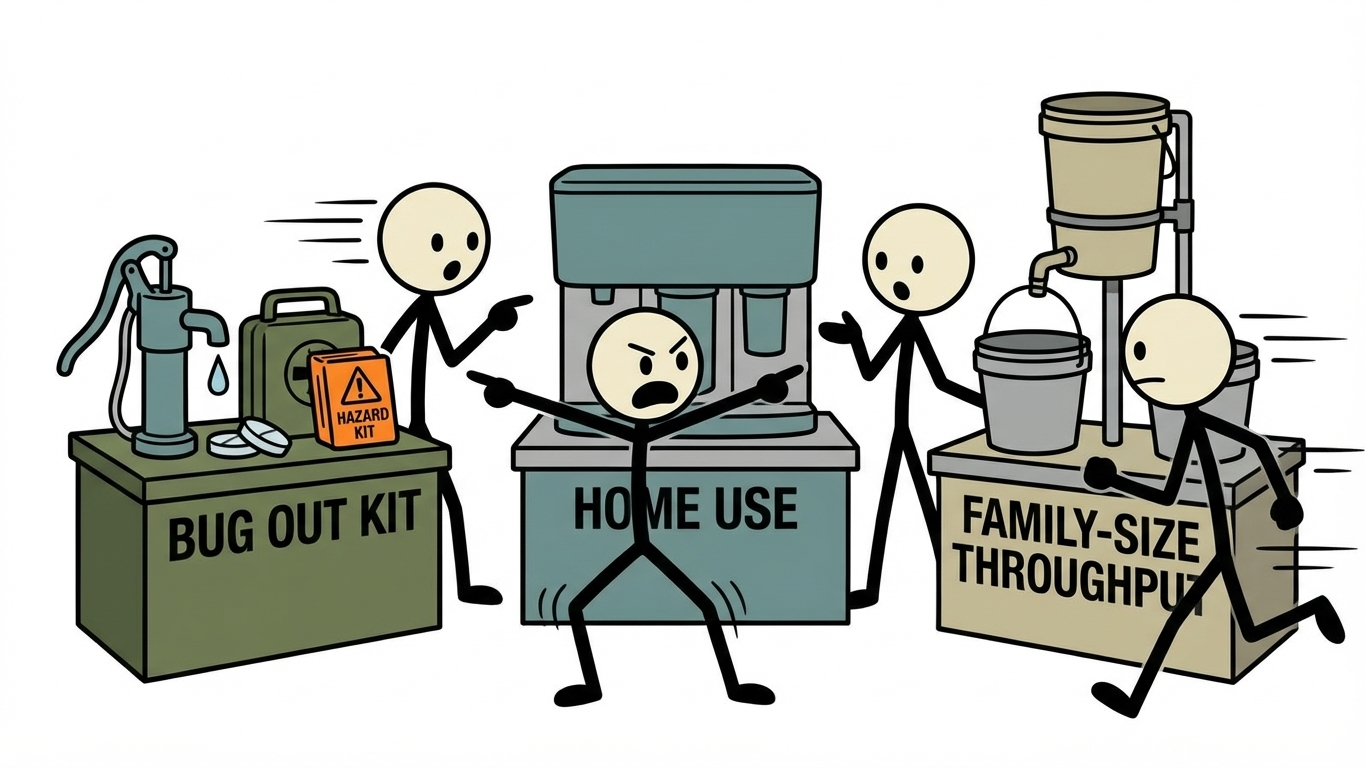
Securing a reliable water Supply Calculator isn't just about stacking plastic bottles in the basement. It requires a dynamic approach that accounts for home sheltering, mobile evacuations, and long-term sustainability. You need systems capable of turning questionable water sources—like rain barrels, nearby streams, or compromised tap water—into safe, clean drinking water.
Navigating the market of survival gear can be overwhelming. To build a resilient household, you must understand the critical differences between filtration and purification, evaluate flow rates, and choose the right tools for specific scenarios. This guide breaks down the science of safe water, comparing the best emergency water filter options for stationary family use alongside lightweight, high-performance gear for your Go-Bag Builders. For a quick definition, see water filter. For a quick definition, see water storage.
Filtration vs. Purification: Understanding the Science
Before investing in any emergency water system, it is crucial to understand the scientific distinction between filtration and purification. Many people use these terms interchangeably, but in the realm of survival and emergency preparedness, confusing the two can lead to severe gastrointestinal illness.
Water filtration is a physical process. It involves passing boil water advisory through a porous medium—such as a hollow fiber membrane, ceramic shell, or activated carbon block. These microscopic pores are designed to trap physical debris, protozoa (like Giardia and Cryptosporidium), and bacteria (like E. coli and Salmonella). Most high-quality filters have a pore size of 0.1 or 0.2 microns, which is highly effective against these larger biological threats.
However, filtration has a blind spot: viruses. Viruses such as Hepatitis A, Norovirus, and Rotavirus are exponentially smaller than bacteria, often measuring between 0.02 and 0.05 microns. These pathogens can easily slip through the pores of a standard water filter. This is where water purification for emergencies becomes necessary. Purification involves neutralizing or removing viruses, typically through chemical treatments (like chlorine dioxide), ultraviolet (UV) light, boiling, or advanced sub-micron purifiers.
The CDC emphasizes that in North America, backcountry water sources are primarily threatened by bacteria and protozoa, making standard micro-filtration sufficient for most hiking trips. However, in a disaster scenario where municipal sewage lines rupture or floodwaters inundate neighborhoods, the risk of viral contamination skyrockets. Therefore, a comprehensive disaster water filter strategy must account for both physical filtration and viral purification.
High-Capacity Solutions: Home Use and Family Throughput
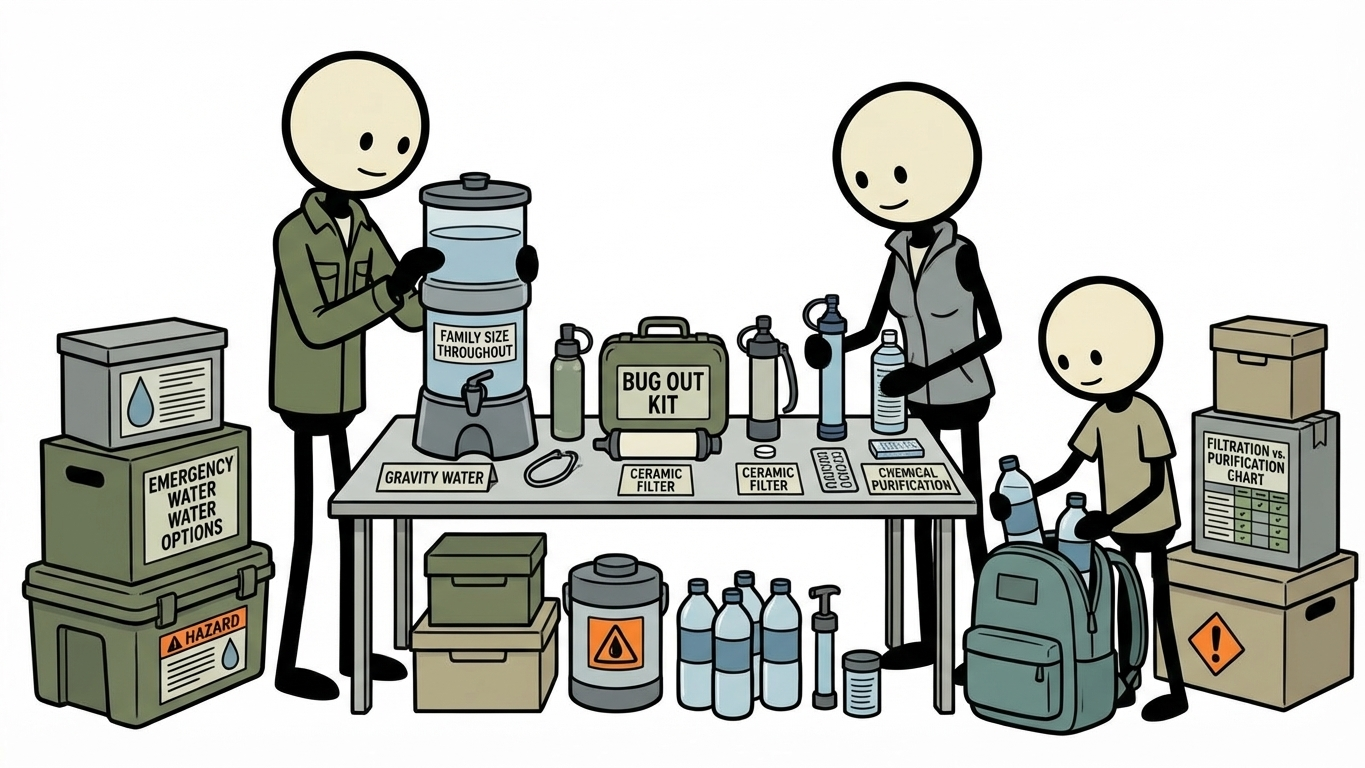
When sheltering in place during a prolonged utility outage, your primary concern is volume. A family of four requires an absolute minimum of four gallons of water per day just to survive, but realistically, you will need closer to 10 to 12 gallons daily to accommodate basic hygiene, cooking, and sanitation. Hand-pumping water for an entire family is exhausting and inefficient. For home use, you need a high-capacity system that operates passively.
The Gravity Water Filter
For household preparedness, a gravity water filter is widely considered the gold standard. These systems consist of two stacked stainless steel or durable plastic chambers. You pour dirty water into the top chamber, and gravity slowly pulls it down through dense filter elements into the bottom chamber, where it is stored safely until you open the spigot.
The beauty of a gravity water filter lies in its passive operation. It requires no electricity, no manual pumping, and no water pressure. You simply fill it and walk away. Leading brands utilize advanced ceramic or compressed carbon block filters that not only remove bacteria and protozoa but also absorb heavy metals, volatile organic compounds (VOCs), and chlorine.
When selecting the best emergency water filter for your home, consider the holding capacity and the flow rate. A system with a 2.25-gallon to 3-gallon capacity is generally ideal for a standard family. Depending on the number of filter elements installed in the upper chamber, these units can process anywhere from 1 to 4 gallons per hour. This throughput is more than sufficient to keep a family hydrated and clean without constant monitoring.
Filter Lifespan and Maintenance
Another major advantage of gravity-fed systems is their longevity. High-quality carbon or ceramic elements can often filter thousands of gallons of water before needing replacement. For example, a set of premium black carbon filters can last for up to 6,000 gallons. For a family consuming 10 gallons a day, that equates to over a year and a half of continuous, safe water.
Maintenance is straightforward but vital. Over time, sediment and particulate matter will clog the microscopic pores of the filter elements, slowing the flow rate to a trickle. When this happens, the elements can be removed and gently scrubbed under running water with a scouring pad to expose a fresh layer of pores, instantly restoring the flow rate. This field-maintainability makes them an exceptional disaster water filter for long-term grid-down scenarios.
Bug Out Kits: Portable and Mobile Filtration
If a disaster forces you to evacuate your home, a bulky stainless steel gravity filter is not practical. Your bug out bag requires water processing tools that are lightweight, durable, and capable of providing immediate access to safe drinking water while on the move. Mobile filtration falls into three primary categories: pump filters, squeeze filters, and straw filters.
Squeeze Filters: The Modern Standard
In recent years, hollow fiber membrane squeeze filters have revolutionized portable water processing. These devices are incredibly light (often weighing less than 3 ounces) and screw directly onto standard disposable water bottles or included heavy-duty pouches. You fill the pouch with dirty water, attach the filter, and squeeze the clean water into a clean vessel or directly into your mouth.
For those looking for a robust Lifestraw alternative, squeeze filters are vastly superior for bug out bags. While standard survival straws require you to lay on your stomach and suck water directly from a puddle—making it impossible to transport clean water with you—a squeeze filter allows you to process large batches of water to fill your canteens and hydration bladders for the journey ahead. Models from brands like Sawyer and Katadyn offer impressive flow rates of up to 1 liter per minute and boast lifespans of up to 100,000 gallons if properly backflushed.
Pump Filters
While slightly heavier and bulkier than squeeze filters, mechanical pump filters have a distinct advantage in specific environments. A pump filter utilizes a hose with a pre-filter float that you drop into the water source. By manually pumping a handle, you force water through an internal ceramic or fiberglass element and out through an output hose into your canteen.
Pump filters are exceptional when dealing with shallow, hard-to-reach water sources. If your only water source is a thin puddle in a rocky crevice, it can be nearly impossible to submerge a squeeze pouch to fill it. A pump filter’s intake hose can be dropped into an inch of water, allowing you to extract life-saving hydration from sources that other filters cannot utilize. Furthermore, many pump filters feature carbon cores that improve the taste of stagnant water, which is a significant psychological boost during a stressful evacuation.
Water Purification for Emergencies: Defeating Viruses
As established, physical filtration is only half the battle when dealing with floodwaters or compromised municipal sewage. To ensure your family is safe from waterborne viruses, you must incorporate purification methods into your emergency plans. These methods are essential backups for your primary filtration systems.
Chemical Purification
Chemical treatments are inexpensive, take up virtually no space in a bug out bag, and are highly effective against viruses and bacteria. Historically, iodine tablets were the standard for survival kits. However, iodine leaves a strong, unpleasant chemical taste in the water and is ineffective against Cryptosporidium, a particularly resilient protozoan with a hard outer shell.
Today, chlorine dioxide is the chemical treatment of choice for emergency responders and survivalists. Chlorine dioxide is a powerful oxidizer that effectively destroys bacteria, viruses, and even Cryptosporidium, without leaving the harsh taste associated with iodine. It is available in liquid drops (which require mixing a two-part solution) or convenient foil-wrapped tablets. The primary drawback of chemical purification is time; while viruses and bacteria are neutralized quickly, it can take up to four hours for chlorine dioxide to fully penetrate and destroy cold-water Cryptosporidium.
In a true household emergency where commercial tablets run out, standard unscented household bleach can be used, as recommended by the CDC and FEMA. You must use regular, unscented liquid bleach containing 5.25% to 8.25% sodium hypochlorite. The CDC protocol dictates adding 2 drops of bleach per quart (or liter) of water, stirring well, and letting it sit for 30 minutes. If the water does not have a slight bleach odor after 30 minutes, repeat the dose and wait another 15 minutes. While this method kills viruses and bacteria, it does not kill Cryptosporidium, making it a secondary option to boiling or chlorine dioxide.
Ultraviolet (UV) Purification
Ultraviolet light technology offers a rapid, chemical-free method of water purification for emergencies. UV purifiers are small, battery-operated, pen-like devices that you stir in a container of water. The UV-C light scrambles the DNA and RNA of bacteria, protozoa, and viruses, rendering them unable to reproduce and harmless to human digestion.
UV purification is incredibly fast, often treating a liter of water in just 90 seconds. It leaves no chemical taste and requires no waiting period. However, UV light has a critical limitation: it relies on clear water. If the water is murky, turbid, or filled with suspended silt, the pathogens can "hide" behind the particles in the shadows of the UV light, surviving the treatment. Therefore, UV purifiers must be used in conjunction with a physical filter or after the water has been thoroughly clarified.
The Gold Standard: Boiling
When in doubt, fire is your most reliable ally. Boiling is the most foolproof method of water purification. The American Red Cross and the CDC confirm that bringing water to a rolling boil for 1 full minute will kill all bacteria, protozoa, and viruses. If you are at an elevation above 6,500 feet, water boils at a lower temperature, so you must extend the boiling time to 3 minutes.
While boiling is 100% effective against biological pathogens, it is resource-intensive. It requires fuel—whether that is propane, butane, or scavenged firewood—and time to cool before consumption. In a long-term grid-down scenario, fuel conservation is critical, meaning boiling should be utilized strategically rather than as your sole source of daily water processing.
Addressing Chemical Contaminants and Heavy Metals
Biological threats are the most immediate cause of acute illness, but chemical contaminants pose a severe, insidious threat during widespread disasters. The USGS and NOAA have extensively documented the aftermath of major hurricanes and floods, noting that floodwaters routinely breach industrial sites, gas stations, agricultural chemical storage, and municipal waste facilities.
If you are forced to source water from urban runoff or flooded residential areas, standard hollow-fiber micro-filters will not protect you. Micro-filters cannot trap dissolved chemicals, pesticides, herbicides, or heavy metals like lead and mercury. To combat these threats, you must utilize activated carbon filtration.
Activated carbon works through a process called adsorption. The carbon is treated to be incredibly porous, creating a massive surface area. As water passes through, chemical molecules and heavy metal ions become trapped within the microscopic pores of the carbon. This is why the best emergency water filter for home use—such as a high-end gravity water filter—incorporates dense carbon blocks.
For mobile bug out kits, look for specialized portable filters that include an integrated carbon stage or an attachable carbon secondary filter. Be aware that carbon filters have a much shorter lifespan than ceramic or hollow-fiber elements. Once the carbon pores are filled with contaminants, the filter can no longer adsorb chemicals and must be replaced. Always stock replacement carbon elements in your emergency supplies.
Creating a Layered Family Water Strategy
Relying on a single piece of equipment is a dangerous gamble in emergency preparedness. Equipment breaks, filters clog, and batteries die. A resilient family requires a layered water strategy that combines multiple methods to handle any scenario. This concept is known as multi-stage water processing.
Imagine a scenario where a severe storm knocks out the municipal water supply, and your only accessible water source is a muddy, stagnant decorative pond in your neighborhood. Running this water directly through your premium gravity water filter will instantly clog the expensive ceramic elements with mud and algae. Instead, you must layer your approach:
- Stage 1: Pre-filtration (Clarification). First, collect the dirty water in a bucket. Pour it through a dense cotton cloth, a coffee filter, or a clean bandana into a second bucket. This removes large debris, leaves, insects, and heavy mud. Alternatively, let the water sit undisturbed for a few hours so the heavy silt settles to the bottom, then carefully scoop the clear water off the top.
- Stage 2: Micro-filtration. Now that the water is visually clear, process it through your primary disaster water filter (like your gravity filter or a pump filter). This stage physically removes the invisible bacteria and protozoa, as well as dissolved chemicals if a carbon element is present.
- Stage 3: Purification. Because the water came from an urban environment with potential sewage runoff, you must assume viral contamination. Treat the filtered water with chlorine dioxide tablets or a UV purifier to neutralize any remaining viruses.
By layering these techniques, you protect your expensive filter elements from premature failure, ensure the water tastes clean, and guarantee that it is 100% biologically safe for your family to consume.
Maintenance, Lifespan, and Winter Storage
Procuring the best emergency water filter is only the first step; maintaining it ensures it will actually work when the crisis strikes. Improper storage is the leading cause of filter failure among survivalists.
Hollow fiber membranes and ceramic filters are highly susceptible to freeze damage. When you use a filter, microscopic droplets of water remain trapped inside the pores. If you store that filter in the trunk of your car or an unheated garage during winter, those water droplets will freeze and expand. This expansion micro-fractures the ceramic or tears the hollow fibers. The damage is completely invisible to the naked eye, but it allows dangerous pathogens to pass straight through the filter.
If you live in a cold climate, always store your water filters inside your climate-controlled home. If you are bugging out in freezing temperatures, keep your portable squeeze or pump filter inside your jacket, close to your body heat, to prevent it from freezing between uses.
Additionally, filters must be thoroughly dried before long-term storage to prevent mold and mildew growth. After testing or using your filter, backflush it with clean water, shake out the excess moisture, and leave it in a warm, dry place with good airflow for several days before sealing it away in your emergency kit.
Empowering Your Household for the Unexpected
Water independence is the absolute foundation of emergency preparedness. While the fragility of our modern infrastructure can seem daunting, securing your family’s water supply is a highly solvable problem. By understanding the critical differences between filtration and purification, and by investing in the right mix of high-capacity gravity filters for your home and mobile systems for your bug out bags, you strip away the vulnerability of utility dependence.
You do not need to live in fear of the next grid failure or boil water advisory. With a layered strategy, a stockpile of chemical purifiers, and a solid understanding of CDC and FEMA protocols, you have the power to transform virtually any water source into safe, life-sustaining hydration. Take stock of your current supplies, address the gaps in your viral purification and chemical filtration, and build a water resilient household that can weather any storm.
Learn comprehensive water treatment through our water and food storage guide. Review water purification in our emergency water storage guide. Use our water calculator to determine quantities. Build emergency kits with our go-bag builder. Master water safety through our preparedness courses.
Frequently Asked Questions
How much water should I store per person?
Store at least 1 gallon per person per day for drinking and minimal hygiene, and more in hot climates.
How often should stored water be rotated?
Commercial sealed water can last longer, but rotating every 6 to 12 months keeps quality high and your routine simple.
Is boiling enough to make water safe?
Boiling is effective against most pathogens but does not remove chemical contamination. Use filtration and source awareness too.
What is the best emergency water filter type for families?
Gravity filters are usually best for households because they process larger volumes with low effort and no electricity.
Can I drink pool water in an emergency?
Only after proper treatment and with caution. Pool chemicals and contaminants require correct filtration and disinfection.
Sources & Further Reading
Related resource: Bug-Out 101 Course.
Related resource: Bug-Out Evacuation Guide.