⚡ Key Facts: Evaluating Power Stations Beyond the Discount Tag
- Usable Capacity vs. Nameplate Rating: A power station rated at 1,000 watt-hours (Wh) rarely delivers 1,000 Wh of AC power; internal depth-of-discharge buffers and inverter conversion losses reduce real-world output by 15% to 25%.
- Battery Chemistry Longevity: Lithium Iron Phosphate (LiFePO4/LFP) cells retain 80% capacity after 3,000 to 4,000 full cycles, whereas older Nickel Manganese Cobalt (NMC) chemistries degrade after just 500 to 800 cycles.
- The "Phantom Load" Trap: Large inverters consume between 15 and 45 watts per hour simply being powered on, which can exhaust a portable power station overnight even if the attached appliance draws almost nothing.
- Grid Vulnerability Metrics: According to the Department of Energy (DOE) and the North American Electric Reliability Corporation (NERC), weather-related blackouts have doubled over the past two decades, making reliable off-grid storage an essential baseline utility.
- Holiday Clearance Warnings: Retailers frequently slash prices by 40% to 50% during Black Friday on legacy NMC units to deplete backlogged stock before newer, safer, long-cycle LFP models fully replace them.
According to the National Oceanic and Atmospheric Administration (NOAA), the United States experienced an unprecedented frequency of billion-dollar weather disasters in recent years, leaving millions of homes without municipal grid service for days or weeks. When severe winter storms, atmospheric rivers, or late-season hurricanes knock out electrical substations, a battery is not a novelty gadget—it is critical infrastructure. Yet, as November arrives, marketing departments flood retail channels with frantic promotions designed to hijack your buying decisions. Sorting through seasonal retail events requires setting aside high-contrast promotional banners and analyzing the underlying engineering: cell chemistry, thermal performance, and inverter efficiency. For the practical checklist side, use the community emergency preparedness guide.
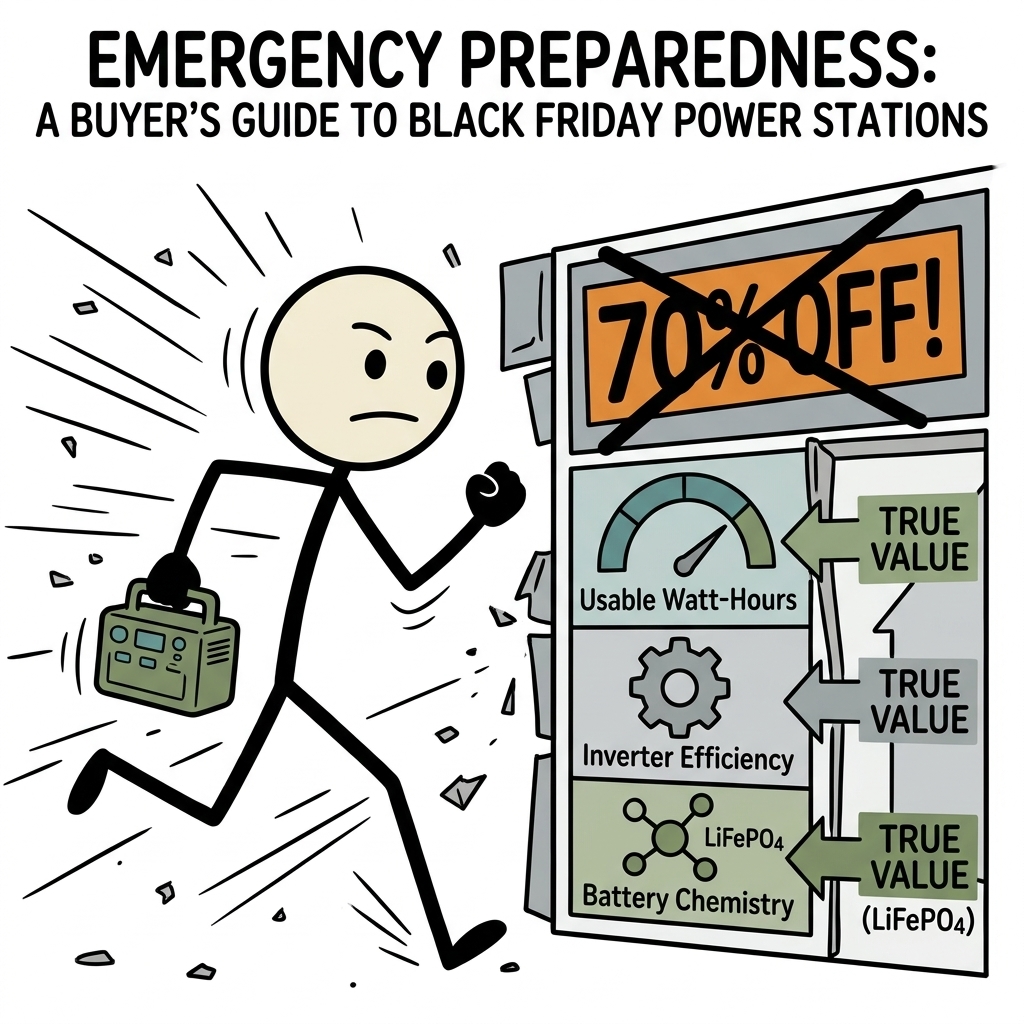
The Holiday Discount Illusion: Why 50% Off Can Be an Expensive Mistake
Every holiday shopping season, online marketplaces and direct-to-consumer websites spotlight dramatic price cuts. You will see banners trumpeting hundreds of dollars off original list prices, framed as the ultimate solar generator Black Friday event. To make an informed, safety-critical investment, you must first recognize the retail mechanics driving these promotions.
Many seasonal markdowns rely on reference pricing manipulation. Manufacturers list a newly launched product at an inflated, artificial Manufacturer's Suggested Retail Price (MSRP) for a brief window, only to drop it back to standard market value during holiday promotional periods. The consumer registers a massive discount percentage, but the financial transaction reflects ordinary retail value. In emergency preparedness, this psychological anchoring is dangerous because it leads buyers to choose a battery based on perceived savings rather than operational capabilities.
Even more critical is product obsolescence clearing. Portable power station engineering has evolved rapidly. Over the past three years, the industry shifted decisively away from volatile, shorter-lived cell chemistries toward heavy-duty commercial-grade cells. Retailers use seasonal sales events to empty warehouse shelves of discontinued models. If you buy a discontinued unit, you may save upfront cash, but you are often purchasing degraded inventory that has rested in unconditioned logistics warehouses for months, with no long-term firmware updates or replacement parts available.
Demystifying Usable Battery Capacity: The Physics Behind the Spec Sheet
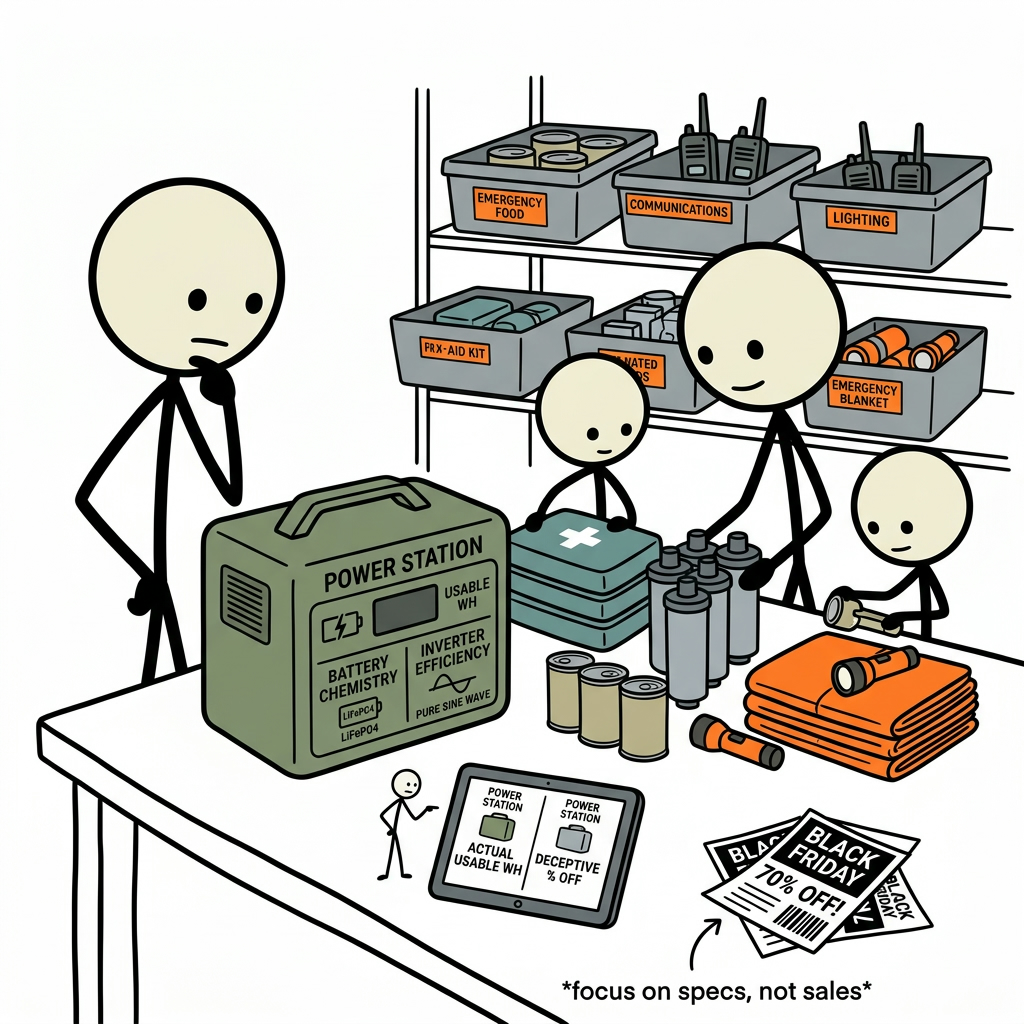
When selecting the best portable power station for emergencies, the most prominent number on the chassis is its nameplate watt-hour (Wh) rating. A 1,000 Wh unit suggests it can deliver 1,000 watts of sustained energy for one hour, or 100 watts for ten hours. In real-world Survival Scenarioss, this mathematical directness does not match operating realities.
The energy stored chemically within individual lithium cells cannot be extracted with 100% efficiency. To calculate true usable battery capacity, you must account for the mechanical realities of the Battery Management System (BMS) and the electrical conversion path. Two distinct loss factors dictate your actual emergency runtime: Depth of Discharge (DoD) margins and DC-to-AC inverter conversion losses.
The Usable Energy Formula
To establish how much power will actually enter your appliances, family emergency planners use a standard calculation:
Actual Usable Wh = Nameplate Wh × Depth of Discharge (DoD) × Inverter Conversion Efficiency
Every modern, high-grade power station integrates a BMS designed to prevent individual cells from discharging to a true zero-volt state, which permanently damages lithium structures. Most manufacturers cap the Depth of Discharge between 90% and 95%. Consequently, on an advertised 1,000 Wh station, 50 to 100 Wh of stored energy is kept permanently in reserve to protect cell health.
Inverter Conversion and Parasitic Losses
Energy in the battery cells is stored as Direct Current (DC). The standard wall plugs (NEMA 5-15R) on the front panel must output 120-volt Alternating Current (AC). This requires an internal inverter, which generates heat during conversion. High-tier pure sine wave inverters operate at roughly 85% to 90% electrical efficiency under optimal loads.
Applying this formula to that theoretical 1,000 Wh station reveals the performance gap:
- Nameplate Capacity: 1,000 Wh
- Available after DoD Buffer (90%): 900 Wh
- Delivered after Inverter Losses (88% efficiency): 792 Wh
In practice, a 1,000 Wh power station reliably delivers between 750 and 800 watt-hours of alternating current. If you size your emergency medical devices, critical emergency communication plan equipment, or refrigeration systems against the number printed on the outer casing, you will encounter unexpected shutdowns during prolonged power outages.
Additionally, small loads reveal the problem of inverter idle consumption, commonly called parasitic draw. Keeping an internal 2,000-watt inverter switched on requires energy to power its internal cooling fans, logic boards, and voltage transformers. If you plug in a 10-watt mobile phone charger, the inverter itself may consume 25 to 35 watts simply running the conversion circuitry. In an emergency, always run low-draw devices from native 12V DC barrel ports or USB connections to bypass the inverter entirely.
Battery Chemistry Breakdown: LiFePO4 vs. NMC
The single most critical technical factor when shopping Black Friday power station deals is cell chemistry. The portable power market relies on two primary formulations: Lithium Iron Phosphate (LiFePO4, or LFP) and Nickel Manganese Cobalt (Li-NiMnCo, or NMC). In an emergency preparedness framework, these two chemistries serve completely different operational profiles.
Cycle Life and Economic Durability
LFP chemistry provides unmatched cycle longevity. A cycle represents draining a battery from 100% to zero and recharging it back to full. High-grade LiFePO4 cells are rated for 3,000 to 4,000 full discharge cycles before their total storage capacity degrades to 80% of its factory rating. If you cycled an LFP station once every single day, it would take nearly a decade to reach that threshold.
By contrast, legacy NMC chemistry typically offers a service life of 500 to 800 cycles to 80% capacity. While NMC remains common in smartphones and electric vehicles where minimum weight is the governing constraint, it is less suited for long-term home resilience. A deeply discounted NMC unit may show performance degradation within two to three years of routine testing and cycling.
Thermal Stability and Safe Indoor Operation
The Federal Emergency Management Agency (FEMA) and the Centers for Disease Control and Prevention (CDC) consistently warn against running combustion generators indoors, on balconies, or near open windows due to carbon monoxide poisoning risks. Portable power stations offer safe indoor operation because they produce zero direct emissions. However, battery thermal dynamics still require close examination.
LiFePO4 chemistry features a much higher thermal runaway threshold (approximately 270°C / 518°F) compared to NMC (approximately 150°C to 210°C / 302°F to 410°F). The chemical bonds in iron phosphate are fundamentally more stable under physical puncture, extreme electrical overcharging, or elevated ambient temperatures. If you must store and operate high-capacity electrical storage inside living areas, LFP provides a wider thermal safety margin.
| Performance Metric | LiFePO4 (LFP) | NMC (Ternary Lithium) |
|---|---|---|
| Cycle Life (to 80% Capacity) | 3,000 – 4,000+ cycles | 500 – 800 cycles |
| Thermal Runaway Point | ~270°C (518°F) | ~150°C – 210°C (302°F – 410°F) |
| Energy Density (Weight to Power) | Moderate (heavier per Wh) | High (lighter per Wh) |
| Cold Weather Charging Floor | 0°C (32°F) strictly enforced | 0°C (32°F) strictly enforced |
| Typical Calendar Lifespan | 10 – 15 years | 3 – 5 years |
The primary tradeoff is weight. LFP cells are roughly 20% to 30% heavier than NMC equivalents with identical capacity. For an emergency backup power deployment intended for home sheltering, mobility within the house, or vehicle-supported evacuations, the added mass of LFP is well worth its tenfold operational lifespan and superior thermal stability.
Inverter Architecture: Pure Sine Wave vs. Modified Sine Wave
A battery station is only as functional as its power delivery mechanism. The inverter converts the low-voltage DC energy from the internal cells into standard utility-grade electricity. Never invest in a power station that lacks a verified Pure Sine Wave inverter.
Alternating current supplied by the municipal power grid shifts smoothly between positive and negative potentials, producing a uniform, undulating wave. Pure sine wave inverters replicate this wave profile using high-frequency pulse-width modulation. Cheaper, off-brand backup supplies often cut manufacturing costs by utilizing modified sine wave (or "square wave") inverters.
Sensitive medical hardware, such as Continuous Positive Airway Pressure (CPAP) blowers, oxygen concentrators, and portable dialysis monitors, can fail or trigger error codes on modified sine wave systems. Modern household refrigeration compressors, variable-speed fan motors, and high-efficiency furnace blowers run hotter, buzz loudly, and can suffer premature electrical burnout when driven by modified sine waves. Verify that every port provides true pure sine output under load.
Continuous Wattage vs. Surge Overhead
Equipment containing electrical inductors, compressors, or pumps requires substantially more power during startup than while running steadily. This is known as the inrush current or surge requirement.
A residential refrigerator might draw only 120 to 180 continuous running watts once its cycle stabilizes. However, the exact moment the cooling compressor engages, it demands an initial surge of 800 to 1,200 watts for a fraction of a second. If your station provides 600 watts of continuous output with an 800-watt surge ceiling, the compressor's startup demand will trip the station's internal overload breakers, cutting power instantly.
When selecting a power station for domestic emergency survival, aim for an inverter whose continuous wattage output exceeds the running requirements of your combined appliances by at least 30%, with a momentary peak surge capacity double its continuous baseline.
Real-World Triage: Sizing Emergency Backup Power for Critical Loads
The American Red Cross advises households to maintain supplies capable of sustaining shelter-in-place operations for a minimum of three to seven days, depending on local geography. Electrical energy must be prioritized through cold-eyed triage: life safety first, environmental protection second, communication third, and comfort last.
Evaluating potential hardware purchases means compiling a realistic power budget based on real-world consumption rather than peak ratings.
1. Life Safety: Medical Equipment
For individuals relying on a CPAP device, running out of power is an immediate health crisis. A standard CPAP machine uses roughly 30 to 60 watts if the heated humidifier and heated tubing are turned off. Over an eight-hour sleep cycle, that equals roughly 240 to 480 Wh. If the heated humidifier remains activated, consumption can jump to over 100 watts per hour, draining an 800 Wh station in a single night. A prepared household plans for unheated operation to stretch available battery storage.
2. Food Safety: Residential Refrigeration
The CDC states that a sealed refrigerator will safely keep food cold for up to four hours during a power failure, after which temperatures rise above safe storage levels (40°F / 4°C), risking rapid bacterial growth. A modern 18 to 22 cubic-foot refrigerator averages roughly 1,000 to 1,500 Wh over a 24-hour period, depending on ambient room temperature and how often the door is opened. To sustain refrigeration across a multi-day grid failure without supplemental generation, a home requires at least 2,000 Wh of storage capacity dedicated solely to food preservation.
3. Critical Communications and Information
Recharging smartphones, powering an optical network terminal (ONT) and home Wi-Fi router, and charging NOAA emergency weather radios demands comparatively little power:
- Smartphones: 10 to 15 Wh per complete charge cycle.
- Mesh Wi-Fi Router / Fiber ONT: 12 to 20 continuous watts (approx. 280 to 480 Wh daily).
- Emergency GMRS / Ham Radio Handheld: 10 to 18 Wh per complete charge cycle.
A mid-sized 500 Wh power station running exclusively DC loads can keep a household’s baseline communication infrastructure online for two to three days without requiring external recharge inputs.
Solar Generator Black Friday Bundles: The Input Math
A battery storage unit without an energy input path is merely a temporary buffer. True resilience requires the ability to capture energy off-grid. November retailers frequently market complete "solar generators," which package a portable power station alongside matching foldable photovoltaic arrays. Evaluating these bundles requires looking closely at input hardware limitations.
MPPT vs. PWM Charge Controllers
Never purchase a solar generator setup that utilizes a Pulse Width Modulation (PWM) solar charge controller. Modern emergency setups require Maximum Power Point Tracking (MPPT). MPPT controllers dynamically adjust voltage and current characteristics to pull the maximum possible wattage out of the panels under fluctuating sunlight, operating at 95% to 98% efficiency compared to the 70% to 75% typical of basic PWM units.
Winter Irradiance Realities
November holiday purchases arrive at the winter solstice, the period of the lowest solar irradiance in the Northern Hemisphere. If an ice storm collapses your local grid in January, a 200-watt solar panel will not generate 200 watts. Factoring in low solar angles, heavy cloud cover, and seasonal haze, real production rarely exceeds 50% to 70% of panel ratings, limited to just 2.5 to 4 "peak sun hours" per day.
Consider this real-world recharging equation for a common winter storm scenario:
- Battery Storage: 1,000 Wh depleted unit
- Panel Rating: 200-watt theoretical nameplate
- Real-World Winter Performance Factor: 60% (generating ~120 watts actual output)
- Available Peak Sun Hours: 3 hours of direct exposure
- Total Daily Energy Harvested: 120W × 3 hours = 360 Wh
In this common winter scenario, that 200-watt panel covers only about a third of the battery's total capacity each day. If your survival plan depends on renewable energy to sustain life-support systems or basic emergency food storage guide through extended winter blackouts, your solar array's rated wattage must substantially exceed your daily electrical consumption.
DC Input Ceilings: Voltage and Amperage Caps
Always inspect the solar input limits of the power station's internal charge controller before buying solar panels. Pay particular attention to:
- Maximum Open Circuit Voltage (Voc): Exceeding this input voltage will trigger protective shutoffs or permanently fry the controller's input circuitry. Cold winter air actually causes solar panel voltage to rise above factory ratings.
- Maximum Amperage Limit: If your station caps solar input current at 10 amps, pairing it with panels capable of outputting 16 amps will simply waste the extra current.
The Emergency Preparedness Buyer's Scorecard
Before entering payment information during seasonal sales, run the candidate power system through this practical checklist to separate dependable emergency equipment from short-lived lifestyle electronics.
- Cell Chemistry Verification: Is the internal pack explicitly specified as Lithium Iron Phosphate (LiFePO4/LFP)? If the technical manual merely says "Lithium-Ion," it is almost always older, lower-cycle NMC chemistry.
- True Uninterruptible Power Supply (UPS) Functionality: Can the unit remain plugged between the wall outlet and critical equipment without battery degradation? Look for a switchover transfer speed below 20 milliseconds, which prevents CPAP machines and home networks from restarting during sudden dropouts.
- Sub-Zero Battery Temperature Safeguards: Attempting to charge any lithium-based battery below freezing (0°C / 32°F) causes irreversible metallic lithium plating, permanently destroying the pack and creating a fire hazard. Ensure the station's BMS features low-temperature charging cutoff sensors, or choose an advanced system with built-in warming pads.
- Expandable Storage Options: Does the architecture support daisy-chaining extra battery expansion packs via external DC ports? Scalable systems allow you to increase total capacity as your needs grow without paying for redundant inverters.
- AC Fast Charging and Generator Support: When your municipal grid flickers back on for just two hours, or if you run a neighbor's gas generator briefly, can the battery recharge rapidly? Modern units should safely absorb an 80% charge from an AC wall outlet within 60 to 90 minutes.
Investing in Resilience Over Percentages
Navigating holiday sales events requires stripping away promotional hype and evaluating hardware with the objective clarity of an engineer. High-percentage discounts mean very little if a portable power station fails to cycle your refrigerator's compressor, trips its safety breakers under light continuous loads, or loses half its storage capacity after a few years of storage. True emergency backup power is defined by reliable battery chemistry, pure sine wave power delivery, and balanced input charging.
As you assess seasonal discounts, look closely at the specifications. Sizing your system around true usable watt-hours, choosing durable LiFePO4 cells, and ensuring clear compatibility with your home's most essential equipment turns a speculative holiday purchase into an enduring piece of survival infrastructure. Prepare your home with purpose, build around proven physics, and establish an off-grid energy reserve you can depend on when the lights go out.
Frequently Asked Questions
How do I calculate the actual usable capacity of a portable power station?
Multiply the advertised watt-hour (Wh) rating by 0.85 to account for inverter conversion inefficiency and depth-of-discharge buffers. A 1,000Wh battery generally yields approximately 800 to 850Wh of actual usable power for AC-connected appliances.
Why is LiFePO4 battery chemistry preferred over standard lithium-ion for emergency prep?
Lithium Iron Phosphate (LiFePO4/LFP) cells offer 2,500 to 3,500+ charge cycles to 80% capacity compared to 500 to 800 cycles for traditional NMC chemistries, providing a decade-long shelf life, greater thermal stability, and reduced fire risk during storage.
What is the difference between continuous wattage and surge wattage?
Continuous wattage is the sustained power a station delivers safely, while surge (peak) wattage handles the brief 2–3x power spike required to start inductive loads like refrigerator compressors, sump pumps, and power tools.
How do I determine if a power station can safely run sensitive medical devices like a CPAP?
Ensure the power station features a Pure Sine Wave inverter, which prevents electrical hum and component damage in sensitive electronics, and look for dedicated 12V DC ports, which run CPAP machines up to 30% longer than AC wall plugs by skipping the DC-to-AC conversion.
Why does recharge input speed matter more than discount pricing during an emergency?
During rolling blackouts or intermittent grid recovery, a unit with 1,200W+ AC fast-charging can replenish from 0% to 80% in under an hour, whereas cheaper, slower-charging stations may take 6 to 8 hours to recharge before the power cuts out again.
Sources & Further Reading
- Ready.gov - Power Outages Preparedness
- U.S. Department of Energy - Estimating Appliance and Home Electronic Energy Use
- Federal Emergency Management Agency (FEMA) - Emergency Power Planning Fact Sheet
- American Red Cross - Power Outage Safety Guidelines
- Centers for Disease Control and Prevention - Safety Guidelines for Power Outages