⚡ Key Facts
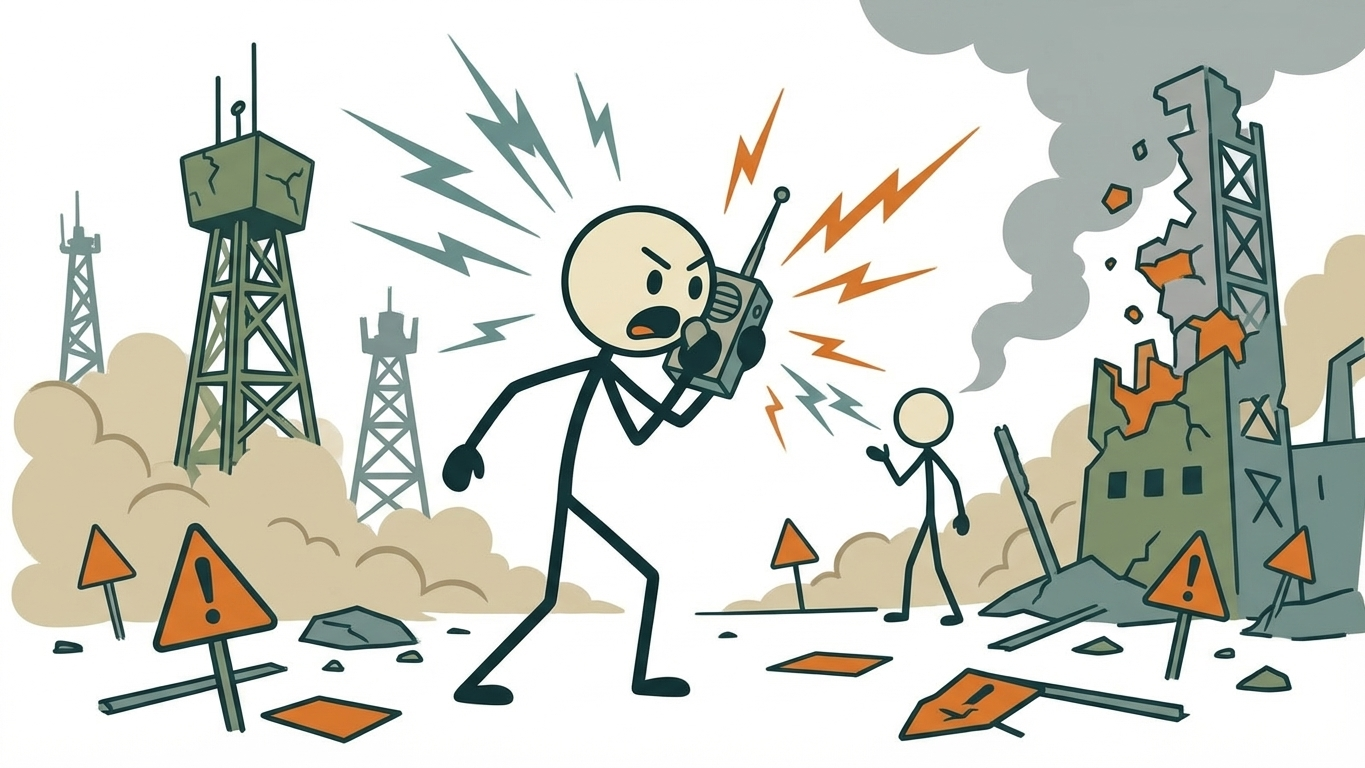
- Cell Towers Are Vulnerable: According to the Federal Communications Commission (FCC), cell towers typically only have 4 to 8 hours of battery backup power during a grid outage.
- Text Over Voice: The Federal Emergency Management Agency (FEMA) advises that text messages use significantly less network bandwidth than voice calls, making them far more likely to transmit successfully during network congestion.
- The Out-of-State Strategy: The American Red Cross highly recommends designating an out-of-area contact, as local phone lines and cellular networks are often overwhelmed or destroyed within the immediate disaster zone.
- Planning Gaps: FEMA’s National Household Survey reveals that nearly half of all American adults do not have a documented family communication plan in place for emergencies.
- Alternative Tech Saves Lives: During major natural disasters like Hurricane Katrina and the Maui wildfires, amateur (ham) radio operators and satellite messengers provided critical communication lifelines when all traditional infrastructure collapsed.
Make the First Three Days Concrete
Your communication plan should work for the same initial window as your water, food, light, and medicines. Start with the 72-hour emergency preparedness rule and choose check-in times, meeting places, and offline contact details for those first three days.
Emergency Walkie-Talkie Channels and Radio Frequencies
Before buying radios, agree on an emergency walkie-talkie channel, a check-in time, and simple call signs for your household. There is no single universal emergency channel for every situation, so use the FRS, GMRS, and ham radio frequency guide to understand the legal channels, licensing rules, and realistic range before making a plan.
Imagine reaching for your smartphone in the immediate aftermath of a severe earthquake, a rapidly approaching wildfire, or a devastating hurricane. You need to check on your spouse, find out if your children’s school is evacuating, and let your parents know you are safe. But when you look at the screen, you see the dreaded "No Service" indicator. The illusion of constant connectivity shatters in an instant. This is a terrifying scenario, but it is also a highly predictable one. When disaster strikes, modern communication infrastructure is often the first system to fail. For a step-by-step template, see family emergency plan template. For a deeper field checklist, the urban grid-down communications course walks through backup comms, navigation, and security when normal networks fail.
For a broader playbook, use our community emergency preparedness guide to turn these steps into a practical plan.
In our hyper-connected world, we have outsourced our peace of mind to cellular networks and Wi-Fi routers. We assume we can reach anyone, anywhere, at a moment's notice. However, true preparedness requires acknowledging the fragility of these systems and building robust redundancies. An effective emergency communication plan is not just a list of phone numbers; it is a comprehensive strategy that dictates how your family will share critical information when standard methods evaporate. For a step-by-step template, see scenario playbooks. For a quick definition, see comms plan.
Developing a resilient family communication plan emergency protocol empowers you to take control of the chaos. By understanding why networks fail, mastering the rules of disaster communication, and investing in alternative off-grid communication tools, you can ensure that your family remains connected when it matters most. Preparedness is not about fear; it is about replacing panic with actionable, reliable systems. For a step-by-step template, see supply calculator.
The Illusion of Constant Connectivity: Why Cell Networks Fail
To build an effective emergency communication plan, you must first understand the vulnerabilities of the systems you rely on daily. Cellular networks are modern engineering marvels, but they are incredibly fragile when subjected to the extreme stresses of a natural disaster. The failure of these networks usually comes down to three primary factors: power loss, physical damage, and network congestion. For a step-by-step template, see water storage calculator.
The Power Grid Dependency
Cellular towers do not operate in a vacuum; they are entirely dependent on the local electrical grid. When a severe storm or earthquake knocks out power to a region, cell towers automatically switch to backup power systems. According to the FCC, these backups are typically composed of lead-acid batteries that provide a mere 4 to 8 hours of operation. Some critical towers are equipped with diesel or propane generators, but these rely on passable roads for fuel deliveries. If a blizzard or flood blocks Supply Calculator routes, those generators will eventually run dry, taking the network down with them. For a step-by-step template, see go-bag essentials checklist.
Physical Destruction of Infrastructure
Disasters do not respect infrastructure. Hurricanes, tornadoes, and wildfires frequently cause catastrophic physical damage to communication hardware. The United States Geological Survey (USGS) and NOAA frequently document the destruction of cell towers, fiber-optic cables, and switching stations following major environmental events. High winds can snap tower masts, wildfires can melt underground fiber-optic lines, and floods can submerge critical electrical components. When the hardware itself is destroyed, no amount of backup power will restore your signal.
The Bottleneck of Network Congestion
Even if a cell tower survives a disaster and maintains power, it can still become functionally useless due to network congestion. Cellular networks are designed to handle average daily traffic, not the sudden, massive spike of every single person in a city trying to make a phone call simultaneously. When a disaster occurs, human instinct drives us to immediately call our loved ones. This sudden surge overloads the network's bandwidth. The system becomes bottlenecked, resulting in fast busy signals, dropped calls, and the inability to connect. This congestion can last for hours or even days as emergency responders and civilians vie for the same limited bandwidth.
The Golden Rule of Disaster Communication: Text Instead of Call
When you are caught in an emergency and find that your phone still has a faint signal, your immediate instinct will likely be to dial a loved one's number. You must resist this urge. The golden rule of disaster communication, echoed by FEMA, the FCC, and emergency management agencies worldwide, is simple: text, do not call.
The Technical Advantage of Texting
The reason for this rule lies in how data is transmitted across cellular networks. Voice calls require a dedicated, continuous, and relatively wide channel of bandwidth to remain open for the duration of the conversation. If the network is congested, there simply isn't enough space to open or maintain that channel, resulting in a failed call.
Text messages (SMS), on the other hand, use a fraction of the bandwidth. More importantly, text messages operate on a "packet-switched" system. They are broken down into tiny packets of data that can slip through microscopic gaps in network traffic. If a cell tower is overwhelmed, a text message will queue in the system and automatically send the millisecond a sliver of bandwidth becomes available. A call requires a sustained connection; a text only requires a momentary one.
Best Practices for Emergency Texting
When sending a text during a crisis, efficiency is paramount. You want to convey the maximum amount of critical information in the shortest possible message to ensure it transmits easily and doesn't drain your phone's battery. Keep your messages brief, factual, and actionable.
- Include Time and Date: Network delays can cause texts to arrive hours after they were sent. Always start your message with the current time (e.g., "10:15 AM Tuesday").
- State Your Status and Location: Be precise. "10:15 AM. We are safe. Sheltering in the basement. House is intact."
- Outline Your Next Steps: Let your contact know what you are doing next so they aren't waiting for an immediate reply. "Conserving battery. Will text again at 4:00 PM."
- Avoid Group Texts: Group messages require more data and can cause delivery failures. Text your designated out-of-area contact directly.
The Out-of-Area Contact Strategy
One of the most common mistakes families make when drafting an emergency communication plan is designating a local relative or friend as the primary point of contact. If a massive hurricane strikes your coastal city, your local contact is likely dealing with the exact same power outages, network failures, and evacuation orders that you are. You need a communication hub that is completely isolated from your local disaster zone.
Why Distance Matters
The American Red Cross strongly advocates for the "Out-of-Area Contact" strategy. This involves selecting a trusted friend or family member who lives at least 100 miles away—preferably in a different state—to act as your family's central communication node. Because this person is outside the impact zone, their power grid and cellular networks will be fully functional.
How the Strategy Works
During a disaster, local phone lines are often jammed, but long-distance lines frequently remain open and accessible. If your family is separated during an emergency—perhaps you are at work, your spouse is running errands, and the kids are at school—everyone should be instructed to contact the designated out-of-area individual.
Instead of trying to reach each other locally and failing due to congestion, every family member texts or calls the out-of-area contact to check in. This designated person records everyone's status, location, and intentions. When you finally get a message through to your out-of-area contact, they can instantly update you on the whereabouts and safety of the rest of your family. They essentially become your personal emergency dispatch center.
Selecting and Equipping Your Contact
Choose someone who is reliable, calm under pressure, and generally keeps their phone accessible. Once you select this person, ask for their permission and ensure they understand their role. Provide them with a digital and physical copy of your family's emergency communication plan, including the phone numbers of your workplaces, your children's schools, and local emergency services in your area.
Building Your Family Communication Protocols
A reliable out-of-area contact is just one piece of the puzzle. To truly protect your loved ones, you need a comprehensive family communication plan emergency protocol. This plan must be documented, distributed, and practiced long before the skies turn dark. Relying on your memory during a high-stress adrenaline dump is a recipe for failure.
Documenting Critical Information
Begin by creating a master document that contains every vital piece of information your family might need. Do not rely on the contact list saved in your smartphone; if your phone dies or is lost, you will be completely cut off. Your master document should include:
- Full legal names, dates of birth, and medical conditions of every family member.
- Cell phone numbers and email addresses for the immediate family.
- The name, address, and phone number of your out-of-area contact.
- Contact information for schools, daycares, and workplaces.
- Numbers for local utility companies, poison control, and non-emergency police lines.
Print multiple copies of this document. Keep a master copy in your home emergency kit, place a copy in the glovebox of every vehicle, and ensure every family member has a miniaturized version. Create laminated, wallet-sized "Emergency Contact Cards" for your children to keep in their school backpacks.
Establishing Rally Points
Communication isn't just about sharing information; it's about facilitating reunification. If you cannot reach each other via phone or text, your family needs pre-determined physical locations where you will meet. You should establish three distinct rally points:
- The Neighborhood Rally Point: A specific spot near your home, such as a neighbor's driveway or a large tree at the end of the street. This is used for sudden, localized emergencies like a house fire.
- The Regional Rally Point: A location within your town but outside your immediate neighborhood, such as a specific library, community center, or grocery store parking lot. This is used if your neighborhood is evacuated or inaccessible.
- The Out-of-Town Rally Point: A location in a neighboring city or town, or the home of your out-of-area contact. This is your destination during a large-scale regional evacuation, such as a hurricane or massive wildfire.
Practicing the Protocol
A plan on paper is useless if no one knows how to execute it. Hold a family meeting to discuss the protocols. Role-play different scenarios with your children. Ask them, "If an earthquake happens while you are at school and you can't reach us, who do you call? Where do we meet?" Practice texting your out-of-area contact twice a year, perhaps coinciding with daylight saving time when you check your smoke detector batteries.
Beyond the Cell Phone: Alternative Emergency Communication Devices
When cellular networks and the power grid suffer catastrophic, prolonged failures, traditional communication methods become obsolete. To maintain a true lifeline, your emergency communication plan must incorporate off-grid communication tools. Investing in emergency communication devices provides a critical layer of redundancy, ensuring you can gather intelligence and broadcast your status regardless of the infrastructure around you.
Two-Way Radios (Walkie-Talkies)
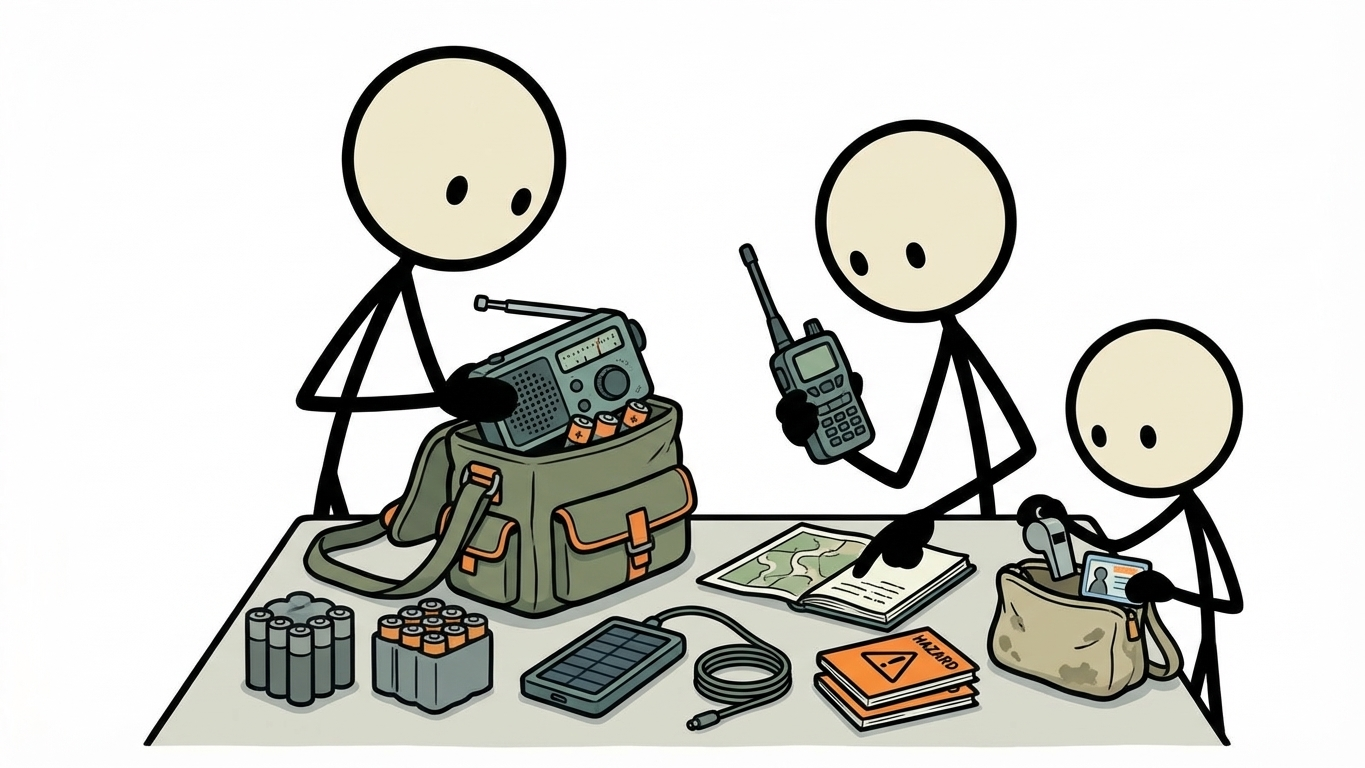
For short-range, tactical communication, two-way radios are indispensable. They are ideal for staying in contact with family members while convoying during an evacuation or coordinating tasks around your property during a blackout.
FRS (Family Radio Service) Radios: These are the standard walkie-talkies you find in sporting goods stores. They operate on UHF frequencies, require no license, and are extremely easy to use. However, be wary of the marketing claims on the box. While they may claim a "36-mile range," in reality, buildings, trees, and terrain will limit FRS radios to about 1 to 2 miles of effective range.
GMRS (General Mobile Radio Service) Radios: GMRS radios offer a significant step up in power and capability. They operate on similar frequencies to FRS but are allowed to transmit at much higher wattages (up to 50 watts for mobile units, compared to FRS's 2 watts). GMRS radios can also utilize repeater stations, which can bounce your signal over mountains and across cities, vastly increasing your range. Operating a GMRS radio requires a license from the FCC, but there is no test required—you simply pay a fee, and the license covers your entire immediate family.
Amateur (Ham) Radio
Amateur radio, commonly known as ham radio, is the undisputed king of off-grid communication. During major disasters, when all other systems fail, ham radio operators are consistently the ones passing critical information to emergency services and facilitating rescues. The American Radio Relay League (ARRL) frequently coordinates with FEMA to provide auxiliary communications during crises.
Ham radios operate across a vast spectrum of frequencies. Handheld VHF/UHF radios (like the popular and affordable Baofeng models) are excellent for local and regional communication, especially when utilizing the massive network of amateur radio repeaters scattered across the country. High Frequency (HF) radios, which require larger antennas and more power, can literally bounce signals off the ionosphere, allowing you to communicate across the country or even around the globe without any grid infrastructure.
To legally transmit on amateur radio bands, you must pass an FCC examination to earn your license (Technician, General, or Amateur Extra). Studying for this exam is an excellent way to deeply understand radio theory, antenna construction, and disaster communication protocols. Even if you do not have a license, it is perfectly legal to buy a ham radio and listen to transmissions, which can provide invaluable real-time intelligence during a crisis.
Satellite Messengers and Phones
If you want guaranteed communication regardless of local infrastructure or terrain, satellite technology is the ultimate solution. Because these devices connect directly to satellites in low Earth orbit, they are completely immune to terrestrial power outages, destroyed cell towers, or network congestion.
Satellite Phones: Devices operating on the Iridium or Inmarsat networks allow you to make voice calls from virtually anywhere on the planet. While highly effective, they are expensive to purchase and require costly monthly subscription plans, making them prohibitive for many families.
Satellite Messengers: Devices like the Garmin inReach, Zoleo, or Somewear Global Hotspot offer a much more affordable and practical alternative. These rugged devices pair with your smartphone via Bluetooth and allow you to send SMS text messages and emails via satellite. Crucially, they also feature dedicated SOS buttons that immediately transmit your precise GPS coordinates to a 24/7 international search and rescue coordination center. While they still require a subscription, the plans are significantly cheaper than satellite phone plans, making them a must-have for serious emergency preparedness.
Mesh Networks
Mesh networking is an emerging and highly effective technology for off-grid communication. Devices like goTenna or those utilizing the Meshtastic open-source project operate on LoRa (Long Range) radio frequencies. You pair the small mesh device to your smartphone, allowing you to send text messages and GPS locations to other users via an app.
The brilliance of mesh networks is that every device acts as a relay node. If you want to send a message to a family member three miles away, but they are out of direct range, your signal can automatically "hop" off other users' mesh devices in the area until it reaches its destination. The more people using the network, the stronger and more resilient the communication web becomes, entirely independent of Wi-Fi or cellular service.
Staying Informed: One-Way Communication Tools
An emergency communication plan isn't just about outputting information; it is equally about gathering life-saving intelligence. In a rapidly evolving disaster, knowing the path of a storm, the location of a chemical spill, or the status of evacuation routes is critical. You must have reliable methods for one-way information gathering.
NOAA Weather Radios
Every household should have a dedicated NOAA (National Oceanic and Atmospheric Administration) weather radio. These devices are tuned to a nationwide network of radio stations broadcasting continuous weather information directly from the nearest National Weather Service office.
When purchasing a NOAA radio, look for one with SAME (Specific Area Message Encoding) technology. This allows you to program your specific county into the radio. Instead of listening to alerts for the entire state, the radio will remain silent until a severe weather warning is issued specifically for your area, at which point it will sound a loud alarm to wake you up. Ensure your radio has multiple power options, including battery backup, a hand crank, and a solar panel, so it remains functional during extended grid-down scenarios.
The Emergency Alert System (EAS) and WEA
Familiarize yourself with the Emergency Alert System (EAS), which broadcasts over standard AM/FM radio stations and local television. Keeping a battery-powered or hand-crank AM/FM radio in your emergency kit guarantees you can tune into local news broadcasts for municipal updates.
Additionally, ensure that Wireless Emergency Alerts (WEA) are enabled in your smartphone's notification settings. These are the loud, un-ignorable alerts sent by government agencies regarding extreme weather, AMBER alerts, and presidential mandates. While they rely on cell towers, they use a dedicated broadcast channel that bypasses standard network congestion, making them highly reliable as long as the tower has power.
Taking Action Today
The chaos of a disaster is not the time to figure out how you will reach your loved ones. An effective emergency communication plan requires forethought, documentation, and the right equipment. By understanding the limitations of cellular networks, prioritizing text over voice, establishing an out-of-area contact, and investing in off-grid emergency communication devices, you build an invisible shield of resilience around your family.
Do not wait for the next severe storm warning or breaking news alert to take action. Tonight, sit down with your family, draft your communication protocols, print your contact cards, and order a reliable weather radio. Preparedness is the ultimate expression of care, ensuring that no matter what happens to the grid, your family's connection to one another remains unbroken.
Build comprehensive communication plans with our family emergency planning guide. Review broader preparedness through our emergency preparedness guide. Test your plan with our family evacuation drill plan. Use our supply calculator for communications equipment. Take training at our preparedness courses.
Frequently Asked Questions
Why do cell phones stop working during disasters?
Cell towers handle a finite number of simultaneous connections. When a disaster triggers thousands of people in the same area to call at once, the network becomes congested and calls fail to connect. Additionally, towers may lose power, be physically damaged, or have their backhaul (the connection between the tower and the broader network) disrupted. Text messages require far less bandwidth than voice calls and are more likely to get through during congestion.
What is an out-of-area contact and why do I need one?
An out-of-area contact is a trusted person who lives far from your region — a relative or friend in a different state. In a regional disaster, local networks are overwhelmed while long-distance connections often stay clearer. Designate one person that every family member will contact to report their status. That person becomes the family's communication hub, relaying messages between separated members even when direct local calls fail.
What are the best backup communication devices for emergencies?
For short-range neighborhood use: FRS walkie-talkies (no license, 1-3km range in open areas) are inexpensive and reliable. For regional communication: GMRS radios (license required, $35, no test) reach 5-50km with repeaters. For national or global reach: a satellite communicator like a Garmin inReach allows two-way texting from anywhere on Earth for a monthly subscription. Ham radio offers the most range and flexibility but requires a license examination. For a broader perspective on how communities handle these situations, see our community emergency preparedness guide.
How does text messaging work better than calls during disasters?
Voice calls require a continuous, two-way connection — they fail entirely when the network is congested. SMS text messages are sent in small packets that queue and retry automatically; they'll often get through minutes or hours after you send them. Use short, clear texts: your location, whether you're safe, and where you're headed. The wireless carriers also broadcast Wireless Emergency Alerts (WEA) as texts to all phones in an affected area, regardless of network load.
What should be on my family's emergency communication card?
Every family member should carry a laminated card in their wallet with: your out-of-area contact's name, phone, and email; all immediate family member phone numbers; your three rally points (home, neighborhood, regional); your family's designated meeting time (e.g., 'meet at rally point 2 at 6pm if no contact by then'); and the local emergency management agency's non-emergency number. Children should memorize the out-of-area contact number.
Sources & Further Reading
Related resource: Natural Disaster Survival Guide.