⚡ Key Facts
- Evacuation Speed Saves Lives: According to the United States Geological Survey (USGS) and wildfire data, residents in rapid-onset disasters often have less than 15 minutes to evacuate, making heavy, single-bag preparedness strategies highly dangerous.
- The Preparedness Gap: FEMA reports that nearly 60% of American adults have not participated in a basic preparedness drill, leaving them highly vulnerable when forced to make split-second evacuation decisions.
- Weather Extremes are Accelerating: The National Oceanic and Atmospheric Administration (NOAA) continues to track record-breaking billion-dollar weather disasters annually, proving that modern threats require adaptable, multi-tiered evacuation plans rather than a one-size-fits-all approach.
- Modular Preparedness is Recommended: Centers for Disease Control and Prevention (CDC) guidelines strongly emphasize building modular emergency kits that can be easily adapted to specific family needs, including distinct medical, pediatric, and geriatric supplies.
- Self-Sufficiency Timelines: While the American Red Cross traditionally recommends preparing for at least 72 hours of self-sufficiency, modern grid vulnerabilities dictate that families must be ready to scale their survival systems for weeks or months.
Imagine waking up at 2:00 AM to the acrid smell of smoke, or the deafening blare of a flash flood warning on your smartphone. The authorities are demanding immediate evacuation. You look out your window and realize you have exactly three minutes to get your family out the door. In that terrifying, adrenaline-fueled moment, the last thing you want to do is struggle to drag a 70-pound survival backpack down the hallway. Yet, this is exactly the scenario many well-intentioned preppers are inadvertently setting themselves up for. See Family and Community Resilience (Spanish) for additional options. See Scenario Deep Dives (Spanish) for additional options. See Family and Community Resilience (Spanish) for additional options. See Scenario Deep Dives (Spanish) for additional options. See Spanish emergency scenarios for additional options. See French emergency scenarios for additional options.
For years, the survival community has been locked in an endless, cyclical argument over the bob vs inch bag. Should you pack a lightweight bug out bag designed for a three-day journey to a safe location? Or should you pack an INCH (I'm Never Coming Home) bag, loaded with heavy axes, heirloom seeds, and cast-iron cookware to rebuild civilization from scratch? This binary thinking is not just flawed; it is actively dangerous. It forces individuals to choose between being dangerously under-equipped for a long-term disaster or fatally over-encumbered during a rapid-onset emergency.
The truth is, true readiness does not force you to choose between speed and sustainability. Instead of arguing about the bug out bag vs inch bag, modern survivalists and responsible family protectors are adopting a highly adaptable, layered approach. By implementing a priority bag system, you can ensure that you have exactly what you need, exactly when you need it, without sacrificing mobility or long-term survivability. This comprehensive guide will break down why the traditional debate is dead, and how you can structure your own scalable emergency bag system mapped directly to Protocol Survival's proven frameworks: Protocol Alpha, Protocol Blackout, and Protocol Fortress.
The Fatal Flaw of the Bug Out Bag vs INCH Bag Debate
To understand why we need a new framework, we first must dissect why the traditional debate fails. The standard Bug Out Bag (BOB) is typically designed around the 72-hour rule. Based on historical data from FEMA and the Red Cross, it generally takes emergency services about rule of threes to restore basic infrastructure or establish relief camps following a localized disaster. Therefore, the traditional BOB is packed with three days of food, water, and basic shelter.
Conversely, the INCH bag is born from the ultimate doomsday scenario. It assumes an apocalyptic event where your home is destroyed, society has permanently collapsed, and you are literally never coming home. To survive this, preppers pack INCH bags with heavy tools, full-sized solar panels, extensive trapping and fishing gear, and massive amounts of ammunition. The result is often a monstrous pack weighing upwards of 60 to 80 pounds.
The problem arises when reality strikes. Disasters do not conform to our neatly categorized bags. If a sudden wildfire threatens your neighborhood - as seen in the devastating Camp Fire in Paradise, California - you need to move at a sprint. If you try to throw an 80-pound INCH bag onto your back while wrangling terrified children and pets, your lack of mobility could cost you your life. On the flip side, if you evacuate with only a 72-hour BOB, and the disaster completely levels your region and permanently destroys the power grid, your three days of supplies will run out just as the real struggle begins.
The psychology of packing also plays a detrimental role in this binary debate. People tend to pack their fears. Because we fear starvation, we pack too much food. Because we fear freezing, we pack massive sleeping bags. This "fear packing" inevitably turns a nimble Bug Out Bag into a bloated INCH bag, destroying the primary purpose of evacuation: speed. The solution is not to compromise by building a mediocre, mid-weight bag. The solution is to separate your gear by priority.
Enter the Priority Bag System
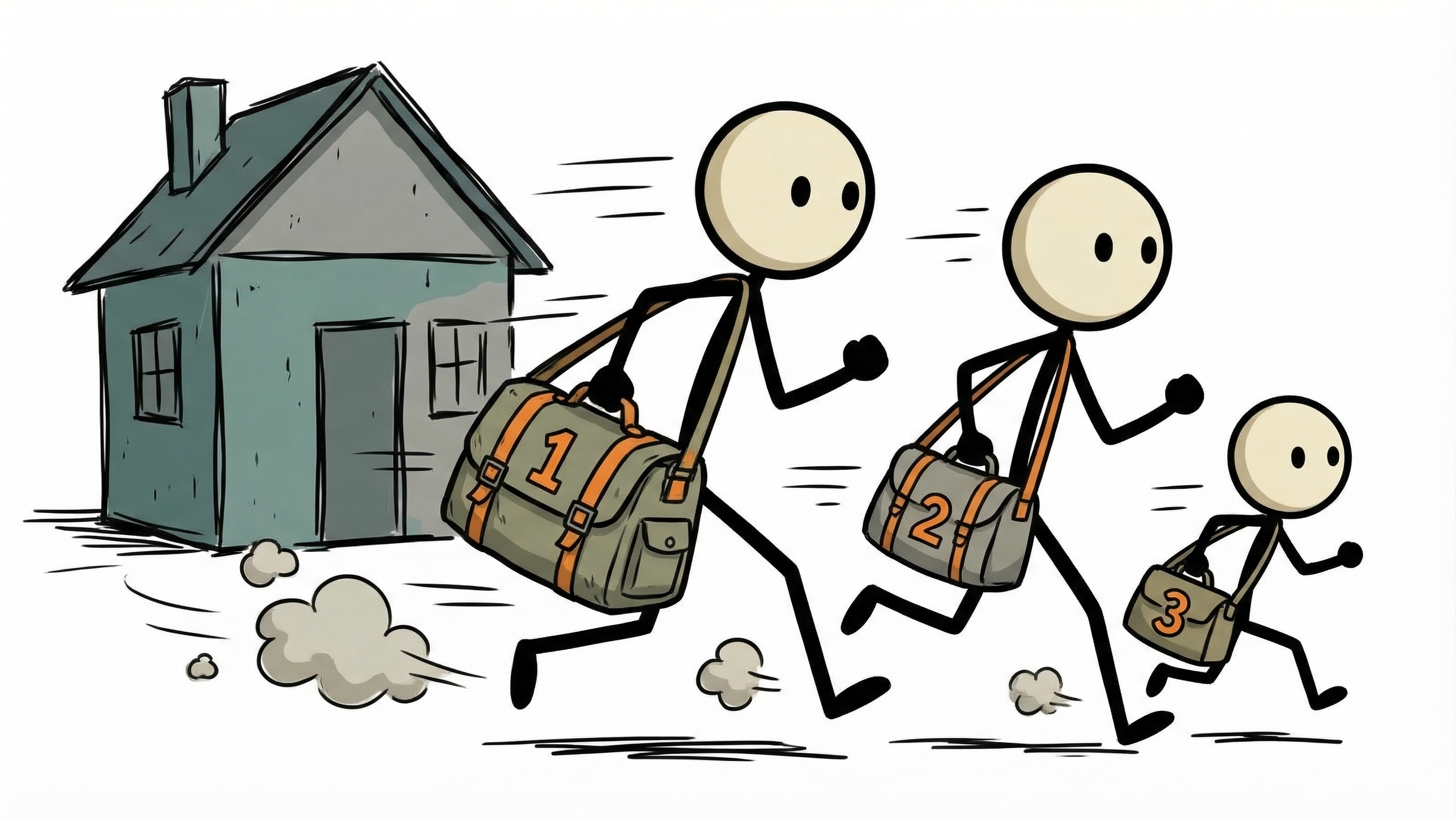
The priority bag system completely eliminates the need to choose between speed and long-term survival. Instead of cramming every conceivable survival item into a single pack, this system utilizes a layered, modular approach. Think of it like dressing for extreme cold weather: you have a lightweight base layer for moisture management, a mid-layer for insulation, and a heavy outer shell for extreme protection. You add or remove layers based on the immediate environment.
Your emergency bag system should function exactly the same way. By dividing your gear into distinct tiers based on the urgency of the threat, you regain total control over your evacuation. If you have two minutes to flee a house fire, you grab Bag #1 and run. If you have two hours warning before a hurricane makes landfall, you load Bag #1 and Bag #2 into your vehicle. If you have two days to evacuate ahead of a massive regional collapse, you load all three bags.
This tiered methodology is not just theoretical; it is heavily utilized by military special operations, wildland firefighters, and search-and-rescue teams. It guarantees that you are never weighed down by gear you don't immediately need, while ensuring your long-term assets are staged and ready if time permits. Let's break down how to structure this system using Protocol Survival's distinct readiness tiers.
Protocol Alpha (Priority 1): The Immediate Evacuation Bag
Protocol Alpha represents your absolute baseline of survival. This is Bag #1. The timeframe for this kit is 0 to 24 hours. The scenarios that dictate Protocol Alpha are sudden, violent, and immediate: a house fire, a localized chemical spill, an active home invasion, or a sudden earthquake.
The primary focus of Bag #1 is extreme mobility, immediate life safety, and identity preservation. This bag should be incredibly lightweight - ideally under 10 to 12 pounds. It is often a small sling bag, a low-profile messenger bag, or a compact 15-liter daypack. It must be small enough that you can sprint with it, climb a fence with it, or comfortably wear it while driving a vehicle.
Core Loadout for Protocol Alpha
- Immediate Life Safety: A specialized trauma kit (not just a basic first aid kit). This must include a CoTCCC-approved tourniquet, hemostatic gauze, chest seals, and trauma shears. In a sudden disaster, severe bleeding is the most immediate threat to life.
- Respiratory Protection: The CDC highly recommends keeping N95 or P100 particulate respirators readily available. Whether you are fleeing a burning building, navigating earthquake dust, or escaping a chemical plume, protecting your lungs is a first-priority action.
- Identity & Financial Preservation: FEMA stresses the importance of document backups. Bag #1 must contain a waterproof USB drive loaded with encrypted copies of your IDs, deeds, insurance policies, and family photos. Additionally, keep a stash of physical cash in small denominations, as digital payment systems often fail instantly during power disruptions.
- Minimal Sustenance: Do not pack a camp stove or freeze-dried meals here. Pack highly dense, ready-to-eat calories like SOS emergency ration bars or protein blocks. Include a single stainless steel water bottle (single-wall, so it can be boiled in) filled with clean water.
- Illumination & Signaling: A high-lumen tactical flashlight with a strobe function, a reliable headlamp to keep your hands free, and a loud emergency whistle.
Bag #1 should be staged near your primary exit point, or even kept in your vehicle if you commute daily. It is the core of any comprehensive go-bag essentials guide because it is the one bag you are guaranteed to take with you, no matter how little time you have.
Protocol Blackout (Priority 2): The Extended Survival Kit
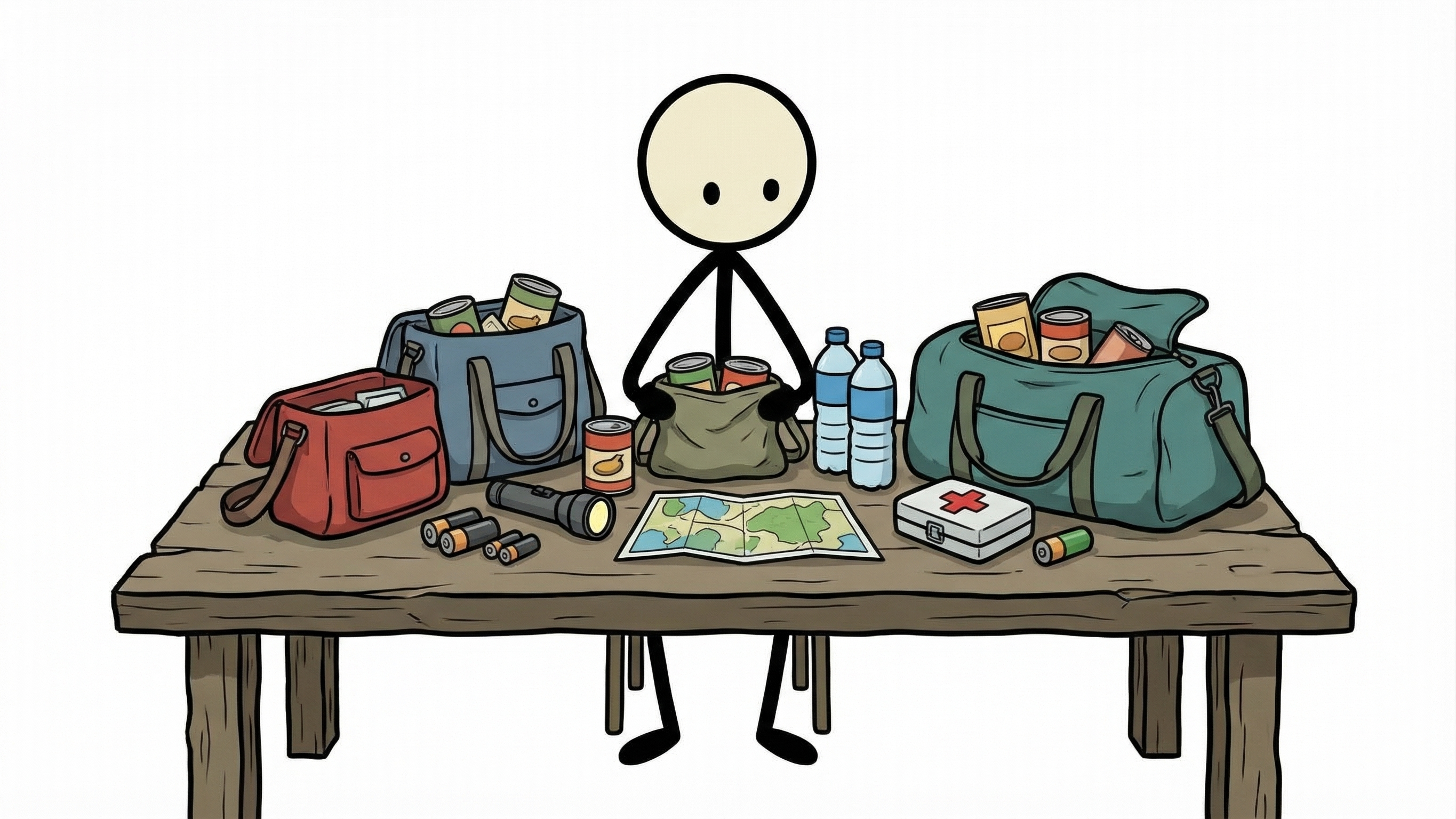
Protocol Blackout is Bag #2. This is the natural evolution of the traditional Bug Out Bag. The timeframe for this kit is 72 hours to one week. The scenarios that dictate Protocol Blackout include regional power grid failures, mandatory hurricane evacuations, severe winter storms, or localized civil unrest. Browse our Survival Scenarios to understand how each disaster type demands a different response.
When you grab Bag #2, it is assumed that you are also wearing Bag #1. Bag #2 is a larger, traditional 35 to 45-liter backpack. Because Bag #1 is handling your immediate trauma and document needs, Bag #2 is entirely dedicated to sustained survival: shelter, water procurement, and extended caloric intake. The weight of this bag should be carefully managed, aiming for no more than 15% to 20% of your total body weight.
Core Loadout for Protocol Blackout
- Water Procurement & Filtration: While Bag #1 has a water bottle, Bag #2 must have the ability to make dirty water safe. Use our Water Calculator to determine exactly how much water your family needs per day. The CDC outlines strict guidelines for water purification. Your kit should include a reliable hollow-membrane water filter (like a Sawyer Squeeze or LifeStraw Peak), chemical purification tablets (chlorine dioxide), and a collapsible water bladder for carrying extra capacity.
- Environmental Protection (Shelter): Exposure to the elements kills faster than dehydration. This bag requires a lightweight, durable shelter system. A heavy-duty reflective emergency tent, a silnylon tarp with paracord, and a compact, climate-appropriate sleeping bag or emergency bivvy are mandatory.
- Extended Nutrition: Pack 72 hours of lightweight, freeze-dried meals that require only hot water to prepare. Our Supply Calculator can help you determine the right quantities for your household. Pair this with a compact isobutane camping stove, a titanium cup for boiling, and a spork.
- Power & Communications: A rugged power bank (ideally 10,000mAh to 20,000mAh) with appropriate charging cables to keep your smartphone alive. Include a portable NOAA weather radio (hand-crank or battery-operated) to receive critical emergency broadcasts when cellular networks fail.
- Hygiene & Sanitation: Often overlooked in the bob vs inch bag debate, hygiene is critical to preventing disease over a multi-day crisis. Pack wet wipes, a travel toothbrush, concentrated biodegradable soap, and heavy-duty contractor garbage bags (which double as emergency ponchos or shelter waterproofing).
Bag #2 allows you to comfortably survive a chaotic week while navigating to a secondary bug-out location, a relative's house, or an official relief shelter. It provides independence from the fragile municipal grid.
Protocol Fortress (Priority 3): The Long-Term SHTF Loadout
Protocol Fortress is Bag #3. This is where the elements of the infamous INCH bag finally come into play, but properly contextualized. The timeframe for this kit is weeks, months, or indefinite. The scenario is a total societal collapse, a catastrophic EMP (Electromagnetic Pulse), or an event that permanently displaces you from your region.
Crucially, Bag #3 is rarely a traditional backpack. Because it is designed for long-term rebuilding and bushcraft, it is exceptionally heavy. Therefore, Protocol Fortress is best staged in heavy-duty, weather-resistant storage totes (like Pelican cases or Plano trunks) designed to be thrown into the back of a truck, SUV, or a utility trailer. If you are forced to evacuate on foot, you leave Bag #3 behind and survive on Bags 1 and 2. You only take Protocol Fortress if you have a functioning vehicle and sufficient warning time.
Core Loadout for Protocol Fortress
- Heavy Tools & Bushcraft: To build permanent shelters and process firewood, you need serious tools. A full-sized felling axe, a folding bow saw, a high-quality fixed-blade bushcraft knife, and a multi-tool. Include sharpening stones to maintain these edges over months of use.
- Renewable Sustenance: You cannot carry enough food to last forever. Protocol Fortress must include the means to acquire calories from the land. This means a comprehensive fishing kit, wire snares for trapping small game, a reliable hunting rifle or takedown bow (where legally applicable), and a vault of non-GMO heirloom seeds for eventual agricultural efforts.
- Advanced Medical & Dental: Moving beyond first aid, you must prepare for long-term health management without hospitals. This includes a comprehensive sick-call kit, over-the-counter medications in bulk, a field dental kit (with temporary filling material), and a suturing kit (only to be used with proper training).
- Renewable Energy: A foldable, high-wattage solar panel array paired with a high-capacity portable power station. This allows you to recharge rechargeable AA/AAA batteries, run small medical devices, and keep two-way radios functioning indefinitely.
- Barter & Community Assets: In a long-term scenario, community is survival. Pack items that hold immense value in a post-grid world: extra water filters, bulk salt, coffee, alcohol, and basic hand tools. These items can be traded for things you may lack.
By relegating these heavy, long-term items to Protocol Fortress, you free up your immediate evacuation bags to do what they do best: keep you fast, light, and alive during the initial chaos.
Practical Grab-and-Go Setup Advice for Families
Understanding the priority bag system is only half the battle. Implementing it effectively within a family unit requires careful planning, communication, and staging. A single, able-bodied adult can easily manage a complex loadout, but when you introduce children, elderly parents, or pets into the mix, the dynamics of an emergency bag system change drastically.
Distributing the Load
Never rely on one person to carry everything. Every capable member of the family should have their own Protocol Alpha (Bag #1). Even a five-year-old child can carry a small, lightweight backpack containing their own emergency whistle, a small water bottle, an ID card with emergency contacts, and a high-calorie snack. This ensures that if you are separated in a chaotic crowd, your child has basic identification and signaling tools.
For Protocol Blackout (Bag #2), the load should be distributed among the adults and older teenagers. You do not need to pack three separate camping stoves. Instead, modularize the family gear. One adult carries the primary shelter system (tent/tarps) and the stove. The other adult carries the bulk of the water filtration and the primary medical kit. Teenagers can carry the freeze-dried food and their own sleeping bags. This team-based approach drastically reduces the individual weight burden.
Addressing Pediatric and Special Needs
The American Red Cross emphasizes that children process trauma very differently than adults. A comprehensive family emergency plan must prioritize psychological comfort. Include a favorite small toy, a deck of cards, or a familiar blanket in your child's bag. In a terrifying shelter environment, these simple items can prevent psychological shock and keep children calm, which in turn allows parents to focus on critical decision-making.
If you have family members with specific medical needs, those must be integrated into Bag #1. Asthma inhalers, EpiPens, insulin (with cold packs), and a minimum of a 14-day supply of prescription medications must be staged where they can be grabbed instantly.
Staging and Accessibility
An emergency bag system is useless if it is buried under holiday decorations in the attic. Your priority bags must be staged strategically.
- Bag #1 (Alpha): Keep this near the primary exit of your home - a mudroom, a front hall closet, or right next to your bed. Alternatively, keep a dedicated Alpha bag in every family vehicle.
- Bag #2 (Blackout): Store these in an easily accessible, climate-controlled closet near the front door or in an attached garage. Do not store them in a damp basement where mildew can destroy fabrics and food.
- Bag #3 (Fortress): Keep these heavy totes stacked securely in the garage, immediately adjacent to the vehicle you plan to use for evacuation. Ensure the path from the totes to the trunk is clear of clutter.
The Importance of the Quarterly Audit
Preparedness is not a set-it-and-forget-it endeavor. You must perform a quarterly audit of your entire emergency bag system. As the seasons change, your gear must change. A sleeping bag rated for summer will lead to hypothermia in a winter blackout. During your audit, rotate out expiring food and medications, check the expiration dates on your hemostatic gauze, physically test your water filters, and ensure all power banks are fully charged. Furthermore, as children grow, their clothing and shoe sizes change - an emergency pair of shoes packed a year ago will be useless to a growing child today.
Mastering Your Evacuation Strategy
The era of arguing over the bob vs inch bag is over. By abandoning the binary mindset and adopting a tiered priority bag system, you empower yourself to face any disaster with absolute confidence. You are no longer trapped by the anxiety of choosing between speed and sustainability. Whether you have two minutes to sprint from a burning home or two days to prepare for a societal blackout, this modular approach guarantees that you have the precise tools required to protect your family.
Preparedness is not about hoarding gear; it is about organizing chaos. By aligning your loadouts with Protocol Alpha, Protocol Blackout, and Protocol Fortress, you transform a pile of survival equipment into a highly tactical, life-saving system. Take the time this weekend to audit your current bags, strip out the unnecessary weight, and structure your gear by priority. When the sirens sound and the countdown begins, you won't be panicking - you will be executing a plan. Ready to take the next step? Explore the Protocol Survival app to access scenario-based drills and personalized bag-building tools.
Master evacuation bag selection through our bug-out evacuation guide. Compare strategies in our bug-out bag checklist. Calculate your needs with our supply calculator. Use our go-bag builder to customize your kit. Take advanced training through our preparedness courses.
Frequently Asked Questions
What is the difference between a BOB and an INCH bag?
A Bug-Out Bag (BOB) is designed for short-term evacuations (72 hours to a few days), while an I'm Never Coming Home Again (INCH) bag is built for long-term wilderness survival with no return planned. The problem: you rarely know which scenario you're actually facing when disaster strikes.
What is a priority bag system?
A priority bag system organizes your gear by how urgently you'll need it, not by how long you plan to be gone. Bag #1 is your immediate grab-and-go kit for any emergency. Bag #2 holds overflow gear you grab if you have an extra 30 seconds. Bag #3 is your extended kit for vehicle or long-term scenarios.
Should I build a BOB or an INCH bag?
Neither exclusively. Instead of one heavy INCH bag that's hard to carry quickly, or a minimal BOB that leaves you under-prepared, build a layered priority system. Pack Bag #1 light and always ready. Add Bag #2 for more capacity. Only grab Bag #3 when you have time and transport.
How heavy should a bug-out bag be?
Your primary bag (Priority 1) should weigh no more than 20-25% of your body weight - ideally less. If your bag is so heavy you can't run with it, it defeats the purpose. Distribute heavier items (food, water, tools) across Priority 2 and 3 bags that you load into a vehicle.
What goes in each priority bag?
Priority 1 (Grab & Go): water, food bars, first aid, documents, phone charger, headlamp, multi-tool - everything you need for 72 hours on foot. Priority 2 (Extended Kit): more food, clothing, larger tools, weapons. Priority 3 (Home Base / Vehicle): bulk food, water storage, long-term gear.
Sources & Further Reading
Related resource: Bug-Out 101 Course.
Related resource: Bug-Out Evacuation Guide.
Related resource: Real-World Emergency Scenarios Guide.