⚡ Key Facts
- Time is the ultimate enemy: During rapid-onset disasters like wildfires, flash floods, or chemical spills, evacuations often happen with less than 15 minutes of warning.
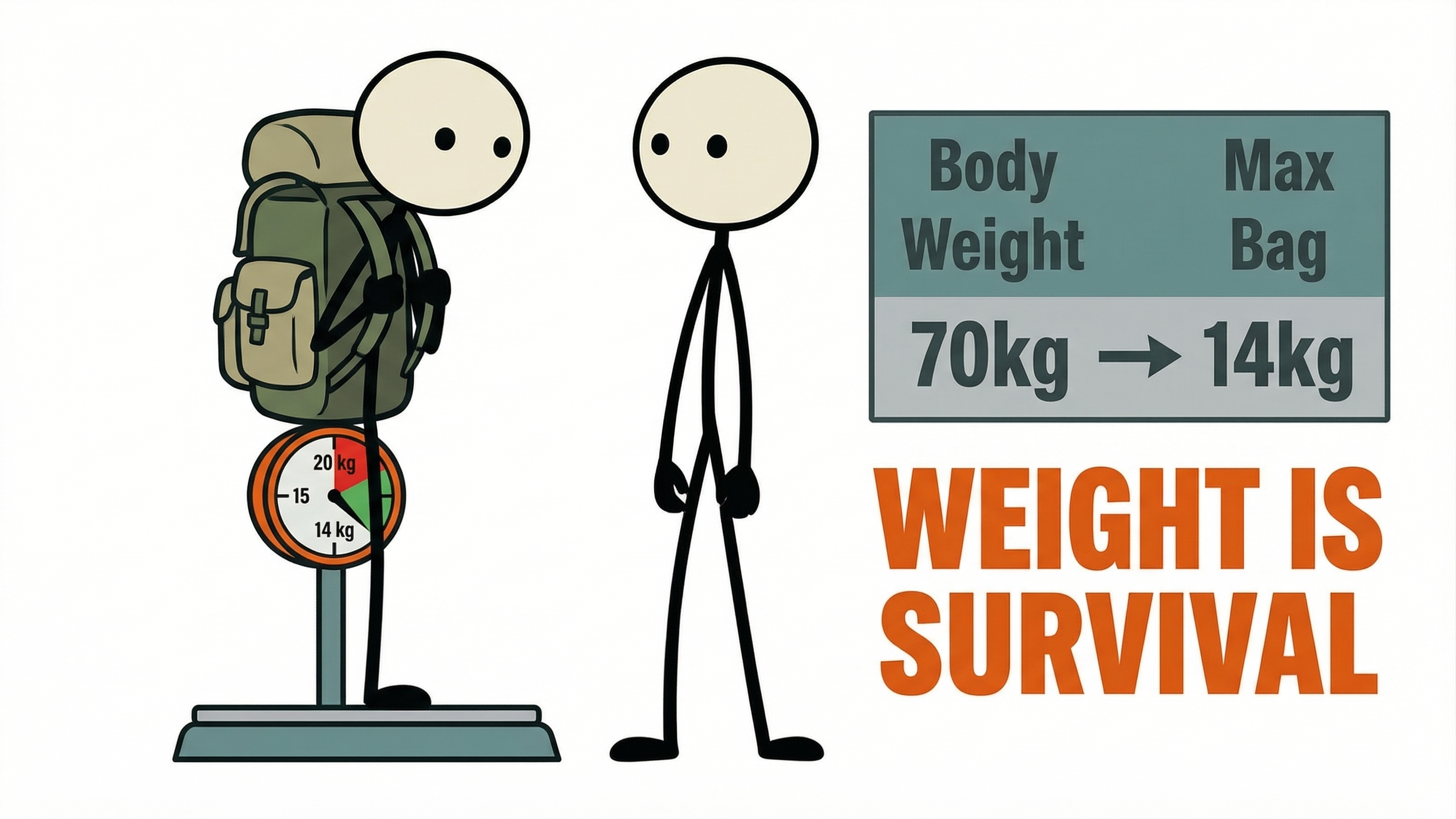
- Weight dictates mobility: A properly packed evacuation bag should weigh no more than 15-20% of your total body weight. Anything heavier severely limits your ability to travel on foot over rough terrain.
- Water logistics: The American Red Cross recommends one gallon of water per person per day. However, since three gallons weigh roughly 25 pounds, a modern 72 hour bag prioritizes portable water filtration over bulk storage.
- The preparedness gap: According to FEMA’s National Household Survey, nearly half of all Americans lack basic emergency supplies, leaving them entirely reliant on overwhelmed municipal rescue services during a crisis.
- The Rule of Threes: A comprehensive bug out bag checklist is built around human survival limits: 3 hours without shelter in extreme environments, 3 days without water, and 3 weeks without food.
Choose a Practical Cutting Tool
A knife is a useful part of a kit, but it should serve a clear job: cordage, packaging, food tasks, and small repairs. Compare practical fixed-blade and compact options in our best survival knives guide, then match the tool to the rest of your water, light, medical, and food plan.
Start With Three Days
For most households, 72 hours is 3 days of essentials before outside help or normal services may return. Use the 72-hour emergency preparedness guide to turn this checklist into a realistic water, food, light, communications, and family-plan baseline.
First 72 Hours: Fast Action Path
The query behind this page is simple: 72 hours is 3 days. In preparedness terms, those three days are the bridge between a normal household and delayed outside help. Start with the 72-hour rule guide, then build skills through the free Catastrophe Survival 101 course.
For the practical kit, use the 72-hour kit guide, calculate supplies with the supply calculator, and set water targets with the water calculator.
If you want a complete step-by-step framework, start with our Bug Out 101 course to build a practical evacuation plan fast.
Imagine waking up at 2:00 AM to the acrid smell of smoke, the piercing wail of community sirens, and an emergency alert vibrating on your phone. The message is blunt: Evacuate immediately. You have ten minutes before the only road out of your neighborhood is cut off. In that moment of adrenaline and panic, decision fatigue sets in instantly. Do you run around the house frantically trying to gather irreplaceable documents, medications, and clothes in a trash bag? Or do you walk to your closet, grab a single, pre-packed backpack, and calmly walk out the door? See Catastrophe Survival 101 (Spanish) for additional options. See Catastrophe Survival 101 (Spanish) for additional options. See Go-Bag Builder for additional options. See Go-Bag Builder for additional options.
Disasters do not make appointments. Whether you are facing a hurricane on the Gulf Coast, a wildfire in California, a winter grid failure in Texas, or a localized hazardous materials spill, your ability to leave quickly and safely depends entirely on your prior planning. This is the exact purpose of an emergency bug out bag. It is your ultimate insurance policy-a self-contained survival system designed to sustain you for the critical first 72 hours of a crisis.
Building the perfect evacuation bag isn't about hoarding doomsday supplies or preparing to live in the wilderness indefinitely. It is about bridging the gap between a compromised location and a safe destination. This comprehensive guide will walk you through the ultimate bug out bag checklist, backed by data from emergency management agencies, to ensure you and your family are ready for the unexpected.
The Philosophy of the 72 Hour Bag
Before diving into the specific go bag essentials, it is crucial to understand what this bag actually is-and what it isn't. An emergency go bag (frequently referred to as a bug out bag, GOOD bag, or 72 hour bag) is a portable kit that contains the items you require to survive for three days. For a quick definition, see rule of threes.
Why 72 hours? Federal agencies like FEMA and the CDC use the 72-hour benchmark because, in the event of a major natural disaster or regional catastrophe, it typically takes local, state, and federal relief organizations up to three days to mobilize and establish reliable supply chains, shelters, and medical outposts. During that window, you are your own first responder.
The goal of this bag is transit, not long-term homesteading. Your mindset should be focused on moving from Point A (danger) to Point B (safety), a key principle in our bug-out evacuation guide. Every item you pack must earn its place by being lightweight, multi-functional, and absolutely essential to your immediate survival.
Choosing the Right Backpack: The Foundation
The most comprehensive bug out bag checklist is useless if the bag carrying your gear tears at the seams or destroys your back after a single mile of walking. Selecting the right backpack is your first major decision, but it should still fit into a complete emergency preparedness gear guide rather than becoming an isolated pack list.
Avoid massive, 100-liter expedition packs. If you have the space, you will inevitably fill it with unnecessary gear, resulting in a bag you cannot physically carry. For most adults, a high-quality backpack with a capacity between 40 and 60 liters is the sweet spot. This provides enough room for your 72 hour bag essentials without encouraging overpacking.
Look for a pack with an internal frame, padded shoulder straps, and a robust, padded hip belt. The hip belt is non-negotiable; it transfers the weight of the pack from your fragile shoulders to your stronger leg and core muscles. Additionally, consider the "Gray Man" concept. While tactical, military-style backpacks with MOLLE webbing are durable, they also scream "I have survival gear" to desperate people during a crisis. A rugged, muted-color hiking backpack often allows you to blend in with the crowd much more effectively.
The Ultimate Bug Out Bag Checklist: Category Breakdown
To prevent your evacuation bag from becoming a disorganized jumble of gear, you must approach packing systematically. We break down the checklist into survival-focused categories, prioritizing the items that will keep you alive when municipal services fail.
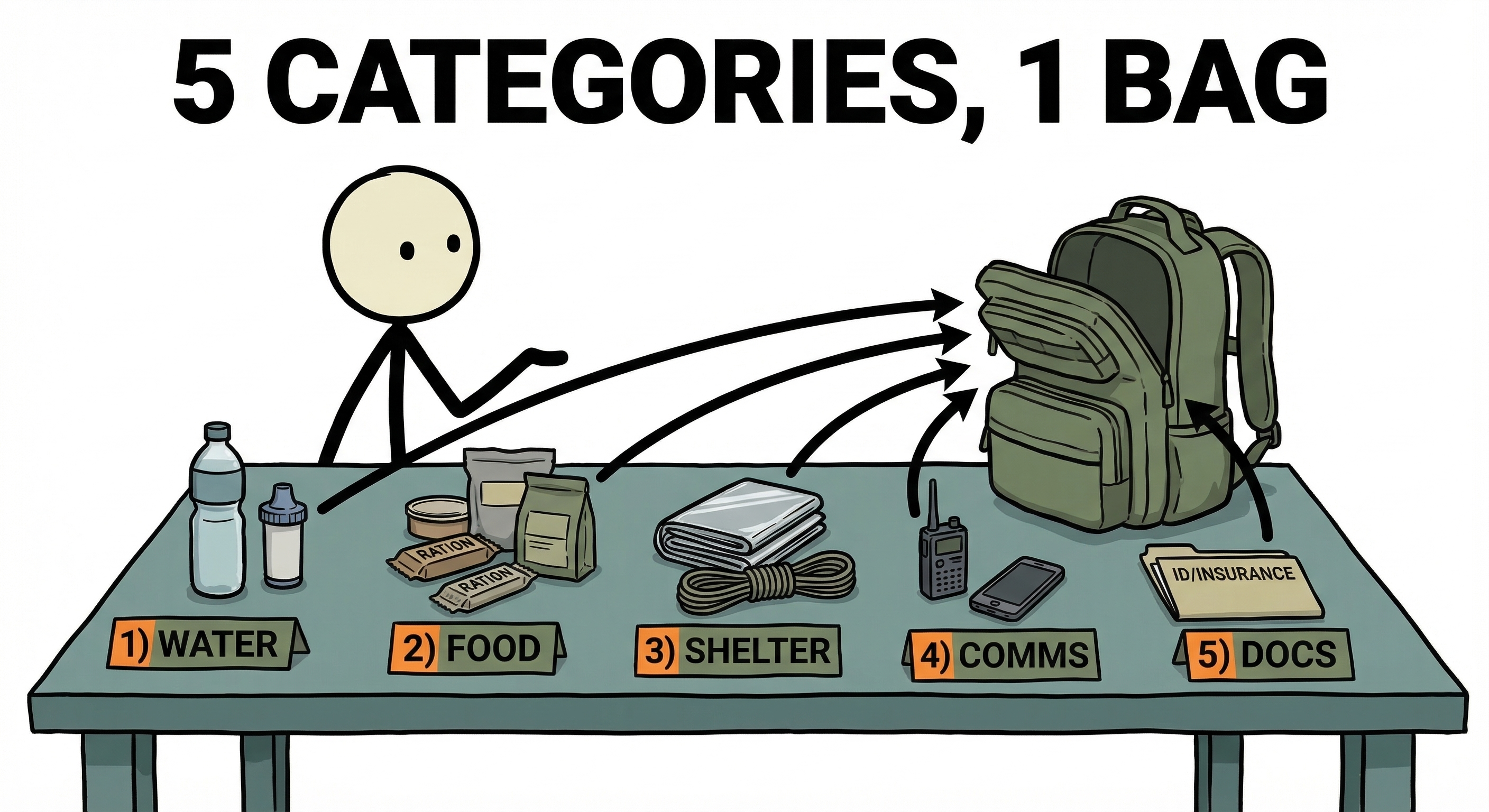
1. Water and Hydration: Your Ultimate Priority
You can survive three weeks without food, but only three days without water. Dehydration leads to cognitive decline, lethargy, and eventually death. However, water is incredibly heavy-weighing roughly 8.34 pounds per gallon. Carrying a three-day supply for one person (25 lbs) is a massive burden for a mobile evacuation bag.
The solution is a hybrid approach: carry a small amount of clean water for immediate use, and pack the tools necessary to procure and purify more water along your route, a core concept in emergency water storage.
- Stainless Steel Single-Wall Water Bottle: Pack a 32oz to 40oz uninsulated steel bottle (like a Klean Kanteen). Unlike plastic, a single-wall steel bottle can be placed directly over a fire to boil and purify scavenged water.
- Pre-packaged Drinking Water: Include 2 to 3 emergency water pouches (like Datrex) or a sturdy hydration bladder filled with 2 liters of water for day one.
- Portable Water Filter: This is a cornerstone of your go bag essentials. Devices like the Sawyer Squeeze or LifeStraw allow you to safely drink from streams, lakes, or questionable municipal taps by filtering out 99.9999% of waterborne bacteria and protozoa.
- Water Purification Tablets: Pack a bottle of Potable Aqua or chlorine dioxide tablets. They weigh almost nothing, take up zero space, and act as a foolproof backup if your mechanical filter breaks or freezes.
- Sillcock Key: For urban evacuations, a 4-way sillcock key allows you to open tamper-resistant commercial water spigots found on the exterior of office buildings and strip malls.
2. Food and Nutrition: High Energy, Low Weight
During an evacuation, your body will be burning significantly more calories than usual due to stress, physical exertion, and potential exposure to the elements. Your emergency go bag needs three days' worth of non-perishable, calorie-dense food (our supply calculator can help you determine the exact amounts) that requires little to no preparation.
Avoid canned goods; they are heavy, contain mostly water weight, and require a can opener. Avoid foods that require complex cooking or large amounts of precious drinking water to rehydrate.
- Emergency Ration Bars: Brands like SOS or Datrex make Coast Guard-approved ration bars. A single block provides 3,600 calories, tastes like a shortbread cookie, withstands extreme temperature fluctuations in the trunk of a car, and has a 5-year shelf life.
- Freeze-Dried Meals: Pouches from Mountain House or Peak Refuel are incredibly lightweight and offer high morale value because they taste like real, hot meals. However, they do require boiling water.
- Trail Mix and Jerky: High-protein and high-fat snacks provide sustained energy without the sugar crash.
- Electrolyte Powders: Stress and walking will deplete your sodium and potassium. Packets of Liquid I.V. or Gatorade powder can prevent debilitating muscle cramps.
- Utensils: A simple titanium spork is all you need.
3. Shelter, Clothing, and Warmth
According to survival experts, exposure to extreme temperatures kills far faster than dehydration. Hypothermia can set in even at 50°F (10°C) if you are wet and exposed to wind. Your evacuation bag must contain a micro-climate to protect your core body temperature.
When packing clothes, remember the golden rule of the outdoors: Cotton kills. Cotton absorbs sweat and rain, loses all its insulating properties, and clings to your skin, accelerating heat loss. Opt exclusively for synthetic moisture-wicking materials or merino wool.
- Emergency Bivvy or Mylar Blanket: Standard foil space blankets tear easily. Upgrade to a reusable emergency bivvy sack (like the SOL Escape Bivvy). It reflects 90% of your body heat back to you and is wind and waterproof.
- Lightweight Tarp and Paracord: A 10x10 silnylon tarp and 50 feet of 550 paracord allow you to quickly construct a waterproof shelter to keep rain and snow off your sleeping area.
- Base Layers: One set of merino wool thermal top and bottoms.
- Socks: Three pairs of high-quality merino wool hiking socks (like Darn Tough). Keeping your feet dry and blister-free is critical if you are forced to walk.
- Weather Shell: A lightweight, packable rain jacket or poncho.
- Warmth Layer: A packable down or synthetic puffer jacket.
- Sturdy Footwear: While not *in* the bag, you should keep a pair of broken-in hiking boots directly next to your bag. Never evacuate in flip-flops.
4. First Aid, Medical, and Hygiene
During a disaster, EMS response times will be severely delayed or nonexistent. Your bug out bag checklist must include a medical kit capable of addressing both minor inconveniences and major trauma. Do not rely solely on a cheap, pre-made drugstore kit that contains 100 band-aids and nothing else.
- Trauma Kit (IFAK): Pack a genuine CAT (Combat Application Tourniquet), Israeli bandage, compressed gauze for wound packing, and trauma shears. Bleeding out is a leading cause of preventable death in physical disasters.
- Basic First Aid: Assorted adhesive bandages, blister treatments (Moleskin), antibiotic ointment, hydrocortisone cream, and medical tape.
- Medications: A 7 to 14-day supply of any life-saving prescription medications you take. Also include over-the-counter mainstays: Ibuprofen (pain/inflammation), Acetaminophen (fever), Loperamide (anti-diarrheal-crucial, as dehydration from illness is deadly), and an antihistamine like Benadryl.
- Hygiene Supplies: Travel-sized toothbrush and paste, a small bottle of concentrated biodegradable soap (like Dr. Bronner's), and hand sanitizer.
- Sanitation: A package of heavy-duty wet wipes (often called "dude wipes" or field bath wipes) and a few heavy-duty black trash bags for waste disposal. Poor sanitation leads to disease outbreaks in post-disaster environments.
- N95 Respirator Masks: Essential for filtering out ash during wildfires, dust from collapsed structures (like earthquakes), or airborne pathogens. CDC guidelines heavily recommend N95s over cloth masks for particulate matter.
5. Illumination, Communication, and Navigation
When the power grid fails, the world goes pitch black, and cell towers are often overwhelmed or destroyed. You need tools to see, navigate, and receive vital information from authorities.
- Headlamp: Prioritize a high-quality LED headlamp over a handheld flashlight. In an emergency, you need both hands free to carry children, hold handrails, or administer first aid. Pack extra lithium batteries, as they perform better in cold weather than alkalines.
- Emergency Radio: A compact, hand-crank NOAA weather radio with AM/FM capabilities. This ensures you can receive emergency broadcast updates regarding evacuation routes and shelter locations even when cell networks are down.
- Power Bank and Cables: A high-capacity (10,000mAh to 20,000mAh) portable power bank and the necessary charging cables for your smartphone. Your phone is a flashlight, a map, and a communication device-keeping it alive is paramount.
- Physical Maps: Do not rely entirely on Google Maps. If the cellular network drops, your phone cannot download map data. Keep a physical, waterproof topographical map of your local area and state, along with a reliable compass. Highlight multiple evacuation routes out of your city.
6. Critical Documents and Cash
If your home is destroyed by a flood or fire, proving your identity, proving you own the property, and accessing your insurance policies will be your first major administrative hurdles. Your emergency go bag must protect your digital and physical life.
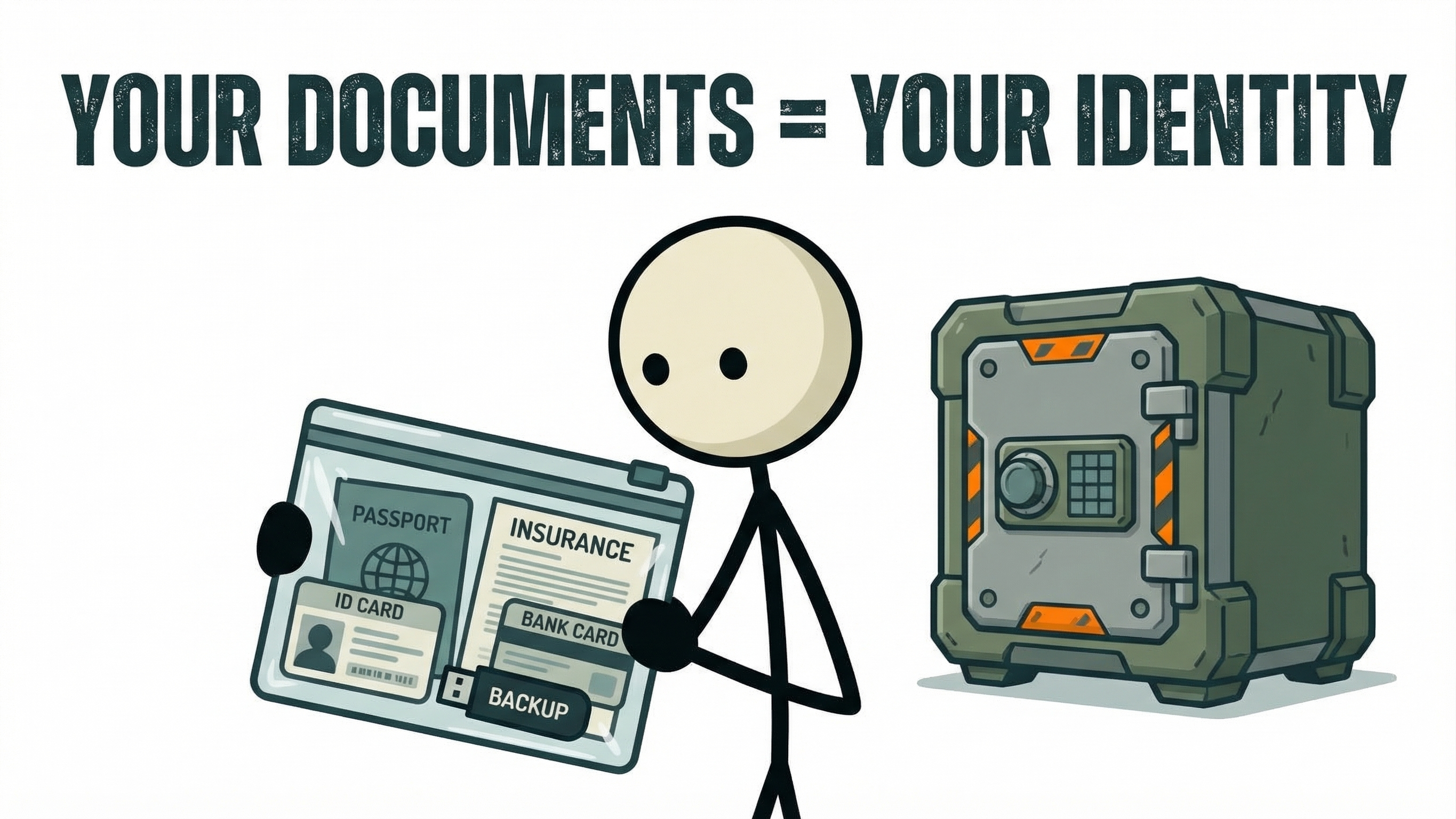
- Waterproof Document Pouch: Store all physical documents in a high-quality, watertight sleeve.
- Identification: Photocopies of driver’s licenses, passports, birth certificates, and Social Security cards for every family member.
- Financial and Legal: Copies of your home deed or lease, vehicle titles, health insurance cards, and homeowners/renters insurance policies.
- Emergency Contacts: A laminated list of phone numbers for family, doctors, and out-of-state contacts. You likely don't have these memorized, and if your phone dies, you lose access to them.
- Encrypted USB Drive: Scan all the above documents, plus family photos and a video walkthrough of your home's inventory (for insurance claims), onto a password-protected thumb drive.
- Emergency Cash: When power goes out, credit card terminals and ATMs cease to function. Cash is king. Keep $300 to $500 in small denominations ($1, $5, $10, $20 bills). A gas station attendant won't be able to break a $100 bill if you are trying to buy a $3 bottle of water during an evacuation.
7. Essential Tools and Miscellaneous Gear
A few carefully selected tools can make a massive difference in your ability to adapt to a changing environment.
- Multi-Tool: A high-quality multi-tool (like a Leatherman or Gerber) featuring pliers, a knife blade, screwdrivers, and a can opener. It replaces a toolbox worth of gear.
- Fixed-Blade Knife: A sturdy, full-tang survival knife (like a Morakniv) for heavier tasks like processing wood for a fire or cutting thick materials.
- Fire Starting Kit: Two Bic lighters, a ferrocerium rod, and waterproof tinder (cotton balls soaked in petroleum jelly work perfectly and cost pennies).
- Duct Tape: Wrap a few feet of heavy-duty duct tape around an old gift card or water bottle to save space. It can repair tents, patch clothing, or serve as an emergency bandage.
- Work Gloves: A pair of leather or heavy-duty synthetic work gloves. Disasters create debris, broken glass, and sharp metal. Protecting your hands is vital to maintaining your ability to work.
Tailoring Your Go Bag Essentials for Your Family
The checklist above forms the core foundation of a 72 hour bag, but true preparedness requires customization. You must adapt your evacuation bag-using a tool like our go bag builder can help-to fit the unique demographics of your household and the specific geography of your region.
For Children: If you have kids, they need their own scaled-down bags if they are old enough to carry them. Pack kid-friendly snacks, pediatric medications, a change of clothes, and most importantly, comfort items. A small stuffed animal, a coloring book, or a deck of cards can drastically reduce a child's psychological trauma during a terrifying event.
For Pets: Your furry family members need go bag essentials, too. A pet evacuation kit should include a collapsible silicone bowl, three days of dry food, extra water, a spare leash and collar, waste bags, and a copy of their vaccination records (many emergency shelters will not accept pets without proof of rabies vaccination).
For Climate: Adjust your gear based on where you live. If you live in the Pacific Northwest, prioritize heavy-duty rain gear and extra socks. If you live in the arid Southwest, you must dedicate more space and weight to water storage and electrolyte replenishment. If you face harsh winters, chemical hand warmers and thicker thermal layers are mandatory.
How to Pack Your Evacuation Bag
Having the right gear is only half the battle; how you pack it determines how comfortably you can carry it. Poor weight distribution can pull you backward, strain your lower back, and cause premature fatigue.
Follow the "ABC" packing method: Accessibility, Balance, and Compression.
- The Bottom (Zone 1): Pack your lightest, bulkiest items here, such as your sleeping bag, emergency bivvy, and spare clothing. This creates a stable base.
- The Middle (Zone 2): This is your center of gravity. Pack your heaviest items here, as close to your spine as possible. This includes your water supply, food rations, and heavy tools. Keeping heavy gear close to your back prevents the bag from swaying.
- The Top (Zone 3): Pack items you might need quickly while on the move, such as your weather shell, snacks, and water filter.
- The Outside Pockets: Reserve these for high-priority, instant-access items. Your trauma kit, headlamp, and a map should be reachable without having to dig through the main compartment of your bag.
Maintaining and Auditing Your 72 Hour Bag
An emergency go bag is not a "set it and forget it" project. Food expires, batteries leak, and children outgrow clothes. A neglected bag can be just as dangerous as having no bag at all, giving you a false sense of security.
Establish a routine to audit your bug out bag checklist every six months. A highly effective strategy is to tie this audit to Daylight Saving Time. When you change your clocks in the spring and fall, open your bag. Rotate out expiring food and water, replace the batteries in your headlamp and radio, ensure medications are still potent, and swap out clothing to match the upcoming season (e.g., removing winter thermals and adding lighter layers for summer).
Building an evacuation bag is one of the most proactive, empowering steps you can take for your personal safety. It transforms you from a potential victim waiting for rescue into a resilient individual capable of navigating a crisis on your own terms, a mindset we cultivate in our Catastrophe Survival 101 course. Start small, gather the essentials, customize the kit to your reality, and gain the profound peace of mind that comes from knowing you are ready for whatever happens next.
Related preparedness term: ferro rod.
Related preparedness term: paracord.
Frequently Asked Questions
What is a bug-out bag and why do I need one?
A bug-out bag (also called a go-bag) is a pre-packed backpack containing everything you need to survive 72 hours if you're forced to evacuate quickly. Natural disasters, wildfires, and infrastructure failures can force rapid evacuation with no time to gather supplies - having a bag ready means you grab it and go.
How heavy should a bug-out bag be?
Your bug-out bag should weigh no more than 15-20% of your body weight. A 70kg adult should aim for a maximum of 14kg. Heavier bags slow you down and cause fatigue - if you have to walk several miles over rough terrain, a lighter, well-organized bag beats a heavy, cluttered one every time.
What are the most important items in a bug-out bag?
The non-negotiables are: water (minimum 1.5L plus a filter), 3 days of calorie-dense no-cook food, a basic trauma first aid kit, a headlamp with extra batteries, an emergency mylar blanket, waterproof copies of ID and insurance documents, and a hand-crank or battery radio for emergency broadcasts.
How often should I update my bug-out bag?
Audit your bag at least twice a year - a good habit is to check it when clocks change for daylight saving time. Replace expired food and medications, update document copies, check that batteries still hold charge, and swap out clothing for the current season and your family's current sizes.
Should every family member have their own bug-out bag?
Yes. Adults should carry their own full kit. Children and elderly family members can carry lighter versions scaled to their ability - water, snacks, a mylar blanket, and their medications. Distributing the load means no single person is overloaded, and if family members get separated, everyone has the essentials.
Sources & Further Reading
If a term is unfamiliar, check the preparedness glossary for quick definitions while you build your plan.
Related resource: Go Bag Builder.
Related resource: Bug-Out Evacuation Guide.