⚡ Key Facts
- Mass Displacement is Real: According to the Federal Emergency Management Agency (FEMA), millions of Americans are displaced annually by natural disasters, underscoring the need for a secondary fallback location.
- Water is the Ultimate Priority: The United States Geological Survey (USGS) notes that groundwater supplies over 50% of the nation's drinking water, making accessible wells or year-round surface water a non-negotiable property feature.
- Gridlock is Inevitable: Department of Transportation (DOT) data from past mass evacuations (such as Hurricane Rita) shows highway speeds can drop below 10 mph, requiring meticulous route planning and fuel management.
- Sanitation Saves Lives: The Centers for Disease Control and Prevention (CDC) warns that poor sanitation and waterborne illnesses are the leading causes of preventable death following a major infrastructure collapse.
- Weather Extremes are Increasing: The National Oceanic and Atmospheric Administration (NOAA) reports a rising frequency of billion-dollar weather disasters, making geographic risk assessment critical before purchasing land.
When a crisis strikes, the window to make rational, life-saving decisions closes rapidly. Whether you are facing a localized natural disaster, a prolonged grid failure, or a sudden evacuation order, having a designated safe haven transforms a chaotic flight into a strategic relocation. The concept of bug out location planning is not about paranoia; it is about taking proactive ownership of your family’s safety and continuity. See the go-bag essentials guide.
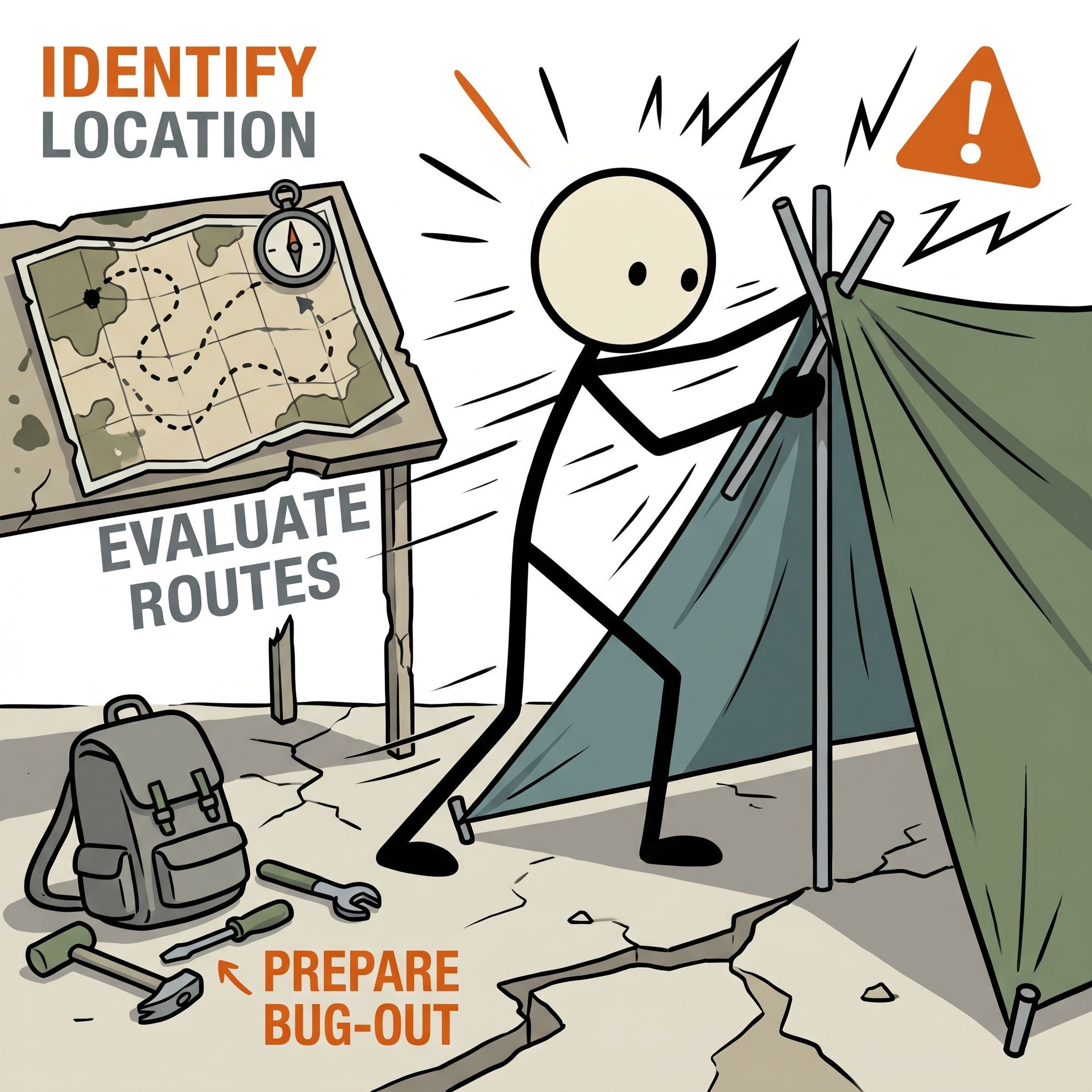
However, securing a viable fallback property is far more complex than simply buying a cheap plot of raw land in the woods. A true survival retreat property must meet rigorous standards for defensibility, sustainability, and accessibility. If you cannot reach your property, or if it cannot sustain you once you arrive, it is a liability rather than a lifeline. See the go-bag builder.
This comprehensive guide will walk you through the practical steps of identifying, evaluating, and preparing a resilient bug-out location. We will explore geographic criteria, logistical route planning, infrastructure development, and the often-overlooked legal hurdles of off-grid land ownership. By the end of this guide, you will have the actionable knowledge required to build a sustainable, secure, and legally sound emergency refuge. See the supply calculator.
The Core Emergency Retreat Location Criteria
Choosing the right piece of land is the foundation of your entire preparedness strategy. When evaluating potential emergency retreat location criteria, you must look past the scenic views and assess the property through the lens of long-term survival. The land must be able to provide for your basic needs—water, food, and shelter—without reliance on municipal utilities. See the water calculator.
Water: The Non-Negotiable Resource
You can survive weeks without food, but only days without water. A property without a reliable, year-round water source is entirely useless for long-term habitation. When evaluating land, you must verify the presence of surface water (creeks, rivers, ponds) or viable groundwater. See the survival scenarios library.
Consult USGS groundwater maps to determine the depth of the local water table. If you plan to drill a well, you need to know if you will hit water at 50 feet or 500 feet, as the latter will be prohibitively expensive and difficult to pump off-grid. Furthermore, surface water must be evaluated for seasonal reliability. A creek that runs dry in August cannot support a garden or livestock.
Topography and Defensibility
The physical layout of your shtf bug out property plays a massive role in both its agricultural viability and its security. Flat, open land is great for farming but offers zero privacy or defensive advantages. Conversely, steep, heavily wooded mountainous terrain offers excellent concealment but makes building and growing food incredibly difficult.
The ideal topography is a mix of both. Look for properties with a southern-facing slope, which maximizes solar exposure for both off-grid solar panels and agricultural growing seasons. The property should ideally be situated at a higher elevation than the surrounding access roads. This provides a clear line of sight to monitor approaching traffic and naturally deters casual trespassers.
Agricultural Viability and Soil Quality
If you are forced to relocate to your bug-out location for an extended period, you will eventually deplete your stored food. Sustainable survival requires the ability to grow calories. Before purchasing land, investigate the local soil composition and the USDA Hardiness Zone.
You can use the USDA’s Web Soil Survey tool to check the arability of a specific parcel. Avoid land with heavily compacted clay or pure sand, as amending this soil for agriculture requires years of labor and imported materials. You want a location with rich loam, adequate drainage, and enough clear acreage to support a substantial garden and small livestock.
Geographic Risk Assessment
Do not buy a property to escape one disaster only to place yourself in the path of another. Utilize the FEMA National Risk Index to evaluate a county’s historical exposure to natural hazards. If you are fleeing urban unrest, you do not want to end up in a rural flood zone or a high-risk wildfire corridor.
Avoid properties located immediately downstream from major dams, within recognized 100-year flood plains, or adjacent to primary targets like military bases or major chemical manufacturing plants. Your goal is to find a geographically stable pocket of land that minimizes external threats.
Distance, Geography, and Route Planning
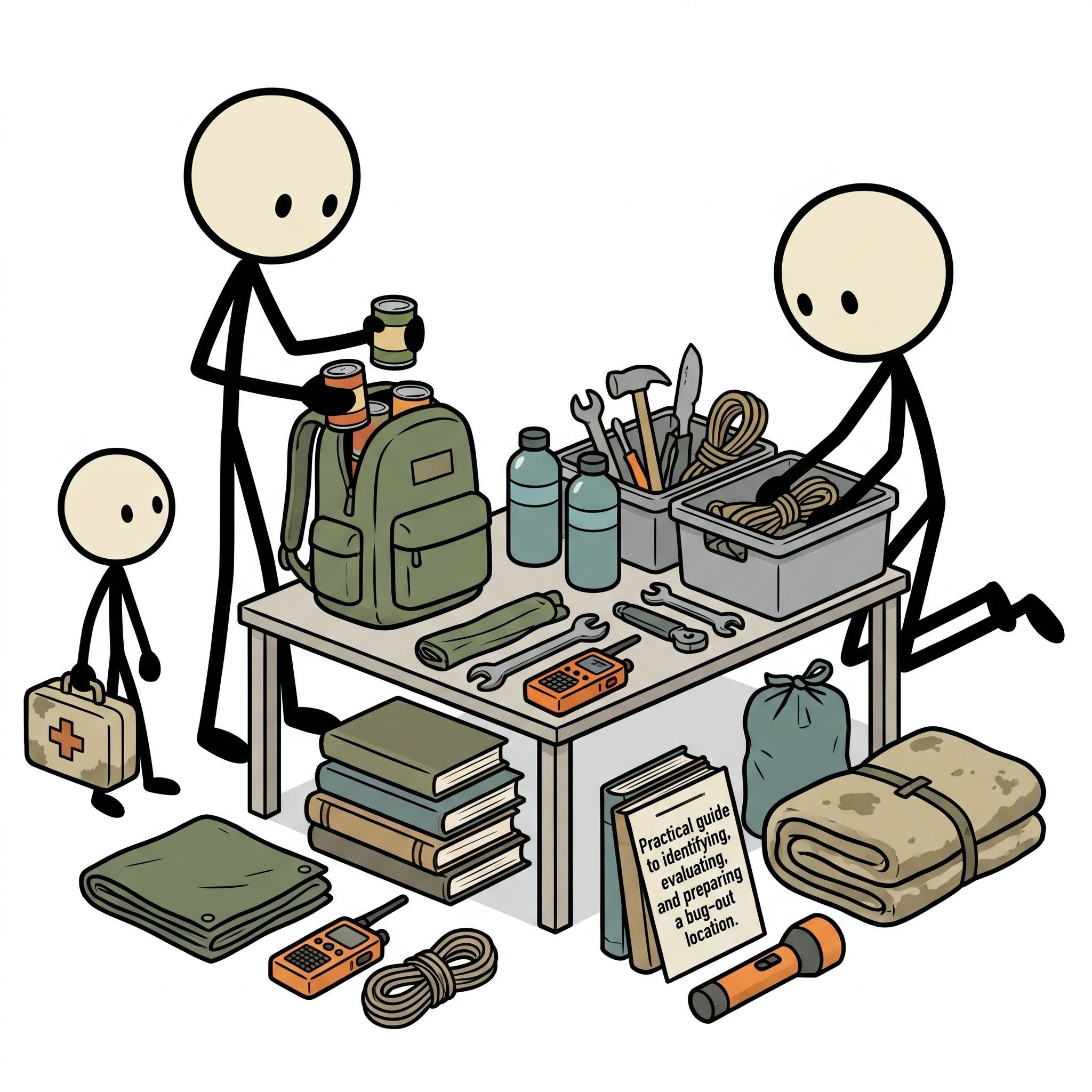
The most perfectly outfitted survival retreat property in the world is useless if you cannot reach it during a crisis. The distance between your primary residence and your bug-out location is a delicate balancing act. It must be far enough away to escape the blast radius or chaos of your primary location, but close enough to reach on a single tank of gas under adverse conditions.
The "Goldilocks" Distance
As a general rule, your bug-out location should be between 50 and 150 miles from your primary residence. This distance is typically sufficient to remove you from localized natural disasters, urban grid failures, and civil unrest. It is also a distance that can be covered in a few hours of driving, or, in an absolute Survival Scenarios scenario, a week of hard walking.
If your property is 500 miles away, you are introducing massive logistical liabilities. In a major crisis, gas stations will run dry, and highways will become parking lots. Relying on the ability to refuel en route is a dangerous gamble.
The P.A.C.E. Route Methodology
Never rely on a single route to your destination. Highway closures, accidents, military checkpoints, or natural obstacles can render your primary path impassable in minutes. Adopt the military P.A.C.E. planning methodology for your travel routes:
- Primary Route: The fastest, most direct path under normal conditions (usually interstate highways).
- Alternate Route: A secondary path using state highways and paved county roads, avoiding major metropolitan choke points.
- Contingency Route: A slower, more obscure path utilizing gravel roads, forest service roads, and rural backways.
- Emergency Route: A worst-case scenario route that assumes you are traveling on foot, utilizing rail lines, utility corridors, or hiking trails.
Identifying Choke Points
When mapping your routes, you must identify and plan around geographic choke points. Bridges, tunnels, mountain passes, and ferry crossings are critical vulnerabilities. If a bridge is washed out or a tunnel is blocked by stalled vehicles, you must have an immediate detour mapped out.
Keep physical, waterproof topographical maps in your vehicle. Do not rely solely on GPS or smartphone navigation, as cellular networks are notoriously fragile during mass emergencies. The American Red Cross emphasizes the importance of having hard-copy maps and knowing how to navigate with a compass during regional power outages.
Bug Out Retreat Setup and Habitation Improvements
Transforming raw land into a functional, life-sustaining refuge requires a phased approach to bug out retreat setup. You cannot build a self-sufficient homestead overnight. Your improvements should be prioritized based on immediate survival needs: shelter, water processing, sanitation, and off-grid energy.
Phase 1: Immediate Shelter and Security
If you have to bug out tomorrow, you need a place to sleep that protects you from the elements. Before you build a permanent structure, establish a temporary base camp. Many property owners start by parking a used RV or travel trailer on the land. This provides immediate, weather-tight shelter, a basic kitchen, and a lockable door.
Alternatively, constructing a sturdy, weather-proof shed or utilizing a modified shipping container can serve as an excellent first-phase shelter. Shipping containers are particularly popular for a shtf bug out property because they are highly secure, rodent-proof, and can be locked down tight when you are absent.
Phase 2: Water Processing and Storage
Having a water source on the property is only step one; you must be able to filter, store, and distribute it. Install a rainwater catchment system on the roof of your shelter or RV. A metal roof feeding into a series of dark, UV-resistant IBC totes can capture hundreds of Water Calculator during a single rainstorm.
For purification, implement a multi-stage system. Use physical sediment filters to remove debris, followed by high-capacity gravity filters (like Berkey or LifeStraw Family systems) to remove bacteria and protozoa. Always keep a supply of calcium hypochlorite or household bleach on hand for chemical water disinfection, adhering to CDC guidelines for safe drinking water treatment.
Phase 3: Off-Grid Sanitation
Sanitation is arguably the most neglected aspect of bug out location planning. Without municipal sewage, human waste quickly becomes a deadly biological hazard. The CDC notes that cholera, dysentery, and typhoid are massive threats in post-disaster environments.
Establish a dedicated sanitation plan immediately. For short-term use, a deep trench latrine located at least 200 feet away from any water source and downhill from your camp is necessary. For long-term habitation, invest in a high-quality composting toilet system. Composting toilets safely break down human waste into harmless organic matter without the need for running water or a massive septic leach field.
Phase 4: Off-Grid Energy Systems
While you can survive without electricity, having power drastically improves your quality of life, security, and communication capabilities. Start with a modest, scalable solar generator system. Portable power stations paired with 200-400 watts of folding solar panels are enough to run medical devices, recharge radios, power LED lighting, and keep power tools operational.
As you develop the property, you can scale up to a permanent solar array with a deep-cycle battery bank. Additionally, ensure you have a robust stockpile of seasoned firewood. Wood is the ultimate off-grid fuel for both heating your shelter and cooking food when propane or solar options fail.
Implementing a Staged Caching Strategy
When an emergency forces you to evacuate, your vehicle's cargo capacity will be severely limited. If you are forced to abandon your vehicle and proceed on foot, your carrying capacity drops to whatever fits in your backpack. To mitigate this risk, successful bug out location planning incorporates a staged caching strategy.
Caching involves hiding essential supplies along your evacuation routes and safely storing bulk gear at your retreat location ahead of time. This ensures that even if you arrive with nothing but the clothes on your back, you have the resources necessary to survive.
Route Caching
Route caches are small, hidden supply drops located along your primary, alternate, and contingency travel paths. These caches should be buried or concealed on public land (like national forests) or on private land where you have explicit permission. They are designed to resupply you during the journey.
A typical route cache should contain high-calorie survival rations, water purification tablets, a change of dry socks, basic first aid supplies, and spare ammunition if applicable. The goal is to provide just enough fuel and gear to get you to the next waypoint.
On-Site Property Caching
You do not want to leave your most valuable survival gear sitting inside a highly visible cabin or shed where it can be easily stolen by looters or squatters while you are away. Instead, cache your high-value items securely on your property.
Burying supplies is the most secure method. Use schedule 40 PVC pipes with sealed end-caps to create waterproof, crush-proof cache tubes. For larger items, rugged, waterproof cases (like Pelican cases) can be buried below the frost line.
Preserving Cached Supplies
Moisture and temperature fluctuations are the enemies of cached gear. When packing your cache tubes, place all items inside sealed Mylar bags with oxygen absorbers to prevent rust and degradation. Toss in several large silica gel desiccant packs to absorb any trapped moisture.
Carefully map your cache locations using precise GPS coordinates, but also memorize physical landmarks using pacing and compass bearings. A GPS device may fail or lose power, so you must be able to locate your buried lifelines using traditional analog navigation.
Legal Considerations and Property Access
One of the most frustrating barriers to establishing a survival retreat property is navigating the labyrinth of local laws, zoning ordinances, and property rights. Purchasing land does not automatically grant you the freedom to build or live exactly as you please. Failing to research legal considerations can result in massive fines, forced demolition of your structures, or denial of access to your own land.
Zoning Laws and Building Codes
Many rural counties have strict zoning laws that dictate what you can and cannot do on your land. Some jurisdictions prohibit living in an RV for more than 14 days a year. Others mandate a minimum square footage for residential dwellings, effectively outlawing tiny homes or small survival cabins.
Before buying, you must visit the county zoning office. Look for counties with relaxed building codes or areas zoned for agricultural or unrestricted use. If you plan to build an alternative structure (like an earthship or a shipping container home), ensure the local building inspector will actually issue a permit for it. Going completely "under the radar" and building without permits is a massive risk that can lead to the county condemning your property.
Water Rights: Riparian vs. Prior Appropriation
Just because a river flows through your property does not mean you have the legal right to use that water. Water rights in the United States are highly complex.
In the Eastern United States, water is generally governed by Riparian Rights, meaning if your land touches the water, you have a reasonable right to use it. However, in the Western United States, water is largely governed by the doctrine of Prior Appropriation (often summarized as "first in time, first in right"). This means someone miles away could own the rights to the creek on your land, and drawing water from it for your garden could result in a lawsuit or criminal charges.
Always demand a clear explanation of the water and mineral rights attached to the deed before finalizing a land purchase. If the water rights have been severed from the property, walk away.
Easements and Access Rights
Never buy land-locked property. If your bug-out location is surrounded by private land owned by others, you must have a legally recorded easement that grants you the right to pass through their property to reach yours.
A "handshake agreement" with a neighbor is not sufficient. If that neighbor sells their land, the new owner can legally block your access, rendering your retreat completely unreachable. Ensure that all access roads and easements are permanently recorded on the property deed.
Absentee Ownership and Squatters
Security is a major concern for a property that sits vacant for 95% of the year. Absentee owners are prime targets for vandalism, theft, and squatters. In some jurisdictions, squatters can claim legal rights to your land if they occupy it for a certain period and you fail to evict them.
Mitigate this by installing heavy-duty gates at the property entrance with hardened locks. Post highly visible "No Trespassing" signs to establish a legal baseline for prosecution. If possible, cultivate a good relationship with a trusted full-time neighbor who can keep an eye on your property and alert you to any suspicious activity. You can also install cellular-enabled trail cameras that send photos directly to your phone if someone breaches your perimeter.
Final Thoughts on Securing Your Future
Establishing a resilient bug-out location is not a weekend project; it is a long-term investment in your family's ultimate safety and independence. By strictly evaluating emergency retreat location criteria, meticulously planning your travel routes, and incrementally improving your off-grid infrastructure, you transition from a state of vulnerability to a state of absolute readiness.
Do not let the scope of the project overwhelm you. Start by identifying the right region, secure a legally sound piece of land, and begin with basic, temporary shelter. Over time, as you add water catchment, solar power, and staged caches, your property will evolve into an impenetrable fortress of self-reliance. When the grid fails or disaster strikes, you will not be a refugee at the mercy of overwhelmed government agencies; you will be a capable individual executing a well-laid plan, heading toward a secure and sustainable home.
Frequently Asked Questions
How far should a bug-out location be from your home?
Your bug-out location should be reachable in 72 hours by foot if necessary (roughly 75-100 miles maximum walking distance). A location 1-3 hours from home by car that can be walked to in extreme need is the realistic sweet spot.
What are the most important criteria for a bug-out location?
Water source on property (year-round creek, spring, or well), defensible natural terrain, at least two approach routes, distance from major population centers, land that can support food production, and good southern sun exposure.
What is cache-and-stage prepping for a bug-out location?
Cache-and-stage means pre-positioning supplies at your bug-out location so you don't have to carry everything during evacuation. A weather-sealed cache buried on the property can hold food, water treatment supplies, fuel, tools, and emergency medications.
Plan your bug-out evacuation location carefully. Compare with shelter-in-place strategies. Develop family emergency planning protocols. Build your escape kit with our go-bag builder and check our courses.
Sources & Further Reading
- USDA Forest Service Land Management
- FEMA Emergency Relocation Planning
- The Encyclopedia of Country Living by Carla Emery