⚡ Key Facts
- Paperwork Delays Recovery: According to the Federal Emergency Management Agency (FEMA), proving identity and homeownership without documentation can delay disaster assistance funds by weeks or even months.
- Billion-Dollar Disasters are Rising: The National Oceanic and Atmospheric Administration (NOAA) recorded a historic 28 distinct billion-dollar weather and climate disasters in the U.S. in 2023, highlighting the universal need for rapid evacuation readiness.
- Digital Vulnerability: The American Red Cross emphasizes that physical, waterproof backups are non-negotiable, as prolonged power and cellular outages routinely render cloud-based documents inaccessible during the critical first 72 hours of a crisis.
- The Cash Imperative: The Federal Deposit Insurance Corporation (FDIC) advises keeping physical currency on hand during natural disasters, as point-of-sale systems and ATMs immediately fail during localized grid-down scenarios.
Imagine waking up at 2:00 AM to the blare of an emergency alert on your phone. A fast-moving wildfire, a sudden flash flood, or a mandatory hurricane evacuation order has given you exactly fifteen minutes to leave your home. In that adrenaline-fueled blur, you grab your family, your pets, and your physical survival gear. But what about your life on paper? Surviving the immediate physical threat of a disaster is only phase one of an emergency. Phase two is the long, arduous process of recovery, and that battle is fought entirely with documentation.
When the smoke clears or the floodwaters recede, the bureaucratic machinery begins. You will need to prove who you are, what you own, and what medical care you require. Without a comprehensive emergency documents kit, survivors often find themselves trapped in a secondary nightmare of red tape. Replacing a lost driver's license, birth certificate, or property deed while simultaneously trying to secure temporary housing and FEMA assistance is a monumental task.
True preparedness guides means securing your administrative life with the same vigilance you apply to your physical safety. This requires a multi-layered approach: curating the right physical copies, implementing military-grade encrypted digital backups, utilizing specialized waterproof storage, and maintaining a robust cash strategy. By taking control of your vital information now, you empower yourself to navigate the chaos of recovery with confidence, speed, and resilience.
The Bureaucratic Reality of Disaster Recovery
The immediate aftermath of a severe weather event or localized disaster is characterized by confusion and resource scarcity. Local government offices may be destroyed, closed, or operating with skeleton crews. In these scenarios, the burden of proof falls entirely on the survivor. FEMA, insurance adjusters, and medical providers require strict verification before they can allocate resources, disburse funds, or provide life-saving care.
Consider the requirements for FEMA’s Individual Assistance program. To qualify for housing assistance or grants to replace personal property, applicants must verify their identity, confirm their occupancy or ownership of the damaged property, and provide proof of insurance. If those documents burned in a fire or dissolved in floodwaters, the application process grinds to a halt. Agencies like the Red Cross and FEMA work diligently to help survivors, but their hands are tied by federal regulations regarding fraud prevention.
This is why a proactive approach is critical. You cannot wait until a storm is named or an evacuation order is issued to begin gathering your paperwork. Creating a comprehensive disaster paperwork checklist is an act of profound self-reliance. It ensures that when you interact with aid organizations, banks, and insurance companies, you are holding all the cards.
Compiling Your Disaster Paperwork Checklist
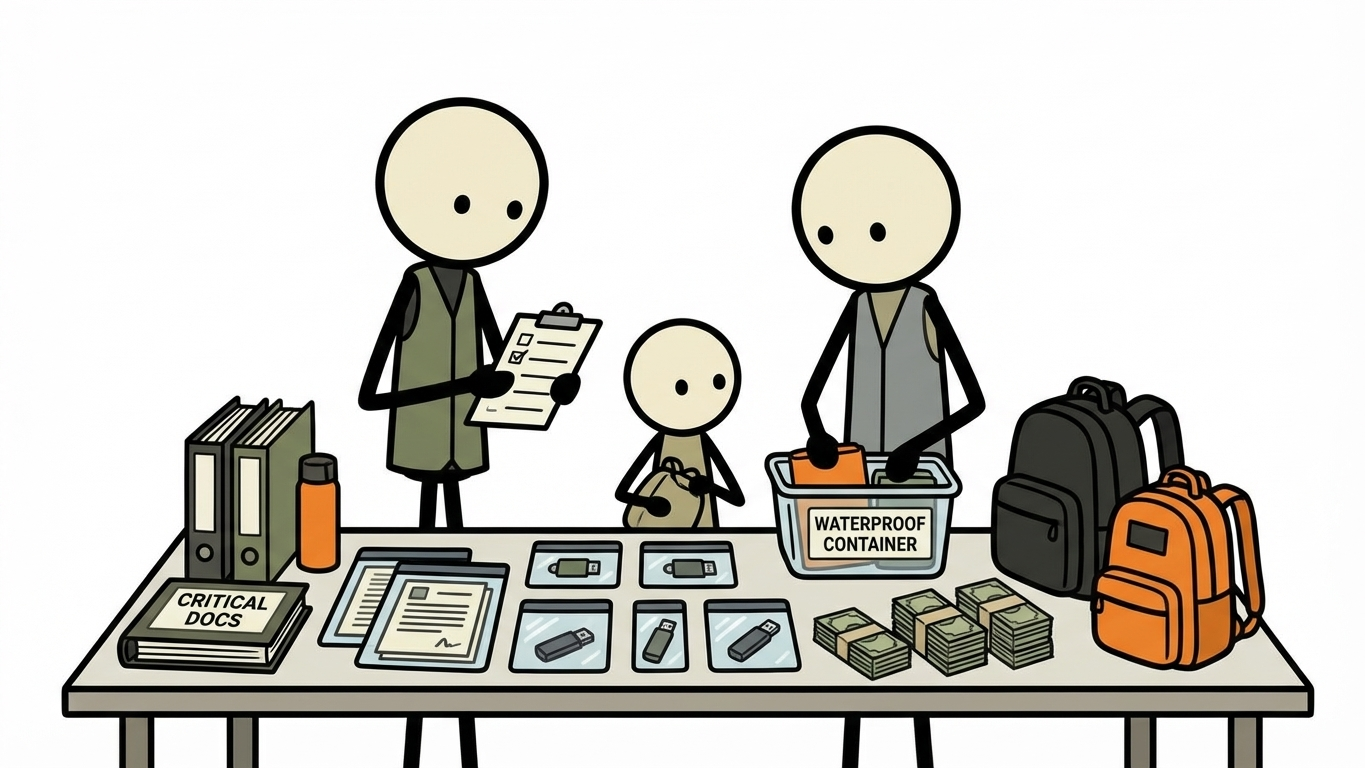
Building an administrative survival kit requires systematic organization. You must gather documents that cover every facet of your personal, financial, and medical life. The goal is to create a portable archive that allows you to seamlessly reconstruct your life in a new location if necessary. Break your checklist down into three distinct categories to ensure nothing is overlooked.
Category 1: Vital Identity Records
Your ability to prove who you are is the foundation of all post-disaster recovery. A reliable identity documents backup is your first line of defense against bureaucratic paralysis. These are the hardest documents to replace because the agencies that issue them require other forms of ID to process your request—a catch-22 you desperately want to avoid.
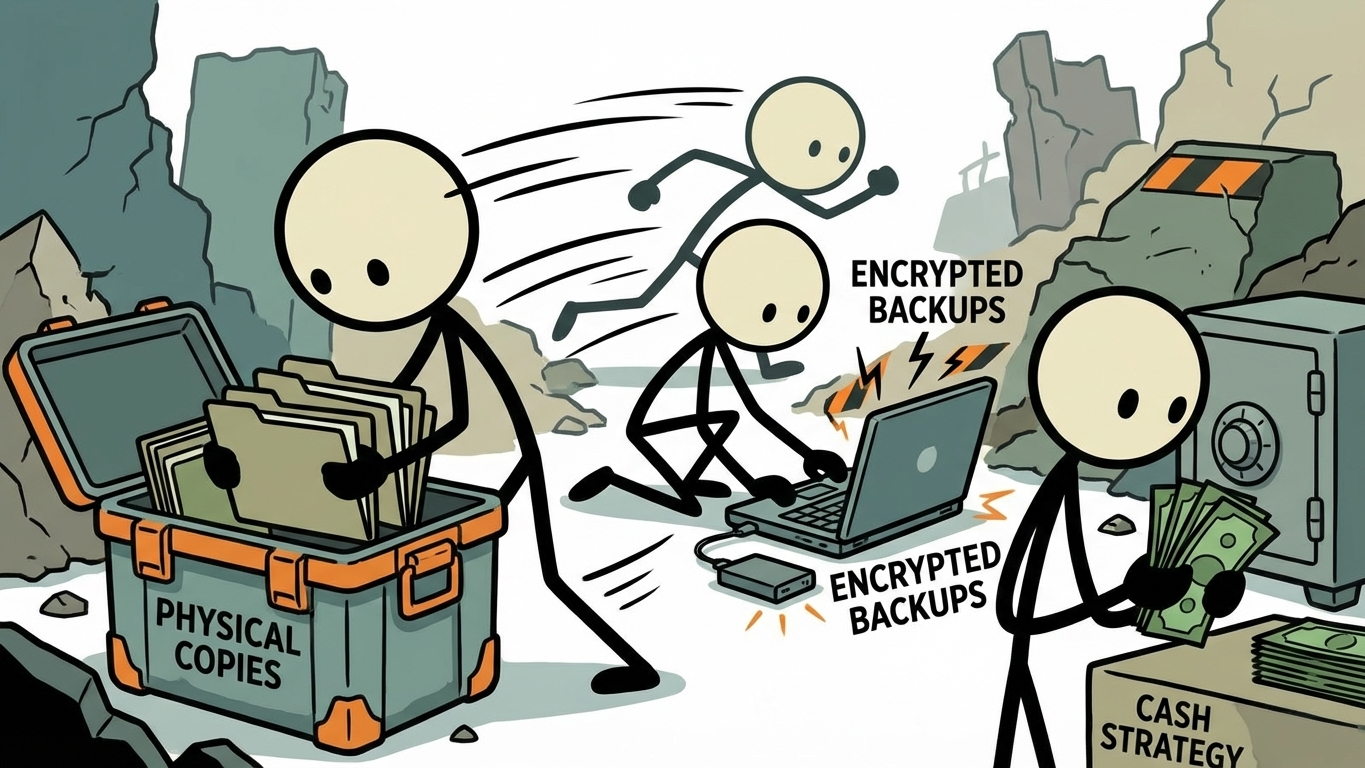
- Driver’s Licenses and State IDs: Ensure copies are front and back.
- Passports and Global Entry Cards: Essential not just for international travel, but as a universally accepted Tier-1 federal identification.
- Birth Certificates and Adoption Papers: Required for enrolling children in new schools and applying for various federal aid programs.
- Social Security Cards: Critical for employment, tax purposes, and accessing government benefits.
- Marriage Licenses and Divorce Decrees: Necessary for proving legal relationships, especially regarding medical decisions and asset distribution.
- Naturalization or Citizenship Documents: Irreplaceable proof of legal status.
Category 2: Financial and Property Records
Financial recovery hinges on your ability to prove what you own and access your assets. When homes are destroyed, the immediate priority becomes filing insurance claims. Without policy numbers and declaration pages, you are entirely dependent on the insurance company's internal systems, which may also be overwhelmed.
- Property Deeds and Vehicle Titles: Proof of ownership is mandatory for FEMA property assistance and insurance payouts.
- Lease Agreements: Renters must prove occupancy to qualify for specific FEMA grants and renter's insurance claims.
- Insurance Policies: Include homeowners, renters, auto, life, and umbrella policies. Highlight the declaration pages containing policy numbers and agent contact info.
- Recent Financial Statements: Keep the most recent statements for checking, savings, retirement, and investment accounts.
- Tax Returns: The IRS recommends keeping at least the last three years of federal and state tax returns on hand.
- Estate Planning Documents: Wills, trusts, and power of attorney documents ensure your legal wishes are respected during chaotic times.
Category 3: Medical and Health Directives
During an evacuation, you may be separated from your primary care physicians and local pharmacies. The Centers for Disease Control and Prevention (CDC) stresses the importance of maintaining portable medical records to ensure continuity of care, especially for individuals with chronic illnesses.
- Health Insurance and Medicare Cards: Front and back copies to facilitate emergency care at out-of-network facilities.
- Current Prescription Lists: Include exact dosages, prescribing doctor information, and pharmacy contact details.
- Immunization Records: Particularly important for children who may need to temporarily enroll in new school districts.
- Allergy and Blood Type Information: Critical data for emergency room physicians treating you or your family members.
- Living Wills and Medical Power of Attorney: Ensures your healthcare directives are followed if you are incapacitated.
Securing Physical Copies: Waterproofing and Go Bag Documents
Once you have gathered the items on your disaster paperwork checklist, the next step is physical protection. Paper is inherently fragile; it is susceptible to fire, water, humidity, and physical tearing. How you store these documents is just as important as having them in the first place.
You must implement a three-tier system for physical document storage. Tier one is your primary home safe. Tier two is an off-site location, such as a bank safe deposit box or a trusted family member's home in a different geographic region. Tier three consists of your go-bag essentials guide documents, which are specifically curated for rapid evacuation.
The Science of Waterproof Storage
Standard office folders and standard zip-top sandwich bags are woefully inadequate for Survival Scenarioss. When navigating floodwaters or enduring torrential rain, standard plastic bags will eventually fail at the seams or the seal. You need specialized waterproof storage designed to withstand total submersion.
Look for storage solutions that boast an IPX rating. The Ingress Protection (IP) scale measures a product's resistance to water and dust. For emergency documents, you want a minimum rating of IPX7 (can be submerged in 1 meter of water for 30 minutes) or ideally IPX8 (continuous submersion). Brands like aLOKSAK produce military-grade storage bags that are guaranteed waterproof to 60 meters and remain flexible in extreme temperatures.
For added protection, utilize heavy-duty dry bags—the kind used by kayakers and white-water rafters. Place your documents inside an IPX8 rated plastic sleeve, and then place that sleeve inside a roll-top dry bag. This double-barrier method ensures that even if the outer bag is punctured by debris, the inner documents remain pristine.
Staging Your Go Bag Documents
Your go bag documents should be a highly condensed, easily portable version of your master files. You do not need to carry three years of tax returns on your back during an evacuation, but you absolutely must carry your identity documents backup, core insurance pages, and medical lists.
Use a brightly colored, fire-and-water-resistant document pouch. The bright color (like neon orange or yellow) ensures it is easily visible in low-light conditions or if dropped in the brush. Store this pouch in a dedicated, easily accessible compartment of your primary Go-Bag Builder. Do not bury it at the bottom beneath heavy gear where the documents could become crumpled or torn.
Furthermore, consider laminating crucial single-page documents, such as emergency contact lists and medical summaries. Lamination adds a layer of physical durability, preventing the paper from deteriorating due to sweat, humidity, or friction inside your backpack.
The Digital Vault: Encrypted Digital Backups
While physical copies are essential for grid-down scenarios, digital backups provide an indestructible secondary layer of security. If your home is destroyed and your go bag is lost, a properly executed digital backup ensures your life can still be reconstructed. However, digitizing your most sensitive personal information introduces significant cybersecurity risks. You cannot simply take photos of your social security card and leave them sitting in your smartphone's camera roll.
Your digital strategy must rely on robust encryption. Encryption scrambles your data into an unreadable format that can only be unlocked with a specific cryptographic key or password. This ensures that if your digital storage device falls into the wrong hands, your identity remains secure.
The 3-2-1 Backup Strategy
IT professionals and data security experts universally recommend the 3-2-1 backup rule. For an emergency documents kit, this translates to having three total copies of your data, stored on two different types of media, with one copy kept off-site. Your physical documents represent one copy. Your digital strategy will fulfill the rest.
Start by purchasing two high-quality, hardware-encrypted USB flash drives. Brands like IronKey or Apricorn offer flash drives with physical keypads on the device itself. The data on the drive is secured using AES 256-bit hardware encryption—the same standard utilized by the U.S. military and federal government. If the drive is lost or stolen, the data will self-destruct after a certain number of incorrect PIN attempts, rendering it useless to identity thieves.
Scan all the documents from your disaster paperwork checklist using a high-resolution scanner. Save them as PDF files, organized into clearly labeled folders (e.g., "01_Identity", "02_Insurance", "03_Medical"). Load these files onto both encrypted USB drives. Keep one drive in your go bag, and place the second drive in your off-site safe deposit box.
Cloud Storage: Convenience vs. Security
The "1" in the 3-2-1 strategy refers to off-site storage, and cloud computing is the most convenient way to achieve this. Storing an encrypted digital backup in the cloud ensures that even if your entire geographic region is devastated, your documents survive on servers located hundreds or thousands of miles away.
However, standard cloud storage providers (like Google Drive or Dropbox) hold the encryption keys to your data. For maximum security, you should utilize zero-knowledge cloud storage providers, such as Sync.com or Tresorit. Zero-knowledge encryption means that the data is encrypted on your device before it is uploaded to the cloud, and only you hold the decryption key. The cloud provider cannot read your files, even if they are compelled by a data breach or legal subpoena.
Alternatively, you can use software like VeraCrypt to create an encrypted container file on your local computer. You place your scanned PDFs inside this container, lock it with a strong passphrase, and then upload that single encrypted file to a standard cloud provider. This hybrid approach offers the convenience of mainstream cloud storage with the security of personal encryption.
Cash Strategy for Emergencies: Why Cash is Still King
In our increasingly cashless society, it is easy to forget how fragile digital payment infrastructure truly is. When disaster strikes, the power grid is usually the first casualty. Without electricity, point-of-sale terminals, credit card readers, and ATMs become instant paperweights. Furthermore, even if a store has backup generators, severe weather often severs the fiber-optic cables and cellular networks required to process digital transactions.
History is replete with examples of digital commerce failing during crises. During the 2003 Northeast Blackout, millions of people were left unable to purchase food or fuel because they relied entirely on plastic. More recently, in the aftermath of major hurricanes in the Gulf Coast, cash was the only accepted currency for weeks while telecommunications infrastructure was slowly rebuilt.
Having dedicated cash for emergencies is not an outdated concept; it is a fundamental pillar of modern preparedness. It provides you with immediate purchasing power, allowing you to secure scarce resources like gasoline, bottled water, hotel rooms, and emergency repairs when others are turned away.
Calculating Your Target Amount
How much cash should you keep in your emergency documents kit? The answer depends on your family size, geographic location, and specific risk factors. However, a standard rule of thumb endorsed by emergency management professionals is to keep enough cash to cover at least three to five days of essential living expenses.
Calculate the cost of a three-night stay at a modest hotel located at least 100 miles from your home (representing a safe evacuation distance). Add the cost of three tanks of gasoline, meals for your family for five days, and a buffer for emergency supplies or minor vehicle repairs. For a family of four, this target amount typically ranges between $500 and $1,500.
Do not view this money as an emergency fund for a broken water heater or a sudden medical bill. This is strictly "grid-down" cash. It should be physically segregated from your daily finances and treated as untouchable survival gear.
The Importance of Small Denominations
Having $1,000 in hundred-dollar bills is better than having no cash at all, but it is highly impractical during a disaster. When the grid is down, stores cannot open their electronic registers, and they quickly run out of change. If you try to buy a $5 bag of ice with a $100 bill, the merchant will likely refuse the sale because they cannot break the bill, or you will be forced to forfeit the $95 in change.
Your emergency cash strategy must prioritize small denominations. A well-structured cash reserve should look something like this:
- $1 Bills: Keep at least $50 in singles. These are invaluable for vending machines, small items, and exact change scenarios.
- $5 and $10 Bills: The bulk of your transactional cash should be in fives and tens. They are universally accepted and rarely require the merchant to provide significant change.
- $20 Bills: Useful for mid-sized purchases like a tank of gas or a hardware store run for tarps and plywood.
- $50 and $100 Bills: Keep a few larger bills strictly for major expenses, such as paying for a hotel room upfront or securing emergency towing services.
Store your cash for emergencies inside the same waterproof, fire-resistant pouch as your go bag documents. Divide the cash into two or three separate envelopes. If you need to pull out money in a chaotic environment, you do not want to flash a massive stack of bills, which could make you a target for theft. Keep a small envelope of transactional cash easily accessible, and keep the bulk of the reserve hidden deeper in your kit.
Maintaining and Auditing Your Preparedness Portfolio
An emergency documents kit is not a "set it and forget it" project. Life is dynamic, and your documentation changes constantly. Insurance policies renew, passports expire, medical prescriptions are altered, and property is bought or sold. If you build a flawless kit today but fail to update it, it will be dangerously obsolete within two years.
To ensure your records remain accurate, establish a strict auditing schedule. Many preparedness experts recommend tying this audit to a recurring annual event, such as the end of daylight saving time, the start of hurricane/wildfire season, or the filing of your annual tax returns.
During your annual audit, perform the following tasks:
- Check Expiration Dates: Review passports, driver's licenses, and credit cards stored in your kit. Initiate renewals for any documents expiring within the next six months.
- Update Financial Records: Replace old bank statements and tax returns with the most current versions.
- Refresh Medical Data: Ensure your prescription lists reflect your current dosages and that new vaccination records are included.
- Rotate Your Cash: While cash doesn't expire, it is good practice to count your cash for emergencies, ensure the denominations are still appropriate, and verify that none of the bills have become damaged by moisture.
- Test Your Digital Backups: Plug in your encrypted USB drives and verify that you still remember the PINs or passphrases. Open the PDF files to ensure the data hasn't become corrupted. Log into your secure cloud storage to confirm your remote backups are accessible.
Additionally, take this time to review your family emergency plan with your family. Ensure that multiple adults in the household know exactly where the primary safe is located, where the go bag documents are staged, and how to access the digital backups if the primary planner is incapacitated.
Empowering Your Future Through Preparation
Disasters strip away our sense of control, replacing the predictability of daily life with chaos and uncertainty. While you cannot stop a hurricane from making landfall or a wildfire from sweeping through a valley, you have absolute control over how you prepare for the aftermath. Building a comprehensive emergency documents kit, securing it with waterproof storage, implementing encrypted digital backups, and establishing a resilient cash strategy are not acts of paranoia—they are acts of profound responsibility.
By taking the time today to organize your identity documents backup and compile your disaster paperwork checklist, you are building an administrative fortress. You are ensuring that when the storm passes, you will not be a victim of bureaucratic delays or grid-down financial paralysis. Instead, you will be equipped to advocate for yourself, protect your family's assets, and begin the process of rebuilding with speed, dignity, and unwavering confidence.
Protect your vital documents using our emergency preparedness guide. Learn financial preparedness from our family emergency plan. Organize your documents with our go-bag builder. Calculate document storage needs with our supply calculator. Get expert financial disaster training through our preparedness courses.
Frequently Asked Questions
What is the first step to prepare for this scenario?
Start with a realistic risk assessment for your location, then build a simple written plan your whole household can follow.
How much should beginners spend initially?
Begin with high-impact basics and a phased budget. Small consistent upgrades beat expensive one-time purchases.
How often should plans and gear be reviewed?
Audit every 6 to 12 months and after every real incident to capture lessons learned.
What should go in every emergency kit?
Water, food, first aid, lighting, communication, documents, and essential medications.
How do I get family buy-in for preparedness?
Keep it practical, avoid fear language, and run short drills that show clear everyday value.