⚡ Key Facts
- Communication fails first: According to the Federal Emergency Management Agency (FEMA), cellular networks routinely crash during regional disasters due to localized damage and system overload.
- Text over talk: The FCC advises that SMS text messages require significantly less network bandwidth than voice calls, making them much more likely to transmit successfully during an emergency.
- Distance matters: A reliable family disaster plan relies on an out-of-state contact, as long-distance routing switches are less likely to be affected by local infrastructure failures.
- Practice saves lives: The American Red Cross reports that families who physically practice their emergency response plans are significantly more likely to evacuate safely and reunite quickly.
- Role clarity prevents panic: Assigning specific, pre-determined tasks to family members reduces cognitive overload and decision paralysis during the critical first five minutes of a crisis.
Choose a Communication Method Before the Emergency
Put one primary method and one backup into the family plan, together with a meeting point and check-in schedule. The emergency radio frequency guide explains why there is no universal channel and how FRS, GMRS, and ham radio differ.
Keep Your Plan Usable
A written checklist is only useful if it stays current. The Protocol Survival preparedness app helps households track supplies, turn gaps into next actions, and keep the plan ready to use when normal services are disrupted.
Start With Three Days
For most households, 72 hours is 3 days of essentials before outside help or normal services may return. Use the 72-hour emergency preparedness guide to turn this checklist into a realistic water, food, light, communications, and family-plan baseline.
First 72 Hours: Fast Action Path
The query behind this page is simple: 72 hours is 3 days. In preparedness terms, those three days are the bridge between a normal household and delayed outside help. Start with the 72-hour rule guide, then build skills through the free Catastrophe Survival 101 course.
For the practical kit, use the 72-hour kit guide, calculate supplies with the supply calculator, and set water targets with the water calculator.
Picture this: It is 2:15 PM on a Tuesday. You are at the office, your spouse is running errands across town, and your children are at two different schools. Suddenly, a severe weather alert blares from your phone. Moments later, the power flickers, and your cellular network drops to "No Service." Do you know exactly where your family will go? Do your children know who is picking them up? If you cannot reach each other for the next 48 hours, do you have a shared understanding of how to reunite? For millions of households, the answer is a terrifying "no." Disasters do not wait for a convenient time when everyone is gathered around the dinner table. They strike during the chaos of daily life. This is why hoping for the best is not a strategy. True resilience requires taking proactive steps today to ensure your loved ones can navigate the unexpected tomorrow.
For a broader playbook, use our community emergency preparedness guide to turn these steps into a practical plan.
The Psychology of Preparedness: Why You Need a Plan Now
When an emergency strikes, the human brain undergoes a massive chemical shift. Adrenaline and cortisol flood your system, triggering the "fight, flight, or freeze" response. While this biological reaction is designed to keep you alive, it severely degrades your prefrontal cortex-the part of your brain responsible for complex problem-solving and logical decision-making. You cannot rely on your ability to improvise when a wildfire is cresting the hill or floodwaters are rising. You need a default framework to fall back on.
Creating a comprehensive family emergency plan offloads that cognitive burden. Instead of trying to invent a survival strategy while panicked, you simply execute the steps you have already agreed upon. This shift from improvisation to execution saves precious minutes. In scenarios like rapid-onset house fires or flash floods, those minutes are the difference between a close call and a tragedy.
Furthermore, an emergency plan for family members provides an incredible sense of psychological security, especially for children. Kids are highly perceptive; they absorb the anxiety of the adults around them. When they know there is a solid, practiced plan in place, their fear is replaced with a sense of agency and purpose. They transform from helpless bystanders into active participants in their own safety.
Step 1: Building a Resilient Communication Strategy
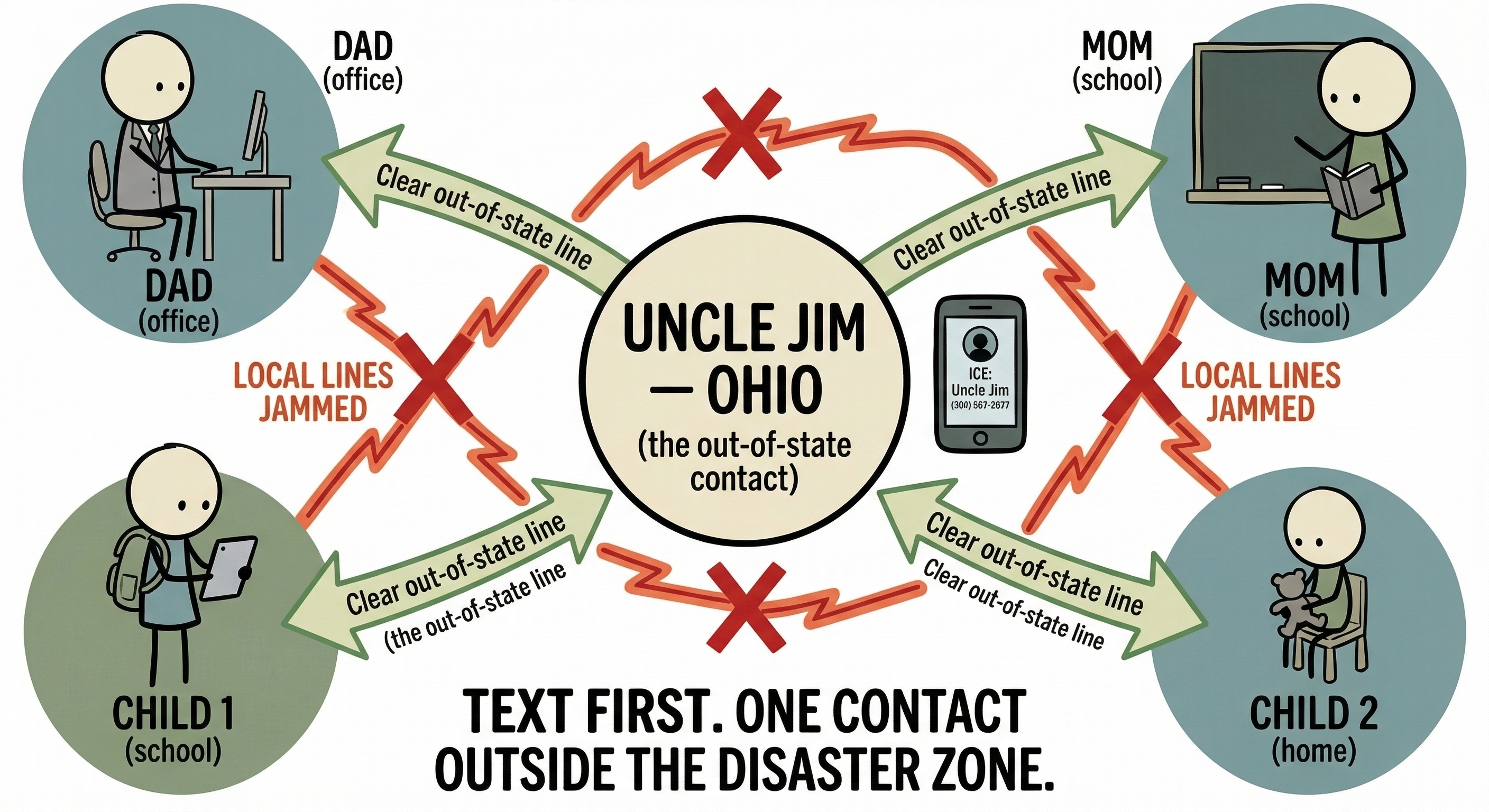
During a crisis, your primary goal is to establish contact, confirm everyone’s safety, and initiate your reunification strategy. Unfortunately, local communication infrastructure is almost always the first casualty of a disaster. Cell towers lose power, fiber optic cables are severed, and local networks become instantly jammed by thousands of people trying to call 911 or their relatives simultaneously.
The Out-of-State Contact (OOSC)
The cornerstone of your communication plan is the Out-of-State Contact. Because local phone switches jam quickly, it is often impossible to call across town. However, calling long-distance routes your connection through different, less congested network hubs. You might not be able to call your partner three miles away, but you both might be able to call your aunt in Ohio.
Select one reliable friend or relative who lives at least 200 miles away-preferably out of your immediate region so they are not affected by the same weather event or disaster. This person becomes your family’s central command node. If your family is separated, everyone knows to check in with the OOSC to leave their status, location, and next steps.
Text Messages Over Voice Calls
If you must use your mobile phone, remember the golden rule of disaster communication: Text, don't talk. Voice calls require a continuous, dedicated slice of network bandwidth. If that bandwidth is full, the call fails. SMS text messages, on the other hand, use the network's control channel. They are tiny packets of data that will sit in a queue and slip through the network the moment a fraction of a second of bandwidth opens up.
Keep your emergency texts brief, clear, and timestamped. Networks can sometimes delay text messages, so adding the time to the body of your message prevents confusion. For example: "14:30 - Safe at office. Moving to Rally Point Bravo. Battery at 40%."
Alternative Communication Tools
Do not rely entirely on cellular networks. When learning how to make an emergency plan, you must build redundancy into your communications. Consider investing in a set of GMRS (General Mobile Radio Service) or FRS (Family Radio Service) two-way radios. These are excellent for neighborhood-level communication if cell towers go dark.
For more severe scenarios, satellite messengers (like Garmin inReach or Zoleo) are invaluable. These devices bypass terrestrial cellular networks entirely, connecting directly to low-earth orbit satellites to send text messages and GPS coordinates to your loved ones or emergency services.
Step 2: Establishing Family Rally Points
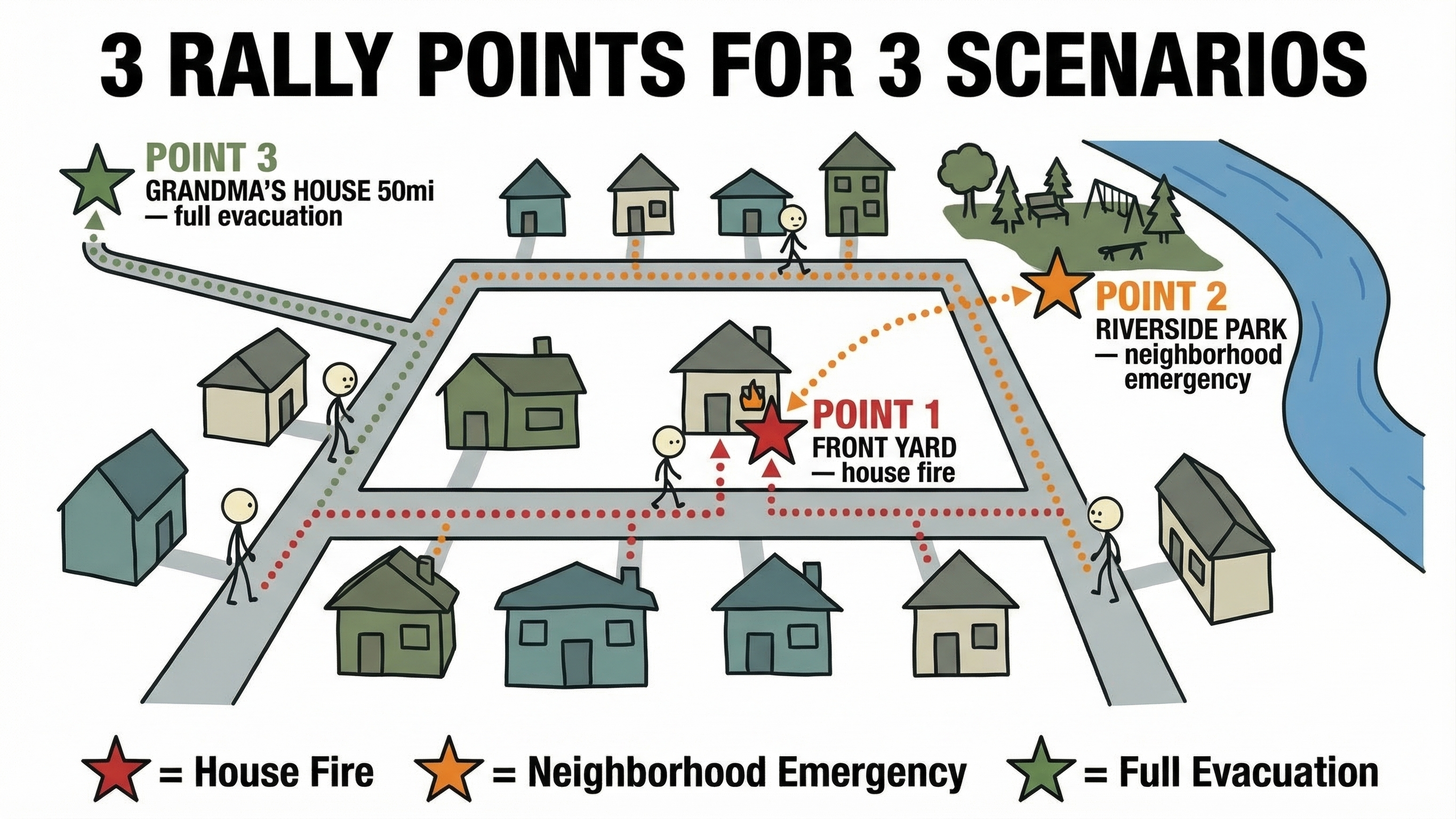
If communication fails completely, you need a physical fail-safe. Rally points are pre-determined locations where your family will automatically go to reunite if you cannot reach each other. A robust family disaster plan requires at least three distinct rally points, scaled to the severity of the emergency.
Tier 1: The Immediate Vicinity (The Home)
Your first rally point is used for sudden, highly localized emergencies, such as a house fire or a carbon monoxide leak. This location should be a safe distance from your home but within visual range. A specific neighbor's driveway, a large oak tree across the street, or a neighborhood mailbox cluster are ideal choices.
The rule for the Tier 1 rally point is simple: Once you are out, you stay out. Everyone goes directly to this spot so you can perform an immediate headcount before first responders arrive. Never re-enter a burning or compromised building to look for someone who might already be outside waiting at the rally point.
Tier 2: The Neighborhood Safe Zone
Your second rally point comes into play if your immediate street is inaccessible or unsafe. This could be due to a localized hazardous materials spill, a gas main rupture, or a law enforcement perimeter. This location should be within walking distance of your home but outside your immediate subdivision or block.
Good Tier 2 rally points include a neighborhood park, a nearby school parking lot, or a local community center. Ensure that every member of the family-including children-knows multiple walking routes to get to this location without relying on a vehicle or GPS.
Tier 3: The Regional Evacuation Point
The final rally point is for wide-area disasters requiring mandatory evacuation, such as hurricanes, massive wildfires, or severe regional flooding. This location should be in a different town or county, ideally 50 to 100 miles away. Often, this is the home of a trusted friend or relative.
If you do not have family nearby, designate a specific, easily identifiable public landmark in a neighboring city, such as a major hotel lobby, a specific highway rest stop, or a large shopping center. When selecting a Tier 3 location, ensure it is accessible via multiple highways and is far enough away to likely be unaffected by the disaster impacting your home.
Step 3: Mapping Fail-Proof Evacuation Routes
Knowing your destination is only half the battle; knowing how to get there when infrastructure fails is equally critical. During a mass evacuation, primary highways and interstates become parking lots. GPS routing algorithms rely on cellular data, which will likely be unavailable or highly inaccurate due to rapidly changing road closures.
Primary, Secondary, and Tertiary Routes
Your family emergency plan must include at least three different routes to your Tier 3 rally point. Your primary route is your standard highway path. Your secondary route should utilize state roads and local highways. Your tertiary route should rely on backroads, county lanes, and alternate paths that most evacuating traffic will ignore.
Take the time to physically drive these routes on a weekend. Look for potential choke points. Are there bridges that could wash out? Are there single-lane roads surrounded by dense forest that could be blocked by fallen trees? Identifying these hazards beforehand allows you to adjust your routes accordingly.
The Importance of Physical Maps
Digital dependency is a massive vulnerability during a crisis. You must have hardcopy, physical maps in every vehicle and in your home go-bags. Purchase detailed state and county topographical maps or gazetteers.
Take a few hours to customize these maps. Use a highlighter to mark your primary, secondary, and tertiary evacuation routes. Circle the locations of local hospitals, police stations, and gas stations. Mark areas prone to flooding or roads that are historically closed during winter storms. A customized physical map is worth its weight in gold when the digital world goes dark.
Before you finalize those routes, check your household's local hazard profile with the Risk by ZIP tool so the plan reflects the disasters most likely to affect your specific area.
Vehicle Readiness and the Half-Tank Rule
An evacuation route is useless if your vehicle cannot make the journey. Adopt the "half-tank rule" as a permanent family policy: never let your vehicle's fuel tank fall below half full. During a disaster, gas stations will run out of fuel within hours, and those that have fuel will have lines stretching for miles. If the power grid is down, the pumps will not work at all.
Additionally, keep a dedicated emergency kit in your trunk. This should include jumper cables, tire repair tools, a first aid kit, extra water, high-calorie snacks, blankets, and a battery-powered weather radio. If you are forced to abandon your vehicle and proceed on foot, you should have a designated "get-home bag" ready to grab and go.
Step 4: Assigning Roles and Responsibilities
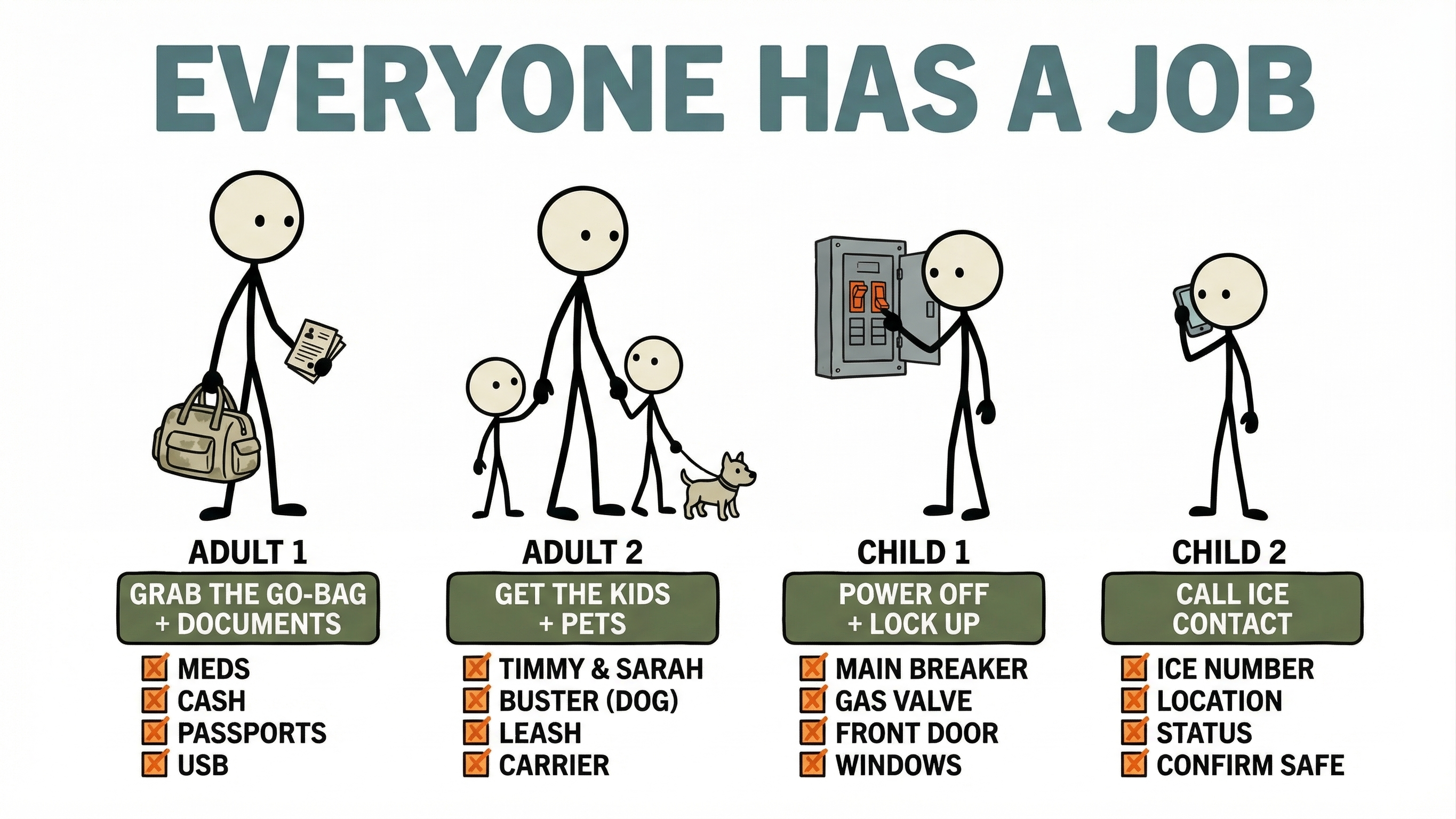
Chaos thrives in the absence of leadership and structure. When an emergency happens, people often freeze because they do not know what they are supposed to do. A well-crafted family disaster plan eliminates this confusion by assigning specific, pre-determined roles to every family member.
The Incident Commander
Usually an adult, this person makes the final call on whether to shelter in place or evacuate. They are responsible for monitoring emergency broadcasts, assessing the immediate threat, and giving the green light to execute the plan. They maintain a calm, authoritative presence to prevent panic.
The Communicator
This role is tasked with managing the flow of information. They are responsible for texting the out-of-state contact, checking in with neighbors, and gathering important documents (like the family emergency plan template binder, passports, and insurance papers). If you are evacuating, the Communicator rides shotgun and navigates using the physical maps.
The Quartermaster
The Quartermaster is responsible for logistics and supplies. Their job is to grab the family go-bags, ensure emergency water and food supplies are loaded into the vehicle, and grab the first-aid kits. They perform a rapid sweep of the essential gear before the family departs.
The Utility Manager
In events like earthquakes or severe storms, compromised utilities can destroy a home even after the initial disaster has passed. The Utility Manager is trained to rapidly shut off the main water valve, the natural gas line, and the main electrical breaker. This person must know exactly where the shut-off valves are located and have the necessary tools (like a gas shut-off wrench) permanently attached or stored right next to the utility meters.
The Wrangler (Pets and Dependents)
If you have pets, elderly family members, or infants, someone must be explicitly assigned to their care. The Wrangler is responsible for getting pets into carriers, grabbing pet food and medications, and ensuring vulnerable family members are safely escorted to the rally point or vehicle. Never assume someone else is grabbing the dog-assign the task explicitly.
Building Redundancy
What happens if the Utility Manager is at work when the earthquake hits? Your plan must include cross-training. Every adult and capable teenager should know how to perform every role. Establish a "primary" and "backup" for each responsibility so the plan can flex and adapt to who is actually present when disaster strikes.
Step 5: Creating Your Family Emergency Plan Template
A plan that exists only in your head is not a plan; it is an intention. To be effective, your strategy must be documented, accessible, and easily understood by everyone in the household. Building a written family emergency plan template is the glue that holds your preparations together.
The Core Information Binder
Create a physical emergency binder. This should be a waterproof, fire-resistant folder stored in a known, easily accessible location (like a front hall closet or near the primary exit). This binder should contain:
- Contact Lists: Phone numbers and addresses for your out-of-state contact, local emergency services, utility companies, doctors, and nearby relatives. Do not rely on your phone's address book.
- Medical Profiles: A detailed list of medical conditions, blood types, allergies, and current prescriptions (including dosages) for every family member.
- Vital Documents: Photocopies of driver's licenses, passports, birth certificates, social security cards, and health insurance cards.
- Property Information: Copies of your home insurance policy, vehicle registrations, and a USB drive containing a video walk-through of your home for insurance purposes.
- The Plan Itself: A printed sheet detailing your rally points, evacuation routes, and assigned roles.
Wallet Cards and Digital Backups
In addition to the master binder, create laminated, wallet-sized emergency cards for every family member. These cards should list the out-of-state contact number, local emergency numbers, and the addresses of your three rally points. Ensure your children keep these cards in their school backpacks.
Finally, utilize secure cloud storage. Scan all the documents in your emergency binder and upload them to an encrypted cloud service. If your home is destroyed and you lose your physical binder, you can still access your vital information from any internet-connected device in the world.
Handling School and Workplace Protocols
Your personal plan must integrate seamlessly with the emergency protocols of the places where your family spends the most time. If a disaster occurs at 10:00 AM on a Wednesday, your children will be subject to their school's lockdown or evacuation procedures, and you will be subject to your employer's protocols.
Visit your children's schools and request a copy of their emergency response plan. Where do they evacuate the students if the building is unsafe? What is their policy on releasing children to adults other than their primary guardians? Ensure you have updated the school's emergency release form to include trusted neighbors or local relatives who can legally pick up your children if you are trapped across town.
Similarly, familiarize yourself with your workplace evacuation routes and rally points. If you know you will be delayed at your office's mandatory rally point, your family needs to know not to panic when you do not immediately arrive at your home's Tier 1 location.
Step 6: Stress-Testing the Plan (Practice Makes Prepared)
The military operates on a simple philosophy: you do not rise to the occasion; you default to your level of training. If you write a brilliant family emergency plan but never practice it, it will likely fail when you need it most. Routine drilling builds muscle memory, exposes flaws in your strategy, and normalizes emergency response for your children.
Tabletop Exercises
Start with low-stress, conversational practice. Once a quarter, sit down over dinner and run a "tabletop exercise." Propose a scenario: "It is 2:00 AM, the smoke detectors are going off, and the hallway is full of smoke. What do we do?" Let your family talk through their actions. Ask your kids questions like, "Who is your out-of-state contact?" and "Where is our neighborhood rally point?" This keeps the information fresh without causing anxiety.
Physical Walk-Throughs
Twice a year, conduct physical drills. Run a home fire drill where everyone must evacuate to the Tier 1 rally point in under two minutes. Have the Utility Manager practice putting the wrench on the gas valve (without actually turning it off). Have the Quartermaster time how long it takes to load the go-bags into the car.
Turn evacuation route practice into a family outing. Drive your secondary and tertiary routes to your Tier 3 rally point, noting any new construction, road changes, or potential hazards. Familiarity breeds calm. If your children have driven the evacuation route multiple times on sunny weekends, they will be much less frightened doing it during a midnight storm.
Review and Revise
Life changes, and your emergency plan must change with it. Set a recurring calendar alert to review your plan every six months-many families tie this to Daylight Saving Time when they are already changing smoke detector batteries. Update your contact lists, ensure clothes in the go-bags still fit growing children, check the expiration dates on emergency food and medications, and adjust roles if someone has moved away or a new baby has arrived.
Creating a family emergency plan is not an act of paranoia; it is the ultimate act of love and responsibility. It is a tangible declaration that you value your family's safety enough to prepare for the worst. By establishing clear communication channels, identifying secure rally points, mapping resilient evacuation routes, and assigning decisive roles, you strip away the chaos of a crisis. You replace panic with purpose. You cannot control when a disaster will strike, but with a solid plan, tested and ready, you absolutely control how your family will survive it.
Learn more about comprehensive family planning in our family emergency planning guide. Get practical tools with our supply calculator to determine household needs. For deeper training, check out our preparedness courses. Also explore emergency communication planning and our master preparedness guide.
Frequently Asked Questions
Why does a family need a written emergency plan?
During a real emergency, stress, adrenaline, and disrupted communications make it nearly impossible to think clearly and coordinate on the fly. A written, practiced plan removes decision-making from the crisis moment. When everyone knows their role, where to meet, and who to call before the emergency happens, the family functions as a unit instead of falling apart under pressure.
What should a family emergency plan include?
A complete plan covers: one out-of-state contact everyone can reach even when local lines are jammed, at least two rally points (one near your home, one outside the neighborhood), evacuation routes for at least three different exits from your city, assigned roles for each family member, and a waterproof card with all critical phone numbers - kept in every family member's bag and wallet.
Why should the emergency contact be out of state?
In a regional disaster, local phone networks get jammed by millions of simultaneous calls. Long-distance lines - calls routing outside the affected area - often stay clearer because they use different network infrastructure. Designating one out-of-state relative or friend as your family's central hub means everyone can relay their status through a single point of contact, even when local calls fail. For a broader perspective on how communities handle these situations, see our community emergency preparedness guide.
How do I practice a family emergency plan with kids?
Run a family drill at least twice a year. Practice the Drop-Cover-Hold On position for earthquakes, walk the evacuation route to each rally point, call or text the out-of-state contact together, and have each child demonstrate their assigned role. Keep drills calm and matter-of-fact - frame them as skill-building, not something scary. Kids who have practiced respond far more calmly under real stress.
How often should we update our family emergency plan?
Review it at least once a year, and immediately after any major life change: a new address, a child starting at a different school, a family member developing a new medical condition, or a change in work location. Update the out-of-state contact card and reprint it every time anything changes. An outdated plan with wrong rally points or old phone numbers can be worse than no plan at all.
Sources & Further Reading
If a term is unfamiliar, check the preparedness glossary for quick definitions while you build your plan.