⚡ Key Facts
- Infection is the primary threat: According to the Centers for Disease Control and Prevention (CDC), up to 10,000 people die annually in the U.S. from burn-related infections, making sterility crucial when hospitals are inaccessible.
- Cool, never cold: The American Red Cross mandates cooling burns with cool or lukewarm water (around 60°F to 77°F) for at least 10 to 20 minutes; using ice causes severe tissue damage and frostbite.
- The "Rule of Nines" dictates triage: First responders use this anatomical formula to estimate the Total Body Surface Area (TBSA) affected, which directly informs fluid replacement and evacuation urgency.
- Fluid loss is immediate and lethal: Severe burns destroy the skin's ability to retain moisture, leading to hypovolemic shock; aggressive oral or intravenous rehydration is required within the first 24 hours.
- Airway burns are silent killers: The Federal Emergency Management Agency (FEMA) warns that soot around the nose or mouth indicates potential inhalation injury, requiring immediate evacuation regardless of external burn size.
Imagine a widespread disaster scenario—a hurricane has knocked out the power grid, or an earthquake has severed supply lines. You are relying on open campfires to boil your drinking water and cook your meals. In a split second, a pot of boiling water overturns, or a flare-up catches a synthetic sleeve on fire. In normal circumstances, you would dial 911 and be rushed to a specialized burn unit. In a severe emergency or grid-down scenario, you are the first responder, the transport team, and the definitive care provider. For deeper prep, consult our family emergency planning guide for critical decisions.
Burns are uniquely devastating injuries. Unlike a laceration that simply needs to be closed and kept clean, a severe burn fundamentally alters the body's physiology. It destroys the skin's thermoregulation, opens massive gateways for opportunistic pathogens, and triggers systemic shock through rapid fluid loss. Knowing how to execute proper emergency burn treatment is not just about alleviating pain; it is about halting a cascade of life-threatening biological failures. Our medical preparedness guide covers essential protocols for managing medical crises.
This comprehensive guide will equip you with the knowledge to assess, stabilize, and manage burn injuries when modern medical infrastructure is completely out of reach. By relying on established protocols from disaster response agencies, you can act with confidence, mitigate the worst outcomes, and save lives when every second counts. Beyond first aid, develop a comprehensive supply plan for emergency scenarios.
Assessing the Damage: Burn Severity Classification
You cannot treat a burn effectively if you do not understand what you are looking at. Burn severity is categorized by depth (how many layers of skin are destroyed) and size (how much of the body is affected). In an emergency, accurately classifying the burn dictates your entire treatment plan. For deeper prep, review an assessment of heart disease emergency care for similar medical triage principles.
Classification by Depth
The medical community categorizes burns into four primary degrees. Understanding these distinctions is the foundation of burn first aid severe burns management.
- First-Degree Burns (Superficial): These burns affect only the epidermis (the outermost layer of skin). The skin will appear red, dry, and painful, similar to a standard sunburn. There are no blisters. These generally heal on their own within a week and rarely require intensive emergency intervention.
- Second-Degree Burns (Partial-Thickness): These burns penetrate the epidermis and reach the dermis. The skin will be intensely red, swollen, and notoriously painful. The hallmark sign of a second-degree burn is the presence of blisters, which may weep clear fluid. These burns carry a high risk of infection and require meticulous wound care.
- Third-Degree Burns (Full-Thickness): These catastrophic injuries destroy both the epidermis and the dermis, often reaching the subcutaneous tissue. The burn site may appear stiff, waxy white, leathery, or charred black. Counterintuitively, third-degree burns are often painless at the center because the nerve endings have been completely incinerated.
- Fourth-Degree Burns: The most severe classification, where the burn extends entirely through the skin and subcutaneous fat, destroying underlying muscle, tendons, and bone. These injuries are almost always fatal in a natural disaster scenario without immediate, advanced surgical intervention.
The Silent Killer: Inhalation Burns
Never base your assessment solely on what you see on the skin. Inhalation injuries occur when a victim breathes in superheated air, toxic smoke, or chemical fumes. The National Oceanic and Atmospheric Administration (NOAA) and fire agencies warn that airway burns cause massive swelling in the throat and lungs, which can asphyxiate a patient hours after the event. For deeper prep, review real-world survival scenarios.
Look for soot around the mouth and nose, singed facial hair, coughing up dark mucus, or a hoarse, raspy voice. If you observe any of these signs, the patient's airway is compromised. This is a strict "load and go" evacuation scenario.
Sizing the Burn: The Rule of Nines
To determine the Total Body Surface Area (TBSA) affected, emergency responders use the "Rule of Nines." This system divides the adult body into sections that each represent roughly 9% of the total surface area. You only calculate TBSA for second and third-degree burns; ignore first-degree burns in this math.
- Head and Neck: 9% (4.5% front, 4.5% back)
- Each Arm: 9% (4.5% front, 4.5% back)
- Anterior Torso (Chest and Belly): 18%
- Posterior Torso (Back): 18%
- Each Leg: 18% (9% front, 9% back)
- Groin/Genitals: 1%
For smaller, scattered burns, use the "Palmar Method." The size of the patient's palm (excluding the fingers) represents approximately 1% of their TBSA. Accurately calculating TBSA is vital because any burn exceeding 10% TBSA in an adult (or 5% in a child) triggers systemic shock and requires aggressive fluid replacement.
Immediate Treatment Protocols: The First 15 Minutes
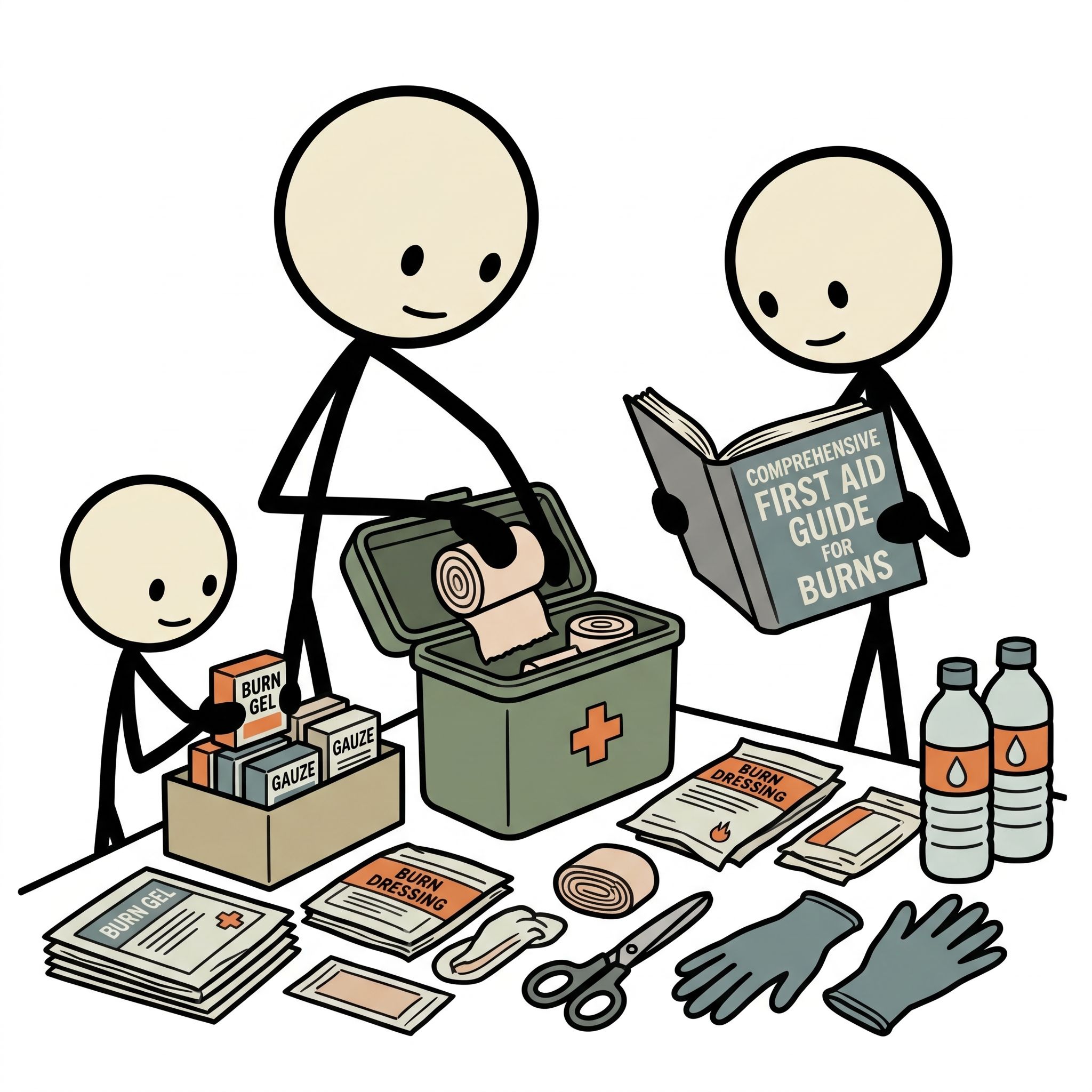
The actions you take in the first few minutes after a burn occurs will dictate the patient's chances of survival. Your goal is to halt the physiological damage and stabilize the victim.
Step 1: Stop the Burning Process
A burn does not stop simply because the patient is removed from the fire. The skin holds onto thermal energy, and the tissue will continue to cook from the inside out until that heat is dissipated. If the patient is on fire, enforce the "Stop, Drop, and Roll" technique. Smother flames with a heavy wool blanket or coat—never use synthetic materials like nylon, which will melt directly into the skin.
If the burn is chemical, brush off any dry powders with a gloved hand before applying water. Applying water to certain dry chemicals (like dry lime) can trigger a violent exothermic reaction, making the burn significantly worse. For liquid chemical burns, flush the area with massive amounts of water for at least 20 minutes.
Step 2: Cool the Burn Correctly
Immediate cooling is the cornerstone of emergency burn treatment. Flush the affected area with cool, clean water (ideally between 60°F and 77°F). Continue this process for 10 to 20 minutes. The American Red Cross explicitly advises against using ice or ice water.
Why no ice? Ice causes severe vasoconstriction, meaning it forcefully shrinks the blood vessels. This cuts off vital blood flow to the already damaged tissue, turning a survivable second-degree burn into a necrotic third-degree burn. Furthermore, do not cool large burns (over 20% TBSA) for more than a few minutes, as this can rapidly plunge the victim into clinical hypothermia.
Step 3: Remove Constrictions
Burns cause massive, rapid swelling (edema) as fluid rushes to the damaged tissue. You must immediately remove all rings, watches, bracelets, belts, and tight clothing from the burned area and surrounding limbs. If a ring is left on a burned finger, the swelling will turn the jewelry into a tourniquet, cutting off circulation and potentially requiring amputation.
If clothing is melted or stuck to the burn, do not attempt to peel it off. Cut around the stuck fabric, leaving the adhered portion exactly where it is. Yanking melted synthetic fabric will rip away whatever healthy tissue remains beneath it.
Step 4: Protect and Cover
Once the burn is cooled, your immediate goal shifts to protecting the exposed tissue from the environment. Cover the burn with a sterile, non-fluffy dressing. A specialized burn dressing or sterile gauze is ideal. If you lack medical supplies, use a clean cotton sheet, a freshly laundered pillowcase, or even plastic wrap (which is surprisingly sterile and prevents air from hitting exposed nerve endings, greatly reducing pain).
Do not apply any creams, ointments, or topical antibiotics during this initial phase. Your only priority is to cool the burn, stop the thermal damage, and shield the wound from airborne bacteria.
What NOT to Do: Dangerous Burn Care Myths
In high-stress survival situations, people often revert to old wives' tales and folk remedies. When treating burns without hospital access, these myths are not just unhelpful—they are actively dangerous and can easily lead to lethal infections or worsened tissue damage.
Myth 1: Applying Butter, Oil, or Grease
This is perhaps the most persistent and dangerous burn myth. Applying butter, cooking oil, bacon grease, or petroleum jelly to a fresh burn traps the thermal energy inside the tissue. Because grease is an insulator, it prevents the burn from cooling, causing the skin to continue cooking.
Furthermore, these substances are not sterile. Introducing food products to an open, weeping wound is a guaranteed way to introduce bacteria. When medical professionals eventually treat the patient, they will have to violently scrub the grease out of the raw wound, causing excruciating pain and further tissue destruction.
Myth 2: Popping Blisters
Second-degree burns produce large, fluid-filled blisters. The temptation to pop or drain them is strong, but you must resist it. A blister is the body's natural, sterile biological dressing. The fluid inside contains immune cells and growth factors that promote healing, while the intact skin acts as an impenetrable barrier against bacteria.
If a blister pops on its own, do not peel away the dead skin. Gently wash the area with mild soap and sterile water, apply a thin layer of antibacterial ointment (if the burn is older than 24 hours and fully cooled), and cover it with a sterile dressing.
Myth 3: Using Toothpaste or Aloe Vera on Severe Burns
While aloe vera is excellent for superficial first-degree sunburns, it has no place inside the open weeping wounds of a second or third-degree burn. Toothpaste is even worse; it contains abrasives, mint, and chemicals that will severely irritate raw tissue and cause excruciating pain. Stick to sterile water and clean, dry dressings for serious burns.
Infection Prevention: Burn Care in a Survival Scenario
If you are trapped in a grid-down disaster where evacuation is impossible, your role shifts from first responder to long-term caregiver. The harsh reality of burn care survival scenario management is that the initial thermal injury rarely kills the patient. The true enemy is sepsis—a massive, systemic infection.
When the skin is destroyed, the body loses its primary defense mechanism. The burn site becomes an all-you-can-eat buffet for environmental bacteria. Managing this requires strict, almost obsessive hygiene protocols.
Establishing a Sterile Environment
Before you even touch a burn patient, you must wash your hands thoroughly with soap and water, or use a high-alcohol hand sanitizer. If you have them, don sterile nitrile gloves. The environment where you change the dressings must be as clean as possible. Keep pets away, sweep the area to minimize airborne dust, and ensure the patient is resting on clean linens.
Daily Wound Cleaning
After the first 24 hours, the burn must be cleaned daily to remove dead tissue and prevent bacterial colonization. Boil water for at least one minute (or three minutes at high altitudes) and let it cool to room temperature to create a sterile irrigation fluid. You can add a small amount of mild, unscented soap.
Gently wash the burn. Do not scrub. You will likely see "slough" (yellowish, stringy dead tissue) forming. In a hospital, doctors perform sharp debridement to remove this. In a survival scenario, aggressive mechanical debridement is too risky due to bleeding and pain. Instead, rely on gentle daily washing to let the dead tissue naturally separate.
Applying Dressings and Antimicrobials
Once the wound is clean and patted dry with sterile gauze, you must apply a topical antimicrobial. If you have a well-stocked medical kit, Silver Sulfadiazine (Silvadene) cream is the gold standard for burn care. Apply a layer roughly 1/16th of an inch thick.
If pharmaceutical supplies are exhausted, medical-grade honey (like Manuka honey) is a scientifically proven alternative. The CDC and various wound care journals acknowledge that high-quality honey creates an osmotic gradient that draws fluid out of bacterial cells, killing them, while maintaining a moist healing environment. Apply the honey to the sterile gauze, not directly to the burn, to minimize pain during application.
Wrap the burn with a non-adherent dressing (like Telfa pads) so the bandage doesn't stick to the raw tissue. Secure it with a rolled gauze bandage. Wrap firmly enough to keep the dressing in place, but loosely enough to allow for continued swelling. Change this dressing once a day, or twice a day if the wound is heavily weeping fluid.
Managing the Systemic Impact: Fluid Resuscitation
Treating severe burns is not just a localized skin issue; it is a full-body crisis. When a significant portion of the skin is burned, the body's blood vessels become "leaky." Plasma, the liquid portion of the blood, seeps out of the vascular system and into the surrounding tissues, causing massive swelling.
This process leads to hypovolemic shock. The heart has less fluid to pump, blood pressure plummets, and vital organs begin to shut down. If the patient has burns covering more than 15% of their body, aggressive fluid replacement is mandatory.
Hydration Protocols
In a hospital, doctors use the Parkland Formula to calculate precise intravenous (IV) fluid needs. If you are trained and equipped to start an IV with Lactated Ringer's solution, this is the time to do it. However, if you are treating burns without hospital equipment, you must rely on aggressive oral rehydration.
Do not give the patient plain water. Plain water will dilute their remaining electrolytes and worsen their condition. You must provide an Oral Rehydration Solution (ORS). You can make a life-saving ORS by mixing:
- 1 liter of clean, treated water
- 6 level teaspoons of sugar
- 1/2 level teaspoon of salt
Have the patient sip this solution constantly. To gauge if your fluid resuscitation is working, monitor their urine output. The patient should be producing clear or light-yellow urine at least once every three to four hours. If their urine is dark brown, or if they stop urinating entirely, their kidneys are failing due to lack of fluid, and you must increase their intake immediately.
Evacuation Decisions: When to Risk Transport
In any disaster, deciding whether to "stay and play" or "load and go" is a heavy burden. Moving a severely injured patient over rough terrain or through a dangerous environment carries immense risk. However, certain burn injuries simply cannot be managed in an austere environment.
Providing first aid for serious burns ultimately requires knowing your limitations. The American Burn Association has established strict criteria for when a patient must be treated at a specialized burn center. In a survival scenario, you should consider the following conditions as mandatory evacuation triggers. If any of these are present, you must risk transport the moment it is physically possible to do so:
Mandatory Evacuation Criteria
- Airway Compromise: Any suspicion of inhalation injury, soot in the mouth, or singed nasal hairs. The airway will swell shut, and the patient will suffocate without advanced intubation.
- High TBSA: Any partial-thickness (second-degree) burn covering more than 10% of the body surface area.
- Third-Degree Burns: Any full-thickness burn, regardless of its size. Third-degree burns will not heal on their own; they require surgical excision and skin grafting to close the wound and prevent lethal sepsis.
- Critical Areas: Burns involving the face, hands, feet, genitalia, perineum, or major joints. Burns in these areas cause massive functional impairment. As burns heal, the skin tightens and contracts. A severely burned hand left to heal in the wild will contract into a useless, agonizing claw.
- Circumferential Burns: A burn that goes entirely around a limb or the torso. As the burned tissue swells, the leathery dead skin acts like a tourniquet. On a limb, this will cut off blood flow and require amputation. On the torso, it will prevent the chest from expanding, suffocating the patient. Hospitals treat this with an escharotomy (slicing the burned skin to relieve pressure), a procedure too dangerous for a layman to attempt.
Stabilizing for the Journey
If you must evacuate, ensure the patient is stabilized first. Cover all burns with clean, dry dressings to prevent contamination during transport. Wrap the patient in thermal blankets; severe burn victims lose their ability to regulate body temperature and are highly susceptible to hypothermia, even in warm weather. Elevate burned extremities above the level of the heart to reduce swelling and throbbing pain during the journey. Keep them constantly hydrated with oral rehydration salts.
Surviving a severe burn in a post-disaster environment is an agonizing, uphill battle. It requires immense physical resilience from the patient and unwavering discipline from the caregiver. By understanding the physiology of burns, adhering strictly to sterile protocols, avoiding dangerous folk myths, and knowing exactly when to initiate an emergency evacuation, you transform yourself from a helpless bystander into a highly capable lifeline. Prepare your medical kits now, memorize the Rule of Nines, and respect the destructive power of thermal injuries. To stay current on medical emergencies, check our courses for the latest protocols.
Frequently Asked Questions
How do I classify burn severity?
First-degree: redness, pain, no blisters. Second-degree: blisters, intense pain, wet appearance. Third-degree: white, brown, or black skin, often painless, leathery texture — all skin layers destroyed. Third-degree and large second-degree burns require urgent medical care.
What is the correct immediate treatment for a serious burn?
Cool the burn with cool (not cold or ice) running water for 20 minutes — this is the single most important first step and reduces both injury depth and pain. Cover loosely with clean non-fluffy material. Do not burst blisters. Do not apply butter, oil, toothpaste, or any home remedy.
Why is ice dangerous on burns?
Ice and very cold water cause vasoconstriction that extends the burn depth and can cause frostbite on damaged tissue. Cool tap water at 15-25°C for 20 continuous minutes is correct — it removes heat without damaging tissue further.
Sources & Further Reading
- ABA American Burn Association First Aid
- WHO Burns First Aid
- Red Cross Burn First Aid Guidelines
- CDC Burns and Scalds Prevention
Related resource: Water Calculator.
Related resource: Medical Emergencies & Field First Aid Course.
Related resource: Scenario Deep Dives Course.
Related resource: Medical Preparedness Guide.