⚡ Key Facts
- Grid Vulnerability: According to the U.S. Energy Information Administration (EIA), the average U.S. electricity customer experiences over five hours of power interruptions annually, with severe weather events pushing this into days or weeks in affected regions.
- Fire Hazards: The American Red Cross strongly advises against using candles during blackouts, noting that alternative lighting is critical to preventing residential fires during Survival Scenarioss.
- Injury Prevention: The Centers for Disease Control and Prevention (CDC) cites falls as a leading cause of injury during power outages, making reliable, hands-free illumination essential for navigating dark homes.
- Preparedness Standards: FEMA’s Ready.gov guidelines recommend that every household emergency kit include at least one reliable light source per person, alongside extra batteries.
- Battery Reliability: The U.S. Geological Survey (USGS) notes that during severe winter storms, standard alkaline batteries can lose up to half their capacity, making lithium-based lighting solutions superior for cold-weather survival.
Lighting Is a First-Three-Days Essential
Test headlamps and battery rotation before an outage, then size them for a realistic initial period rather than an abstract worst case. Use the 72-hour emergency plan to balance lighting with water, food, communications, and family needs.
The moment the grid fails, your environment fundamentally changes. A familiar living room suddenly becomes a landscape of trip hazards, while the simple act of navigating stairs or locating your emergency supplies turns into a dangerous task. As extreme weather events increase in frequency and intensity—documented extensively by the National Oceanic and Atmospheric Administration (NOAA)—the reality is that power outages are no longer a matter of "if," but "when." Relying on your smartphone's built-in flashlight is a critical mistake; it drains the battery you desperately need for emergency communications and offers inadequate illumination for serious tasks. To truly secure your home and protect your family, you need a dedicated emergency lighting guide that breaks down the tools required to conquer the darkness. See our bug-out evacuation guide for step-by-step details.
Choosing the right illumination isn't just about buying the brightest bulb on the market. It is about understanding the specific tactical and practical applications of different light sources. Whether you are sheltering in place during a multi-day blizzard, evacuating ahead of a hurricane, or simply managing a localized blackout, your lighting strategy dictates your ability to respond safely. This comprehensive comparison of flashlights, headlamps, and solar lanterns will help you build a resilient, multi-layered approach to power outage lighting. See our water calculator for step-by-step details. For a quick definition, see grid down.
The Core of Your Emergency Lighting Guide
Before diving into the specific hardware, it is crucial to understand why a diversified lighting strategy is necessary. Emergency lighting serves three distinct purposes: navigation, task execution, and area illumination. No single device performs all three of these functions perfectly. A heavy-duty spotlight might help you signal for help across a flooded neighborhood, but it will blind your family if you use it to read a map in a small tent. Conversely, a soft ambient lantern is perfect for waiting out a storm in your living room but useless if you need to inspect a damaged roof in the pouring rain. See our water and food storage guide for step-by-step details.
Furthermore, lighting provides immense psychological benefits. The Federal Emergency Management Agency (FEMA) emphasizes that maintaining a sense of normalcy and calm is vital during disasters, particularly for households with children. Darkness breeds anxiety and disorientation. Instantly restoring visibility through reliable power outage lighting reduces panic, allows for immediate situational assessment, and empowers you to take decisive action. See our survival scenarios library for step-by-step details.
To build a foolproof system, you must evaluate the "Big Three" of survival illumination: handheld flashlights, wearable headlamps, and area-lighting solar lanterns. Each plays a non-negotiable role in a well-rounded emergency preparedness kit. See our Protocol Survival app plans for step-by-step details.
Best Survival Flashlights: The Tactical Powerhouses
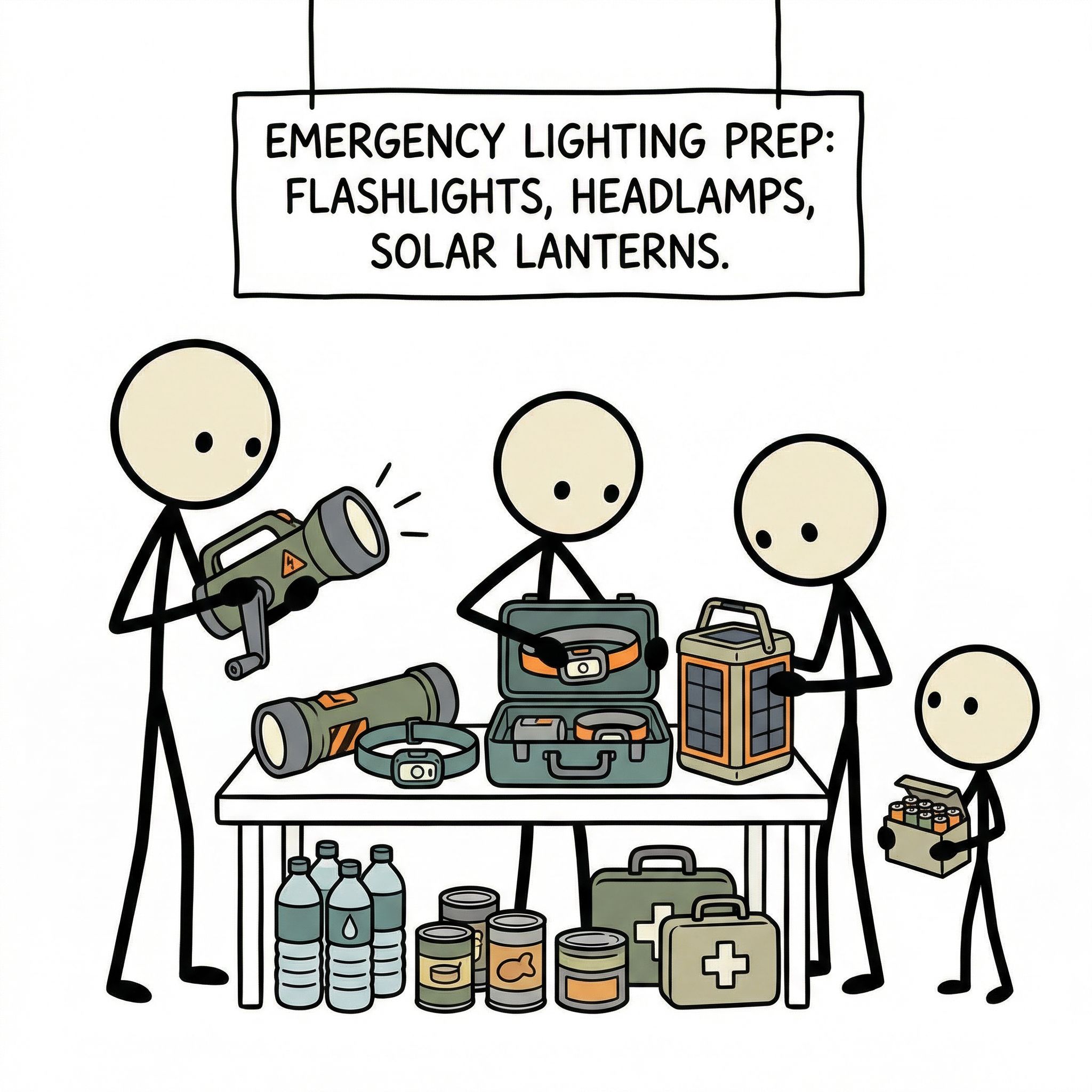
When most people think of emergency lighting, the traditional handheld flashlight is the first tool that comes to mind. Modern LED technology has transformed the humble flashlight from a dim, battery-draining plastic tube into a rugged, high-output tactical instrument. The best survival flashlights are designed to project intense beams of light over long distances, making them the ultimate tool for search and rescue, perimeter checks, and signaling for help.
Strengths of Handheld Flashlights
The primary advantage of a handheld flashlight is raw power. Because they are not constrained by the weight limits of a device worn on your head, flashlights can house larger batteries and more powerful LED emitters. This allows for massive lumen outputs and deep, polished reflectors that can "throw" a beam hundreds of yards. If you need to identify a potential threat in your backyard or signal a first responder vehicle down the street, a tactical flashlight is unmatched.
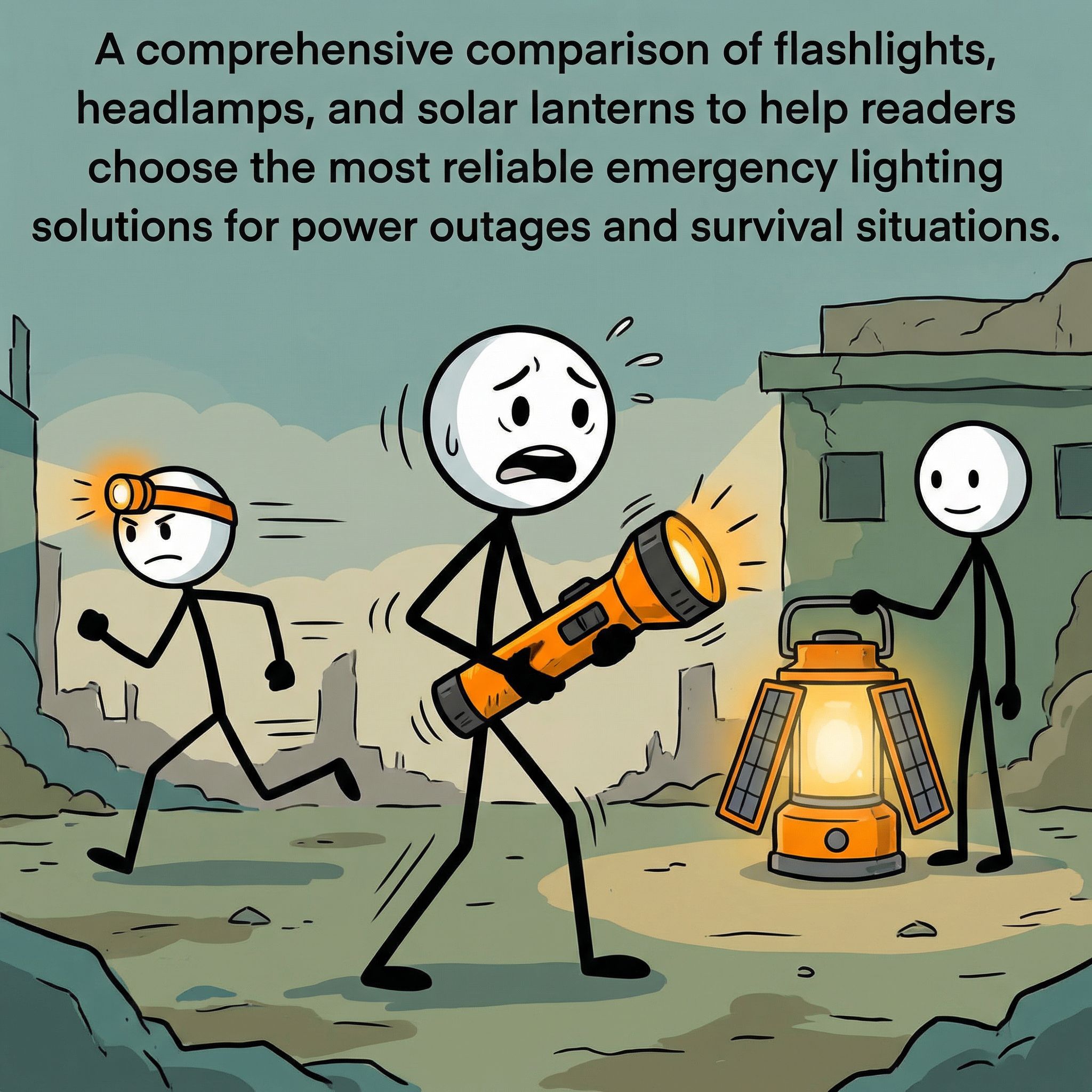
Durability is another major factor. Top-tier survival flashlights are typically milled from aerospace-grade aluminum, making them highly resistant to impact. Many are designed to serve double duty as a self-defense tool, featuring strike bezels that can shatter glass in an auto-evacuation scenario. Furthermore, handheld lights offer directional control; you can point the beam exactly where you need it without having to turn your head, which is crucial when navigating unfamiliar or debris-strewn terrain.
Weaknesses and Limitations
The most glaring drawback of a flashlight is that it occupies one of your hands. During a crisis, your hands are your most valuable assets. If you are carrying a child, applying a tourniquet, carrying water, or operating a generator, holding a flashlight becomes a severe liability. While you can tuck a flashlight under your arm or hold it in your mouth, these are temporary and highly inefficient workarounds.
Additionally, high-output flashlights can quickly burn through batteries if left on their maximum settings. The intense, focused beam that makes them great for outdoor navigation can also create harsh, blinding reflections when used indoors, ruining your natural night vision.
What to Look For in a Survival Flashlight
- Variable Modes: Look for lights with multiple brightness settings. A "firefly" or "moonlight" mode (1-5 lumens) can run for weeks on a single battery, which is vital for long-term power outages.
- Dual-Fuel Capability: The best survival flashlights can accept multiple battery types, such as a rechargeable 18650 lithium-ion battery or standard CR123A primary lithium cells. This flexibility is critical when local supply chains fail.
- IPX8 Waterproof Rating: Disasters often involve water. Ensure your flashlight is rated IPX8, meaning it can survive continuous submersion in water deeper than 1 meter.
- Tail-Cap Switch: In high-stress situations, fine motor skills degrade. A large, tactile button on the tail of the flashlight is easier to operate in the dark or while wearing heavy gloves than a small side switch.
Survival Headlamps: Hands-Free Efficiency
If flashlights are the powerhouses of your emergency kit, survival headlamps are the workhorses. Worn on the forehead via an adjustable strap, a headlamp directs light exactly where you are looking, leaving both hands completely free. For any active task during a blackout, a headlamp is arguably the most important piece of lighting gear you can own.
Strengths of Wearable Headlamps
The CDC emphasizes that fall prevention is critical during grid failures. A headlamp allows you to use handrails while navigating dark stairwells, significantly reducing injury risk. Beyond safety, hands-free lighting is essential for practical survival tasks. Whether you are bandaging a wound, chopping firewood, cooking over a camp stove, or reading an emergency radio manual, a headlamp makes the job exponentially easier.
Modern survival headlamps are incredibly lightweight and efficient. Because they are designed for close-to-medium range work, they typically utilize "flood" beams rather than focused "spot" beams. This creates a wide, smooth wash of light that illuminates your immediate surroundings without creating a disorienting tunnel-vision effect.
Weaknesses and Limitations
Because they must be comfortable to wear for extended periods, headlamps cannot carry the massive battery banks found in heavy-duty flashlights. This generally limits their maximum lumen output and total battery life on high settings. While a headlamp is perfect for navigating a trail or a dark house, it lacks the throw distance required to spot a street sign from a distance or signal a helicopter.
Another minor drawback is the "blinding effect" in group settings. Because the light follows your gaze, turning to speak to a family member while wearing a headlamp will shine the beam directly into their eyes. Proper etiquette and utilizing adjustable tilt brackets are necessary to avoid blinding your companions.
What to Look For in a Survival Headlamp
- Red Light Mode: This is a non-negotiable feature for survival headlamps. Red light does not cause your pupils to constrict, allowing you to preserve your natural night vision. It is also less visible from a distance (important for operational security) and attracts fewer insects.
- Regulated Output: Cheaper headlamps gradually dim as the battery drains. Regulated headlamps maintain a constant brightness level until the battery is nearly depleted, ensuring consistent visibility.
- Lockout Feature: A headlamp is useless if it accidentally turns on inside your Go-Bag Builder and drains the battery. Look for a physical or electronic lockout mode that prevents accidental activation.
- Comfort and Weight Distribution: For extended wear, consider headlamps that place the battery pack at the rear of the strap. This balances the weight and prevents the light from sliding down your forehead during rigorous activity.
Emergency Solar Lanterns: Sustainable Area Illumination
While flashlights and headlamps are designed for movement and action, emergency solar lanterns are designed for stationary endurance. When a power outage stretches from hours into days, constantly running battery-powered directional lights is inefficient and psychologically exhausting. You need ambient, room-filling light to recreate a sense of normalcy. This is where solar lanterns excel.
Strengths of Solar Lanterns
The most significant advantage of emergency solar lanterns is their absolute independence from the power grid and finite battery supplies. Equipped with built-in photovoltaic panels, these lanterns can be recharged daily by simply placing them in direct sunlight. In a long-term grid-down scenario, where alkaline batteries are sold out and the fuel for your generator has run dry, a solar lantern guarantees you will have light every single night.
Solar lanterns provide 360-degree ambient light, making them the perfect alternative to dangerous open flames. The American Red Cross responds to thousands of home fires every year caused by candles used during power outages. Solar lanterns eliminate this risk entirely, making them incredibly safe to use around children, pets, and flammable emergency supplies. Furthermore, many modern solar lanterns are collapsible or inflatable, taking up almost no space in a bug-out bag or emergency bin.
Weaknesses and Limitations
The reliance on the sun is a double-edged sword. If a power outage is caused by a multi-day hurricane, blizzard, or heavy overcast weather, your ability to recharge a solar lantern will be severely hampered. Solar panels require direct, unobstructed sunlight to charge efficiently; charging through a tinted window on a cloudy day can take exponentially longer than the manufacturer claims.
Additionally, solar lanterns are strictly for stationary area lighting. They are entirely unsuited for navigation. Carrying a glowing orb in front of you destroys your night vision and fails to cast light far enough ahead to reveal obstacles. They are also generally less durable than milled aluminum flashlights, particularly the inflatable PVC models, which can be punctured by sharp debris.
What to Look For in an Emergency Solar Lantern
- USB Pass-Through Charging: The best emergency solar lanterns feature dual charging capabilities. They can be charged via the sun, but also via USB when power is available. More importantly, many can act as a power bank, allowing you to siphon their battery power to charge a dying smartphone in an emergency.
- Diffused Enclosures: Look for lanterns with frosted or matte enclosures rather than clear plastic. Diffused light is much softer on the eyes and reduces harsh shadows in a room.
- Collapsible Design: Space is at a premium in any emergency kit. Inflatable or accordion-style lanterns pack flat, allowing you to store multiple units in a small footprint.
- Battery Capacity Indicators: A visual LED indicator showing how much charge the lantern holds is critical for managing your power consumption throughout the night.
The Science of Power Outage Lighting: Lumens, Batteries, and Durability
To fully utilize this emergency lighting guide, you must understand the technical specifications that separate professional-grade survival gear from cheap novelty lights. Manufacturers often use marketing jargon to sell inferior products. By understanding lumens, battery chemistry, and ingress protection, you can make informed, data-driven decisions.
Understanding Lumens and Beam Distance
A lumen is a unit of measurement that quantifies the total amount of visible light emitted by a source. However, chasing the highest lumen count is a common beginner mistake. A 2,000-lumen flashlight will drain its battery in minutes and generate excessive heat. For practical power outage lighting, efficiency is key.
For close-up tasks like reading or cooking, 10 to 50 lumens is perfectly adequate. For walking around a dark house or navigating a clear trail, 100 to 300 lumens is ideal. High outputs of 500 to 1,000+ lumens should be reserved strictly for brief moments of identifying distant objects or signaling. Pay attention to the "candela" rating as well; while lumens measure total light, candela measures the peak intensity of the beam. A light with high candela will throw a focused beam much further, even if the total lumen count is relatively low.
Battery Chemistry: The Lifeblood of Your Light
The type of battery your light uses will dictate its reliability in extreme conditions. The USGS warns that severe winter weather profoundly impacts infrastructure and equipment. Standard alkaline batteries (like everyday AAs and AAAs) suffer massive voltage drops in freezing temperatures. Worse, alkaline batteries are notorious for leaking corrosive acid when stored for long periods, potentially destroying your emergency flashlight from the inside out.
For survival applications, lithium is the gold standard. Primary (non-rechargeable) lithium batteries, such as the CR123A or Energizer Ultimate Lithium AAs, have a 10-year shelf life, do not leak, and perform exceptionally well in sub-zero temperatures. For rechargeable systems, Lithium-Ion (Li-ion) batteries, particularly the 18650 and 21700 cells, offer incredible energy density and long runtimes. The ideal emergency light is "dual-fuel," capable of running on a rechargeable Li-ion battery for daily use, but able to accept primary lithium cells as a backup when charging is impossible.
Durability and IPX Ratings
Disasters are chaotic, wet, and dirty. Your lighting equipment must be able to survive being dropped on concrete, submerged in floodwaters, or covered in mud. The ANSI FL1 standard is a set of guidelines used by reputable manufacturers to test and rate their lights.
When reviewing specifications, look closely at the Ingress Protection (IP) rating. An IPX4 rating means the light is only splash-resistant—fine for a light drizzle, but inadequate for serious storms. An IPX7 rating ensures the light can survive being submerged in one meter of water for 30 minutes. For ultimate reliability, seek out IPX8 rated gear, which guarantees continuous operation underwater. Impact resistance is also tested under the ANSI standard; a quality survival light should be rated to survive a drop of at least 1.5 meters onto a solid surface.
Building Your Ultimate Emergency Lighting System
Now that we have compared the strengths and weaknesses of the best survival flashlights, survival headlamps, and emergency solar lanterns, it is time to build your strategy. Relying on a single light source is a recipe for failure. The military and emergency management agencies preach the rule of "Two is one, and one is none." Redundancy is the cornerstone of preparedness.
To secure your home for the next grid failure, you should implement a "Layered Lighting Strategy." This approach ensures that you have the right tool for every specific phase of an emergency.
Layer 1: Personal Task Lighting (The Headlamp)
Every member of your household should have their own dedicated headlamp. This is your primary tool for action. Keep it accessible—perhaps looped around the bedpost or inside your nightstand drawer. If an earthquake or severe storm knocks out the power in the middle of the night, you can instantly strap on the headlamp, leaving your hands free to grab your family, your communication devices, and your bug-out bags. Ensure each headlamp is equipped with lithium batteries to prevent leakage during long-term storage.
Layer 2: Navigational and Defensive Lighting (The Flashlight)
Your household should have at least one or two high-quality, high-lumen tactical flashlights. Keep one near the primary exit of your home and another in your vehicle's emergency kit. This is the tool you will use to investigate noises outside, scan the tree line for storm damage, or signal to neighbors and first responders. Choose a model with a robust aluminum body, a tail-cap switch, and a strobe function for emergency signaling.
Layer 3: Ambient Area Lighting (The Solar Lantern)
For long-term power outages, you need sustainable area lighting to preserve your battery supplies. Store two to three emergency solar lanterns in a window that receives daily sunlight, or keep them collapsed in your emergency bin ready to be deployed. When the sun goes down, place these lanterns in central gathering areas like the kitchen or living room. They will provide the psychological comfort of a lit room, allow your family to eat and play games safely, and eliminate the severe fire hazards associated with traditional wax candles.
Maintenance and Storage Best Practices
Even the most expensive emergency lighting guide is useless if your gear is dead when you need it. Establish a routine maintenance schedule for your power outage lighting. Every six months—perhaps aligning with Daylight Saving Time—inspect all your lights. Test the switches, cycle through the modes, and check the battery compartments for any signs of corrosion. Top off all rechargeable lithium-ion batteries, as they naturally self-discharge over time. If you use alkaline batteries in any secondary gear, replace them annually regardless of use to prevent leakage.
Empowering Your Preparedness Journey
Facing a severe power outage or survival situation does not have to be a terrifying experience. Darkness only breeds fear when you are unprepared for it. By understanding the distinct advantages of handheld flashlights for powerful navigation, the hands-free efficiency of headlamps for critical tasks, and the sustainable, safe illumination of solar lanterns, you take absolute control over your environment. Investing in high-quality, reliable lighting is an investment in your family's safety, mobility, and peace of mind. Equip yourself with the right tools, maintain your gear diligently, and you will be ready to confidently navigate whatever challenges the storm brings.
Frequently Asked Questions
What is the best type of emergency lighting for a power outage?
A combination of headlamps for hands-free mobility, flashlights for focused directional beams, and solar lanterns for illuminating entire rooms is ideal for extended power outages.
How many lumens do I need for an emergency flashlight?
For general emergency use, a flashlight with 100 to 300 lumens is sufficient for navigating indoors and outdoors safely without draining the battery too quickly.
Are solar lanterns reliable during winter emergencies?
Yes, but they charge significantly slower on cloudy winter days. It is best to keep them fully charged before a storm and choose models that also feature backup USB charging or hand-crank options.
Why are headlamps recommended for survival kits?
Headlamps provide hands-free lighting, which is essential for safely performing critical tasks like administering first aid, cooking, or carrying supplies in the dark.
How often should I check the batteries in my emergency lights?
You should inspect and test the batteries in your emergency flashlights and headlamps at least every six months, replacing them as needed to ensure readiness and prevent corrosive leakage.