⚡ Key Facts
- The 72-Hour Standard: FEMA and the American Red Cross explicitly design their baseline survival guidelines around a 72-hour window, as it can take up to three days for federal and local relief workers to reach affected neighborhoods after a catastrophic event.
- Biological Limits: The human body can only survive approximately three days (72 hours) without water, making this timeframe not just a logistical guideline, but a biological absolute.
- Grid Vulnerability: During the 2021 Texas winter storm, over 4.5 million homes lost power. Millions were left without running water or heat for well over 72 hours, proving that modern infrastructure can collapse overnight.
- The Preparedness Gap: Despite 80% of Americans living in counties that have experienced a weather-related disaster in the past decade, studies show less than half of the population has a basic 72-hour survival plan in place.
For radiological events, the first 72 hours have their own rules around fallout decay, shielding, and contamination control. See Surviving a Radiation Emergency: The First 72 Hours for a focused course on that scenario.
Food Backup Skills That Support the First 72 Hours
After water and a basic 72-hour kit, close the food-access gaps that break real emergency plans. Learn how to open a can without a can opener, compare whether a home freeze dryer is worth it for preppers, and add safe wild-food awareness with the plantain weed identification guide.
First 72 Hours: Fast Action Path
The query behind this page is simple: 72 hours is 3 days. In preparedness terms, those three days are the bridge between a normal household and delayed outside help. Start with the 72-hour rule guide, then build skills through the free Catastrophe Survival 101 course.
For the practical kit, use the 72-hour kit guide, calculate supplies with the supply calculator, and set water targets with the water calculator.
Quick Answer: What Is the 72-Hour Rule?
The 72-hour rule means your household should be able to handle the first rule of threes of a disruption without outside help. That does not mean help always arrives after exactly 72 hours. It means the first three days are when water, food, light, medical needs, communication, warmth, and family coordination matter most.
For a practical 72-hour kit, prepare at least three days of water, ready-to-eat food, first aid, medication, phone power, lights, radio, sanitation supplies, weather layers, documents, and a simple family plan.
Start with the Supply Calculator, then build mobile essentials in the Go-Bag Builder and connect the plan to the Emergency Preparedness Guide.
72-Hour Kit Checklist
- Water: at least one gallon per person per day, plus filtration or purification backup.
- Food: ready-to-eat meals, no-cook foods, snacks, and a manual can opener.
- Medical: first aid kit, prescriptions, copies of medical info, glasses, and allergy supplies.
- Light and power: headlamps, flashlights, batteries, power banks, and charging cables.
- Communication: battery or hand-crank radio, printed contacts, local meetup plan, and cash.
- Shelter and warmth: blankets, rain layers, gloves, hats, and safe backup heat planning.
Why the First 72 Hours Matter
In February 2021, Winter Storm Uri slammed into Texas. The state’s power grid, completely unprepared for the deep freeze, buckled under the strain. Within hours, over 4.5 million homes were plunged into darkness. As temperatures plummeted into the single digits, the cascading effects began: water pipes shattered, grocery store shelves were stripped bare, and gas stations went dark. People resorted to burning their own furniture in their living rooms just to keep their children from freezing.
For a broader playbook, use our real-world emergency scenarios guide to turn these steps into a practical plan.
For millions of Texans, the illusion of modern safety vanished in an instant. Emergency services were paralyzed. 911 operators were overwhelmed, and ambulances couldn't navigate the ice-choked roads. If you needed help, you were entirely on your own.
This wasn't a scene from a dystopian movie; it was a stark, real-world reminder of a fundamental truth in emergency management: when a true catastrophe strikes, the cavalry is not coming to save you right away. You are your own first responder. This harsh reality is the foundation of the 72-Hour Rule.
Whether you are facing a hurricane, a massive earthquake, a wildfire, or a sudden grid collapse, the first three days are the crucible. How you prepare for, and navigate, these critical 72 hours will largely dictate whether you become a survivor or a statistic. Proper disaster preparedness isn't about paranoia; it is an insurance policy for your life. Let's break down exactly why the 72-hour window is so critical, and how you can build a comprehensive 72-hour survival plan to protect yourself and your family.
Why 72 Hours? The Math of Disaster Response
You might wonder why emergency organizations like FEMA and the Red Cross obsess over the number 72. Why not 24 hours? Why not a week? The answer lies in the harsh logistics of disaster response and the fragility of human biology.
First, consider local infrastructure. Your city’s emergency services-police, fire, and EMS-are scaled to handle everyday emergencies. They are designed to manage a few house fires, a handful of car accidents, and routine medical calls. They are absolutely not scaled to handle a systemic collapse where tens of thousands of people need help simultaneously. When a SHTF hits, local resources are instantly overwhelmed.
Second, consider the physical environment. A major earthquake destroys bridges and overpasses. A hurricane floods highways and downs power lines. A blizzard makes roads impassable. Even if federal aid is mobilized immediately, heavy equipment must be brought in to clear paths before supply trucks and rescue personnel can reach ground zero. Bureaucracy, damage assessment, and mobilization take time. Historically, it takes a minimum of three days for external, large-scale relief logistics to establish a foothold in a devastated area.
Finally, there is the biological clock. The "Rule of Threes" in survival states that you can survive three minutes without oxygen, three hours in extreme environments without shelter, three days without water, and three weeks without food. The 72-hour mark is the absolute limit of human endurance without hydration. If rescue takes longer than three days and you haven't prepared, your body will simply begin to shut down.
Water: The Absolute Priority
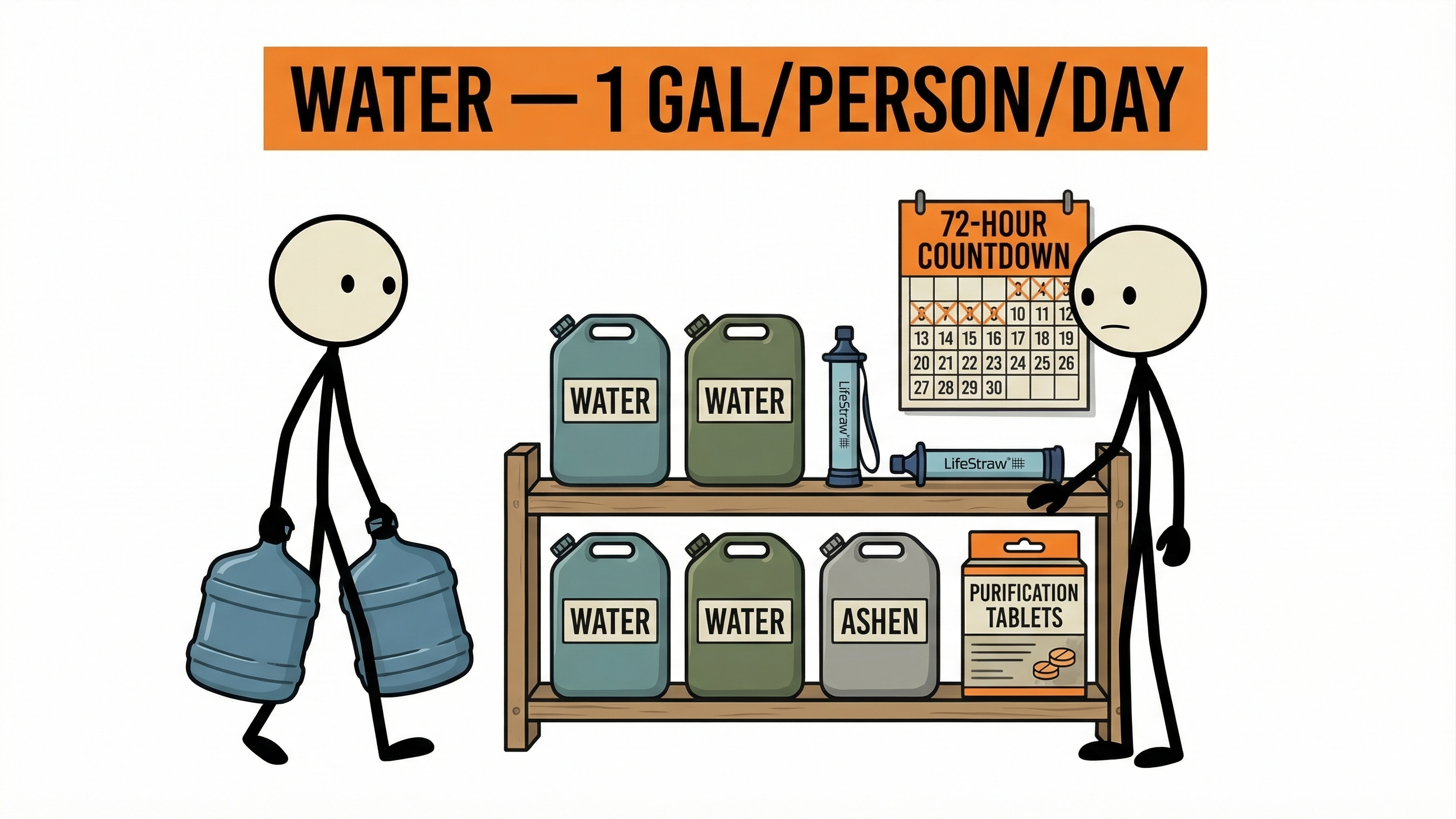
If you only take one piece of advice from this guide, let it be this: store more water. In the hierarchy of survival needs, water trumps almost everything else. When the power grid fails, municipal water treatment plants often fail with it. Even if water still flows from your tap, it may be contaminated, leading to "boil water" advisories-which are useless if you have no way to boil water.
The Baseline Requirement: The golden rule for a 72-hour emergency kit is one gallon of water per person, per day, and a broader emergency preparedness gear guide can help you verify the rest of your baseline supplies before you build around water. For a three-day period, that means an absolute minimum of three gallons per person. This accounts for drinking and very basic hygiene. However, if you live in a hot climate, or if you are pregnant, nursing, or exerting physical energy (like clearing debris), you will need significantly more. Don't forget your pets-they need about an ounce of water per pound of body weight daily.
Storage Solutions: Relying on a few flimsy plastic water bottles from the grocery store is a mistake. They degrade over time and are prone to leaking. Instead, invest in heavy-duty, BPA-free water storage containers like Aqua-Tainers (which hold 7 gallons each) or military-style Jerry cans. If you have advanced warning of an impending disaster-like a hurricane-use a WaterBOB. This is a heavy-duty food-grade plastic bladder that lines your bathtub and can hold up to 100 gallons of tap water, keeping it safe from dirt and soap residue.
Purification Backup: Stored water is great, but you must also have a way to make dirty water drinkable. Your 72-hour survival plan should include multiple methods of water filtration and purification.
- Filtration: Keep a Sawyer Squeeze or LifeStraw Family in your kit. These micro-filters can remove 99.9999% of waterborne bacteria and protozoa from questionable water sources.
- Chemical Purification: Keep water purification tablets (like Potable Aqua) or a small dropper bottle of regular, unscented household bleach. (The EPA recommends 8 drops of 6% bleach per gallon of clear water; let it sit for 30 minutes before drinking).
- Boiling: If you have a camp stove, bringing water to a rolling boil for one minute (three minutes at high altitudes) is a foolproof way to kill pathogens.
Food: Fuel for the Fight
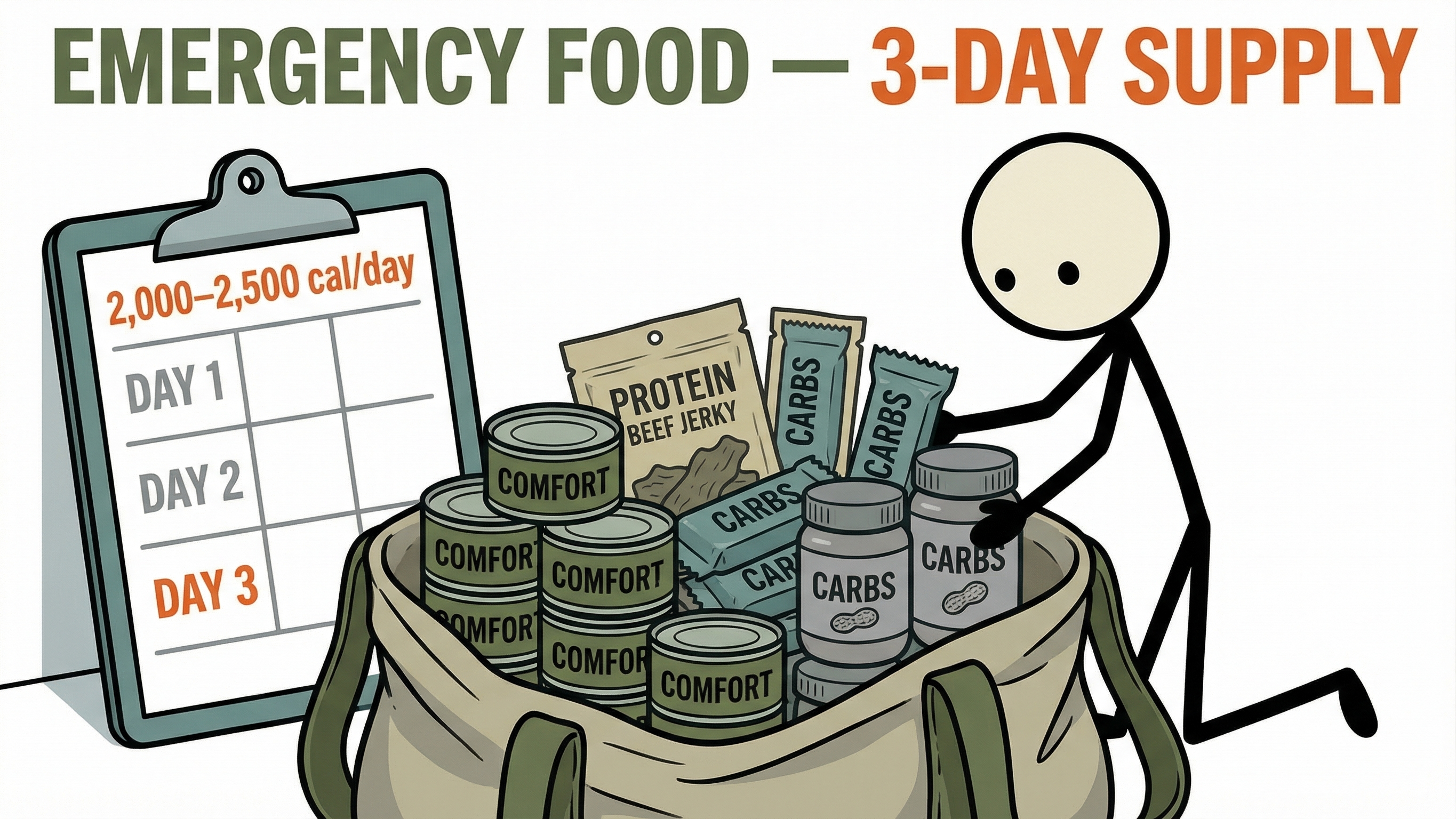
While you can technically survive three weeks without food, trying to navigate a high-stress, physically demanding disaster scenario on an empty stomach is a recipe for disaster. Hunger causes fatigue, impairs cognitive function, and leads to poor decision-making. A well-thought-out emergency food supply is essential for keeping your energy and morale high.
Caloric Density is King: When building your 72-hour emergency kit, forget about diet plans. You need calories, and you need them in a compact, durable format. Aim for a minimum of 2,000 to 2,500 calories per person, per day. Stress and physical exertion will cause your body to burn through fuel much faster than a normal day at the office.
The "No-Cook" Foundation: The core of your three-day supply must be food that requires zero cooking, zero preparation, and zero added water. If your gas is shut off and you are sheltering in the dark, you need to be able to open a package and eat immediately. Excellent options include:
- High-calorie protein bars and meal replacement bars (like Cliff bars or SOS emergency rations).
- Peanut butter or almond butter (incredibly calorie-dense and rich in healthy fats).
- Beef jerky and canned meats (tuna, chicken, Spam).
- Trail mix, mixed nuts, and dried fruit.
- Canned beans and chili (do not forget to pack a heavy-duty manual can opener!).
Freeze-Dried and MREs: If you have a reliable way to boil water (such as a Jetboil or a small butane camp stove), freeze-dried meals from brands like Mountain House or Peak Refuel are excellent additions to your emergency food supply. They are lightweight, have a 25-year shelf life, and provide a hot, comforting meal which can significantly boost morale. Military MREs (Meals Ready-to-Eat) are another option; they come with their own flameless ration heaters, though they are heavier and can be tough on the digestive system if eaten exclusively.
Rotation is Vital: Emergency food is not a "set it and forget it" investment. Even canned goods expire. Make it a habit to audit your food supply every six months-perhaps when you change your clocks for daylight saving time. Eat the food that is nearing its expiration date and replace it with fresh stock. This practice, known as "first in, first out" (FIFO), ensures your supply is always ready when you need it.
First Aid and Trauma: Beyond the Band-Aid
Most people think they are medically prepared because they have a plastic box under their sink containing some adhesive bandages, a tube of Neosporin, and some expired aspirin. In a localized disaster where paramedics are just a 911 call away, that might suffice. In a 72-hour grid-down scenario where ambulances cannot reach you, a "boo-boo kit" is woefully inadequate.
You must prepare for severe trauma. Earthquakes cause structural collapses. Hurricanes turn debris into flying shrapnel. Panicked evacuations lead to severe car accidents. Your medical kit must be designed to stop massive bleeding and stabilize a patient until definitive care becomes available.
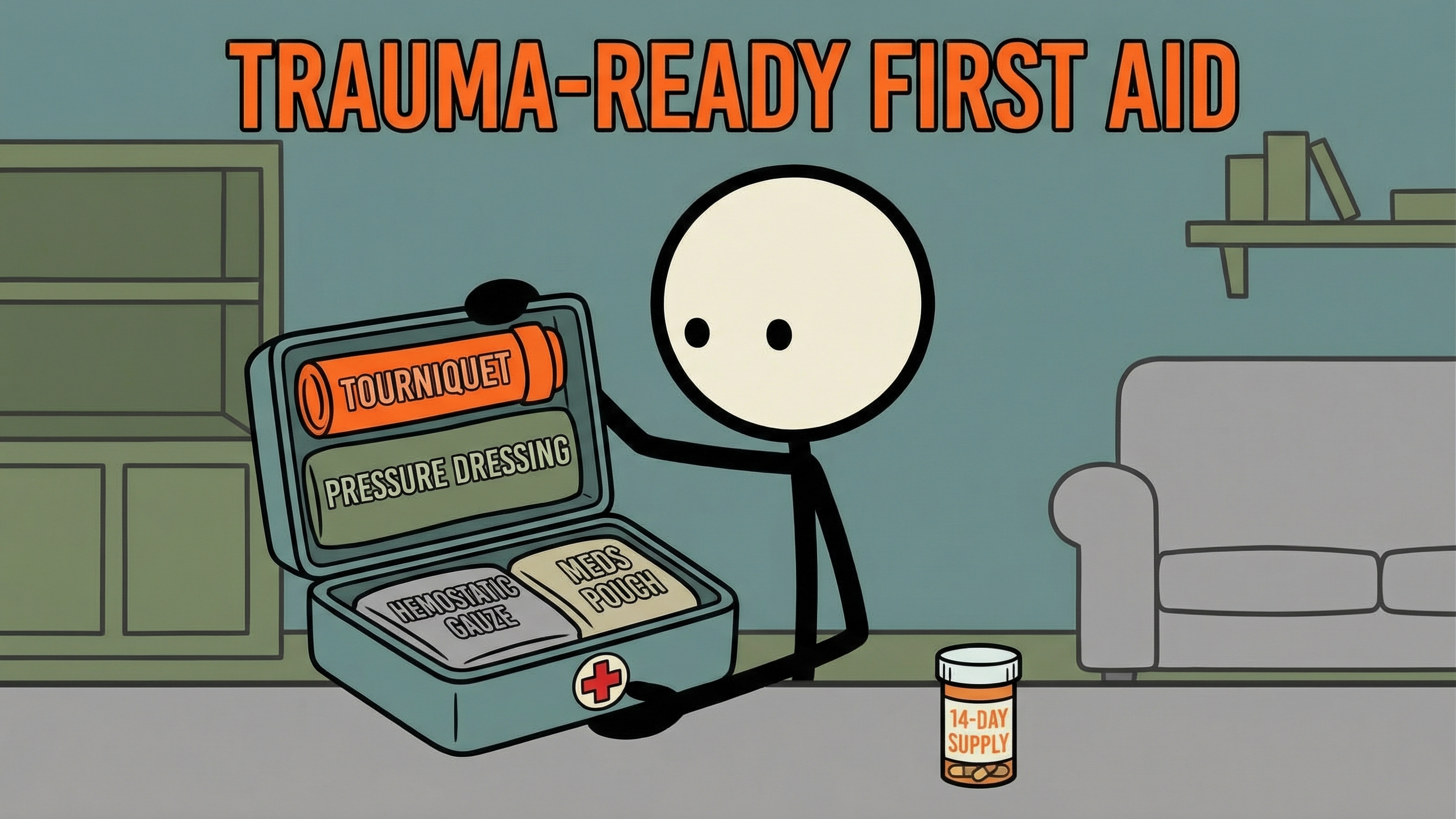
The Trauma Kit (IFAK): Your 72-hour survival plan must include an Individual First Aid Kit (IFAK) focused on the MARCH algorithm (Massive hemorrhage, Airway, Respiration, Circulation, Hypothermia). Essential trauma items include:
- Tourniquets: The single most important life-saving device for arterial bleeding. Buy only CoTCCC-approved tourniquets, such as the North American Rescue CAT (Combat Application Tourniquet) or the SOF-T. Beware of cheap Amazon knock-offs; they will snap under pressure when you need them most.
- Hemostatic Gauze: Dressings impregnated with clotting agents (like QuikClot or Celox) to pack deep wounds where a tourniquet cannot be applied (e.g., groin or armpit).
- Pressure Dressings: Such as the Israeli Battle Dressing (IBD), which combines a sterile pad with an elastic bandage and a pressure bar to clamp down on bleeding.
- Chest Seals: Vented seals used to treat penetrating chest wounds and prevent tension pneumothorax.
Everyday Medications and OTCs: Beyond trauma, you must manage chronic conditions and everyday ailments. A minor case of diarrhea can become fatal in a survival situation due to rapid dehydration. Pack a comprehensive supply of Over-The-Counter (OTC) meds: ibuprofen for pain/inflammation, loperamide (Imodium) for diarrhea, diphenhydramine (Benadryl) for allergic reactions, and broad-spectrum antibiotics if you have legal access to them.
Crucially, stockpile a minimum of a 7-to-14 day backup of any life-saving prescription medications you or your family members take (insulin, heart medication, asthma inhalers). Pharmacies will be closed, looted, or unable to process insurance claims during a major disaster.
Shelter, Warmth, and Off-Grid Power
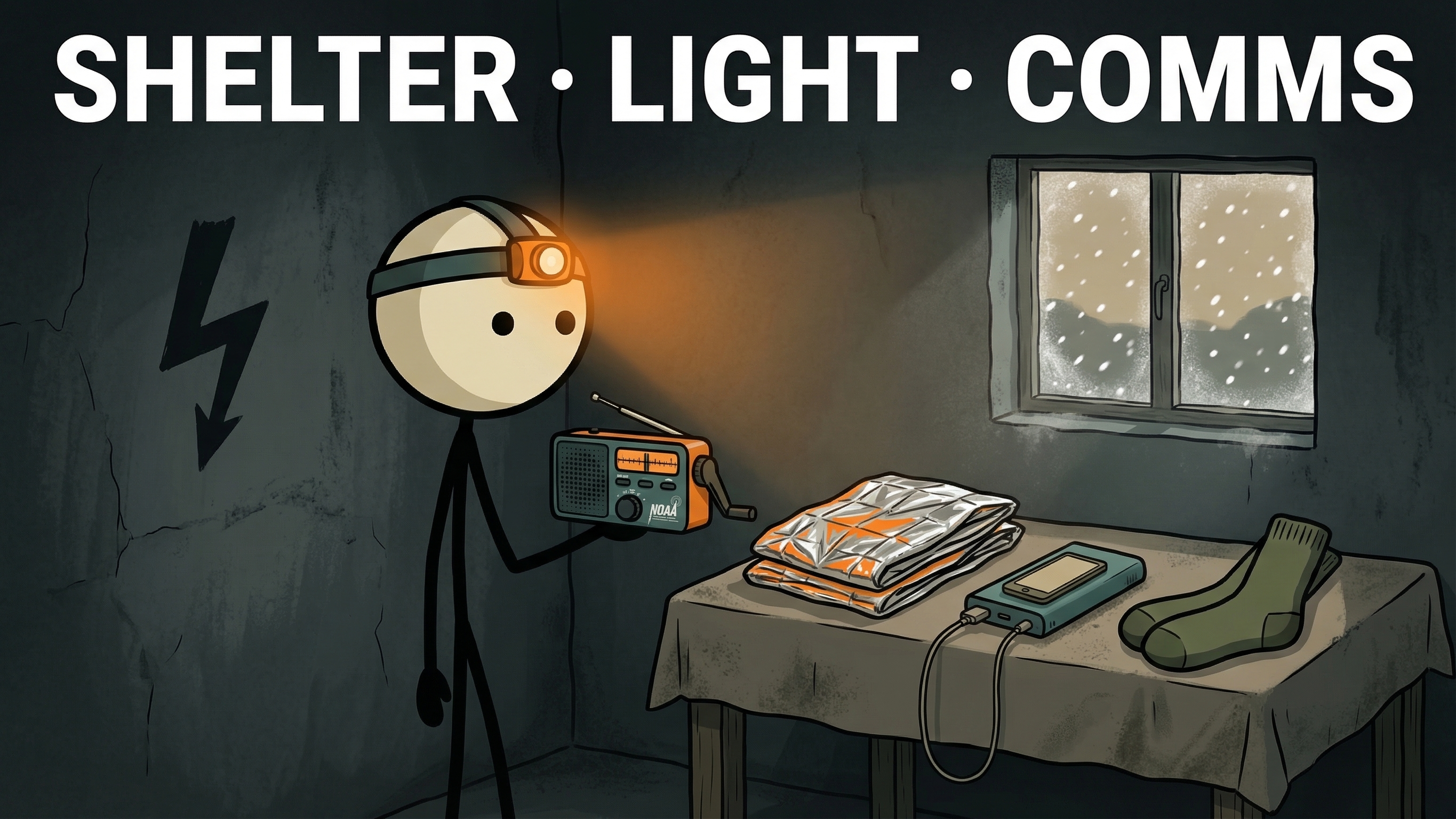
Exposure is a silent, rapid killer. Depending on your environment, hypothermia or hyperthermia can kill you much faster than dehydration. Your 72-hour emergency kit must account for maintaining your core body temperature, whether you are sheltering in place in a freezing home or evacuating on foot in the blistering sun.
Sheltering in Place: If the power goes out during winter, your home will rapidly lose heat. You need to create a "micro-climate." Choose one small, interior room of your house-preferably with few windows-and have everyone, including pets, sleep in that room. Body heat will raise the ambient temperature. You can even pitch a camping tent inside the room for an additional layer of insulation. Seal off doors and windows with heavy blankets or plastic sheeting and duct tape to prevent drafts. Ensure you have high-quality, zero-degree sleeping bags and wool blankets. Never burn charcoal or use unvented gas generators indoors, as carbon monoxide poisoning is a leading cause of death following winter storms.
The Evacuation Go-Bag: If you are forced to flee, your shelter needs to be portable. Every go-bag should contain an emergency bivvy (a sleeping bag made of heat-reflective mylar), a durable waterproof tarp, and 550 paracord to rig a hasty shelter. Clothing is your first line of shelter. Pack sturdy hiking boots, wool socks (cotton kills because it loses all insulation properties when wet), moisture-wicking base layers, and a waterproof outer shell.
Off-Grid Power and Information: Information is as vital as water in a disaster. You need to know where the storm is moving, where the evacuation routes are, and when help is coming.
- NOAA Weather Radio: A hand-crank or battery-operated emergency radio is non-negotiable. Look for one that receives NOAA weather alerts and has built-in solar charging and a flashlight.
- Power Banks: Keep high-capacity lithium-ion power banks (20,000mAh or higher) fully charged to keep your smartphones alive. Even if cell towers are down, your phone holds downloaded offline maps, survival guides, and family photos.
- Lighting: Headlamps are vastly superior to flashlights because they keep your hands free to work, carry children, or render first aid. Pack extra lithium batteries, as they perform better in extreme cold than alkaline batteries.
The Family Action Plan: Chaos Mitigation
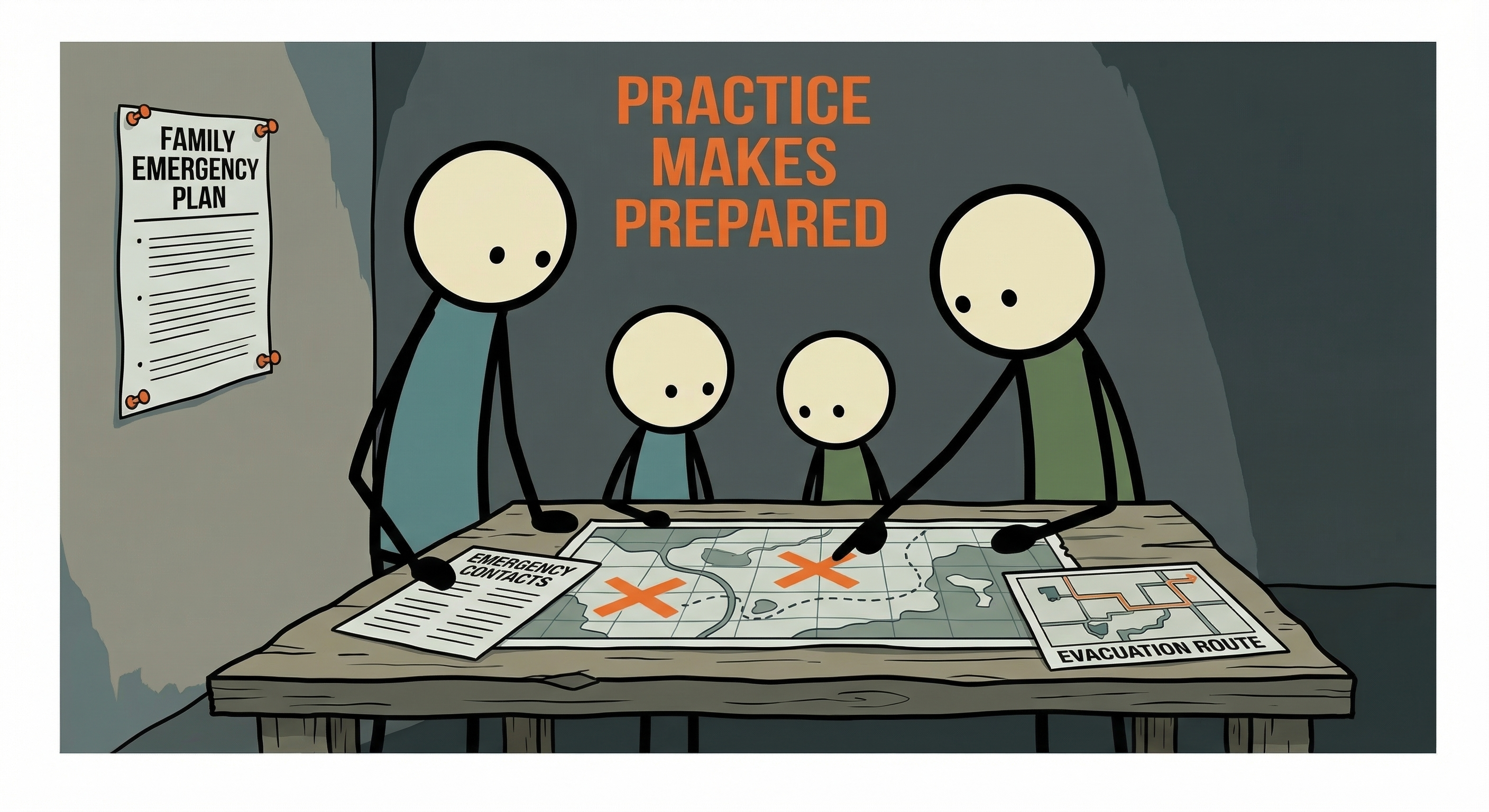
You can buy the best emergency food supply, the most expensive water filters, and professional-grade trauma gear, but if you do not have a cohesive family plan, chaos will reign. Disasters rarely happen when everyone is conveniently sitting together in the living room. They happen at 2:00 PM on a Tuesday when you are at the office, your spouse is at the grocery store, and your kids are at two different schools.
Communication Protocols: During a mass emergency, local cell towers will either lose power or become completely jammed by millions of people trying to make calls simultaneously. Voice calls will likely fail. However, text messages require significantly less bandwidth and will often "piggyback" their way through the network when voice calls cannot. Teach your family to text, not call.
The Out-of-State Contact: Because local networks get jammed, long-distance lines are often clearer. Designate one trusted person who lives out of state-an aunt in Ohio, a brother in Florida-to be your family's central communications hub. If family members are separated, everyone checks in with the out-of-state contact to report their status and location, and that contact relays the information to the rest of the family.
Rally Points: If you cannot communicate, you need pre-established physical meeting locations. Establish three distinct rally points:
- Immediate: Right outside your home (e.g., the mailbox or a specific neighbor's driveway) in case of a sudden house fire.
- Neighborhood: A location within walking distance (e.g., a local park or community center) if your street is inaccessible.
- Regional: A location outside of your immediate town (e.g., a relative's house 50 miles away) in case of a city-wide mandatory evacuation.
Write these locations, along with important phone numbers, on physical index cards and laminate them. Put one in every family member's go-bag and wallet. You cannot rely on a dead smartphone for your emergency contacts.
Three Fatal Mistakes to Avoid
As you build your 72-hour survival plan, be highly aware of the common pitfalls that trap even well-intentioned preppers. Avoiding these three fatal mistakes can be the difference between life and death.
1. Normalcy Bias
Normalcy bias is a psychological state where people underestimate both the likelihood of a disaster and its potential effects. It is the voice in your head that says, "That only happens on the news, it won't happen here." This bias paralyzes people. Overcoming it requires a conscious acceptance that bad things can and do happen, and that preparing for them is a rational, responsible act.
2. The "I'll Just Figure It Out" Fallacy
Buying gear is easy; acquiring skills is hard. Having a tourniquet is useless if you don't know how to apply it under extreme stress. Having a water filter is pointless if you've never back-flushed it and it clogs on the first use. You must practice with your gear. Turn off your home's main breaker for a weekend and see how your family functions. Go camping with only the items in your go-bag. Practice reveals the holes in your 72-hour survival plan before your life depends on it.
3. Packing Too Heavy
When building an evacuation go-bag, the temptation is to pack for every conceivable scenario, resulting in a 60-pound monster that you can barely lift, let alone carry for miles over rough terrain. A go-bag is not meant to sustain you forever; it is meant to keep you alive for 72 hours while you move from point A to point B. A good rule of thumb is that your go-bag should weigh no more than 15% to 20% of your total body weight. Stick to the absolute essentials: water, high-calorie food, shelter, trauma medicine, and off-grid comms.
Next Steps: Start Building Your Foundation Today
Looking at the sheer scope of disaster preparedness can feel overwhelming. The key is not to panic, but to act. You do not need to buy thousands of dollars worth of gear overnight. Preparedness is a journey of incremental steps.
Start today. The next time you are at the grocery store, buy three extra gallons of water and slide them under your bed. Pick up a few extra cans of chili and a jar of peanut butter. Order a high-quality tourniquet and watch a medical training video on how to apply it. Sit down with your family over dinner tonight and designate your out-of-state contact and your neighborhood rally point.
By taking these small, deliberate actions, you are shifting from a mindset of vulnerability to one of resilience. The 72-Hour Rule is an unforgiving reality of modern disasters, but it is a reality you can conquer. When the grid fails, when the sirens sound, and when the first three days decide everything, you will not be a victim waiting for rescue. You will be ready.
Next Step
Use the Supply Calculator to size your first 72 hours, then turn the mobile portion into a bag with the Go-Bag Builder.
Frequently Asked Questions
Is 72 hours the same as 3 days?
Yes. Seventy-two hours equals three days. In preparedness, it usually means having enough supplies and planning to function for the first three days of an emergency without outside help.
Why are the first 72 hours important?
The first 72 hours are when normal systems may be disrupted but organized help may not yet be available everywhere. Water, food, medication, lighting, communication, sanitation, and family coordination are the highest priorities.
What should be in a 72-hour kit?
A 72-hour kit should include water, ready-to-eat food, first aid, medications, flashlight or headlamp, batteries, phone power, radio, sanitation items, weather layers, copies of key documents, cash, and a family contact plan.
How much water do you need for 72 hours?
Use at least one gallon per person per day. For 72 hours, that is three gallons per person as a minimum, with more for heat, medical needs, pets, hygiene, and cooking.
Does the 72-hour rule mean I only need three days of supplies?
No. A 72-hour kit is the baseline. It helps you survive the first shock of an event, but resilient households should build toward two weeks, one month, and eventually longer-term water, food, medication, and power plans.
Sources & Further Reading
- Build A Kit - Ready.gov (U.S. Department of Homeland Security)
- Prepared, Not Scared: Disaster Preparedness Guide - FEMA
- Survival Kit Supplies - American Red Cross
- Emergency Preparedness & Response - Centers for Disease Control and Prevention (CDC)
- Winter Storm Power Outage Safety - National Weather Service / NOAA
Related resource: Catastrophe Survival 101 Course.
Related resource: Family & Community Resilience Course.
Related resource: Scenario Deep Dives Course.
Related resource: Family Emergency Planning Guide.
Related resource: Natural Disaster Survival Guide.