⚡ Key Facts
- Historical Precedent: According to the NOAA Space Weather Prediction Center, the 1859 Carrington Event represents a real-world crisis scenario. A Coronal Mass Ejection (CME). If a similar event occurred today, it could cause trillions of dollars in damage to global electrical infrastructure.
- Grid Vulnerability: The Congressional EMP Commission has repeatedly warned that a High-Altitude Electromagnetic Pulse (HEMP) could severely damage the national power grid, potentially leading to months or years of widespread outages.
- Faraday Efficacy: A properly constructed Faraday cage can achieve an attenuation level of 50 to 80 decibels (dB), effectively blocking the destructive radio frequency waves generated by an EMP.
- Holistic Readiness: FEMA and the American Red Cross recommend that households maintain at least a two-week supply of water and non-perishable food, though experts advise a minimum of 30 to 90 days of supplies for severe grid-down scenarios.
Imagine waking up to absolute silence. The familiar hum of the refrigerator is gone. The lights won't turn on, the digital clocks are blank, and your smartphone displays "No Service." When you turn the key in your car's ignition, nothing happens. This is the reality of a severe electromagnetic pulse (EMP) or a massive Coronal Mass Ejection (CME)—a sudden, catastrophic failure of the electrical grid — one of the most severe survival scenarios and the microchips that power modern life. See Scenario Deep Dives (Spanish) for additional options. See Scenario Deep Dives (Spanish) for additional options.
While Hollywood often portrays this scenario as an immediate descent into chaos, the reality of survival comes down to practical, methodical preparation — starting with a well-stocked go-bag. Understanding how to shield critical electronics and sustain your household without the grid is not about giving in to fear. A solid family emergency plan is the foundation; it is about taking control. By implementing sound scientific principles and following guidelines from agencies like FEMA and NOAA, you can insulate your family from the worst effects of an electromagnetic disaster. For a quick definition, see EMP.
This comprehensive guide will walk you through the realities of EMPs and CMEs, the physics of proper shielding, how to build your own storage solutions, which devices to prioritize, and the essential steps for holistic household resilience.
Understanding the Threat: EMPs vs. CMEs
To effectively prepare, you must first understand what you are preparing against. While often grouped together in survival discussions, an EMP and a CME are different phenomena with distinct characteristics. Recognizing these differences is the foundation of effective cme preparedness and overall electrical resilience.
High-Altitude Electromagnetic Pulse (HEMP)
A HEMP is a man-made threat, typically generated by the detonation of a nuclear device high in the atmosphere. The gamma rays from the explosion interact with the Earth's magnetic field, creating a massive burst of electromagnetic energy. The Congressional EMP Commission divides a HEMP into three distinct waves:
- E1 (The Fast Pulse): Occurring in mere nanoseconds, this is a high-frequency, incredibly intense energy wave. It is fast enough to bypass traditional surge protectors, directly destroying the delicate microchips inside computers, vehicles, communication devices, and medical equipment.
- E2 (The Intermediate Pulse): Arriving microseconds later, the E2 wave is similar to a localized lightning strike. While modern infrastructure has some protection against lightning, the E1 wave will have likely already destroyed these protective relays, leaving systems highly vulnerable to E2.
- E3 (The Slow Pulse): Lasting from tens of seconds to several minutes, the E3 wave induces massive direct currents in long electrical conductors, such as power lines. This generates immense heat, melting the massive, custom-built transformers that form the backbone of the national power grid.
Coronal Mass Ejections (CMEs)
A CME is a natural phenomenon originating from the sun. When the sun releases a massive cloud of plasma and magnetic fields, it can strike the Earth. According to the NOAA Space Weather Prediction Center, these geomagnetic storms do not produce an E1 or E2 wave. Therefore, a CME will generally not fry your smartphone, laptop, or car engine directly.
However, CMEs do produce an effect identical to the E3 wave of a HEMP. The resulting geomagnetically induced currents (GICs) can overwhelm the power grid, destroying high-voltage transformers and causing cascading blackouts. For step-by-step guidance on handling extended outages, see our power outage survival guide. The 1989 Quebec blackout, which left millions without power in a matter of seconds, was caused by a relatively mild CME. Therefore, CME preparedness primarily focuses on surviving a long-term grid failure rather than shielding personal electronics.
The Science of Shielding: How Faraday Cages Work
If an E1 pulse from a HEMP is the primary threat to your personal electronics, the faraday cage is your primary defense. Named after the 19th-century scientist Michael Faraday, a Faraday cage is an enclosure formed by conductive material. When an external electrical field (like an EMP) hits the cage, the conductive material causes the electric charges to distribute along the exterior of the cage, canceling out the field's effect on the interior.
For effective emp protection, a Faraday cage must meet two absolute requirements:
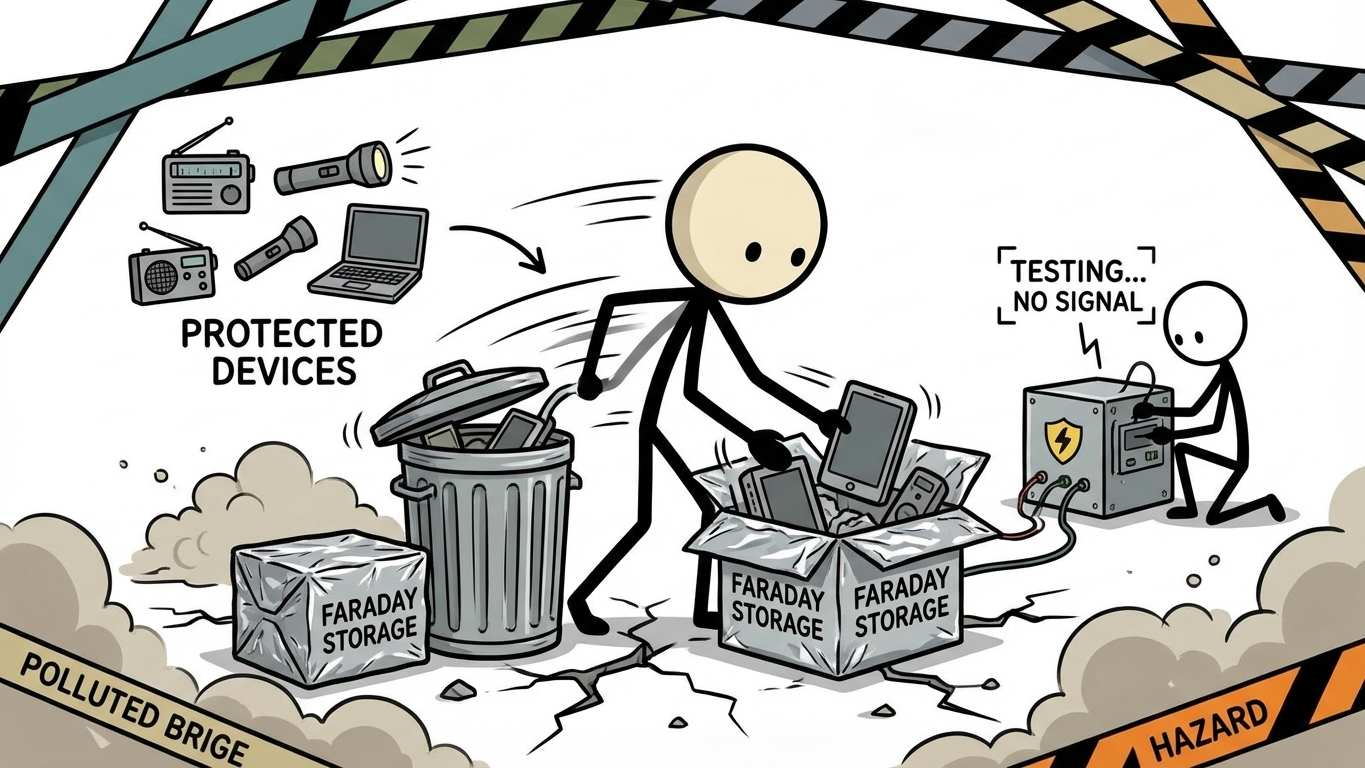
- Continuous Conductivity: The outer shell must be highly conductive and completely sealed. Even small gaps, seams, or unsealed lids can allow high-frequency radio waves to penetrate the enclosure, rendering it useless.
- Interior Insulation: The items inside the cage must never touch the conductive outer walls. If a device touches the metal exterior, the electromagnetic energy will transfer directly into the device, destroying it.
Attenuation is the metric used to measure a Faraday cage's effectiveness, expressed in decibels (dB). A reduction of 10 dB means the energy is reduced by a factor of 10. A 20 dB reduction is a factor of 100. For robust EMP protection, you should aim for an attenuation of at least 50 dB across a wide frequency range (from 1 MHz to 10 GHz).
Practical Faraday Storage Options
You do not need military-grade budgets to achieve military-grade shielding. There are several highly effective ways to protect electronics from emp events using accessible materials.
Store-Bought Faraday Bags
The market is flooded with Faraday bags made from multiple layers of metallic shielding fabric (often a blend of copper and nickel). These are excellent for small items like smartphones, USB drives, and portable hard drives. When purchasing commercial bags, look for products that specify their attenuation levels (e.g., "80 dB attenuation") and feature a double-roll Velcro closure to ensure a tight seal. However, relying solely on commercial bags for all your gear can become prohibitively expensive.
The Galvanized Trash Can (Faraday Cage DIY)
The gold standard for household faraday cage diy is the galvanized steel trash can. It is affordable, spacious, and highly effective when modified correctly. Here is how to build one:
- Select the Can: Purchase a new, tight-fitting galvanized steel trash can with a lid (typically 10 to 30 gallons). Ensure there are no dents or rust spots.
- Line the Interior: To prevent your devices from touching the metal, line the entire interior—bottom, sides, and the underside of the lid—with a non-conductive material. Cardboard is excellent and cheap. You can also use closed-cell foam, rubber mats, or heavy-duty plastic totes that fit snugly inside the can.
- Seal the Lid: The weakest point of any trash can Faraday cage is the seam where the lid meets the can. To ensure continuous conductivity, seal this gap using conductive aluminum foil tape. When you close the can, wrap the tape securely around the entire circumference of the lid seam.
Nested Faraday Cages
For critical, life-saving electronics, the best practice is "nesting"—placing a Faraday cage inside another Faraday cage. For example, you might place a ham radio inside a commercial Faraday bag, place that bag inside a cardboard box, and place that box inside your sealed galvanized steel trash can. This compounding effect significantly increases the total decibel attenuation, providing near-impenetrable protection against even the most severe E1 pulses.
Prioritizing Your Electronics: What to Protect
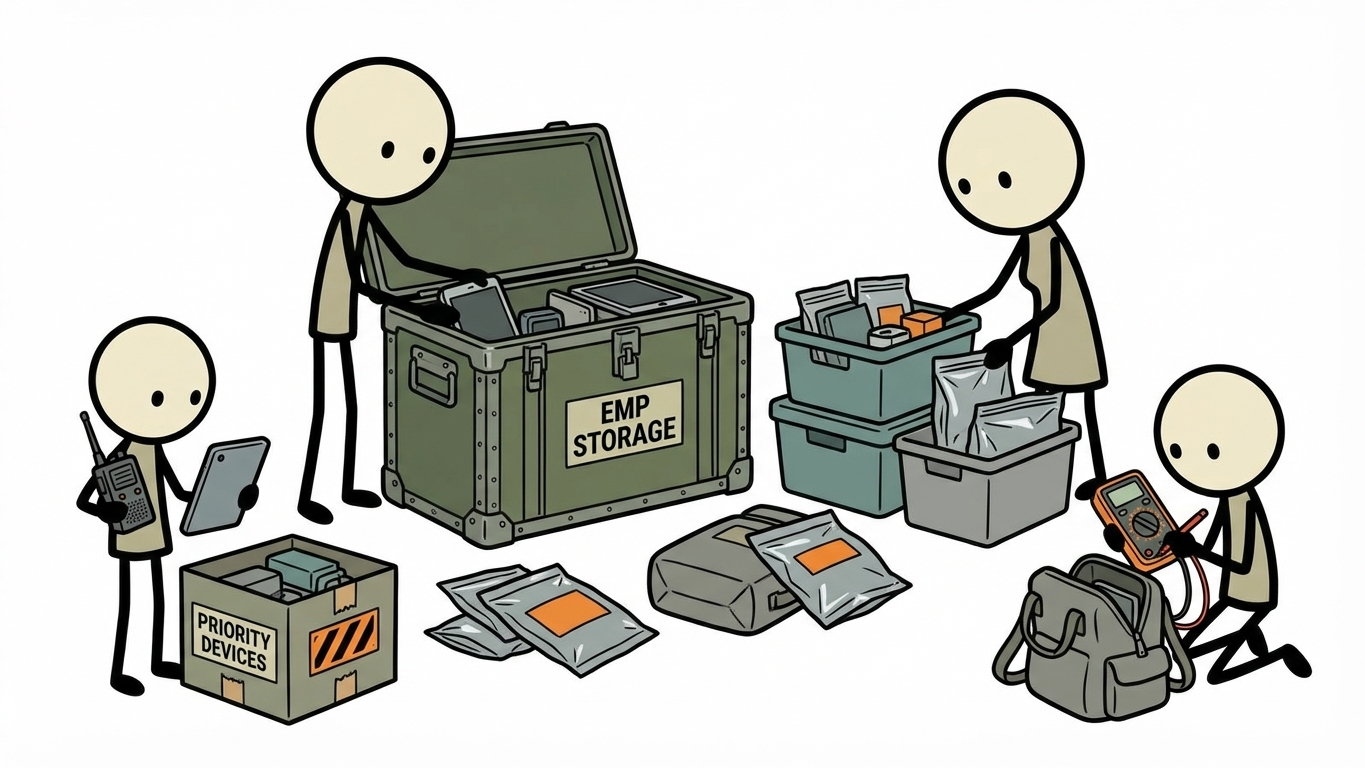
A common mistake in emergency preparedness is trying to save everything. Space inside your Faraday cages is limited, and you must be ruthlessly practical about what you choose to store. A tablet loaded with movies might offer comfort, but it will not save your life. You must prioritize equipment that facilitates communication, survival, and recovery.
Tier 1: Life Safety and Communication
These are the items that should be nested in your most secure Faraday enclosures. They are critical for immediate survival and situational awareness.
- Two-Way Radios: Handheld ham radios (like the popular Baofeng UV-5R), GMRS radios, or CB radios. Ensure you store them with their antennas detached, as an attached antenna acts as a lightning rod for EMP energy.
- NOAA Weather Radios: A hand-crank or battery-operated emergency radio to receive government broadcasts and updates.
- Medical Equipment: If someone in your household relies on electronic medical devices (CPAP machines, nebulizers, digital blood pressure monitors, or electronic blood sugar testers), backup units must be shielded.
- Geiger Counters: In the event of a nuclear EMP, localized radiation may be a concern. A digital or analog dosimeter/Geiger counter is crucial for assessing environmental safety.
Tier 2: Information and Navigation
Once immediate safety is secured, you will need information to rebuild and navigate your new reality.
- An Offline Digital Library: An older, dedicated tablet or e-reader loaded with survival manuals, medical textbooks, agricultural guides, and local topographical maps. Ensure the device is powered off completely before storing.
- Navigation Tools: Standalone GPS units. While the GPS satellite constellation may survive an EMP, ground control stations may not. However, having the hardware protected gives you a chance of utilizing the network if it remains operational.
- Digital Storage: USB flash drives or solid-state drives (SSDs) containing copies of your crucial personal documents, property deeds, identification, and family photos.
Tier 3: Power Generation and Illumination
To use the devices you have protected, you will need a way to power them in a grid-down environment.
- Solar Charge Controllers: Solar panels themselves are generally resistant to EMPs due to their lack of complex microcircuitry. However, the charge controllers and inverters required to make that power usable are highly vulnerable. Store backup solar charge controllers in your Faraday cage.
- Battery Banks: High-capacity lithium-ion power banks or small portable power stations. Ensure they are stored at roughly a 50% charge to prolong battery health over long-term storage.
- LED Flashlights and Headlamps: Modern LED lights contain delicate driver circuits that can be fried by an EMP. Store a few high-quality tactical flashlights and headlamps in your enclosure.
Testing Your EMP Protection Systems
Assuming your Faraday cage works without testing it is a dangerous gamble. While you cannot simulate a true E1 electromagnetic pulse in your garage, you can test your enclosure's ability to block various frequencies of radio frequency (RF) energy. If your cage cannot block common RF signals, it will certainly fail to protect electronics from emp waves.
Follow this multi-step testing methodology to verify your shielding:
Step 1: The Visual Inspection
Before testing with devices, use your eyes. Are there any visible gaps? Is the lid of the trash can warped? Is the aluminum tape peeling? If light can get in, electromagnetic energy can get in. Ensure the structural integrity of your conductive layer is absolute.
Step 2: The FM Radio Test
Turn on a small, battery-powered FM radio and tune it to a strong local station. Turn the volume up loud. Place the radio inside your Faraday cage and seal the lid securely. If the cage is working, the music should cut out completely, replaced by dead silence or faint static. If you can still hear the broadcast clearly, your cage is leaking RF energy.
Step 3: The Cellular Test
Cell phones operate on higher frequencies than FM radios, making this a slightly more rigorous test. Place your smartphone inside the cage, ensuring the volume is up and the ringer is on. Seal the cage completely. Use another phone to call the phone inside the cage. If the phone rings, your cage has failed. It should go straight to voicemail, indicating that the cellular signal cannot penetrate the shielding.
Step 4: The Wi-Fi/Bluetooth Test
For an even higher frequency test, connect a device to a Bluetooth speaker and place the device inside the sealed cage. The music should immediately disconnect. Alternatively, place a smartphone inside, seal it, and check your router's connected devices list on a computer. If the phone drops off the network, the cage is successfully blocking the Wi-Fi signal.
Note on Testing Limitations: It is important to acknowledge that military-grade EMPs generate frequencies both lower and higher than commercial cellular and radio signals. Passing the cell phone test does not guarantee 100% immunity to a nuclear EMP. However, it is the most practical baseline test available to civilians, and failing the cell phone test guarantees your cage is ineffective.
Beyond Electronics: Comprehensive Grid Down Preparedness
Protecting a ham radio and a solar charger is an excellent step, but it is ultimately useless if you cannot meet your basic physiological needs. True grid down preparedness requires a holistic approach. An EMP or a severe CME will instantly halt the complex supply chains that deliver our water, food, and medicine. You must be prepared to sustain your household independently.
Water Security and Sanitation
Without electricity, municipal water pumps will fail. High-rise apartment buildings will lose water pressure instantly, and suburban taps will run dry within days as water towers drain. The CDC and FEMA recommend storing a minimum of one gallon of Water Calculator per day for drinking and sanitation.
For a long-term grid-down scenario, stored water will eventually run out. You must have the means to source and purify water locally. Invest in high-volume gravity water filters (like those utilizing ceramic or hollow-fiber membranes), water purification tablets, and unscented liquid household bleach. Furthermore, without running water, modern plumbing ceases to function. Stockpile heavy-duty contractor bags, five-gallon buckets, and sawdust or cat litter to create emergency dry toilets, preventing the spread of deadly sanitation-related diseases like cholera and dysentery.
Long-Term Food Storage
Supermarkets operate on "just-in-time" delivery models. In the event of an EMP, grocery store shelves will be cleared within hours, and the trucks to restock them will not arrive. While FEMA advises a two-week supply of non-perishable food for general emergencies, a catastrophic grid failure demands a much deeper pantry.
Focus on calorie-dense, shelf-stable foods that require minimal water and cooking fuel to prepare. Build a foundation of staples: white rice, dried beans, pasta, oats, and canned meats. Supplement this with freeze-dried survival food buckets, which boast a 25-year shelf life. Remember to store a manual can opener—an electric one will be useless.
Medical Preparedness
Hospitals will be overwhelmed and operating on limited generator power—if those generators survive the EMP. Pharmacies will be inaccessible. You must become your family's primary care provider for basic injuries and illnesses. Stock a comprehensive trauma kit, including tourniquets, hemostatic gauze, and pressure dressings. Equally important is a deep supply of over-the-counter medications: pain relievers, anti-diarrheals, antihistamines, and broad-spectrum topical antibiotics. If you require prescription medication, work with your doctor to build an emergency reserve.
Security and Community
A prolonged blackout will test the social fabric. While physical security measures—reinforced doors, window security film, and legal means of self-defense—are necessary, your greatest asset in a long-term crisis is your community. You cannot pull 24-hour security watches, grow food, purify water, and maintain a household alone. Build relationships with your neighbors now. A neighborhood that works together to pool resources, share skills, and provide mutual defense is exponentially more likely to survive a catastrophic event than an isolated individual.
The Psychological Aspect of Survival
Preparing for an event as massive as an EMP or a CME can feel overwhelming. It is easy to succumb to anxiety when contemplating the fragility of our modern infrastructure. However, the antidote to anxiety is action. Every gallon of water you store, every radio you place in a Faraday cage, and every new skill you learn builds a buffer between your family and the chaos of a grid-down scenario.
Maintain a positive, pragmatic mindset. The goal is not to live in fear of the sky, but to acknowledge the data provided by agencies like the USGS, NOAA, and the EMP Commission, and take logical steps to mitigate those risks. Resilience is a muscle that must be exercised. As you systematically build your supplies and test your systems, you transition from a state of vulnerability to a state of empowerment.
Taking Control of Your Preparedness Journey
The threat of an electromagnetic pulse or a severe coronal mass ejection is a stark reminder of our dependence on the fragile electrical grid. Yet, history and science show us that survival is entirely possible for those who prepare. By understanding the physics of Faraday cages, prioritizing the protection of life-saving electronics, rigorously testing your shielding, and committing to holistic grid-down readiness, you are actively securing your family's future.
Disasters strip away the conveniences of modern life, but they do not have to strip away your safety. The time to build your resilience is now, while the lights are on and the supply chains are flowing. Take inventory of your critical devices, build your first Faraday cage this weekend, and take pride in knowing that no matter what happens to the grid, you possess the knowledge and the gear to weather the storm.
Learn EMP protection strategies from our emergency preparedness guide. Understand grid failure response in our power outage survival guide. Build EMP-proof kits with our go-bag builder. Calculate Faraday cage supplies with our supply calculator. Get EMP training through our preparedness courses.
Frequently Asked Questions
What is the first step to prepare for this scenario?
Start with a realistic risk assessment for your location, then build a simple written plan your whole household can follow.
How much should beginners spend initially?
Begin with high-impact basics and a phased budget. Small consistent upgrades beat expensive one-time purchases.
How often should plans and gear be reviewed?
Audit every 6 to 12 months and after every real incident to capture lessons learned.
What should go in every emergency kit?
Water, food, first aid, lighting, communication, documents, and essential medications.
How do I get family buy-in for preparedness?
Keep it practical, avoid fear language, and run short drills that show clear everyday value.