⚡ Key Facts
- Underprepared Population: According to FEMA’s National Household Survey, while 80% of Americans acknowledge the importance of disaster preparedness, only about 51% feel they have the resources and knowledge to survive a sudden emergency. For the practical checklist side, use the community emergency preparedness guide.
- The Golden Minutes: The American College of Surgeons (ACS) reports that uncontrolled hemorrhaging is the leading cause of preventable death in trauma cases, with a victim capable of bleeding out in as little as 3 to 5 minutes.
- Grid Vulnerability: Data from the U.S. Energy Information Administration (EIA) shows that the average American utility customer experiences over five hours of power interruptions annually, a number that spikes drastically during localized weather crises.
- Rapid-Onset Disasters: The United States Geological Survey (USGS) notes that millions of citizens live in active seismic zones where earthquakes strike with zero warning, leaving no time to retrieve heavy home-based survival kits.
Picture a typical Tuesday afternoon. You are sitting in a high-rise office building, commuting on a crowded subway, or picking up groceries when the world suddenly shifts. A localized grid failure plunges your city into darkness, a severe weather event triggers immediate flash flooding, or an active threat forces a rapid evacuation. In these critical, high-stress moments, you cannot rely on the heavy Go-Bag Builder sitting in your closet or the emergency supplies stashed in your vehicle's trunk. Your immediate survival depends entirely on what is physically on your person. This is where the concept of everyday carry for preppers transitions from a hobby into a lifesaving discipline. By selecting lightweight, highly functional, and low-profile gear, you can navigate unexpected crises with confidence, all while blending seamlessly into any environment without drawing unwanted attention.
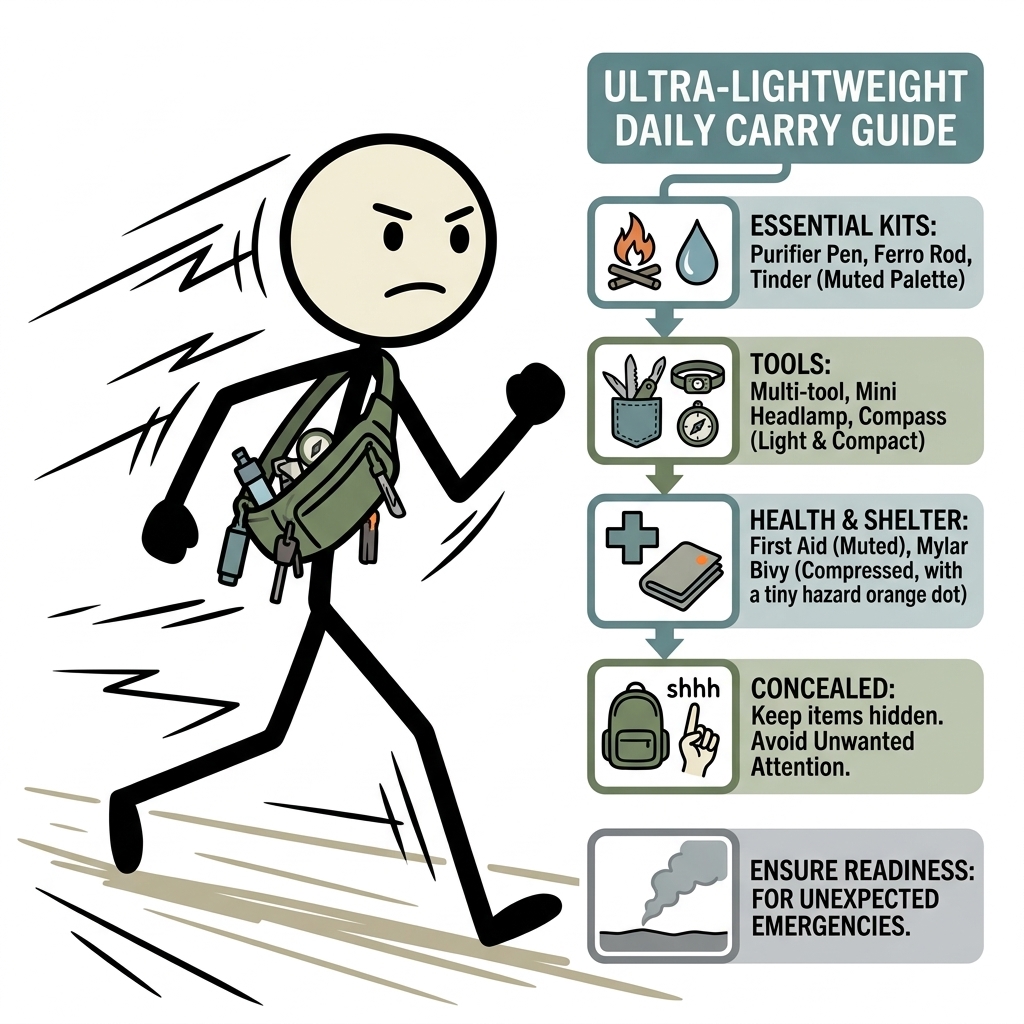
The Philosophy of Gray Man EDC: Low Profile, High Utility
In the emergency preparedness community, the "Gray Man" concept is a foundational strategy. It refers to the ability to blend into any crowd or environment, avoiding behavior or gear that identifies you as a target, a tactical enthusiast, or someone carrying valuable supplies. When selecting your daily preparedness gear, the goal is to maximize utility while minimizing both physical weight and visual signature. Heavy tactical backpacks covered in MOLLE webbing, military-grade pouches, and camouflage patterns scream "loot drop" in a civil unrest or evacuation scenario. They invite scrutiny from both desperate individuals and law enforcement.
True everyday readiness relies on items that fit comfortably into standard pockets, look like ordinary civilian accessories, and serve multiple functions. Every ounce you add to your pockets increases physical fatigue and the likelihood that you will eventually leave your gear at home. Therefore, your prepper EDC list should prioritize items that offer a high weight-to-utility ratio. By focusing on multi-use, lightweight tools, you create a frictionless system that you can carry comfortably from the boardroom to the backcountry without a second thought.
The Core Pillars of Daily Preparedness
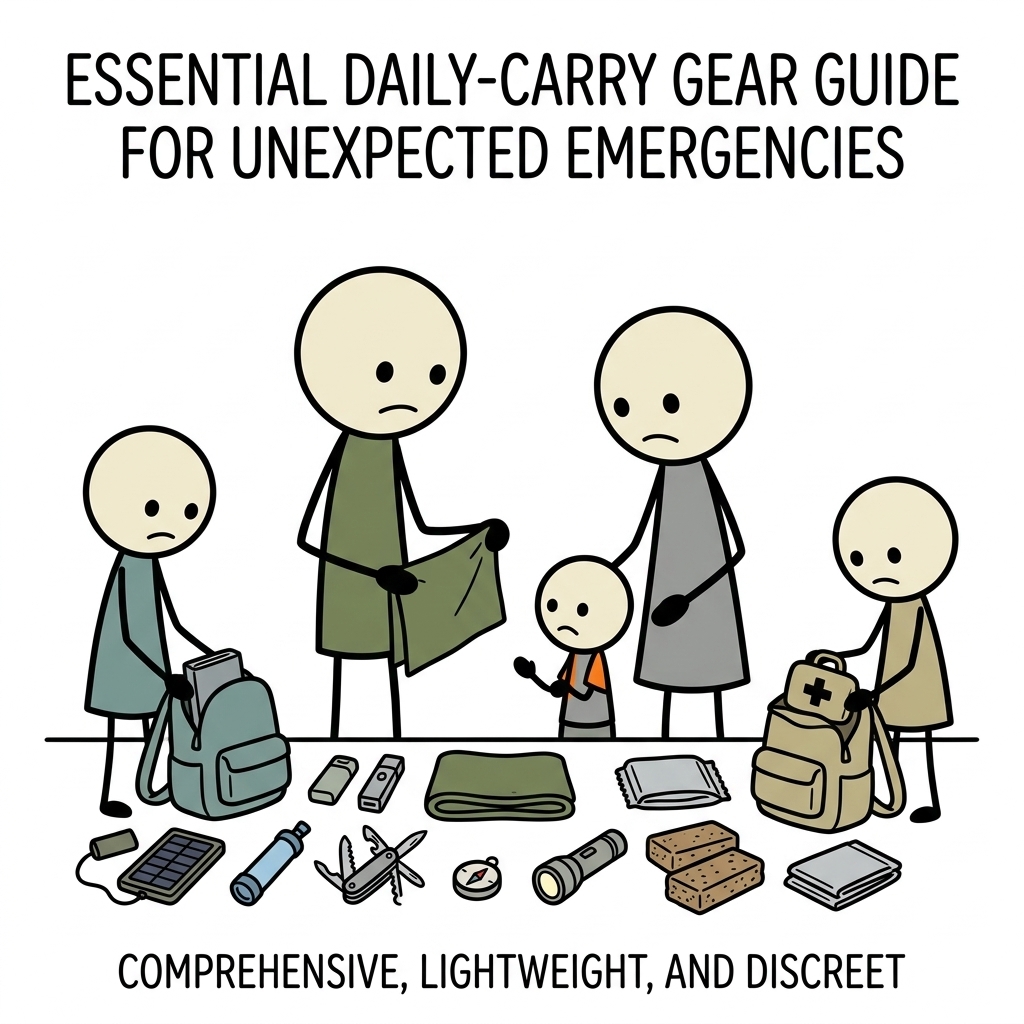
To build an effective, lightweight survival system, you must categorize your gear based on immediate human survival needs. In a sudden emergency, your priorities are trauma management, water procurement, navigation, illumination, emergency communication plan, and basic utility. Below, we break down these essential categories and highlight the specific, lightweight tools recommended for daily carry.
1. Emergency Medical and Trauma Management
When an emergency strikes, physical injury is often the most immediate threat. Whether it is shattered glass from an earthquake, debris from a severe storm, or a violent incident, severe bleeding must be addressed instantly. The American Red Cross and emergency medical services consistently emphasize that waiting for first responders during a mass-casualty event can take too long. You must be your own first responder.
While a full first-aid kit is too bulky for your pockets, a minimalist trauma kit is highly packable. Your daily carry should prioritize bleeding control over minor comfort items like adhesive bandages or aspirin. A compact, flat-folded tourniquet (such as a SWAT-T or a vacuum-sealed, ultra-flat tourniquet) can easily slip into a back pocket or an inside jacket pocket. Additionally, a package of compressed hemostatic gauze (like QuikClot or Celox) and a pair of nitrile gloves take up virtually no space but provide the tools necessary to pack a severe wound and save a life.
2. Water Procurement and Micro-Filtration
The human body can only survive for about three days without water, but dehydration can impair cognitive function, decision-making, and physical endurance within hours. The Centers for Disease Control and Prevention (CDC) warns that municipal water systems are highly vulnerable to contamination during natural disasters, flooding, or cyberattacks on infrastructure.
To ensure access to clean drinking water without carrying heavy bottles, integrate micro-filtration tools into your daily setup. A modern hollow-fiber membrane filter, such as the Sawyer Micro Squeeze or the Katadyn BeFree, weighs only a couple of ounces and can filter up to 100,000 Water Calculator. Pair this with a collapsible, ultralight water bottle (like a Platypus or Hydrapak bottle) that rolls up to the size of a deck of cards when empty. If space is incredibly tight, a few individually wrapped chlorine dioxide water purification tablets can be tucked into your wallet, providing a reliable backup chemical treatment method.
3. Illumination and Emergency Signaling
Power outages are the most common denominator in almost every Survival Scenarios. When the electrical grid fails, urban environments transform into dark, hazardous labyrinths. Relying on your smartphone's flashlight is a critical mistake: it drains your primary communication device's battery, offers poor light throw, and is fragile to drop in a high-stress exit.
A dedicated, high-output EDC flashlight is an absolute necessity. Modern LED technology allows manufacturers to produce lights no larger than a pen that output over 500 lumens of light. Look for a flashlight that features a deep-carry pocket clip, a durable aluminum body, and a rechargeable battery (preferably via USB-C to match your phone charger). A strong light can illuminate dark stairwells, blind potential attackers, and signal for help. For hands-free operation, choose a model with a two-way pocket clip that can be attached to the brim of a baseball cap, instantly converting it into a headlamp.
4. Utility Tools and Entry/Exit Options
During an evacuation or shelter-in-place scenario, you may need to open packages, cut seatbelts, pry open jammed battery compartments, or perform minor repairs on your gear. A massive survival knife or a full-sized multi-tool is heavy and often illegal to carry in municipal areas, corporate offices, or federal buildings.
Instead, look for a lightweight, travel-friendly multi-tool. Brands like Leatherman and Victorinox offer pocket-sized options that feature spring-action scissors, a small blade, screwdrivers, and wire cutters while weighing under three ounces. If you frequently travel through areas with strict knife laws, look for TSA-compliant, bladeless multi-tools that rely on pry bars, hex wrenches, and package openers. These tools keep you prepared without causing issues at security checkpoints.
Designing Your Pocket Survival Kit
One of the most efficient ways to carry essential survival gear without cluttering your pockets is to build a modular, consolidated pocket survival kit. This micro-kit acts as your last line of defense, housing tiny but crucial survival items in a single, crush-proof container. A classic aluminum tin or a small, weather-resistant zippered pouch serves as the perfect container, fitting easily into a jacket pocket or the bottom of a daily commuter bag.
When assembling a pocket survival kit, focus on micro-items that address multiple survival needs. Below is an optimized layout for a high-utility micro-kit:
| Category | Micro-Kit Item | Primary Survival Purpose |
|---|---|---|
| Fire & Warmth | Miniature Ferrocerium Rod & Tinder Quick Tabs | Reliable emergency fire starting in wet or freezing conditions. |
| Navigation | Liquid-Filled Button Compass | Basic direction finding when GPS and cellular networks fail. |
| Signaling | Flat Emergency Whistle (100+ Decibels) | Attracting search and rescue teams without exhausting your voice. |
| Repair | 5 Feet of Heavy-Duty Duct Tape (Flat Folded) | Gear repair, improvising bandages, or securing emergency shelter. |
| Tools | Ultra-Thin Razor Blade or Scalpel | Precision cutting tasks while maintaining an incredibly low profile. |
| Water | 4x Aquatabs Water Purification Tablets | Purifying up to four liters of suspect water in emergency situations. |
By keeping these items consolidated, you avoid the hassle of loose gear floating around your pockets. If you need to change clothes rapidly or scale down your loadout, you can simply grab this single tin or pouch and know that your core survival bases are covered.
The Ultimate Prepper EDC List (Tiered System)
To help you organize your daily carry, we have structured the ultimate prepper EDC list into a tiered system. This allows you to scale your preparedness level based on where you are going, your local laws, and how much weight you are comfortable carrying on a daily basis.
Tier 1: On-Body Essentials (Pockets & Belt)
These are the non-negotiable items that should never leave your person when you walk out the front door. They are lightweight, completely discreet, and form the foundation of your daily preparedness.
- Tactical/EDC Pen: A rugged, aluminum or titanium pen that uses pressurized ink cartridges (allowing it to write on wet surfaces or upside down). It functions as a standard writing tool but doubles as a highly effective, low-profile self-defense implement.
- Slimline LED Flashlight: A high-quality light (minimum 300 lumens) with a rechargeable battery.
- Minimalist Multi-Tool: A pocket-friendly tool featuring pliers, wire cutters, and basic drivers.
- Flat-Folded Tourniquet: Tucked into a back pocket or ankle holster for immediate trauma response.
- Cash Reserve: A folded $50 or $100 bill tucked behind your driver's license. When power grids fail, credit card processors and ATMs go offline instantly; cash remains king in the initial hours of a crisis.
Tier 2: Pocket Organizer or Small Pouch (Cargo Pocket or Jacket)
This tier adds capability for water filtration, fire starting, and navigation. It can be kept in a small zippered pouch that slips into a cargo pocket, jacket pocket, or briefcase.
- The Pocket Survival Kit: The consolidated tin or pouch detailed in the section above.
- Collapsible Water Bottle & Micro-Filter: Allows you to source and clean water on the move.
- Write-in-the-Rain Notepad: For leaving notes, recording medical information, or mapping routes when digital devices fail.
- High-Capacity Power Bank: An ultra-thin, carbon-fiber power bank (like the Nitecore NB10000) paired with a multi-use charging cable to keep your phone and flashlight powered.
Tier 3: The Commuter/Office Bag (Under 10 lbs)
If you carry a laptop bag, briefcase, or small backpack to work or school, you have the opportunity to expand your capabilities slightly without looking like an outdoor survivalist. This bag should look completely professional on the outside while housing key emergency assets on the inside.
- Emergency Poncho or Mylar Bivvy: Provides instant protection from wind, rain, and hypothermia while packing down to the size of a wallet.
- N95 or P100 Respirator Mask: Packed flat. The CDC and FEMA emphasize the importance of respiratory protection during urban disasters, where dust, smoke, asbestos, and airborne pathogens present immediate health hazards.
- USB Rechargeable AM/FM/Weather Radio: A pocket-sized radio to receive NOAA emergency broadcasts and localized emergency instructions during communications blackouts.
- High-Calorie Food Bars: Two or three non-perishable, temperature-stable food bars (like Millennium or Mainstay bars) to maintain energy levels during a long walk home.
Training and Situational Awareness: The Ultimate Force Multipliers
It is a common pitfall in the preparedness community to focus entirely on gear while ignoring the mental and physical skills required to use it. The most expensive pocket survival kit or tactical flashlight is completely useless if you lack the knowledge to operate it under pressure, or if your physical fitness prevents you from walking a few miles home.
FEMA’s emergency guidelines consistently highlight that training is the most critical element of disaster resilience. Seek out local training opportunities to complement your essential survival gear:
- Stop the Bleed Course: A free or low-cost class offered by local hospitals and fire departments that teaches you how to apply tourniquets and pack wounds correctly.
- Land Navigation Basics: Learn how to read a physical topographic map and use a button compass. In a major regional emergency, GPS networks can be jammed, spoofed, or rendered inaccessible due to grid failures.
- Physical Conditioning: Ensure your body is capable of walking home. If your daily commute is 10 miles, ask yourself honestly if you could walk that distance carrying your Tier 3 commuter bag in your current physical shape.
Furthermore, cultivate situational awareness. This is the simple practice of paying attention to your surroundings, identifying secondary exits when entering a building, noticing changes in crowd behavior, and monitoring weather reports via NOAA alerts before traveling. Recognizing a developing threat even 30 seconds before those around you gives you a massive head start, allowing you to evacuate safely before panic sets in.
Building a Resilient Mindset for Daily Life
True everyday preparedness is not about living in a state of constant fear or anticipating a cinematic, cataclysmic collapse around every corner. Instead, it is about developing a quiet, empowering confidence. By carefully curating a lightweight, low-profile selection of daily preparedness gear, you ensure that you are never caught completely empty-handed when life throws an unexpected curveball. You protect your family, assist those around you, and navigate disruptions with calm, deliberate action. Start small: audit your current pockets, invest in high-quality, lightweight tools, and commit to the training that transforms your gear from simple metal and plastic into lifesaving instruments of survival.
Frequently Asked Questions
What is Everyday Carry (EDC) in emergency preparedness?
Everyday Carry (EDC) refers to the collection of essential items you carry on your person daily to handle unexpected situations, minor emergencies, or survival scenarios.
What are the most critical items to include in a basic EDC kit?
A basic EDC kit should include a pocket knife or multi-tool, a compact flashlight, a means of making fire (like a lighter), a small first aid kit, and a communication device.
How does EDC differ from a Bug Out Bag (BOB)?
EDC consists of items carried directly on your body for daily use and immediate emergencies, whereas a Bug Out Bag is a larger backpack designed to sustain you for at least 72 hours during an evacuation.
Why is a flashlight considered a vital EDC item?
A flashlight is crucial because power outages, dark stairwells, or nighttime emergencies can occur instantly, and navigating in the dark is a major safety hazard.
How should I choose a multi-tool for my EDC?
Choose a multi-tool based on your daily environment, prioritizing features like pliers, wire cutters, a knife blade, and screwdrivers, while ensuring it complies with local laws.