⚡ Key Facts
- FEMA Preparedness Gap: According to FEMA’s National Household Survey, while nearly 90% of Americans acknowledge the importance of disaster preparedness, fewer than 50% have assembled a dedicated emergency communication plan or consolidated their vital documents.
- Delayed Aid Recovery: The American Red Cross notes that replacing critical identification documents (such as birth certificates, social security cards, and property deeds) through standard government channels can take between 4 to 12 weeks post-disaster, which can severely stall immediate recovery assistance.
- Faster Claims Processing: Data from the Insurance Information Institute (III) shows that policyholders who present physical copies of their insurance declaration pages immediately after a disaster experience up to a 50% faster claims processing and payout timeline.
- Identity Theft Risk: The Federal Trade Commission (FTC) warns that natural disasters create high-risk environments for identity theft, highlighting the need for secure, water-resistant, and encrypted storage systems for all personal records.
Imagine a sudden knock on your door at 2:00 AM. A fast-moving wildfire, flash flood, or industrial accident has triggered an immediate evacuation order. Our natural disaster survival guide walks you through each scenario in detail. for your neighborhood. You have exactly ten minutes to gather your family, your pets, and your most critical belongings before leaving your home behind. In the midst of adrenaline and panic, would you be able to locate your home insurance policy, your children's birth certificates, your medical records, and your estate documents? For most families, these vital papers are scattered across various filing cabinets, desk drawers, and digital folders. By consolidating these assets into a single, highly secure family emergency plan binder, you replace chaotic panic with structured, decisive action, ensuring your family's identity, finances, and history remain intact no matter what lies ahead.
The Anatomy of an Emergency Document Binder
An emergency document binder (often referred to as a go-bag essentials guide documents binder) is a centralized, physical portfolio containing certified copies and originals of your family’s most critical personal, financial, medical, and legal records. While we live in an increasingly digital world, physical disasters like hurricanes, earthquakes, and cyberattacks on power grids can instantly render digital networks, cellular towers, and cloud storage inaccessible. Having a physical, grab-and-go portfolio ensures you can prove your identity, access your financial assets, and secure medical care when the grid is completely offline.
However, a physical binder is only one half of a complete disaster strategy. True resilience relies on a hybrid approach: a rugged physical binder for immediate evacuations and a secure, encrypted digital backup for off-site redundancy. Together, these elements form a comprehensive emergency preparedness document kit that safeguards your family’s administrative footprint. By building this resource before a crisis strikes, you protect your household from the secondary disaster of identity theft, prolonged insurance disputes, and delayed government aid.
Step-by-Step Document Checklist: What to Include
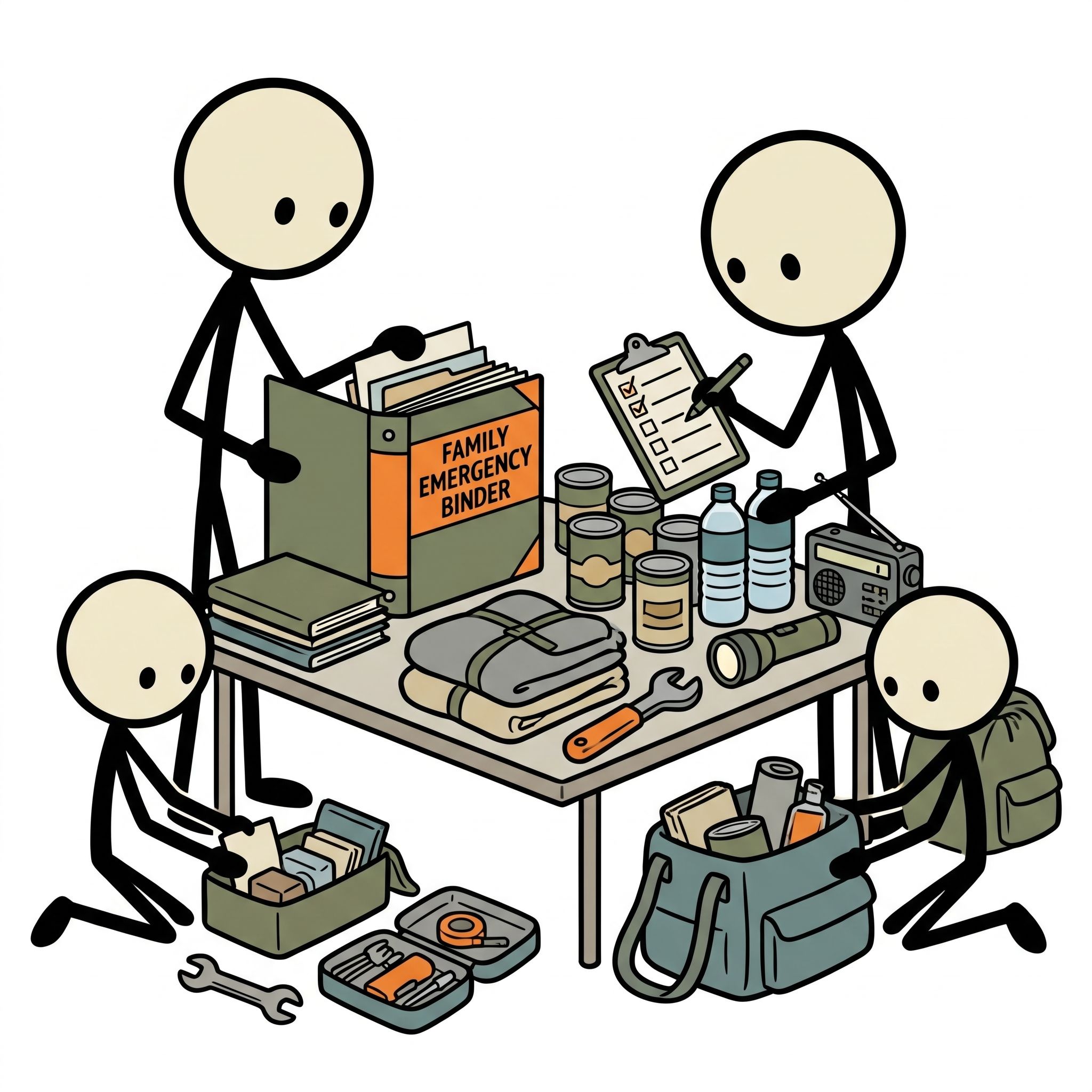
To make your binder truly effective, it must be organized logically so that any family member—or emergency responder—can locate vital information in seconds. We recommend dividing your binder into five distinct, color-coded sections using heavy-duty tabbed dividers. Below is the comprehensive checklist of documents you should gather and secure within each section.
Section 1: Vital Identification & Citizenship Records
This section serves as the ultimate proof of who you are and who belongs to your household. During a large-scale evacuation, federal and state agencies (such as FEMA or the Red Cross) will require these documents to verify your identity before distributing aid, housing vouchers, or emergency funds.
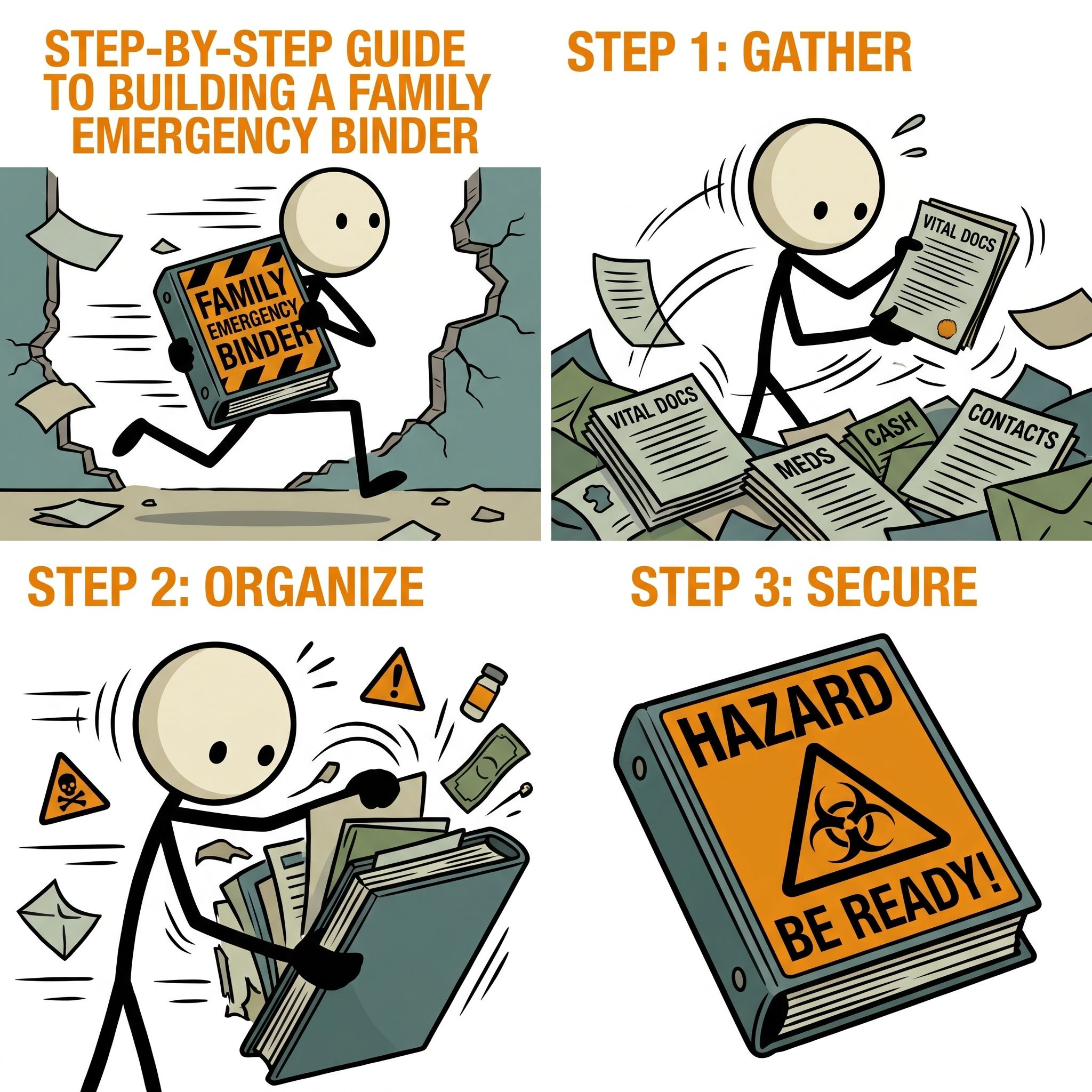
- Government-Issued Photo IDs: High-resolution color copies of driver’s licenses, state ID cards, and military IDs for all adult family members.
- Passports and Visa Documents: Original passports (if not stored in a primary home safe) or high-quality color copies, including visa stamps and green cards.
- Birth and Death Certificates: Certified copies of birth certificates for all family members, as well as death certificates of immediate family if relevant to estate administration.
- Social Security Cards: Original cards or certified copies. These are crucial for proving identity when applying for disaster loans or federal relief.
- Marriage, Divorce, and Custody Agreements: Legal certificates proving marital status, child custody arrangements, and adoption papers. These are vital for proving guardianship at emergency shelters or medical facilities.
- Military Discharge Papers (DD-214): Essential for veterans to access emergency housing, medical care, and specialized federal benefits post-disaster.
- Pet Identification and Vaccination Records: Color photos of your pets with family members (to prove ownership), microchip numbers, and rabies vaccination certificates, which are often mandatory for pet-friendly emergency shelters.
Section 2: Financial & Property Assets
Disasters can disrupt local banking networks, freeze electronic transactions, and damage physical properties. This section contains the proof of your financial health, outstanding liabilities, and property ownership, allowing you to file insurance claims and secure emergency capital immediately.
- Homeownership and Rental Documentation: Copies of your home mortgage deed, lease agreements, property tax receipts, and land surveys. These prove your legal right to re-enter a disaster zone or claim property damages.
- Vehicle Titles and Registrations: Proof of ownership for all cars, boats, RVs, or utility trailers owned by the household.
- Insurance Policies (The Declaration Pages): The first 2–3 pages of your homeowners, renters, auto, flood, windstorm, and life insurance policies. These pages list your policy numbers, coverage limits, deductibles, and claim contact numbers.
- Financial Account Statements: Recent statements (within the last 3 months) for checking, savings, investment, and retirement accounts, complete with account numbers and routing codes.
- Tax Returns: Copies of the first two pages of your federal and state tax returns from the past two years. FEMA and the Small Business Administration (SBA) often require these to verify pre-disaster income for low-interest recovery loans.
- Outstanding Debt Records: Information on active car loans, student loans, and credit card accounts, which helps you contact creditors to request temporary payment deferrals during a declared disaster.
Section 3: Medical Histories & Health Records
In a crisis, access to healthcare can be disrupted, and you may find yourself working with emergency medical personnel who have no access to your digital medical records. This section of your family emergency records ensures continuity of care and prevents dangerous medical errors.
- Health Insurance Cards: Copies of the front and back of all health, dental, vision, and prescription drug insurance cards.
- Immunization and Vaccination Records: Up-to-date records for all family members, which may be required to enroll children in temporary schools or access certain shelters.
- Active Medication Lists and Dosages: A comprehensive list of all prescription medications, exact dosages, prescribing doctors, and pharmacy contact information.
- Critical Medical History Summaries: Brief summaries detailing chronic conditions (e.g., diabetes, severe allergies, cardiac history, asthma), past major surgeries, and blood types for each family member.
- Equipment Specifications: Documentation for necessary medical hardware, such as pacemaker serial numbers, oxygen concentrator settings, or wheelchair specifications.
Section 4: Legal Contracts & Estate Planning
If you or a loved one is incapacitated during an emergency, having immediate physical access to legal directives is a matter of life and death. Do not rely on a lawyer’s office to retrieve these documents during a regional crisis.
- Wills, Trusts, and Codicils: Executed copies of your Last Will and Testament and active living trust documents.
- Durable Power of Attorney (POA): Legal documents designating who has the authority to make financial and legal decisions on your behalf if you are unable to do so.
- Healthcare Proxy / Medical Power of Attorney: Designated individuals authorized to make medical decisions on your behalf during an emergency.
- Living Wills and Advanced Directives: Clear instructions regarding your preferences for life-support, resuscitation, and end-of-life care.
Section 5: Emergency Contacts & Household Communication Plan
When cellular networks fail, you cannot rely on your smartphone’s contact list. This section acts as your offline directory, ensuring you can coordinate with loved ones and recovery services.
- Out-of-State Emergency Contact: The name, phone number, physical address, and email of a designated relative or friend living outside your immediate geographic region (who can act as a central communications hub).
- Local Contact Directory: Phone numbers and addresses for local utility companies, employers, schools, neighbors, and local emergency management agencies.
- Family Meeting Locations: Written plans detailing your household's designated meeting spots near your home, outside your neighborhood, and outside your town.
- Physical Maps: Local and regional paper maps with evacuation routes and emergency shelters clearly marked.
Designing the Physical Binder: Durability & Organization
A standard school binder made of cheap vinyl and thin paper will not survive the harsh conditions of a real-world disaster. If your home experiences a pipe burst, a roof collapse, or a fire, your documents must be shielded from water, smoke, and physical impact. Investing in high-quality materials is essential for building a reliable go bag documents binder.
Material Specifications for Maximum Protection
When selecting your binder and storage accessories, prioritize the following industrial-grade specifications:
- The Outer Shell: Choose a heavy-duty, zippered binder. Look for models constructed from silicone-coated fiberglass or ballistic nylon, which offer high-level water resistance and basic fire protection. A secure zipper enclosure prevents loose papers from falling out during rapid transit.
- Plastic Sheet Protectors: Every single document must be housed in an individual, heavy-duty plastic sleeve. Ensure the sleeves are labeled "acid-free" and "archival-safe" (polypropylene) to prevent the plastic from lifting ink off your original documents over time. Avoid PVC-based protectors, which degrade and stick to paper over time.
- Color-Coded Tab Dividers: Use durable plastic dividers with write-on or printable tabs to separate your five core sections. Color-coding (e.g., Red for Medical, Green for Financial) allows you to navigate the binder instantly in low-light environments.
- Utility Pouches: Include a heavy-duty zippered utility pouch inside the binder to hold small, loose items like backup USB drives, extra keys, passport photos, and emergency currency.
Cash Reserves and Physical Additions
During a widespread power outage, credit card terminals and ATMs will go offline. Your binder should contain a secure cash reserve to facilitate emergency purchases of fuel, food, and lodging. We recommend keeping between $200 and $500 in your binder's utility pouch, divided primarily into small denominations ($1, $5, $10, and $20 bills), as merchants may not be able to make change for $50 or $100 bills during a crisis.
Additionally, include two physical passport-sized photos for every family member. If you are displaced and need to replace lost passports or secure emergency identification cards, having pre-printed photos will bypass long lines and closed photo centers.
The Digital Backup Strategy: Redundancy is Resilience
A physical binder is vulnerable to being lost, stolen, or physically destroyed alongside your home if you cannot reach it in time. To achieve true preparedness, you must implement a robust digital backup strategy based on the time-tested 3-2-1 backup rule: keep three copies of your data, stored on two different types of media, with at least one copy stored off-site.
Step 1: High-Quality Digital Scanning
Do not simply take quick smartphone photos of your documents; these are often blurry, off-angle, and difficult to read. Instead, use a dedicated flatbed scanner or a high-quality mobile scanning application (such as Adobe Scan, Microsoft Lens, or SwiftScan). Scan all documents in full color at a minimum resolution of 300 DPI (dots per inch). Save the files as searchable PDFs rather than JPEG images, as PDFs are easier to organize, print, and navigate.
Step 2: Local Encrypted Storage
Store your scanned PDFs on a dedicated, high-speed USB flash drive or an external solid-state drive (SSD). Because these files contain highly sensitive personal information, the drive must be encrypted to prevent unauthorized access if it is lost or stolen. You can use built-in operating system tools like BitLocker (Windows) or FileVault (Mac) to encrypt your drive, or utilize free, open-source cross-platform encryption software like VeraCrypt. Once encrypted, store this USB drive directly inside the zippered pouch of your physical family emergency binder.
Step 3: Secure, Zero-Knowledge Cloud Storage
To satisfy the off-site requirement of the 3-2-1 rule, upload your encrypted files to a secure cloud storage provider. Avoid standard, unencrypted public cloud folders. Instead, opt for "zero-knowledge" encrypted cloud services (such as Proton Drive, Tresorit, or Mega), which encrypt your data on your local device before transmitting it to the cloud. This ensures that even if the cloud provider experiences a data breach, your sensitive family records remain completely unreadable to hackers.
| Backup Layer | Storage Media | Security Measure | Primary Purpose |
|---|---|---|---|
| Layer 1 (Physical) | Heavy-duty zippered binder with plastic sleeves | Stored in a fireproof safe; kept confidential | Immediate, offline grab-and-go access during evacuations. |
| Layer 2 (Local Digital) | Encrypted USB Flash Drive or SSD inside binder | BitLocker, FileVault, or VeraCrypt encryption | Compact, high-capacity digital storage of all files for rapid recovery. |
| Layer 3 (Off-site Digital) | Zero-Knowledge Cloud Storage (Proton, Tresorit) | End-to-end encryption, multi-factor authentication (MFA) | Access records from anywhere in the world if physical binder is lost. |
Storage, Security, and Safeguarding Your Identity
Your emergency preparedness document kit is a double-edged sword. While it is your greatest administrative shield during a disaster, it also represents a goldmine for identity thieves if it falls into the wrong hands. It contains every piece of data required to open bank accounts, secure fraudulent loans, and compromise your medical identity. Therefore, maintaining strict security protocols is just as important as gathering the documents themselves.
In-Home Storage Protocols
When you are not actively evacuating, your physical binder should never be left sitting on an open bookshelf or in an unlocked desk drawer. Store it inside a high-quality, UL-certified fireproof and waterproof home safe. Look for a safe with a minimum fire rating of 30 minutes at 1550°F (843°C) and a waterproof seal that protects contents during flood events or fire suppression efforts. Ensure the safe is bolted to the floor or a wall studs to prevent physical theft. If you live in an area prone to severe flooding, store the safe on the second floor of your home, provided it remains easily accessible during an evacuation.
Discreet Transportation
When transporting your binder during an evacuation, practice strict operational security (OPSEC). Avoid using bright, neon-colored binders labeled "EMERGENCY DOCUMENTS" in bold print. Instead, use a plain, unmarked black or dark grey binder that looks like a standard, low-value business portfolio. Never leave your binder unattended in an unlocked vehicle, and keep it concealed inside a backpack or go bag rather than carrying it openly in public shelters or recovery centers.
The Maintenance and Updating Schedule
An emergency binder is not a "set-it-and-forget-it" project. Insurance policies renew annually, medical prescriptions change, financial accounts are closed or opened, and children grow older. An outdated binder can cause significant delays when trying to file claims or verify medical histories during a crisis. To keep your family emergency records highly accurate, establish a regular maintenance schedule.
We recommend conducting a comprehensive binder review twice a year. A simple way to remember this is to align your binder audits with Daylight Saving Time transitions (when you change your clocks and test your home smoke detectors). During your bi-annual audit, use the following checklist to update your materials:
- Review all insurance declaration pages to ensure policy numbers, coverage limits, and contact numbers are current.
- Check expiration dates on passports, driver's licenses, and military IDs; replace any copies that are nearing expiration.
- Update medication lists, dosages, and active health insurance cards for all family members.
- Verify that emergency contact phone numbers and addresses are still correct, especially for out-of-state contacts who may have moved.
- Rotate the cash cash reserves in your binder to ensure you have crisp, clean bills, and update the digital files on your encrypted USB drive and cloud storage to match your physical updates.
Putting the Binder to Work: Real-World Emergency Scenarios
Having a well-organized binder is only half the battle; you must also understand how to deploy it effectively across different Survival Scenarioss. Below is a guide on how to utilize your binder during four common crisis situations.
Scenario A: Rapid Evacuation (Wildfires, Hurricanes, Floods)
In a rapid evacuation scenario, time is your most precious commodity. Because you have consolidated your critical administrative life into a single portfolio, your evacuation protocol is simple and streamlined:
- Retrieve the binder from your home safe and place it directly into your primary go bag or backpack.
- Ensure the binder is zipped closed and positioned in a waterproof compartment or wrapped in a heavy-duty plastic bag for added moisture protection.
- Once you arrive at an emergency shelter or temporary lodging, keep the binder on your person or locked securely in your vehicle's trunk out of sight. Use the physical copies of your IDs to register for services, and use the insurance contact sheets to immediately notify your providers of your evacuation status.
Scenario B: Shelter-in-Place and Regional Grid Failures
During severe winter storms, solar flares, or cyberattacks on local infrastructure, you may find yourself sheltering in place without electricity, internet, or cellular communication for days or weeks. In this scenario, your binder serves as your offline database:
- Use the paper maps in Section 5 to identify local emergency resources, water distribution points, and alternative travel routes without relying on GPS.
- Access the physical contact directory to locate utility providers and local emergency services via landline or satellite phone if cellular networks are down.
- Utilize the cash reserves in Section 4 to purchase fuel, food, or critical medical supplies from local merchants who are operating without electronic payment systems.
Scenario C: Sudden Medical Emergencies
If a family member suffers a sudden, life-threatening medical emergency or is incapacitated in an accident, your binder provides first responders and hospital staff with the immediate information they need to save lives:
- Present the medical history summaries and active medication lists to paramedics or ER doctors to prevent adverse drug interactions and speed up diagnosis.
- Provide the hospital administration with the physical copies of your health insurance cards and the patient’s Durable Healthcare Power of Attorney and Living Will. This ensures the patient's medical preferences are respected and allows you to make legal medical decisions without delay.
Scenario D: Post-Disaster Rebuilding and Insurance Claims
Frequently Asked Questions
What documents belong in a family emergency binder?
Essential: passports or birth certificates, driver's licenses, Social Security numbers, insurance cards (health, home, auto, life), bank account information, property titles and deeds, and marriage certificates. Medical: medication lists, immunization records, emergency contacts. Financial: recent tax returns and credit card emergency numbers.
Should I keep the actual documents or copies?
Keep high-quality copies in the emergency binder and store originals in a fireproof home safe or safe deposit box. For maximum redundancy: physical copies in the binder, encrypted digital copies on a USB drive in the binder, and encrypted cloud backup accessible from any device.
How often should I update my emergency binder?
Full review annually (set a calendar reminder). Update immediately after life changes: moving, marriage, divorce, new insurance, new medications, new vehicle, birth, or adoption. Set a phone alarm to check insurance expiration dates every 6 months.
Create your family emergency planning binder. Check college emergency preparedness resources. Develop emergency preparedness plans. Use our supply calculator and check our courses.