⚡ Key Facts
- The Preparedness Gap: According to a Federal Emergency Management Agency (FEMA) national survey, while 80% of Americans acknowledge the importance of emergency preparedness, only 40% have a dedicated household emergency plan.
- Water Survival Threshold: The Centers for Disease Control and Prevention (CDC) and the American Red Cross state that human survival drops drastically after 3 to 5 days without water, making a minimum of 1 gallon per person per day non-negotiable.
- Disaster Frequency: National Oceanic and Atmospheric Administration (NOAA) data shows that weather and climate disasters causing over $1 billion in damage are occurring more frequently, rising from an average of 8.5 events per year in the 1990s to over 20 events annually in recent years.
- emergency communication plan Failures: During major disasters, traditional cellular voice networks experience up to a 90% failure rate due to physical damage and network congestion, emphasizing the need for alternative communication protocols.
When a crisis strikes, adrenaline floods the human body, triggering a "fight, flight, or freeze" response that can severely impair cognitive function. In these critical moments, decisions should not be made on the fly. True resilience is not born out of panic, but out of a structured, rehearsed strategy. By bundling the critical pillars of survival—water, food, communication, documentation, medical supplies, and physical practice—into a singular, cohesive household action plan, you remove guesswork from the equation. This comprehensive guide will walk you through building a high-utility, step-by-step framework that transforms abstract readiness into concrete, life-saving actions for your entire household.
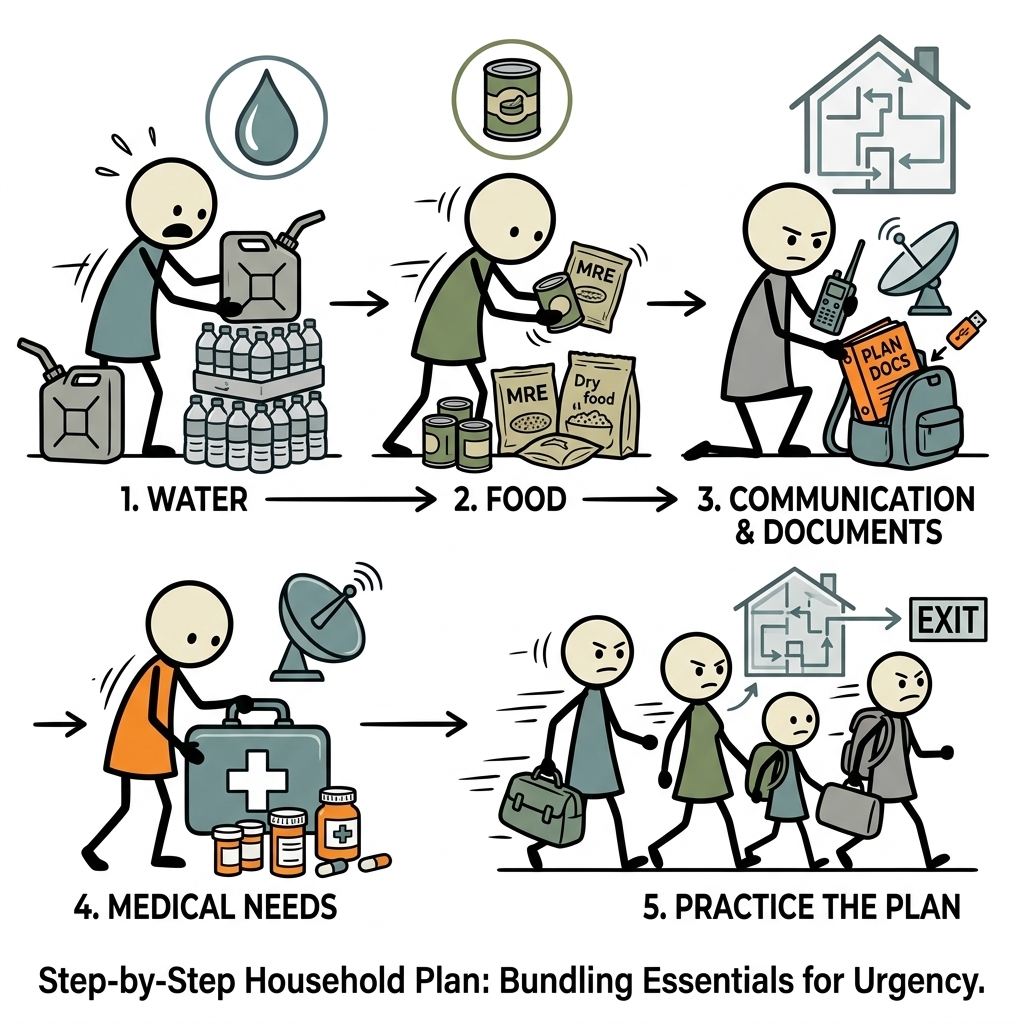
1. Water: The Absolute Foundation of Life
Water is the most immediate biological priority in any Survival Scenarios. While a human can survive for weeks without food, dehydration can become fatal in a matter of days, and mild cognitive decline begins after losing just 1.5% of your body's water volume. To safeguard your household, you must plan for both storage and active purification.
The Math of Hydration and Sanitation
The baseline standard recommended by FEMA and the CDC is one gallon of water per person, per day. However, this is a baseline, not a luxury standard. To build an effective emergency preparedness checklist family plan, you must break down this volume into specific allocations:
- Drinking Water: 0.5 gallons per day for basic metabolic hydration under normal conditions. This requirement increases for pregnant women, nursing mothers, children, and individuals in hot climates.
- Hygiene and Food Prep: 0.5 gallons per day for basic handwashing, limited dish cleaning, and rehydrating dried foods.
- Pet Needs: Do not forget domestic animals. Large dogs require up to 1 gallon per day, while cats and small dogs generally require 1 to 2 cups per day.
For a family of four with one medium-sized dog, a standard 3-day emergency supply requires at least 13.5 gallons of water. A more resilient 14-day supply requires 63 gallons.
Storage Best Practices
Storing water incorrectly can lead to bacterial contamination, making your supply unusable when you need it most. Avoid using milk jugs or recycled juice containers; the plastic polymer in milk jugs degrades rapidly, and residual sugars can foster harmful bacterial growth. Instead, utilize food-grade, BPA-free plastic containers, such as heavy-duty polyethylene jugs or 55-gallon drums. Store your containers in a cool, dark, and dry environment to prevent algae growth and chemical leaching from the plastic. Every six months, rotate your stored water by using it for household tasks or plants, and refill the containers with fresh, chlorinated tap water.
Purification and Filtration Protocols
Stored water can eventually run out, necessitating the harvesting of local water sources like rainwater, streams, or municipal distribution points of unknown quality. Your plan must include redundant purification methods:
- Boiling: The gold standard for pathogen destruction. Bring water to a rolling boil for at least one full minute (or three minutes at altitudes above 6,500 feet) to kill viruses, bacteria, and protozoa.
- Chemical Disinfection: If boiling is not an option, use unscented liquid household chlorine bleach (containing 5% to 9% sodium hypochlorite). Add 8 drops (about 1/8 teaspoon) of bleach per gallon of clear water, stir, and let it stand for 30 minutes. If the water is cloudy, double the dosage to 16 drops.
- Mechanical Filtration: Equip your kit with point-of-use microfiltration systems (such as hollow-fiber membrane filters rated at 0.1 microns or absolute). Note that standard camping filters remove bacteria and protozoa but do not remove viruses; for virus protection, you will need a purifier rated to remove particles down to 0.02 microns.
2. Food: Caloric Security and Nutrient Density
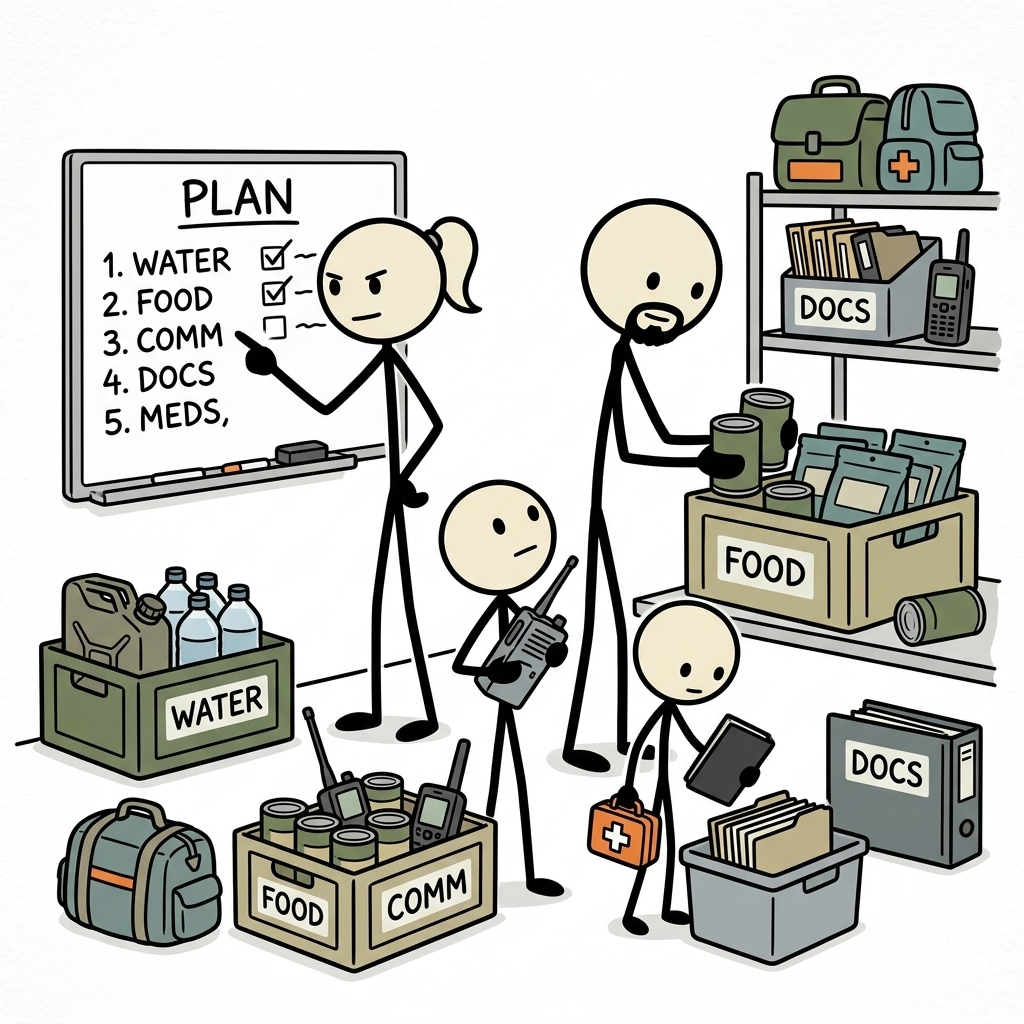
During a disaster, your body will likely experience increased physical exertion and stress, raising your caloric requirements. Food provides more than just physical energy; it offers psychological comfort, stability, and a sense of normalcy in chaotic circumstances. Building a robust emergency food storage guide requires focusing on shelf-stability, nutritional balance, and ease of preparation.
Caloric and Nutritional Planning
When developing your emergency preparedness checklist family checklist, aim for a minimum of 2,000 calories per adult per day, balanced across proteins, carbohydrates, and healthy fats. Avoid high-sodium foods that will increase your water consumption. Focus on a mix of the following categories:
- Ready-to-Eat Canned Goods: Canned meats (tuna, chicken, salmon), beans, vegetables, and low-sodium soups. These require no cooking or water reconstitution.
- Dry Goods and Grains: White rice, rolled oats, dried beans, and pasta. These are highly cost-effective and have a shelf life of up to 30 years when sealed in Mylar bags with oxygen absorbers.
- High-Density Energy Foods: Peanut butter, nuts, dried fruits, protein bars, and beef jerky. These offer high caloric density with minimal weight and volume.
- Specialty and Comfort Items: Instant coffee, tea, hard candies, and spices. Do not underestimate the morale boost that hot coffee or a sweet treat can provide during a prolonged power outage.
The FIFO Rotation Method
To prevent your food supply from expiring, implement the "First In, First Out" (FIFO) rotation method. Organize your pantry so that older items are pushed to the front to be used first, while newly purchased items are placed in the back. Check expiration dates twice a year—ideally during daylight saving time transitions—and donate items nearing their expiration to local food banks, replacing them with fresh stock.
Off-Grid Cooking and Utilities
A cupboard full of raw rice and dried beans is useless if your electric stove is dead and you have no way to boil water. Your household plan must include an alternative, safe cooking method:
- Camp Stoves: Propane or butane single-burner stoves are excellent for outdoor use. Never use camp stoves, charcoal grills, or generator-powered hot plates indoors due to the extreme danger of carbon monoxide poisoning.
- Manual Tools: Ensure you have at least two high-quality manual can openers. Electric can openers are useless during grid failures, and struggling to open a can with a knife is a common cause of severe lacerations during disasters.
- Fuel Storage: Store propane canisters or butane bottles in a well-ventilated garage or outdoor shed—never inside the main living areas of your home. Keep enough fuel on hand to support your cooking needs for at least two weeks.
3. Communication: Establishing Your Family Network
The moments immediately following a major event are often characterized by a complete breakdown of local communications. Cell towers become overloaded with emergency calls, lines go down, and internet routing stations lose power. Without a pre-established communication protocol, family members can easily become separated and anxious, leading to hasty and dangerous decisions.
The Out-of-Town Contact Strategy
During a localized disaster, local cellular networks are usually jammed, but long-distance routing channels often remain clear. This is why your emergency preparedness checklist family emergency plan preparedness plan must center around a designated Out-of-Town Contact. Choose a relative or friend who lives at least 100 miles outside your immediate metropolitan area.
In an emergency, every family member should contact this designated person to report their safety and location. It is much easier for four family members to make one long-distance call or send a single text to an out-of-state number than it is for them to coordinate directly with each other within a congested local network area.
Text vs. Voice and the Power of SMS
Teach every member of your household that text messages are far more likely to get through than voice calls during a crisis. SMS text messages use significantly less bandwidth than voice calls and operate on a "store-and-forward" protocol. If a network is congested, a text message will continue to attempt delivery in the background until a small packet of bandwidth opens up, whereas a voice call will simply fail or drop immediately.
Establishing Meeting Points
If communication networks fail entirely, you must have pre-arranged physical meeting locations. Establish three distinct meeting points based on the nature of the emergency:
| Meeting Point Level | Location Description | Best Used For... |
|---|---|---|
| Level 1: Immediate | Right outside your home (e.g., a specific neighbor's driveway or mailbox). | Sudden events like house fires or gas leaks. |
| Level 2: Neighborhood | A location outside your immediate street (e.g., a local school, library, or park). | Events where you cannot access your home or street, such as localized flooding or police activity. |
| Level 3: Regional | A secure location outside your town or city (e.g., a relative's home or a designated town hall). | Wide-scale evacuations (hurricanes, wildfires) where the entire neighborhood must be cleared. |
Redundant Communication Gear
Do not rely solely on smartphones. Equip your household with alternative communication tools:
- NOAA Weather Radio: A battery-powered or hand-crank NOAA weather radio provides continuous, official broadcasts on weather hazards, civil emergencies, and evacuation routes directly from the National Weather Service.
- Family Radio Service (FRS) or GMRS Radios: High-quality two-way walkie-talkies are invaluable for short-range communication (usually 1 to 2 miles in suburban environments) if family members are separated near the home.
- Backup Power Banks: Keep several high-capacity (10,000 to 20,000 mAh) external USB battery packs charged and ready to keep mobile devices powered for several days.
4. Documents: Safeguarding Identity and Assets
In the aftermath of a disaster, recovering your life, filing insurance claims, and proving your identity are crucial for long-term survival and recovery. If you are forced to evacuate your home in minutes, you cannot afford to spend time searching through filing cabinets for vital paperwork. You need a dedicated, secure document system.
The Waterproof, Fireproof Binder
Create a physical "Go-Binder" using a heavy-duty, waterproof, and fire-resistant document bag. This binder should contain physical, certified copies of your household's most critical documents. Organize them using plastic sheet protectors for quick reference:
- Identity Documents: Passports, birth certificates, driver's licenses, Social Security cards, marriage certificates, and military discharge papers (DD-214).
- Financial Records: Recent bank statements, tax returns, mortgage deeds, vehicle titles, and active credit card numbers with customer service contact details.
- Insurance Policies: Full copies of homeowners, renters, auto, health, and life insurance policies, complete with policy numbers and claims department phone numbers.
- Medical Information: Immunization records, lists of current prescription medications (with dosages and prescribing doctors), health insurance cards, and copies of living wills or powers of attorney.
The Digital Backup Protocol
Physical documents can still be lost or damaged in extreme scenarios. Create a redundant digital archive of every document in your Go-Binder. Scan these documents at a high resolution and store them on a secure, hardware-encrypted USB flash drive. Keep this drive on your keychain or inside your physical Go-Binder. Additionally, upload these encrypted files to a secure, password-protected cloud storage service, ensuring you can access them from any internet-connected device worldwide.
Cash: The Ultimate Offline Currency
When the electrical grid goes down, credit card terminals, ATMs, and digital payment apps like Apple Pay or Venmo instantly stop working. Retailers who remain open will operate on a cash-only basis. Keep a dedicated emergency cash reserve inside your Go-Binder. This reserve should consist of small denominations ($1, $5, $10, and $20 bills). Merchants running on backup power or manual ledgers may not be able to make change for a $100 bill, and carrying smaller bills prevents you from overpaying for essential supplies like fuel or water.
5. Medical Needs: Beyond the Basic First Aid Kit
Emergency medical services (EMS) will be severely delayed or completely unavailable during a major disaster. Your household must be prepared to manage both acute trauma injuries and chronic health conditions without professional medical assistance for several days or even weeks.
Building a Trauma-Ready Medical Kit
Most off-the-shelf first aid kits are designed for minor cuts, scrapes, and insect bites. They are wholly inadequate for serious injuries. Your medical kit should be divided into two distinct sections: everyday first aid and advanced trauma management.
- Trauma Supplies: Focus on severe bleeding control. Include CoTCCC-approved windlass tourniquets (such as the CAT Gen 7), hemostatic gauze (like QuikClot) to promote rapid clotting, pressure dressings (Israeli bandages), chest seals for penetrating thoracic wounds, and trauma shears to quickly cut through heavy clothing.
- Orthopedic Support: Include SAM splints, elastic bandages (Ace wraps), and triangular bandages to immobilize sprained or fractured limbs.
- Over-the-Counter (OTC) Medications: Stock broad-spectrum antibiotics (if prescribed by a doctor for emergency use), pain relievers/fever reducers (ibuprofen, acetaminophen), antihistamines for allergic reactions, anti-diarrheal medications (loperamide), and rehydration salts.
Managing Prescription Medications
If a member of your household relies on daily maintenance medications (such as insulin, blood pressure medication, or asthma inhalers), a sudden supply disruption can quickly turn life-threatening. Work with your primary care physician to secure an emergency buffer supply. Many insurance companies allow for a "vacation override" once a year, enabling you to secure an extra 30-day supply. If this is not possible, build up a buffer by refilling your prescriptions at the earliest allowable date every month, gradually accumulating a 7-to-14-day surplus.
Sanitation and Hygiene Management
When municipal sewer systems fail, disease can spread rapidly through a household. Proper sanitation is a critical medical countermeasure. Ensure your kit contains:
- Emergency Toilet System: A five-gallon bucket lined with heavy-duty trash bags, utilizing kitty litter, sawdust, or chlorinated powder to neutralize odors and dry out waste.
- Personal Hygiene Supplies: Large quantities of hand sanitizer (at least 60% alcohol content), wet wipes for waterless bathing, heavy-duty nitrile gloves, and a reliable supply of feminine hygiene products.
- Waste Disposal: Heavy-duty contractor trash bags and zip ties to safely seal and store human waste until municipal services resume.
6. The Rehearsal: Transforming Knowledge into Muscle Memory
The most comprehensive emergency plan is only as good as your family's ability to execute it under pressure. During high-stress events, cognitive processing slows down, and we default to our lowest level of training. Regular practice sessions turn complex procedures into automatic muscle memory.
Conducting Realistic Drills
Do not simply read through your plan; actively practice it. Schedule family drills twice a year. Make these exercises realistic but non-threatening, especially for children:
- The 2-Minute Evacuation Drill: Set a timer for two minutes without warning. Have every family member locate their personal "go-bag essentials guides," secure their critical documents, and gather at your Level 1 meeting point outside. Afterward, discuss what went well and what was forgotten.
- The Blackout Night: Turn off the main electrical breaker to your home on a Friday evening. Spend the night using only your emergency lighting, cooking on your camp stove (outdoors), and utilizing your stored Water Calculator. This exercise quickly reveals gaps in your gear and teaches family members how to navigate the home safely in the dark.
- The Communication Check: While family members are at work, school, or running errands, initiate an emergency alert via text message. Instruct everyone to contact your designated Out-of-Town Contact and report their status. Track how long it takes for the entire network to sync up.
Annual Maintenance and Review
An emergency plan is a living document that must evolve alongside your household's needs. Set a recurring calendar reminder every spring and autumn to perform the following maintenance tasks:
- Check Expiration Dates: Inspect all stored food, water, and OTC medications. Rotate items that are within six months of expiration into your daily-use pantry.
- Inspect Medical Supplies: Ensure sterile packaging is intact and that tourniquets or bandages have not been degraded by heat or moisture exposure.
- Update Contacts and Documents: Verify that phone numbers, insurance policies, and medical records in your Go-Binder are current. Replace any outdated paperwork.
- Test Batteries and Gear: Charge all portable power banks, test the batteries in your NOAA weather radio, and run your emergency generator under load for 15 minutes to ensure it functions correctly.
Taking the First Step Toward Resilience
Building a complete household emergency plan can feel overwhelming when viewed as a single, massive project. The key to success is incremental progress. Do not try to accomplish everything in a single weekend. Start by securing a three-day supply of water for your family this week. Next week, establish your Out-of-Town Contact and print your vital documents. By systematically tackling each pillar of preparedness step-by-step, you will replace vulnerability with capability. Preparedness is not about living in fear of the future; it is about having the confidence, tools, and training to navigate whatever challenges come your way, ensuring your family's safety and peace of mind.
Frequently Asked Questions
What should a emergency preparedness checklist family plan include?
Start with the immediate safety steps, the supplies and records your household needs, a communication plan, and a regular review schedule. Follow local official guidance during an active emergency.
How often should I review emergency preparedness checklist family preparations?
Review them at least twice a year and whenever your household, medication, location, or local risks change. Replace expired supplies and practice key steps.
Where can I find reliable emergency guidance?
Use local emergency management alerts and established public-health or emergency-management agencies. A blog guide should support, not replace, official real-time instructions.