⚡ Key Facts
- Industrial Density: The U.S. Gulf Coast is home to over 40% of the nation's petrochemical manufacturing capacity, with thousands of Risk Management Program (RMP) facilities operating in hurricane-prone zones.
- Compound Disasters: During Hurricane Harvey in 2017, industrial facilities released an estimated 8.3 million pounds of unpermitted air pollutants during storm-related shutdowns, startups, and equipment failures.
- Respiratory Reality: Standard N95 particulate masks offer zero protection against toxic industrial gases and chemical vapors; NIOSH-approved elastomeric respirators with multi-gas/vapor cartridges are required.
- Vapor Dynamics: Hazardous gases behave differently based on vapor density; chlorine gas is heavier than air and sinks into low-lying areas, while anhydrous ammonia is lighter than air and rises, directly impacting your shelter-in-place strategy.
- The Recirculation Rule: When evacuating a chemical plume by vehicle, setting your HVAC system to "recirculate" can reduce indoor particulate and vapor intrusion by up to 80% compared to drawing in outside air.
For residents of the Gulf Coast, the threat of severe weather is a familiar annual reality. However, along the industrial corridor stretching from Corpus Christi, Texas, through the Houston Ship Channel, and across southern Louisiana’s "Cancer Alley" to New Orleans, hurricanes and tropical storms do not arrive in isolation. They land atop one of the densest concentrations of petrochemical infrastructure on Earth. When a Category 4 hurricane collides with a refinery complex, the result is a compound disaster: a simultaneous natural hazard and industrial hazardous materials (hazmat) emergency. Preparing for these overlapping crises requires a specialized survival strategy that goes far beyond standard hurricane prep. By understanding the physics of chemical releases, mastering the mechanics of shelter-in-place protocols, and knowing how to navigate a toxic evacuation route, you can protect your family from these invisible, high-consequence threats.
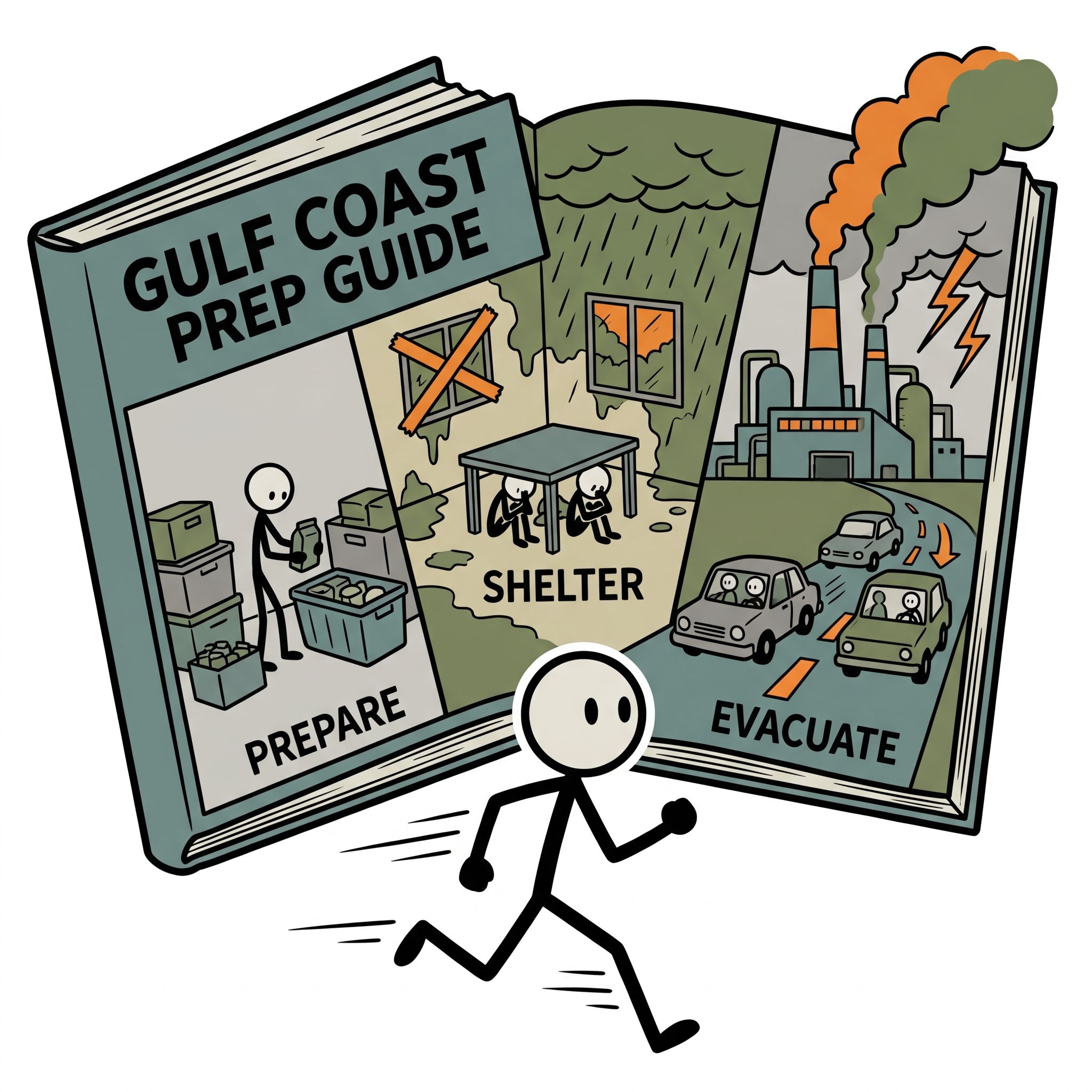
The Gulf Coast Reality: Where Natural Hazards Meet Industrial Hazards
The Gulf Coast is uniquely vulnerable to compound disasters. According to the National Oceanic and Atmospheric Administration (NOAA), the frequency and intensity of rapid-onset tropical systems in the Gulf of Mexico are increasing. Simultaneously, the Environmental Protection Agency (EPA) tracks thousands of facilities under its Risk Management Program (RMP) in this exact region. These facilities store, process, and transport millions of gallons of hazardous substances, including anhydrous ammonia, chlorine, hydrogen fluoride, and benzene.
During an extreme weather event, these industrial sites face multiple failure points. High winds can shear off storage tank valves or compromise floating roof tanks, releasing volatile organic compounds (VOCs) into the atmosphere. Storm surges and torrential rainfall can flood containment dikes, causing chemical run-off into local waterways or triggering thermal reactions in water-reactive substances. Furthermore, widespread power grid failures—a common consequence of Gulf storms—can disable critical cooling systems. As documented by the Chemical Safety Board (CSB) during the 2017 Arkema chemical plant fire in Crosby, Texas, the loss of refrigeration for organic peroxides can lead to rapid decomposition, runaway thermal reactions, explosions, and toxic smoke plumes. For residents living downwind, Gulf Coast hazmat preparedness is not a theoretical exercise; it is an essential life skill.
To survive these compound events, you must understand that the emergency response systems we rely on during normal blue-sky days—such as local fire department hazmat teams—may be delayed or entirely incapacitated by storm debris, flooding, and high winds. Self-reliance, informed by scientific principles and agency-vetted protocols, is your primary line of defense.
Phase 1: Pre-Incident Hazard Mapping and Home Hardening
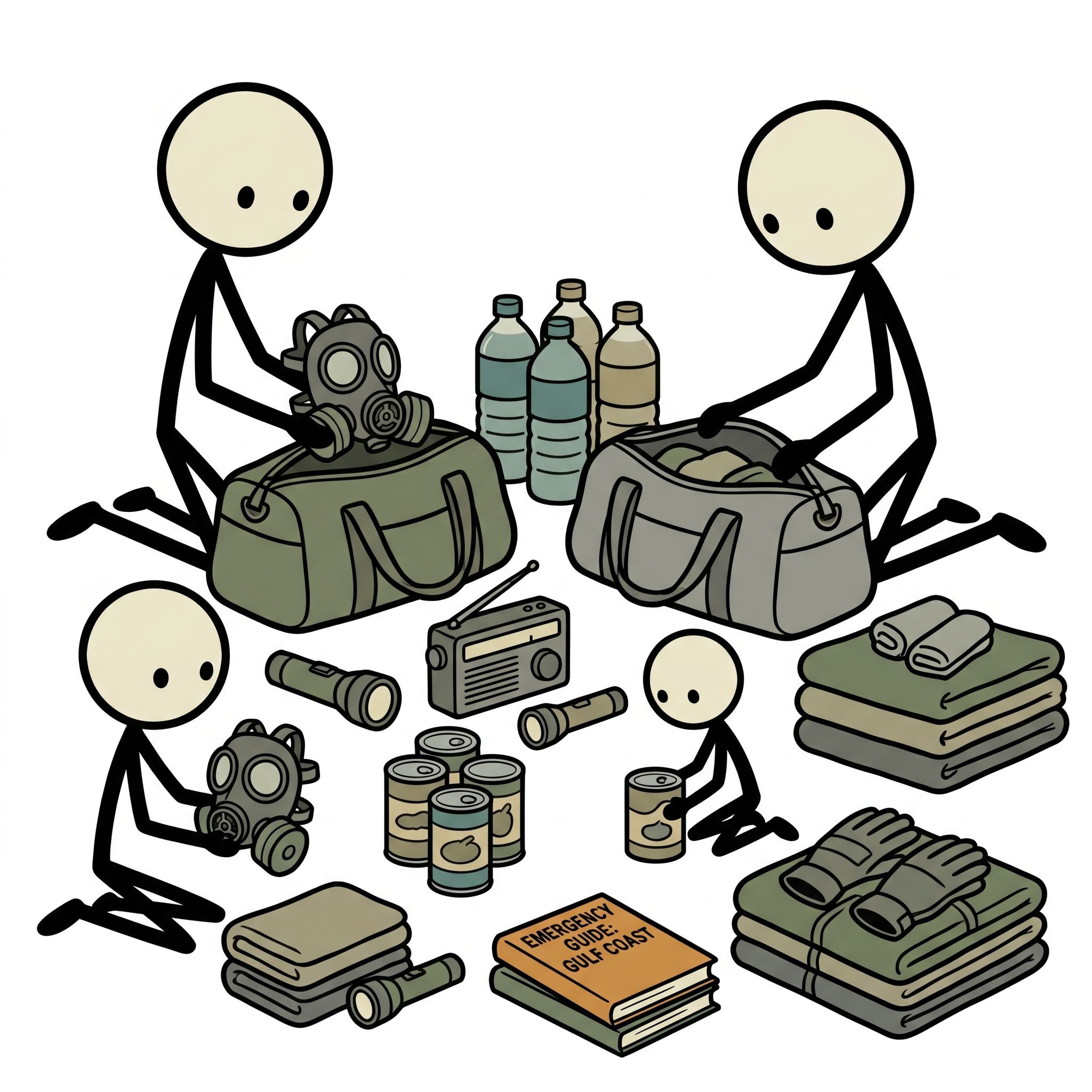
Effective petrochemical emergency preparedness begins long before a storm enters the Gulf. You must conduct a localized risk assessment to understand exactly what hazards lie upwind of your home, and then harden your living space to act as a barrier against both wind and toxic vapors.
1. Conduct a Localized Vulnerability Assessment
You cannot prepare for a threat you cannot identify. Under the Emergency Planning and Community Right-to-Know Act (EPCRA), you have access to information regarding hazardous chemicals in your community. Use the following steps to map your local risks:
- Identify Near-Source Hazards: Contact your county or parish Local Emergency Planning Committee (LEPC). Ask for the Tier II emergency and hazardous chemical inventory reports for facilities within a 5-mile radius of your home.
- Analyze the EPA's EJScreen: Use the EPA's Environmental Justice Screening and Mapping Tool online to locate nearby RMP facilities and understand their historical compliance and chemical storage profiles.
- Map Prevailing Wind Patterns: Utilize NOAA data to understand prevailing wind directions during different seasons. In the Gulf Coast, summer and autumn winds typically blow from the south-southeast, meaning communities north and northwest of industrial zones are frequently downwind during hurricane season.
2. Build a Specialized Hazmat Emergency Kit
A standard hurricane kit containing bottled water, canned goods, and flashlights is insufficient for an industrial accident. You must supplement your supplies with specialized equipment designed to mitigate chemical exposures. Your enhanced kit should include:
- NIOSH-Approved Respirators: Standard N95 or surgical masks only filter particulates; they offer zero protection against chemical vapors and gases. Equip every family member with a half-mask or full-face elastomeric respirator fitted with multi-gas/vapor cartridges (such as 3M 6006 or equivalent) and a P100 particulate pre-filter. Ensure these are fit-tested annually.
- Non-Vented Goggles: Many industrial gases (like chlorine and ammonia) are highly corrosive to the eyes. Store tight-fitting, non-vented safety goggles for every household member.
- Sealing Materials: Keep at least three rolls of heavy-duty, 2-inch wide duct tape or clean-release painter's tape, along with several rolls of 4-mil or 6-mil thick plastic sheeting pre-cut to fit your home's windows, doors, and vents.
- Chemical-Resistant Gloves: Store heavy-duty nitrile or neoprene gloves (minimum 15-mil thickness) to handle potentially contaminated surfaces or debris post-storm.
- Communication Tools: A battery-powered or hand-crank NOAA Weather Radio with Specific Area Message Encoding (SAME) alerts to receive real-time Emergency Alert System (EAS) broadcasts even when cellular networks fail.
3. Home Hardening for Vapor Intrusion
Your home can serve as an effective shelter if you minimize its air exchange rate. Identify all passive ventilation points, such as dryer vents, bathroom exhaust fans, fireplace dampers, and pet doors. Ensure that dampers function correctly and can be sealed tightly from the inside. Install high-quality weather stripping on all exterior doors and windows, and caulk any visible gaps in your home’s envelope where utility lines enter the structure.
Phase 2: The Art and Science of Sheltering in Place
When an industrial accident occurs during a severe weather event, local authorities may issue a "shelter-in-place" order. This is often the safest course of action when outdoor air is contaminated and high winds or flooding make evacuation impossible. However, a successful shelter in place chemical release protocol requires immediate, disciplined execution to prevent the toxic plume from infiltrating your safe zone.
The Step-by-Step Sealing Protocol
The moment a chemical release is reported or you detect a chemical odor (such as the rotten-egg smell of hydrogen sulfide or the bleach-like odor of chlorine), execute the following steps immediately:
- Bring Everyone Inside: Immediately gather your family and pets indoors. Do not leave anyone outside to secure loose yard items if a chemical plume is active.
- Close and Lock All Openings: Close and lock all exterior doors and windows. Locking them is critical, as it compresses the weather stripping, creating a significantly tighter seal against vapor intrusion.
- Deactivate HVAC Systems: Turn off all air conditioners, heating units, and ventilation systems. Ensure that any fresh-air intake features on your HVAC system are closed. Switch off all exhaust fans in kitchens, bathrooms, and utility rooms.
- Select Your Safe Room: Choose an interior room with the fewest doors and windows. Ideally, this should be a room with access to water, such as a master bathroom or utility room.
- The Physics of Gas Density: Your choice of floor depends on the specific chemical released. If the release involves a gas heavier than air (such as chlorine, density 2.5 times that of air), seek a room on an upper floor, as these gases will settle into low-lying areas and basements. If the gas is lighter than air (such as anhydrous ammonia, density 0.6 times that of air), seek a lower-level interior room, provided it is safe from rising floodwaters. If the chemical is unknown, select a middle-level or upper-level interior room to balance flood and vapor risks.
- Seal the Room's Envelope: Use your pre-cut plastic sheeting and tape to seal all windows, doors, electrical outlets, and HVAC vents inside your designated safe room. Tape the plastic sheeting securely, overlapping the edges by at least three inches.
- The Threshold Seal: Place a damp towel firmly against the crack at the bottom of the entry door to block any drafts before taping over the entire door frame.
- Manage Your Air Supply: Do not panic about running out of oxygen. A typical residential room contains enough air to sustain several people for several hours. Sheltering in place is a temporary measure—usually lasting from two to six hours—designed to let the highest concentration of a toxic plume pass over your location.
Navigating the Compound Dilemma: Wind vs. Vapor
During a hurricane, you may face a conflicting scenario: high winds require you to stay away from windows, while a chemical release requires you to seal yourself in an airtight space. If your designated safe room has windows, cover them with heavy blankets or mattresses to protect against flying debris while maintaining your vapor seal. Always prioritize your life-safety threats: if the wind is actively destroying your shelter, don your respirator and move to the strongest structural point of the building, even if it compromises your airtight seal.
Phase 3: Tactical Evacuation Protocols
There are scenarios where sheltering in place is untenable—such as when a facility fire threatens to cause a catastrophic explosion, or when rising floodwaters force you out of your home during a toxic release. In these high-stakes moments, executing a precise chemical spill evacuation protocol is critical to your survival.
1. Analyze Wind Direction and Plume Dynamics
Never evacuate blindly. Walking or driving directly into a toxic plume can be fatal. Before stepping outside, determine the wind direction using local weather apps, a wind vane, or by observing the movement of trees, smoke, or rain.
The golden rule of chemical evacuation is to travel crosswind—perpendicular to the direction the wind is blowing—rather than directly downwind or upwind. Traveling directly downwind keeps you inside the expanding path of the plume. Traveling directly upwind may bring you closer to the hazardous source. By moving perpendicular to the wind, you can exit the narrow path of the plume in the shortest distance possible.
| Wind Direction (From) | Plume Movement (To) | Safe Evacuation Trajectory |
|---|---|---|
| North | South | East or West (90-degree angle) |
| East | West | North or South (90-degree angle) |
| South | North | East or West (90-degree angle) |
| West | East | North or South (90-degree angle) |
2. Vehicle Preparation and Operation
If evacuating by car, your vehicle can provide a moderate level of protection if operated correctly. Before starting your engine, ensure all windows and sunroofs are completely closed.
Set your vehicle's climate control system to "Recirculate" and turn off any automatic fresh-air features. This prevents the system from pulling outside air and toxic fumes directly into the cabin. If you must drive through an area with a visible haze, smoke, or a strong chemical odor, turn the entire HVAC system off completely to minimize air exchange. Drive at a safe, controlled speed; chemical clouds can severely reduce visibility, and roads may be compromised by storm debris or floodwaters.
3. Navigating Compound Flood Hazards
Along the Gulf Coast, heavy rains quickly flood underpasses and low-lying roads. This poses a double hazard during an industrial emergency. Many hazardous gases are heavier than air and will pool in the same low-lying areas, underpasses, and depressions where floodwaters accumulate.
Never drive through flooded roadways. Not only do you risk stalling your vehicle, but you may also drive directly into a concentrated pocket of toxic gas or contaminated water. If your vehicle stalls in a flooded area near an active chemical release, immediately check the wind direction, don your respirator, exit the vehicle, and move to higher ground on foot.
Phase 4: Post-Incident Recovery and Decontamination
The danger does not end once the storm passes or the initial leak is contained. Entering contaminated areas or handling exposed materials can lead to secondary exposure. Understanding the basics of industrial accident survival recovery will protect you from long-term health consequences.
1. Execute Immediate Personal Decontamination
If you suspect you have been exposed to chemical vapors, aerosols, or contaminated floodwaters, you must perform decontamination immediately to prevent chemical burns and systemic absorption. The Centers for Disease Control and Prevention (CDC) recommends the following protocol:
- Remove Contaminated Clothing: Carefully remove all outer clothing. Do not pull shirts or sweaters over your head, as this can transfer chemicals to your eyes, nose, and mouth. Instead, use scissors to cut the clothing off your body if necessary.
- Double-Bag the Clothing: Place all contaminated clothing inside a plastic garbage bag. Seal the bag tightly, then place it inside a second plastic bag and seal that as well. Discard it according to local hazardous waste guidelines; do not wash or reuse it.
- Wash Thoroughly: Wash your entire body with large amounts of lukewarm water and mild soap. Do not scrub your skin aggressively, as this can cause abrasions that allow chemicals to penetrate deeper into your tissues. Flush your eyes with clean, running water or saline solution for at least 15 to 20 minutes if you experience stinging or watering.
- Change into Clean Clothes: Dress in uncontaminated clothing that has been stored in a sealed plastic bin or bag.
2. Assess Your Home Before Re-Entry
Do not return to your home until local officials have declared the area safe. Even if the outdoor air is clear, toxic gases can remain trapped inside structures that were not properly sealed.
Upon returning, open all doors and windows to thoroughly ventilate the house for at least 30 minutes before turning your HVAC system back on. Inspect your property for signs of chemical deposition, such as unusual oily films on surfaces, dead vegetation, or dead wildlife. If you suspect your home’s exterior or soil has been contaminated, contact your local health department or the EPA's National Response Center (NRC) to request an environmental assessment.
3. Managing Contaminated Water and Food Supplies
During a compound disaster, local water treatment facilities may be offline or compromised by chemical run-off. Do not drink, cook with, or bathe in tap water until municipal authorities confirm it is safe.
Boiling water kills biological pathogens (like bacteria and viruses), but it does not remove chemical contaminants. In fact, boiling can concentrate certain chemicals or release toxic vapors into your kitchen air. Rely exclusively on bottled water or certified chemical-filtration systems (such as active carbon or reverse osmosis units rated for chemical removal) until the Water Calculator is cleared. Discard any uncovered food, garden produce, or medicines that may have been exposed to chemical plumes or floodwaters.
Conclusion: Empowerment Through Preparation
Living on the Gulf Coast means accepting the dynamic power of nature and the industrial footprint that fuels our modern economy. While the threat of a compound natural-industrial disaster is serious, it is not a scenario for fear; it is a call for structured preparedness. By understanding the physical properties of chemical hazards, equipping your household with the correct protective gear, and practicing your shelter and family emergency plans, you transform vulnerability into resilience. You cannot control when a storm makes landfall or when an industrial valve fails, but you can control your readiness. Take these steps today to ensure that when the sirens sound, your family is prepared to act with confidence, precision, and the power of survival science on your side.
Frequently Asked Questions
What is the first thing I should do during a petrochemical leak or hazmat release?
Immediately shelter in place, close all windows and doors, turn off all HVAC systems to prevent outdoor air from circulating inside, and monitor local emergency broadcasts.
How do I know if a hazmat evacuation order has been issued in my Gulf Coast community?
Monitor local news, NOAA Weather Radio, and sign up for local county or parish emergency management alerts and Wireless Emergency Alerts (WEA).
What specific items should be added to a hazmat emergency kit?
Include plastic sheeting, heavy-duty duct tape for sealing doors and vents, N95 or particulate respirators, and a multi-day supply of bottled water.
What is the proper protocol for sheltering in place during a chemical emergency?
Go to an interior room on the highest level possible (some gases are heavier than air), seal all doors, windows, and vents with plastic and tape, and stay inside until authorities declare it safe.
How do Gulf Coast hurricanes impact petrochemical hazard risks?
Severe storms and flooding can cause power outages, physical damage to industrial facilities, and chemical spills, making early evacuation planning and shelter preparedness vital.
Learn about natural disaster survival for hazmat incidents. Review air quality preparedness strategies. Develop emergency preparedness plans. Use our supply calculator and check our courses.