⚡ Key Facts
- According to the National Oceanic and Atmospheric Administration (NOAA), the U.S. experiences dozens of billion-dollar weather disasters annually, frequently resulting in prolonged, widespread power outages.
- The Federal Emergency Management Agency (FEMA) officially advises all households to maintain a basic set of manual tools to secure their home's envelope following severe weather events.
- Centers for Disease Control and Prevention (CDC) data shows a significant spike in severe injuries from chainsaws and power tools following natural disasters, making manual tools a safer alternative for fatigued or untrained individuals.
- A well-maintained, high-carbon steel crosscut saw can slice through a 10-inch fallen pine log in under three minutes, requiring absolutely zero fuel, electricity, or complex maintenance.
- Historical tool manufacturing peaked in material quality between 1880 and 1940; restoring vintage hand tools often yields stronger, more durable implements than modern, mass-produced equivalents.
A Knife Is a Different Tool Than a Pry Bar
Keep cutting, prying, and repair jobs separate so one overloaded tool does not become a failure point. For a practical bug out knife, compare blade strength, sheath carry, and realistic field tasks before adding it to a grid-down tool kit.
Imagine the immediate aftermath of a severe, localized disaster. A Category 4 hurricane, a violent derecho, or a massive winter storm has just rolled through your region. The power grid is completely dark, and local utility companies are estimating weeks before restoration. You step outside to find a heavy oak branch resting on your roof and a shattered living room window letting in the elements. See the survival scenarios library for a practical checklist. Review the go-bag essentials guide to adapt these steps.
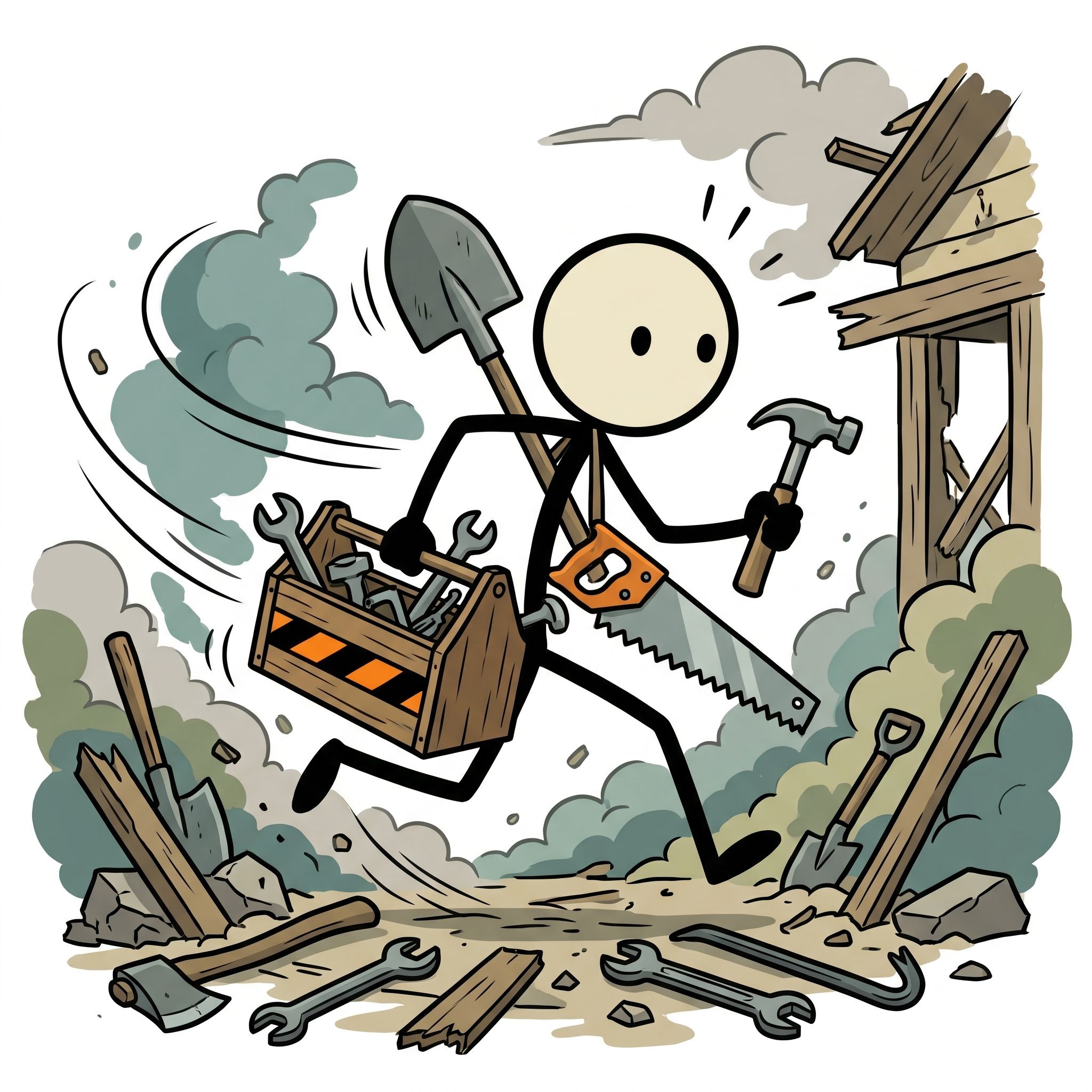
In this exact moment, your battery-powered tools are only as good as their current charge. Your gas-powered chainsaw is useless if the local stations are closed or their pumps lack electricity. This is where true self-reliance begins. The ability to repair your shelter, clear debris, and build essential structures without relying on modern infrastructure is a cornerstone of genuine preparedness. See the family emergency plan guide for a practical checklist. Review the go-bag builder tool to adapt these steps.
Building a collection of non electric tools emergency responders and historical craftsmen would recognize is about reclaiming independence. It is about acknowledging that while power tools are incredibly convenient, they introduce a fragile dependency into your survival plan. This guide will walk you through the exact implements you need, how to source them, and the critical knowledge required to keep them functional for a lifetime. See the Protocol Survival app plans for a practical checklist.
The Reality of the Grid-Down Scenario
We live in an era of unprecedented convenience, but that convenience is tethered to a highly complex and vulnerable power grid. According to the Department of Energy, the United States experiences more power outages than any other developed nation. When severe weather strikes, the fragility of this system is immediately exposed.
The American Red Cross consistently emphasizes that post-disaster self-reliance drastically reduces your overall risk. If your home's envelope is compromised by wind or debris, you cannot wait days for emergency services or contractors to arrive. You must have the capacity to board up windows, tarp roofs, and stabilize structural damage immediately. When deploying hand tools grid down scenarios become manageable tasks rather than catastrophic emergencies.
Furthermore, the CDC tracks post-disaster hospital admissions and notes a tragic irony: many injuries occur not during the storm, but during the cleanup. Exhausted, stressed homeowners frequently injure themselves using heavy chainsaws or power saws they rarely operate. Manual tools, while requiring physical exertion, operate at the speed of the user. They are inherently safer, quieter, and completely immune to the supply chain disruptions that halt fuel deliveries.
The Comprehensive Survival Hand Tools List
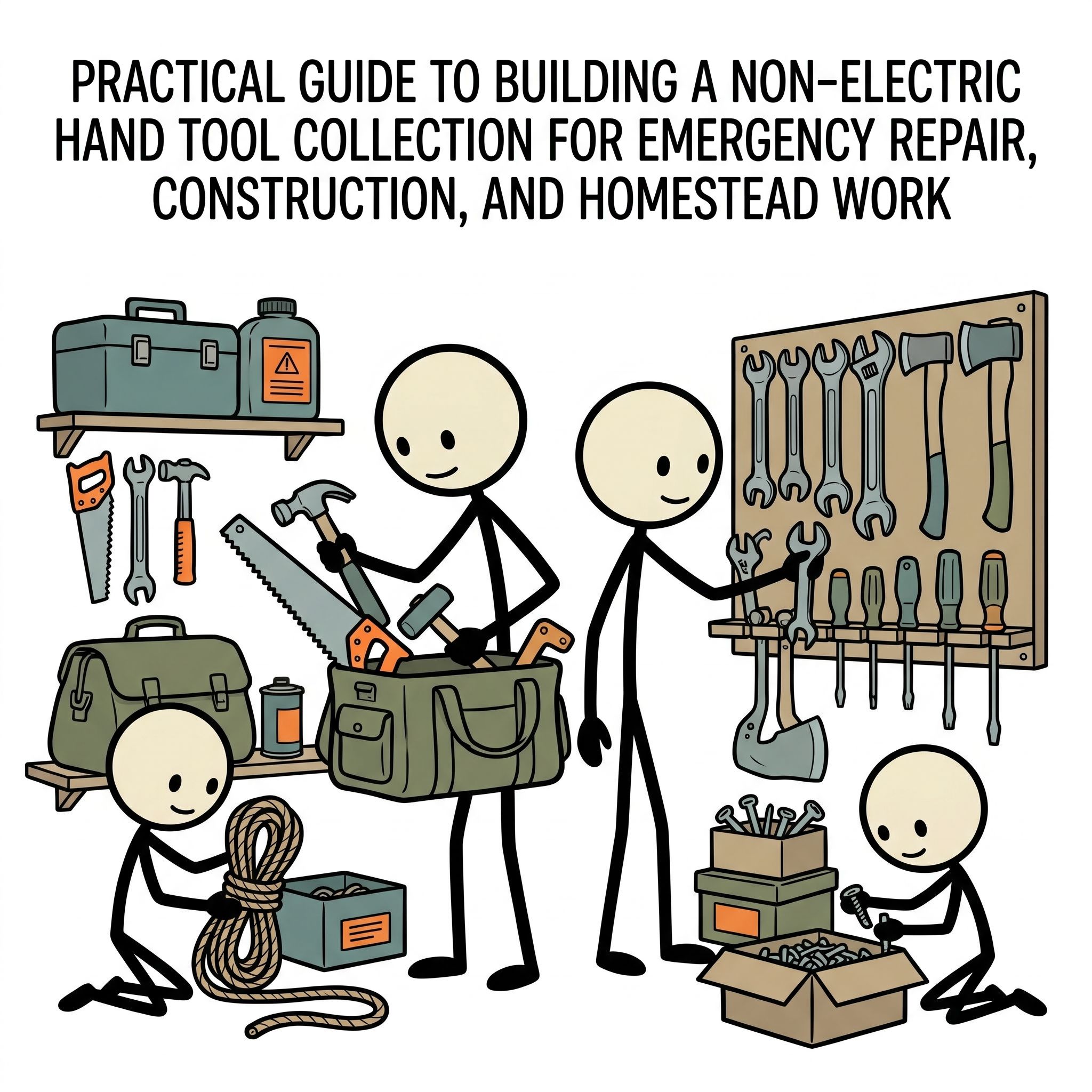
Curating your survival hand tools list requires careful thought and prioritization. You are not just buying tools; you are building a manual capability system. We can break this system down into core categories: cutting, boring, fastening, and heavy groundwork.
Wood Cutting and Clearing
Clearing fallen timber and cutting dimensional lumber are the most energy-intensive tasks you will face. Without a chainsaw or circular saw, you need highly efficient manual alternatives. The key here is having the right blade for the right task.
- The Felling Axe: Essential for taking down standing deadwood or clearing large fallen limbs. Look for a 3.5 to 4-pound head on a 36-inch hickory handle. The longer handle provides the necessary kinetic energy for deep, effective bites into the wood.
- The Boy's Axe: A slightly smaller axe, typically with a 2.5-pound head and a 28-inch handle. This is the ultimate utility tool for limbing downed trees and general camp tasks. It is lighter to swing, reducing fatigue during extended use.
- The Crosscut Saw: Often called a two-man saw, though single-man versions exist. These large saws feature aggressive teeth designed specifically to cut across the grain of thick logs. They are indispensable for clearing roads or processing large firewood rounds.
- The Bow Saw: A modern marvel of manual efficiency. Utilizing a thin, highly tensioned steel blade, a bow saw tears through branches and small logs with incredible speed. Keep several replacement blades on hand, as they cannot be easily sharpened.
- The Hand Saw (Rip and Crosscut): For carpentry and home repair. A crosscut saw cuts across the wood grain (like cutting a 2x4 to length), while a rip saw cuts parallel to the grain (like splitting a board down the middle). You need both to effectively work with dimensional lumber.
Boring and Drilling
Creating holes is a fundamental requirement for both structural repair and homestead construction. Battery-powered drills are ubiquitous today, but their manual predecessors offer astonishing torque and reliability.
- The Brace and Bit: This is the heavy-duty workhorse of manual drilling. The brace acts as a crank, providing massive mechanical advantage, while the auger bit pulls itself into the wood. A quality brace and bit can bore a one-inch hole through solid oak without breaking a sweat.
- The Eggbeater Drill: For smaller, precision holes (typically 1/4 inch or less). This tool uses a geared wheel to spin a drill bit rapidly. It is perfect for pre-drilling screw holes to prevent wood from splitting during delicate repairs.
- The Hand Awl: A simple, pointed steel spike with a wooden handle. It is used to pierce heavy canvas, leather, or to mark the exact starting point for a drill bit so it does not wander.
Fastening and Assembly
Once your materials are cut and drilled, they must be securely joined. The tools in this category are the backbone of any basic home repair kit recommended by FEMA.
- Framing Hammer and Finish Hammer: A heavy framing hammer (20-22 ounces) with a milled face is necessary for driving large nails into structural lumber. A lighter finish hammer (16 ounces) with a smooth face is better for delicate work and driving smaller fasteners.
- Yankee Screwdriver: A brilliant piece of early 20th-century engineering. This ratcheting, pump-action screwdriver drives screws rapidly just by pushing down on the handle. It is the closest manual equivalent to a modern impact driver.
- Standard Screwdriver Set: A robust set of flathead and Phillips screwdrivers with full tangs (the steel runs all the way through the handle). Full-tang screwdrivers can endure light tapping with a hammer if a screw is stubbornly stuck.
- Adjustable Wrenches and Pliers: Essential for tightening bolts, fixing plumbing, and general mechanical repair. The USGS strongly recommends keeping a dedicated, heavy-duty adjustable wrench near your gas meter to shut off utilities immediately following an earthquake.
Demolition and Heavy Lifting
Disaster recovery often requires moving objects much heavier than you can lift safely. Leverage and mechanical advantage are your best friends in a grid-down environment.
- The Wrecking Bar (Crowbar): A 36-inch or 48-inch solid steel bar. It provides the leverage needed to pry apart damaged structures, lift heavy debris off trapped items, or break through stubborn roots.
- Manual Come-Along (Hand Winch): A ratcheting cable winch operated by a hand lever. A heavy-duty come-along can drag fallen trees off a driveway, pull a stuck vehicle out of the mud, or tension a structural support cable.
- Block and Tackle: A system of ropes and pulleys. By distributing the load across multiple pulleys, a block and tackle allows a single person to hoist hundreds of pounds of material into the air with minimal physical effort.
Essential Off Grid Tools Homestead and Construction
Surviving the immediate aftermath of a disaster is only phase one. If you are looking at a long-term grid-down scenario, or if you are actively building a self-reliant lifestyle, your tool needs will expand. Gathering off grid tools homestead builders rely on allows you to move from simple repair to active construction.
Timber framing is the traditional method of building sturdy barns, cabins, and homes without relying on mass-produced nails or brackets. This technique relies on interlocking wood joints, specifically the mortise and tenon. To accomplish this, you need specialized, heavy-duty hand tools.
Framing chisels (often called slick chisels) are massive, two-handed tools used to pare away thick layers of wood. Paired with a heavy wooden mallet, a good set of chisels allows you to carve precise joints into raw logs. You will also need a variety of hand planes—specifically a jack plane for rough sizing and a smoothing plane for finishing—to square up rough-sawn lumber.
Furthermore, precision layout tools are completely immune to EMPs or dead batteries. A high-quality framing square, a combination square, a spirit level, and a traditional plumb bob (a weighted tip on a string that uses gravity to find a perfect vertical line) are mandatory. A structure built out of plumb will eventually fail, regardless of how strong the materials are.
Sourcing Quality Manual Tools for Preppers
When selecting manual tools for preppers, the most important metric is durability. Unfortunately, many modern hand tools found in big-box hardware stores are manufactured with cheap, brittle alloys and plastic components designed for casual, weekend use. In a survival situation, a broken tool is a dangerous liability.
To find truly reliable manual tools, you often have to look to the past. Tool manufacturing in the United States and Europe reached a zenith of quality between the late 1800s and the mid-1900s. Companies utilized drop-forged, high-carbon steel that holds an incredibly sharp edge and resists catastrophic failure.
Flea markets, estate sales, antique stores, and online auction sites are goldmines for these vintage tools. Look for trusted legacy brands like Disston (saws), Stanley (planes and drills), Plumb or Kelly (axes), and Millers Falls. Do not be deterred by surface rust or a broken wooden handle. Surface rust can be soaked off with white vinegar, and hanging a new hickory handle is a foundational preparedness skill.
If you must buy new, avoid bargain bins entirely. Seek out specialty woodworking and forestry suppliers. Look for tools explicitly advertising high-carbon steel construction and solid hickory or ash handles. Remember, you are purchasing life-saving equipment; treat the investment with the same gravity you would a first-aid kit or water filtration system.
The One Skill That Makes Them All Effective: Maintenance and Sharpening
You can spend thousands of dollars accumulating the finest vintage hand tools in the world, but without one specific skill, they will eventually become useless metal clubs. That skill is sharpening. A dull axe will bounce off a log and strike your leg. A dull saw will bind in the wood, exhausting you in minutes. A dull chisel will crush wood fibers rather than slicing them.
The ability to restore a razor-sharp edge to high-carbon steel is the master skill of the manual tool user. It requires patience, practice, and an understanding of edge geometry. When you master this, your tools become infinitely renewable resources.
The Mechanics of a Sharp Edge
Sharpening is not magic; it is the process of removing microscopic amounts of steel to create two intersecting planes. When you grind a blade on a stone or with a file, you are pushing the steel until a microscopic ridge—called a "burr"—forms on the opposite side of the edge.
Once you feel that burr catch on your fingernail, you know you have ground the edge entirely to the apex. You then flip the tool, grind the other side to push the burr back, and progressively use finer stones to polish that edge until the burr breaks off completely, leaving a razor-sharp apex.
Essential Sharpening Tools
To maintain your non electric tools emergency kit, you need a dedicated sharpening kit that requires no power. This kit should be kept in a waterproof container and be easily accessible.
- Mill Bastard Files: Essential for axes, machetes, and shovels. A large, flat file will quickly remove damaged steel and establish a new working edge on heavy striking tools. Always file into the edge, and use a file card (a small wire brush) to keep the file teeth clean.
- Whetstones (Oil or Water): Required for chisels, plane irons, and knives. A dual-sided stone (coarse on one side, fine on the other) is ideal. Oil stones use honing oil to float away metal swarf, while water stones use water. Water stones cut faster but dish out more quickly and require flattening.
- Taper Files (Triangular Files): These are specifically designed for sharpening handsaws. Saw sharpening is a specialized skill involving setting the teeth (bending them slightly outward) and filing the cutting angles. Learning this skill makes your crosscut and rip saws heirloom tools.
- Leather Strop and Honing Compound: The final step in sharpening. Stropping a blade on a piece of leather loaded with a microscopic abrasive compound polishes the edge to a mirror finish, removing the final remnants of the burr. This is what makes a tool "scary sharp."
Rust Prevention and Handle Care
Sharpening is only half of the maintenance equation. Moisture is the silent killer of manual tools. In a humid, post-disaster environment, high-carbon steel will begin to flash-rust within hours of exposure.
After every use, tools must be wiped down. Keep a rag soaked in 3-in-One oil, mineral oil, or a specialized rust preventative like Boeshield T-9 in your tool chest. A quick wipe down displaces moisture and leaves a protective barrier. For long-term storage, paste wax is an excellent, durable protectant for both steel and cast iron surfaces.
Wooden handles require equal attention. A dried-out hickory handle will shrink, causing the axe or hammer head to become dangerously loose. It will also become brittle and prone to snapping. Once a year, sand your wooden handles lightly and rub them down with boiled linseed oil. The wood will drink the oil in, polymerizing inside the fibers to keep the handle flexible, strong, and weather-resistant.
Equipped for Independence
Transitioning away from a total reliance on the power grid is a profound step toward true resilience. When you hold a well-tuned, freshly sharpened vintage hand tool, you are holding generations of human ingenuity. You are holding a device that cares nothing for rolling blackouts, fuel shortages, or electrical grid failures.
By carefully curating a comprehensive manual tool collection and dedicating the time to master sharpening and maintenance, you transform yourself from a passive victim of circumstances into an active, capable responder. You gain the power to secure your shelter, process your own fuel, and rebuild your environment with your own two hands. In an unpredictable world, that level of independence is the ultimate survival tool.
Frequently Asked Questions
What are the most essential hand tools for emergency preparedness?
The core set: a quality crosscut hand saw, a friction fire and brace with bits, chisels, a good hammer, a hand plane, a level and square, and measuring tape. These let you build, repair, and modify wood structures without any power.
Can hand tools actually replace power tools for real construction?
For most repair, maintenance, and small construction tasks — yes. A sharp hand saw cuts as fast as a circular saw for shorter cuts. The key is sharp, quality tools. A well-maintained hand plane or chisel outperforms a dull power tool.
What single skill makes hand tools dramatically more effective?
Sharpening. A sharp chisel, plane blade, or saw requires a fraction of the force of a dull one. Learn to sharpen on water stones (1000/6000 grit). The ability to sharpen your own tools transforms a frustrating experience into an efficient one.
Sources & Further Reading
- USDA Forest Products Laboratory Hand Tool Guide
- Roy Underhill The Woodwright's Shop
- Mother Earth News Hand Tools
For comprehensive preparedness, explore our emergency preparedness guide and consider food preservation methods. Additionally, review our bug-out evacuation planning resources and use our go-bag builder to prepare. Finally, check our courses for complete training.\n
Related resource: Emergency Preparedness Guide.