⚡ Key Facts
- Fire Containment: According to the National Fire Protection Association (NFPA), there are approximately 14,500 high-rise structure fires per year in the U.S., but thanks to modern compartmentalization codes, the vast majority are contained to the floor—or even the specific room—of origin.
- Evacuation Timing: FEMA data indicates that a full stairwell evacuation of a 50-story building can take anywhere from 1.5 to 3 hours, depending on occupant density, physical mobility, and stairwell clearance.
- Water Vulnerability: Municipal water pressure typically only reaches the first 4 to 6 floors of a building. Higher floors rely on electric booster pumps, meaning a power grid failure instantly becomes a water crisis.
- Elevator Protocols: While traditional elevators are strictly prohibited during fires, the International Building Code (IBC) now recognizes Occupant Evacuation Elevators (OEE) in some newer skyscrapers, though stairwells remain the primary fail-safe.
- Earthquake Safety: The U.S. Geological Survey (USGS) strongly advises against evacuating a high-rise during an earthquake; residents should "Drop, Cover, and Hold On" inside, as exterior falling glass and debris pose the greatest lethal threat.
Living in the clouds offers unparalleled views, distance from street-level noise, and a unique sense of urban tranquility. But when the power grid fails, a fire alarm blares, or a severe weather event strikes, the realities of gravity and logistical isolation set in rapidly. During the 2003 Northeast Blackout, hundreds of thousands of high-rise residents suddenly found themselves trapped in a vertical wilderness. Without electricity, elevators became metal cages, water taps ran dry on upper floors, and a quick trip to the grocery store transformed into an exhausting, multi-hour physical expedition.
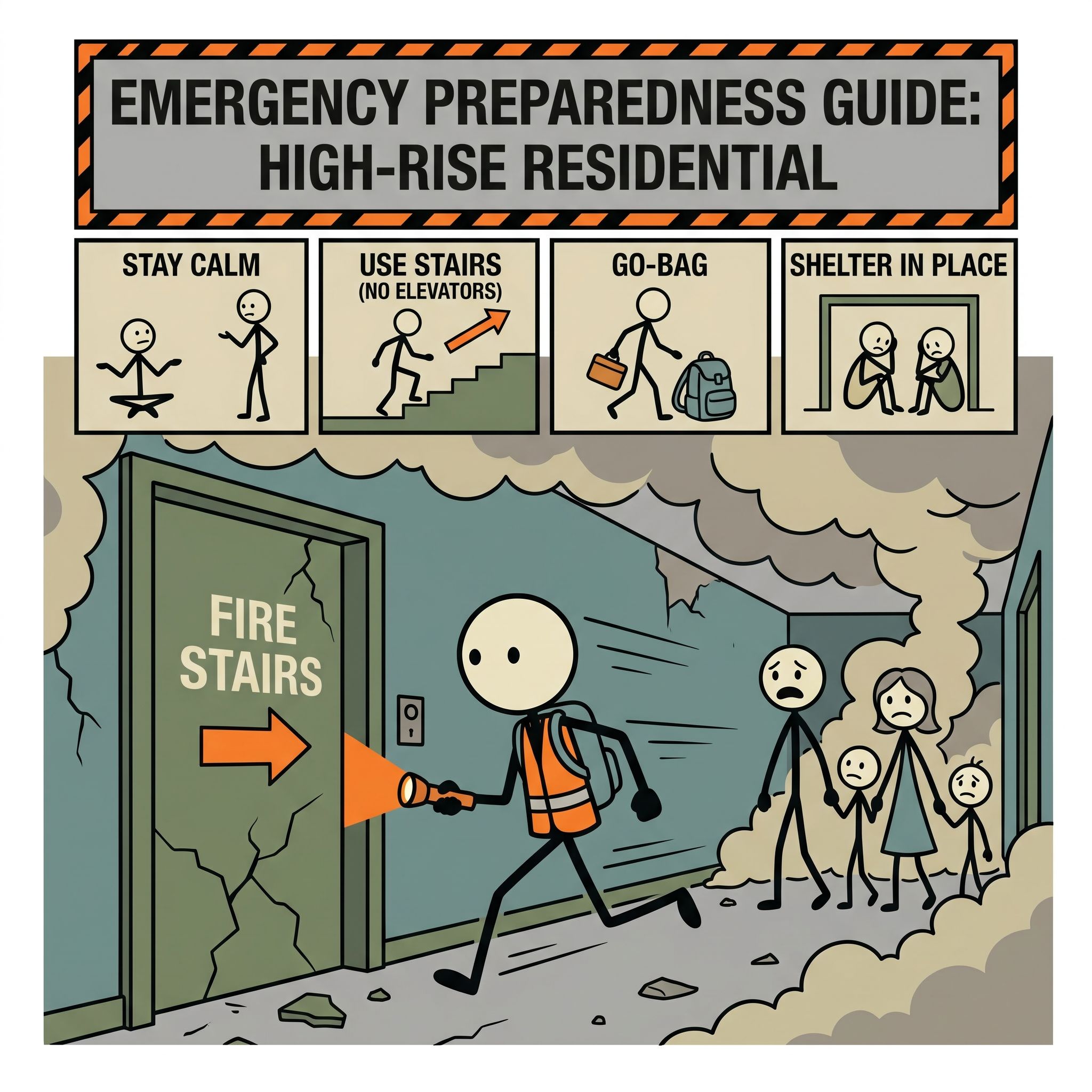
Approaching high rise emergency preparedness requires a fundamental shift in survival thinking. The traditional suburban strategies of simply loading up a vehicle and driving away, or storing hundreds of Water Calculator in a basement, do not apply when you live hundreds of feet above the pavement. In a skyscraper, your environment is entirely dependent on complex, interconnected, and electrically powered systems. When those systems fail, you are left to rely on your own physical endurance, the supplies you have cached in your limited square footage, and your understanding of building physics.
However, tall buildings are also incredible feats of modern engineering, designed with massive structural redundancies, advanced fire suppression systems, and weather-resistant architecture. By understanding how your building operates under stress, you can transform your apartment from a potential trap into an impenetrable fortress. This comprehensive guide will navigate the unique challenges of tall building disaster prep, from conquering the vertical commute and surviving utility outages to making the critical decision of whether to bug-in or bug-out.
The Unique Dynamics of Tall Building Disaster Prep
The NFPA defines a high-rise as a building greater than 75 feet in height (roughly seven stories) measured from the lowest level of fire department vehicle access to the floor of the highest occupiable story. At this height, standard fire ladders can no longer reach windows, fundamentally changing how emergencies must be handled. You are no longer relying on an exterior rescue; you are relying on interior survival systems.
In a single-family home, the barrier between you and the outside world is a single door. In a high-rise, your egress route is a complex maze of corridors, fire doors, and thousands of steps. Furthermore, you share this egress route with hundreds, sometimes thousands, of other people who may be panicked, injured, or moving slowly. This shared infrastructure means your personal skyscraper family emergency plan must account not only for your own capabilities but also for the unpredictable behavior of the crowd.
Preparation in this environment requires mastering the concept of "vertical isolation." When a major disaster strikes—such as a grid-down scenario, a severe hurricane, or widespread civil unrest—first responders will be overwhelmed. High-rise residents must be prepared to be entirely self-sufficient for a minimum of 72 hours, and ideally up to two weeks, without relying on building management or municipal services.
Elevator Dependency and the Elevator Outage Emergency
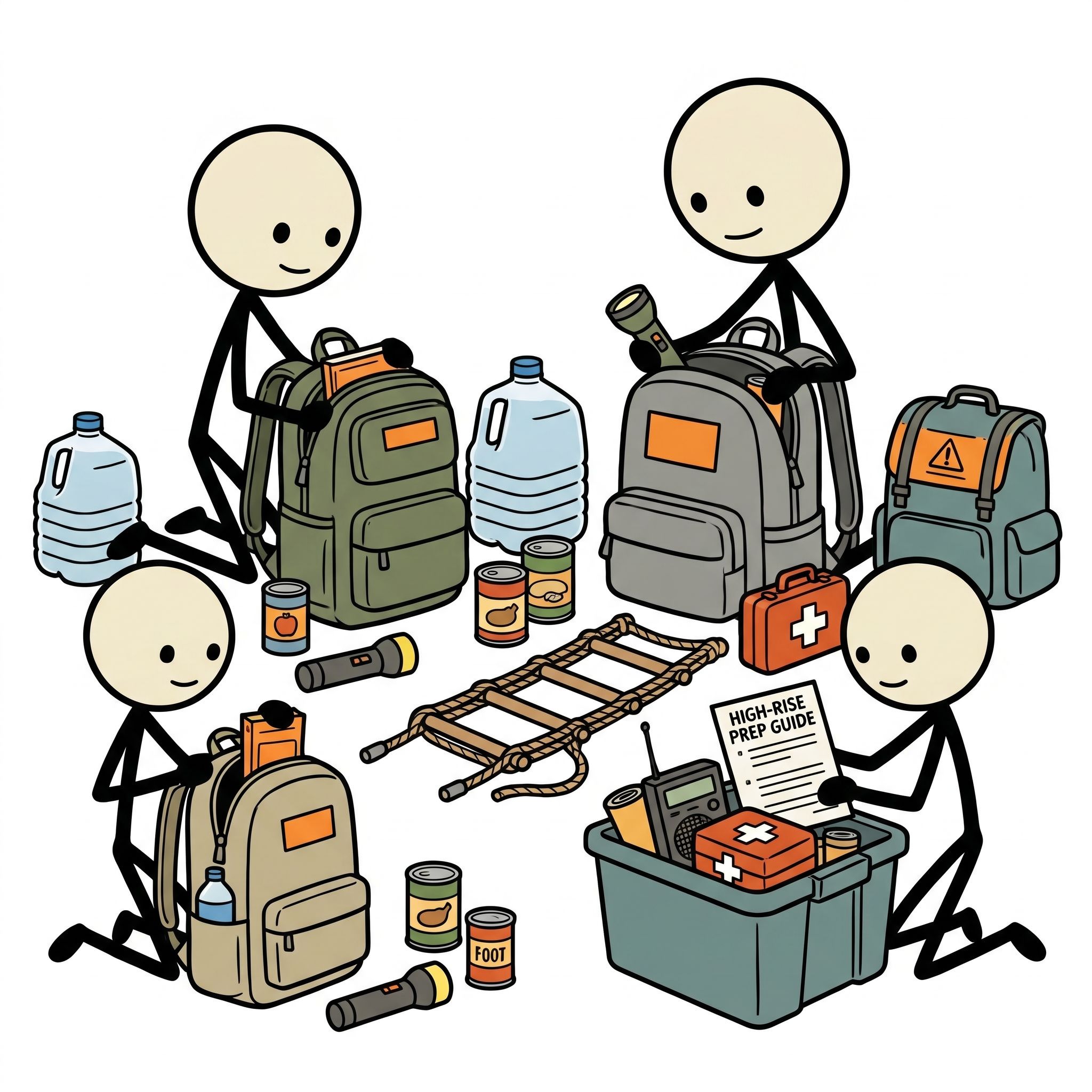
Modern society takes the elevator for granted, viewing it as a seamless extension of the hallway. But in an emergency, elevator dependency becomes one of the most significant vulnerabilities for high-rise residents. An elevator outage emergency can be triggered by rolling blackouts, severe storms, earthquakes, or localized mechanical failures. When the carriage stops moving, your world instantly shrinks.
The Reality of the Vertical Commute
If you live on the 30th floor and the power goes out, simply getting to the ground level and back up requires a level of physical exertion that most people rarely experience. A standard flight of stairs contains about 12 to 15 steps. Climbing 30 flights means ascending over 400 steps. For a healthy adult, this can take 15 to 30 minutes of strenuous cardiovascular effort. For the elderly, those with medical conditions, or parents carrying small children, it may be entirely impossible.
To prepare for an elevator outage emergency, you must honestly assess your physical fitness. Incorporate stair climbing into your regular exercise routine. Furthermore, always keep a comfortable pair of walking shoes at your office and in your vehicle. If an earthquake or blackout occurs while you are at work in a high-rise, attempting to navigate dozens of flights of stairs in dress shoes or heels is a recipe for severe injury.
When You Are Trapped Inside an Elevator
If a power failure occurs while you are inside the elevator cab, panic is your greatest enemy. Modern elevators are equipped with multiple redundant safety brakes; they will not plummet to the ground. They are also not airtight, meaning you will not run out of oxygen, even if the ventilation fan stops.
If trapped, immediately press the call button to alert building security or the monitoring company. If the system is dead, use your cell phone if you have a signal. If there is no signal, bang on the doors and shout at regular intervals to alert people in the adjacent hallways. Never attempt to pry the doors open and climb out. Many fatalities occur when people try to self-rescue and fall down the open elevator shaft. Sit down, conserve your energy, and wait for professional rescue.
Stairwell Evacuation Challenges and Strategies
When the fire alarm sounds or an evacuation order is given, the stairwell becomes the central artery of your skyscraper evacuation plan. However, high-rise stairwells present unique physiological and psychological challenges that are rarely discussed in standard emergency manuals.
The Physiology of the Descent
While climbing stairs is a massive cardiovascular challenge, walking down stairs places immense eccentric stress on your leg muscles and joints. As you descend, your quadriceps and calves must constantly brake your body weight against gravity. Navigating 40 flights of stairs downward frequently leads to a phenomenon known as "jelly legs," where uncontrollable muscle tremors make it difficult to stand, let alone walk.
To mitigate this, pacing is critical. Do not run. Take steady, deliberate steps. Use the handrails to distribute some of your body weight to your upper body, relieving pressure on your knees. If you feel your legs beginning to shake, pull off onto a landing, step out of the flow of traffic, and rest for 60 seconds.
Crowd Dynamics and Choke Points
In a fully occupied building, a mass evacuation will result in severe bottlenecking. People move at different speeds. You will encounter elderly residents, people with pets, and individuals carrying heavy bags. Frustration and panic can easily spread in these confined concrete tubes.
When executing your skyscraper evacuation plan, stay to the right side of the stairwell. This allows faster-moving individuals to pass on your left, and crucially, it keeps the left lane open for firefighters and first responders who will be ascending the stairs carrying heavy gear. Always follow the instructions of emergency personnel, and if you encounter someone struggling, offer assistance if you can do so without endangering yourself.
The Hollywood Roof Rescue Myth
A dangerous misconception, popularized by action movies, is that you should head to the roof for a helicopter rescue during a high-rise emergency. FEMA and fire departments across the country explicitly warn against this. Roof doors are frequently locked for security reasons, and even if they are open, the thermal updrafts and thick smoke generated by a building fire make helicopter rescues incredibly dangerous, if not impossible.
Unless your primary downward path is entirely blocked by fire or smoke, you should always evacuate downward. If the downward path is blocked, you should seek refuge on a clear floor, cross over to an alternate stairwell (many high-rises have interconnected stairwells), and continue your descent.
High Rise Fire Safety Prep: Surviving the Unthinkable
Fire is the most terrifying prospect for any high-rise resident. However, it is essential to understand that modern skyscrapers are built with incredibly strict fire codes. High rise fire safety prep is about leveraging the building's engineering to your advantage.
Understanding Compartmentalization
Modern high-rises are designed like a series of stacked concrete boxes. Floors, walls, and doors are constructed using fire-rated materials designed to contain a blaze to its room or floor of origin for a specified period (usually 1 to 2 hours). This is known as compartmentalization. Because of this design, a fire on the 10th floor rarely poses an immediate thermal threat to someone on the 40th floor.
When a fire alarm goes off, listen carefully to the building's public address system. Many modern buildings use staggered or phased evacuations. They will only evacuate the fire floor, the floor above, and the floor below. The rest of the building may be instructed to "defend in place." Unnecessarily entering the stairwell when your floor is not at risk can expose you to smoke and impede the movement of firefighters.
Defend in Place Strategies
If you are instructed to stay in your apartment, or if the hallways are too thick with smoke to escape, you must execute a "defend in place" strategy. Your goal is to seal your environment against toxic smoke, which is the leading cause of fire-related fatalities.
- Seal the Door: Use wet towels, blankets, or duct tape to seal the cracks around your front door.
- Block Vents: Tape plastic sheeting or trash bags over HVAC vents to prevent smoke from being pushed into your unit from other parts of the building.
- Signal for Help: Call 911 to report your exact location (building address and apartment number). Hang a brightly colored cloth or use a flashlight in your window to signal to responders outside.
- Manage Air Quality: If smoke begins to seep in, stay low to the floor where the air is cleanest. Do not break a window unless absolutely necessary; breaking a window can alter the air pressure and actually draw smoke into your apartment.
Personal Smoke Hoods
A critical component of high rise fire safety prep is owning a personal smoke hood or escape respirator for every member of your household. These devices, which fit over your head and seal around your neck, filter out carbon monoxide and toxic particulates, giving you 15 to 30 minutes of clean air to navigate a smoky hallway or stairwell. Keep them easily accessible, preferably in a nightstand or next to your front door.
Water Pressure Issues and Utility Interruptions
One of the most overlooked aspects of high-rise emergency preparedness is the behavior of water. Municipal water systems operate on pressure, usually between 40 to 60 PSI. This pressure is only strong enough to push water up to about the 4th, 5th, or 6th floor of a building. To service the floors above, skyscrapers use massive electric booster pumps located in mechanical rooms.
When the power grid fails, those pumps stop. The water currently sitting in the pipes will drain rapidly as people turn on their taps, and within minutes, anyone living above the 6th floor will be without running water. This means no drinking water, no running sinks, and critically, no flushing toilets.
Water Storage Strategies for Small Spaces
The CDC recommends storing at least one gallon of water per person, per day, for a minimum of three days. In a high-rise, you should aim for a two-week supply, as retrieving water from ground-level distribution centers involves the grueling vertical commute mentioned earlier.
However, storing 30 to 40 gallons of water in a small apartment requires creativity. Water is heavy (roughly 8.3 pounds per gallon), so you must also be mindful of your building's floor load limits, though most modern concrete slabs can handle standard storage.
- Modular Containers: Utilize stackable, 5-gallon water bricks that can be slid under beds or stacked in the back of closets.
- The Bathtub Strategy: If you have advance warning of a grid-down event (like an approaching hurricane), immediately fill your bathtub. To keep this water sanitary for drinking, invest in a heavy-duty plastic bathtub liner (like a WaterBOB) that can hold up to 100 gallons of sealed, clean water.
- Water Filtration: Store portable water filters (such as a LifeStraw Family or Sawyer Squeeze). If you are forced to harvest water from the building's water heater or rain runoff from a balcony, you must be able to filter it before consumption.
Sanitation Without Running Water
Without water pressure, your toilet becomes useless after the first flush. In a densely populated high-rise, a lack of sanitation can lead to rapid disease spread and unbearable living conditions.
To prepare, stockpile heavy-duty, puncture-resistant black trash bags and a supply of desiccants, such as sawdust, kitty litter, or specialized portable toilet chemicals. When the water stops, line your toilet bowl with a bag. After each use, cover the waste with a layer of kitty litter to absorb moisture and neutralize odors. Once the bag is full, seal it tightly and store it on a balcony or in a designated, ventilated area until municipal trash services resume or you can safely transport it to the ground level.
Bug-In vs. Bug-Out: The Ultimate Skyscraper Decision
In the emergency preparedness community, the debate between sheltering in place (bugging in) and evacuating (bugging out) is constant. When you live in a high-rise, this decision is drastically magnified. Leaving your apartment means giving up your shelter, your primary supply cache, and your security, all while facing the physical gauntlet of the stairwell.
When to Bug-In
As a general rule, if your building is structurally sound and not actively on fire, bugging in is the safest option. High-rises are robust structures. During severe weather events like hurricanes or blizzards, the sheer mass of the building provides excellent protection. In the event of civil unrest, being 20 stories above the street offers a massive tactical advantage; rioters and looters rarely climb dozens of flights of stairs.
Pandemics and biological threats also dictate a bug-in strategy. A well-prepared high-rise apartment allows you to isolate entirely from the general population. If you have secured adequate food, water, and medical supplies, your apartment becomes an impenetrable quarantine zone.
When to Bug-Out
There are, however, specific scenarios where immediate evacuation is non-negotiable. You must execute your bug-out plan if:
- Uncontained Fire: If a fire is on your floor, or the floor immediately below you, and the alarm system instructs you to leave, evacuate immediately.
- Structural Compromise: If an earthquake, explosion, or severe engineering failure causes visible structural damage (cracked load-bearing columns, sagging floors), you must leave. *Note: During an active earthquake, the USGS advises you to stay inside and take cover. Evacuate only after the shaking stops and structural damage is apparent.*
- Long-Term Grid Failure: If the power goes out and remains out for weeks, the lack of water, sanitation, and climate control will eventually render the building uninhabitable. If you exhaust your supplies, you must bug out to a secondary location.
The High-Rise Bug-Out Bag
If you must leave, your Go-Bag Builder (BOB) needs to be tailored for the vertical descent. Weight is your primary enemy. A 50-pound tactical backpack might be fine for walking on flat ground, but carrying it down 40 flights of stairs will destroy your knees and exhaust you before you even reach the lobby.
Keep your high-rise bug-out bag under 20 pounds. Focus strictly on immediate survival: a high-quality respirator/smoke hood, a powerful headlamp (stairwells will be pitch black without power), a liter of water, high-calorie energy bars, a first aid kit, important documents, and a compact crowbar or multi-tool in case you encounter jammed fire doors.
Building Your High-Rise Emergency Kit
Adapting standard emergency kits for tall building disaster prep requires focusing on the specific vulnerabilities of elevated living. Beyond the standard FEMA recommendations of food, water, and first aid, high-rise residents must consider climate control, communication, and balcony safety.
Climate Control Without Power
High-rises feature massive glass windows that offer beautiful views but act as giant magnifying glasses. In the summer, a power outage means no air conditioning, and a high-rise apartment can quickly become a deadly greenhouse. Conversely, in the winter, the wind chill at higher elevations can strip heat from the building rapidly.
For summer emergencies, invest in reflective Mylar blankets or blackout curtains. Taping Mylar to your sun-facing windows will reflect the solar radiation outward, drastically lowering the interior temperature. Battery-operated or USB-rechargeable fans are also essential for circulating air.
For winter emergencies, designate one small interior room (like a walk-in closet or bathroom) as your "warm room." Seal off the rest of the apartment, set up a specialized indoor-safe propane heater (like a Mr. Heater Buddy, ensuring you have a battery-operated carbon monoxide detector running), and use sub-zero sleeping bags to retain body heat.
Communication from the Clouds
Height provides a distinct advantage when it comes to radio communications. If cellular networks are overloaded or destroyed, high-rise residents can utilize two-way radios to gather information and communicate over vast distances. A standard GMRS or HAM radio transmitting from a 30th-floor balcony can achieve line-of-sight communication for dozens of miles, far outperforming a radio on the ground level.
Ensure you have a hand-crank or solar-powered NOAA weather radio to receive emergency broadcasts. Since you are elevated, you will likely have excellent reception, allowing you to stay informed about the disaster's progression and official evacuation orders.
Balcony Considerations
If your apartment features a balcony, it can be a vital asset for emergency preparedness, but it must be managed carefully. Balconies can be used to store sealed sanitation bags, capture rainwater, or operate a small solar panel to recharge critical devices like cell phones and flashlights.
However, wind speeds increase dramatically at higher elevations. During a severe storm or hurricane, any loose items on a balcony—including lightweight emergency supplies, patio furniture, or potted plants—can become lethal projectiles. If severe weather approaches, strip your balcony bare and bring all items inside to protect your windows and the people below.
Taking Control of Your Vertical Environment
High rise emergency preparedness requires acknowledging that you are living in a complex, machine-dependent environment. By understanding the mechanics of your building—from the physics of water pressure to the engineering of fire compartmentalization—you strip away the fear of the unknown. An elevator outage or a stairwell evacuation is no longer a chaotic nightmare, but a logistical challenge that you have already planned and trained for. You have the power to turn your elevated apartment into a secure, self-sufficient sanctuary. Take the time today to assess your supplies, map your stairwells, and build a plan that ensures you and your family can confidently weather any storm, no matter how high above the ground you are.
Frequently Asked Questions
How does a power outage affect water pressure in a high-rise?
Buildings above 6-7 stories require booster pumps to maintain water pressure on upper floors. When power fails, these pumps stop and pressure drops to zero within minutes. Stock extra water (at least 3 gallons per person for 3 days) specifically for this scenario.
How do I prepare for stairwell evacuation from a high floor?
Regularly walk your evacuation route to the stairwell. Practice descending with your fully loaded go-bag. A 10-minute stairwell descent with a 25-lb bag is exhausting. Consider a lighter 'high-rise evacuation bag' with only the absolute essentials for rapid exit.
Is it better to shelter in a high-rise or evacuate during a disaster?
For most disasters except fire: shelter-in-place in a high-rise has significant advantages. You're above flood risk, have a structurally robust building, and evacuation into urban crisis can be more dangerous than staying. Exceptions: building structural damage, ordered evacuation, fire, or complete utility failure.
Strengthen your emergency preparedness guide for high-rise buildings. Review shelter-in-place strategies. Plan with family emergency planning resources. Build your kit with our go-bag builder and browse our courses.
Sources & Further Reading
- NFPA High-Rise Building Safety
- FEMA High-Rise Emergency Preparedness
- NYC Emergency Evacuation Guidelines
- Ready.gov Urban Preparedness