⚡ Key Facts
- Grid Vulnerability is Increasing: According to the Department of Energy (DOE), power outages lasting longer than eight hours have more than doubled over the past decade due to aging infrastructure and extreme weather.
- Standard Solar Goes Dark: Without a battery system, grid-tied solar panels automatically shut off during a blackout to prevent back-feeding electricity and injuring utility workers.
- Medical Preparedness: The Centers for Disease Control and Prevention (CDC) warns that prolonged power losses pose severe risks to those relying on CPAP machines, oxygen concentrators, and refrigerated medications—making reliable backup power a life-saving necessity.
- Federal Incentives: The federal solar tax credit allows homeowners to deduct up to 30% of the cost of installing residential solar and battery storage systems, making emergency independence more accessible.
- Scalable Solutions: Emergency solar power is not all-or-nothing; setups range from $300 portable stations for basic communication to comprehensive whole-home systems capable of running HVAC units indefinitely.
Imagine the unsettling quiet that follows a sudden, widespread power grid failure. The hum of the refrigerator stops, the Wi-Fi router goes dark, and the digital clocks fade to black. According to the National Oceanic and Atmospheric Administration (NOAA), the frequency of billion-dollar weather disasters is rising, bringing with them a surge in localized and regional power outages. Whether you are facing a winter blizzard, a severe hurricane, or a rolling blackout during a summer heatwave, losing electricity is no longer a rare anomaly—it is a foreseeable event that demands proactive preparation. For practical planning, use the water storage math.
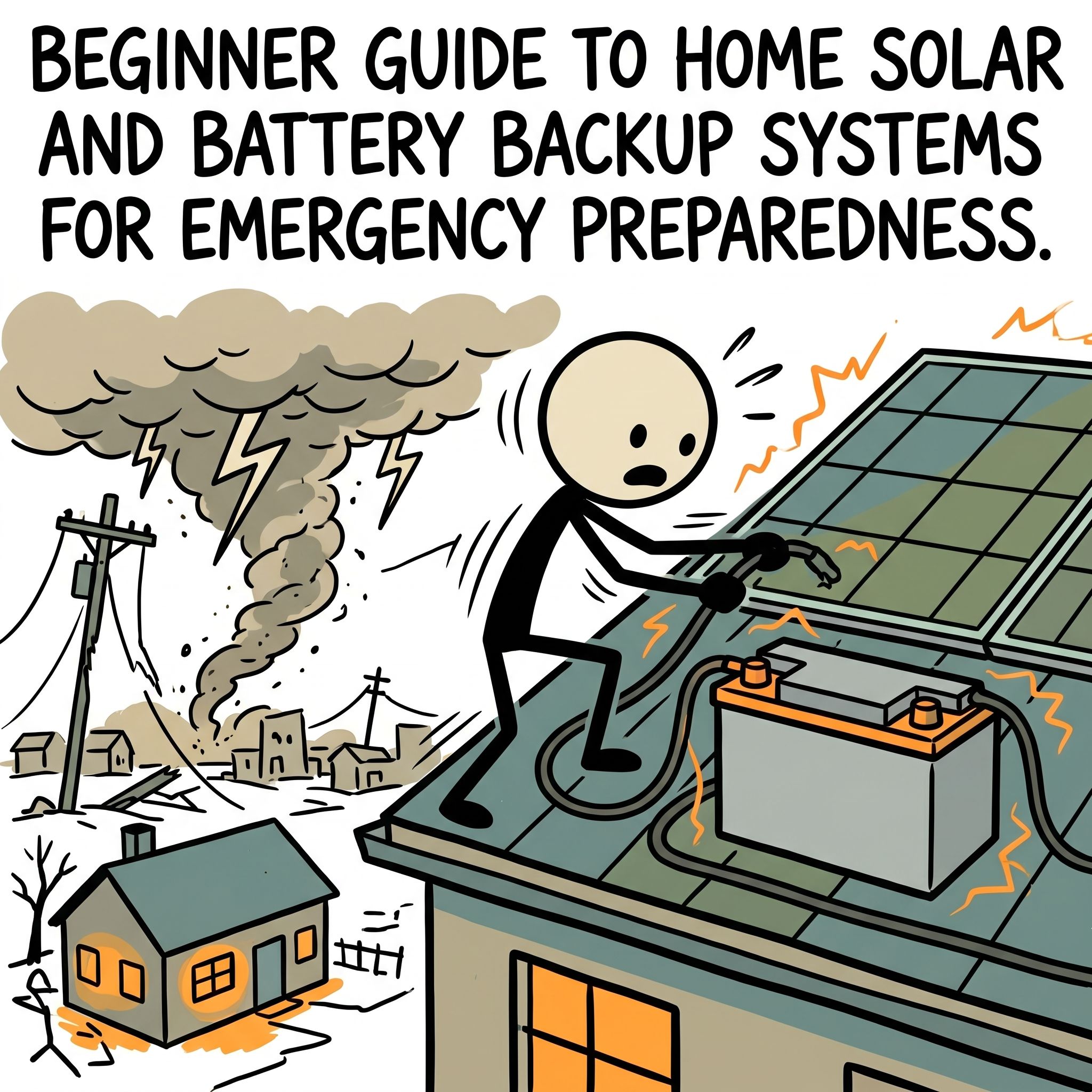
For decades, the default response to blackouts was the traditional gas-powered generator. While effective in the short term, gas generators come with significant drawbacks: they are incredibly loud, they require a constant supply of highly flammable fuel that may be scarce during a crisis, and they pose deadly carbon monoxide risks if not operated at a safe distance. Today, a quieter, cleaner, and ultimately more sustainable solution has emerged: home solar emergency backup systems. For practical planning, use the supply planning calculator. For a quick definition, see two is one, one is none.
Harnessing the power of the sun to keep your family safe, connected, and comfortable is one of the most empowering steps you can take in your preparedness journey. However, navigating the world of inverters, battery chemistries, and wattage calculations can feel overwhelming for a beginner. This comprehensive guide will demystify solar power for blackout scenarios, walking you through everything from small, portable emergency kits to robust, whole-home microgrids. By understanding your specific needs, you can build a resilient safety net that keeps the lights on when the rest of the neighborhood goes dark. For practical planning, use the go-bag essentials.
The Big Misconception: Why Standard Solar Isn't Enough
Before diving into the types of backup systems available, it is absolutely critical to address the most common misconception in solar panel emergency prep. Many homeowners believe that simply having solar panels on their roof guarantees electricity during a grid failure. Unfortunately, for the vast majority of traditional grid-tied systems, this is entirely false. For practical planning, use the emergency food storage basics.
Standard solar installations are directly tethered to the municipal power grid. When the sun shines, your panels generate direct current (DC) electricity, which an inverter converts into the alternating current (AC) used by your home appliances. Any excess power is sent back into the grid, often earning you a credit from your utility company. However, when the grid goes down, your grid-tied inverter is legally required to shut down immediately. This is a vital safety feature known as "anti-islanding." If your panels continued to pump electricity into the dead grid, it could electrocute the utility line workers who are trying to repair the infrastructure. For practical planning, use the survival scenarios library.
To truly achieve solar power for blackout situations, you must incorporate energy storage—specifically, a battery system. By adding a battery, you create a "hybrid" or "off-grid" capability. When the grid fails, a specialized transfer switch automatically disconnects your home from the utility lines. Your solar panels then route their generated power directly into your battery bank, which in turn powers your home safely and independently. Understanding this distinction is the foundational first step in building a resilient emergency power plan. For practical planning, use the Protocol Survival app.
Tier 1: Portable Solar Generators (Small Setups)
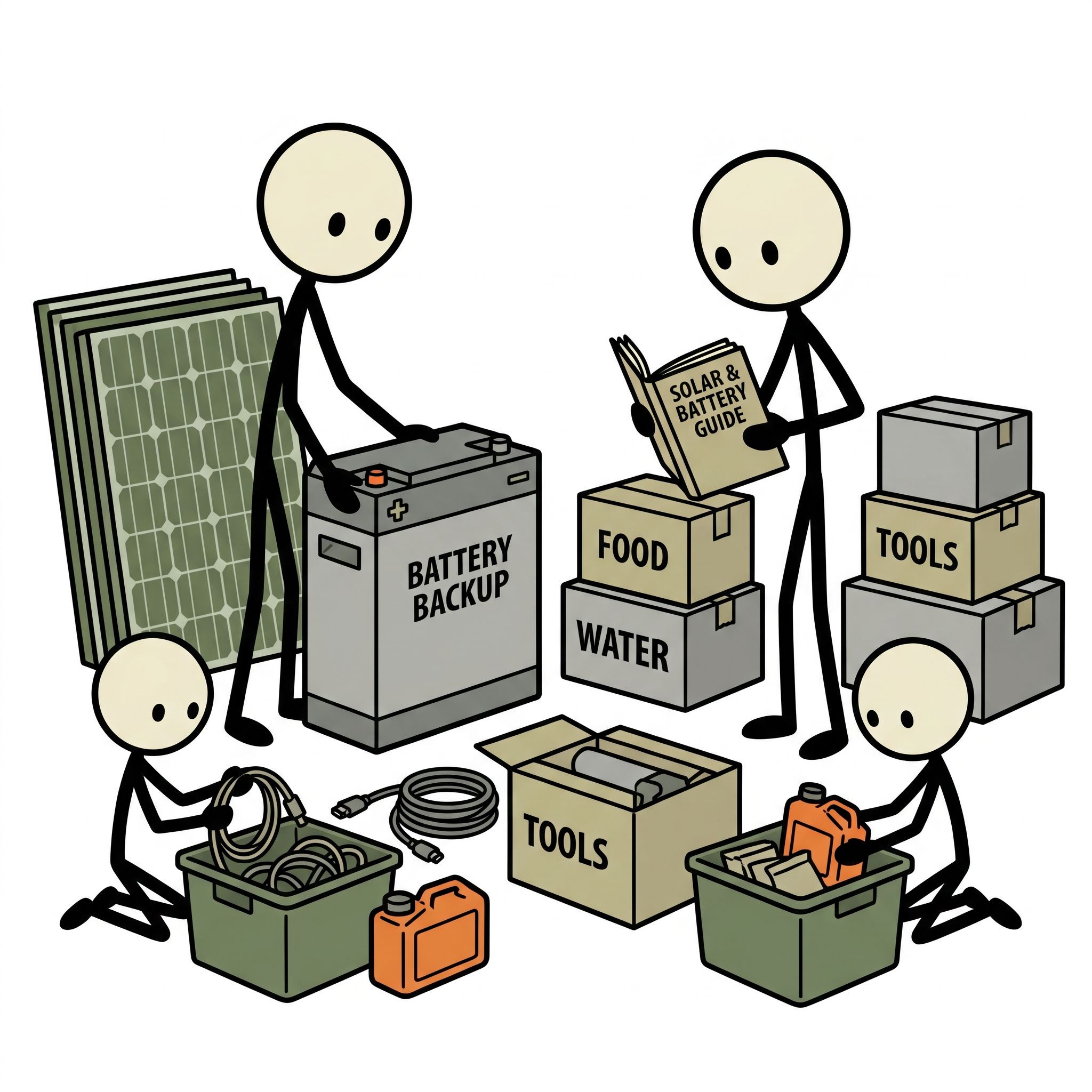
If you are renting an apartment, living on a tight budget, or simply looking to start your preparedness journey without a massive investment, portable solar generators are an excellent entry point. Despite the name "generator," these devices do not have an engine or use fuel. They are essentially high-capacity lithium battery packs equipped with built-in inverters, AC wall outlets, USB ports, and inputs for portable solar panels.
What They Can Power
Small to mid-sized portable systems (typically ranging from 300 to 1,500 watt-hours of capacity) are designed to keep critical, low-draw electronics functioning. According to FEMA and the Red Cross, maintaining communication and situational awareness is paramount during the first 72 hours of a disaster. A portable solar generator excels at this.
With a portable setup, you can easily charge smartphones, run emergency weather radios, power laptops to monitor local news, and keep rechargeable flashlights topped off. More importantly, they are vital for individuals with specific medical needs. A 1,000-watt-hour portable station can comfortably run a CPAP machine for several nights or keep a mini medical fridge cold to preserve life-saving medications like insulin, adhering to CDC guidelines for medication storage during emergencies.
Pros and Cons of Portable Setups
The primary advantage of a portable system is its plug-and-play simplicity. There are no permits required, no electricians to hire, and no complex installations. You simply set up the foldable solar panels in your yard or on a balcony, plug them into the battery unit, and let the sun do the work. Furthermore, because they emit no fumes and operate silently, they are perfectly safe to use indoors—a massive advantage over gas generators during severe weather when going outside is dangerous.
The limitation, however, is capacity. Portable systems cannot tie into your home's circuit breaker. You must plug devices directly into the unit itself. They lack the output to run heavy appliances like central air conditioning, electric water heaters, or large space heaters. If the sky remains heavily overcast for days, a small foldable solar panel (typically 100W to 200W) may struggle to recharge the battery fast enough to keep up with even moderate usage.
Tier 2: Partial Home Backup (Mid-Sized Setups)
For homeowners who want to protect their emergency food storage guide, maintain basic comfort, and keep essential home systems running without the expense of a massive whole-home system, a mid-sized residential solar battery backup is the sweet spot. These systems typically involve permanent rooftop solar panels paired with a wall-mounted battery bank (ranging from 5 to 15 kilowatt-hours) and a dedicated "critical loads panel."
Understanding the Critical Loads Panel
In a partial home backup scenario, you are not trying to power your entire house. Instead, an electrician installs a secondary sub-panel next to your main breaker box. You then select a handful of essential circuits to move over to this critical loads panel. When the grid goes down, your main breaker shuts off, but the critical loads panel remains powered by your solar and battery system.
What should you include in a critical load? The focus should be on survival, safety, and preventing property damage. Typical critical circuits include:
- The Kitchen Refrigerator: The CDC notes that a closed refrigerator will only keep food safe for about 4 hours during an outage. Powering your fridge prevents hundreds of dollars of food spoilage and ensures safe nutrition.
- Well Pumps: If you live in a rural area, losing power means losing running water. A mid-sized solar battery can provide the surge power needed to run a well pump, ensuring sanitation and hydration.
- Basic Lighting and Outlets: Keeping a few strategic rooms lit (like the kitchen and living room) and powering outlets for internet routers and device charging.
- Gas Furnace Blowers: While a battery may struggle to run electric baseboard heat, it can easily power the electric blower fan of a natural gas or propane furnace, keeping your home warm during winter blackouts.
The Balance of Power
A mid-sized system requires active management during an emergency. You become the master of your own microgrid. If it is a sunny day, your rooftop panels will power your critical loads directly while simultaneously recharging the battery for nighttime use. However, if a hurricane has knocked out the power and the sky is dark with rain, you will need to ration your battery usage, perhaps turning off the fridge for a few hours overnight or limiting the use of the microwave.
Tier 3: Whole-Home Solar and Battery Backup
When you are looking for the ultimate peace of mind and the best solar battery home emergencies could possibly require, you are looking at a whole-home backup system. This is the top tier of emergency preparedness, designed to make grid failures completely unnoticeable to your family.
Seamless Integration and High Capacity
Whole-home systems utilize large rooftop solar arrays paired with massive battery banks, often stacking multiple batteries together to achieve 20, 30, or even 40+ kilowatt-hours (kWh) of storage. Instead of a critical loads panel, these systems use a smart gateway or automatic transfer switch that manages the entire main breaker panel.
When a blackout strikes, the system detects the voltage drop and switches to battery power in a fraction of a second. The transition is so fast that digital clocks won't reset, and desktop computers won't shut down. You can continue to live your life exactly as you did when the grid was functional.
What a Whole-Home System Covers
Unlike the smaller tiers, a robust whole-home home solar emergency backup can handle heavy, 240-volt appliances. This includes:
- Central Heating, Ventilation, and Air Conditioning (HVAC): Extremely vital during deadly summer heatwaves or polar vortex winter storms.
- Electric Ranges and Ovens: Allowing you to cook full, hot meals safely without relying on outdoor camp stoves.
- Electric Water Heaters: Providing hot showers for hygiene and morale during extended recovery periods.
- Electric Vehicle (EV) Charging: Ensuring your transportation remains fueled even if local gas stations lose power and cannot pump fuel.
While whole-home systems offer unparalleled luxury and safety during a disaster, they require a significant roof footprint for enough panels to generate the required daily energy, and they represent a substantial financial investment. Even with a massive system, extreme weather events that block out the sun for multiple consecutive days will eventually deplete the batteries, meaning mindful energy conservation is still an essential preparedness skill.
Sizing Basics: Calculating Your Emergency Load
One of the most intimidating aspects of solar panel emergency prep is understanding the math. How do you know what size battery or how many panels you need? To avoid overpaying for a system that is too large, or dangerously under-sizing a system that will fail you when you need it most, you must conduct a home energy audit.
Running Watts vs. Surge Watts
Every electrical device in your home has two wattage ratings you must understand: running watts and surge (or starting) watts.
Running Watts (also called continuous watts) is the amount of power an appliance needs to operate normally. For example, a standard refrigerator might require 600 watts to keep running while the compressor is on.
Surge Watts is the brief, massive spike in power required to start an appliance with an electric motor. That same refrigerator might require 1,800 watts for just two seconds to start the compressor.
When choosing an inverter (the brain of your solar/battery system that converts DC to AC), it must be rated to handle the combined running watts of everything you want to power simultaneously, plus the highest single surge wattage of your largest appliance. If your inverter is too small, a surging well pump or refrigerator will trip the system's internal breaker, shutting down your power.
Watt-Hours and Battery Capacity
While watts measure the flow of power, watt-hours (Wh) or kilowatt-hours (kWh) measure the storage of power. One kilowatt-hour equals 1,000 watt-hours. This is how you determine how long your battery will last when the sun goes down.
To calculate your needs, multiply the running watts of an appliance by the number of hours you plan to run it.
- A 10-watt LED light bulb run for 5 hours = 50 Wh.
- A 60-watt CPAP machine run for 8 hours = 480 Wh.
- A 600-watt refrigerator run for 10 hours (compressors cycle on and off, so they don't run 24/7) = 6,000 Wh (or 6 kWh).
If your critical overnight load totals 7 kWh, you will need a battery bank larger than 7 kWh to make it to morning without the system dying. Preparedness experts recommend adding a 20% to 30% buffer to your calculations to account for inefficiencies in the inverter and to prevent draining your batteries to absolute zero, which can degrade their lifespan.
Battery Chemistry: Choosing the Right Lifeline
When researching the best solar battery home emergencies might throw your way, you will quickly encounter different battery chemistries. The type of battery you choose dictates its safety, lifespan, and performance in extreme temperatures.
Lead-Acid Batteries
The old standard for off-grid solar, lead-acid batteries (like those used in cars) are the cheapest option upfront. However, they are heavy, require regular maintenance (checking water levels in flooded types), and must be vented due to off-gassing toxic fumes. Furthermore, you can only safely discharge them to 50% of their total capacity without causing permanent damage. They are generally not recommended for modern, reliable emergency home backup.
Lithium-Ion (NMC)
Nickel Manganese Cobalt (NMC) lithium batteries are incredibly energy-dense, meaning they pack a massive amount of power into a small, lightweight footprint. This is the chemistry used in most smartphones, electric vehicles, and popular home battery walls. They can be discharged deeply (up to 90% or more) and require zero maintenance. However, they have a specific thermal runaway risk; if punctured or severely overheated, they can catch fire. They also have a lifespan of roughly 500 to 1,000 charge cycles before degrading.
Lithium Iron Phosphate (LiFePO4 / LFP)
For emergency preparedness, Lithium Iron Phosphate is widely considered the gold standard. While slightly larger and heavier than NMC batteries, LFP batteries are incredibly stable. They are virtually immune to thermal runaway, making them much safer to store inside your home or garage. Most importantly, they boast an incredible lifespan—often rated for 3,000 to 6,000 charge cycles. Even with heavy daily use, an LFP battery can last over a decade, ensuring your investment is ready to perform during a crisis years down the line.
Cost Considerations and Financial Incentives
The cost of a residential solar battery backup system varies wildly based on the tier of preparedness you choose, your geographic location, and the specific brands you select. It is vital to view this not just as a consumer purchase, but as an investment in your home's infrastructure and your family's safety net.
Portable Systems: Entry-level portable power stations with a small foldable panel can start as low as $300. Mid-range portable units capable of running a fridge and medical devices typically range from $1,000 to $2,500. These are out-of-pocket expenses, as they usually do not qualify for tax credits unless permanently installed.
Partial Home Backup: A grid-tied solar array paired with a single home battery (around 10 kWh) and a critical loads panel will generally cost between $15,000 and $25,000 before incentives. The battery itself usually accounts for $8,000 to $12,000 of that total, including installation and permitting.
Whole-Home Systems: A massive solar array paired with multiple stacked batteries designed to run heavy 240V appliances can easily range from $35,000 to over $60,000. While expensive, these systems often eliminate your monthly electric bill entirely during normal grid operation, providing a long-term return on investment.
The Federal Solar Tax Credit
The financial sting of permanent installations is significantly lessened by the federal government. Under the Inflation Reduction Act, homeowners can claim a 30% federal tax credit on the total cost of purchasing and installing solar panels and battery storage systems. This credit applies to the equipment, the labor, the permitting, and the inspection fees.
For example, if your partial home backup system costs $20,000, the 30% tax credit reduces your federal tax liability by $6,000, bringing the effective cost down to $14,000. Furthermore, many states, municipalities, and local utility companies offer their own rebates and incentives for installing battery storage, as it helps stabilize the local grid during peak demand times. Always consult with a certified solar installer and a tax professional to maximize your localized benefits.
Living with Your System: Maintenance and Readiness
Once your home solar emergency backup system is in place, your preparedness journey does not end; it transitions into a phase of maintenance and readiness. A backup system that is ignored until a hurricane makes landfall is a system that might fail when you need it most.
FEMA and the Department of Homeland Security recommend regular testing of all emergency equipment. For portable systems, this means pulling them out of the closet every three to four months, discharging the battery by using it to power a fan or television, and then recharging it via your solar panels. This keeps the battery chemistry active and ensures you remember how to connect the cables under stress.
For permanently installed home systems, most modern setups come with a smartphone application that monitors grid status, solar production, and battery health. Familiarize yourself with the app's "Storm Watch" or "Emergency Backup" mode. When severe weather is forecasted by NOAA or local news, you can manually trigger this mode. The system will stop sending excess solar power to the grid and instead prioritize charging your batteries to 100%, ensuring you have maximum capacity the moment the power lines go down.
Additionally, keep your solar panels clear of debris. A heavy layer of dust, fallen autumn leaves, or winter snow can drastically reduce your solar yield. While rooftop panels usually clean themselves during heavy rain, safely brushing off heavy snow with a specialized roof rake is a crucial winter preparedness task to ensure your batteries can recharge during the short, cold days of a winter blackout.
Taking control of your own power generation is one of the most profound leaps you can make in emergency preparedness. By transitioning away from noisy, fuel-dependent generators and embracing the silent, renewable resilience of a home solar and battery backup system, you insulate your family from the growing instability of the modern power grid. Whether you start small with a portable station to keep your phones and medical devices alive, or invest in a comprehensive microgrid that powers your entire home, you are building a fortress of safety. The sun will rise every morning, regardless of what disasters strike the infrastructure around you. By capturing that energy, you ensure that no matter how dark the circumstances, your home remains a beacon of warmth, light, and unwavering security.
Frequently Asked Questions
What can a typical residential solar + battery system power during an outage?
A standard home battery (Tesla Powerwall: 13.5 kWh) powers essential loads for 12-24 hours without solar. With good solar production, it recharges daily and can run critical circuits (refrigerator, lights, outlets, router, medical devices) indefinitely.
What is the difference between grid-tied, off-grid, and hybrid solar systems?
Grid-tied systems provide zero backup during outages. Off-grid systems are fully independent but expensive. Hybrid systems (grid-tied with battery backup) are the sweet spot — they use the grid when available and provide automatic backup when it fails.
What is the most cost-effective starting point for solar emergency preparedness?
Begin with a portable solar generator (EcoFlow DELTA 2: 1 kWh, $600-800 on sale) paired with a 200W solar panel. This covers phone charging, lights, and a mini-fridge for 1-3 days without sun and indefinitely in good sun.
Strengthen your emergency preparedness plan. Explore battery storage solutions for backup. Prepare for natural disaster preparedness. Use our supply calculator and browse our courses.
Sources & Further Reading
- US DOE Office of Energy Efficiency Solar Energy
- NREL National Renewable Energy Laboratory
- EnergySage Solar Buyer's Guide