⚡ Key Facts
- The 30-Day Rule: FEMA’s National Flood Insurance Program (NFIP) requires a 30-day waiting period for new policies to take effect, making off-season insurance reviews critical.
- Water is the Primary Threat: According to the U.S. Geological Survey (USGS), water from storm surge and inland flooding causes nearly 90% of all tropical cyclone deaths, not high winds.
- Post-Storm Generator Hazards: The Centers for Disease Control and Prevention (CDC) reports that carbon monoxide poisoning from improper generator use is one of the leading causes of preventable post-hurricane fatalities.
- Historical Intensity Shifts: NOAA data reveals that modern Atlantic hurricanes are increasingly undergoing rapid intensification, leaving coastal residents with significantly less time to prepare once a storm forms.
For families living along the Atlantic and Gulf Coasts, the threat of tropical weather is not a matter of "if," but "when." When a major hurricane enters the Gulf of Mexico or tracks toward the Eastern Seaboard, local supermarkets instantly transform into chaotic scrambles for bottled water, plywood, and batteries. This reactive panic is not only stressful, but it also leaves families vulnerable to supply shortages and rushed, inadequate home mitigation. By transitioning from a reactive mindset to a structured, year-round hurricane season prep calendar, you can eliminate the stress of last-minute scrambles and ensure your household is resilient long before the first tropical outlook is issued by the National Hurricane Center.
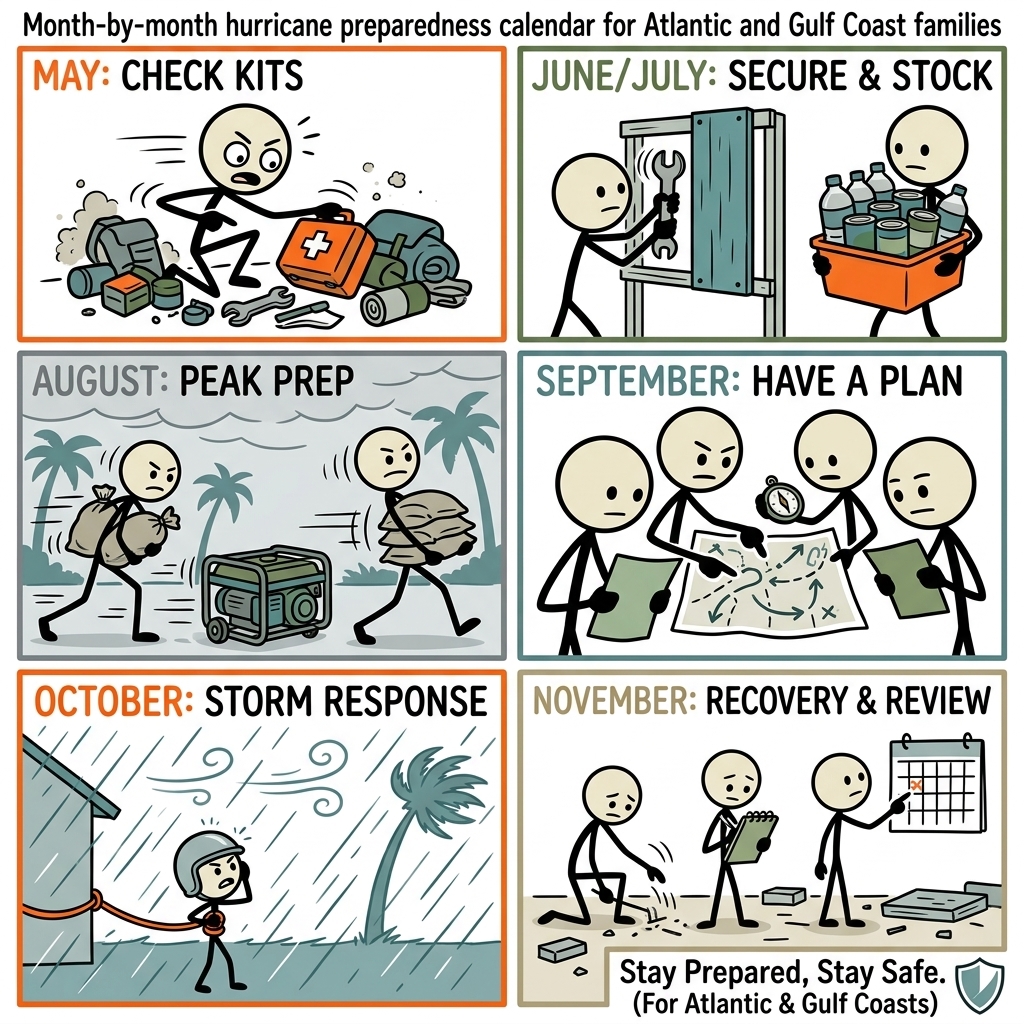
Phase 1: The Off-Season (December to February) — Structural and Administrative Foundations
The off-season is the most overlooked phase of emergency preparedness. While the skies are clear and the tropical Atlantic is quiet, you have the time and space to address the complex administrative and structural tasks that are impossible to resolve during a storm warning. Utilizing this window ensures your financial and physical foundations are secure before supply chains tighten.
December: Document Security and Digital Archiving
The holiday season is the ideal time to secure your family’s critical administrative infrastructure. If you are forced to evacuate, or if your home suffers catastrophic structural damage, having physical and digital access to your legal and financial documents is your lifeline to rapid recovery.
- Create a "Grab-and-Go" Binder: Purchase a heavy-duty, waterproof, and fireproof document bag. Store physical copies of birth certificates, social security cards, passports, property deeds, vehicle titles, marriage certificates, and medical records inside.
- Build an Encrypted Digital Backup: Scan every document in your physical binder. Upload these files to a secure, password-protected cloud storage service, and save a duplicate copy onto an encrypted, waterproof USB flash drive that remains on your keychain or in your Go-Bag Builder.
- Catalog Home Assets: Walk through every room of your home with a video camera or smartphone. Record high-definition footage of your electronics, furniture, appliances, jewelry, and structural finishes. Open closets and drawers. This visual inventory is vital for substantiating insurance claims after a disaster.
January: Insurance Policy Audit and Structural Inspections
Many coastal homeowners mistakenly assume their standard homeowners insurance policy covers all hurricane-related damage. In reality, windstorm damage often carries a separate deductible, and standard policies explicitly exclude rising water. January is the time to identify and close these coverage gaps.
Contact your insurance provider to review your declarations page. Ensure you understand your "hurricane deductible," which is typically calculated as a percentage of your home’s total insured value (often 2% to 10%) rather than a flat dollar amount. Next, secure a separate flood insurance policy through the National Flood Insurance Program (NFIP) or a private carrier. Because the NFIP enforces a strict 30-day waiting period before a policy becomes active, purchasing flood coverage in January guarantees you are protected before the season begins.
Simultaneously, conduct a visual inspection of your home’s exterior. Look for loose roof shingles, damaged soffits, or cracked sealant around windows and doors. If your home relies on hurricane straps or clips to secure the roof to the wall plates, hire a licensed contractor to inspect these connections in your attic space to confirm they are up to local building codes.
February: Mechanical Maintenance and Utility Education
When the power grid fails, your survival and comfort rely heavily on mechanical tools and your ability to control your home's utility systems. February is dedicated to servicing these mechanical assets and educating every capable member of the household on utility safety.
- Service Your Generator: If you own a portable generator, pull it out of storage. Drain any stale fuel from the tank and carburetor, change the engine oil, inspect the spark plug, and run the unit under a power load for at least 20 to 30 minutes. Stock up on spare oil filters, spark plugs, and a siphon pump.
- Inspect Chainsaws and Power Tools: Ensure your chainsaw has a sharp chain, a clean air filter, and adequate bar and chain oil. Test battery-powered drills and impact drivers that you will need to hang plywood window coverings.
- Locate and Label Utility Shut-Offs: Every adult and teenager in your home should know exactly how to shut off the main water valve, the electrical breaker panel, and the natural gas or propane supply. Paint these valves a bright color or label them with durable, weatherproof tags. Keep a dedicated gas shut-off wrench near your gas meter.
Phase 2: The Pre-Season (March to May) — Supply Accumulation and Physical Mitigation
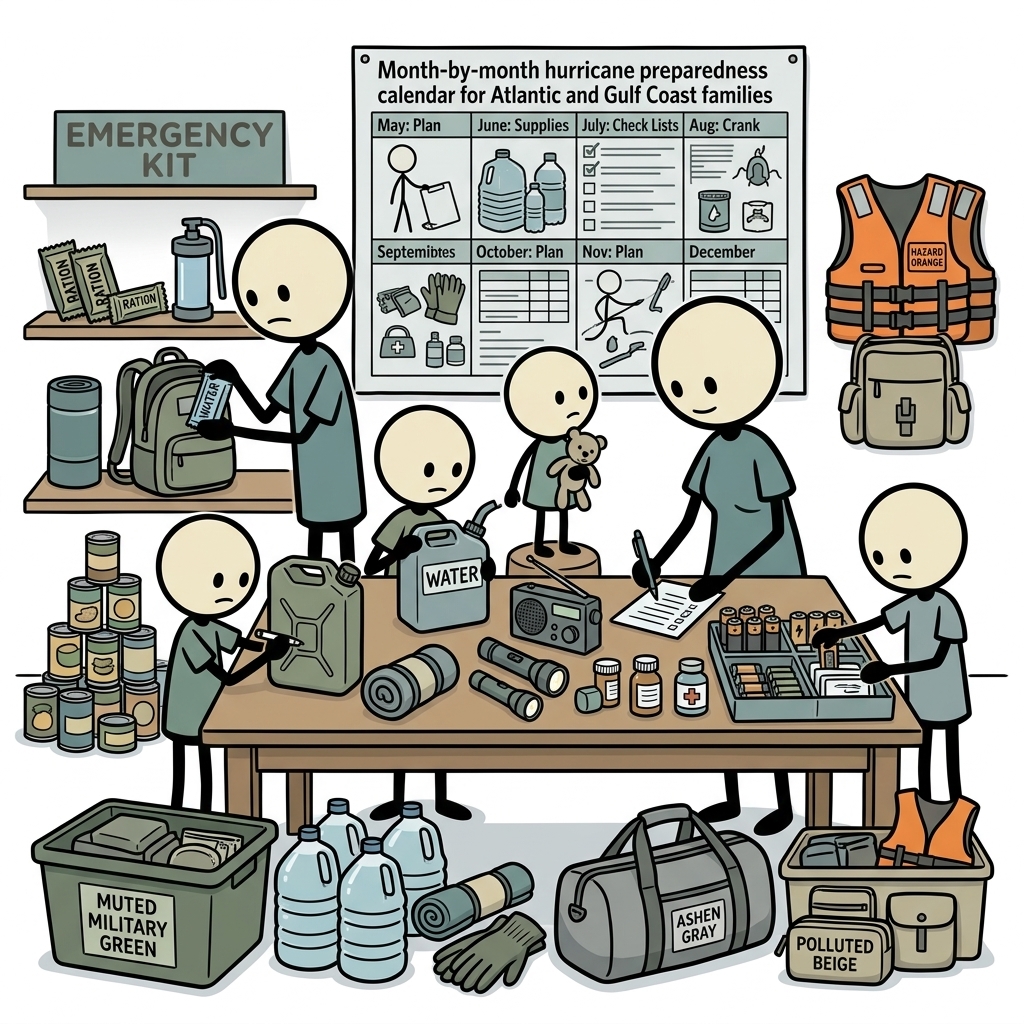
As spring arrives, your hurricane preparedness schedule shifts from administrative planning to active physical preparation. This is the window to build out your physical supplies incrementally, avoiding the financial strain of buying everything at once, while preparing your property for high winds and heavy rainfall.
March: Water, Nutrition, and Medical Supply Rotations
A cornerstone of any coastal family hurricane prep plan is self-sufficiency. FEMA and the American Red Cross recommend a minimum of one gallon of water per person, per day, for at least three to seven days. For a family of four, a two-week supply equates to 56 gallons of water. March is the perfect time to build or rotate this inventory.
Begin by checking the expiration dates on your stored non-perishable foods. Rotate older canned goods, freeze-dried meals, and snacks into your daily pantry for consumption, and replace them with fresh inventory. Focus on nutrient-dense, shelf-stable foods that require no cooking or refrigeration, such as canned meats, peanut butter, dried fruits, and nuts.
Next, audit your family first aid kit. Replace expired medications, sterile wipes, and adhesive bandages. Ensure you have a stock of trauma-grade supplies, including hemostatic agents (QuickClot), tourniquets, pressure dressings, and splints. If anyone in your household relies on prescription medications, speak with your physician about obtaining a "disaster override" prescription to secure an extra 30-day supply to keep on hand.
April: Landscape Mitigation and Drainage Engineering
During a hurricane, your yard can either shield your home or provide the projectiles that destroy it. April’s mild weather is ideal for heavy outdoor labor aimed at reducing wind resistance and managing torrential rainfall runoff.
Begin by evaluating the trees on your property. Dead limbs, overhanging branches touching your roofline, and trees with dense, unpruned canopies are major hazards in high-wind events. Hire a certified arborist to thin out dense canopies, allowing wind to pass through them safely, and to remove dead or diseased wood. Avoid "topping" trees, as this creates weak, easily broken limbs.
Turn your attention to your home's drainage systems. Clear all leaves, pine needles, and debris from your gutters and downspouts. Ensure that your downspout extensions direct water at least six feet away from your home’s foundation. If your property is prone to standing water, clear out drainage ditches, inspect French drains, and verify that nearby street storm drains are free of yard waste and trash. Proper drainage is your primary defense against localized flash flooding.
May: Communication Protocols and Evacuation Drills
May is the final month before the official start of the Atlantic hurricane season on June 1. Use this time to establish your family's emergency emergency communication plan protocols and practice your physical family emergency plan.
- Establish an Out-of-Area Contact: During a localized disaster, local cell towers quickly become overloaded, making local calls difficult. However, long-distance text messages often go through. Designate a relative or friend living in a non-coastal state as your family’s central communication hub. Every family member should check in with this contact to report their safety.
- Map Your Evacuation Routes: Do not rely solely on GPS or smartphone mapping apps, which can direct you into gridlocked traffic or flooded roads. Study your local emergency management agency’s evacuation zone maps. Identify at least three distinct evacuation routes—primary, secondary, and backroads—and print physical road maps for each route to keep in your vehicles.
- Conduct a Physical Evacuation Drill: Treat this as a timed drill. Announce a mock evacuation to your family. Practice packing the vehicles with your "Grab-and-Go" document binder, emergency supply kits, pets, and basic luggage. Time the process, identify bottlenecks, and refine your packing list based on the results.
Phase 3: The Active Season - Early Peak (June to August) — Deployment Readiness
On June 1, the Atlantic hurricane season officially begins. Your focus must now transition from accumulation and planning to active monitoring, tactical readiness, and ensuring that vulnerable family members and pets are fully accounted for in your annual hurricane checklist.
June: Daily Monitoring and Final Supply Audits
With the season underway, situational awareness is your best defense. Establish a daily habit of checking the National Hurricane Center’s (NHC) Two-Day and Seven-Day Graphical Tropical Weather Outlooks. Understanding the development of tropical waves off the coast of Africa or in the Caribbean weeks in advance gives you a massive head start over the general public.
June is also the month to purchase any remaining fresh items on your emergency checklist. This includes purchasing fresh alkaline and lithium batteries for your flashlights, headlamps, and NOAA Weather Radios. Verify that your portable power banks and solar chargers are fully charged and stored in protective, static-free cases. If you rely on reusable water containers, sanitize them thoroughly before filling them with tap water.
July: Special Needs Registries and Pet Preparedness
The heat of mid-summer is the time to finalize plans for the most vulnerable members of your household, including the elderly, infants, individuals with medical dependencies, and family pets.
If you or a family member relies on life-sustaining medical equipment (such as oxygen concentrators, ventilators, or dialysis machines), contact your local emergency management office to register with your county’s Special Needs Registry. This registry alerts emergency services and utility companies of your location, prioritizing your area for power restoration and medical evacuation support.
For your pets, assemble a dedicated emergency kit. This kit must include a two-week supply of pet food, bowls, manual can openers, pet medications, leashes, harnesses, and a sturdy, well-ventilated pet carrier labeled with your contact information. Keep a copy of your pet’s vaccination records inside a waterproof sleeve; most public shelters and pet-friendly hotels will not admit animals without proof of rabies vaccinations.
August: The Peak Begins — Go-Bag Inspections and Cash Reserves
August marks the beginning of the historical peak of the Atlantic hurricane season. Atmospheric conditions become highly favorable for rapid storm development. This is the time to move your family to a state of high readiness.
Conduct a thorough inspection of your individual "go-bag essentials guides" (72-hour survival kits). Each family member should have a dedicated backpack containing:
- Three days of lightweight, durable clothing (long pants, moisture-wicking shirts, sturdy shoes).
- A personal water filter or purification tablets.
- High-calorie emergency food storage guide bars.
- A personal first aid kit, prescription medications, and hygiene items.
- A headlamp with spare batteries, a multi-tool, and a emergency whistle.
- N95 dust masks and heavy-duty work gloves.
Additionally, begin building a physical cash reserve. When a hurricane strikes and the regional electrical grid collapses, credit card processing networks, ATMs, and point-of-sale systems will be offline for days or weeks. Retailers and gas stations that manage to open will operate on a cash-only basis. Store at least $500 to $1,000 in small bills ($1s, $5s, $10s, and $20s) inside your waterproof document safe.
Phase 4: The Peak & Late Season (September to November) — Vigilance and Response
September and October represent the most volatile months of the atlantic gulf coast emergency prep cycle. Major hurricanes during this period are often larger, stronger, and capable of producing devastating storm surges and widespread inland flooding. Your preparation during the off-season and pre-season is put to the test now.
September: Storm Tracking, Evacuation Triggers, and Home Hardening
September 10 is the statistical peak of the hurricane season. If a tropical system is tracking toward your region, you must execute your pre-planned response protocols without hesitation. Do not wait for mandatory evacuation orders to make your decision; establish your own family "evacuation triggers" based on storm intensity and your local geography.
For example, if you live in a designated storm surge zone, a mobile home, or an area with a single evacuation route, your trigger should be a Hurricane Watch (issued 48 hours before tropical-storm-force winds are expected). If you live in a well-built inland home outside of flood zones, your trigger may involve sheltering in place, unless the storm reaches Category 4 or 5 strength.
If your trigger dictates sheltering in place, begin hardening your home immediately upon the issuance of a watch. Deploy your hurricane shutters or install your pre-cut 5/8-inch exterior-grade plywood window coverings. Secure all loose outdoor items, including patio furniture, grills, potted plants, and trash cans, inside your garage or home. Clean out your bathtub with bleach and fill it with water; this water will be used for flushing toilets and washing hands if municipal water pressure fails.
October: Late-Season Cold Fronts and Rapid Development
While October brings cooler fall weather to much of the country, the Gulf of Mexico and Western Caribbean remain incredibly warm. Late-season storms often form rapidly in these areas and are steered quickly toward the Gulf Coast or the Florida peninsula by passing cold fronts. These storms can be highly unpredictable and move at twice the forward speed of summer hurricanes.
Continue to monitor the National Hurricane Center daily. Adjust your emergency supplies to account for cooler post-storm temperatures. If a late-season storm knocks out power, nights can become surprisingly cold. Ensure your emergency supplies include heavy wool blankets, sleeping bags rated for lower temperatures, and long-sleeved thermal layers for every family member.
November: Transitioning to the Post-Season and Safety Audits
November 30 marks the official end of the hurricane season. While the threat of tropical activity drops dramatically, do not let your guard down entirely. November is the time to transition your gear safely into storage while conducting a post-season audit of your performance.
Safely empty any stored water containers that you filled during active storm threats to prevent stagnant water from harboring bacteria. Clean and dry your Water Calculator containers thoroughly before storing them in a dark, cool space. Inspect your hurricane shutters, lubricate the mounting tracks, and store any mounting hardware in clearly labeled containers so they are easily accessible next spring.
Phase 5: The Post-Storm Review & Recovery Framework
True preparedness extends beyond surviving the winds of a storm; it includes navigating the complex, hazardous days and weeks that follow a major landfall. Having a clear recovery protocol minimizes your exposure to post-storm hazards and accelerates your financial recovery.
| Recovery Phase | Immediate Action Item | Safety & Compliance Focus |
|---|---|---|
| Hours 1–24 | Assess structural integrity; check for gas leaks and structural collapse before entering. | Do not wade in floodwaters; treat all downed utility lines as live and dangerous. |
| Days 2–7 | Document all physical damage with photos/video; file insurance and FEMA claims. | Operate generators at least 20 feet away from the home, windows, and doors to prevent CO poisoning. |
| Weeks 1–4 | Mitigate further damage (tarp roofs, dry out interior); hire licensed contractors. | Verify contractor licenses and insurance; avoid door-to-door repair solicitors. |
Immediate Safety Protocols
The period immediately following a hurricane landfall is statistically more dangerous than the storm itself. If you evacuated, do not return to your home until local emergency management officials have declared your area safe. Roads may be blocked by fallen trees, washed-out bridges, or downed live power lines.
If you sheltered in place, conduct an immediate safety sweep of your property. Wear heavy boots, long pants, and thick leather work gloves. Watch for displaced wildlife, including venomous snakes and fire ants, which often seek high ground or float on floodwaters. Never wade through standing floodwater; it is frequently contaminated with raw sewage, industrial chemicals, and hidden debris, and it can carry a lethal electrical charge from downed underground power lines.
Safe Generator and Tool Operation
If your power is out and you are operating a portable generator, you must strictly adhere to safety guidelines to prevent carbon monoxide (CO) poisoning. Never, under any circumstances, operate a generator inside a home, garage, carport, basement, or near an open window or door. The CDC recommends placing the generator at least 20 feet away from your home, with the engine exhaust pointed away from any living structures. Install battery-operated CO detectors on every level of your home.
When clearing fallen trees and debris, prioritize safety. Always wear eye protection, ear protection, and steel-toed boots when operating a chainsaw. If you are not experienced in clearing large, tensioned trees or working on roofs, hire a professional. Hospital emergency rooms are routinely flooded with chainsaw and ladder-fall injuries in the days following a hurricane, diverting critical medical resources away from life-threatening emergencies.
Documenting Damage and Filing Claims
To ensure a smooth recovery process, treat your damaged property like a crime scene. Before you clean up any debris, sweep water out of your home, or throw away damaged items, document everything. Take hundreds of high-resolution photos and videos of your home’s exterior, interior, roof, outbuildings, and landscaping. Capture close-up shots of waterlines on drywall, damaged structural elements, and ruined personal property.
Once documented, contact your insurance company immediately to file your claim. Insurance companies process claims on a first-come, first-served basis; being among the first to file ensures an adjuster is assigned to your case quickly. Keep a detailed log of every phone call, email, and conversation you have with your insurance company, noting the date, time, name of the representative, and details of the discussion. If your area receives a federal disaster declaration, register for assistance with FEMA at DisasterAssistance.gov to access emergency grants for temporary housing and immediate repairs.
The Path to Permanent Resilience
True emergency preparedness is not a frantic weekend chore triggered by a late-night weather report; it is a deliberate, seasonal rhythm that integrates seamlessly into your family's lifestyle. By committing to this comprehensive, month-by-month hurricane preparedness calendar, you replace anxiety with action and fear with capability. Protecting your family along the Atlantic and Gulf Coasts is about controlling the variables you can, when you can. Start today by securing your digital documents, auditing your insurance policies, and building your supplies step-by-step. When the next storm rises in the Atlantic, you will not be standing in long lines at the hardware store—you will be sitting safely in your hardened home, fully prepared to weather the storm.
Frequently Asked Questions
When should coastal families start hurricane prep each year?
January through May is the off-season window for major projects: reviewing and restocking supplies, completing home hardening (impact windows, roof straps, generator maintenance), reviewing insurance policies, and updating evacuation routes. By May 31, you should be fully prepared for June 1 season start.
What is the most important pre-season hurricane prep task?
Insurance review. Verify you have adequate windstorm coverage, that your flood insurance (separate from homeowner's) is current, and understand your deductibles. Document your possessions with video. The time to discover insurance gaps is before the storm, not during the claim.
How does hurricane prep differ by month during the season?
June-July: watch season alerts, verify supplies are complete. August-September: peak season — highest vigilance, fuel topped off, bag packed. When a storm forms: track it, review evacuation plan, top up prescriptions and cash. October-November: wind-down season but remain prepared through November 30.