⚡ Key Facts
- Widespread Reliance: According to the Centers for Disease Control and Prevention (CDC), nearly 50% of Americans have used at least one prescription drug in the past 30 days, making medication continuity a critical infrastructure issue.
- Disaster Vulnerability: The American Red Cross reports that replacing lost, damaged, or forgotten prescription medications is consistently one of the top reasons disaster survivors seek medical attention at emergency shelters.
- Supply Chain Fragility: Data from the United States Geological Survey (USGS) and the National Oceanic and Atmospheric Administration (NOAA) indicates that major seismic events or Category 4+ hurricanes can sever local supply chains and block pharmacy deliveries for two to four weeks.
- Federal Recommendations: The Federal Emergency Management Agency (FEMA) explicitly advises all households to maintain a minimum of a 30-day backup supply of all essential medications, though many preparedness experts advocate for a 90-day buffer.
When the skies darken and the grid fails, the immediate focus naturally shifts to water, food, and physical shelter. Yet one of the most overlooked elements of any go-bag essentials checklist is medication. Yet, for millions of people, the most acute threat during a localized or national disaster isn't starvation or exposure—it is the sudden, terrifying separation from life-sustaining medications. In the aftermath of Hurricane Maria in Puerto Rico and Hurricane Ida in Louisiana, we saw a grim reality unfold: modern pharmacies operate on highly fragile, "just-in-time" inventory systems. When the power goes out, the internet drops, and the delivery trucks stop running, the pharmacy doors lock. Period. Taking control of your medical destiny requires moving beyond the standard first-aid kit and embracing comprehensive medication preparedness. By legally building a buffer, coordinating with your medical providers, mastering storage, and organizing your documentation, you can insulate yourself and your loved ones from the devastating medical fallout of a grid-down scenario. You do not have to be at the mercy of a broken supply chain. See Supply Calculator for additional options. See Supply Calculator for additional options.
The Reality of the Pharmacy Outage Plan
To understand why a robust pharmacy outage plan is non-negotiable, you must first understand how modern pharmacies function. Gone are the days when a local pharmacist kept a massive stockpile of pills in the back room. Today’s pharmaceutical supply chain is a marvel of algorithmic efficiency, designed to minimize overhead and maximize profit. Pharmacies receive daily or bi-weekly shipments based on predictive software. They stock only what they expect to sell in the immediate future.
When a disaster strikes — whether one of the common survival scenarios or an unexpected crisis — this efficiency becomes a fatal flaw. A pharmacy relies on a constant, uninterrupted flow of electricity to keep automated dispensing cabinets operational, refrigerators running for biologics and insulin, and electronic prescribing networks online to verify insurance and prescriptions. Without the internet, pharmacists cannot legally verify your prescription status or check for dangerous drug interactions. Furthermore, if roads are impassable due to floodwaters, debris, or seismic damage, the delivery trucks that resupply the pharmacy simply cannot get through.
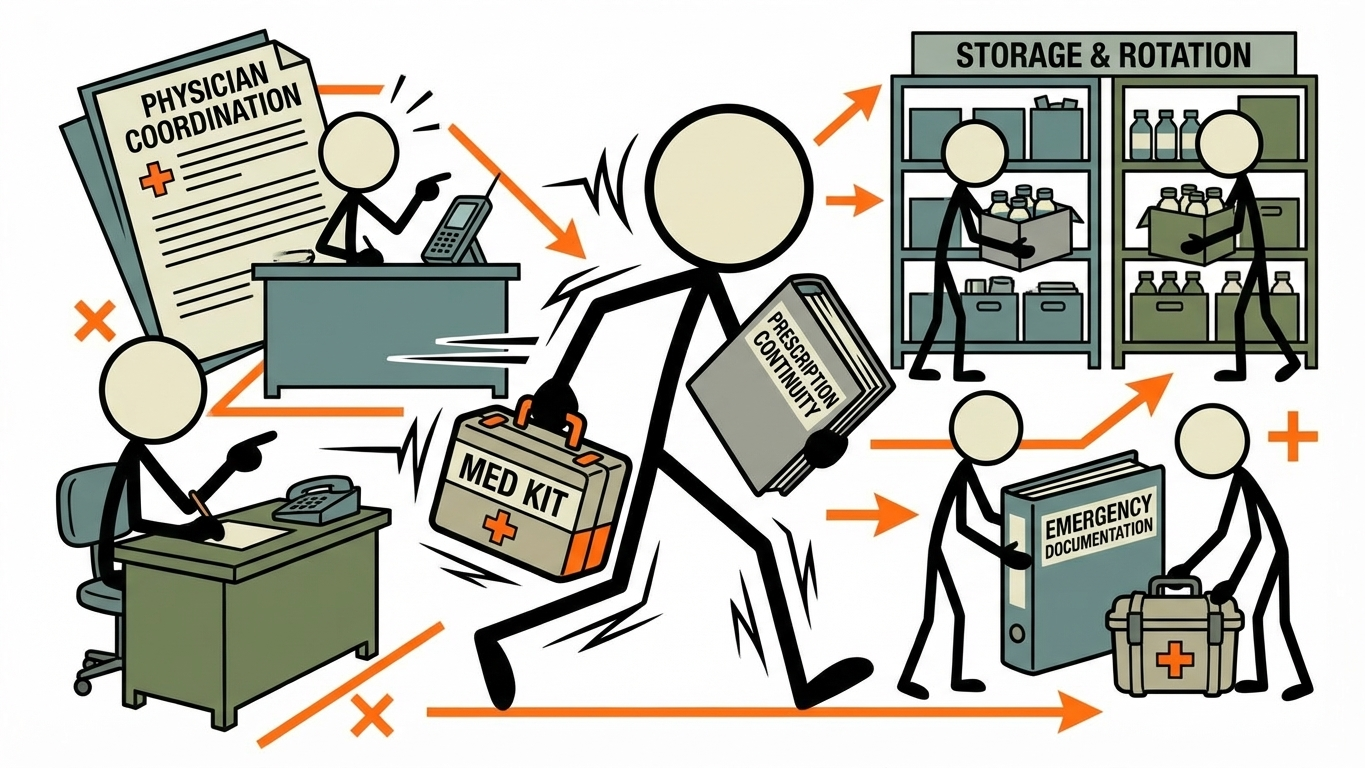
Your personal pharmacy outage plan is your strategic response to this systemic vulnerability. It is a proactive framework that works alongside your family emergency planwork designed to ensure that you have the physical medications in your possession before the crisis hits, the knowledge to store them correctly without grid power, and the documentation required to prove your medical needs to emergency responders if evacuation becomes necessary. Waiting until the National Weather Service issues a warning to rush to the pharmacy is a failing strategy. By the time the warning is broadcast, the lines will be wrapped around the building, and the shelves will be stripped bare.
Building Your Prescription Emergency Supply
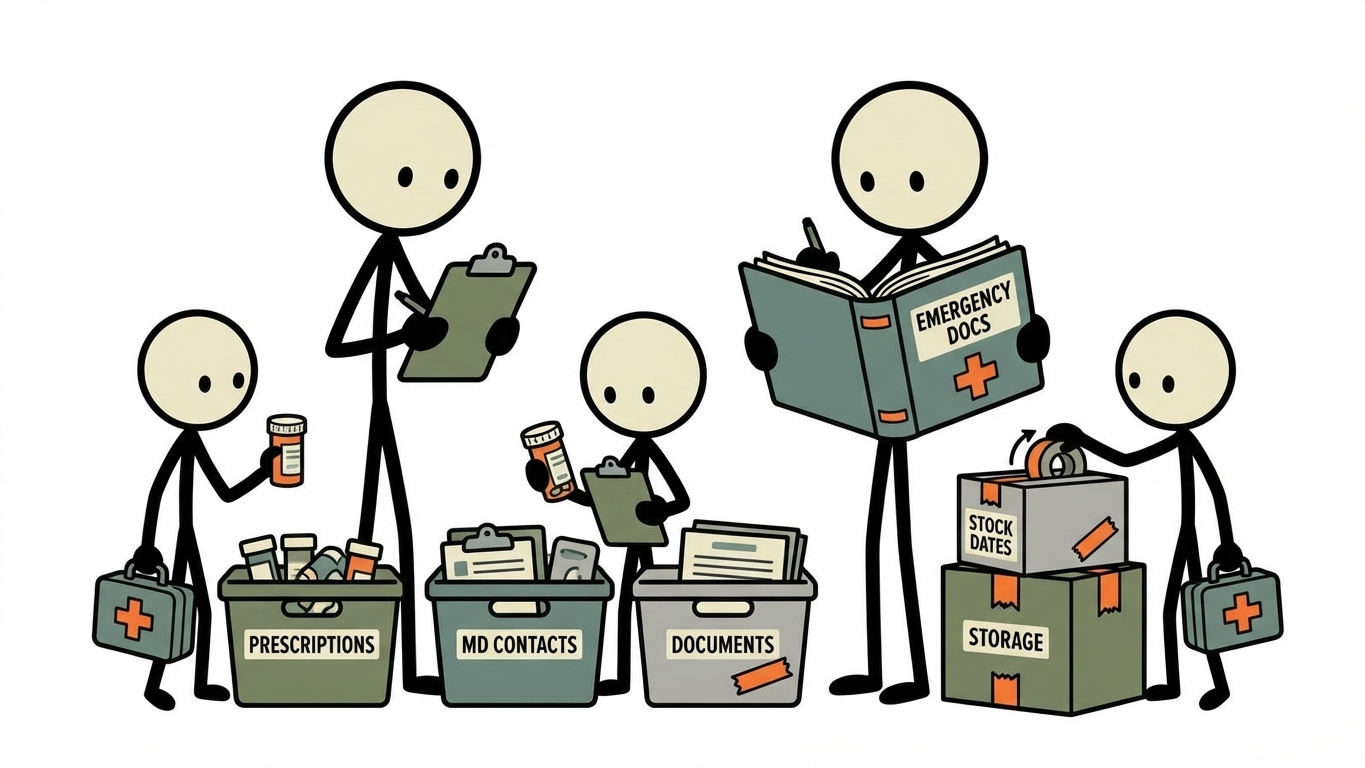
The cornerstone of medical independence is securing a prescription emergency supply. However, building this stockpile — much like using a supply calculator for food and water presents a unique challenge: unlike buying extra canned goods, you cannot simply walk into a store and purchase extra prescription medications. Insurance companies impose strict "Refill Too Soon" limits, and federal laws heavily regulate the dispensing of controlled substances. Overcoming these hurdles requires strategy, persistence, and an understanding of the healthcare system.
Transition to 90-Day Supplies
The easiest and most effective first step is to transition all eligible maintenance medications from 30-day refills to 90-day refills. Most insurance providers actually prefer this and will incentivize it through lower copays, particularly if you use their preferred mail-order pharmacy. Once you receive your 90-day supply, wait until you have about 15 to 20 days of medication left before requesting your next refill. By consistently refilling at the earliest allowable date (usually when 75% to 80% of the prescription is consumed), you will naturally accumulate a rolling buffer over several months.
Utilize Vacation Overrides
Most health insurance plans allow for at least one "vacation override" or "travel override" per year. This is a policy feature designed for people traveling out of the country for extended periods. By calling your insurance provider and requesting a vacation override, your pharmacist can legally dispense an extra 30-day or even 90-day supply of your medication, covered by your insurance. Once acquired, this extra supply instantly becomes the foundation of your emergency stockpile.
The Out-of-Pocket Strategy
If your insurance company is uncooperative, you have the right to bypass them entirely. Insurance companies dictate what they will pay for, not necessarily what your doctor can prescribe. You can ask your physician to write an additional prescription specifically for emergency preparedness. You can then take this paper prescription to a different pharmacy and pay for it out-of-pocket using cash. To mitigate the cost, utilize discount programs like GoodRx, Cost Plus Drugs, or manufacturer discount cards. Many generic maintenance medications for blood pressure, cholesterol, and thyroid conditions cost less than $15 for a month's supply when utilizing these discount networks.
Navigating Controlled Substances
Building a prescription emergency supply for controlled substances (Schedule II-V drugs, such as certain pain medications, ADHD stimulants, or anti-anxiety medications) is significantly more difficult due to DEA regulations. You cannot use vacation overrides or cash-pay strategies to stockpile these easily. In these cases, your only legal and viable option is meticulous, strict adherence to your prescribed dosage, ensuring you never run out early, and having a candid conversation with your doctor about emergency bridging strategies or non-controlled alternative therapies that can be used if a disaster cuts off your access.
Physician Coordination for Chronic Illness Preparedness
Your physician is your most valuable ally in chronic illness preparedness. However, many people are hesitant to discuss disaster preparedness with their doctors, fearing they will be labeled as alarmist. The key is to frame the conversation around official federal guidelines and historical precedents.
Scripting the Conversation
When you sit down with your doctor, keep the focus practical and grounded. You might say: "Doctor, I've been reviewing the recent FEMA and Red Cross guidelines regarding emergency preparedness for our region. They strongly recommend that households maintain at least a 30 to 60-day backup supply of essential medications in case of severe weather or supply chain disruptions. I want to make sure I am fully prepared so I don't experience a medical crisis during a disaster. Can we work together to build a safe backup supply of my prescriptions?" This approach demonstrates that you are acting rationally, following government advice, and prioritizing your health.
Alternative Formulations and Shelf Life
During this consultation, discuss the stability of your medications. Ask your doctor if there are alternative formulations that are better suited for austere environments. For example, if you or your child takes a medication in a liquid suspension that requires refrigeration, ask if there is a chewable tablet, a capsule, or a powder-for-reconstitution alternative that is shelf-stable. Liquid antibiotics degrade rapidly without refrigeration, whereas dry powders can last for years if kept away from moisture. Coordinating these details in advance is the essence of true chronic illness preparedness.
Securing Paper Prescriptions
In our digital age, electronic prescribing (e-prescribing) is the norm. The doctor clicks a button, and the pharmacy receives the order. But what happens when the local cell towers are destroyed by a hurricane or an earthquake severs fiber-optic cables? The e-prescribing network collapses. Ask your doctor to provide physical, signed paper copies of your most critical prescriptions to keep in your emergency kit. If you are forced to evacuate to another state or region, having a hard copy allows a pharmacist in a different jurisdiction to legally verify and fill your medication without waiting for internet systems to come back online.
Optimal Medication Storage and Environmental Control
Acquiring your emergency supply is only half the battle — just as with emergency food storage, keeping it viable is the other; keeping it viable is the other. Medications are complex chemical compounds that degrade when exposed to heat, light, oxygen, and moisture. The standard practice of keeping medications in a bathroom medicine cabinet is actually the worst possible choice, as the daily fluctuations in heat and extreme humidity from showers accelerate chemical breakdown.
Temperature and Humidity Management
The United States Pharmacopeia (USP) defines "controlled room temperature" as 68°F to 77°F (20°C to 25°C), with brief excursions permitted up to 86°F (30°C). To maximize the shelf life of your medication preparedness stockpile, store your pills in a cool, dark, and dry location, such as a master bedroom closet or a dedicated storage tote in a temperature-controlled basement. Always keep medications in their original, airtight, amber-colored pharmacy bottles, as these are specifically designed to filter out degrading ultraviolet light. To combat humidity, add food-grade silica gel desiccant packets to your medication storage containers to absorb ambient moisture.
The Challenge of Refrigerated Medications
For individuals relying on insulin, biologic immunosuppressants, or certain liquid antibiotics, a power outage is a race against the clock. These medications typically require strict storage between 36°F and 46°F (2°C to 8°C). Freezing them is just as destructive as overheating them; if insulin freezes, the protein structure is permanently destroyed, rendering it useless.
To prepare for grid failure, invest in specialized medical cooling wallets, such as FRIO bags. These utilize evaporative cooling technology—you simply soak the inner wallet in water, and the evaporative process keeps the medication cool for days without electricity, provided there is adequate airflow. For longer-term outages, a high-retention cooler (like a Yeti or RTIC) paired with phase-change material (PCM) ice packs can maintain precise refrigerator temperatures for up to a week. PCM packs are superior to standard ice because they freeze and thaw at specific temperatures, preventing the accidental freezing of your fragile biologics.
Understanding Expiration Dates
It is vital to understand the difference between a medication's "expiration date" and its actual chemical viability. The federal Shelf Life Extension Program (SLEP), conducted by the FDA and the Department of Defense, has repeatedly shown that the vast majority of solid-pill medications retain 90% or more of their potency for years—sometimes decades—past their stamped expiration dates, provided they are stored optimally. While you should always strive to use unexpired medications, in a true life-or-death Survival Scenarios where no fresh supply is available, an expired tablet is almost always better than no tablet at all. (Note: This does not apply to liquid medications, insulins, biologics, or tetracycline antibiotics, which can become toxic or entirely ineffective upon expiration).
Implementation and Rotation: The FIFO Method
A medication stockpile is not a "set it and forget it" asset. If you simply throw extra bottles into a box and ignore them, you will eventually be left with a stash of severely degraded drugs. To maintain the integrity of your supply, you must implement a strict rotation system. The gold standard for inventory management in emergency preparedness is the FIFO method: First In, First Out.
Setting Up the Rotation Cycle
When you bring a new prescription home from the pharmacy, do not open it immediately. Instead, place this newest bottle at the back of your emergency supply. Take the oldest bottle from the front of the supply and move it into your daily pill organizer or active use area. By continuously cycling your medications in this manner, your emergency stockpile is always composed of the freshest possible inventory, while you consume the older stock well before it reaches its expiration date.
Visual Organization and Tracking
To make FIFO effortless, organize your storage visually. Use clear acrylic bins or dedicated drawers for each family member's medications. Label the top of every bottle clearly with a permanent marker, writing the drug name, dosage, and the expiration date in large, easy-to-read numbers. In a high-stress disaster environment, perhaps under the dim light of a flashlight, you do not want to be squinting at tiny pharmacy print.
For advanced medication preparedness, maintain a simple tracking spreadsheet or a dedicated notebook. Log the medication name, the total number of pills in reserve, and the earliest expiration date in the batch. Review this log quarterly. This practice not only ensures your rotation is working but also immediately alerts you if your buffer is shrinking and you need to request a refill.
Emergency Medical Records and Documentation
Physical medications are useless if emergency medical personnel do not know how or when to administer them, or if you are evacuated to a new hospital that has no record of your complex medical history. Emergency medical records are the silent heroes of disaster survival. If you are unconscious, confused, or separated from your primary caregiver, your documentation must speak for you.
Building the Medical Go-Binder
Every household should have a physical "Medical Go-Binder" stored in a waterproof, fire-resistant bag, placed right next to your emergency medical kit. Do not rely solely on digital portals like MyChart; these systems require internet access and passwords, both of which may be unavailable in a crisis. Your binder should contain hard copies of the following for every family member:
- Demographics and Contacts: Full legal name, date of birth, blood type, and emergency contact numbers (including out-of-state contacts).
- The Master Medication List: A meticulously detailed list of every prescription, over-the-counter drug, and supplement taken. Include the exact drug name, dosage (e.g., 50mg), frequency (e.g., twice daily), the prescribing doctor's name, and the specific medical condition it treats.
- Allergies and Contraindications: Highlight any severe allergies to medications (like penicillin), foods, or environmental factors, and describe the specific reaction (e.g., anaphylaxis vs. mild rash).
- Surgical and Medical History: A summary of major past surgeries, chronic diagnoses, and dates of significant medical events.
- Device Information: If you have an implanted device (pacemaker, insulin pump, cochlear implant), include the manufacturer, model number, serial number, and the contact information for the device representative.
- Legal Directives: Copies of Advance Directives, Living Wills, Medical Powers of Attorney, and POLST/MOLST (Physician Orders for Life-Sustaining Treatment) forms.
- Insurance and Identification: High-quality photocopies of the front and back of health insurance cards, Medicare/Medicaid cards, and government-issued IDs.
Digital Redundancy and the 3-2-1 Rule
While paper is king during a blackout, digital backups are essential for catastrophic events like house fires or severe floods where physical items might be lost. Follow the 3-2-1 backup rule for your emergency medical records: keep three total copies, on two different mediums, with one stored off-site. Scan all the documents from your Go-Binder and save them onto a hardware-encrypted USB flash drive (to comply with HIPAA-style privacy standards and protect against identity theft). Keep this flash drive on your keychain or in your everyday carry bag. Additionally, consider storing a secure, encrypted digital copy in a cloud locker that can be accessed from any smartphone once cellular service is restored.
Special Considerations for Medical Devices and Power
For many facing chronic illnesses, medications are intrinsically linked to medical devices. If your survival depends on a CPAP machine, an oxygen concentrator, a home dialysis machine, or an electronic nebulizer, your chronic illness preparedness plan must heavily prioritize redundant power generation. A grid failure turns these life-saving devices into useless plastic within seconds.
Calculating Power Needs
The first step is determining the exact energy consumption of your medical devices. Look at the power brick or the back panel of your device to find the wattage (or multiply the Volts by the Amps to get the Watts). Once you know the wattage, multiply it by the number of hours you need the device to run each day to calculate your required Watt-hours (Wh). For example, a CPAP machine drawing 40 Watts used for 8 hours a night requires 320 Watt-hours of energy per day.
Generators and Portable Power Stations
To bridge the power gap, invest in a high-quality portable power station (often referred to as a solar generator). Brands like EcoFlow, Jackery, or Bluetti offer lithium-iron-phosphate (LiFePO4) battery stations that can be safely operated indoors, unlike gas generators which produce deadly carbon monoxide. Ensure the power station you choose features a "Pure Sine Wave" inverter; sensitive medical equipment contains microprocessors that can be damaged by the "Modified Sine Wave" power produced by cheaper inverters.
Pair your portable power station with portable solar panels. This creates a sustainable, closed-loop energy system. During the day, the solar panels recharge the battery station, and at night, the battery station powers your CPAP, oxygen concentrator, or the mini-fridge holding your insulin. For those reliant on oxygen, also ensure you have a physical backup supply of compressed oxygen cylinders to bridge any gaps if the concentrator fails or the solar panels cannot gather enough sunlight during a storm.
Over-the-Counter Bridges and Triage Management
Despite the best-laid plans, there is always a statistical possibility that a disaster will outlast your prescription emergency supply. In these extreme edge cases, your preparedness strategy must pivot from continuity to triage and symptom management. This is where a deeply stocked over-the-counter (OTC) medical kit becomes invaluable.
Bridging the Gap
While OTC medications cannot cure or replace complex prescription drugs, they can often manage the dangerous secondary symptoms of withdrawal or condition exacerbation. If you run out of prescription blood pressure medication, the immediate danger is a hypertensive crisis. While you cannot buy a beta-blocker OTC, having a robust supply of low-dose aspirin can help thin the blood and mitigate the risk of a resulting cardiac event while you seek emergency medical extraction. If a prescription anti-inflammatory for rheumatoid arthritis runs out, alternating high doses of OTC Ibuprofen and Acetaminophen can provide a temporary bridge to keep the patient mobile enough to evacuate.
Stockpiling Complementary Supplies
Your emergency medical cache should include high-quality OTC equivalents for pain management, severe allergy response (like liquid Diphenhydramine/Benadryl, which acts faster than pills), gastrointestinal distress (loperamide for diarrhea, which can be fatal due to dehydration in a disaster), and broad-spectrum topical antibiotics. Furthermore, stock up on electrolyte replacement powders. Many chronic illnesses and the stress of a disaster environment rapidly deplete the body's sodium and potassium levels, leading to severe complications that mimic or worsen prescription withdrawal symptoms.
Empowering Your Medical Independence
True emergency preparedness is not about giving in to fear; it is about systematically removing the unknowns from your future. The modern healthcare supply chain is a miracle of convenience, but it is not designed to withstand the chaos of a severe natural disaster or a protracted grid-down scenario. By taking immediate, actionable steps today—securing a 90-day prescription emergency supply, having transparent conversations with your physician, optimizing your storage systems, and meticulously organizing your emergency medical records—you transform yourself from a passive patient into an empowered survivor. You cannot control the weather, the power grid, or the global supply chain, but you absolutely have the power to protect your health, ensure your medication continuity, and safeguard the lives of those who depend on you.
Ensure medication readiness through our medical preparedness guide. Learn family health planning from our family emergency plan. Build medical kits with our go-bag builder. Calculate medication quantities with our supply calculator. Get medical training through our preparedness courses.
Frequently Asked Questions
How much prescription medication should I keep?
Work with your clinician and pharmacy to maintain a legal buffer and refill schedule that reduces interruption risk.
How should medicines be stored during outages?
Follow label temperature rules, use insulated storage for sensitive meds, and monitor storage conditions.
What records should be in a medical go-kit?
Include prescriptions, dosages, physician contacts, allergies, diagnoses, and insurance details in printed and digital form.
Can I substitute medications during shortages?
Only with professional guidance. Never change doses or drug types without clinical approval.
What if my pharmacy is closed after a disaster?
Use your backup pharmacy list, contact your insurer help line, and bring documented prescriptions and ID.
Sources & Further Reading
Related resource: Supply Calculator.
Related resource: Emergency Preparedness Guide.