⚡ Key Facts
- The Historical Precedent: The 1811–1812 New Madrid earthquake sequence included at least three major shocks estimated between magnitude 7.2 and 8.2, which temporarily reversed the flow of the Mississippi River and shook areas over 1,000 miles away.
- Seismic Amplification: Due to the dense, cold, and highly continuous geological crust of the eastern United States, seismic waves in the Midwest travel up to 20 times farther than they do along the San Andreas Fault in California.
- USGS Probability Estimates: The United States Geological Survey (USGS) estimates a 7% to 10% chance of a repeat magnitude 7.0 to 8.0 event, and a 28% to 46% chance of a magnitude 6.0 or greater event, within any given 50-year window.
- FEMA Impact Projections: A worst-case scenario seismic event along the New Madrid Fault Zone could instantly displace over 7.2 million people, damage 700,000 buildings, and cause over $300 billion in direct economic losses across eight states.
Imagine the ground beneath the American Heartland shifting violently, not for a brief moment, but for several agonizing minutes. In the winter of 1811, this was the terrifying reality for residents of the Mississippi River Valley, when a series of massive earthquakes shattered the wilderness, rang church bells in Boston, and woke up President James Madison in Washington, D.C. Today, the New Madrid Fault Zone (NMFZ) remains a sleeping giant beneath the fertile soils of Missouri, Arkansas, Tennessee, Kentucky, Illinois, Indiana, Mississippi, and Alabama. While West Coast fault lines dominate the headlines, the unique geology of the Midwest means a major rupture here would be far more devastating over a much wider geographic area. True emergency preparedness Midwest planning requires a specialized understanding of this threat, moving beyond generic advice to deliver a robust, region-specific strategy for survival.
The Sleeping Giant: New Madrid Earthquake History & Geology
To understand the necessity of Midwest earthquake preparedness, one must first understand the unique and volatile nature of the New Madrid Fault Zone. Unlike the plate-boundary faults of California, the NMFZ is an intraplate fault system embedded deep within the North American tectonic plate. It is a failed rift—known geologically as the Reelfoot Rift—dating back roughly 500 million years when the continent tried, and failed, to split apart. This ancient scar remains a zone of deep-seated weakness, highly susceptible to tectonic stresses radiating from the Atlantic Ocean's mid-oceanic ridge.
The New Madrid earthquake history is defined by the catastrophic sequence of 1811–1812. Between December 16, 1811, and February 7, 1812, three massive earthquakes and thousands of aftershocks battered the region. The shaking was so intense that it created Reelfoot Lake in Tennessee, caused waterfalls to form on the Mississippi River, and triggered a phenomenon known as soil liquefaction across thousands of square miles. The sheer scale of these historical events serves as a stark warning to modern family emergency planners.
The Physics of Midwestern Seismic Attenuation
One of the most critical concepts in this earthquake survival guide is "attenuation"—the rate at which seismic energy dissipates as it travels away from the epicenter. In the western United States, the crust is highly fractured, hot, and young, which acts like a shock absorber, rapidly dampening seismic waves. In contrast, the cratonic crust of the Midwest is exceptionally old, cold, dense, and continuous.
When an earthquake strikes the NMFZ, the seismic waves travel through this dense bedrock with incredible efficiency. A magnitude 7.0 earthquake in Memphis, Tennessee, would shake an area roughly ten times larger than a magnitude 7.0 earthquake in San Francisco, California. The shaking would be felt intensely from the Gulf Coast to the Great Lakes, and from the Great Plains to the Atlantic Seaboard. This geological reality means that even if you live hundreds of miles from the fault line, you are still well within the danger zone.
The Threat of Soil Liquefaction
Another major geological hazard unique to the Mississippi River Valley is soil liquefaction. Much of the region sits on deep, unconsolidated alluvial soils—sands, silts, and gravels deposited by rivers over millions of years. These soils are heavily saturated with water.
When subjected to prolonged, intense shaking, the water pressure within the soil pores rises to the point where the soil completely loses its shear strength and behaves like a liquid. Entire buildings can sink, tilt, or collapse; roads can buckle and slide; and underground pipelines can float to the surface or rupture. Liquefaction along the Mississippi and Ohio River valleys would instantly sever critical transportation and utility corridors, isolating entire metropolitan areas.
The Unique Vulnerabilities of Midwestern Infrastructure
The primary danger in any major seismic event is not the movement of the ground itself, but the failure of man-made structures. The Midwest faces several distinct structural vulnerabilities that would amplify the impact of a major New Madrid rupture. Understanding these vulnerabilities is key to developing an effective emergency preparedness Midwest strategy.
Unreinforced Masonry (URM) Buildings
A significant portion of the commercial and residential building stock in Midwestern cities like St. Louis, Memphis, Evansville, and Paducah consists of unreinforced masonry (URM)—buildings constructed of brick, stone, or concrete block without steel reinforcing bars. These structures are highly susceptible to collapse during lateral seismic shaking.
During a major earthquake, URM walls quickly crack, pull away from floors and roofs, and collapse outward into the streets. Chimneys, parapets, and decorative cornices are the first to fall, creating a lethal rain of debris for anyone attempting to flee outside. While modern building codes in some Midwestern municipalities have integrated seismic standards, millions of older homes and historic commercial buildings remain highly vulnerable.
Critical Bridge Crossings and Transportation Bottlenecks
The Midwest is defined by its great rivers—the Mississippi, the Ohio, the Missouri, and the Tennessee. These waterways are crossed by hundreds of massive bridges that carry interstate highways, freight railways, and utility lines. Most of these bridges were not designed to withstand major seismic forces.
According to studies by the Central United States Earthquake Consortium (CUSEC), a major NMFZ event would likely collapse or disable dozens of critical bridge crossings. This would instantly sever the nation’s east-west transportation corridors, halting the flow of food, medicine, and fuel across the entire United States. Local communities would find themselves isolated, with emergency services unable to cross rivers to deliver aid or evacuate the injured.
Interdependent Utility Grid Failures
The NMFZ is crossed by some of the nation's most critical energy infrastructure, including high-pressure natural gas pipelines, crude oil pipelines, and major electrical transmission lines that supply the East Coast. The combination of ground shaking, landslides, and liquefaction would likely rupture these pipelines and topple transmission towers.
The resulting utility failures would be highly interdependent. A loss of electrical power would disable water treatment plants and fuel pumps, while ruptured gas lines would spark widespread fires that cannot be easily extinguished due to broken water mains. This cascading failure of critical infrastructure means that Midwesterners must prepare for a prolonged period of self-reliance.
Phase 1: Proactive Preparation (Before the Quake)
Survival is largely determined before the first tremor is ever felt. True emergency preparedness Midwest planning requires a systematic approach to mitigating hazards in your home, securing vital supplies, and establishing a emergency communication plan framework that does not rely on cellular networks.
Structural and Non-Structural Home Mitigation
You do not need to be a structural engineer to make your home significantly safer. Non-structural hazards—falling objects, breaking glass, and shifting appliances—cause the vast majority of non-fatal injuries during earthquakes. Take the following steps to secure your living space:
- Secure Heavy Furniture: Anchor tall bookcases, filing cabinets, armoires, and entertainment centers to wall studs using heavy-duty L-brackets or nylon safety straps.
- Latch Cabinet Doors: Install child-safety latches or magnetic locks on kitchen and bathroom cabinets to prevent dishes, glassware, and hazardous chemicals from flying out.
- Secure the Water Heater: A tipped water heater is not only a major fire hazard due to ruptured gas or electrical lines, but it also ruins 30 to 50 gallons of precious emergency drinking water. Strap your water heater to the wall studs using heavy-gauge metal strapping kits at both the top and bottom.
- Install Flexible Utility Connectors: Replace rigid yellow brass gas lines with flexible stainless-steel connectors on all major appliances, including stoves, dryers, and water heaters.
- Mount Wall Art Safely: Avoid hanging heavy mirrors, framed pictures, or shelving directly over beds, couches, or desks. Use closed-loop picture hooks that prevent frames from bouncing off the wall.
The 14-Day Midwest Survival Kit
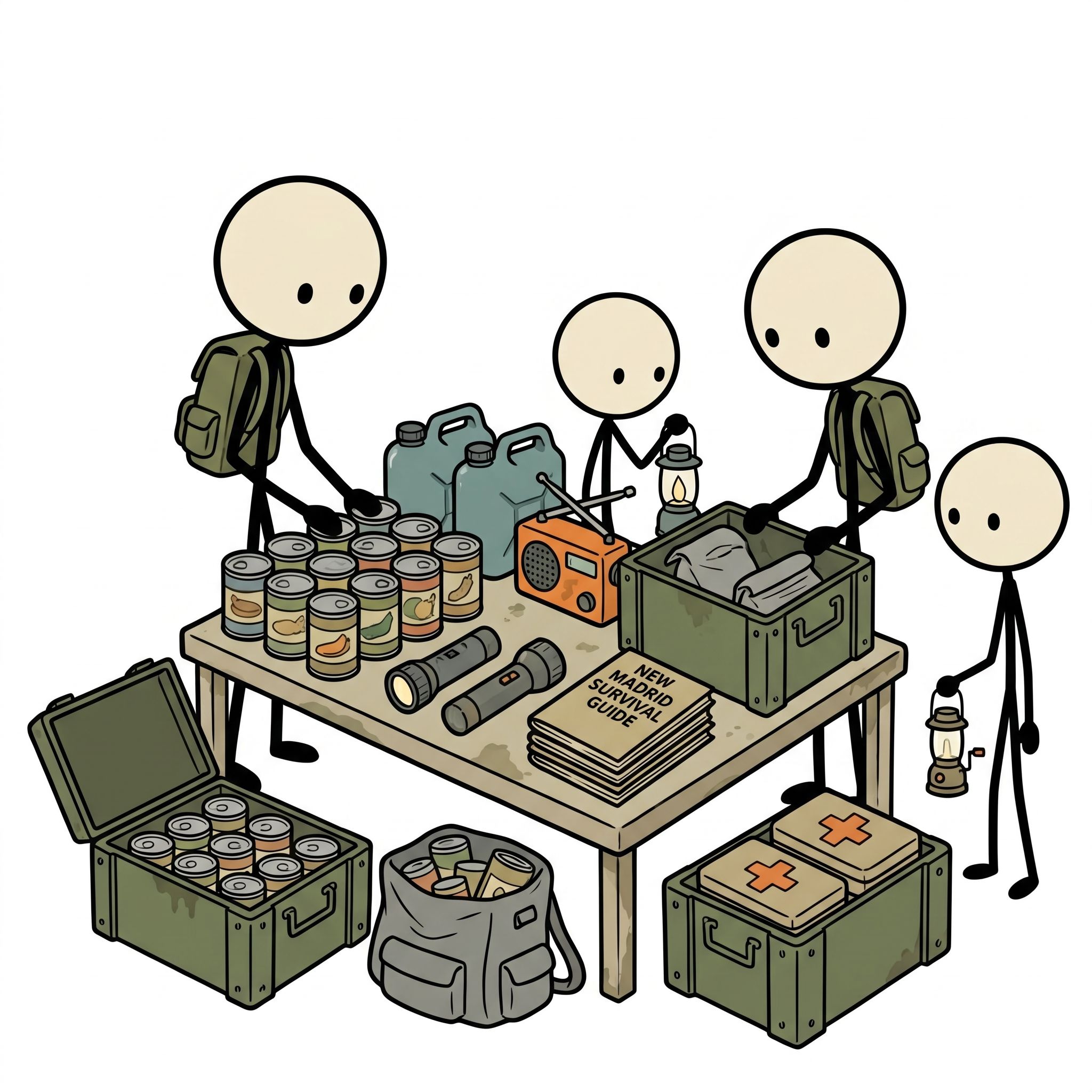
While federal agencies like FEMA historically recommended a 72-hour emergency kit, the reality of a major New Madrid event dictates a much longer timeline. Because of the vast geographic impact and the destruction of transportation infrastructure, emergency services will be overwhelmed. You should prepare to be completely self-sufficient for a minimum of 14 days.
| Category | Essential Items | Target Quantity (Per Person) |
|---|---|---|
| Water | Potable water, unscented household bleach, gravity-fed water filters (e.g., Sawyer or Berkey). | 1 gallon per day (14 gallons total per person). |
| Food | Shelf-stable, non-perishable items requiring no cooking (canned meats, peanut butter, MREs, dried fruits). | 2,000–2,500 calories per day for 14 days. |
| First Aid & Medical | Trauma dressings, tourniquets, splints, antiseptic, and a minimum 30-day supply of critical prescription medications. | 1 comprehensive trauma kit per household. |
| Sanitation & Hygiene | 5-gallon buckets with snap-on toilet seats, heavy-duty contractor trash bags, kitty litter, wet wipes, hand sanitizer. | 2 buckets per household, 100 contractor bags. |
| Tools & Utility Control | Non-sparking gas shutoff wrench, pry bar, heavy-duty work gloves, safety goggles, dust masks (N95). | 1 set of emergency tools per household. |
| Power & Communication | Hand-crank NOAA weather radio, solar power banks, headlamps, extra batteries, offline maps. | 1 radio, 2 power banks, headlamps for all. |
Developing a Resilient Family Communication Plan
During a major disaster, local cellular towers will either be physically damaged or completely overwhelmed by call volume. Do not count on being able to make a standard voice call to locate your family members. Establish a communication plan that bypasses local network congestion:
Identify an out-of-state emergency contact—ideally someone living in the western or northeastern U.S. who is completely unaffected by the regional disaster. During network congestion, text messages (SMS) are far more likely to go through than voice calls because they require significantly less bandwidth and will continue to attempt transmission in the background. Instruct all family members to send a single text to the out-of-state contact indicating their safety and location. Establish pre-determined physical meeting locations near your home, school, and workplace in case all communication networks fail entirely.
Phase 2: Immediate Action (During the Shaking)
When the earth begins to shake, you have only seconds to react. Your physical response during these critical moments will directly determine your chances of survival. It is vital to separate life-saving facts from dangerous myths.
Drop, Cover, and Hold On
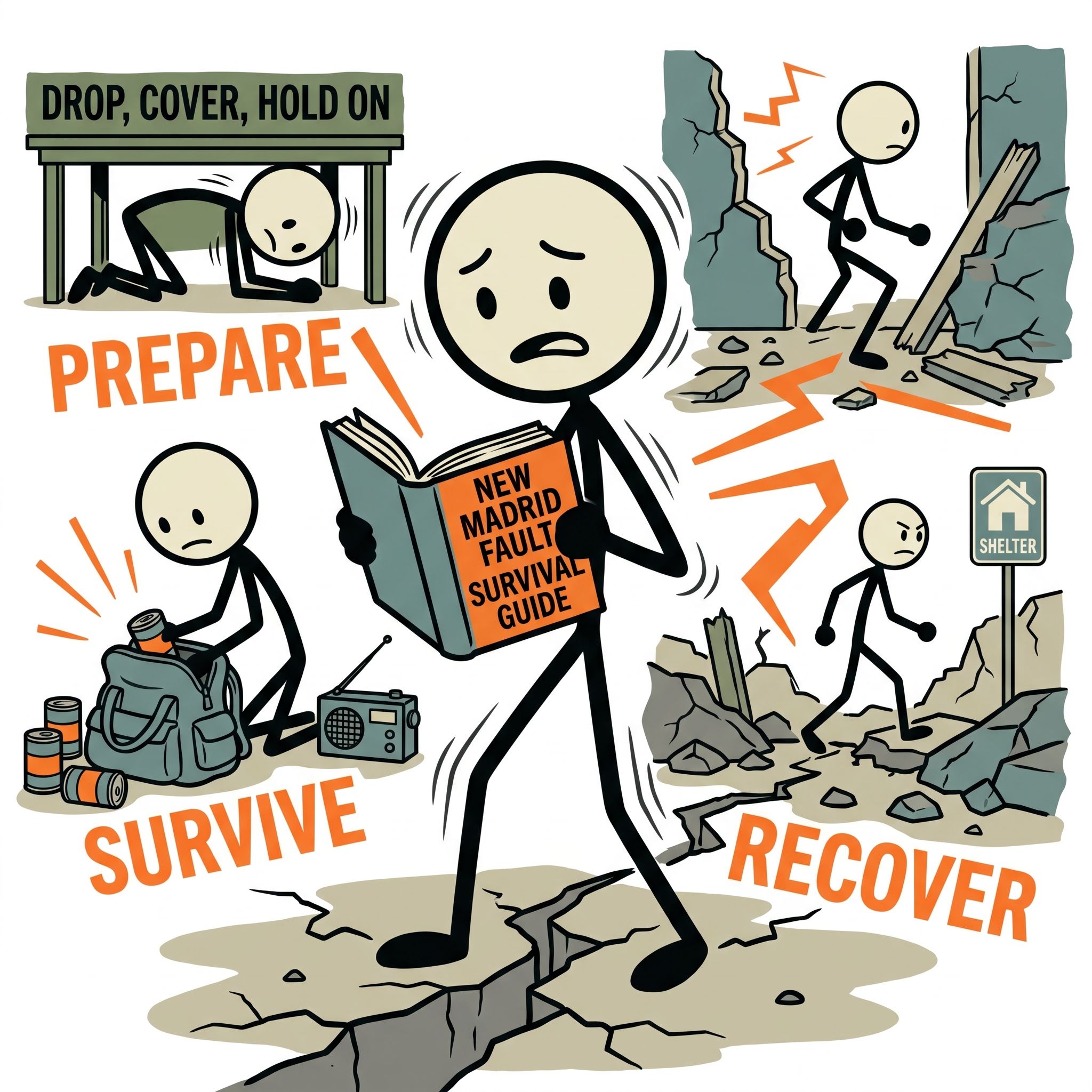
The gold standard for earthquake survival, endorsed by FEMA, the Red Cross, and the USGS, is Drop, Cover, and Hold On. This simple, three-step action is designed to protect you from falling debris, which is the leading cause of injury during an earthquake.
- DROP down onto your hands and knees. This position protects you from being knocked off your feet by violent ground movement and keeps you low to the ground, reducing your profile as a target for flying objects.
- COVER your head and neck with your arms. If a sturdy desk, table, or workbench is nearby, crawl underneath it for shelter. If no shelter is available, crawl next to an interior wall, away from windows, and cover your head and neck with both arms.
- HOLD ON to your shelter (or your head and neck) until the shaking stops. Be prepared to move with your shelter if the shaking shifts it across the floor.
Debunking Dangerous Myths
There are several persistent, dangerous myths regarding earthquake survival that must be aggressively debunked. The first is the "doorframe myth." In modern homes, doorframes are no stronger than any other part of the house, and they do not protect you from flying or falling objects. Standing in a doorway leaves you completely exposed.
The second is the "Triangle of Life" theory, which suggests finding a void next to a large object rather than going under it. This theory is highly dangerous and relies on the assumption that buildings will always undergo a total "pancake" collapse, which is rare in the United States. In reality, attempting to move during violent shaking to find a "void" frequently results in severe falls and exposure to flying debris. Stick to the scientifically proven Drop, Cover, and Hold On method.
Scenario-Specific Survival Tactics
Your immediate response must adapt to your physical environment when the shaking begins:
- If Indoors: Stay indoors. Do not run outside. Most injuries occur when people try to exit buildings during shaking and are struck by falling bricks, glass, or collapsing facades. Move away from windows, outer walls, and heavy light fixtures.
- If in Bed: If you are in bed when the shaking starts, stay there. Turn face down, cover your head and neck with your pillow, and hold on with both hands. The bed frame and mattress provide excellent protection against falling plaster and ceiling debris.
- If Driving: Pull over safely to the side of the road, away from overpasses, bridges, power lines, and large signboards. Set the parking brake and remain inside the vehicle. The car's suspension will absorb much of the shaking, and the metal roof provides protection from falling debris. Once the shaking stops, proceed with extreme caution, avoiding bridges and ramps that may have been structurally compromised.
- If Outdoors: Move to an open area away from buildings, power lines, trees, and streetlights. Drop to the ground and protect your head and neck. If you are in a dense downtown area, duck into the nearest building lobby or alcove to protect yourself from falling glass and masonry.
Phase 3: The Critical Aftermath (The First 72 Hours)
The cessation of shaking does not mean the danger has passed. The immediate aftermath of a major New Madrid earthquake is a highly volatile environment characterized by aftershocks, fires, hazardous material leaks, and structural instability.
Immediate Hazard Assessment and Utility Control
Your first priority after the shaking stops is to assess your immediate surroundings for life-threatening hazards. Check yourself and those around you for injuries, rendering basic first aid as necessary. Once stable, systematically secure your home's utilities to prevent secondary disasters:
Sniff for Gas: If you smell gas, hear a hissing sound, or suspect a leak, immediately shut off the main gas valve using a non-sparking wrench. The main valve is typically located on the pipe coming out of the ground next to your gas meter. Turn the valve a quarter-turn in either direction so the tang (the part you put the wrench on) is crosswise to the pipe. Warning: Do not turn the gas back on yourself; this must only be done by a qualified technician once the system is certified safe.
Inspect Electrical Systems: If you see sparks, frayed wires, or smell burning insulation, shut off the main electrical breaker at the circuit panel. Do not attempt to touch electrical panels or switches if you are standing in water or if the panel itself is wet.
Shut Off the Water Main: Water mains often rupture during earthquakes, allowing contaminants to seep into the local water system. Shut off your home's main water valve (usually located in the basement, crawlspace, or near the street curb) to isolate and preserve the clean water trapped inside your home's pipes and water heater.
Navigating the Reality of Aftershocks
A major New Madrid earthquake will be followed by a prolonged sequence of aftershocks. Some of these aftershocks may be nearly as large as the initial quake, capable of collapsing structures already weakened by the main shock. Treat every aftershock with the same gravity as the primary event: immediately Drop, Cover, and Hold On. Avoid entering damaged buildings, and do not attempt to clear debris from structurally compromised areas until the seismic activity has stabilized.
Sanitation and Waste Management in a Grid-Down Environment
With municipal water and sewer systems likely offline for weeks or months, proper sanitation is critical to prevent the outbreak of waterborne diseases like cholera and dysentery. Under no circumstances should you flush toilets or pour waste down drains until local authorities confirm the sewer lines are intact.
Implement a two-bucket sanitation system. Label one 5-gallon bucket for liquid waste (urine) and another for solid waste (feces). Liquid waste can be diluted with water and disposed of in a designated outdoor area. Solid waste must be collected in heavy-duty contractor bags lining the second bucket. After each use, cover the waste with a layer of kitty litter, sawdust, or dry soil to control odor and moisture. Once a bag is full, seal it securely and store it in a designated, secure outdoor location away from pests and water sources until emergency waste management systems are established.
Phase 4: Long-Term Recovery and Community Resilience
Recovering from a major New Madrid Fault Zone event is a marathon, not a sprint. The scale of the destruction will require communities to band together, adapt to a prolonged lack of public services, and navigate complex financial and psychological landscapes.
Water Purification and Food Safety
As your stored water supplies begin to dwindle, you must transition to harvesting and purifying water from alternative sources, such as rainwater, swimming pools, or nearby streams. Always treat harvested water as contaminated. Implement a multi-stage purification process:
First, strain the water through a clean cloth, coffee filter, or paper towel to remove large suspended particles. Next, pass the water through a high-quality hollow-fiber membrane filter (such as a Sawyer or Berkey filter) to remove bacteria and protozoa. Finally, disinfect the water to kill viruses. The most reliable method is boiling the water vigorously for at least one full minute. If fuel is scarce, disinfect the water by adding 8 drops (about 1/8 teaspoon) of fresh, unscented liquid household chlorine bleach per gallon of water. Stir thoroughly and let it stand for 30 minutes before drinking.
Monitor your emergency food storage guide closely. Consume highly perishable items from your refrigerator first, followed by frozen foods from your freezer (keep freezer doors closed as much as possible to preserve cold air). Save your shelf-stable canned goods and dry rations for last. If a can is swollen, dented, or rusted, discard it immediately to prevent botulism.
The Power of Community: Mutual Aid and CERT
No individual or family can survive a major regional disaster in isolation. The key to long-term recovery lies in Protocol Survival community. Get to know your neighbors now, identify those with specialized skills (medical professionals, carpenters, mechanics, ham radio operators), and note those who may need extra assistance during a crisis, such as the elderly or disabled.
Consider joining a local Community real-world Survival Scenarioss guide Team (CERT). Sponsored by FEMA, CERT programs train citizens in basic disaster response skills, including fire safety, light search and rescue, team organization, and disaster medical operations. By integrating with local emergency services, CERT-trained citizens can act as critical force multipliers when professional first responders are overwhelmed.
Financial and Psychological Recovery
The financial impact of a major New Madrid earthquake will be staggering. Standard homeowners and renters insurance policies do not cover earthquake damage. To protect your financial future, consult your insurance agent about adding a specific earthquake rider to your policy. Keep digital and physical copies of all critical financial documents, including property deeds, insurance policies, medical records, and identification, stored in a secure, waterproof, and fireproof container.
Do not underestimate the psychological toll of a major seismic disaster. The combination of intense physical danger, prolonged loss of modern conveniences, and community destruction can lead to acute stress disorder and post-traumatic stress. Be proactive in monitoring the mental health of your family, especially children. Maintain routines where possible, communicate openly about fears, and support one another with empathy and patience as you work together to rebuild.
The New Madrid Fault Zone is an undeniable, scientifically validated threat to the heart of America. While we cannot predict exactly when this sleeping giant will next awaken, we can control how prepared we are to meet it. By taking concrete, proactive steps today—securing your home, assembling a robust 14-day survival kit, mastering life-saving physical responses, and building strong community networks—you transform fear into actionable resilience. Empower yourself, protect your family, and ensure that when the Midwest shakes, your household stands strong.
Frequently Asked Questions
What is the New Madrid Seismic Zone (NMSZ)?
The New Madrid Seismic Zone is a major active fault system in the Central United States, spanning parts of Missouri, Arkansas, Tennessee, Kentucky, and Illinois, capable of producing high-magnitude earthquakes.
How do I prepare my home for a New Madrid earthquake?
Secure heavy furniture, appliances, and water heaters to wall studs. Install latching cabinet doors, use flexible gas lines, and store heavy or breakable items on lower shelves.
What should I do during an earthquake?
Practice 'Drop, Cover, and Hold On.' Drop to your hands and knees, cover your head and neck under a sturdy table or desk, and hold on until the shaking stops.
What should be in a basic earthquake emergency kit?
Your kit should include at least a three-day supply of water (one gallon per person per day), non-perishable food, a hand-crank or battery-powered radio, a flashlight, a first aid kit, and essential medications.
Why is the New Madrid fault dangerous if it rarely has major quakes?
The geologic structure of the Midwest allows seismic waves to travel much further and cause damage over a significantly wider area than similar-magnitude earthquakes on the West Coast.