⚡ Key Facts
- Cellular Vulnerability: According to the Federal Emergency Management Agency (FEMA), severe weather events routinely disable up to 70% of local cellular towers within the first 24 hours of a disaster.
- Rescue Efficiency: The American Red Cross notes that providing precise GPS coordinates to first responders can reduce search and rescue (SAR) deployment times by up to 80%.
- Pole-to-Pole Coverage: The Iridium satellite network (used by Garmin and Zoleo) utilizes 66 cross-linked Low Earth Orbit (LEO) satellites to provide 100% global coverage, avoiding terrestrial dead zones.
- Medical Triage: The Centers for Disease Control and Prevention (CDC) emphasizes that two-way communication during remote medical emergencies allows for critical pre-arrival triage instructions, significantly increasing survival rates.
When the sky turns dark, the wind howls, and the power grid goes silent, your smartphone quickly transforms from a vital lifeline into an expensive glass brick. Whether you are navigating the aftermath of a catastrophic hurricane, surviving a sudden earthquake, or facing a medical emergency deep in the backcountry, communication is your most critical asset. Terrestrial cellular networks are notoriously fragile, relying on physical towers that are easily compromised by high winds, floods, or power outages. In these moments, possessing the best satellite communicator emergency device is not a luxury; it is a fundamental pillar of modern survival. See the family emergency communication plan for a practical setup.
For years, emergency preparedness meant keeping a battery-powered radio and a whistle in your Go-Bag Builder. Today, technology has empowered us to carry a global lifeline in the palm of our hands. Satellite communicators bridge the gap between complete isolation and immediate rescue. They allow you to send SOS distress signals to global response centers, text your loved ones that you are safe, and receive critical weather updates when local news stations are offline.
However, not all devices are created equal. The market is dominated by three major players, each offering distinct advantages, network capabilities, and pricing structures. In this comprehensive satellite communicator comparison, we will conduct a head-to-head analysis of the Garmin inReach, the SPOT X, and the Zoleo Satellite Messenger. We will break down their two-way messaging features, SOS protocols, subscription costs, and global coverage to help you choose the ultimate device for your personal preparedness plan. See the Protocol Survival app for a practical setup.
Why Cellular Networks Fail (And Why Satellite is Essential)
To understand the value of a satellite communicator, we must first understand the limitations of our daily technology. Cellular networks operate via a complex web of terrestrial infrastructure. When you send a text message, your phone connects to the nearest cell tower, which routes the data through underground fiber-optic cables to a switching center. This system is highly efficient during normal conditions but incredibly vulnerable during a crisis. See the evacuation checklist framework for a practical setup.
The United States Geological Survey (USGS) has extensively documented how seismic events can sever underground fiber-optic cables, instantly blinding local communication networks. Similarly, FEMA regularly reports on the devastating impact of hurricanes on coastal cell towers, which can be stripped of their antennas by high winds or rendered useless when backup generators run out of fuel or flood.
Satellite communicators bypass this terrestrial chaos entirely. By communicating directly with constellations of satellites orbiting hundreds of miles above the Earth, these devices ensure your message gets out regardless of what is happening on the ground. Incorporating two way satellite messaging prep into your family emergency plan means you are no longer reliant on local infrastructure to call for help or coordinate with family members.
The Contenders at a Glance
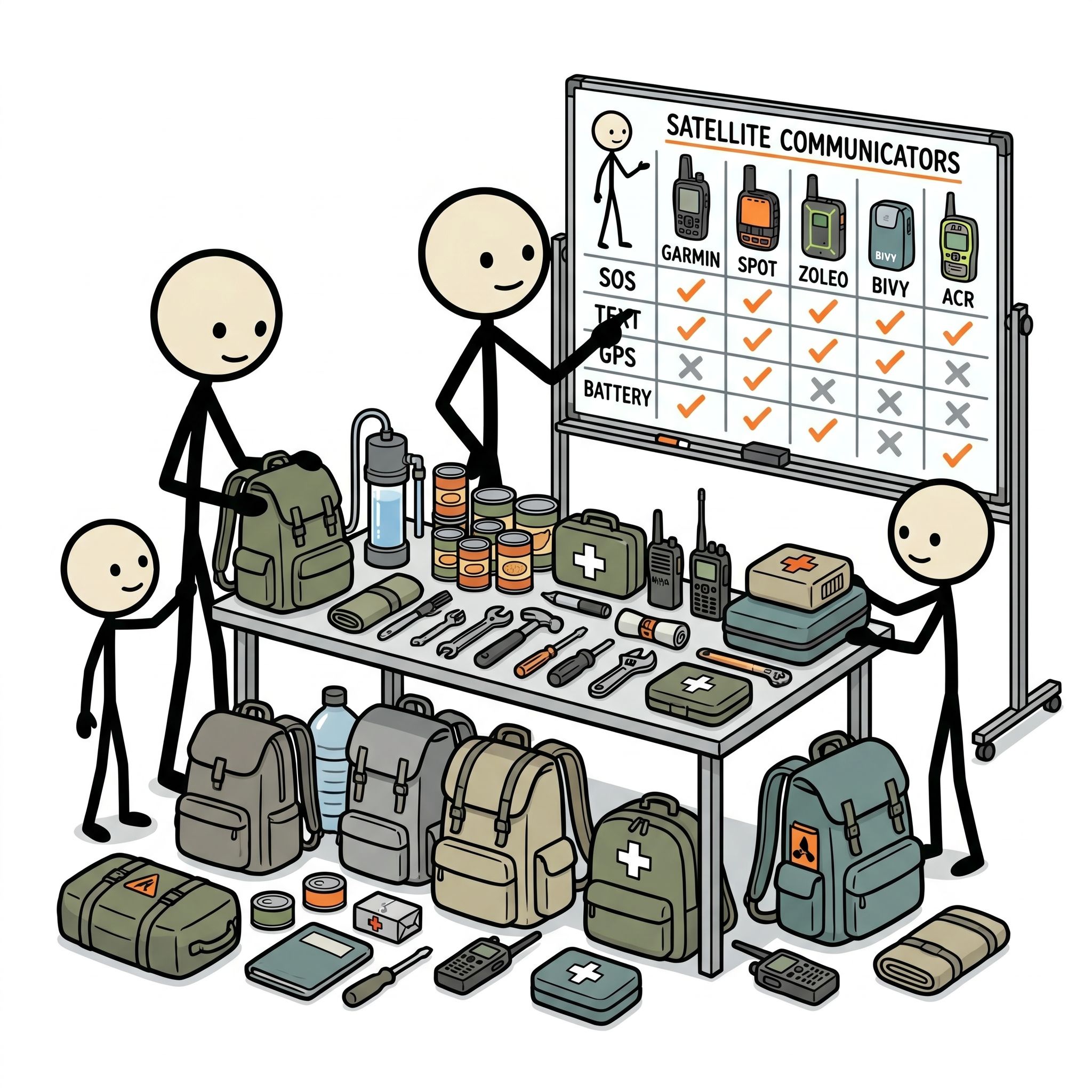
Before diving into the technical specifications, let us establish a baseline understanding of the three primary devices we are evaluating. Each of these communicators has earned its place in the survival community, but they approach the problem of off-grid communication from slightly different angles.
Garmin inReach (Mini 2 and Messenger)
Garmin is widely considered the gold standard in satellite communication. Following their acquisition of DeLorme, Garmin integrated the legendary inReach technology into their robust ecosystem of GPS devices. The inReach Mini 2 is a rugged, compact powerhouse favored by alpinists and preppers alike, while the inReach Messenger focuses heavily on seamless text communication with an incredible battery life.
SPOT (SPOT X and Gen4)
SPOT was one of the original pioneers in commercial satellite tracking and SOS beacons. Owned by Globalstar, SPOT devices have initiated thousands of rescues worldwide. The SPOT X is their flagship two-way communicator, featuring a physical QWERTY keyboard reminiscent of early Blackberries, making it a unique standalone device that does not strictly require a smartphone to operate efficiently.
Zoleo Satellite Messenger
Zoleo is the newest disrupter in the market. Rather than functioning as a standalone GPS unit with a screen, the Zoleo device acts as a rugged satellite antenna for your smartphone. Its greatest strength lies in its proprietary app, which seamlessly routes your messages over Wi-Fi, cellular, or satellite networks depending on what is currently available, ensuring the lowest cost and highest efficiency.
Satellite Networks: Iridium vs. Globalstar
A satellite communicator is only as reliable as the network it operates on. In the debate of Garmin inReach vs SPOT, the underlying satellite constellations are the most critical differentiating factor. You are essentially choosing between the Iridium network and the Globalstar network.
The Iridium Network (Garmin and Zoleo)
Both Garmin and Zoleo utilize the Iridium satellite constellation. This network consists of 66 cross-linked Low Earth Orbit (LEO) satellites. The defining feature of Iridium is its true, 100% global pole-to-pole coverage. Because the satellites are cross-linked in space, they can pass your message from one satellite to another until it reaches a ground station.
Whether you are stranded in a deep slot canyon in Utah, sailing across the Pacific Ocean, or enduring a blizzard in the Arctic Circle, the Iridium network will connect. For those building a comprehensive emergency kit, this level of absolute reliability is often the deciding factor.
The Globalstar Network (SPOT)
SPOT devices rely on the Globalstar network. While Globalstar also utilizes LEO satellites, they are not cross-linked in space. Instead, a Globalstar satellite must be simultaneously in view of your SPOT device and a terrestrial ground station to transmit a message. This architecture creates a "bent-pipe" system.
As a result, SPOT offers excellent coverage across the continental United States, Canada, Europe, and Australia, but it suffers from distinct blind spots. Deep ocean coverage, parts of sub-Saharan Africa, and the extreme polar regions are not covered. For most North American users dealing with localized natural disasters, Globalstar is more than sufficient. However, for global travelers, it presents a limitation. See the scenario playbooks for a practical setup.
Two-Way Messaging Capabilities
The ability to simply press an SOS button is vital, but modern survival requires nuance. If you are trapped in your home after an earthquake, you may not need a helicopter rescue; you may just need to tell your family you are safe, or coordinate a pickup point. This is where two-way messaging becomes indispensable.
Zoleo: The Seamless Communicator
The Zoleo satellite messenger shines brightest in its messaging capabilities. When you activate a Zoleo, you are assigned a dedicated SMS phone number and an email address. This means your contacts can text you just like they normally would, without needing to use a special web portal.
Furthermore, the Zoleo app is brilliantly designed for rolling disasters. If your home Wi-Fi is still working, the app sends messages over Wi-Fi. If Wi-Fi fails but cellular data is available, it uses cellular. If all terrestrial networks collapse, it automatically seamlessly switches to the Iridium satellite network. This preserves your satellite message allotment and ensures continuous communication.
Garmin inReach: The Robust Ecosystem
Garmin devices pair with the Garmin Messenger or Earthmate apps via Bluetooth. Like Zoleo, you can type messages on your smartphone and send them via satellite. The inReach Mini 2 also allows you to type custom messages directly on the device using its small screen and buttons. While tedious, this standalone capability is a massive advantage if your smartphone battery dies or is damaged during a disaster.
Garmin also allows you to send unlimited "Preset Messages" (e.g., "I am safe," "Checking in") for free on most plans, which is an excellent way to keep family updated without incurring overage charges.
SPOT X: The Standalone Texter
The SPOT X takes a completely different approach. It features an illuminated, physical QWERTY keyboard. While you can pair it with a smartphone app, the SPOT X is designed to be fully functional on its own. If you are in a situation where preserving your smartphone battery is critical, the SPOT X allows you to type out detailed messages quickly and efficiently directly on the device.
However, SPOT users are not assigned a permanent, dedicated SMS number. Messages sent from a SPOT device arrive with a link, and the recipient must reply to that specific thread, which can be slightly less intuitive for the person on the other end.
SOS Protocols and Search & Rescue (SAR)
When the worst-case scenario unfolds, the SOS button is your ultimate lifeline. Pressing this button initiates a complex, highly coordinated global response. Understanding how these protocols work is a vital aspect of emergency preparedness.
The Response Centers
When you trigger an SOS on a Garmin or Zoleo device, the signal is routed to Garmin Response (formerly the GEOS International Emergency Response Coordination Center). Located in Texas, this facility operates 24/7/365 and is staffed by trained emergency dispatchers. They immediately receive your GPS coordinates and your user profile information.
SPOT devices route their SOS signals to FocusPoint International, another highly respected global crisis response center. Both centers operate similarly: they verify the emergency, contact local first responders (sheriff's departments, Coast Guard, international SAR teams), and stay in communication with you until help arrives.
The Power of Two-Way SOS
The CDC emphasizes that delayed medical care in remote or disaster-stricken areas significantly increases mortality rates. Two-way satellite communicators mitigate this risk. When you press SOS on any of these three devices, you can text back and forth with the response center.
You can explain the exact nature of the emergency: "Trapped in vehicle due to floodwaters," or "Family member experiencing cardiac symptoms, need medical guidance." The dispatchers can then relay this information to incoming paramedics, ensuring they arrive with the correct equipment. They can also provide you with basic first-aid instructions while you wait, empowering you to stabilize the situation. See the water planning calculator for a practical setup.
Weather Forecasting Capabilities
In a Survival Scenarios, knowledge is power. The National Oceanic and Atmospheric Administration (NOAA) warns that severe weather patterns can shift rapidly, turning a manageable situation into a deadly one. Accessing accurate weather forecasts when the grid is down is a critical feature of these devices.
Garmin inReach: Offers highly detailed weather forecasts powered by Dark Sky. You can request basic or premium forecasts for your current location or a specific waypoint. Premium forecasts provide detailed atmospheric data, which is invaluable for predicting storm fronts or temperature drops.
Zoleo: Partners with AerisWeather to provide highly accurate, hyper-local forecasts directly to the Zoleo app. The user interface is incredibly intuitive, displaying hourly and daily forecasts that look just like the weather app on your smartphone.
SPOT: Does not currently offer a built-in, on-demand weather forecasting feature in the same robust manner as Garmin or Zoleo. You would need to rely on a contact at home to check the weather and text you the updates manually.
Subscription Costs and Hidden Fees
A satellite communicator requires an active subscription plan to function. This is not a one-time purchase; it is an ongoing investment in your safety. Understanding the pricing structures is essential to maintaining your preparedness without breaking the bank.
Garmin inReach Plans
Garmin offers both Annual and "Freedom" (month-to-month) plans. The base "Safety" plan typically costs around $15 per month. This provides unlimited SOS, unlimited preset messages, and a small allotment of custom text messages (usually 10). Overage charges apply if you exceed your custom text limit. Freedom plans require an annual fee (around $35) but allow you to suspend the service during months you do not need it, which is ideal for seasonal hikers or those preparing specifically for hurricane season.
Zoleo Plans
Zoleo's pricing is highly competitive. Their base plan is roughly $20 per month and includes 250 satellite messages (Wi-Fi and cellular messages are free and unlimited). This generous message allotment makes Zoleo incredibly cost-effective for users who want to chat frequently. Zoleo also offers a suspension feature for a nominal monthly fee (around $4), allowing you to keep your dedicated SMS number active even when the device is packed away in your emergency kit.
SPOT Plans
SPOT offers competitive annual and flexible month-to-month plans. Their base plan usually runs around $15 per month. SPOT is often praised for offering unlimited custom messaging on their higher-tier plans at a lower price point than Garmin. However, you must factor in an annual network maintenance fee, which can surprise new users. If budget is your primary concern and you live within the Globalstar coverage area, SPOT offers immense value.
Device Deep Dives: Pros and Cons
To synthesize this data, let us look at the specific strengths and weaknesses of the hardware itself.
Garmin inReach Mini 2
- Pros: 100% global Iridium coverage. Incredible battery life (up to 14 days in 10-minute tracking mode, or nearly a month in power-save mode). Standalone messaging via on-device screen. TracBack routing feature to help you navigate back to your starting point.
- Cons: Highest upfront hardware cost. Typing on the device without a smartphone is slow and cumbersome.
- Best Feature: The rugged reliability and battery management make it the ultimate bug-out bag essential.
Zoleo Satellite Messenger
- Pros: 100% global Iridium coverage. The most intuitive, seamless app experience. Dedicated SMS number makes it easy for family to reach you. Automatically utilizes cellular/Wi-Fi to save satellite data. Lowest cost-per-message ratio.
- Cons: No screen or keyboard on the device; highly reliant on a functional, charged smartphone for messaging (though the SOS and check-in buttons work independently).
- Best Feature: The seamless network switching makes it incredibly user-friendly for non-technical family members.
SPOT X
- Pros: Physical QWERTY keyboard allows for rapid, standalone messaging. Lower upfront hardware cost than Garmin. Excellent battery life. Dedicated compass and waypoint navigation features.
- Cons: Globalstar network lacks true global coverage (blind spots in oceans and polar regions). No dedicated SMS number for inbound messages.
- Best Feature: The physical keyboard provides unparalleled independence from your smartphone.
Scenario-Based Recommendations: Which is Best for You?
Emergency preparedness is deeply personal. The threats you face dictate the gear you carry. Here is how these devices stack up in real-world survival scenarios.
Scenario A: The Urban Evacuee (Hurricanes, Earthquakes, Wildfires)
If your primary concern is maintaining communication when the local power grid and cell towers collapse due to a natural disaster, the Zoleo Satellite Messenger is the clear winner. During a rolling blackout, you may have intermittent access to Wi-Fi or spotty cell service. Zoleo's app will seamlessly route your messages through whatever network is available. Furthermore, your family across the country can simply text your dedicated Zoleo phone number to check on you, providing immense peace of mind without requiring them to learn a new system.
Scenario B: The Backcountry Adventurer & Deep Woods Prepper
If you are venturing far off the grid, hunting in remote wilderness, or building a deep-woods bug-out location, the Garmin inReach Mini 2 is unparalleled. Its ruggedness, true global coverage, and extreme battery life are unmatched. In a scenario where your smartphone breaks or dies from cold exposure, the inReach Mini 2 still allows you to navigate via GPS, trigger an SOS, and slowly type out custom messages to rescuers. It is the ultimate standalone safety net.
Scenario C: The Budget-Conscious Family
If you want the security of an SOS button and two-way messaging but are constrained by a tight budget, the SPOT X offers a fantastic entry point. The hardware is frequently on sale, and the physical keyboard means you do not have to worry about keeping a smartphone charged during a prolonged grid-down situation. As long as you are operating within North America or other major Globalstar coverage zones, the SPOT X will reliably connect you to FocusPoint International in an emergency.
Scenario D: The Global Traveler
For those who travel internationally, sail offshore, or work in remote regions of the globe, the Iridium network is non-negotiable. Both the Garmin inReach and the Zoleo fit the bill here. However, Garmin’s robust integration with digital mapping and standalone navigation edges out Zoleo for extreme, trans-continental exploration.
Best Practices for Satellite Communicator Preparedness
Owning the device is only the first step. To truly integrate a satellite communicator into your emergency preparedness plan, you must establish strict operational protocols.
- Test Regularly: FEMA recommends testing all emergency communication equipment monthly. Take your device outside, ensure it has a clear view of the sky, and send a test message to a family member. Verify that your subscription is active and your credit card on file has not expired.
- Pre-Program Contacts: Do not wait until a disaster strikes to enter phone numbers. Pre-load your device and app with the numbers of family members, out-of-state emergency contacts, and local non-emergency dispatch numbers.
- Customize Preset Messages: Tailor your free preset messages to your specific emergency plan. Examples include: "I am safe at the rally point," "Grid is down but I am okay," or "Delayed but safe, do not worry."
- Battery Management: Store your device fully charged, and keep it powered off in your Faraday bag or emergency kit until needed. Pair it with a high-capacity solar power bank to ensure you can recharge both the communicator and your smartphone during an extended blackout.
- Educate Your Family: A satellite communicator is useless if you are incapacitated and your family does not know how to use it. Train your spouse and older children on how to turn the device on, orient it toward the sky, and press the SOS button.
Securing Your Lifeline
The illusion of permanent connectivity is one of the greatest vulnerabilities in modern society. We assume that because we can stream high-definition video from our living rooms, we will always be able to call 911 when disaster strikes. History, meteorology, and emergency management data consistently prove otherwise. When terrestrial infrastructure fails, the sky is your only reliable pathway to safety.
Choosing to invest in a satellite communicator is a profound step toward self-reliance. Whether you opt for the rugged independence of the Garmin inReach, the seamless connectivity of the Zoleo, or the budget-friendly utility of the SPOT X, you are taking control of your family's safety. You are ensuring that no matter how dark the storm gets, or how far off the grid you find yourself, you will never be truly alone. Equip yourself, test your gear, train your family, and step into the unpredictable future with the confidence that you are prepared for whatever comes your way.
For broader buying research, use the preparedness product comparisons hub to compare emergency gear categories before you spend money. If you are narrowing a decision between two specific options, the survival gear vs comparisons page keeps those head-to-head choices organized.
Frequently Asked Questions
What is a satellite communicator and how does it work?
Satellite communicators use low-earth orbit satellite networks to send and receive messages from anywhere on Earth with sky view, regardless of cellular coverage. Most support two-way text messaging and SOS activation connecting to 24/7 emergency coordination centers.
What is the difference between Garmin InReach, SPOT, and Zoleo?
Garmin InReach uses the Iridium network (true global coverage), supports two-way messaging, and has the most features. SPOT uses Globalstar (limited high-latitude coverage), mostly one-way messaging. Zoleo uses Iridium with more flexible plans. InReach leads on features; Zoleo is more affordable.
Should I choose a satellite communicator or a PLB?
A PLB (Personal Locator Beacon) is a one-way SOS-only device with no subscription fee. A satellite communicator adds two-way messaging, tracking, and regular communication. For pure emergency preparedness in non-remote scenarios, a PLB is cheaper. For those who travel in remote areas, a satellite communicator justifies the subscription.
Review our bug-out evacuation guide. Compare land navigation without GPS skills. Develop comprehensive preparedness plans. Build your kit with our go-bag builder and explore our courses.
Sources & Further Reading
- Garmin InReach Device Documentation
- SPOT Satellite Messenger Specs
- Zoleo Documentation
- GEOS Emergency Response Center