⚡ Key Facts
- Space Constraints: The average U.S. apartment size has shrunk to approximately 887 square feet, making traditional bulk-buying emergency strategies physically impractical. For the practical checklist side, use the community emergency preparedness guide.
- FEMA Standards: FEMA and the American Red Cross recommend a minimum 3-day emergency supply, though a 14-day self-sufficiency window is highly recommended for urban disasters. For the practical checklist side, use the neighborhood preparedness network.
- Thermal Degradation: Ambient temperatures above 75°F (common in top-floor apartments during power outages) can accelerate food nutrient loss and spoil dry goods up to 50% faster.
- The Space Penalty: Cylindrical cans and round buckets waste up to 21.5% of shelf volume compared to square or rectangular modular storage containers.
- The Weight Factor: Water weighs 8.34 pounds per gallon; storing a 14-day supply for two people (28 gallons) adds over 233 pounds of dead weight to apartment flooring or shelving.
Imagine a sudden grid failure in the middle of a record-breaking summer heatwave. In a high-rise apartment or a compact townhouse, the elevators stop working, the municipal water pumps lose pressure, and the local grocery store shelves are cleared within hours. For urban and suburban dwellers, the romanticized image of a sprawling basement root cellar packed with hundreds of pounds of bulk grains is entirely detached from reality. However, physical space limitations should never be equated with vulnerability. With a strategic approach to food storage for small spaces emergency preparedness, you can build a highly resilient, nutrient-dense, and climate-protected stockpile without sacrificing your living space, interior design, or peace of mind.
The Spatial Challenge of Urban Emergency Preparedness
According to the Federal Emergency Management Agency (FEMA), every household should maintain a baseline supply of non-perishable food and water. Yet, standard emergency preparedness guides often assume the reader has a garage, a basement, or at least a dedicated pantry. In an apartment, condo, or tiny home, every square foot must serve multiple purposes.
To build an effective system of food storage for small spaces, you must shift your mindset from "bulk hoarding" to "spatial optimization." This means maximizing nutritional density per cubic inch, utilizing vertical and hidden dead zones, and selecting storage mediums that protect your investment from the unique environmental hazards of multi-family housing, such as shared pests, fluctuating microclimates, and limited structural load capacities.
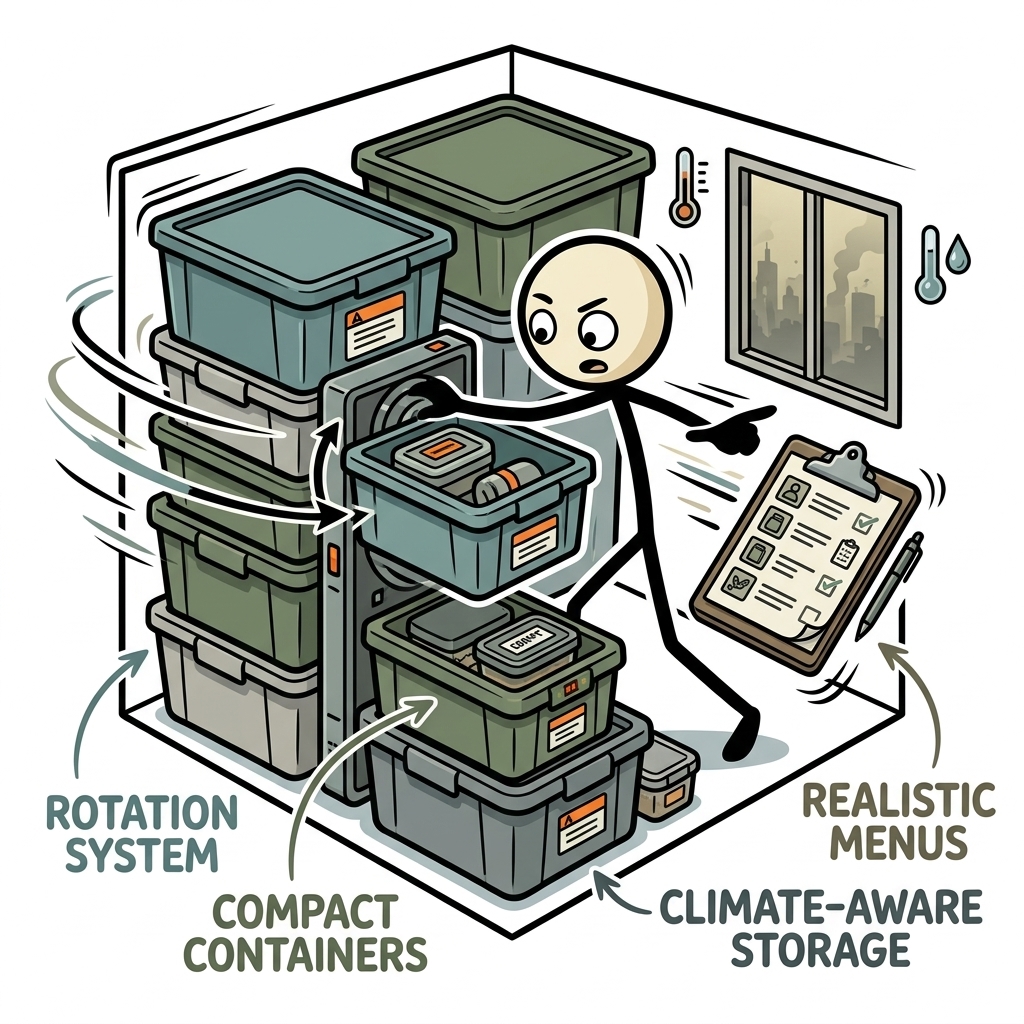
When executing a strategy for food storage for small spaces, success relies on four core pillars: active rotation, compact and modular containers, realistic low-utility menus, and climate-aware micro-storage. By mastering these four disciplines, you can turn a standard reach-in closet or the empty space beneath a queen-sized bed into a robust survival pantry capable of sustaining your household for weeks.
Pillar 1: Active Rotation and the FIFO System
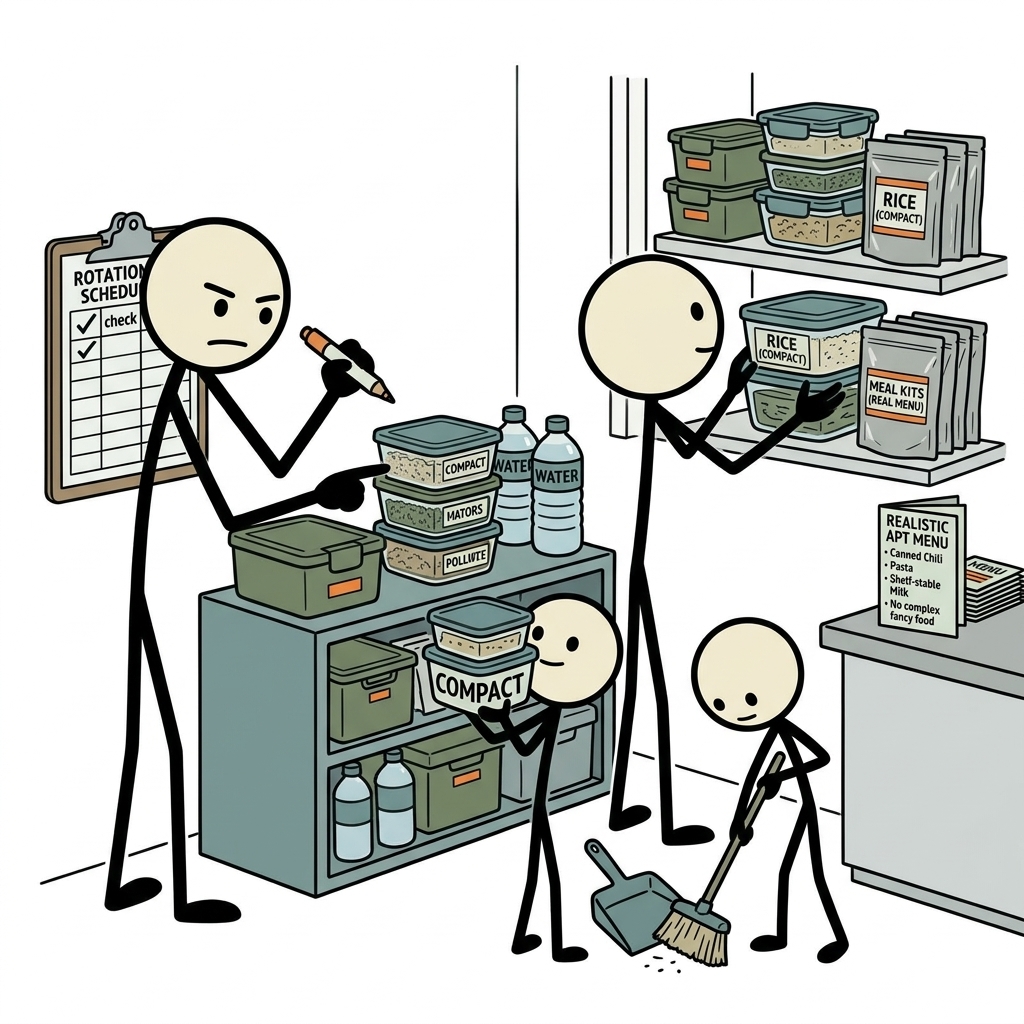
The greatest threat to a small-space emergency food storage guide is not a disaster; it is silent spoilage. In confined quarters, food that is tucked away out of sight is easily forgotten. When an emergency finally strikes, you do not want to discover that your primary protein sources expired two years ago.
Implementing First-In, First-Out (FIFO) in Tight Quarters
The First-In, First-Out (FIFO) method is the gold standard of commercial kitchen inventory management, and it is highly effective for home emergency preparedness. The concept is simple: the oldest inventory is always consumed first, while new purchases are placed at the back of the queue. In a deep pantry cabinet, this can be achieved using gravity-fed can organizers or sliding wire baskets that allow you to load from the rear and retrieve from the front.
For those utilizing closets or under-bed storage, a low-tech color-coded dot system works wonders. Assign a specific color to each calendar year (e.g., green for 2025, blue for 2026, red for 2027). When you purchase emergency items, place a colored sticker on the lid or face of the container. This visual aid allows you to scan your entire inventory in seconds and identify which items need to be integrated into your weekly meals before they expire.
Integrating Emergency Stockpile with Daily Meals
A common mistake is stocking "survival food" that your family does not normally eat. This leads to food waste and potential digestive distress during an already stressful Survival Scenarios. Instead, focus your food storage for small spaces on foods you already enjoy.
If you regularly consume canned tuna, chicken breast, black beans, or white rice, buy these items in slight excess. If your household consumes two cans of black beans a week, maintain a rolling stock of twenty cans. As you use two, buy two more to replace them at the back of the stack. This rolling inventory ensures your food remains fresh, requires zero dedicated "survival-only" budget, and naturally rotates without extra effort.
Pillar 2: Compact, Modular, and Protective Containers
When space is at a premium, the geometry of your storage containers matters just as much as what is inside them. Standard grocery packaging is designed for marketing appeal, not spatial efficiency. Cardboard boxes are full of dead air, structurally weak, and highly vulnerable to pests and moisture.
The Geometry of Storage: Round vs. Square
In a small apartment, cylindrical containers are a luxury you cannot afford. Simple geometry dictates that packing cylinders together leaves roughly 21.5% of the footprint as empty, unusable space. By transferring dry goods into square or rectangular modular containers, you instantly reclaim nearly a quarter of your shelf volume.
Look for heavy-duty, BPA-free, food-grade plastics (labeled with resin identification code #2 HDPE or #5 PP). These containers should feature gasket-sealed, airtight locking lids that stack securely on top of one another without sliding. High-quality modular containers not only maximize physical space but also create an impenetrable barrier against pests like weevils and mice, which can easily chew through cardboard and thin plastic film.
Mylar Bags and Oxygen Absorbers for Long-Term Dry Goods
For dry goods intended for long-term storage (such as white rice, oats, pinto beans, and pasta), Mylar bags paired with oxygen absorbers are the ultimate space-saving solution. Unlike bulky plastic buckets, Mylar bags conform entirely to the shape of their contents, eliminating dead air space.
Pillar 3: Designing Realistic, Low-Utility Menus
During an urban emergency, you must assume that municipal utilities—electricity, natural gas, and running water—will be unavailable. Your emergency menu must reflect this reality. Designing a menu that requires boiling water for 20 minutes or utilizing an electric blender is a recipe for failure when the grid goes down.
The No-Cook and Low-Water Menu Strategy
Water is your most precious resource during a crisis. If you rely solely on dehydrated or freeze-dried foods, you will deplete your drinking Water Calculator simply by rehydrating your meals. Furthermore, cooking food generates heat and steam, which can quickly make a small, unventilated apartment uncomfortable during a summer power outage.
Prioritize foods that are either ready-to-eat straight from the packaging or require minimal heating and water. Canned meats (chicken, salmon, sardines), canned vegetables, fruit cups, nut butters, and pre-cooked vacuum-sealed grain pouches are excellent options. They contain their own moisture, reducing your reliance on stored drinking water, and can be consumed cold if necessary.
Calculating Caloric and Nutritional Density
When space is limited, focus on caloric density. A pound of white rice contains roughly 1,600 calories, while a pound of peanut butter contains over 2,600 calories. Prioritize healthy fats and proteins that keep you satiated longer and provide sustained energy.
- Nut Butters and Seeds: High in healthy fats, protein-dense, shelf-stable, and highly compact.
- Canned Fatty Fish: Sardines, mackerel, and salmon provide essential omega-3 fatty acids and high-quality protein with zero cooking required.
- Potted Meats and Jerky: Provide concentrated sodium and protein, which are essential for maintaining electrolyte balance during high-stress events.
- Ghee (Clarified Butter): Extremely shelf-stable, calorie-dense, and excellent for adding flavor and clean fats to basic grains.
Pillar 4: Climate-Aware Micro-Storage in Apartments
The three enemies of food preservation are heat, light, and moisture. In a single-family home with a basement, maintaining a cool, dark, dry environment is relatively straightforward. In an apartment, particularly one on an upper floor or with large windows, indoor temperatures can fluctuate wildly, accelerating the degradation of your food supply.
Identifying and Avoiding Microclimate Hotspots
Before placing a single can or bag into storage, conduct a thermal and moisture audit of your living space. Avoid storing food in the following high-risk zones:
| High-Risk Zone | The Hazard | Better Alternative |
|---|---|---|
| Above the Refrigerator | Appliances vent significant heat from their compressors, warming overhead cabinets. | Use this space for lightweight, non-food prep gear like manual can openers or flashlights. |
| Exterior-Facing Walls | Absorb solar radiation, radiating heat directly into adjacent closets or cabinets. | Utilize interior partition walls or central closets. |
| Under-Sink Cabinets | High risk of plumbing leaks, high humidity, and chemical exposure. | Keep this area reserved for cleaning supplies; store food in dry, elevated spaces. |
| Laundry Closets | Washing machines and dryers generate extreme heat and humidity in confined spaces. | Store food in bedroom closets or under-bed storage containers. |
Optimizing Hidden Cold Spots
To maximize your food storage for small spaces emergency preparedness, look for areas that remain naturally insulated from temperature swings. The center of your apartment, away from windows and exterior walls, is always the most stable climate zone.
The space beneath a bed is highly underutilized. It is shielded from light, sits low to the ground where temperatures are naturally cooler, and can accommodate low-profile, rolling storage bins. Similarly, the floor of a central coat closet or linen closet provides an excellent, dark, and temperature-stable environment for canned goods and water storage.
The Ultimate Food Storage for Small Spaces Checklist
Building your emergency pantry does not have to happen overnight. This comprehensive food storage for small spaces checklist is designed to help you systematically build a highly compact, 14-day emergency supply for two adults, focusing on nutritional balance, spatial efficiency, and low-utility preparation.
1. Proteins & Fats (No-Cook / Low-Utility)
- [ ] 12 cans of premium canned chicken breast or turkey (12.5 oz cans)
- [ ] 12 cans of wild-caught sardines, tuna, or salmon (5 oz cans)
- [ ] 4 jars of natural peanut, almond, or sunflower seed butter (16 oz jars)
- [ ] 2 jars of organic ghee or coconut oil (14 oz jars - highly calorie-dense)
- [ ] 4 bags of high-quality beef, turkey, or mushroom jerky (3 oz bags)
2. Starches, Grains & Quick Carbs
- [ ] 6 boxes of pre-cooked, vacuum-sealed brown or white rice pouches (8.5 oz pouches - ready to eat cold or warm)
- [ ] 4 boxes of rolled oats (18 oz canisters - can be cold-soaked overnight in water)
- [ ] 4 boxes of high-density crackers or pilot bread (sturdy, low-moisture, long shelf-life)
- [ ] 2 bags of organic quinoa or couscous (cooks rapidly with minimal water compared to traditional rice)
3. Fruits, Vegetables & Micro-Nutrients
- [ ] 12 cans of low-sodium canned black, pinto, or garbanzo beans (15 oz cans - pre-cooked, great cold in salads)
- [ ] 12 single-serve fruit cups in 100% juice (peaches, pears, mandarin oranges - provides hydration and vitamin C)
- [ ] 6 cans of low-sodium green beans, peas, or sweet corn (15 oz cans)
- [ ] 2 tins of high-quality freeze-dried vegetable powder (adds instant vitamins to any basic meal)
4. Hydration & Electrolytes
- [ ] 28 gallons of purified water (1 gallon per person, per day for 14 days)
- [ ] 2 boxes of high-grade oral rehydration salts (ORS) or electrolyte replacement powders
- [ ] 1 compact, gravity-fed water filter (such as a Sawyer Squeeze or Lifestraw Flex) to purify municipal water if pressure drops but supply remains
5. Comfort, Morale & Condiments
- [ ] 1 bottle of high-quality hot sauce or soy sauce (critical for preventing "appetite fatigue")
- [ ] 1 container of sea salt and black pepper
- [ ] 1 box of instant coffee, tea bags, or hot cocoa mix (a major psychological boost during stressful events)
- [ ] 2 jars of raw honey (natural sweetener, never spoils, and possesses mild antibacterial properties)
Water Storage in Tight Quarters: The Heavyweight Challenge
While food can be compacted, water cannot. According to the Centers for Disease Control and Prevention (CDC), you must store a minimum of one gallon of water per person, per day for drinking and sanitation. For a two-person household over a 14-day period, this equates to 28 gallons. At 8.34 pounds per gallon, you are looking at over 233 pounds of liquid storage.
Solving the Weight and Space Equation
Do not store your entire water supply in one place, especially on cheap, wall-mounted shelving or lightweight particleboard furniture. A single shelf collapsing can rupture your containers, ruin your food supply, and cause thousands of dollars in water damage to your apartment and the unit below yours.
Instead, distribute the weight. Keep water containers on the floor, preferably in the corners of rooms or against load-bearing walls where the building's structural integrity is highest.
Avoid standard 1-gallon milk jugs from the grocery store. The plastic is thin, biodegradable, and highly prone to micro-leaks within a year. Instead, invest in heavy-duty, stackable water containers, often referred to as "water bricks." These containers are made from food-grade HDPE plastic, feature integrated handles, and lock together like building blocks. Their rectangular profile allows you to stack them tightly in the back of a closet, behind a couch, or along the floor of a hallway, maximizing vertical space while minimizing the footprint.
A Step-by-Step Implementation Plan
Building a resilient food storage system in a small space does not require a massive lifestyle change or a major financial investment. By taking a systematic, phased approach, you can build your emergency pantry over the course of four weeks without cluttering your home.
Week 1: The Space Audit and De-cluttering
Before buying any food, audit your living space. Look for underutilized areas: the space above kitchen cabinets, the floor of your bedroom closet, the bottom of a linen closet, or the empty space behind your living room sofa. Clean these areas thoroughly. Measure the dimensions of these spaces so you know exactly what size storage bins or water bricks will fit.
Week 2: Water and Foundation Nutrition
Focus on your most critical survival asset: water. Purchase your first 14 gallons of water using high-quality, stackable containers. Place them in your designated floor-level storage areas. Along with the water, purchase your first week's worth of high-density, no-cook proteins and fats (such as canned tuna, chicken, and nut butters).
Week 3: Starches, Grains, and Modular Containers
Acquire your modular, airtight containers or Mylar bags. Purchase your dry goods (rice, oats, pasta) and transfer them into these protective containers. Position them in your cool, dark micro-storage locations. Remember to label every container with its color-coded expiration date sticker.
Week 4: Fruits, Vegetables, and Comfort Items
Complete your 14-day supply by adding canned fruits, vegetables, and morale-boosting items like coffee, honey, and spices. Set up your inventory tracking sheet or app. Establish a routine to check your inventory once every six months (e.g., during daylight saving time changes) to rotate any items nearing their expiration dates.
Empowered Preparedness for Every Home
Emergency preparedness is not reserved for those with acres of land and sprawling basements. In fact, the density and complexity of urban environments make smart, localized food storage even more critical for apartment and condo dwellers. By shifting your focus to high-density nutrition, utilizing space-saving modular containers, establishing a strict rotation system, and respecting the microclimates of your home, you can build a highly effective survival pantry. You do not need a lot of space to be prepared—you simply need to make the space you have work smarter. Take control of your household's resilience today, one square foot at a time.
Frequently Asked Questions
What should a food storage for small spaces plan include?
Start with the immediate safety steps, the supplies and records your household needs, a communication plan, and a regular review schedule. Follow local official guidance during an active emergency.
How often should I review food storage for small spaces preparations?
Review them at least twice a year and whenever your household, medication, location, or local risks change. Replace expired supplies and practice key steps.
Where can I find reliable emergency guidance?
Use local emergency management alerts and established public-health or emergency-management agencies. A blog guide should support, not replace, official real-time instructions.