⚡ Key Facts
- Advance Warning is Real: NOAA’s Space Weather Prediction Center monitors the sun 24/7, typically providing a 12- to 72-hour warning before a severe Coronal Mass Ejection (CME) impacts Earth.
- Infrastructure Over Individual Devices: Unlike a localized electromagnetic pulse (EMP), a geomagnetic storm primarily threatens long-line infrastructure (high-voltage power grids, undersea internet cables) rather than unplugged personal electronics or modern vehicles.
- Massive Economic Risk: According to the National Academy of Sciences, a modern Carrington-level event could cause $1 to $2 trillion in damages in the first year alone, requiring four to ten years for full recovery.
- Extended Grid Outages: A G5 geomagnetic storm impact has the potential to melt custom-built Extra High Voltage (EHV) transformers, potentially causing regional power outages that last for weeks or months.
- Official Recommendations: The Federal Emergency Management Agency (FEMA) and the Red Cross advise that basic space weather emergency kits should sustain a household for a minimum of 14 days without relying on municipal utilities or supply chains.
In September 1859, the sun unleashed a violent eruption that slammed into Earth's magnetic field. Telegraph wires—the cutting-edge technology of the era—burst into flames, shocking operators and igniting paper messages. Auroras, usually confined to the poles, burned so brightly in the sky over the Caribbean that people woke up and began making breakfast, believing it was dawn. This was the Carrington Event, the most intense geomagnetic storm in recorded history. If a similar event struck our hyper-connected, electricity-dependent world today, the consequences would be drastically different than a few sparked telegraph wires. See scenario playbooks for a practical checklist.
For nuclear emergencies specifically, see our nuclear fallout first 24 hours guide - the actions you take in the first hour are critical.
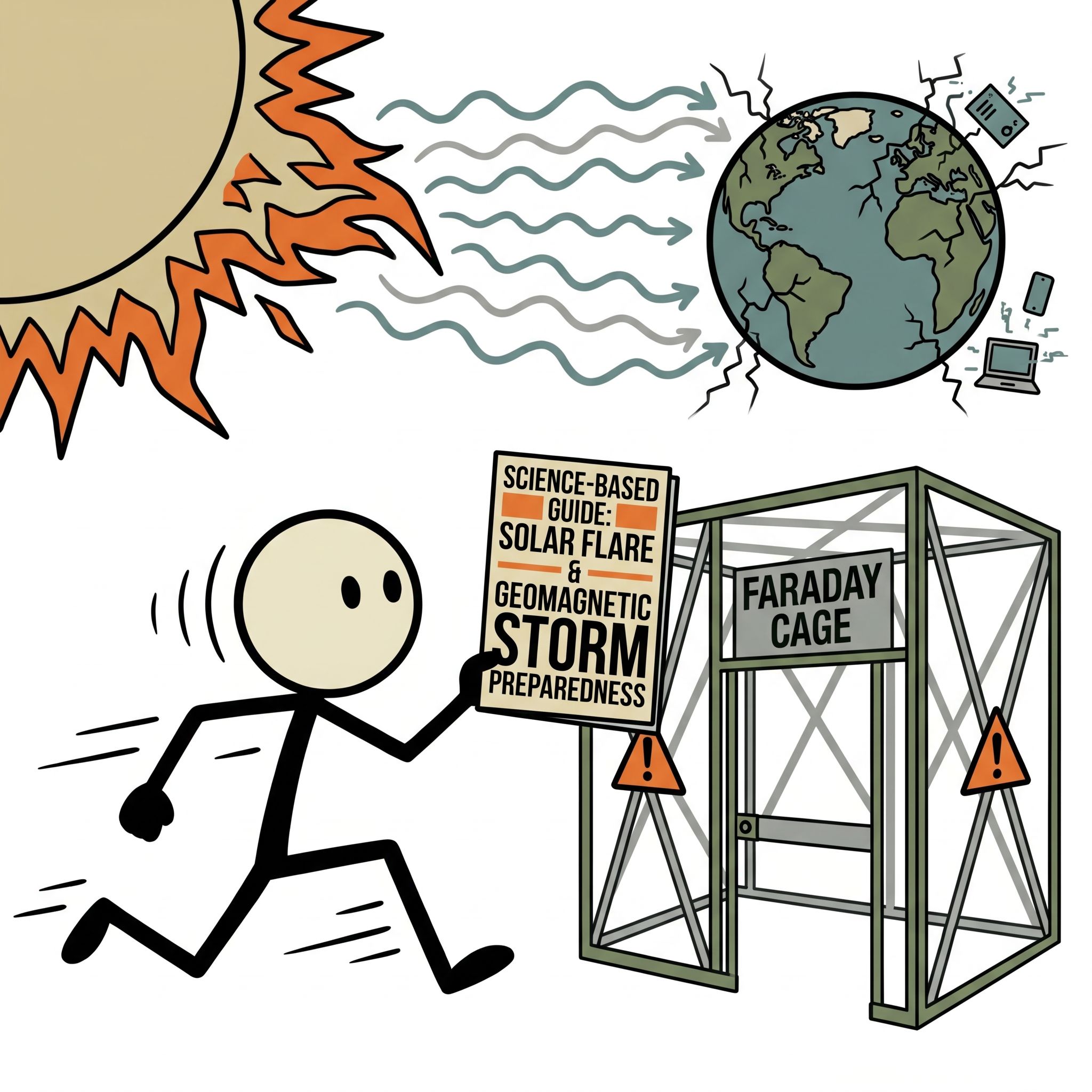
As we navigate Solar Cycle 25, solar activity is increasing, bringing space weather to the forefront of national security and family emergency planning. However, the internet is flooded with misinformation, portraying solar flares as apocalyptic events that will instantly fry every smartphone, pacemaker, and vehicle on the planet. The reality is far more nuanced, though no less serious. See water storage calculator for a practical checklist.
Proper solar flare preparedness requires separating Hollywood fiction from scientific fact. By understanding the actual physics behind space weather, the realistic vulnerabilities of our power grid, and the guidelines set forth by agencies like FEMA, NOAA, and the CDC, you can build a resilient, science-based plan. This guide will walk you through exactly what these astronomical events do, what they don't do, and how you can prepare your household for a long-term grid-down scenario. See supply planning calculator for a practical checklist.
The Science of Space Weather: Flares vs. CMEs
To build an effective geomagnetic storm emergency prep plan, you must first understand the enemy. The terms "solar flare" and "geomagnetic storm" are often used interchangeably in the media, but they describe entirely different phenomena with distinct impacts on Earth. See family emergency plan for a practical checklist.
What is a Solar Flare?
A solar flare is an intense burst of radiation coming from the release of magnetic energy associated with sunspots. Flares travel at the speed of light, meaning that when we see them happen on the sun, they are already impacting Earth just eight minutes later. See go-bag essentials checklist for a practical checklist.
Solar flares are categorized by their strength. The classes include A, B, C, M, and X, with X-class solar flares being the most powerful. Within the X-class, there is a numerical scale; an X2 flare is twice as intense as an X1. While X-class flares are massive, their primary terrestrial impact is on the sunlit side of the Earth, where their X-rays and extreme ultraviolet light can ionize the upper atmosphere. This causes high-frequency (HF) radio blackouts and can degrade or block GPS signals. However, a solar flare alone does not cause power grid failures.
What is a Coronal Mass Ejection (CME)?
The true threat to our electrical infrastructure comes from Coronal Mass Ejections. A CME is a massive cloud of solar plasma and magnetic fields ejected from the sun's corona. Unlike the speed-of-light radiation of a flare, a CME is made of physical matter. It travels much slower, taking anywhere from 15 to 72 hours to reach Earth.
When a CME collides with Earth's magnetosphere, it causes a major disturbance known as a geomagnetic storm. NOAA ranks geomagnetic storms on a G-scale from G1 (Minor) to G5 (Extreme). It is the G5 geomagnetic storm impact that emergency planners and grid operators worry about most.
Understanding a Carrington-Level Event
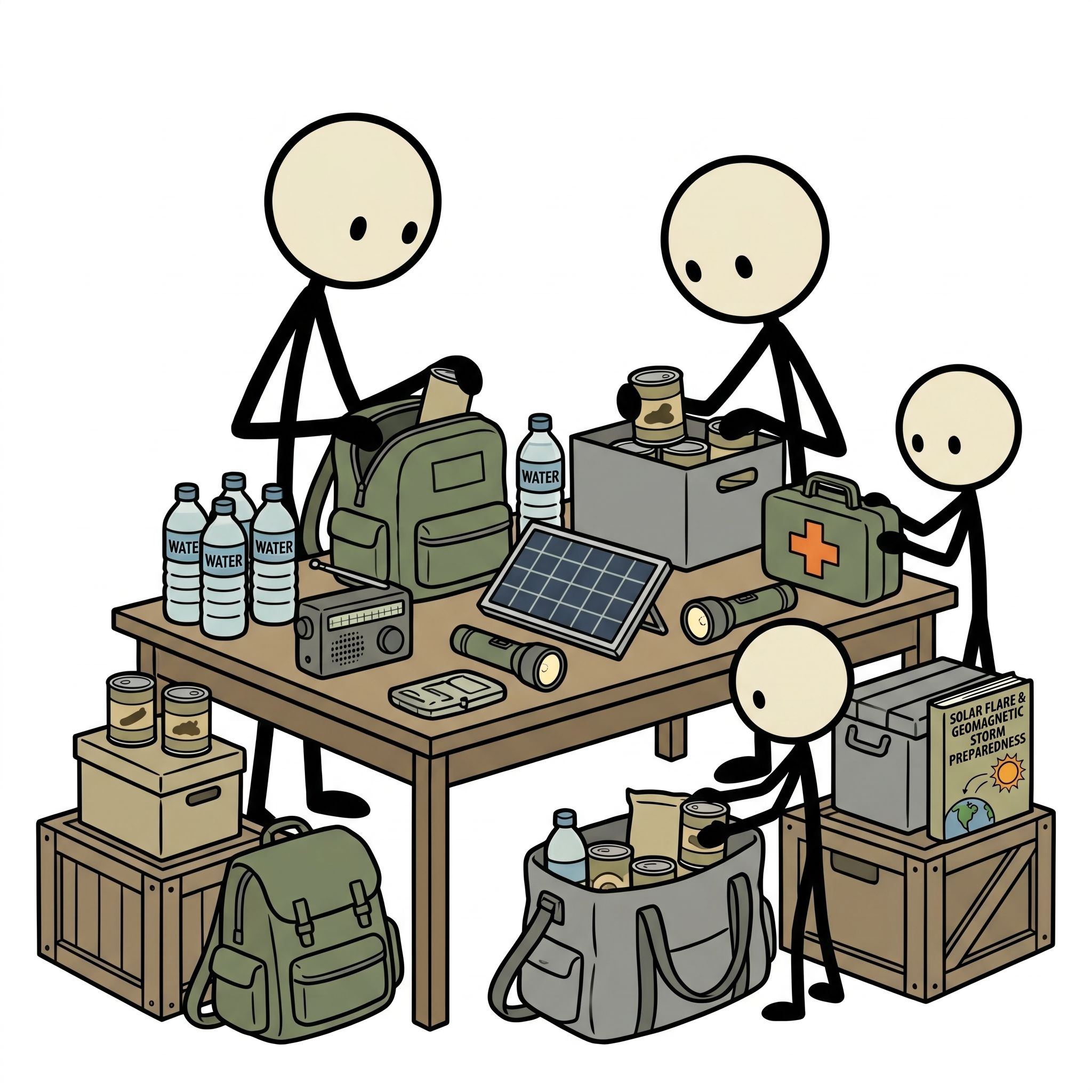
When experts discuss carrington event preparedness, they are referring to a Survival Scenarios scenario: a massive, fast-moving CME that strikes Earth with a magnetic field oriented opposite to our own, allowing maximum energy transfer into our atmosphere.
The Mechanics of Grid Failure
During a severe geomagnetic storm, the fluctuating magnetic fields in space induce electrical currents in the ground here on Earth. These are called Geomagnetically Induced Currents (GICs). GICs seek the path of least resistance. Rocks and soil are poor conductors, but human-made infrastructure—specifically long metal lines like high-voltage transmission cables, oil pipelines, and railway tracks—are excellent conductors.
When GICs enter the power grid, they travel along transmission lines and enter Extra High Voltage (EHV) transformers. These transformers are designed to handle alternating current (AC), but GICs act like direct current (DC). This causes the transformers' magnetic cores to saturate, overheat, and potentially melt. If enough EHV transformers fail simultaneously, the grid collapses.
Modern Precedents
We do not have to look back to 1859 to see this in action. In March 1989, a severe geomagnetic storm struck Earth. Within 90 seconds, the GICs tripped circuit breakers across the Hydro-Québec power grid in Canada. Six million people were left without electricity for nine hours in the freezing cold. Today's grid is far more interconnected and operates closer to its maximum capacity, making it even more vulnerable to cascading failures.
Realistic Risk Assessment: Hype vs. Reality
The most crucial step in space weather emergency planning is understanding what will actually break. Fear-mongering websites often confuse CMEs with high-altitude electromagnetic pulses (HEMPs) caused by nuclear weapons. The physics, and therefore the impacts, are very different.
What Will NOT Break
A CME does not produce the fast-pulse E1 wave associated with a nuclear EMP. The E1 wave is what fries microchips and small electronics. Therefore, during a G5 geomagnetic storm:
- Your smartphone will not fry: The device itself will turn on and function, though cellular networks may be down due to power loss.
- Your car will not die in the street: Modern vehicles, even EVs, are too small to absorb enough GIC to damage their electronics.
- Unplugged electronics are safe: Your laptop, emergency radio, and flashlights do not need to be stored in a military-grade Faraday cage to survive a solar storm.
What WILL Break
The danger of a CME lies in its long-duration, low-frequency energy (similar to the E3 wave of an EMP). This energy targets long conductors. The realistic threats include:
- The Power Grid: Extended regional or national blackouts due to damaged EHV transformers.
- Water and Sanitation: Municipal water pumps require massive amounts of electricity. When the grid dies, water pressure drops, and sewage treatment plants fail.
- Supply Chains: Without power, gas stations cannot pump fuel. Without fuel, grocery store delivery trucks stop running. Modern just-in-time supply chains hold only about three days of inventory.
- Communications: Submarine internet cables have repeaters spaced along the ocean floor that are vulnerable to GICs. While local fiber optics might survive, global internet traffic could be severely bottlenecked or severed.
Grid Impact Scenarios: Short-Term vs. Long-Term
When planning your solar flare preparedness strategy, you must prepare for the cascading effects of grid failure. The Department of Energy and FEMA categorize grid outages by their duration and severity.
The 72-Hour Scenario (G3 to G4 Storms)
In a moderate to severe storm, grid operators (warned in advance by NOAA) may intentionally shut down parts of the power grid to protect the transformers from GICs. This rolling blackout scenario is an inconvenience but highly manageable. You would rely on your emergency pantry, flashlights, and battery banks until operators bring the grid back online once the solar storm passes.
The Long-Term Scenario (G5 Carrington-Level Event)
If grid operators fail to shut down in time, or if the storm is overwhelmingly powerful, EHV transformers will be destroyed. This is the nightmare scenario. EHV transformers weigh hundreds of tons, cost millions of dollars, and are custom-built. The global supply chain for these transformers is incredibly slow; lead times for replacements are typically 12 to 24 months.
In this scenario, parts of the country could be without municipal power for months. The CDC and FEMA emphasize that in long-term power outages, the primary causes of mortality are not the initial event, but the secondary effects: lack of clean water, inability to refrigerate vital medications, carbon monoxide poisoning from improper generator use, and exposure to extreme temperatures.
Solar Flare Preparedness: Building Your Resilience Plan
Because a space weather emergency primarily manifests as a long-term grid-down scenario, your preparation should focus on self-reliance. The goal is to safely shelter in place for weeks or months without municipal utilities.
1. Water Independence
Water is your most critical priority. When the grid goes down, your taps will run dry within 24 to 48 hours as municipal water towers empty.
- Storage: The FEMA and Red Cross standard is one gallon of water per person, per day, for drinking and basic hygiene. For a 14-day minimum, a family of four needs 56 gallons. Utilize food-grade water barrels, stackable water bricks, and thoroughly cleaned two-liter soda bottles.
- Emergency Capture: If NOAA issues a CME warning, immediately fill your bathtubs using a water containment bag (like a WaterBOB) to store up to 100 gallons of clean water safely.
- Filtration and Purification: You must have the ability to make unsafe water drinkable. Invest in high-volume gravity water filters (e.g., Berkey or LifeStraw Family). Stock up on unscented liquid household bleach (calcium hypochlorite) and water purification tablets for chemical treatment.
2. Shelf-Stable Food Supply
Your refrigerator will be useless within 4 hours of a power outage, and your freezer will thaw in 48 hours. A robust carrington event preparedness plan requires a deep pantry of shelf-stable foods.
- Short-Term (First 2 Weeks): Focus on foods that require no cooking or extra water. Canned meats, canned vegetables, peanut butter, protein bars, and trail mix are ideal.
- Long-Term (1 to 6 Months): Transition to bulk staples. Store white rice, dried beans, lentils, pasta, and oats in Mylar bags with oxygen absorbers inside food-grade buckets. This method preserves food for up to 25 years.
- Cooking Off-Grid: Have a safe way to cook outdoors. Propane camping stoves, solar ovens, and biomass rocket stoves are excellent choices. Never use a charcoal grill or camping stove indoors, as carbon monoxide buildup is deadly.
3. Medical and First Aid Preparedness
During a severe space weather emergency, emergency medical services (EMS) will be overwhelmed or completely unavailable. Hospitals running on backup generators will triage only the most critical patients.
- Prescription Medications: The CDC recommends maintaining at least a 30-day supply of vital prescriptions. Talk to your doctor about securing emergency backups of heart medications, insulin, or asthma inhalers.
- First Aid Trauma Kits: Go beyond bandaids. Your kit should include tourniquets, hemostatic dressings (QuikClot), splints, butterfly closures, and burn gels.
- Over-the-Counter Meds: Stockpile ibuprofen, acetaminophen, antihistamines, anti-diarrheal medications, and electrolyte powders. Dehydration from gastrointestinal issues is a major threat in grid-down scenarios.
4. Sanitation and Hygiene
Without running water, toilets will not flush. Poor sanitation leads to diseases like cholera and dysentery, which historically skyrocket during prolonged infrastructure failures.
- The Two-Bucket System: Create an emergency toilet using two 5-gallon buckets lined with heavy-duty trash bags—one for liquids and one for solids.
- Odor and Pathogen Control: Stockpile carbon-rich cover materials like sawdust, peat moss, or kitty litter to cover solid waste. This dries out the waste and eliminates odors.
- Hygiene Supplies: Store ample supplies of hand sanitizer, wet wipes, heavy-duty contractor bags, and feminine hygiene products.
Protecting Electronics and Maintaining Communications
While a CME won't fry your phone in your pocket, the power surges traveling through the electrical grid certainly can destroy anything plugged into the wall when the storm hits.
Power Management
The moment NOAA issues a severe geomagnetic storm warning, unplug all sensitive electronics from your wall outlets. This includes computers, televisions, medical devices, and smart appliances. Standard surge protectors are designed for lightning strikes and minor grid fluctuations; they will not stop a massive GIC surge.
Off-Grid Power Generation
To survive a G5 geomagnetic storm impact, you need a way to generate your own electricity for critical tasks like charging radios, powering medical devices, and running LED lights.
- Solar Generators: Portable lithium-iron-phosphate (LiFePO4) power stations paired with foldable solar panels are ideal. They run silently, require no liquid fuel, and can be used safely indoors.
- Gas/Propane Generators: Inverter generators are great for heavy loads (like running a well pump), but fuel will become scarce immediately. If you store gasoline, use fuel stabilizers and rotate your supply every six months.
Emergency Communications
The internet and cellular networks will likely fail during a Carrington-level event. Information will be your most valuable resource.
- NOAA Weather Radio: Keep a battery-operated or hand-crank emergency radio to receive official government broadcasts and updates on the space weather emergency.
- Two-Way Radios: FRS and GMRS walkie-talkies are excellent for short-range communication with family members and neighbors.
- Ham Radio (Amateur Radio): For long-distance communication, High Frequency (HF) Ham radio is the gold standard. While the solar flare itself will disrupt HF bands temporarily by ionizing the atmosphere, those bands will recover. Ham radio operators are historically the backbone of emergency communications when the grid fails.
Community Readiness and Psychological Resilience
Survival is rarely a solo endeavor. The most overlooked aspect of solar flare preparedness is community integration. In a prolonged grid-down scenario, isolated individuals face significantly higher risks than organized neighborhoods.
Building a Mutual Assistance Group
Get to know your neighbors before a disaster strikes. Understand the skills and resources available in your immediate vicinity. Who is a nurse? Who has a tractor? Who has a deep well? By pooling resources and skills, a neighborhood can establish security, share bulk food, and maintain morale. The Red Cross strongly advocates for community-level emergency planning.
Managing Psychological Stress
The transition from a high-tech, comfortable life to an off-grid, labor-intensive existence will cause severe psychological shock for many. Maintain a library of physical books, board games, and hobby materials. Keeping morale high, especially for children, is just as critical as maintaining your physical calorie intake. Focus on establishing a daily routine early in the crisis to give your family a sense of normalcy and purpose.
Facing the reality of a severe space weather emergency can seem daunting, but it is entirely survivable with rational, science-based preparation. The sun's cycles are predictable, and unlike earthquakes or tornadoes, our agencies can give us advance warning of an incoming CME. By viewing solar flare preparedness not as a reason to panic, but as a practical insurance policy for your family's safety, you reclaim control. Take the first steps today: build your Water Calculator, deepen your pantry, secure off-grid power, and rest easy knowing you are ready to weather the storm, no matter what the sun throws our way.
Frequently Asked Questions
What is the real risk of solar flares and geomagnetic storms to everyday people?
Moderate events (G1-G3) cause aurora but minimal practical impact. Strong events (G4-G5) can disrupt GPS, satellite communications, HF radio, and cause voltage irregularities in power grids. A Carrington-level event (1859) would cause prolonged grid failures across wide areas.
How is a geomagnetic storm different from an EMP?
A nuclear EMP produces an instantaneous, extremely high-power pulse that destroys unprotected electronics directly. A geomagnetic storm induces slow-moving currents in long conductors (power lines) and damages grid transformers — it doesn't fry your car electronics or household appliances directly.
How do I monitor space weather alerts?
NOAA's Space Weather Prediction Center (spaceweather.noaa.gov) provides real-time monitoring and alerts. Sign up for NOAA SWPC email alerts — a G4+ event gives 15-60 minutes of warning after impact on Earth's magnetosphere.
Strengthen your emergency preparedness guide for EMPs. Explore solar backup systems for power. Prepare for natural disaster survival scenarios. Calculate needs with our supply calculator and explore our courses.
Sources & Further Reading
- NOAA Space Weather Prediction Center
- NASA Goddard Space Weather Lab
- FEMA Space Weather Preparedness
- NERC Geomagnetic Disturbance Standards
Related resource: Nuclear Fallout: First 24 Hours Guide.