⚡ Key Facts
- FEMA Insights: Over 60% of American households have not practiced a disaster drill, yet teenagers who undergo active preparedness training report up to a 40% reduction in disaster-related anxiety.
- Red Cross Statistics: Sudden cardiac arrest claims over 350,000 lives annually in the U.S. Immediate CPR by a trained bystander can double or triple survival rates—a skill teens as young as 12 can master.
- CDC Guidance: Active, task-oriented coping mechanisms significantly mitigate long-term psychological trauma in youth during crises, transforming them from passive victims into resilient responders.
- USGS & NOAA Data: In major natural disasters, professional emergency services are often delayed by 72 hours or more, meaning teenagers are frequently the first line of defense for themselves and younger siblings.
Imagine this scenario: A sudden, severe storm system knocks out the local power grid, cell towers go dark, and localized flash flooding begins to rise at the edge of your property. You are stuck at work, miles away, blocked by road closures and downed trees. At home, your teenager is alone with their younger sibling. In this critical window, does your teen panic, retreat to their room, and wait for help that may be hours away? Or do they systematically execute a pre-arranged family emergency plan, secure the home’s utilities, establish offline emergency communication plans, and keep their sibling safe and calm? The difference between these two outcomes lies entirely in how we approach teen emergency preparedness today.
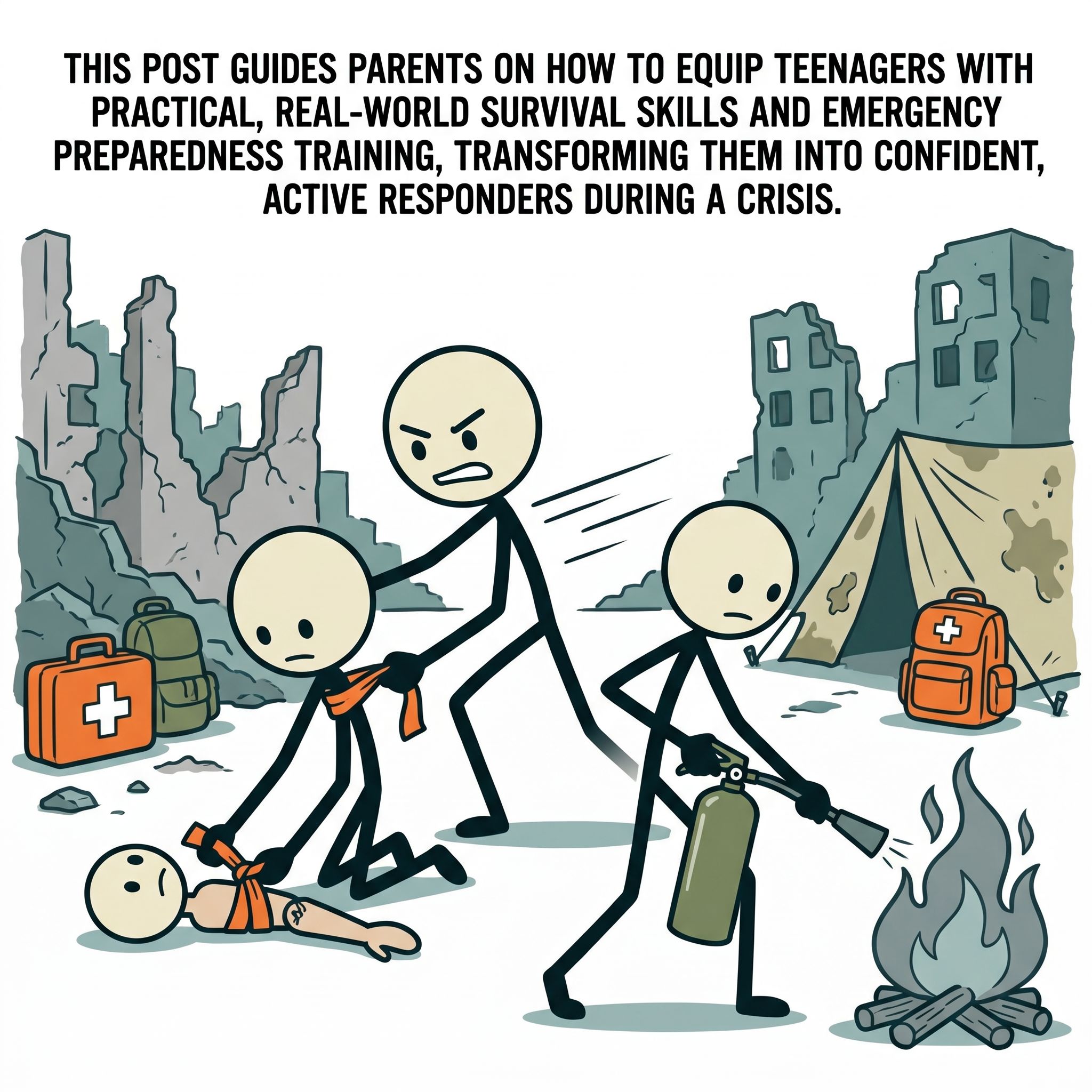
For decades, emergency planning has treated teenagers as dependents—extra mouths to feed and protect during a crisis. However, modern emergency management agencies, including FEMA and the American Red Cross, are shifting this paradigm. Teenagers possess the physical strength, rapid cognitive processing, and technological literacy to be some of our most valuable assets during an emergency. By intentionally teaching teenagers survival and disaster readiness skills, we do more than just add an capable hand to our household emergency plan; we foster lifelong resilience, self-reliance, and confidence that will serve them far beyond the boundaries of a crisis.
The Psychology of Teen Preparedness: Shifting from Passive to Active
To successfully engage teenagers in emergency preparedness, we must first understand their unique developmental stage. The adolescent brain is undergoing rapid reorganization, particularly in the prefrontal cortex, which governs risk assessment, long-term planning, and emotional regulation. Traditional parenting methods that rely on lecturing or fear-mongering often trigger a defensive "it won't happen to me" response or lead to paralyzing anxiety. Instead, effective youth disaster readiness must be framed around empowerment, agency, and leadership.
When we teach survival skills, we are not preparing them for a fictional post-apocalyptic wasteland; we are equipping them with practical life skills. Frame these capabilities as a form of modern self-sovereignty. Teenagers naturally crave independence and responsibility. By positioning disaster readiness as an elite skill set—akin to learning how to drive or mastering a sport—you tap into their intrinsic desire for autonomy. They cease to be passive bystanders waiting for parental rescue and instead become active partners in household safety.
Moving Beyond the "Prepper" Stigma
Many teens may initially resist preparedness training because they associate it with extreme subcultures or sensationalized media. Demystify the concept by focusing on civic duty and Protocol Survival community. Highlight how organizations like FEMA’s Teen CERT (Community real-world Survival Scenarioss guide Team) and the Civil Air Patrol utilize young people to perform real, life-saving work. Show them that true preparedness is quiet, methodical, and deeply practical. It is about having the competence to handle the unexpected, whether that is a flat tire on a dark highway, a medical emergency at a school event, or a regional natural disaster.
Core Survival Skills for Teens: The Practical Playbook
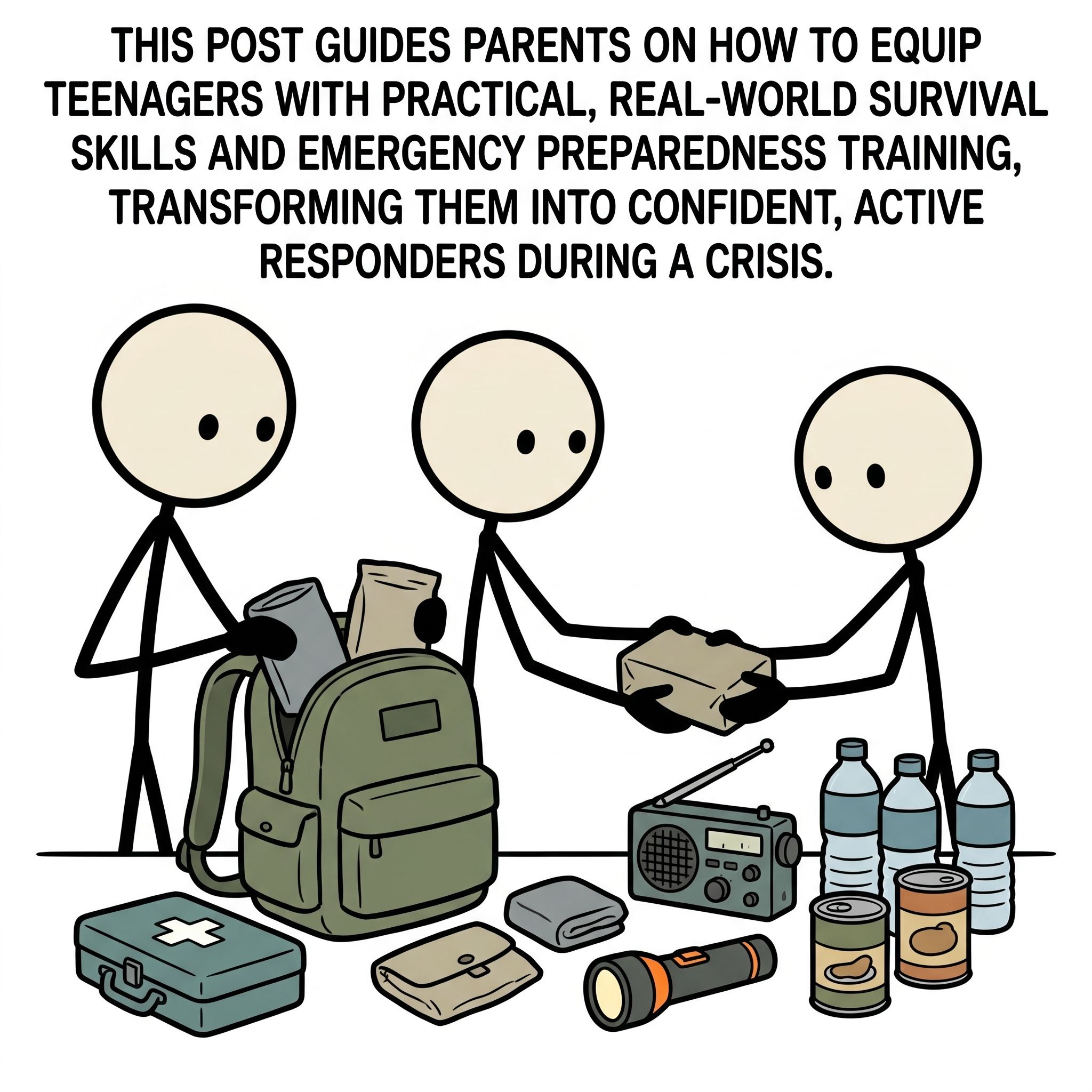
The foundation of survival skills for teens rests on a handful of core competencies. These are not abstract concepts; they are physical, hands-on skills that require instruction, demonstration, and repeated practice. When a crisis strikes, muscle memory replaces panic. Here are the essential survival pillars every teenager should master before leaving home.
1. Water Procurement and Purification
In any prolonged grid-down scenario, municipal water systems can fail or become contaminated within hours. Your teen must know how to secure clean drinking water. Start by teaching them the location and operation of the home's main water shutoff valve. If a water advisory is issued, shutting this valve prevents contaminated municipal water from entering the home's plumbing. Teach them that the home's water heater contains 40 to 80 gallons of pressurized, clean water that can be drained and utilized in an emergency.
Beyond municipal sources, they must master the science of purification. Teach them the difference between filtration and purification, and ensure they know how to use three distinct methods:
- Mechanical Filtration: Operating hollow-fiber membrane filters (such as a Sawyer Squeeze or Lifestraw) to remove bacteria and protozoa.
- Chemical Treatment: Using Aquatabs, chlorine dioxide, or household unscented bleach (8 drops per gallon of water, let sit for 30 minutes) to neutralize viruses.
- Thermal Purification: Bringing water to a rolling boil for at least one full minute (or three minutes at elevations above 6,500 feet) as recommended by the CDC.
2. Emergency First Aid and Trauma Care
Standard first aid training often focuses on minor cuts and scrapes, but emergency skills for youth must include life-saving trauma care. Enroll your teenager in a certified first aid, CPR, and AED course through the American Red Cross or the American Heart Association. Additionally, seek out a "Stop the Bleed" course, a national initiative focused on stopping life-threatening hemorrhaging.
Ensure your teen is proficient in the following medical interventions:
- High-Quality CPR and AED Operation: Understanding the depth and rate of chest compressions, and how to confidently deploy an Automated External Defibrillator.
- Tourniquet Application: Knowing how to properly apply a Combat Application Tourniquet (CAT) to a limb—high and tight—to stop arterial bleeding.
- Wound Packing: Utilizing hemostatic gauze or clean cloth to pack deep junctional wounds where tourniquets cannot be applied, followed by direct pressure.
- Treating Shock: Recognizing the signs of shock (pale, cool, clammy skin, rapid heart rate, confusion) and taking corrective action by keeping the patient warm, flat on their back, and elevating their feet slightly.
3. Utility Shutoffs and Fire Safety
During earthquakes, hurricanes, or severe winter storms, residential fires and gas leaks pose an immediate threat to life. Your teenager must know how to safely navigate the home's mechanical systems. Walk them through the basement, garage, or utility closet and physically show them how to operate the following systems:
- The Electrical Breaker Panel: Teach them how to safely shut off individual breakers before flipping the main switch to prevent power surges when the grid comes back online.
- The Main Gas Line: Keep a dedicated wrench near the gas meter. Teach them how to locate the valve and turn it 90 degrees (so the valve is perpendicular to the pipe) to shut off the gas—but emphasize that they should only do this if they smell gas, hear a hissing sound, or suspect a leak, as utility companies must turn it back on.
- Fire Extinguisher Operation: Teach them the PASS method (Pull the pin, Aim at the base of the fire, Squeeze the trigger, Sweep side to side) and place extinguishers in accessible locations like the kitchen, garage, and near bedrooms.
4. Analog Navigation and Spatial Awareness
Modern teenagers are incredibly reliant on GPS and smartphone mapping applications. However, during a severe solar storm, cyberattack, or prolonged power outage, cellular networks and satellite systems can fail. If your teen is away from home when this happens, they must possess the analog navigation skills to return safely.
Equip them with a detailed physical map of your local area, county, and state. Spend an afternoon teaching them how to read topographic lines, identify major landmarks, orient a map using a compass, and plot a route home on foot or by bicycle. Teach them to identify alternative travel corridors that avoid major highways, which are likely to become gridlocked during an evacuation.
Communication and Tech Resilience in a Crisis
While we must prepare teenagers for analog realities, we should also leverage their natural digital fluency. Teenagers are intuitive tech users, but they often do not understand the underlying infrastructure of the internet and cellular networks. In a crisis, this infrastructure is highly vulnerable. We must teach them how to maintain communication resilience when the standard grid fails.
The Physics of Communication: SMS vs. Voice
During a localized disaster, cellular networks quickly become congested as thousands of people attempt to make phone calls simultaneously. Teach your teenager that voice calls require a continuous, dedicated connection, which easily fails under load. In contrast, SMS text messages use packet-switching technology, which requires minimal bandwidth and will continuously attempt to send in the background until a tiny sliver of network capacity becomes available. In a crisis, the rule is simple: Text, do not call. Keep messages brief, factual, and focused on location and safety status.
Offline Digital Tools and Mapping
Before a disaster strikes, help your teen configure their smartphone to function completely offline. Download mapping applications like Organic Maps, Gaia GPS, or Google Maps with pre-cached offline regions of your entire state. These applications utilize the phone's internal GPS chip, which functions independently of cellular service or internet connectivity. Additionally, have them download emergency reference apps, such as the FEMA app and the Red Cross First Aid app, which store medical and survival guides locally on the device's storage.
Alternative Communication Hardware
Introduce your teenager to alternative, off-grid communication devices. Family Radio Service (FRS) and General Mobile Radio Service (GMRS) handheld radios are inexpensive, easy to operate, and provide reliable short-range communication over several miles. Teach them how to program these radios, navigate channels, and use proper radio protocol (e.g., identifying themselves, keeping transmissions brief, and listening before speaking). Discuss the limitations of line-of-sight communication and designate specific "check-in" times during an emergency to conserve battery life.
| Communication Method | Dependence on Infrastructure | Effective Range | Best Use Case |
|---|---|---|---|
| SMS Texting | High (Requires local cell tower) | Global (if network is active) | Initial status updates and quick check-ins |
| Offline Map Apps (GPS) | Low (Requires only satellite GPS) | Global | Navigating home without cellular data |
| FRS/GMRS Radios | None (Point-to-point) | 1 to 5 miles (Terrain dependent) | Tactical communication with nearby family |
| NOAA Weather Radio | Medium (Requires regional transmitter) | 30 to 40 miles | Receiving real-time emergency alerts |
Situational Awareness and Mental Toughness
The most sophisticated survival gear is useless without the mental clarity to deploy it. In a crisis, panic is the ultimate adversary. Teenagers are highly susceptible to peer influence and emotional contagion, making it crucial to teach them situational awareness and emotional regulation techniques. This is a core component of youth disaster readiness.
The OODA Loop: A Framework for Decision-Making
Introduce your teenager to the OODA Loop, a decision-making framework developed by military strategist John Boyd. The acronym stands for:
- Observe: Scanning the environment to gather information, noting changes in surroundings, crowd behavior, or environmental hazards.
- Orient: Analyzing the observed data in real-time, matching it against past training, and identifying immediate threats or opportunities.
- Decide: Selecting a clear, decisive course of action from the available options.
- Act: Executing that decision rapidly and with total commitment, then immediately restarting the loop to assess the results.
By teaching your teen to consciously cycle through the OODA Loop, you give them a structured cognitive tool that actively combats panic and decision paralysis.
Managing the Physiological Response to Stress
When the body enters fight-or-flight mode, the sympathetic nervous system floods the body with adrenaline and cortisol. This results in tunnel vision, loss of fine motor skills, and rapid, shallow breathing. Teach your teenager how to manually override this physiological response using Box Breathing (a technique favored by tactical operators and first responders):
- Inhale deeply through the nose for a count of 4.
- Hold that breath for a count of 4.
- Exhale completely through the mouth for a count of 4.
- Hold the lungs empty for a count of 4.
- Repeat this cycle four times to lower the heart rate and restore executive functioning to the brain.
Public Space Safety and Crowd Dynamics
Teenagers spend a significant amount of time in crowded public spaces—schools, shopping malls, concert venues, and transit hubs. Teach them to practice active situational awareness whenever they enter a new environment. Encourage them to make a habit of identifying at least two emergency exits that are not the main entrance. In a crisis, crowds naturally rush toward the primary exit, often causing dangerous bottlenecks or stampedes. Teach your teen to move perpendicular to the flow of a panicked crowd, seek structural cover, and maintain their footing at all costs.
Actionable Training Exercises and Family Drills
Theoretical knowledge only becomes a functional skill through practical application. To truly build confidence, you must integrate survival training into your family's routine. Avoid making these exercises feel like a chore or a test; instead, frame them as collaborative, engaging challenges.
The "Grid-Down" Weekend Challenge
Once or twice a year, conduct a simulated power outage challenge. On a Friday evening, flip the main electrical breaker for the entire house and turn off the main water valve. For the next 24 to 48 hours, your family must live entirely off their emergency supplies. Put your teenager in charge of specific operations: let them manage the emergency lighting (flashlights, lanterns, headlamps), prepare meals using off-grid camp stoves, purify water from your storage containers, and maintain family morale with analog entertainment. This exercise quickly highlights gaps in your gear and builds immense practical confidence in your teen.
The 10-Minute Evacuation Drill
Unannounced evacuations due to wildfires, chemical spills, or gas leaks require rapid, coordinated action. Conduct a surprise "bug-out" drill. Set a timer for ten minutes and tell your teenager that they must evacuate the house immediately. They must locate and pack their personal emergency kit (go-bag essentials guide), secure their pets, grab essential documents, change into durable outdoor clothing, and meet at the family vehicle. Afterward, conduct a debriefing. What did they forget? What went well? Use this feedback to refine your emergency kits and procedures.
FEMA Teen CERT and Community Involvement
If your teenager shows a strong interest in emergency preparedness, encourage them to seek out formal training. FEMA’s Teen Community Emergency Response Team (CERT) program is an outstanding national initiative that trains high school students in disaster preparedness, light search and rescue, disaster medical operations, and fire safety. This program not only provides high-quality, hands-on instruction from professional first responders but also connects your teen with a network of civic-minded peers, fostering a deep sense of community responsibility and leadership.
Empowering the Next Generation of Responders
Equipping your teenager with survival skills is one of the most profound acts of parenting you can perform. It is an investment in their safety, their character, and their future. By moving them from the role of a passive dependent to that of an active, capable responder, you strip away the fear and uncertainty that so often paralyzes people during a crisis. Instead, you instill a quiet, resilient confidence—a deep-seated knowledge that no matter what challenges the world presents, they possess the intellect, the skills, and the mental fortitude to face them head-on, protect those around them, and lead their community through the storm.
Frequently Asked Questions
What are the most important survival skills to teach a teenager first?
Prioritize situational awareness, basic first aid (including CPR), emergency communication planning, and knowing how to safely shut off home utilities.
How can teenagers get involved in community emergency response?
Teens can join the Teen Community Emergency Response Team (Teen CERT) program, which trains youth in disaster preparedness, fire safety, light search and rescue, and disaster medical operations.
What should be included in a teenager's personal emergency go-bag?
A teen's go-bag should contain a portable phone charger, a basic first aid kit, water, high-calorie snacks, a flashlight, a whistle, emergency contact numbers written on paper, and a multi-tool if age-appropriate.
How do you teach teens to handle a sudden power outage safely?
Instruct them to use LED flashlights instead of candles to prevent fires, keep refrigerator doors closed to preserve food, unplug sensitive electronics to avoid surges, and know how to manually open garage doors.
What is the best way to practice emergency preparedness with teens without causing anxiety?
Frame emergency drills as empowering, skill-building challenges or interactive scenarios. Focus on practical problem-solving and actionable steps rather than worst-case fear tactics.