⚡ Key Facts
- Rapid Escalation: According to the National Oceanic and Atmospheric Administration (NOAA), the average lead time for a tornado warning is just 13 minutes.
- High Frequency: The United States experiences an average of 1,200 tornadoes per year, more than any other country in the world.
- Post-Storm Hazards: The Centers for Disease Control and Prevention (CDC) reports that up to 50% of tornado-related injuries occur after the storm has passed, primarily during rescue and cleanup efforts.
- Shelter Vulnerability: The National Weather Service (NWS) notes that nearly half of all tornado fatalities occur in mobile homes, highlighting the critical need for alternative shelter arrangements.
- Alert Failures: Relying solely on outdoor warning sirens is a dangerous misconception; FEMA emphasizes that these sirens are not designed to wake you up or be heard reliably indoors.
Imagine the sky taking on a bruised, greenish-purple hue while the air grows completely, uncomfortably still. Suddenly, your phone blares with a shrill alarm, and you have exactly 13 minutes to secure your family, your pets, and your life. Thirteen minutes is the national average lead time for a tornado warning. In that brief window, there is no time to formulate a plan, search for flashlights, or debate which room is safest. Survival is not a matter of luck; it is the direct result of deliberate, proactive preparation. When you respect the raw power of nature and put a comprehensive strategy in place, you strip away the panic and replace it with decisive action.
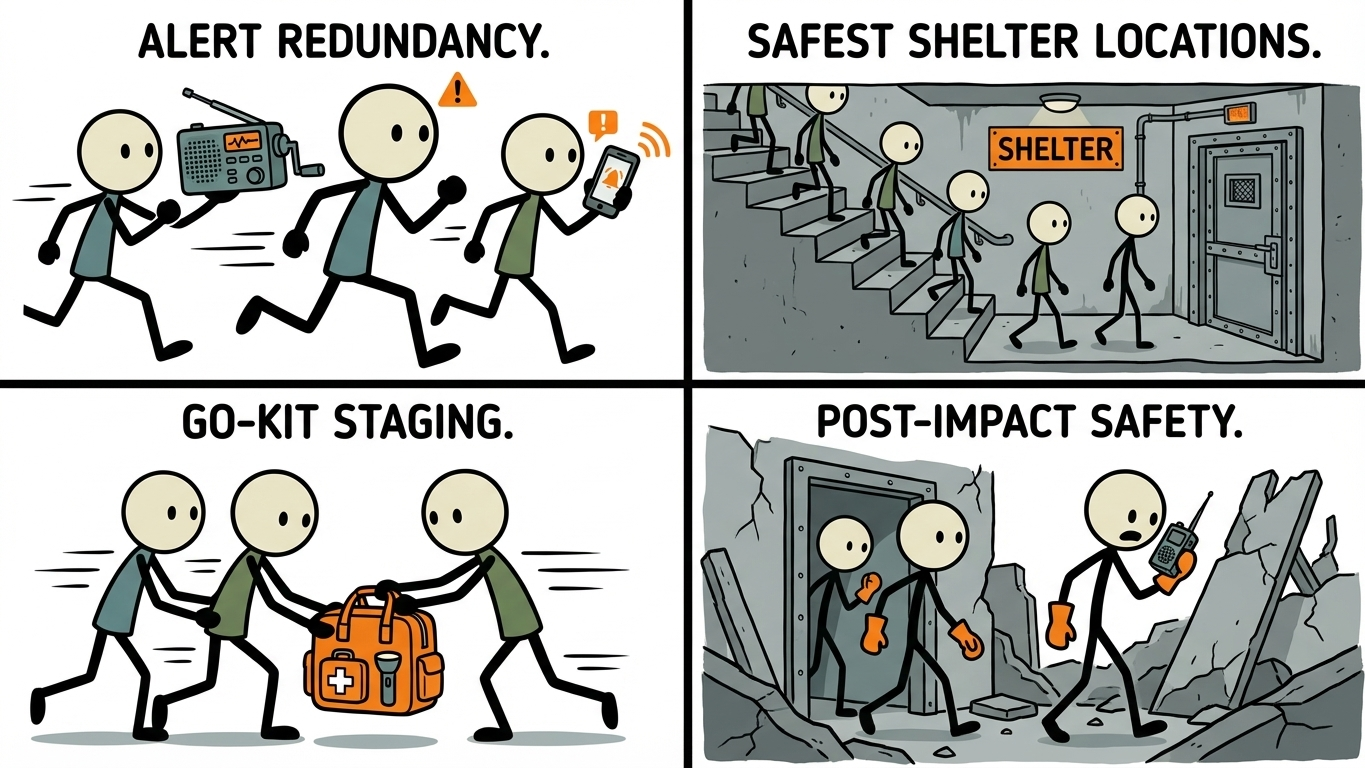
Tornadoes are among the most violent and unpredictable atmospheric phenomena on earth, capable of generating wind speeds that exceed 200 miles per hour. Yet, despite their destructive potential, they are highly survivable events. The key to navigating these terrifying storms lies in establishing a robust tornado preparedness strategy long before the clouds begin to rotate. By understanding how to build alert redundancy, identifying the absolute safest shelter locations in your specific environment, staging a purpose-built go-kit, and knowing how to navigate the hazardous post-impact landscape, you empower yourself to protect what matters most.
Understanding the Threat: Watches, Warnings, and the EF Scale
Before diving into the mechanics of a tornado safety plan, it is crucial to understand the terminology and the scale of the threat. The National Weather Service (NWS) issues specific alerts that dictate your level of required action. Knowing the difference between a watch and a warning is the foundational step in any emergency response.
A Tornado Watch means that atmospheric conditions are favorable for the development of severe thunderstorms capable of producing tornadoes. When a watch is issued, it is your signal to review your plan, check your supplies, and maintain situational awareness. A Tornado Warning, however, means that a tornado has been sighted by weather spotters or indicated by weather radar. A warning demands immediate, decisive action to seek shelter.
Meteorologists measure the intensity of tornadoes using the Enhanced Fujita (EF) Scale, which estimates wind speeds based on the damage left behind. The scale ranges from EF0 (minor damage, winds 65-85 mph) to EF5 (massive devastation, winds over 200 mph). While EF4 and EF5 tornadoes account for only about 2% of all tornadoes, they are responsible for the vast majority of fatalities. Your preparation must be robust enough to withstand the upper extremes of this scale.
Alert Redundancy: Never Miss a Critical Warning
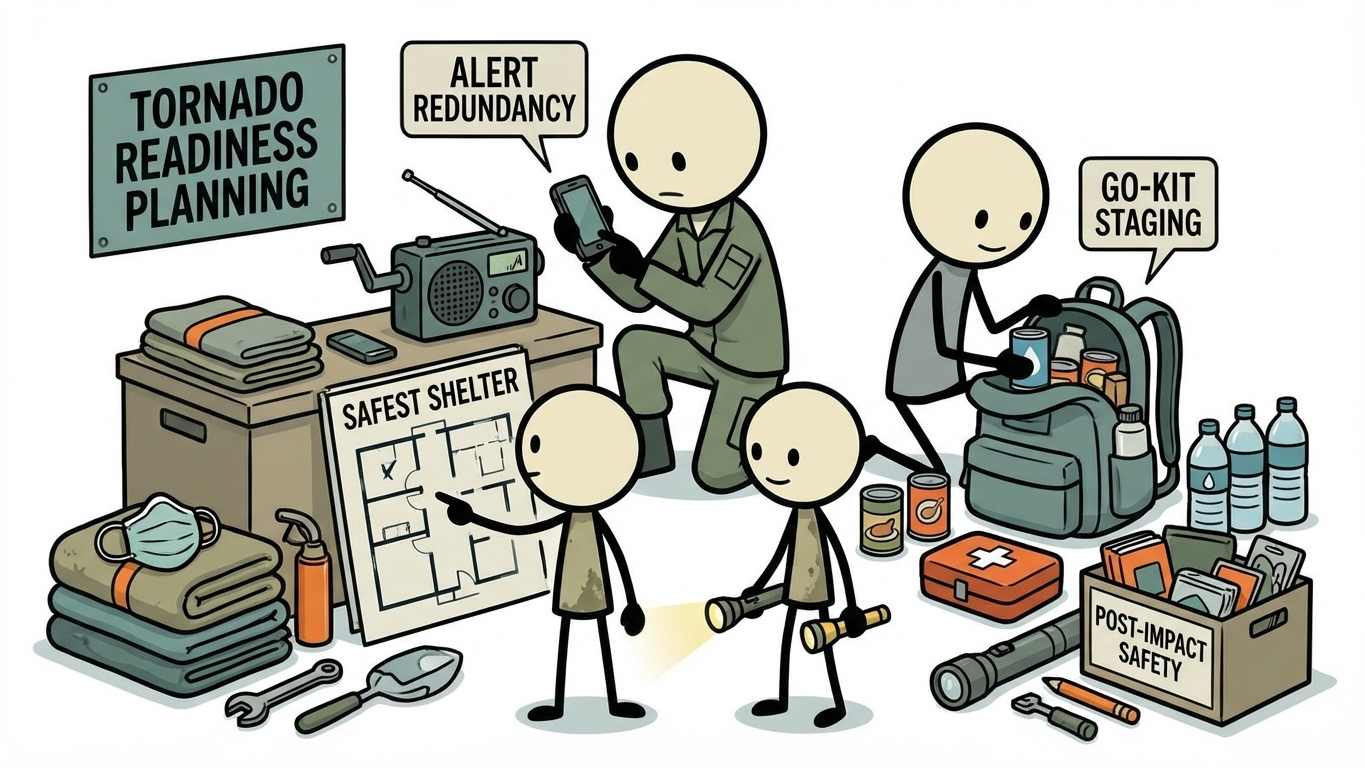
One of the most common and tragic failures during severe weather events is a breakdown in communication. Many people mistakenly believe that outdoor warning sirens will wake them up in the middle of the night. However, FEMA and local emergency management agencies explicitly state that outdoor sirens are designed only to alert people who are currently outdoors. To ensure you receive life-saving information, you must implement alert redundancy.
The Three-Tiered Alert System
A robust tornado safety plan requires multiple, independent methods for receiving warnings. If the power goes out, or if cell towers are overloaded, you need a backup system that will not fail. Implementing a three-tiered approach guarantees that you will be notified, regardless of the circumstances.
- Tier 1: NOAA Weather Radio. This is the gold standard of severe weather alerts. A dedicated NOAA weather radio with Specific Area Message Encoding (S.A.M.E.) technology allows you to program your specific county. Ensure your radio has a battery backup so it functions during power outages. It acts as an indoor smoke detector for severe weather, loudly waking you up when a warning is issued.
- Tier 2: Wireless Emergency Alerts (WEA). Modern smartphones are equipped to receive WEAs, which are broadcast by authorized government agencies. These geo-targeted alerts will sound a distinct tone and vibrate, even if your phone is on silent. Ensure that "Emergency Alerts" are toggled on in your smartphone's notification settings. Additionally, download reliable weather apps from the Red Cross or local news stations for push notifications.
- Tier 3: Local Media and Community Systems. Keep a battery-powered AM/FM radio tuned to local stations. Local meteorologists often provide real-time, street-level tracking of the tornado's path, which is invaluable once you are in your shelter. Furthermore, sign up for your county's specific text or email alert systems, often managed by local emergency management offices.
When applying these tornado warning tips, remember that redundancy is your safety net. Never rely on a single point of failure when your family's safety is on the line.
Identifying and Preparing Your Safest Shelter Location
When the warning sounds, your immediate physical location dictates your survival odds. The physics of a tornado involve not just high-velocity winds, but catastrophic changes in barometric pressure and the creation of deadly, high-speed projectiles. Your shelter must protect you from flying debris and structural collapse.
The Hierarchy of Shelter Options
Not all shelters are created equal. You must evaluate your living situation and pre-determine your designated safe zone long before storm season arrives. Here is the hierarchy of safe locations, based on guidelines from FEMA and the CDC:
- FEMA-Certified Safe Rooms: The absolute safest place to be is an above-ground or below-ground safe room built to FEMA P-320 or P-361 standards. These structures are engineered to withstand EF5 winds and the impact of a 15-pound 2x4 board traveling at 100 mph.
- Underground Basements: If you do not have a certified safe room, a basement is the next best option. However, do not just stand anywhere in the basement. Get under a sturdy piece of furniture, like a heavy workbench or a pool table, to protect yourself from the floor above potentially collapsing. Avoid corners where heavy appliances (like refrigerators or pianos) are located on the floor directly above you.
- Interior, Windowless Rooms: For homes without basements, the rule of thumb is to put as many walls between yourself and the outside as possible. Choose a small, windowless interior room on the lowest level of the house. Bathrooms are often excellent choices because the plumbing within the walls provides additional structural integrity, and the bathtub itself offers a recessed layer of protection. Interior closets and hallways are also viable options.
Locations to Strictly Avoid
Part of your tornado safety plan must include knowing where not to go. Never seek shelter in a room with exterior walls or windows. Glass becomes lethal shrapnel in a tornado. Large, open-span rooms like gymnasiums, cafeterias, and auditoriums are highly susceptible to roof collapse and should be avoided.
If you live in a mobile home, you must understand that there is no safe place inside a mobile home during a tornado. The NWS and CDC are unequivocal on this point: mobile homes can be easily flipped or obliterated by even EF1 tornadoes. If you live in a mobile home park, you must pre-identify a sturdy, permanent building nearby (such as a community clubhouse or a 24-hour business) and factor the travel time into your 13-minute warning window.
The Tornado Emergency Kit: Go-Kit Staging and Essentials
Surviving the immediate impact of the wind is only the first hurdle. Once the storm passes, you may find yourself trapped in your shelter, without power, and surrounded by hazardous debris. This is where a meticulously prepared tornado emergency kit becomes your lifeline. You will not have time to gather these items when the siren sounds; they must be pre-staged.
Strategic Staging
The biggest mistake people make is storing their emergency kit in an inaccessible location, like an attic or a detached garage. Your go-kit must be permanently staged inside your designated shelter area. If your shelter is a basement closet, the kit lives in the basement closet. If a warning is issued in the middle of the night, you should be able to walk into your shelter empty-handed and have everything you need already waiting for you.
The Ultimate Storm Shelter Checklist
A tornado kit differs slightly from a standard earthquake or hurricane kit because the immediate post-storm environment is heavily defined by sharp debris, structural entrapment, and a sudden loss of utilities. Your storm shelter checklist should be broken down into four critical categories:
- Personal Protection Gear: The majority of tornado injuries are blunt force trauma to the head and lacerations to the feet. Your kit must include a properly fitted helmet for every family member (bicycle, batting, or construction helmets work well). Additionally, store a pair of hard-soled, closed-toe shoes or work boots for everyone. Navigating a destroyed home barefoot is a recipe for severe injury. Heavy-duty leather work gloves and safety goggles are also essential for moving debris safely.
- Medical and Trauma Supplies: Emergency Medical Services (EMS) may be delayed by blocked roads. Your kit must include a robust first aid setup that goes beyond bandaids. Include tourniquets (ensure they are CoTCCC approved, like a CAT tourniquet), trauma dressings, sterile gauze, antiseptic wipes, antibiotic ointment, and a 7-day supply of any prescription medications.
- Sustenance and Survival: If you are trapped, you may need to wait hours for rescue. Store at least one gallon of water per person, per day, for a minimum of three days. Include high-calorie, non-perishable food bars that do not require cooking. Pack emergency mylar blankets to prevent hypothermia, as severe storms often bring sudden drops in temperature.
- Signaling and Illumination: If your home collapses, you need to tell rescuers where you are. Pack a loud pealess survival whistle for every family member; blowing a whistle requires far less energy than screaming and can be heard over machinery. Include multiple high-lumen LED flashlights, headlamps (to keep your hands free), and extra batteries. Avoid candles, as ruptured gas lines present an extreme fire hazard.
The Crucial Minutes: Actions to Take When the Siren Sounds
When your NOAA radio alarms or your phone buzzes with a WEA, the time for planning has ended. This is the moment to execute your tornado preparedness drills. Muscle memory and clear communication are your best defenses against panic.
Executing the Household Drill
Immediately gather your family and your pets. Do not waste time trying to open windows to "equalize pressure"—this is a dangerous myth that wastes precious seconds and puts you near glass that is about to shatter. Move rapidly to your pre-designated shelter location.
Once inside the shelter, put on your helmets and hard-soled shoes immediately. If you are using a bathtub, get inside and pull a heavy blanket or a mattress over the top of you to shield against falling debris. Crouch low to the ground, face down, and cover the back of your head and neck with your hands. Keep your emergency kit within arm's reach, and turn on your battery-powered radio to monitor the storm's progress via local media.
What to Do if You Are Caught in a Vehicle
Being in a vehicle during a tornado is an incredibly dangerous scenario. Vehicles are easily tossed and crushed by tornadic winds. If you see a tornado while driving, do not try to outrun it, as tornadoes can change direction erratically and move at highway speeds.
If you have time, pull over, exit the vehicle, and seek shelter in a sturdy building. If no building is available, the NWS advises getting out of the car and lying flat, face-down, in a low-lying area like a ditch or ravine, covering your head with your hands. Never seek shelter under a highway overpass. Overpasses act as wind tunnels, actually accelerating the wind speed and channeling deadly debris directly at you. Overpasses offer zero protection and have been the site of numerous tragic fatalities.
Post-Impact Safety: Navigating the Aftermath
The roar of the wind may have stopped, but the danger is far from over. As noted by the CDC, a staggering number of injuries and fatalities occur in the immediate aftermath of a tornado. The landscape you emerge into will be vastly different from the one you left, filled with hidden, lethal hazards. Navigating this post-impact phase requires extreme caution and discipline.
Assessing the Immediate Environment
If your building has sustained damage, do not rush out blindly. Put on your hard-soled shoes, leather gloves, and safety goggles before attempting to move any debris. Use your flashlights to assess the structural integrity of your surroundings. If you are trapped, do not exhaust yourself by screaming continuously. Instead, use the survival whistle from your tornado emergency kit, blowing it in sharp bursts of three (the universal distress signal) to alert search and rescue teams.
If you are able to safely exit your shelter, do so with extreme care. Watch for exposed nails, splintered wood, and shattered glass. Treat all structural damage as highly unstable; floors may give way, and ceilings may collapse with little warning.
The Invisible Threats: Gas and Electricity
Two of the most profound dangers following a tornado are ruptured natural gas lines and downed electrical wires. If you smell gas (often described as a rotten egg odor) or hear a hissing sound, evacuate the area immediately. Do not turn on any light switches, use a cell phone, or strike a match, as the slightest spark can cause a catastrophic explosion. If you know how to safely turn off the main gas valve from the outside, do so, but never attempt to turn it back on yourself—that must be done by a professional.
Assume that all downed power lines are live and deadly. Electrocution is a leading cause of post-storm fatalities. Never touch a downed line, and do not touch anything that the line is resting on, including fences, puddles of Water Calculator, or vehicles. Keep a distance of at least 35 feet and report the hazard to local utility companies when you are able.
Safe Cleanup and Generator Usage
When the time comes to begin cleanup, pace yourself. The CDC reports high instances of heat exhaustion, dehydration, and heart attacks during post-tornado recovery. Hydrate constantly using the water from your go-kit. If you suffer any cuts or punctures, clean them immediately and thoroughly with the supplies from your trauma kit to prevent severe infections like tetanus.
Finally, if the power grid is down and you choose to use a portable generator, you must adhere to strict safety protocols. Carbon monoxide (CO) poisoning is a silent killer in the aftermath of severe weather. Never operate a generator inside your home, basement, garage, or even near an open window. Generators must be placed outside, at least 20 feet away from any dwelling, to ensure the deadly, odorless exhaust fumes are safely dispersed.
Empowering Yourself Through Preparation
Facing the reality of severe weather can be daunting, but fear is simply a byproduct of feeling out of control. By taking these actionable steps today, you reclaim that control. Establishing a layered alert system, fortifying your shelter, and meticulously staging your emergency supplies transforms you from a potential victim into a capable survivor. A comprehensive tornado safety plan does more than just protect your physical well-being; it provides profound peace of mind. When the skies darken and the sirens wail, you will not have to wonder what to do. You will simply execute your plan, knowing you have done everything in your power to keep your family safe, secure, and ready to weather the storm.
Understand tornado-specific response through our natural disaster survival guide. Create a family shelter plan with our family emergency plan. Prepare your go-bag using our go-bag builder. Calculate tornado supplies with our supply calculator. Get professional tornado training through our preparedness courses.
Frequently Asked Questions
What is the most important weather prep step?
Have redundant alerts, a shelter plan, and pre-staged supplies so you can act immediately when warnings arrive.
Should I shelter in place or evacuate?
Follow local orders and hazard type. Evacuate early when routes are still open and conditions are still manageable.
How often should I update my weather emergency kit?
Review every 6 months, rotate food and medications, and seasonally adjust clothing and shelter items.
How can I reduce panic during severe weather events?
Use checklists, assign roles, and rehearse actions. Familiar routines reduce decision fatigue under stress.
What mistakes do families make most often?
Waiting too long to act, relying on one information source, and not practicing the plan before a real event.