Understanding Emergency Medical Preparedness for the Modern Family
In the realm of family preparedness, few topics are as critical, yet as frequently misunderstood, as medical readiness. When an emergency occurs at home, on the road, or during an outdoor excursion, having the right tools can make a profound difference. However, walking into a medical supply store or browsing online retailers can quickly become overwhelming. You will encounter a confusing array of acronyms and terms: IFAKs, trauma kits, first aid kits, bleed kits, and survival medical packs. Each is marketed as an essential lifesaver, but they serve vastly different purposes.
For a family focused on practical, conservative preparedness, the goal is not to build a mini-hospital in a backpack. Instead, the goal is to understand the specific utility of each kit, acquire high-quality components, and develop the basic skills required to use them safely. This guide will demystify these medical kits, outline their essential contents, provide realistic scenarios for their use, and offer clear guidance on how to build or buy your emergency medical inventory. Most importantly, we will discuss the vital boundaries of training and when to hand over care to professional emergency services.
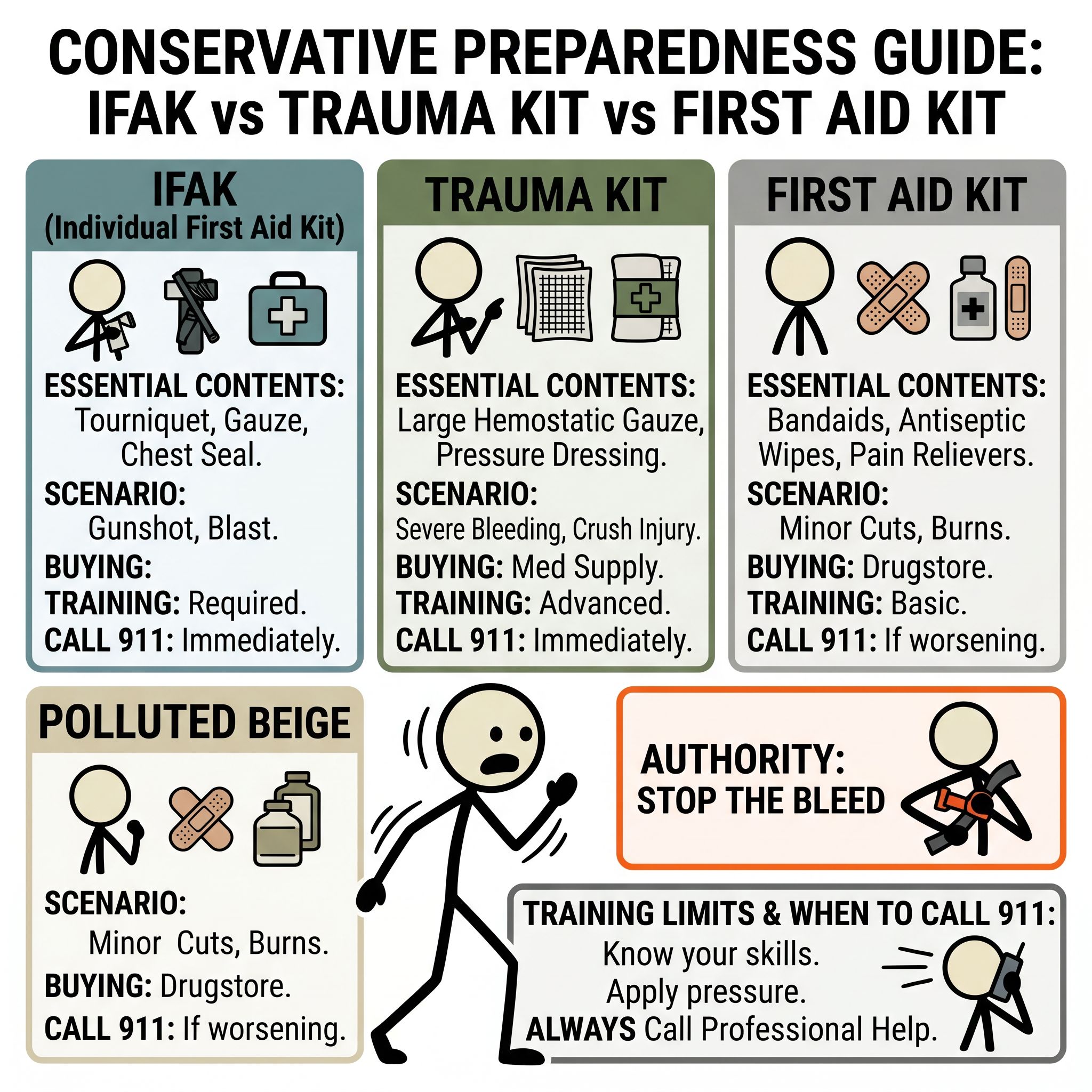
- First aid kits are designed for minor, non-life-threatening injuries like scrapes, minor burns, and small cuts, focusing on comfort and hygiene.
- Trauma kits and IFAKs are designed specifically to address severe, life-threatening injuries, particularly massive hemorrhaging, before professional help arrives.
- High-quality, co-branded, or certified gear is essential; counterfeit medical supplies, especially tourniquets, can fail under pressure and put lives at risk.
- No amount of medical gear can replace structured training; hands-on courses are the foundation of effective emergency response.
- Always call emergency services immediately when a severe, life-threatening injury is identified, rather than waiting to see if you can manage it alone.
A Vital Medical Safety Note
Before exploring the details of emergency medical equipment, we must establish a foundational rule of preparedness: medical gear does not replace training, nor does it replace professional emergency medical care. Owning a high-quality stethoscope does not make someone a cardiologist, and carrying a specialized medical kit does not make someone a paramedic.
The instructions and concepts outlined in this guide are for educational purposes to help you select and organize your preparedness supplies. You should never attempt invasive medical procedures, such as surgical airways or needle decompressions, without professional medical licensure and direct authorization. In any emergency, your primary objective is to stabilize the patient using basic, non-invasive techniques and transfer them to professional medical responders as quickly and safely as possible.
Decoding the Terminology: First Aid Kit vs. Trauma Kit vs. IFAK
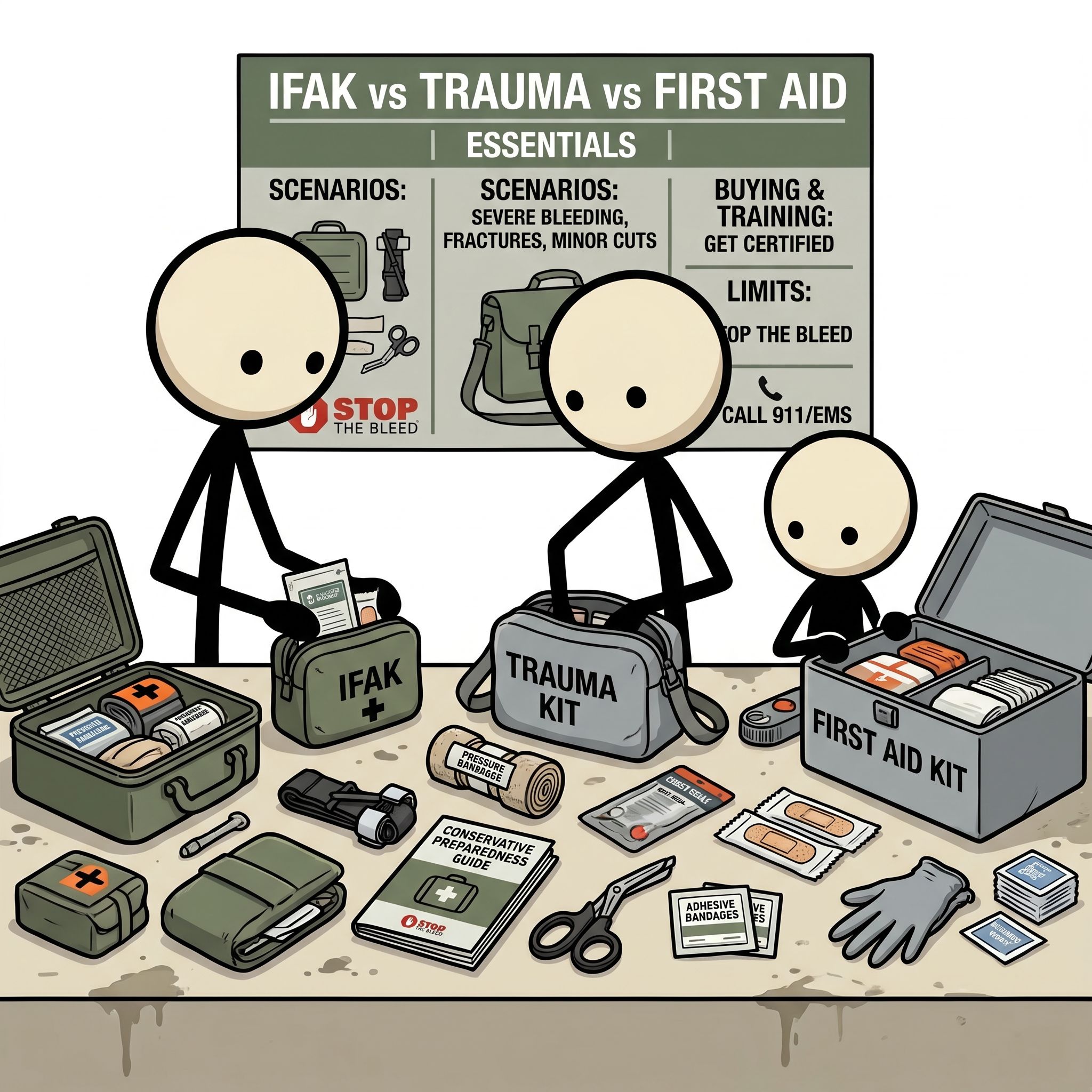
To build a logical medical preparedness plan, you must first understand the distinct categories of medical kits. Using the wrong kit for a situation can lead to poor outcomes, such as wasting precious seconds searching through adhesive bandages during a major bleeding event.
The First Aid Kit: Everyday Care and Comfort
The humble first aid kit is the most common medical resource found in households and workplaces. Its primary purpose is to treat minor, non-life-threatening injuries. These are the daily bumps, scrapes, minor burns, insect stings, and small cuts that occur during normal family activities.
A typical first aid kit contains items that promote hygiene, prevent minor infections, and provide comfort. It is characterized by a high volume of small, consumable items like adhesive bandages, antiseptic wipes, and over-the-counter medications. While a first aid kit is indispensable for daily life, it is not equipped to handle severe, arterial bleeding or major physical trauma. To understand how to optimize these everyday resources, you can read our comprehensive emergency first aid kit guide.
The Trauma Kit: Managing Life-Threatening Injuries
A trauma kit is a specialized collection of medical supplies designed to address severe, life-threatening injuries. The primary objective of a trauma kit is to keep an injured person alive during the critical minutes immediately following an accident, often referred to as the "golden hour," while professional emergency medical services (EMS) are en route.
Unlike a first aid kit, a trauma kit does not contain items for comfort or minor wound care. You will not find small adhesive bandages or burn creams here. Instead, a trauma kit contains robust, medical-grade tools designed to stop massive hemorrhaging, manage basic airway issues, and protect wounds from further contamination. The focus is entirely on stabilization and survival.
The IFAK (Individual First Aid Kit): Personal Trauma Care
The term IFAK stands for Individual First Aid Kit. Despite the word "first aid" in its name, an IFAK is actually a compact, wearable trauma kit. The concept originated in the military, where every soldier carries a standardized kit on their person. The critical rule of the military IFAK is that it is meant to be used on the person carrying it, by themselves or by a comrade using the casualty's own gear.
In a civilian and family preparedness context, an IFAK is a highly portable, single-person trauma kit. It is typically housed in a small, durable pouch that can be attached to a belt, a backpack, or stored in a vehicle glove box. It contains only the bare essentials needed to treat one person suffering from severe trauma, with a heavy emphasis on bleeding control.
Essential Contents for Your Medical Kits
To ensure your family is prepared for both minor mishaps and major emergencies, it is wise to maintain both first aid kits and trauma kits. Here is a breakdown of the essential, non-invasive contents that should be included in each type of kit.
What Belongs in a Standard First Aid Kit?
Your family first aid kit should be easily accessible to everyone in the household and kept well-stocked. It should include:
- Adhesive bandages of various sizes and shapes (for minor cuts and blisters).
- Sterile gauze pads (2x2 inches and 4x4 inches) and adhesive medical tape.
- Antiseptic wipes or benzalkonium chloride packets for wound cleaning.
- Triple-antibiotic ointment packets to prevent infection in minor wounds.
- Hydrocortisone cream for itchy insect bites or mild skin rashes.
- Tweezers for removing splinters or ticks.
- Fine-point scissors for cutting tape or gauze.
- Instant cold packs for sprains and bruises.
- A selection of basic over-the-counter medications, including pain relievers (ibuprofen or acetaminophen), antihistamines for mild allergic reactions, and antacids.
- A basic first aid manual or quick-reference guide.
What Belongs in a Trauma Kit or IFAK?
The contents of a trauma kit or IFAK are strictly regulated by utility and urgency. According to the guidelines established by the nationally recognized Stop the Bleed campaign, the priority in severe trauma is to control life-threatening bleeding. Your trauma kit or IFAK should contain:
- A Windlass Tourniquet: This is the single most important tool for stopping severe, life-threatening bleeding from an arm or leg. Ensure you choose a reputable, co-branded, or widely recommended model, such as the Combat Application Tourniquet (CAT) or the Tactical Rescue Medical Coalition approved SOF Tourniquet.
- A Pressure Dressing: Often referred to as an Israeli Bandage or emergency trauma dressing, a pressure dressing is used to apply constant, firm pressure to a severe wound. It consists of a sterile pad attached to an elastic wrap with a built-in pressure bar or clip.
- Compressed Packing Gauze: High-quality, sterile cotton gauze packed tightly into a small, vacuum-sealed package. This is used to pack deep wounds in areas where a tourniquet cannot be applied, such as the groin, armpit, or neck (referred to as junctional areas).
- Trauma Shears: Heavy-duty, blunt-tipped scissors designed to quickly and safely cut through thick clothing, seatbelts, or leather to expose a wound for treatment.
- Nitrile Gloves: Multiple pairs of heavy-duty, non-latex gloves to protect both the rescuer and the patient from cross-contamination.
- An Emergency Mylar Blanket: Severe blood loss quickly impairs the body's ability to regulate temperature, leading to hypothermia, which worsens blood clotting. A compact thermal blanket helps keep the patient warm.
- Permanent Marker: Used to write the exact time a tourniquet was applied directly onto the patient's forehead or the tourniquet strap, which is vital information for receiving hospital staff.
To explore how to integrate these items into a broader family safety strategy, consult our comprehensive medical preparedness guide.
Realistic Emergency Scenarios: Which Kit Do You Reach For?
To understand the practical application of these kits, let us examine three realistic scenarios that a family might encounter. These examples illustrate how the nature of the injury dictates which kit is appropriate and how time-sensitive your actions must be.
Scenario A: The Backyard Barbecue Mishap
While preparing dinner on the patio, a family member's hand slips while slicing vegetables, resulting in a clean, shallow cut across the palm. The wound bleeds moderately but stops when firm pressure is applied with a clean paper towel. The individual is fully conscious, calm, and experiencing localized pain.
The Correct Action: Reach for the first aid kit. Once the bleeding has stopped with basic pressure, clean the wound thoroughly with an antiseptic wipe, apply a thin layer of triple-antibiotic ointment, and cover it with a sterile adhesive bandage or a gauze pad secured with medical tape. This is a classic first aid scenario where comfort, hygiene, and infection prevention are the primary goals.
Scenario B: The Workshop Power Tool Accident
While working on a DIY home improvement project in the garage, a family member suffers a deep laceration to their forearm from a slipping hand saw. Dark red blood is spurting rapidly from the wound, quickly soaking through their sleeve and pooling on the floor. The injured person is pale, sweating, and visibly panicked.
The Correct Action: Immediately call 911, then reach for the trauma kit or IFAK. This is a life-threatening bleeding emergency. Do not waste time looking for small bandages. Put on your nitrile gloves, use your trauma shears to cut away the sleeve, and immediately apply direct pressure to the wound. If the bleeding does not stop with direct pressure, or if it is too severe, apply a windlass tourniquet high and tight on the arm, tightening it until the bleeding stops. Secure the tourniquet, note the time of application, and monitor the patient until emergency services arrive.
Scenario C: The Rural Highway Collision
While driving on a remote highway, your family vehicle is sideswiped by an oncoming car. You pull over safely, but the passenger in the front seat has been struck by flying glass and debris. They have a deep, gaping wound on their thigh that is bleeding heavily, along with multiple minor cuts on their face and hands.
The Correct Action: Instruct another passenger to call 911. Retrieve your vehicle's trauma kit. Put on gloves, expose the thigh wound using trauma shears, and apply a pressure dressing firmly over the injury. If the bleeding continues to soak through the dressing, apply a tourniquet above the wound on the thigh. Once the life-threatening bleeding is controlled, you can access your first aid kit to clean and cover the minor cuts on the patient's face and hands to prevent infection while waiting for the ambulance.
Buying Guidance: How to Choose Quality and Avoid Pitfalls
When purchasing emergency medical equipment, the market is flooded with cheap, unbranded alternatives. While a budget-friendly option is tempting, medical gear is one area where you must never compromise on quality. A failed tool in a critical moment can have tragic consequences.
The Danger of Counterfeit Tourniquets
The rise of online marketplaces has led to an influx of counterfeit medical supplies, particularly windlass tourniquets. These counterfeit items often look identical to genuine, life-saving devices but are made with cheap, brittle plastics and weak stitching. When a rescuer twists the windlass to apply the necessary pressure to stop arterial blood flow, the plastic windlass can snap, or the strap can tear, rendering the device completely useless.
Always purchase your trauma gear from reputable, authorized distributors or directly from established medical supply manufacturers. Look for brands that are officially recognized by major medical organizations and tactical rescue coalitions. Expect to pay a fair price for a genuine, life-saving tool; if a tourniquet is priced significantly lower than the industry standard, it is likely a dangerous counterfeit.
Pre-Made Kits vs. DIY Customization
For many families, purchasing a pre-assembled kit is the easiest and most convenient way to begin. Many reputable companies offer well-designed first aid kits and trauma kits that are ready for immediate use. When buying a pre-made kit, ensure it comes from a recognized medical supply brand and check the contents list against the recommendations in this guide.
Alternatively, building your own kit allows you to customize the components to your family's specific needs, medical history, and environment. For example, if a family member has a known severe allergy, your custom first aid kit should include space for an emergency epinephrine auto-injector. If you choose the DIY route, purchase a durable, high-visibility, water-resistant pouch and fill it with individually sourced, high-quality components from trusted medical brands.
Storage, Accessibility, and Maintenance
The best medical kit in the world is useless if you cannot find it or if the contents have degraded over time. Keep your medical kits in easily accessible, consistent locations. Every family member should know exactly where the home first aid kit and trauma kits are stored. Keep a dedicated trauma kit in the glove box or trunk of each family vehicle.
Regularly inspect your kits at least once or twice a year. Check the expiration dates on medications, antiseptic wipes, and sterile dressings. Extreme temperatures inside a vehicle can accelerate the degradation of plastics and adhesives, so inspect your vehicle-stored kits more frequently. Replace any damaged, expired, or used items immediately.
Training Limits and When to Call Emergency Services
Having a well-stocked trauma kit is only half of the equation. The other, more critical half is knowing how to use it safely and effectively. This requires structured, hands-on training.
The Gold Standard: Stop the Bleed
The premier authority on civilian hemorrhage control is the Stop the Bleed campaign. Administered by the American College of Surgeons and supported by emergency medical organizations worldwide, this program was developed to teach the public how to stop life-threatening bleeding in emergency situations.
A Stop the Bleed course is typically short, highly practical, and often free or very low-cost. It teaches participants how to recognize life-threatening bleeding, apply direct pressure, pack a deep wound with gauze, and correctly apply a windlass tourniquet. Taking a hands-on course is the single best investment you can make in your family's physical safety. To build a broader foundation of medical knowledge, we highly recommend enrolling in our structured Medical Emergencies and Field First Aid course.
Knowing Your Practical Limits
As a prepared citizen, you must understand the boundaries of your training. Attempting procedures beyond your skill level can cause additional harm to the patient. For example, do not attempt to align broken bones, perform invasive airway procedures, or administer prescription medications that have not been specifically prescribed to the patient by a physician. Stick to the basic, non-invasive life-support steps you have been trained to perform: control bleeding, maintain an open airway through simple positioning, keep the patient warm, and offer calm reassurance.
When to Call Emergency Services Immediately
In any moderate to severe medical situation, your very first step should be to activate emergency medical services (EMS) by calling 911 or your local emergency number. Do not wait to see if your first aid efforts are successful before making the call. Seconds count in a major medical emergency.
You must call emergency services immediately if the patient exhibits any of the following signs:
- Difficulty breathing, rapid shallow breathing, or an inability to speak in full sentences.
- Severe, uncontrolled bleeding that does not stop after a few seconds of direct pressure.
- Loss of consciousness, confusion, dizziness, or sudden changes in mental state.
- Chest pain, pressure, or tightness, which can indicate a serious cardiac event.
- Signs of a severe allergic reaction, such as swelling of the face, lips, or throat, or difficulty swallowing.
- Suspected spinal, neck, or head injuries, especially following a fall or motor vehicle accident.
While you wait for professional help to arrive, your role is to act as a bridge of survival. By utilizing your high-quality trauma kit, applying the principles of the Stop the Bleed program, and maintaining a calm, focused demeanor, you can protect your loved ones and provide vital assistance during their moment of greatest need.
Frequently Asked Questions
Is an IFAK the same as a first aid kit?
No. An IFAK is focused on immediate life-threatening trauma, especially severe bleeding. A first aid kit covers common minor injuries and medications.
What should be in a basic trauma kit?
Start with a quality tourniquet, wound packing gauze, pressure dressing, nitrile gloves, trauma shears, marker, and clear instructions or training references.
Can I use a cheap tourniquet?
Avoid unverified knockoffs. Bleeding-control gear is not the place to save a few dollars because failure can be catastrophic.
Do I need medical training to carry a trauma kit?
You should take a hands-on bleeding-control class such as Stop the Bleed. Gear without practice is much less useful under stress.
Can a trauma kit replace emergency medical care?
No. It is a bridge until professional help arrives. Call emergency services whenever possible and follow local medical guidance.
Sources & Further Reading
Medical Safety Note
This guide is general emergency-preparedness education, not medical advice and not a substitute for hands-on training, licensed clinical care, or emergency services. Use trauma supplies only within your training and local laws. In a real emergency, call emergency services as soon as it is safe to do so.