⚡ Key Facts
- Nearly 45 million homes in the United States are located in the Wildland-Urban Interface (WUI), making them highly susceptible to wildfire threats, according to the U.S. Fire Administration (USFA).
- Wind-blown embers can travel up to 5 miles ahead of the main fire front and are responsible for up to 90% of home ignitions during a wildfire event.
- Maintaining proper defensible space and hardening your home can increase its chances of surviving a wildfire by up to 75%, according to the Federal Emergency Management Agency (FEMA).
- Wildfire smoke contains hazardous fine particulate matter (PM2.5) that the Centers for Disease Control and Prevention (CDC) warns can cause severe respiratory distress hundreds of miles away from the actual burn site.
- The majority of civilian wildfire fatalities occur during last-minute evacuations, highlighting the critical need for a pre-planned, early departure strategy.
If you want a complete step-by-step framework, start with our Bug Out 101 course to build a practical evacuation plan fast.
Imagine waking up in the middle of the night to the smell of dense, acrid smoke and the eerie, orange glow of a sky on fire. A sudden shift in wind direction has pushed a distant blaze directly toward your neighborhood. In these chaotic moments, the difference between panic and purpose comes down to a single factor: preparation. Wildfires are uniquely terrifying because of their staggering speed. Driven by dry fuels and high winds, a wildland fire can consume the equivalent of a football field every second, leaving residents with only minutes to react.
For a broader playbook, use our real-world emergency scenarios guide to turn these steps into a practical plan.
However, while we cannot control the forces of nature, your survival is absolutely within your hands. True wildfire preparedness is not about living in fear; it is about empowerment. By taking deliberate, calculated steps long before the first spark ignites, you can protect your property, safeguard your loved ones, and ensure a swift, organized departure. This comprehensive guide will walk you through the essential phases of a robust wildfire evacuation plan.
From building a resilient perimeter around your home to assembling a life-saving wildfire go bag, understanding emergency alerts, and navigating a safe escape route, we will cover the strategies trusted by top emergency management agencies. Preparedness replaces anxiety with action. Let’s build your survival strategy.
The Foundation of Wildfire Preparedness
The landscape of the American West, and increasingly other parts of the world, has fundamentally changed. According to data from the National Oceanic and Atmospheric Administration (NOAA), wildfire seasons are growing longer, and the fires themselves are burning hotter and faster than in previous decades. This shift requires a change in how we approach living near wildlands. Wildfire preparedness is no longer a seasonal chore; it is a year-round lifestyle commitment.
A comprehensive wildfire evacuation plan begins long before you ever smell smoke. It starts with an honest assessment of your environment and your vulnerabilities. Do you live in a valley where smoke might pool? Is your home situated on a steep slope where fire can race uphill at double its normal speed? Understanding the topography and climate of your specific location is the first step in mitigating your risk.
Furthermore, preparedness is a holistic endeavor. It encompasses the physical hardening of your property, the logistical planning of your escape routes, and the psychological readiness to leave your home behind when the order is given. By breaking this monumental task down into actionable steps, you can systematically eliminate vulnerabilities and build a fortress of readiness around your family.
Building and Maintaining Defensible Space
When most people think of a home burning in a wildfire, they picture a massive wall of flames engulfing the structure. In reality, the U.S. Forest Service reports that the vast majority of homes are destroyed by ember attacks. Millions of burning pieces of wood and vegetation are carried by the wind, landing on roofs, entering vents, and igniting dry brush near the foundation. This is why creating defensible space is the single most effective way to protect your property.
Defensible space is the buffer you create between a building on your property and the grass, trees, shrubs, or any wildland area that surrounds it. This space is needed to slow or stop the spread of wildfire and it protects your home from catching fire—either from direct flame contact or radiant heat. It also provides a safe working area for firefighters to defend your home. Agencies like FEMA and CAL FIRE divide defensible space into three distinct zones.
Zone 0: The Ember-Resistant Zone (0 to 5 Feet)
This is the most critical zone for home survival. The goal here is absolute ember resistance. If an ember lands within five feet of your home, there should be absolutely nothing combustible for it to ignite.
- Remove all combustible materials, including mulch, wood piles, dry leaves, and pine needles from the immediate perimeter of your home.
- Replace organic mulch with hardscaping materials like gravel, pavers, or concrete.
- Clear all dead vegetation from your roof and gutters regularly. A single spark in a gutter full of dry leaves can quickly spread to the roof decking.
- Ensure branches are trimmed back at least 10 feet from your roof and chimney.
- Do not store combustible items like propane tanks, wooden patio furniture, or firewood under decks or overhangs.
Zone 1: The Lean, Clean, and Green Zone (5 to 30 Feet)
The objective in Zone 1 is to reduce the amount of fuel available to an advancing fire, thereby lowering the heat and slowing the flames before they reach the Ember-Resistant Zone.
- Remove all dead plants, grass, and weeds. Keep lawns well-irrigated and mowed to a height of four inches or less.
- Remove dead or dry leaves and pine needles from your yard, roof, and rain gutters.
- Trim trees regularly to keep branches a minimum of 10 feet from other trees. This prevents fire from easily jumping from canopy to canopy.
- Relocate wood piles to Zone 2, completely outside of this 30-foot perimeter.
- Create separation between trees, shrubs, and items that could catch fire, such as patio furniture, wood piles, and swing sets.
Zone 2: The Reduced Fuel Zone (30 to 100 Feet)
Zone 2 extends out to 100 feet from your home, or to your property line. The goal here is to interrupt the fire's path and keep flames smaller and on the ground.
- Cut or mow annual grass down to a maximum height of four inches.
- Create horizontal spacing between shrubs and trees. The spacing should be based on the slope of the land; steeper slopes require greater spacing because fire moves faster uphill.
- Create vertical spacing by removing lower tree branches. A good rule of thumb is to remove branches up to 6 feet from the ground, or one-third the height of smaller trees, to prevent ground fires from climbing into the canopy (known as "ladder fuels").
- Clear heavy accumulations of fallen leaves, needles, twigs, bark, cones, and small branches.
Home Hardening: The Final Layer of Defense
Defensible space works hand-in-hand with home hardening. Upgrading building materials can drastically reduce the chance of ignition. Install a Class A fire-rated roof (such as metal, tile, or asphalt shingles). Cover all exterior vents with 1/8-inch to 1/16-inch metal wire mesh to prevent embers from being blown into the attic or crawl spaces. Upgrade to dual-pane windows with tempered glass, which are much less likely to shatter from the intense radiant heat of an approaching fire.
Assembling Your Wildfire Go Bag
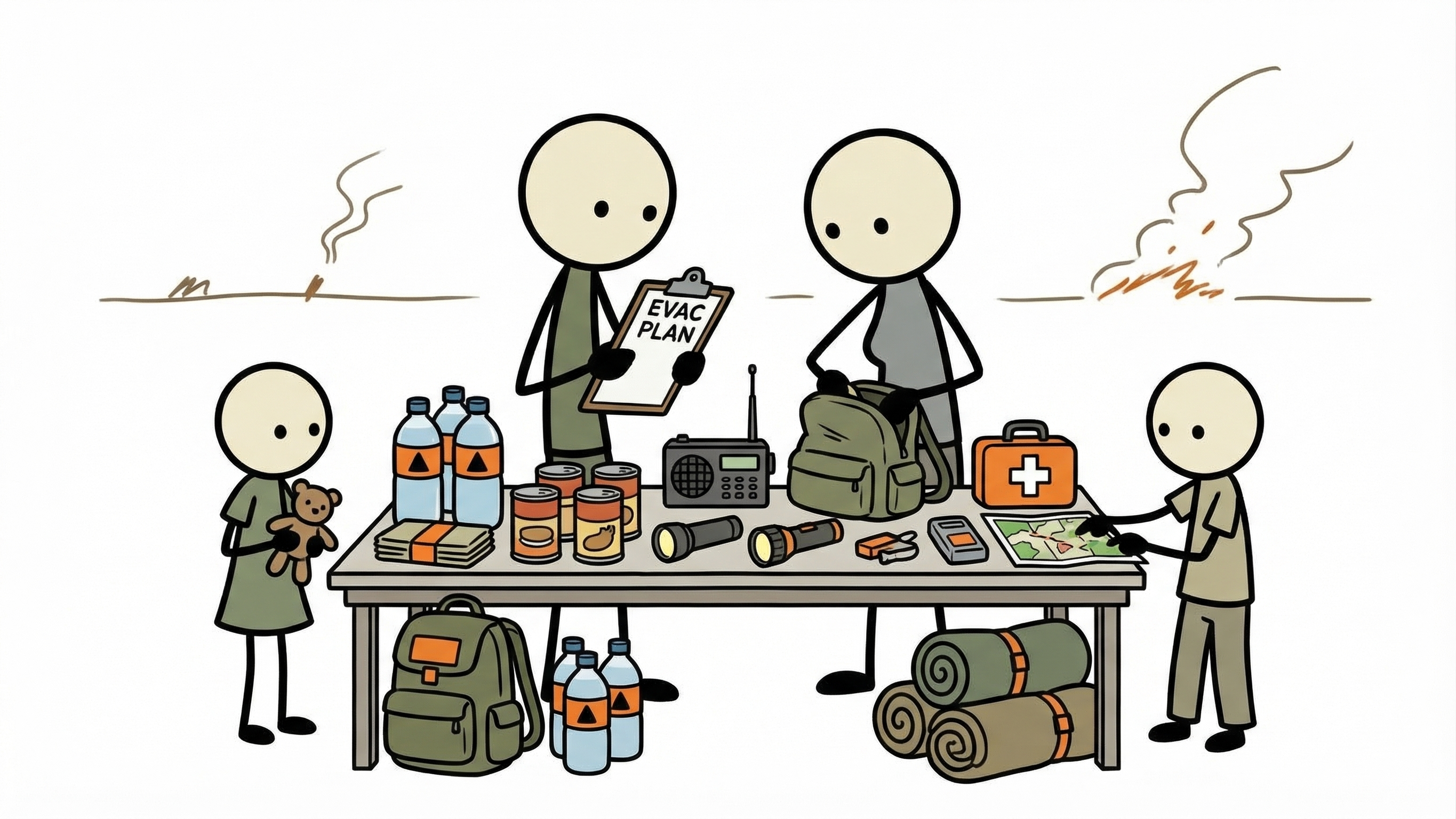
When an evacuation order is issued, you will not have time to pack. The stress and adrenaline of the moment will severely impair your decision-making abilities. This is why assembling a dedicated wildfire go bag is a non-negotiable component of your survival strategy. A go bag ensures that you have the critical items necessary to survive for at least 72 hours away from home.
A wildfire go bag differs slightly from a standard emergency kit because it must account for the specific hazards of fire, such as toxic smoke, intense heat, and sudden darkness due to power outages. Every member of your household—including pets—should have their own easily accessible bag, preferably stored near the front door or pre-loaded in your vehicle during times of high fire danger.
The "Six Ps" of Evacuation
When finalizing your wildfire evacuation checklist, emergency responders recommend organizing your priorities around the "Six Ps." This mnemonic device helps ensure you don't leave anything irreplaceable behind if you have a few extra minutes to load the car.
- People and Pets: Your absolute first priority. Ensure everyone is accounted for and ready to move.
- Papers: Important documents, including deeds, birth certificates, passports, and insurance policies.
- Prescriptions: Medications, eyeglasses, hearing aids, and medical equipment.
- Pictures: Irreplaceable memories, physical photos, and hard drives.
- Personal Computers: Laptops, backup drives, and essential electronics.
- Plastic and Cash: Credit cards, ATM cards, and a reserve of physical cash in small denominations, as power outages will render card readers useless.
Essential Gear for the Wildfire Go Bag
Your physical go bag should be a sturdy, comfortable backpack. Inside, you need to pack items that address the immediate physical threats of a wildfire evacuation.
- N95 Respirators: The CDC stresses that standard cloth masks or surgical masks do nothing to filter out the microscopic PM2.5 particles found in wildfire smoke. You must have NIOSH-approved N95 or P100 respirators to protect your lungs.
- Protective Clothing: Pack long pants, a long-sleeved shirt, and a jacket made from 100% cotton or wool. Never pack synthetic materials like nylon or polyester, as intense radiant heat can cause these fabrics to melt directly onto your skin. Include sturdy, closed-toe leather boots and leather work gloves.
- Eye Protection: Wrap-around safety goggles will protect your eyes from blowing ash, smoke, and embers.
- Water and Hydration: Pack at least one gallon of water per person, per day, for three days. Include a portable water filter in case municipal supplies become compromised.
- First Aid Kit: A comprehensive kit should include burn gels, sterile dressings, bandages, antiseptics, and any specific medical supplies your family requires.
- Navigation and Communication: A battery-powered or hand-crank NOAA weather radio, physical topographical maps of your area (cell towers often burn or overload), a compass, and fully charged power banks for your mobile devices.
- Illumination: High-lumen headlamps with extra batteries. Wildfire smoke can turn midday into pitch-black night, and power grids are usually shut off to prevent further ignitions.
Preparing for Pets and Livestock
Do not forget your animals in your wildfire evacuation plan. For indoor pets, have carriers readily accessible, along with a week's supply of food, Water Calculator, medications, and copies of vaccination records. Ensure your pets are microchipped and wearing collars with updated tags. For larger animals like horses or livestock, evacuation requires significantly more time and logistics. You must pre-arrange transportation trailers and identify safe holding facilities or fairgrounds well outside the fire zone.
Understanding Evacuation Zones and Alerts
Information is your most valuable asset during a wildfire. However, depending on a single source of information can be a fatal mistake. Cell towers can burn down, internet lines can melt, and power grids can fail. A robust wildfire preparedness strategy involves multiple, redundant methods for receiving emergency alerts.
The Alert Systems
First, sign up for your local county's emergency text alert system. Most municipalities use systems like CodeRED or Nixle to push hyper-local information to residents. Second, ensure that Wireless Emergency Alerts (WEA) are enabled on your smartphone. These are broadcast by the government to all cell phones in a specific geographic area, regardless of whether you opted in. Finally, keep a NOAA weather radio on standby. The National Weather Service uses this network to broadcast Red Flag Warnings and emergency evacuation orders even when cellular networks fail.
The "Ready, Set, Go!" Framework
Adopted by the International Association of Fire Chiefs (IAFC), the "Ready, Set, Go!" program is the gold standard for evacuation timing. Understanding these three phases will prevent you from being caught off guard.
- READY (Be Proactive): This is the preparation phase. You have built your defensible space, assembled your wildfire go bag, and finalized your wildfire evacuation checklist. You are monitoring weather conditions and are aware of Red Flag Warnings (days with high temperatures, low humidity, and strong winds).
- SET (Situational Awareness): A fire has started in your region, or an Evacuation Warning has been issued. This means there is a potential threat to life and property. Do not wait. Load your go bags into the vehicle. Back your car into the driveway with the doors unlocked and the keys in the ignition. Dress in your protective cotton/wool clothing. Locate your pets and keep them confined to a single room so you can grab them instantly. If you feel unsafe, leave now—do not wait for an official order.
- GO (Act Early): An Evacuation Order has been issued. The danger is imminent and life-threatening. You must leave immediately by your planned route. Do not stay to gather belongings or hose down your roof. Follow the instructions of law enforcement and emergency personnel.
It is vital to know your specific evacuation zone. Many counties have divided their regions into designated zones with specific alphanumeric codes. Look up your zone on your county's emergency management website, write it down, and keep it on your refrigerator. When an alert is broadcast for "Zone 4B," you need to know instantly if that means you.
Once you have that zone, compare it with the Risk by ZIP tool to see how wildfire risk fits alongside other local hazards that could affect your evacuation timing.
Executing a Fast, Safe Evacuation
When the "Go" order comes, your adrenaline will spike. This is the moment your wildfire evacuation plan is put to the test. Executing a fast, safe evacuation requires discipline, focus, and a strict adherence to the protocols you have practiced.
The Final Minutes Inside the Home
If you have a few minutes before the fire is upon you, take specific steps to give your home a fighting chance and aid the firefighters who may arrive to defend it. First, shut all windows and doors completely to prevent embers from blowing inside, but leave them unlocked so firefighters can enter if necessary. Remove lightweight, highly combustible curtains from windows, and move flammable furniture to the center of the room, away from the glass. Radiant heat can ignite furniture through a window even if the flames never touch the house.
Shut off the gas at the meter or the propane tank to prevent explosions. Turn off the air conditioning to stop the system from drawing smoke into the house. Finally, turn on every light in your home, including porch lights. In the dense, dark smoke of a wildfire, these lights will help firefighters locate your home through the gloom.
Driving Out Safely
Evacuating through a wildfire zone is incredibly dangerous. Visibility may be reduced to zero, and the heat can be intense. As you get into your pre-positioned vehicle, ensure everyone is wearing their N95 masks and protective goggles. Keep the car windows rolled up tightly and set the air conditioning to the "recirculate" mode to prevent the vehicle from pulling toxic smoke into the cabin.
Turn on your headlights, even in the middle of the day, and drive with extreme caution. Watch for downed power lines, fleeing wildlife, and panicked drivers. Never drive through heavy smoke if you cannot see the road ahead; a crashed vehicle or downed tree could be blocking your path. Stick to your pre-planned evacuation routes, but be prepared to use your secondary or tertiary routes if the primary road is blocked by flames or traffic.
What to Do If Trapped
Despite the best planning, fast-moving fires can sometimes cut off all escape routes. If you find yourself trapped in your vehicle, do not attempt to outrun the fire on foot. Park your vehicle in an area clear of vegetation, such as a large paved parking lot, a dirt clearing, or behind a solid structure. Close all windows and vents. Cover yourself and your passengers with the heavy wool blankets from your go bag, get down below the window level, and wait for the fire front to pass. It will be terrifying, and it will get incredibly hot, but the metal shell of the car offers far more protection than being caught in the open.
If you are trapped in your home and cannot evacuate, call 911 to report your location. Fill all sinks and tubs with water. Stay inside the house, away from outside walls and windows. Gather your family in a room at the center of the house or a hallway. Do not shelter in a localized space like a closet or a bathroom without windows, as you need multiple ways out if the house catches fire. Keep your heavy clothing and N95 masks on. Once the main fire front has passed, you must be prepared to exit the house immediately if it has caught fire.
What to Do After the Fire
Surviving the evacuation is the primary goal, but the danger does not end once the flames have passed. The aftermath of a wildfire presents a new set of severe hazards. Your wildfire preparedness mindset must extend into the recovery phase.
Returning Home Safely
Do not attempt to return to your neighborhood until local authorities have officially lifted the evacuation order and declared the area safe. Bypassing barricades is illegal and puts your life at risk. Even if the flames are gone, the infrastructure of your community may be severely compromised. Power lines may be down and energized, roads may be unstable, and underground gas lines may be leaking.
When you are permitted to return, approach your property with extreme caution. Look for "hot spots"—smoldering stumps, roots burning underground, or debris piles that could flare up with a gust of wind. Check the exterior of your home for any signs of smoke or hidden embers, particularly in the roof, gutters, and under the decks. If you see active fire or smell gas, leave the property immediately and call 911.
Navigating Post-Fire Health Hazards
The CDC warns that the ash left behind by wildfires is highly toxic. It contains heavy metals, asbestos, and microscopic particulate matter from burned structures and vehicles. You must wear protective gear when sifting through the remains of a property. Put your N95 respirator back on, wear heavy-duty leather gloves, long sleeves, long pants, and boots. Consider wearing a disposable Tyvek suit to keep toxic ash off your skin and clothing.
Do not consume any food, beverages, or medications that were exposed to heat, smoke, or soot. Assume that your local tap water is contaminated until the municipal water authority issues a statement declaring it safe to drink. Rely on the bottled water from your go bag or emergency supplies in the interim.
Documenting the Damage
If your property has sustained damage, documentation is critical for your insurance claims and federal disaster assistance. Before moving or cleaning anything, take extensive photographs and videos of the damage from multiple angles. Make a detailed list of damaged or destroyed items. Contact your insurance provider as soon as possible to initiate the claims process. The records and documents you saved in your go bag will be invaluable during this stressful time.
Finally, acknowledge the psychological toll of a wildfire. The loss of a home, or even the sheer terror of a close call, can result in severe trauma. Lean on community resources, the Red Cross, and mental health professionals to help you and your family process the event. Recovery is a marathon, not a sprint.
A wildfire is one of the most unpredictable and devastating forces on earth. Yet, by understanding the mechanics of defensible space, assembling a comprehensive wildfire go bag, mastering the alert systems, and practicing your evacuation routes, you strip the fire of its element of surprise. You transform yourself from a potential victim into a prepared survivor. Emergency agencies can provide the warnings, but the responsibility of readiness lies with you. Take the time today to assess your property, pack your bags, and solidify your plan. When the smoke rises and the alarms sound, you will not panic—you will simply execute the plan, protect your family, and survive.
For comprehensive evacuation planning, review our bug-out evacuation guide. Understand broader disaster response in our natural disaster survival guide. Prepare your family using our family emergency plan. Get practical tools from our go-bag builder. Learn advanced skills through our preparedness courses.
Frequently Asked Questions
How much warning will I have before a wildfire evacuation order?
It varies enormously. In some cases you get days of warning as a fire approaches; in others — especially with fast-moving fires driven by wind — you may have under an hour. The 2018 Camp Fire that destroyed Paradise, California moved so fast that many residents had only minutes. Never wait for a mandatory evacuation order if conditions are deteriorating — leave on a voluntary advisory if you have any doubt.
What is defensible space and does it actually work?
Defensible space is the buffer of cleared vegetation around your home that slows a fire's approach and gives firefighters a safer area to work. Research from Cal Fire shows that homes with 30 feet of Zone 1 clearance (low, sparse plants) and 100 feet of Zone 2 clearance (thinned trees) survive wildfires at significantly higher rates. It won't protect against a direct ember storm, but it dramatically improves your odds.
What should be in a wildfire-specific go-bag?
A wildfire go-bag needs everything in a standard go-bag plus: N95 or P100 respirators (smoke inhalation kills), goggles, a change of non-synthetic clothing (synthetics melt), digital copies of insurance documents on a USB drive, and charged power banks. Know where your irreplaceable items are — hard drives, photos, medications — so you can grab them in under 2 minutes. For a broader perspective on how communities handle these situations, see our emergency scenarios guide.
What are the different evacuation zone levels?
Most regions use a 3-zone system: Zone 1 (Evacuation Warning/Advisory) means leave now if you have special needs, livestock, or mobility challenges; Zone 2 (Evacuation Watch) means be ready to leave immediately; Zone 3 (Evacuation Order) means leave immediately — staying is illegal and dangerous. Sign up for your county's emergency alert system to receive zone updates directly to your phone.
Should I wet down my house before evacuating?
If you have extra minutes and a garden hose, wetting your roof, eaves, and vents can reduce ember ignition. But only do this if you have time without risking your escape window. Filling gutters with water and closing all windows, doors, and vents is also helpful. Never sacrifice your evacuation time for home protection — a house can be rebuilt, you cannot.
Sources & Further Reading
Related resource: Bug-Out Evacuation Guide.