⚡ Key Facts
- Severe Safety Risks: According to the Federal Highway Administration (FHWA), over 116,000 Americans are injured and more than 1,300 are killed annually in vehicle crashes on snowy, slushy, or icy pavements. For the practical checklist side, use the community emergency preparedness guide.
- Exposure Danger: The Centers for Disease Control and Prevention (CDC) warns that hypothermia can set in even at temperatures above 40°F (4°C) if a person becomes wet, chilled, or stationary inside a disabled vehicle.
- Battery Depletion: AAA automotive data indicates that at 32°F (0°C), a car battery loses roughly 35% of its starting power, dropping by a massive 60% when temperatures hit 0°F (-18°C).
- Stranded Statistics: FEMA reports that up to 70% of winter-weather-related deaths occur in automobiles or are directly tied to outdoor exposure during major winter storms.
Modern vehicles are marvels of engineering, insulating us from the elements with climate control, heated seats, and advanced traction management. However, this comfort creates a dangerous illusion of safety. When a severe winter storm strikes, or a mechanical failure occurs in sub-zero temperatures, your vehicle can transform from a warm sanctuary into a freezing metal box in a matter of minutes. True winter car emergency kit emergency preparedness is not about hoping for the best; it is about systematically preparing for the worst. By building a comprehensive winter car emergency kit around the six core pillars of survival—warmth, traction, visibility, power, water, and recovery—you transition from a potential statistic to an active survivor capable of weathering any storm.
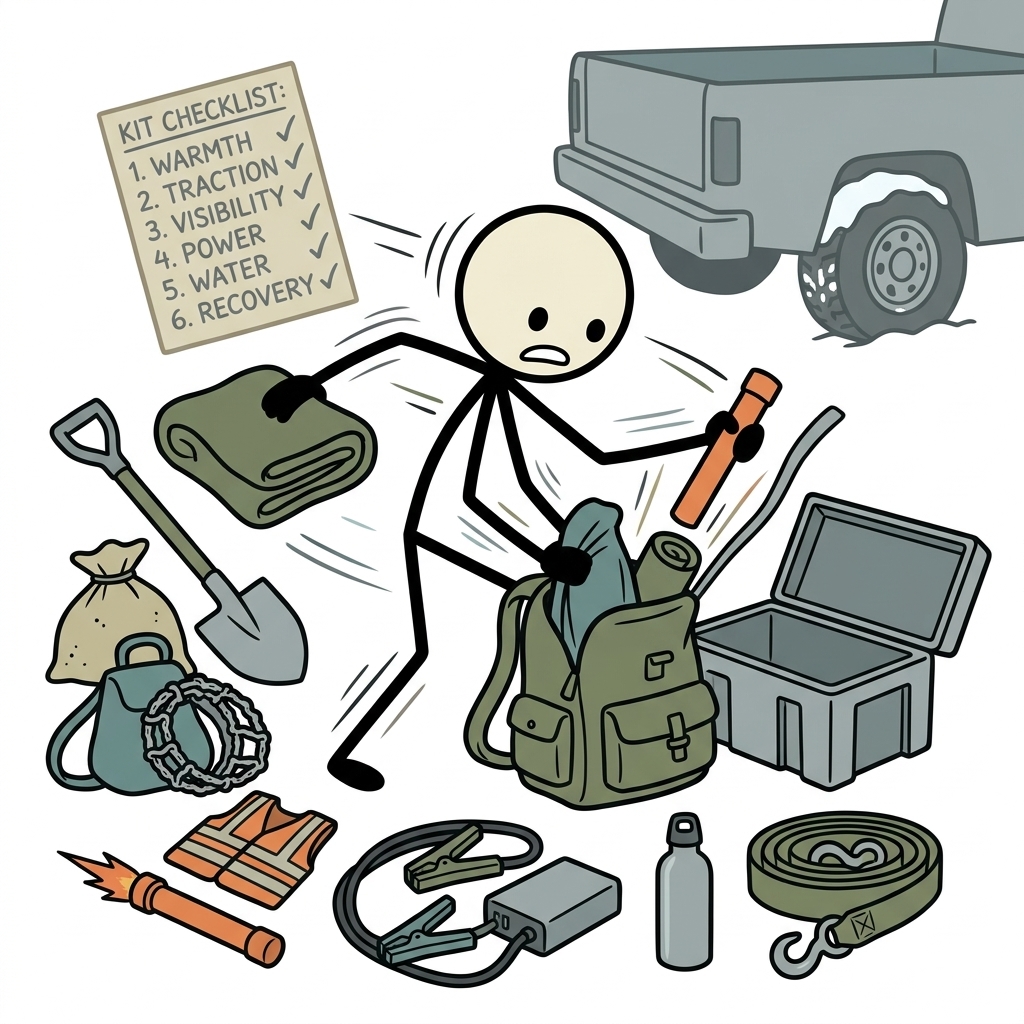
1. Warmth: The Core of Winter Survival
When your vehicle's engine fails, the cabin loses heat at an alarming rate. In sub-freezing conditions, the internal temperature of a car can drop to match the ambient outdoor temperature in less than an hour. Without a reliable heat source and adequate insulation, occupants face the immediate threat of hypothermia and frostbite. According to the CDC, protecting your core body temperature is your absolute highest priority in an emergency situation.
Passive vs. Active Warming Systems
An effective winter car emergency kit relies on a dual-layered approach to heat management: passive insulation to retain your body’s natural heat, and active heating elements to generate warmth. Passive systems are your primary defense because they do not rely on batteries or fuel that can deplete over time.
- Wool Blankets: Unlike cotton or standard synthetic blankets, wool retains up to 80% of its insulating properties even when wet. It is naturally flame-resistant and highly durable. Keep at least two heavy wool blankets in your cargo area.
- Mylar Space Blankets and Bivvy Sacks: These ultra-lightweight sheets reflect up to 90% of your radiated body heat back to you. However, they provide zero insulation from conductive heat loss (such as sitting on a cold car seat). Use them as an outer windproof layer over your wool blankets, or climb inside a Mylar bivvy sack to seal out drafts.
- Active Chemical Heat Packs: Air-activated hand, toe, and body warmers are invaluable. They can be placed inside gloves, boots, or inner pockets near major blood vessels (like the groin, armpits, and neck) to actively warm your blood supply. Ensure you store at least a dozen of these packs, checking their expiration dates annually.
The Danger of "Cotton Kills"
If you must step outside your vehicle to clear snow or assess damage, your clothing choices will dictate your survival. Cotton absorbs moisture (sweat, snow, or rain) and holds it against your skin, accelerating heat loss through conduction. Always pack a spare set of synthetic or merino wool clothing in your winter car emergency kit. This should include a heavy beanie (as significant heat is lost through the head), insulated waterproof gloves, thick wool socks, and a windproof, waterproof outer shell.
2. Traction: Regaining Control on Icy Roadways
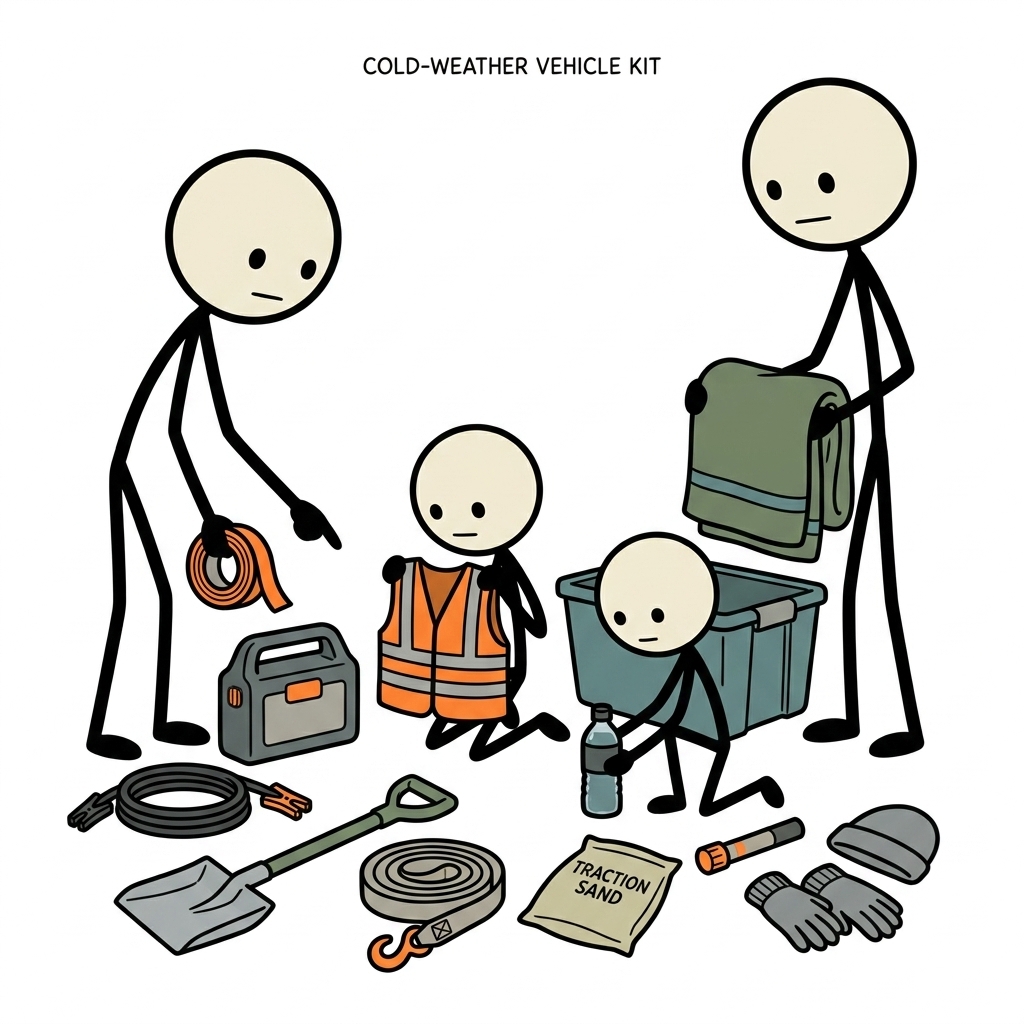
Getting stuck in a snowdrift or losing grip on an icy incline is the most common way drivers become stranded. Maintaining or regaining traction is critical to preventing minor slip-ups from turning into multi-day Survival Scenarioss. Relying solely on your vehicle's all-wheel-drive system is a dangerous mistake; mechanical systems are only as good as the physical grip their tires have on the ground.
Traction Mats vs. Improvised Gritting Agents
If your tires are spinning in a rut, continuing to press the accelerator will only melt the snow beneath the rubber, creating a smooth sheet of ice that worsens your situation. You must introduce a high-friction material between your tire tread and the slick surface.
- Dedicated Traction Mats: Heavy-duty, high-impact polypropylene traction boards (often called recovery tracks) are the gold standard. They feature deep cleats that bite into both the tire tread and the snow or mud below. They are durable, easy to clean, and can also be used as a level platform for a vehicle jack.
- Sand and Non-Clumping Kitty Litter: A 20-pound tube sand bag or a container of coarse, non-clumping clay kitty litter provides excellent grit. Sand is highly effective and adds weight to your trunk or truck bed, improving rear-wheel traction. Avoid clumping clay kitty litter, as it quickly dissolves into a slick, soapy mud when exposed to moisture, making your traction problem worse.
The Essential Snow Shovel
You cannot escape a snowdrift without clearing a path. A flimsy, plastic roadside shovel will snap when forced into packed, frozen ice. Your winter car emergency kit checklist must include a high-quality, collapsible aluminum or steel utility shovel. Look for a model with a telescoping handle and a rigid D-grip, allowing you to dig out your undercarriage, clear your exhaust pipe, and carve away hard-packed snowbanks without breaking the tool.
3. Visibility: Signaling for Help in Whiteout Conditions
During a severe blizzard, visibility can drop to near zero in seconds. The National Oceanic and Atmospheric Administration (NOAA) emphasizes that staying with your vehicle is almost always safer than attempting to walk for help in a whiteout, as search-and-rescue teams can spot a car much easier than a pedestrian. However, you must make your vehicle as visible as possible to both rescuers and other distracted drivers who might collide with your stranded car.
Modern LED Beacons vs. Incendiary Flares
While traditional chemical road flares are highly visible and can melt through ice, they burn out quickly (usually within 15 to 30 minutes) and pose a severe fire hazard near leaking automotive fluids. Modern electronic LED roadside beacons are a safer, more reliable alternative.
- LED Roadside Flares: High-quality LED beacons feature ultra-bright, 360-degree flashing patterns that can be seen from miles away. Many models are magnetic, allowing you to stick them directly to your vehicle's roof or trunk. They are waterproof, crushproof, and can run for dozens of hours on a single set of batteries.
- High-Visibility Safety Vests: If you must exit your vehicle on the side of a highway, you must wear an ANSI Class 2 or Class 3 high-visibility safety vest. Snow, sleet, and foggy windshields make it incredibly difficult for oncoming traffic to see a pedestrian dressed in dark winter clothing.
Hands-Free Lighting
Attempting to change a tire or inspect an engine while holding a flashlight in one hand is inefficient and dangerous. A high-lumen LED headlamp is an indispensable component of your winter car emergency kit emergency preparedness gear. It keeps your hands free to work, directs light exactly where your eyes are looking, and often features a red flashing strobe mode for personal signaling.
4. Power: Maintaining Communication and Vehicle Life
Cold weather is the natural enemy of battery chemistry. At freezing temperatures, the chemical reactions inside lead-acid and lithium-ion batteries slow down dramatically, reducing their capacity and voltage output. If your vehicle's battery dies, you lose your primary source of heat, emergency communication plan, and navigation.
The Portable Lithium Jump Starter
Traditional jumper cables are only useful if another vehicle is present to assist you. In a remote area or during a widespread storm, you may be entirely on your own. A portable lithium-ion jump starter pack allows you to jump-start your vehicle's engine independently.
- Capacity and Amperage: Select a jump starter rated for your specific engine size (measured in cold cranking amps, or CCA). For cold-weather environments, choose a unit with a higher peak amp rating (at least 1000A to 2000A) to overcome the stiff engine oil and sluggish battery chemistry of a frozen car.
- Thermal Management: Lithium-ion batteries lose charge when left in a freezing trunk. Keep your portable jump starter inside a small insulated bag within the vehicle cabin, or bring it indoors to charge during extreme cold snaps. Check its charge level every three months.
Heavy-Duty Jumper Cables
Never rely solely on electronics; always carry a set of heavy-duty booster cables as a mechanical backup. Cheap, thin-gauge cables (such as 10-gauge or 8-gauge) resist electrical current, which can prevent a cold engine from starting. Invest in a set of 4-gauge or 2-gauge copper-clad aluminum or pure copper cables that are at least 12 to 16 feet long, allowing you to connect to another vehicle even if you cannot park nose-to-nose.
Backup Power Banks for Devices
Your cell phone is your primary lifeline to call for emergency services. Keep a high-capacity, dedicated USB power bank in your glove compartment. Store it inside an insulated pouch to protect its battery life, and include heavy-duty charging cables compatible with all devices in your household.
5. Water and Nutrition: Hydration in Sub-Zero Environments
When people think of winter survival, they often overlook hydration. However, dehydration occurs rapidly in cold weather. The air is incredibly dry, and your body must work twice as hard to warm and humidify the cold air you breathe, resulting in significant moisture loss through respiration. The American Red Cross highlights clean drinking water as a non-negotiable component of any mobile emergency kit.
The Frozen Water Dilemma
Storing water in a vehicle during winter presents a unique physical challenge: water expands by approximately 9% when it freezes. If you store water in rigid plastic or glass bottles, they will crack, shatter, and leak once the vehicle warms up.
- Collapsible Polyurethane Flasks: Soft-sided, collapsible water flasks or heavy-duty emergency water pouches are designed to expand without bursting. Fill them only to about 75% capacity to allow room for ice expansion.
- Single-Wall Stainless Steel Bottles: Avoid double-walled, vacuum-insulated bottles for emergency Water Calculator. Instead, pack single-wall stainless steel bottles. If the water inside freezes, you can safely place the unpainted stainless steel bottle directly over a small camp stove, a candle, or your vehicle's engine block to melt the ice (ensure you remove the plastic cap first).
High-Calorie, Low-Moisture Nutrition
Your body burns a massive number of calories in the cold simply to maintain its core temperature through shivering and metabolic thermogenesis. Your winter car emergency kit checklist should feature high-calorie, shelf-stable foods that do not require cooking or water preparation.
- Avoid foods that freeze rock-hard, such as standard chocolate bars or caramel-heavy energy bars, as they can break teeth when frozen.
- Opt for high-fat, low-moisture options like raw nuts, seeds, peanut butter packets, beef jerky, and specialized emergency ration bars (which are designed to remain edible and crumbly at extreme temperatures).
6. Recovery: Self-Rescue and Mechanical Assistance
If your vehicle slides off the road into a ditch, you may need to pull it out or be pulled out by a passing motorist. Without the proper recovery gear, this process can damage your vehicle's frame, suspension, or drive components, or worse, cause catastrophic injuries to those nearby.
Tow Straps vs. Kinetic Recovery Ropes
It is vital to understand the difference between towing a vehicle on a flat road and recovering a stuck vehicle from a ditch or snowbank.
| Gear Type | Material & Physics | Primary Use Case | Safety Considerations |
|---|---|---|---|
| Tow Strap (Static) | Low-stretch polyester with metal hooks or loops. | Pulling a free-rolling vehicle over flat, clear pavement. | Do not use for snatching or jerking a stuck vehicle; the lack of stretch can rip off bumpers or snap the strap. |
| Kinetic Recovery Rope | High-stretch nylon (up to 30% elongation) that stores kinetic energy. | Yanking a heavily stuck vehicle out of deep snow, mud, or a ditch. | Must be rated for at least 3 times the gross vehicle weight (GVW) of the heavier vehicle. Use only with rated recovery points. |
Never attach a recovery strap or rope to a vehicle's suspension components, steering linkage, or a standard trailer hitch ball. Doing so can cause metal parts to shear off under extreme tension, turning them into lethal projectiles. Always connect to designated, frame-mounted recovery points or tow eyes using rated bow shackles or modern soft shackles.
Basic Mechanical Tools and Window Care
Your recovery kit should also include basic hand tools to address minor mechanical issues on the fly. A high-quality multi-tool, a roll of heavy-duty duct tape, zip ties, and a pair of leather work gloves are essential. Additionally, never travel without a brass-blade or heavy-duty polycarbonate ice scraper and snow brush to clear your windows, headlights, and side mirrors before setting off.
The Ultimate Winter Car Emergency Kit Checklist
To help you organize your gear, we have compiled this comprehensive, battle-tested winter car emergency kit checklist. Group these items into durable, waterproof storage bins in your trunk so they remain organized, dry, and easily accessible when you need them most.
Core Survival & Warmth
- [ ] 2x Heavy wool blankets (or sub-zero rated sleeping bags)
- [ ] 2x Mylar thermal bivvy sacks or space blankets
- [ ] 10x Air-activated hand and body warmers
- [ ] Spare change of clothes (wool socks, synthetic thermal base layers, fleece mid-layer)
- [ ] Waterproof insulated winter gloves, warm beanie, and balaclava
Traction & Mobility
- [ ] Collapsible aluminum or steel utility shovel
- [ ] Heavy-duty polypropylene traction mats
- [ ] 20-pound bag of tube sand or non-clumping clay kitty litter
- [ ] Set of fitted tire chains (practice installing them in dry weather first)
Visibility & Signaling
- [ ] 3x Magnetic LED roadside beacons (with spare batteries)
- [ ] ANSI Class 2 or 3 reflective safety vest
- [ ] High-lumen LED headlamp (with extra lithium batteries)
- [ ] 2x Traditional road flares (as a backup heat/light source)
- [ ] Bright orange distress flag or signaling cloth
Power & Communications
- [ ] Portable lithium-ion jump starter pack (1000A+ peak rating)
- [ ] Heavy-duty 4-gauge or 2-gauge jumper cables (12+ feet)
- [ ] High-capacity USB power bank and multi-device charging cables
- [ ] 12V car charger adapter
Water & Hydration
- [ ] 4x Collapsible polyurethane water flasks (filled to 75% capacity)
- [ ] 1x Single-wall stainless steel water bottle (for melting ice/snow)
- [ ] High-calorie emergency food storage guide rations (nuts, seeds, pemmican, specialized survival bars)
Recovery & Tools
- [ ] Kinetic recovery rope (rated for 3x your vehicle's weight)
- [ ] 2x Rated steel D-ring shackles or synthetic soft shackles
- [ ] Heavy-duty brass-blade window scraper and snow brush
- [ ] Multi-tool, duct tape, zip ties, and heavy leather work gloves
- [ ] First-aid kit containing trauma shears, bandages, antiseptic, and personal medications
Conclusion: Empowered Preparedness for the Road Ahead
Building a comprehensive winter car emergency kit is more than just an exercise in gathering gear; it is a fundamental shift in mindset. By proactively assembling these tools, you take control of your safety and ensure that you are never left helpless at the mercy of unpredictable winter weather. Before the first snowflake falls, take the time to inspect your vehicle's fluids, test your battery health, verify your tire tread depth, and pack your survival gear. Armed with knowledge, high-quality equipment, and a prepared mindset, you can navigate the coldest months of the year with the quiet confidence of a true survivor.
Frequently Asked Questions
What should a winter car emergency kit plan include?
Start with the immediate safety steps, the supplies and records your household needs, a communication plan, and a regular review schedule. Follow local official guidance during an active emergency.
How often should I review winter car emergency kit preparations?
Review them at least twice a year and whenever your household, medication, location, or local risks change. Replace expired supplies and practice key steps.
Where can I find reliable emergency guidance?
Use local emergency management alerts and established public-health or emergency-management agencies. A blog guide should support, not replace, official real-time instructions.