⚡ Key Facts
- FEMA & Red Cross Standards: Federal emergency guidelines recommend a minimum of one gallon of Water Calculator, per day, for drinking and sanitation during a disaster.
- Filter Lifespan Discrepancy: The Big Berkey leads the market with a rated lifespan of 6,000 gallons per pair of Black Berkey elements, compared to Propur’s 2,400 gallons and Alexapure’s 5,000 gallons. For the practical checklist side, use the community emergency preparedness guide.
- Fluoride Filtration Mechanics: Propur (ProOne) and Alexapure remove fluoride using a single, integrated filter element, whereas Berkey requires separate, screw-on post-filters (PF-2) that reduce lower-chamber storage capacity. For the practical checklist side, use the emergency communication plan.
- Priming Requirements: Berkey elements require manual priming (forcing water through the pores using a faucet or hand pump) before first use, while ProOne and Alexapure filters do not require priming to function.
- Structural Material: All three systems utilize high-grade 304 stainless steel housings, making them highly resistant to corrosion and physical impact during off-grid operations.
When municipal water grids fail, the clock begins ticking. According to the U.S. Environmental Protection Agency (EPA), aging infrastructure, extreme weather events, and cyber threats trigger thousands of boil water advisories across the United States every year. In a severe grid-down scenario, municipal water treatment facilities can lose power within hours, leaving millions of households without pressurized, potable water. For emergency preparedness strategists, relying on single-use plastic water bottles is a logistical dead end. A high-capacity, gravity-fed water filtration system is the single most critical asset for long-term domestic self-reliance. It transforms raw, questionable water from rain barrels, swimming pools, or local streams into biologically safe, life-sustaining drinking water without requiring electricity, plumbing, or chemical additives.
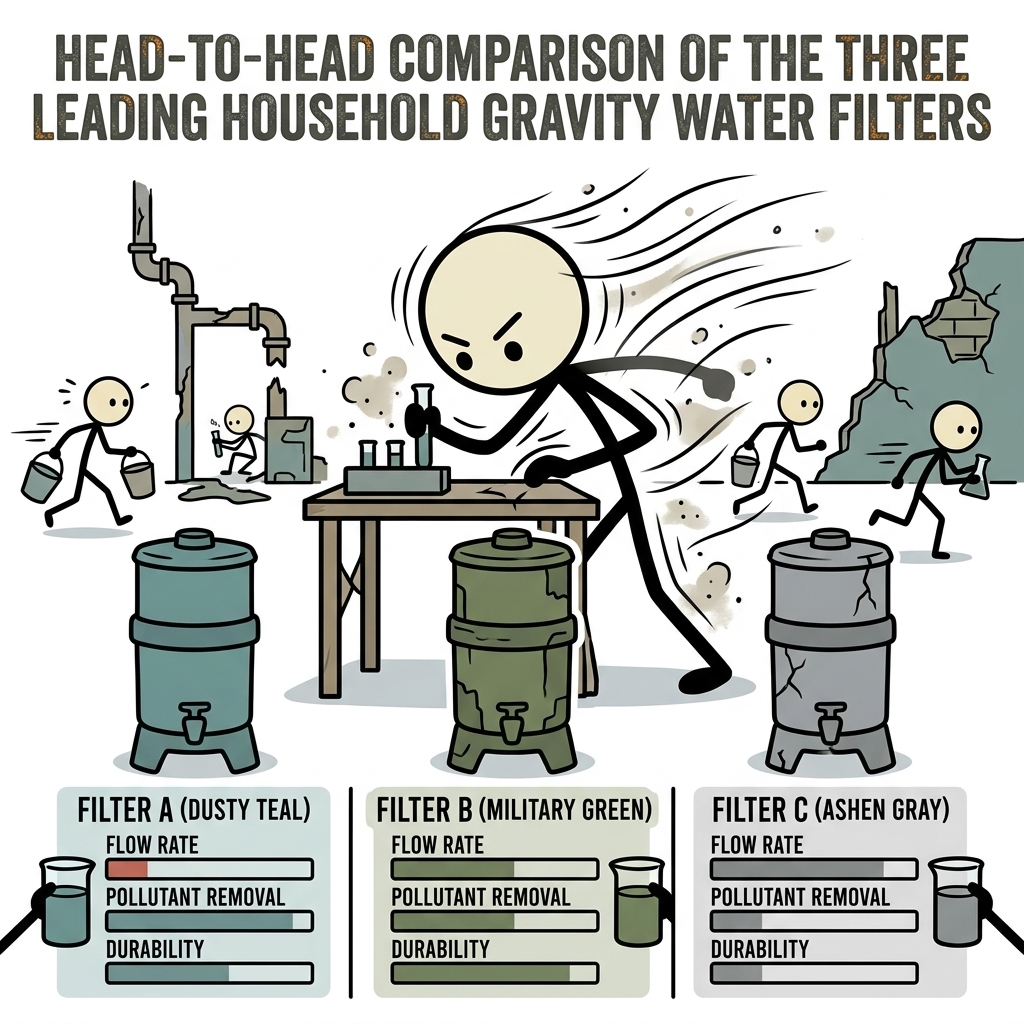
To help you make an informed investment, we have conducted a rigorous, side-by-side comparison of the three leading heavyweights in the gravity filtration market: the Big Berkey, the Propur Big (now ProOne), and the Alexapure Pro. This analysis evaluates each system across six critical dimensions: filtration efficacy, flow rate, storage capacity, filter longevity, cost per gallon, and off-grid emergency reliability. By the end of this guide, you will know precisely which system deserves a permanent place in your family's emergency pantry.
1. The Contenders: System Specifications and Design Philosophy
While all three systems operate on the same fundamental principle—using gravity to draw contaminated water from an upper chamber down through micro-porous filter elements into a lower storage chamber—their execution, filter media chemistry, and design philosophies differ significantly.
The Big Berkey: The Legacy Standard
The Big Berkey is the most recognizable name in the gravity filter industry. Constructed from highly polished 304 stainless steel, it features a 2.25-gallon holding capacity. The system utilizes the proprietary Black Berkey purification elements, which combine microfiltration, adsorption, and ion exchange. The system can house up to four Black Berkey elements simultaneously to increase flow rates. However, its most notable design characteristic is its multi-stage approach: to filter fluoride and arsenic, you must attach separate PF-2 post-filtration elements inside the lower chamber. This design increases the system's footprint and slightly reduces the net storage capacity of the lower chamber.
The Propur (ProOne) Big: The All-in-One Innovator
Propur—which has rebranded its filtration line to ProOne—approaches gravity filtration with a focus on simplicity and material integrity. The ProOne Big system features a 2.75-gallon capacity, making it slightly larger than its competitors. Its defining feature is the ProOne G2.0 filter element. Unlike the Berkey, the ProOne is an "all-in-one" filter. It utilizes a silver-infused ceramic shell combined with a proprietary granular activated carbon core that filters pathogens, heavy metals, chemical residues, and fluoride simultaneously. This eliminates the need for secondary add-on filters, leaving the lower chamber completely unobstructed.
The Alexapure Pro: The Rugged Value Challenger
The Alexapure Pro is manufactured by MyPatriotSupply, a prominent name in the emergency preparedness space. Designed specifically with the prepper in mind, the Alexapure Pro offers a 2.25-gallon capacity and is built from durable 304 stainless steel. It utilizes a single, high-capacity hybrid ceramic and carbon block filter element (the Alexapure Gravity Block). Like the ProOne, the Alexapure filter is an integrated unit that handles heavy metals, fluoride, and pathogens in a single pass. The housing is designed with a brushed finish, which resists fingerprints and field wear better than the highly polished finishes of its competitors.
2. Filtration Efficacy: Contaminant Removal and Certifications
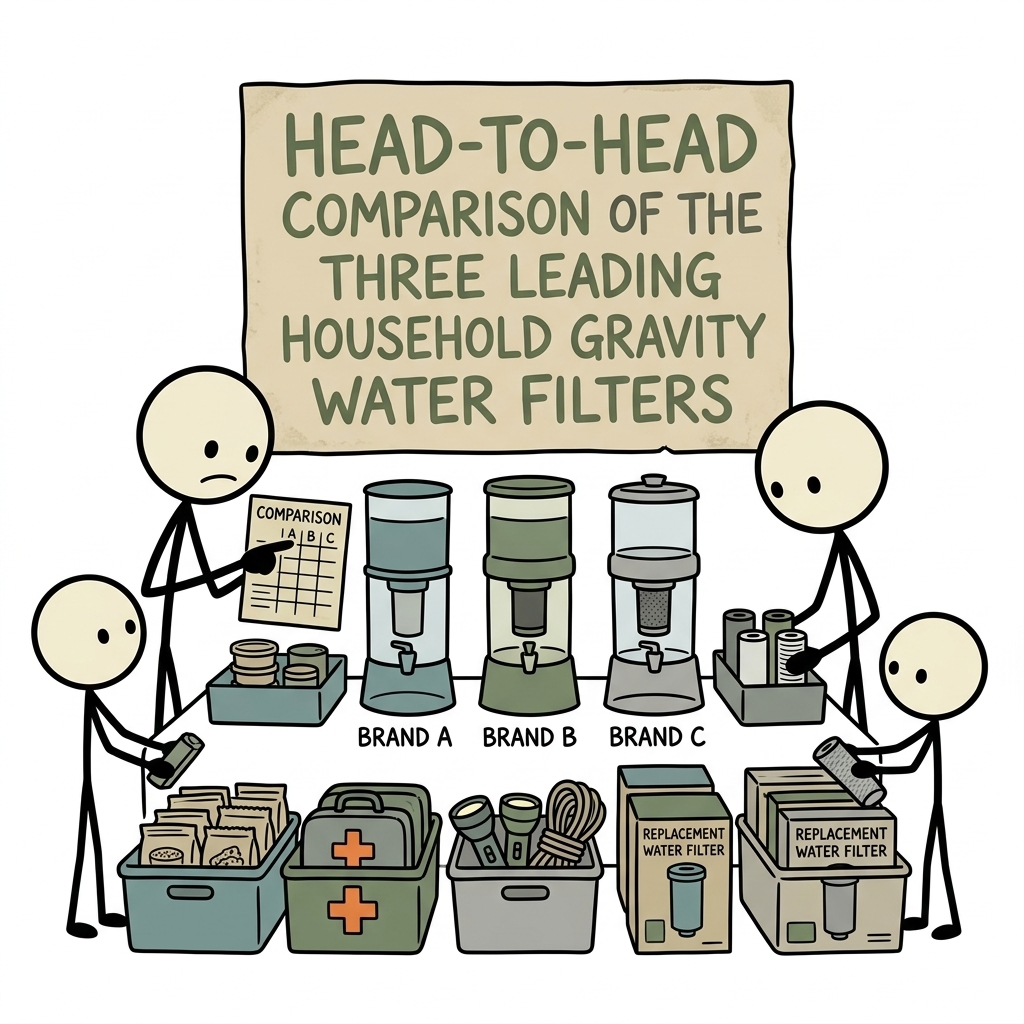
When evaluating a gravity filter for emergency prep, chemical and biological reduction capabilities are paramount. During a disaster, water sources may be contaminated with pathogenic bacteria (such as E. coli and Salmonella), protozoan parasites (such as Cryptosporidium and Giardia), heavy metals, agricultural runoff, and industrial chemicals.
Pathogen and Parasite Reduction
All three systems perform exceptionally well when protecting against waterborne biological threats. According to standards set by the Centers for Disease Control and Prevention (CDC) and the EPA, a system must achieve a log-6 reduction (99.9999%) of bacteria and a log-4 reduction (99.99%) of viruses to be classified as a true water purifier.
- Big Berkey: The Black Berkey elements are tested to remove 99.9999% of pathogenic bacteria and 99.999% of viruses. The filtration mechanism relies on a tortuous path design, where microscopic pores physically trap pathogens, combined with adsorption and micro-adsorption properties that attract and lock contaminants at the molecular level.
- Propur (ProOne): The ProOne G2.0 elements achieve a log-6 (99.9999%) reduction of bacteria and a log-5 (99.999%) reduction of viruses. Its silver-infused ceramic outer shell acts as a powerful barrier; the silver provides oligodynamic properties, which actively inhibit bacterial growth and self-sterilize the filter element over time.
- Alexapure Pro: The Alexapure Gravity Block filter matches these standards, delivering up to 99.9999% reduction of bacteria and viruses. Its hybrid block design combines a dense ceramic outer layer with an advanced carbon block core to ensure physical exclusion of biological threats.
Chemical, Heavy Metal, and Fluoride Removal
The critical divergence in the berkey vs propur water filter debate lies in how each system handles dissolved minerals, heavy metals, and fluoride.
- The Berkey Fluoride Dilemma: Standard Black Berkey elements do not remove fluoride. To achieve fluoride reduction, you must thread PF-2 fluoride filters onto the stems of the Black Berkey elements in the lower chamber. These PF-2 filters use activated alumina (aluminum oxide) to adsorb fluoride. While highly effective, this dual-filter setup is complex, requires careful washing to remove manufacturing dust, and takes up physical space in your clean water reservoir.
- ProOne's All-in-One Simplicity: The ProOne G2.0 filter removes fluoride, heavy metals, pesticides, and pharmaceuticals within a single element. It does not use activated alumina, relying instead on a proprietary carbon formulation. This design keeps the lower chamber clean and simplifies assembly.
- Alexapure's Integrated Block: Like the ProOne, the Alexapure Gravity Block removes fluoride alongside lead, mercury, and volatile organic compounds (VOCs) without secondary filters. This makes maintenance and filter replacement straightforward during high-stress emergency scenarios.
NSF/ANSI Testing Standards
Independent laboratory testing is crucial for verifying these claims. While all three manufacturers provide extensive lab reports on their websites, their certification paths differ:
- ProOne has historically prioritized independent testing conducted by laboratories accredited by the American National Standards Institute (ANSI) to meet NSF standards 42, 53, and 401.
- Alexapure publishes comprehensive test results from ISO 17025 certified laboratories, demonstrating high-percentage removals across hundreds of contaminants, including glyphosate and PFAS.
- Berkey has faced regulatory scrutiny and legal challenges regarding its classification as a pesticide device by the EPA, as well as the lack of official NSF certifications for its complete systems, though they maintain that their independent testing (by labs like Envirotek) proves their filtration claims.
3. Flow Rate and Daily Capacity: Gravity vs. Time
In a Survival Scenarios, a filter's flow rate dictates how efficiently you can hydrate a group, sanitize medical equipment, and cook. Gravity filtration is inherently slow; it relies on the weight of the water in the upper chamber to push molecules through dense filter media. As the water level in the upper chamber drops, the hydrostatic pressure decreases, which slows the filtration rate.
To understand the performance differences, let's look at how these systems compare under standard operating conditions:
| System Model | Holding Capacity | Standard Filter Configuration | Flow Rate (Gallons/Hour) | Max Filter Capacity | Max Flow Rate (Gallons/Hour) |
|---|---|---|---|---|---|
| Big Berkey | 2.25 Gallons | 2 Black Elements | ~3.5 Gallons/Hour | 4 Black Elements | ~7.0 Gallons/Hour |
| Propur (ProOne) Big | 2.75 Gallons | 2 G2.0 9" Elements | ~1.5 to 2.0 Gallons/Hour | 4 G2.0 9" Elements | ~3.5 to 4.0 Gallons/Hour |
| Alexapure Pro | 2.25 Gallons | 1 Gravity Block | ~1.0 Gallon/Hour | 4 Gravity Blocks | ~4.0 Gallons/Hour |
The big berkey filter review data consistently highlights its superior flow rate. With two Black Berkey elements installed, it processes water nearly twice as fast as the ProOne Big and three times as fast as a single-filter Alexapure Pro. The Berkey's faster flow rate is due to the high porosity of its carbon-composite elements. However, this speed comes with a trade-off: more porous filters can saturate faster when processing highly turbid (muddy or sediment-heavy) water, requiring more frequent maintenance.
The ProOne G2.0 filters feature a dense ceramic outer shell that naturally slows water passage, resulting in a lower flow rate. However, this slower contact time can improve chemical adsorption. The Alexapure Pro, when configured with its single standard filter, is the slowest of the three. For a family of four or more, adding a second Alexapure filter is highly recommended to ensure you can meet daily water requirements without long wait times.
4. Filter Longevity and Cost-Per-Gallon Analysis
Acquisition cost is only one part of the financial equation. To find the true cost of ownership, you must calculate the long-term cost per gallon of filtered water. This is determined by dividing the replacement cost of the filter elements by their rated lifespan.
The Math Behind the Lifespans
Let’s analyze the operational costs of each system based on standard manufacturer retail prices and rated lifespans:
1. Big Berkey Cost Analysis
- Initial Investment: ~$450 (includes stainless steel housing and 2 Black Berkey elements).
- Filter Lifespan (Standard): 6,000 gallons per pair of Black Berkey elements.
- Replacement Filter Cost: ~$190 per pair.
- Base Cost Per Gallon: $190 / 6,000 = $0.031 per gallon.
- The Fluoride Variable: If you require fluoride filtration, you must add PF-2 filters. A pair of PF-2 filters costs ~$90 and lasts for 1,000 gallons. To filter 6,000 gallons of fluoride-free water, you will need 6 pairs of PF-2 filters ($540). This increases your total replacement cost to $730, raising the cost per gallon to $0.121 per gallon.
2. Propur (ProOne) Big Cost Analysis
- Initial Investment: ~$350 (includes housing and 2 ProOne G2.0 9" elements).
- Filter Lifespan (Standard): Up to 2,400 gallons per pair of 9" elements.
- Replacement Filter Cost: ~$160 per pair.
- Cost Per Gallon (Integrated Fluoride): $160 / 2,400 = $0.066 per gallon.
3. Alexapure Pro Cost Analysis
- Initial Investment: ~$280 (includes housing and 1 Alexapure Gravity Block).
- Filter Lifespan (Standard): Up to 5,000 gallons per filter (depending on water turbidity).
- Replacement Filter Cost: ~$130 per filter.
- Cost Per Gallon (Integrated Fluoride): $130 / 5,000 = $0.026 per gallon.
A direct alexapure vs berkey comparison reveals that the Alexapure Pro offers excellent long-term value, provided you do not need to process highly turbid water. If you are filtering municipal tap water or relatively clear rainwater, the Alexapure's 5,000-gallon single-filter capacity delivers an exceptionally low cost per gallon. However, if you require fluoride filtration, the ProOne system remains highly competitive. It avoids the added cost, complexity, and physical space requirements of the Berkey's secondary PF-2 post-filters.
5. Emergency Reliability: Off-Grid and Field Performance
When municipal infrastructure fails, you may have to source water from rivers, ponds, or swimming pools. In these situations, laboratory flow rates on clean tap water are no longer relevant. You must evaluate how each system handles real-world, high-turbidity water under survival conditions.
Priming in the Field
One of the most critical factors when choosing a best gravity water filter emergency scenarios require is whether the filter elements need to be primed before use. Priming is the process of saturating the filter media to displace trapped air pockets, which allows water to flow freely under low gravity pressure.
The Black Berkey elements require priming before their first use and after long periods of storage. The standard priming method involves pressing a rubber washer against a pressurized sink faucet to force tap water through the filter pores. In a grid-down situation where municipal tap pressure is unavailable, priming a new or dry Berkey element can be difficult. While you can prime them using a manual priming pump (sold separately), this adds another point of failure and expense to your emergency kit.
In contrast, both the ProOne G2.0 and the Alexapure Gravity Block filters do not require priming. You simply assemble the system, fill the upper chamber, and let gravity do the work. For emergency preparedness, this plug-and-play capability is a major advantage.
Handling High-Turbidity (Muddy) Water
Suspended solids like silt, clay, and organic matter will quickly clog any micro-porous gravity filter. If you pour muddy pond water directly into your system, the flow rate will quickly drop to a slow drip.
- Cleaning the Berkey: Black Berkey elements can be cleaned and restored in the field. You can scrub the outer surface with a non-scratch Scotch-Brite pad under running water to remove the clogged outer layer and restore the flow rate. This process can be repeated multiple times over the life of the filter.
- Cleaning the ProOne: The ProOne's ceramic outer shell is also designed for field maintenance. When the flow rate slows, you can scrub the ceramic dome with a scrub pad to expose fresh, unclogged ceramic pores.
- Cleaning the Alexapure: The Alexapure Gravity Block can be cleaned in a similar manner, though its hybrid block structure is slightly more sensitive to aggressive scrubbing. It is highly recommended to pre-filter turbid water through a clean cloth, coffee filter, or sediment bucket before pouring it into any of these systems to extend the life of your primary filters.
Physical Durability and Component Quality
In a disaster scenario, your equipment must be rugged enough to handle transport and rough handling. All three brands use durable 304 stainless steel chambers that nest inside one another for compact storage and transport. However, the hardware and accessories included with each system vary:
- Spigots: The Big Berkey and Alexapure Pro ship with standard plastic spigots. These plastic spigots are functional but can be prone to cross-threading or cracking under heavy use. ProOne stands out by including a high-quality, solid stainless steel spigot as standard equipment. For the other systems, upgrading to a metal spigot is a highly recommended safety measure.
- Lids and Knobs: The Berkey and ProOne lids feature simple screw-on knobs. The Alexapure Pro features an easy-to-grip handle integrated into the lid design, making it easier to lift and refill during high-volume use.
6. Head-to-Head Comparison Matrix
To summarize the key differences, the table below provides a direct comparison of the Big Berkey, ProOne Big, and Alexapure Pro across all major performance metrics:
| Feature / Metric | Big Berkey | ProOne Big | Alexapure Pro |
|---|---|---|---|
| Chamber Capacity | 2.25 Gallons | 2.75 Gallons | 2.25 Gallons |
| Housing Material | 304 Polished Stainless Steel | 304 Polished Stainless Steel | 304 Brushed Stainless Steel |
| Filter Lifespan (Pair) | 6,000 Gallons | 2,400 Gallons | 5,000 Gallons (Single Filter) |
| Fluoride Removal Method | Requires PF-2 Post-Filters (Adsorption) | Integrated G2.0 Element (Carbon/Ceramic) | Integrated Gravity Block (Carbon/Ceramic) |
| Priming Required? | Yes (Requires faucet or hand pump) | No | No |
| Standard Flow Rate | Fast (~3.5 gal/hr with 2 filters) | Moderate (~1.5–2.0 gal/hr with 2 filters) | Slow (~1.0 gal/hr with 1 filter) |
| Included Spigot | BPA-free Plastic (Metal upgrade available) | Solid Stainless Steel | BPA-free Plastic (Metal upgrade available) |
| Field Cleanable? | Yes (Scrub outer surface) | Yes (Scrub ceramic dome) | Yes (Scrub carbon block) |
7. The Verdict: Which System Belongs in Your Emergency Plan?
Choosing the right gravity water filter depends on your household size, your local water quality concerns, and your emergency preparedness strategy. None of these systems are poor choices; all three will reliably produce biologically safe drinking water from contaminated sources. However, they excel in different areas:
Choose the Big Berkey if your primary concern is high-volume water production and speed. If you have a large family or need to process water for a neighborhood preparedness network group, the Berkey’s fast flow rate and expandable 4-filter configuration make it the clear winner. Just be sure to add a manual priming pump to your storage kit so you can prime the elements during a power outage.
Choose the ProOne (Propur) Big if you want a simple, reliable system with high-quality components right out of the box. Its all-in-one G2.0 filter removes fluoride and heavy metals without the need for secondary post-filters, and it does not require priming. The included stainless steel spigot and larger 2.75-gallon capacity make it an incredibly durable, low-maintenance choice for off-grid survival.
Choose the Alexapure Pro if you are looking for the best balance of value, longevity, and ease of use. With its high-capacity 5,000-gallon filter, brushed stainless steel finish, and simple, no-prime operation, it offers an exceptional cost-per-gallon ratio. It is an ideal choice for budget-conscious preppers who want a reliable system ready for immediate deployment when the grid goes down.
In any emergency scenario, clean water is your first and most critical line of defense. Whichever system you choose, secure your unit, store a set of replacement filters in a cool, dry place, and familiarize yourself with its assembly and maintenance before you need to rely on it. True
Frequently Asked Questions
What is a gravity water filter and how does it work?
Gravity water filters use gravity to pull water through ceramic or carbon block filter elements in a two-chamber stainless steel system — no power or pump required. Most filter 1-4 gallons per hour and treat water from lakes, rivers, and questionable tap water to safe drinking quality.
How does the Big Berkey compare to its competitors?
Big Berkey uses Black Berkey elements with excellent contamination reduction (2.75 gallons/hour, 9.5 gallon capacity). Propur uses ProOne elements with comparable filtration, often with higher virus reduction ratings. Alexapure Pro is the budget option at $150-200 vs $300+ for Berkey.
What contaminants do gravity filters remove?
Quality gravity filters reduce: bacteria (99.9999%+), protozoa (Giardia, Cryptosporidium), heavy metals (lead, arsenic, mercury), chlorine and chloramines, pesticides and herbicides, and many VOCs. Most do not remove dissolved minerals, and some viruses require additional treatment.