⚡ Key Facts
- Indefinite Shelf Stability: According to the U.S. Department of Agriculture (USDA), commercially canned foods remain safe to consume indefinitely if the can remains structurally intact, undamaged, and stored in optimal conditions.
- Quality vs. Safety: The "Best By" and "Use By" stamps found on commercially canned goods are indicators of peak sensory quality and nutritional potency, not federally mandated safety deadlines (with the sole exception of infant formula).
- pH Drives Longevity: Low-acid canned foods (meats, stews, beans) maintain peak structural safety and taste for 2 to 5 years past production dates, while high-acid items (tomatoes, pineapple, sauerkraut) degrade chemically within 12 to 18 months due to ambient acid-metal interaction.
- The Lethal Pathogen: The Centers for Disease Control and Prevention (CDC) warns that Clostridium botulinum spores thrive in the anaerobic (oxygen-free), low-acid, and moist environment of sealed cans, producing a neurotoxin that is completely invisible, tasteless, and odorless.
- Thermal Decay Factor: Sustained storage temperatures above 70°F (21°C) significantly accelerate nutrient loss and chemical decomposition, effectively doubling the rate of food quality degradation for every 18°F (10°C) increase.
When supply chains fracture during prolonged grid-down scenarios or severe natural disasters, your pantry transforms from a simple convenience into a life-support system. In the wake of major weather events like Superstorm Sandy or Hurricane Katrina, relief agencies such as the Federal Emergency Management Agency (FEMA) and the American Red Cross consistently documented that households possessing a resilient, non-perishable food cache were dramatically better equipped to shelter in place without outside intervention. Yet, during emergencies, thousands of pounds of viable rations are prematurely discarded due to widespread misunderstanding of date labeling, while dangerous, compromised cans are unwittingly consumed due to a failure to recognize microscopic structural breaches. Understanding the science behind canned food shelf life, the mechanics of food preservation, and the definitive bio-markers of spoilage is a foundational pillar of operational readiness. For the practical checklist side, use the community emergency preparedness guide.
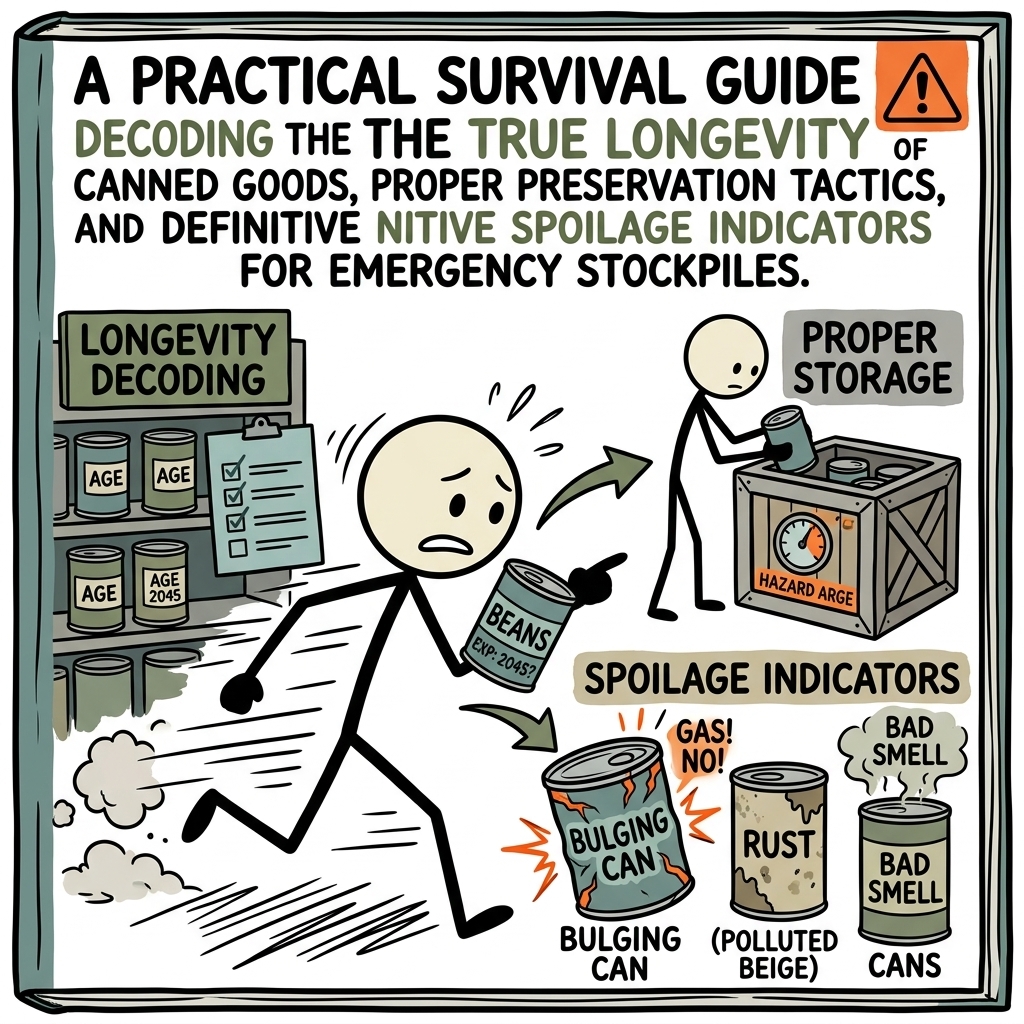
Decoding the Code: Expiration Dates vs. Actual Shelf Stability
The modern consumer market is dominated by an obsession with printed dates. However, the prepper community must operate on empirical scientific principles rather than corporate inventory rotation conventions. To properly manage an emergency emergency food storage guide, you must first demystify what the numbers stamped on the steel cylinder actually represent.
The USDA Food Safety and Inspection Service (FSIS) explicitly states that canned food expiration dates are not federally mandated safety markers. Instead, manufacturers utilize these dates to establish the period during which the product will display its optimal flavor, color, texture, and vitamin retention. Aside from infant formula, federal law does not require commercial food packagers to mark a date indicating when a shelf-stable food becomes dangerous to eat. For the practical checklist side, use the neighborhood preparedness network.
The Three Major Date Distinctions
- "Best if Used By / Before": This date informs consumers of the peak quality window. After this threshold, the food may suffer minor textural degradation, color changes, or slight vitamin loss, but it does not spontaneously become toxic.
- "Sell By": This is an inventory-control mechanism tailored for grocery stores, indicating how long the retail establishment should display the item for sale. It typically leaves a substantial safety buffer for home storage.
- "Use By": While often interpreted as a hard drop-dead date, this simply marks the final date guaranteed by the manufacturer for the product's peak culinary experience.
How long does canned food last when evaluated through an objective survival lens? The short answer: decades, under the right conditions. In 1974, testing conducted by the National Food Processors Association on canned provisions recovered from the steamboat Bertrand—which sank in 1865—revealed that 109-year-old cans of peaches, oysters, and tomatoes were still microbiologically safe. While the food had lost its visual appeal and smelled stale, no microbial growth had occurred. A properly executed industrial seal completely isolates the interior biomass from microbial contamination, halting biological decay entirely. For the practical checklist side, use the emergency communication plan.
The Science of the Can: Retort Processing and Hermetic Sealing
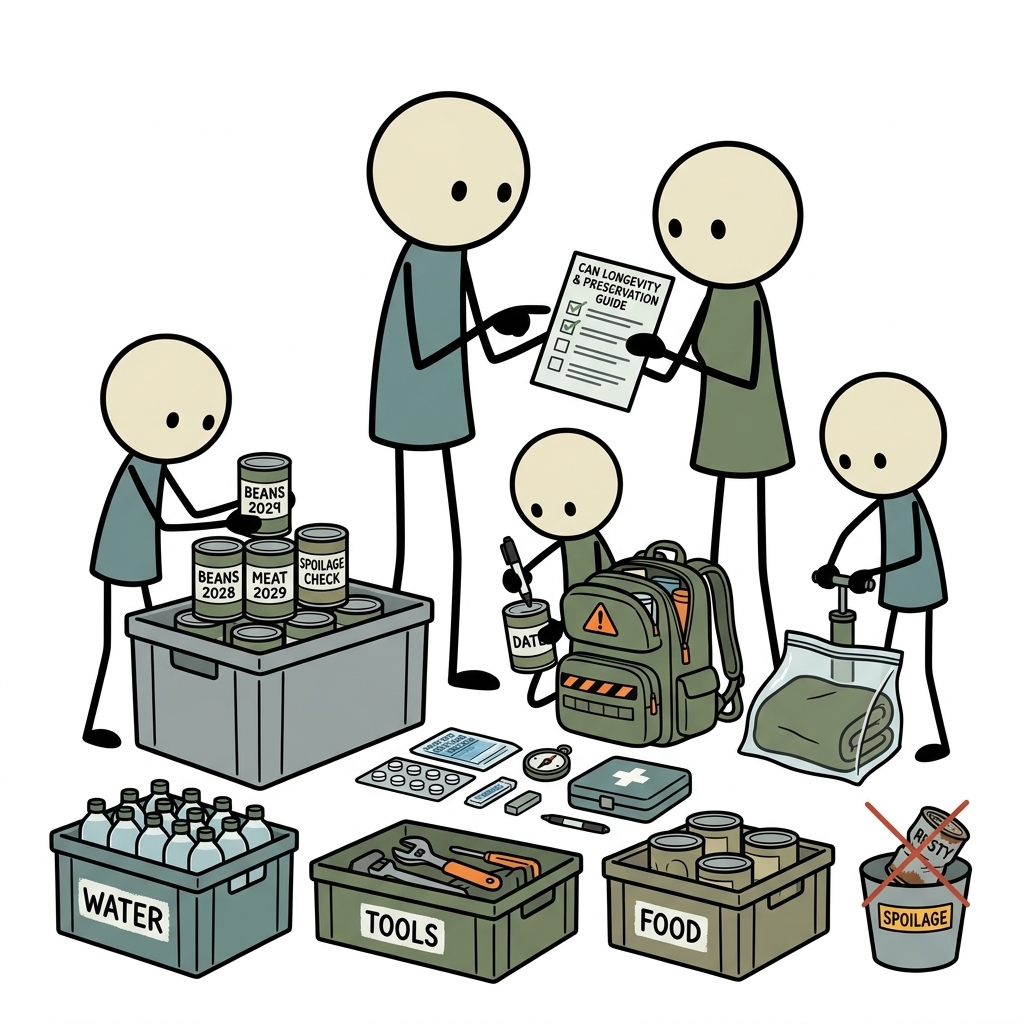
To trust your emergency stores, you must understand the industrial engineering that keeps food preserved without chemical additives. The commercial canning process relies on a two-pronged physical defense: extreme thermal processing (retort cooking) and a hermetic (airtight) mechanical seal.
During retort processing, filled and sealed cans are subjected to pressurized steam cooking at temperatures between 240°F and 250°F (116°C to 121°C). This level of heat exceeds normal boiling points and is specifically calibrated to reach the thermal death point of Clostridium botulinum endospores, the hardiest biological threat in food preservation. Once these spores are destroyed and the interior oxygen is purged by steam displacement, the container cools, generating an internal partial vacuum that pulls the steel lid tight.
The structural integrity of this barrier depends on the double seam. A double seam is an interlocking mechanical joint formed by folding the end curl of the lid together with the flange of the can body through two sequential rolling operations. This mechanical friction joint is fortified with a polymeric sealing compound that cures inside the seam, preventing the ingress of air, moisture, and micro-pathogens. As long as this physical barrier is uncompromised, the contents remain commercially sterile.
High-Acid vs. Low-Acid Chemistry: The Longevity Matrix
Not all canned goods age at the same rate. The chemical composition of the food inside the container dictates its safe functional timeline far more aggressively than the steel exterior. Food scientists categorize canned provisions into two primary categories based on pH: low-acid foods and high-acid foods.
Low-Acid Provisions: The Long-Term Anchors
Foods possessing an equilibrium pH value greater than 4.6 are classified as low-acid. This category forms the structural baseline of your survival caloric reserves.
- Examples: Canned meats (beef, chicken, tuna, pork), poultry, stews, hearty soups, whole kernel corn, pinto and black beans, lentils, peas, and potatoes.
- Safe Horizon: 2 to 5 years past the printed date for standard culinary enjoyment; safe indefinitely for basic survival sustenance if the container is mechanically uncompromised.
- Chemical Behavior: Because these foods lack aggressive chemical acids, the inner protective coating of the can remains intact. The primary degradation over decades is the physical softening of vegetable cellulose, slight gelatinization of proteins, and minimal color shifts due to chemical maillard browning reactions over time.
High-Acid Provisions: The Time-Sensitive Nutrients
Foods with a natural or acidified pH of 4.6 or lower fall into the high-acid category. While acidity is an exceptional natural barrier against microbial proliferation, it acts as an internal corrosive agent against the vessel itself.
- Examples: Diced tomatoes, tomato pastes, citrus fruits, pineapple, pickles, sauerkraut, and foods packed in heavy vinegar-based sauces.
- Safe Horizon: 12 to 18 months from the date of manufacture. Consumption past 2 years frequently results in metallic off-flavors and degraded textures.
- Chemical Behavior: Over extended periods, the natural fruit and acetic acids interact with the tinplate or interior enamel lining. This acid interaction gradually breaks down the interior polymer coating, eventually causing pinhole micro-leaks, off-gassing, or a distinct, unpalatable metallic leaching. High-acid foods must be prioritized for continuous pantry rotation.
Emergency Canned Food Storage: Environmental Tactics
The theoretical shelf stability of canned goods is instantly nullified if you subject the containers to hostile environmental conditions. Establishing an optimal emergency canned food storage strategy requires mitigating four primary environmental adversaries: thermal fluctuations, relative humidity, direct light, and physical impact.
1. Thermal Regulation: The 50°F to 70°F Envelope
Temperature is the single greatest catalyst for biochemical degradation. Heat drives chemical reactions; for every 18°F (10°C) increase above ambient room temperature, the rate of nutritional decay and structural lining breakdown accelerates dramatically. Storing your rations in an uninsulated garage, an attic space, or an external outbuilding where summer temperatures surge past 90°F (32°C) can ruin a five-year stockpile in under twelve months.
The ideal operational storage temperature spans between 50°F and 70°F (10°C to 21°C). FEMA and CDC preparedness guidelines uniformly advise seeking the coolest, thermally stable area of your domicile, such as a dry subterranean basement, a climate-regulated interior closet, or an under-bed clearance away from heating vents and direct exterior walls.
2. Humidity Management and Rust Prevention
High ambient moisture creates external rust (iron oxidation) on the can's tinplate steel shell. Surface rust that can be wiped clean with a dry cloth without leaving pitted indentations is non-critical. However, deep, pitted rust chemically perforates the microscopic thickness of the steel, introducing oxygen and environmental spores into the sterile vacuum chamber.
Maintain relative humidity (RH) levels below 60% in your storage footprint. If you are caching food in subterranean basements prone to dampness, employ a continuous-drain dehumidifier. Never place cans directly onto bare, porous concrete floors; concrete naturally wicks moisture up from the earth via capillary action, corroding the base seams of your bottom cans. Elevate your caches on wooden pallets, plastic shelving units, or sealed shelving systems.
3. Physical Impact and Mechanical Stress
Cans must be protected from significant mechanical trauma. A sudden drop onto a hard floor can flex the double seam just enough to breach the seal for a fraction of a second—a phenomenon known as "microbial aspiration"—sucking in ambient air before re-sealing. Store cans securely on sturdy shelving equipped with retaining lips or bungee cords if you inhabit regions prone to seismic events, as mapped by the United States Geological Survey (USGS).
Definitive Signs of Spoiled Canned Food: The Diagnostic Checklist
When society functions normally, throwing away a questionable can of soup is a mild financial inconvenience. In an acute Survival Scenarios, consuming a contaminated can could lead to incapacitating illness or fatal foodborne intoxication, while throwing away safe food depletes your operational timeline. You must learn to execute a rigorous, clinical physical inspection before opening and consuming any stored provision.
Commit this four-stage sensory inspection process to memory. If a can fails any single metric, it must be designated hazardous waste.
Phase 1: The Visual & Structural Exterior Triage
- Bulging or Swollen Cans: This is a catastrophic fail condition. If the top or bottom lid is domed outward, or if the can rocks back and forth when placed flat, anaerobic bacteria have proliferated within, generating carbon dioxide or hydrogen gas as byproducts. The can is a pressurized biohazard.
- Compromised Rim Seams: Closely inspect the double seam running around the top and bottom circumference. Any dent that crosses, pinches, or fractures this seam breaks the mechanical barrier. Dents located on the flat side of the can are generally acceptable, provided they are gentle and do not feature sharp, creased metal edges.
- Deep Pitted Corrosion: Scrape away any visible rust using your thumb. If the rust leaves a visible dark crater or pit in the steel, assume microscopic structural failure has occurred.
- Signs of External Seepage: Any dried fluid, sticky residue, or crust along the rim seams indicates that contents have escaped under internal pressure or an external breach has compromised the hermetic environment.
Phase 2: The Auditory Opening Inspection
- The Pressure Release Sound: When you puncture the lid with a manual can opener, you should hear a distinct, sharp inward vacuum "hiss." This verifies that the factory pressure differential remained functional.
- The Explosive Ejection: If puncturing the lid results in an outward burst of liquid, foam, or gaseous hiss, the can is pressurized with microbial gas. Step back and discard immediately.
Phase 3: The Olfactory Diagnostic
- Off-Odors: Trust your evolutionary biological warning systems. If an opened low-acid food emits a putrid, sour, ammonia-like, or sulfurous stench, it has undergone microbial breakdown.
- Metallic Chemical Smells: High-acid foods that have degraded the tinplate liner will emit an acrid, sharp, chemical-metallic odor, signaling severe chemical dissolution.
Phase 4: Visual Examination of the Contents
- Unnatural Froth and Foam: The presence of bubbles, foam, or a slimy film floating on the surface of liquid broth or sauces indicates active bacterial fermentation.
- Severe Discoloration: While slight darkening of meat surfaces exposed to headspace air is a normal oxidation reaction, complete graying, black discoloration, or unnatural neon colorations signal deep biochemical collapse.
The Threat of Botulism: The Invisible Killer
The most dangerous foodborne pathogen encountered in emergency food storage is Clostridium botulinum. The CDC highlights that while foodborne botulism outbreaks are statistically rare in commercial food products—largely confined to home-canning procedural errors—the consequences of ingestion are devastating.
The botulinum neurotoxin is among the most lethal substances known to science. It acts by blocking the release of acetylcholine at the neuromuscular junction, precipitating symmetrical descending flaccid paralysis that begins with cranial nerves (causing blurred vision, drooping eyelids, and difficulty swallowing) before paralyzing the respiratory muscles and diaphragm. Without prompt intensive medical care and administration of botulism antitoxin, mortality is high.
Crucially, botulinum toxin does not smell, does not taste bad, and does not look strange. While other common spoilage organisms produce foul gases that visibly bulge cans, pure botulinum contamination can theoretically exist inside an apparently unswollen, benign-looking container if the vacuum was maintained during partial sterilization failure. For this reason, you must adhere strictly to the classic survival edict: "When in doubt, throw it out." Never, under any circumstances, "taste-test" questionable canned goods to determine safety.
If you face a catastrophic scenario where you are forced to consume canned items of questionable provenance that show no signs of physical, auditory, or olfactory spoilage, the World Health Organization (WHO) and USDA note that botulinum neurotoxin is heat-labile. Boiling the food vigorously at a rolling boil (212°F / 100°C) for at least 10 continuous minutes will denature and destroy the active toxin. However, heat will not neutralize chemical toxins produced by other organisms, such as Staphylococcus aureus enterotoxins, making boiling a survival measure of last resort, not a substitute for proper inspection.
Nutritional Reality: What Degrades and What Remains
Survival is not merely about accumulating pure calories; it requires maintaining physical vitality, cognitive clarity, and immune function under severe physical stress. While canned foods maintain their caloric viability for years, their micronutrient density undergoes a steady, measurable decay curve.
The Stable Macronutrients
Macronutrients—proteins, carbohydrates, and dietary fats—are resilient molecular structures. The caloric payload of your canned meat, beans, and stews remains functionally unchanged whether the can is one year old or fifteen years old. The amino acids that build muscle and the complex carbohydrates that provide energy do not simply vanish within a sealed system.
The Vulnerable Micronutrients
Micronutrients exhibit varying degrees of vulnerability to thermal storage conditions and aging:
- Vitamins A, D, E, and K (Fat-Soluble): These vitamins display moderate stability over time. While they suffer a minor initial hit during the high-heat commercial canning phase, their ongoing loss during room-temperature storage is low, roughly 5% to 10% annually.
- Vitamin C and B-Complex Vitamins (Water-Soluble): These are fragile, heat-sensitive, and chemically reactive. Vitamin C degrades steadily over time, often dropping by 50% or more after two to three years of room-temperature storage. Thiamine (Vitamin B1) follows a similar downward trajectory.
- Minerals (Iron, Calcium, Potassium, Zinc): Minerals are elements; they cannot be chemically broken down by canning heat, time, or storage. The mineral content of canned food is effectively permanent, remaining stable for decades.
To offset the predictable nutritional degradation of long-stored canned reserves, augment your emergency stockpile with high-potency, vacuum-sealed multivitamins, mineral supplements, and shelf-stable sources of Vitamin C (such as sealed ascorbic acid powder or electrolyte packs).
The FIFO Protocol: Operational Pantry Management
The most reliable method to ensure your family never relies on degraded or spoiled food during a crisis is institutionalizing the First In, First Out (FIFO) protocol. This industrial inventory management practice ensures that the oldest assets are consumed first, continuously resetting your expiration horizons.
Tactical Stockpile Management Steps
- Date Marking Upon Arrival: Factory date codes are frequently printed in small, illegible alphanumeric codes. The moment you purchase canned goods, use a bold, broad-tipped black permanent marker to write the month and year of acquisition directly onto the top lid.
- Systematic Rotation Shelving: Organize your pantry shelves so that freshly acquired inventory is placed at the back of the row, forcing you to pull the oldest stock from the front. Alternatively, invest in or construct gravity-fed can rotation racks that automate this flow.
- Category Segregation: Separate your low-acid structural staples (beans, meats, soups) from your high-acid perishable items (tomatoes, fruits). Because high-acid items decay three times faster, they require an aggressive, conscious rotation schedule into your daily, non-emergency cooking.
- The "Eat What You Store" Rule: Never purchase bulk emergency foods that you do not routinely consume in your everyday diet. Consuming familiar foods prevents gastrointestinal shock during stressful scenarios and makes running an organic, rolling FIFO system effortless.
Hardware Redundancy: The Critical Failure Point
A cache of five hundred cans of dense stew and protein is entirely useless if you cannot access the contents without lacerating your hands or expending precious calories trying to breach the steel with blunt instruments. Can openers represent a single point of failure in food preparedness.
Electric openers are completely non-viable during prolonged blackouts. Standard commercial manual twist-style can openers contain small gears, plastic handles, and cutting wheels that strip, crack, or slip under high-volume use. Your preparedness plan must integrate high-redundancy, mechanical breach tools.
- Primary Tool: Heavy-duty, all-metal commercial manual openers with hardened steel cutting wheels (such as American-made industrial swing-away variants).
- Secondary Tool: The venerable military-surplus P-38 and P-51 fold-out can openers. These stamp-steel folding blades weigh almost nothing, have zero moving mechanical parts that can jam, and can be worn on keychains or stored within survival go-bags. Keep half a dozen of these dispersed across your gear caches.
- Emergency Field-Expedient Knowledge: In an absolute worst-case scenario where all mechanical tools are lost, you can open a standard can by turning it upside down and rubbing the top rim with firm downward pressure against a flat, abrasive stone, concrete surface, or asphalt. This friction grinds away the thin rolled metal outer lip of the double seam. Once the bead is ground through, squeeze the sides of the can, and the lid will pop cleanly out without spilling the food.
Building an Enduring Emergency Stockpile
True emergency preparedness relies on disciplined knowledge rather than blind faith in stamped numbers or fear-driven stockpiling. Commercially canned goods remain one of the most reliable, cost-effective, and caloric shields against crisis, disease, and societal disruption available to the modern prepper. By matching your storage environment to strict thermal and moisture guidelines, mastering the tactile and visual markers of biological spoilage, and enforcing an active inventory rotation system, you ensure that your emergency pantry remains safe, potent, and mission-ready when your family needs it most.
Frequently Asked Questions
How long does canned food actually remain safe past its printed expiration date?
Most commercially canned foods remain safe indefinitely if the container remains intact. Low-acid canned items like meat, poultry, beans, and stews maintain peak quality for 2 to 5 years past the date, while high-acid foods like canned tomatoes, citrus, and pickles stay optimal for 12 to 18 months.
What is the optimal storage environment for canned emergency food?
Canned goods should be stored off the floor in a cool, dark, and dry environment between 50°F and 70°F (10°C to 21°C). Damp basements cause rust that compromises seals, while temperatures consistently above 95°F accelerate nutrient degradation and spoilage.
What are the definitive signs that a can of food must be thrown out?
Discard cans immediately if they show bulging or swollen lids, deep dents along seams, leaking, extensive rusting, or if they hiss loudly, spurt liquid, or emit foul odors upon opening. Never taste test questionable canned food, as botulinum toxins can be lethal even in microscopic amounts.
Are deeply dented cans safe to consume in an emergency?
Minor superficial dents on the side wall of a can are generally safe, but deep dents that create sharp creases or cross the top, bottom, or side seams compromise the hermetic seal, allowing bacteria to enter, and must be discarded.
What happens if canned food freezes during winter storage?
Freezing causes food liquid to expand, which can rupture seals or split the can seams. If the seam breaks or the lid bulges after freezing, the contents are compromised; if the seal remained intact and the can thawed at room temperature, it should be consumed promptly.