⚡ Key Facts
- Deadly Impact: According to the Centers for Disease Control and Prevention (CDC), more than 400 Americans die each year from unintentional, non-fire-related carbon monoxide exposure, with over 100,000 emergency department visits annually.
- Atmospheric Density: Carbon monoxide has a specific gravity of approximately 0.9657, making it nearly identical in weight to air (1.0). Unlike smoke, it does not immediately rise to the ceiling; it disperses uniformly throughout the living space.
- Regulatory Standard: National Fire Protection Association (NFPA) standard 72 dictates that carbon monoxide alarms must be installed outside each separate sleeping area, in the immediate vicinity of the bedrooms, and on every level of the home, including basements.
- Sensor Lifespan: Electrochemical CO sensors degrade over time. The Consumer Product Safety Commission (CPSC) and manufacturers mandate total unit replacement every 5 to 10 years, regardless of battery functionality.
- Response Thresholds: Under UL standard 2034, residential CO alarms will not sound at negligible background levels (under 30 PPM) to prevent false alerts, but will trigger within 60 to 240 minutes at 70 PPM, and within 4 to 15 minutes at dangerous concentrations of 400 PPM.
During an unseasonably cold autumn night, a high-efficiency residential furnace suffers a microscopic hairline fracture across its heat exchanger. As the family sleeps, an invisible, odorless, and completely tasteless byproduct of incomplete combustion begins to seep into the forced-air ductwork. Within three hours, the ambient indoor concentration climbs from a baseline of zero parts per million (PPM) past 150 PPM. In an unprepared household, this scenario reliably produces irreversible neurological injury or death. In a tactically prepared home, the crisis terminates within minutes—thwarted not by luck, but by the calculated, deliberate carbon monoxide detector placement on the walls and ceilings guarding that household. Early detection is an engineering problem with an absolute, life-saving solution. For the practical checklist side, use the community emergency preparedness guide.
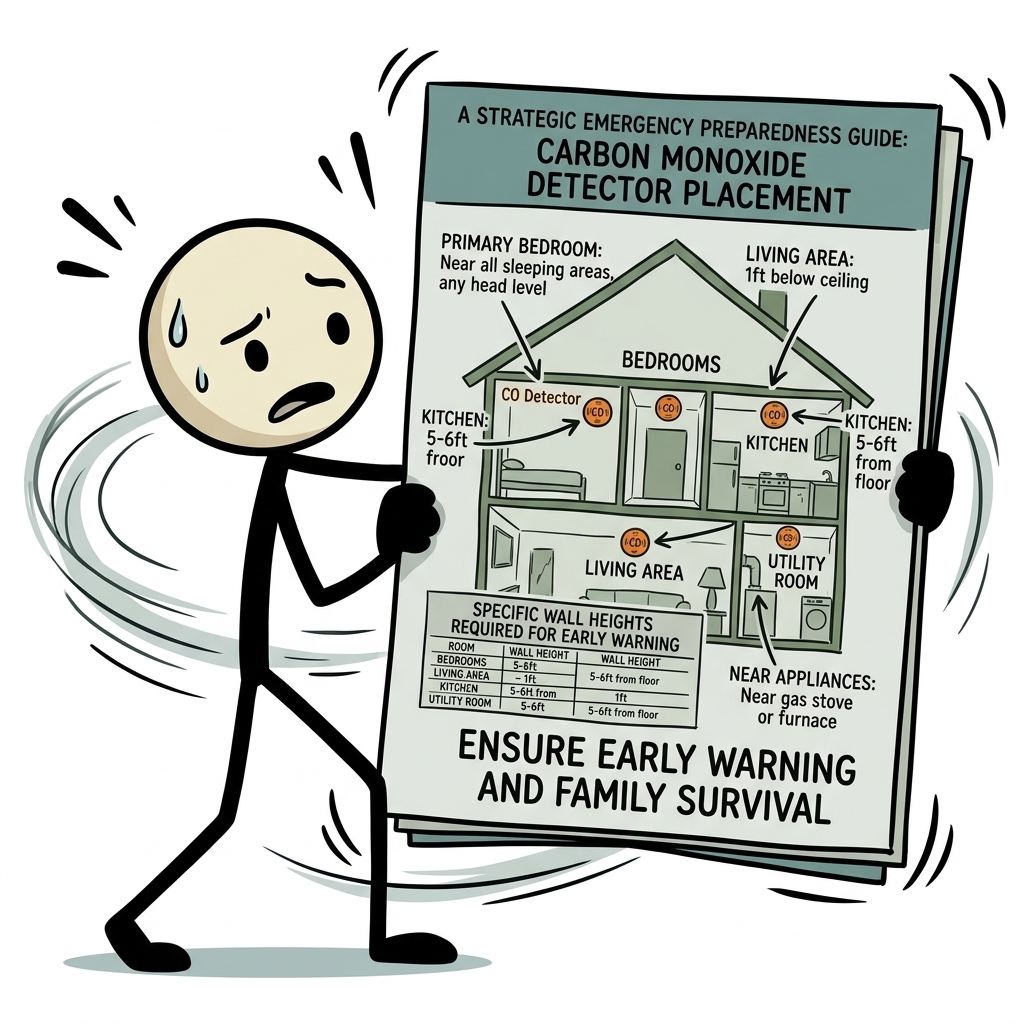
The Physics of Carbon Monoxide: Debunking the Dispersion Myth
To master carbon monoxide detector placement, you must first eliminate a persistent myth that circulates within amateur home improvement forums: the assumption that carbon monoxide behaves like smoke, or conversely, that it sinks like propane or radon. It does neither. Understanding the physical behavior of this toxic gas is the foundational requirement for designing an early-warning life safety envelope. For the practical checklist side, use the neighborhood preparedness network.
Carbon monoxide (CO) consists of one carbon atom and one oxygen atom, yielding a molar mass of 28.01 g/mol. Dry atmospheric air, comprised largely of nitrogen and oxygen, possesses an average molar mass of roughly 28.97 g/mol. This gives carbon monoxide a relative vapor density of 0.9657 relative to ambient air. Because this figure is exceptionally close to 1.0, carbon monoxide does not pool along the floorboards like heavy volatile organic compounds, nor does it immediately draft straight to the highest ridge line of a cathedral ceiling like superheated particulate smoke. For the practical checklist side, use the emergency communication plan.
Instead, carbon monoxide behaves as a neutral gas that mixes rapidly and homogeneously into the surrounding atmosphere through normal molecular diffusion and thermal currents. When CO is generated by an operational heat source—such as a malfunctioning boiler, gas range, or wood-burning stove—it initially rises inside the thermal plume generated by that appliance. However, as the gas moves away from the thermal origin, it quickly equilibrates to room temperature and permeates the breathing zone of the room at an even, deadly distribution. Your home safety alarms must be positioned to intercept this gas precisely where it enters human respiratory pathways. For the practical checklist side, use the family emergency planning guide.
Physiological Vulnerability and parts per million (PPM) Escalation
Carbon monoxide binds to hemoglobin with an affinity approximately 200 to 250 times greater than that of oxygen, forming carboxyhemoglobin (COHb). This binding starves the brain, cardiovascular tissue, and central nervous system of essential oxygen. The health impact is directly tied to the concentration of the exposure and the duration of inhalation: For the practical checklist side, use the real-world emergency scenarios guide.
- 30 to 50 PPM: Minimal baseline exposure. May cause mild frontal headaches or fatigue over prolonged periods of 6 to 8 hours. Often unnoticed during sleep.
- 70 to 100 PPM: Moderate exposure. Induces generalized headache, nausea, lightheadedness, and reduced cognitive capacity within 1 to 2 hours.
- 150 to 200 PPM: Significant toxicity. Rapid onset of disorientation, loss of motor control, vomiting, and collapse within 45 to 90 minutes.
- 400+ PPM: Critical, life-threatening emergency. Confusion, loss of consciousness, and permanent brain damage within 20 to 30 minutes; fatality occurs in less than two hours.
Because the initial symptoms of carbon monoxide poisoning closely mirror viral influenza or simple fatigue, a sleeping person will rarely, if ever, wake up spontaneously from exposure alone. An engineered acoustic warning system is the only reliable defensive countermeasure.
The Elevation Question: Exact Carbon Monoxide Detector Height
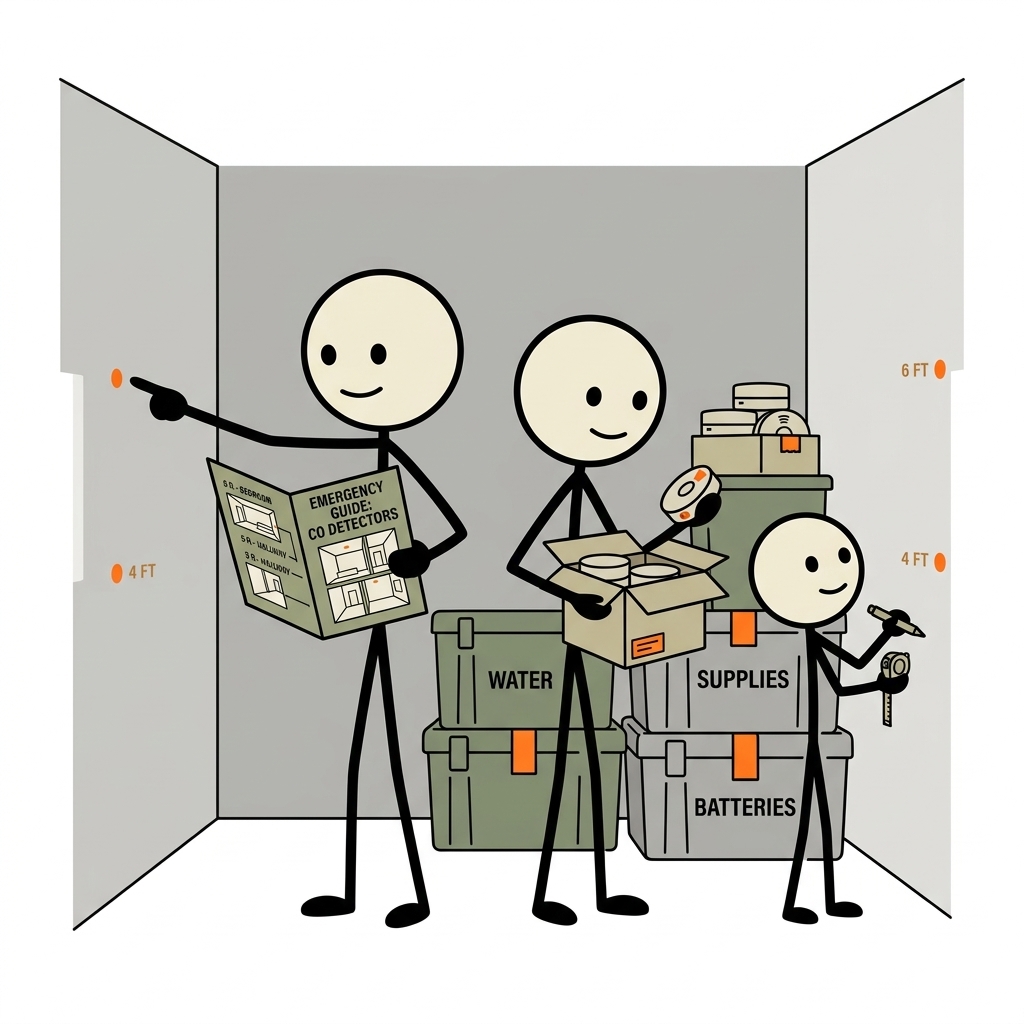
One of the most frequently contested tactical questions in home disaster readiness involves carbon monoxide detector height. The answer depends strictly on whether you are deploying a standalone carbon monoxide detector or an integrated, dual-sensor combination unit (Smoke/CO).
Standalone CO Detectors: The Breathing Zone Standard
Because carbon monoxide blends uniformly with the ambient atmosphere, a standalone unit can technically function at almost any elevation between floor and ceiling. However, optimization matters when minutes dictate survival. The operational recommendation endorsed by safety engineers and public health authorities is to install standalone units at eye level to chest height—approximately 5 feet (1.5 meters) above the finished floor.
There are three critical survival and maintenance reasons for this specific elevation:
- Direct Interception of the Human Breathing Zone: When standing, sitting, or sleeping on an elevated mattress, your respiratory intake aligns closely with the 3-foot to 5-foot band. An alarm placed at 5 feet samples the exact air stratum entering your lungs.
- Visual Verification of Digital Displays: The most reliable tactical CO monitors feature real-time digital liquid crystal displays (LCD) indicating current PPM readings and peak levels. Positioning the unit at 5 feet allows family members to check baseline numbers during routine daily sweeps without using ladders or stooping to baseboards.
- Unobstructed Atmospheric Sampling: Placing alarms on baseboards leaves them vulnerable to furniture obstruction, foot traffic impact, pet dander accumulation, and cleaning chemical interference. Placing them too high complicates the routine physical testing of the device's actuation button.
Combination Smoke/CO Detectors: The Ceiling Standard
If you utilize dual-sensor combination units (which detect both ionization/photoelectric smoke and electrochemical carbon monoxide), fire physics overrides CO physics. Smoke particles are carried upward via buoyant thermal convective currents, requiring detectors to occupy the highest points of the room.
When deploying combination devices, mount them directly to the ceiling at least 4 inches (10 cm) away from any adjacent vertical wall. If wall-mounting a combination device is structurally mandatory, place it high on the vertical wall, strictly between 4 and 12 inches (10 to 30 cm) below the ceiling plane. Never mount a combination detector within the "dead air space" (the direct 4-inch intersection of a wall and ceiling), where stagnant air eddies can prevent smoke and gas from entering the detector's sensing chamber.
| Device Classification | Optimal Installation Height | Primary Strategic Justification |
|---|---|---|
| Standalone CO Alarm | 5 feet (1.5 m) from floor (Eye level) | Samples human breathing zone; enables immediate inspection of digital PPM displays. |
| Plug-in CO Alarm (with battery) | Standard wall outlet height (12–18 inches) | Acceptable compromise for convenience, provided the outlet is not obstructed by furniture or drapes. |
| Combination Smoke & CO Alarm | Ceiling or 4–12 inches down from ceiling | Mandated by NFPA 72 to capture buoyant, superheated smoke and convection plumes. |
Room-by-Room Strategic Layout: Where to Place Carbon Monoxide Detectors
A haphazard placement of safety alarms creates dangerous blind spots. Establishing true defensive depth requires tactical positioning across every habitable zone of your residential compound. The following room-by-room blueprint outlines mandatory CO alarm locations designed to provide early, unambiguous notification.
1. Sleeping Quarters and Hallways (Primary Defense Perimeter)
The primary hazard profile for carbon monoxide peaks when building occupants are asleep and unconscious of early sensory warning signs. According to NFPA standards, a home safety alarm must be positioned within the immediate vicinity of every dedicated sleeping area.
If bedrooms are distributed along an open hallway, install the alarm directly inside that access corridor. The unit should be positioned no further than 10 to 15 feet (3 to 4.5 meters) from any bedroom door. This proximity ensures that when the device sounds its 85-decibel acoustic pattern, the sound pressure level penetrates solid-core, closed bedroom doors with sufficient amplitude to awaken deep sleepers, children, and individuals under the influence of sleep medication.
For homes with long, extended bedroom wings exceeding 30 feet, a single central hallway alarm is inadequate. Install an alarm at both terminal ends of the hallway. Furthermore, if individuals sleep with doors closed and use supplemental room heaters, personal space heaters, or humidifiers, a dedicated CO detector should be installed inside the bedroom suite itself.
2. Every Habitable Floor Level (Vertical Layering)
Under-monitoring multi-level structures is a catastrophic architectural error. Carbon monoxide does not magically move between vertical building envelopes without delay. Floorboards, stairwells, and mechanical sub-assemblies can bottle up toxic concentrations on one level while lower levels register nominal clean air readings.
You must place at least one certified CO alarm on every vertical level of the home, including:
- Finished and Unfinished Basements: Basements frequently house the primary carbon-producing mechanical infrastructure: water heaters, hydronic boilers, and central forced-air furnaces. An alarm here detects equipment breakdown before toxic air enters the building's central vertical ductwork.
- Ground and Intermediate Levels: Common living rooms, dens, and study areas require continuous environmental monitoring, especially those featuring wood stoves or gas-log fireplaces.
- Habitable Attics and Upper Lofts: Warm indoor air moves upward through a home via the "stack effect." In winter months, warm air escaping upward draws carbon monoxide generated from lower mechanical rooms straight toward the top living quarters.
3. The Attached Garage Buffer Zone
An attached garage represents one of the most prolific points of origin for carbon monoxide poisoning in modern homes. Vehicle warm-ups, idling engine runs, remote starters, and fuel-powered maintenance equipment (generators, lawn mowers, pressure washers) generate high concentrations of CO almost instantly.
Never mount a carbon monoxide alarm inside an attached garage. Extreme temperature fluctuations, vehicle exhaust bursts upon engine ignition, and ambient humidity will rapidly foul the electrochemical sensors, triggering chronic false alarms and shortening sensor lifespan. Instead, place the unit inside the living space, approximately 5 to 8 feet away from the interior access door leading to the garage. This forms an airlock-style monitoring station that detects toxic gas pushing past garage weatherstripping before it disperses deep into your kitchen or living quarters.
4. Mechanical Utility Rooms and Central Plant Equipment
Home utility spaces containing fossil fuel appliances require a deliberate, balanced detection strategy. Installing a detector directly next to a gas furnace or water heater is a common homeowner mistake that leads to nuisance tripping. Every time a conventional gas or oil appliance fires up, a tiny, harmless micro-puff of uncombusted exhaust gas can escape before the exhaust flue drafting establishes full upward draw.
To prevent false alarms while maintaining absolute safety, place your alarm at a strategic operational radius: between 15 and 20 feet (4.5 to 6 meters) away from the fuel-burning appliance. This distance provides adequate air dilution for momentary combustion spikes while maintaining extreme sensitivity to systemic mechanical malfunctions, back-drafting flues, or heat exchanger failure.
Dead Zones: Where NEVER to Place a Carbon Monoxide Detector
Effective tactical preparedness requires knowing where equipment must not be deployed. Suboptimal carbon monoxide detector placement can destroy the operational integrity of the electrochemical sensor, blinding your early-warning safety grid.
Avoid placing CO detectors in the following locations:
- Within 5 Feet of Cooking Appliances: Gas ranges, conventional ovens, and cooktops produce small quantities of carbon monoxide during operational ignition. Detectors positioned directly above or immediately adjacent to kitchen stoves will trigger constant false alarms, encouraging building occupants to dangerously disable the device.
- High-Humidity and Wet Envelopes: Never position detectors inside bathrooms, directly outside steam shower rooms, or inside laundry rooms with high-moisture washing appliances. Relative humidity levels exceeding 85% saturate the porous membranes of electrochemical sensors, permanently degrading catalytic reactivity and causing false positive alarms.
- Turbulent Air Streams and Ventilation Drafts: Do not place detectors in direct proximity to forced-air HVAC supply vents, ceiling fans, active exterior doors, or drafty window casings. Rapid, high-velocity airflow can blow carbon monoxide clean across the face of the sensor housing without allowing the gas to diffuse through the monitoring chamber.
- Thermal Extremes (Unconditioned Space): Electrochemical alarms rely on a liquid or gel electrolyte solution inside their sensing cells. Avoid unheated outbuildings, cold storage attics, or exterior breezeways where operational temperatures fall below 40°F (4.4°C) or exceed 100°F (37.8°C). Extreme cold freezes chemical action, while intense heat dries out the electrolyte chemistry.
- Dead Air Pockets: As with smoke detectors, avoid the precise corners formed by two walls meeting the ceiling. The natural aerodynamics of rectangular spaces prevents turbulent air turnover within 4 inches (10 cm) of these intersections.
Tactical Hardware Selection: Engineering Redundancy
A life safety perimeter is only as resilient as the hardware enforcing it. When selecting hardware to execute your carbon monoxide detector placement plan, avoid bare-minimum, single-point-of-failure equipment. Prioritize hardware engineered to professional tactical preparedness standards.
Electrochemical vs. Metal Oxide Sensors
Always verify that your equipment utilizes electrochemical sensing technology that conforms to UL 2034 or EN 50291 manufacturing standards. Electrochemical sensors contain chemical electrodes submerged in an electrolyte solution. When carbon monoxide penetrates the housing, it oxidizes at the sensing electrode, generating an electrical current directly proportional to the gas concentration.
Older or substandard sensors historically relied on metal oxide semiconductors or biomimetic gel strips. These alternate technologies are significantly more vulnerable to sensor drift, exhibit high failure rates, and are notoriously susceptible to false cross-interference from household hairsprays, alcohol cleaners, and cooking vapors.
Power Delivery Architecture and Interconnectivity
The gold standard of emergency preparedness is interconnected power redundancy. Under this architecture, when an alarm situated in an unfinished basement detects a ruptured furnace exhaust, every alarm throughout the upper levels, master bedroom, and nursery actuates simultaneously.
Consider three primary hardware topologies:
- Hardwired with Battery Backup (AC/DC): The preferred installation standard for modern homes. Operating off standard 120-volt residential mains power, these units feature a dedicated physical signal line (or integrated radio-frequency module) connecting all alarms. A 9-volt or sealed lithium battery preserves full monitoring capability during winter electrical grid collapses—the precise moment when backup generators, wood stoves, and auxiliary heaters increase carbon monoxide risk exponentially.
- 10-Year Sealed Lithium Battery Standalones: Ideal for retrofitting older homes lacking multi-station signal wiring. These standalone units eliminate the need to replace batteries annually and feature anti-tamper mechanisms that prevent accidental or deliberate battery removal. Look for models featuring wireless radio-frequency (RF) mesh interconnectivity to replicate the safety of hardwired systems.
- Smart-Grid Connected Systems: Advanced tactical alarms integrate into secure local wireless protocols (Z-Wave, Zigbee, or proprietary encrypted RF). These units push critical push notifications directly to smartphones, enabling homeowners to monitor environmental parameters remotely and dispatch emergency services if toxic events occur while family pets are home alone.
Testing, Calibration, and Lifecycle Replacement Protocols
Deploying alarms is merely the initial physical step; maintaining equipment reliability through systematic testing protocols is what guarantees family survival. Equipment that sits unmaintained on a wall provides nothing more than a false sense of security.
The Distinction Between the Test Button and Gas Sampling
Virtually every homeowner believes that pressing the integrated "TEST" button on their carbon monoxide detector proves the unit will detect carbon monoxide gas. This is incorrect. The physical push-button verifies only that the internal microprocessor is functional, the battery voltage is sufficient to trip the sounder, and the piezoelectric horn functions.
The push-button test does not confirm that the electrochemical sensor port is unblocked, calibrated, or reactive to toxic gas. To execute a comprehensive verification sweep:
- Monthly Functional Sweep: Depress the test button on every deployed unit across all levels. Inform all family members ahead of time to avoid psychological distress, and confirm clear acoustic audibility through closed bedroom doors.
- Annual Gas Diffusion Verification: Use certified aerosol test gas (available through fire and safety supply distributors). Spraying this safe, low-concentration aerosol can across the device's sampling port checks the real-world operational readiness of the sensor matrix.
- Quarterly Physical Cleaning: Vacuum the exterior perimeter vents of your alarms using a soft brush attachment. Dust, household pet dander, and microscopic spider webs regularly collect around sensor inlets, creating an unintended physical barrier that delays gas ingress during an active leak.
The 5-to-10 Year Expiration Clock
Unlike standard ionization smoke alarms that can sometimes function for up to ten years, electrochemical CO sensors experience chemical depletion regardless of whether they have ever been exposed to hazardous gas. Once the internal chemical reagent drops below operational stoichiometry, the device will silently fail to register toxic atmospheres.
Modern devices feature an automated end-of-life (EOL) warning protocol—often a distinct, intermittent chirp accompanied by an "ERR" or "EOL" code on digital models. However, you must not rely entirely on this automated alert. When deploying any new unit, use a permanent marker to write both the Date of Commissioning and the absolute Date of Mandatory Decommissioning directly on the exterior casing. Replace standalone units strictly at the 5- to 7-year mark, and sealed-cell industrial units at the 10-year mark, as dictated by the manufacturer's data sheet.
The Emergency Action Plan: Protocol When the Alarm Sounds
When high-concentration carbon monoxide triggers your home safety alarms, time-wasting analytical confusion can be fatal. If your alarms initiate their four-pulse temporal warning pattern (ANSI/NFPA standardized continuous cycle of 4 short beeps, followed by a 5-second pause), execute the following operational sequence without hesitation:
- Do Not Search for the Origin: Never waste precious seconds checking furnace valves, inspecting the hot water heater, or opening windows. Rapid ventilation complicates forensic tracing by first responders and delays essential evacuation.
- Execute Immediate Tactical Evacuation: Gather all family members and domestic pets immediately. Move briskly down the nearest pre-planned egress paths, remaining below any visible smoke layers if an associated fire is suspected.
- Perform a Complete External Head Count: Muster at your pre-designated family rallying point outside the home (e.g., a specific landmark, mailbox, or neighborhood gate). Verify the physical presence of every single resident.
- Establish External Emergency Communications: Once established safely outside the contaminated building envelope, dial 911 or your local emergency dispatch service. Explicitly state to the dispatcher: "My carbon monoxide alarm is actively sounding, and our household has fully evacuated to our exterior rally point."
- Enforce a Strict Perimeter: Under no circumstances should anyone re-enter the residence until the local Fire Department or hazardous materials response team has cleared the structure. Professional emergency responders carry calibrated, multi-gas monitors to clear the interior environment, isolate the fuel-source malfunction, and declare the atmosphere safe for human re-habitation.
Surviving a carbon monoxide emergency requires removing chance from the equation. By respecting the atmospheric science of this insidious gas, adhering precisely to room-by-room distribution requirements, mounting devices at the correct functional heights, and maintaining disciplined operational checks, you forge an impenetrable life-safety perimeter around those you are sworn to protect.
Frequently Asked Questions
Where is the most important location to install a carbon monoxide detector?
The most critical location is immediately outside each sleeping area so the alarm can awaken occupants at night. You should also install at least one alarm on every level of the home, including the basement.
Should carbon monoxide detectors be installed high on the wall or near the floor?
Carbon monoxide is roughly the same density as air and distributes evenly throughout a room, so alarms work effectively at ceiling height, knee height, or eye level (around 5 feet up), unless combined with a smoke detector which must be on the ceiling or high on the wall.
What locations should be avoided when mounting a CO detector?
Avoid placing detectors within 5 to 15 feet of heating or cooking appliances, directly above bathtubs or sinks, near drafty windows and exterior doors, or in unconditioned spaces where temperatures drop below 40°F (4°C) or exceed 100°F (38°C).
How many carbon monoxide detectors should a multi-story home have?
A multi-story home requires a minimum of one detector on every habitable level—including basements and finished attics—plus an additional detector inside or immediately outside every designated bedroom area.
How often should carbon monoxide alarms be tested and replaced?
Test detectors monthly using the built-in test button, swap replaceable batteries every six to twelve months, and replace the entire detector unit every 5 to 7 years (or up to 10 years if specified by the manufacturer).
Sources & Further Reading
- U.S. Fire Administration (FEMA) - Carbon Monoxide Safety
- Centers for Disease Control and Prevention - Carbon Monoxide Poisoning Prevention
- U.S. Consumer Product Safety Commission - Carbon Monoxide Information Center
- Environmental Protection Agency - Carbon Monoxide's Impact on Indoor Air Quality
- Ready.gov - Home Fires and Home Safety Precautions