⚡ Key Facts
- High Vulnerability: According to the Centers for Disease Control and Prevention (CDC), approximately 1 in 4 U.S. adults lives with a disability, many of whom require daily care and specialized assistance. For the practical checklist side, use the community emergency preparedness guide.
- Disaster Disparity: FEMA reports that over 60% of disaster-related casualties among older adults and individuals with mobility challenges are linked directly to interrupted medical care or a lack of accessible transportation. For the practical checklist side, use the family emergency planning guide.
- Power Dependency: U.S. Department of Energy data indicates that weather-related power outages have increased by 78% over the last decade, posing a critical threat to the millions of individuals relying on home-use medical devices.
- Medication Shortfalls: A survey by the American Red Cross revealed that while nearly half of all Americans rely on daily prescription medications, less than 15% have a designated emergency supply of these life-sustaining drugs.
Imagine a sudden, severe winter storm knocking out power to your neighborhood preparedness network for three days, or a fast-moving wildfire forcing an immediate evacuation of your community. For most, this is a highly stressful disruption. But if you are caring for a child with complex medical needs, an elderly parent with advanced dementia, or a spouse with limited mobility, a disaster like this is a direct threat to survival. In these critical moments, standard preparedness advice—like "grab a flashlight and some canned food"—is woefully inadequate. True safety requires a highly coordinated, resilient, and redundant system designed specifically for the unique vulnerabilities of those who depend on others for their daily care. This guide provides an authoritative, actionable framework for establishing that system, focusing on emergency preparedness for caregivers to ensure safety, continuity of care, and peace of mind when every second counts.
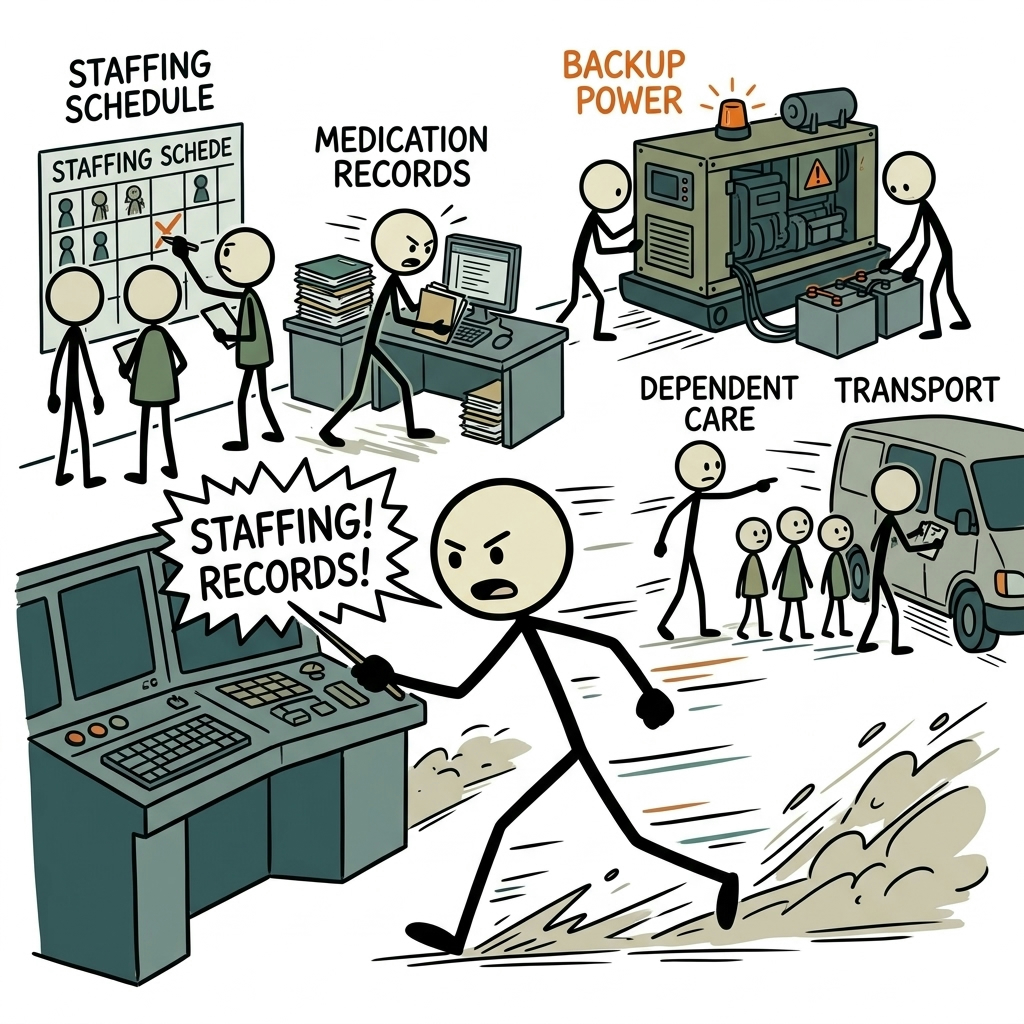
1. Staffing Contingencies & Building a Care Circle
The single greatest point of failure in dependent care during an emergency is the "single caregiver bottleneck." If you are the sole provider of care and you become injured, stranded, or exhausted, your dependent is immediately left vulnerable. To prevent this, you must build a resilient "Care Circle"—a dedicated network of individuals trained and ready to step in at a moment's notice.
The "Rule of Three" for Support Networks
An effective Care Circle should consist of at least three layers of redundancy. Your primary circle includes household members who already understand daily care routines. Your secondary circle consists of nearby neighbors, friends, or local relatives who can reach your home on foot if roads are blocked. Your tertiary circle includes professional caregivers, community organizations, or individuals living outside your immediate geographic area who can assist if a regional evacuation is ordered.
Each member of your Care Circle must have physical access to your home (via a secure key lockbox or smart lock code) and a clear understanding of where emergency supplies are kept. Do not assume people will know what to do; host a brief "walkthrough" at least once a year to show your secondary contacts how to operate specialized equipment, where the main water shut-off valve is, and how to access medical records.
Cross-Training and Care Protocols
Every person in your Care Circle should be cross-trained on essential caregiving tasks. Create simplified, laminated "Quick-Start Guides" for highly specific tasks, such as:
- Safe Transfer Techniques: How to safely move your dependent from a bed to a wheelchair without causing injury to either party.
- Feeding Tube Operations: Basic troubleshooting for enteral feeding pumps, manual flushing procedures, and sanitization protocols.
- Behavioral De-escalation: For dependents with cognitive impairments or neurodivergence, document specific calming techniques, preferred sensory items, and phrases that ease anxiety during high-stress situations.
Coordinating with Professional Agencies
If you rely on home health aides, physical therapists, or nursing agencies, you must proactively review their disaster policies. Ask your agency coordinator for their written emergency protocol. Will they send staff during a mandatory evacuation? How do they prioritize clients during a regional crisis? Ensure your dependent is registered on their "high-priority" list, and establish a clear emergency communication plan plan to verify if a scheduled aide is actually able to make it to your home during severe weather.
2. Medication Records & Medical Documentation
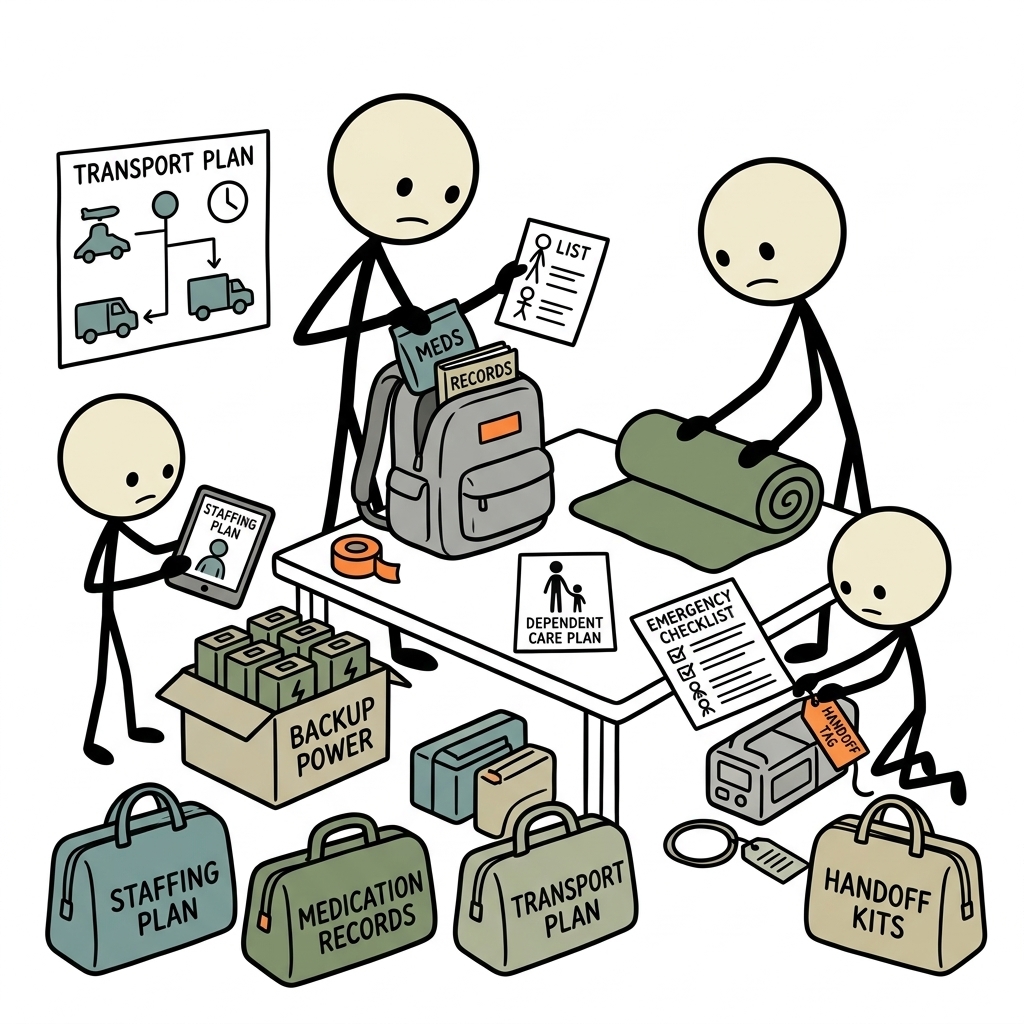
During a crisis, access to accurate medical information and an uninterrupted supply of medication can mean the difference between life and death. In the chaos of an evacuation, you cannot rely on your memory or an active internet connection to retrieve vital health histories or prescription details.
Constructing the Waterproof Emergency Medical File
Every dependent needs a physical, highly visible "Emergency Medical File" stored in a waterproof, fireproof portable pouch. This pouch should be kept near your primary exit, easily accessible during a rapid evacuation. Inside this file, you must include:
- The Medication Administration Record (MAR): A comprehensive list of all current prescriptions, over-the-counter medications, and supplements. Include exact dosages, administration times, prescribing physicians, and the specific purpose of each drug.
- Medical History Summary: A brief, one-page document detailing primary diagnoses, past major surgeries, allergies (especially to medications or latex), and baseline cognitive and physical abilities.
- Insurance and Identification: Photocopies of health insurance cards, Medicare/Medicaid cards, government-issued photo IDs, and guardianship or Power of Attorney (POA) documents.
- Emergency Contacts: A laminated list of primary care physicians, specialists, preferred hospitals, and members of your Care Circle.
Securing an Emergency Medication Supply
The American Red Cross and FEMA recommend maintaining at least a 7-to-14-day supply of all critical medications. Achieving this can be challenging due to insurance restrictions, but there are several strategies caregivers can employ:
First, talk to your prescribing physician about securing an "emergency override" prescription. Many insurance companies will authorize a one-time 30-day or 90-day supply for disaster preparedness, particularly if you live in areas prone to hurricanes, wildfires, or severe winter storms. Second, request refills as early as your insurance allows—typically when you have 5 to 7 days of medication remaining. Over several months, this practice allows you to safely build up a modest buffer supply. Be sure to rotate this stock regularly, using the oldest medications first to prevent expiration.
Managing Temperature-Sensitive Medications
Many critical medications, such as insulin, biologics, and certain liquid antibiotics, require strict refrigeration. To protect these assets during a power outage or evacuation, incorporate the following into your emergency preparedness for caregivers checklist:
- Phase-Change Cooler Packs: Keep specialized medical cooler bags and frozen gel packs ready in your freezer. Unlike standard ice, specialized phase-change materials maintain a steady refrigerated temperature (between 36°F and 46°F) without freezing the medication.
- Digital Thermometers: Use a cooler with an external digital temperature display so you can monitor the internal environment without constantly opening the lid and releasing cold air.
- USB-Powered Mini-Fridges: Consider purchasing a small, portable medical refrigerator that can run off a 12V car outlet or a portable power station.
3. Backup Power Strategies for Medical Devices
For individuals relying on life-sustaining medical equipment—such as ventilators, oxygen concentrators, dialysis machines, or feeding pumps—a power outage is an immediate medical emergency. Caregivers must develop a robust, multi-tiered backup power strategy that guarantees continuous operation of these devices.
Calculating Your Power Requirements
Before purchasing backup power equipment, you must calculate the exact energy demands of your dependent's medical devices. Look at the silver manufacturer's label on the back or bottom of each device to find the wattage (W), voltage (V), or amperage (A). If only amps and volts are listed, calculate wattage using this simple formula:
Watts (W) = Amps (A) × Volts (V)
Create a master log of all devices, their running wattage, and their starting wattage (the brief surge of power required when a motor or compressor turns on). This total will dictate the size and type of backup power source you need.
| Medical Device | Average Running Watts | Average Starting Watts | Critical Considerations |
|---|---|---|---|
| Oxygen Concentrator | 300 – 600W | 1,000 – 1,500W | High continuous draw; requires pure sine wave power. |
| Mechanical Ventilator | 100 – 200W | 200 – 300W | Life-critical; must have multiple redundant power sources. |
| Enteral Feeding Pump | 10 – 30W | 20 – 50W | Often has internal battery; check runtime regularly. |
| Power Wheelchair Charger | 120 – 300W | 300 – 500W | Essential for maintaining mobility during evacuation. |
| CPAP Machine | 30 – 60W | 100 – 150W | Turning off the humidifier heater greatly reduces power draw. |
Selecting the Right Backup Power Technology
Depending on your budget, dwelling type, and medical needs, choose from the following backup power options:
Portable Battery Power Stations (Solar Generators): Devices like those made by EcoFlow, Jackery, or Anker are ideal for indoor use. They emit no toxic fumes, run silently, and can be safely kept inside a bedroom. They can be recharged via standard wall outlets, car chargers, or portable solar panels. Ensure the power station features a "Pure Sine Wave" inverter, as modified sine wave power can damage sensitive medical microprocessors.
Uninterruptible Power Supplies (UPS): A UPS sits between your wall outlet and the medical device. If the grid goes down, the UPS instantly switches to internal battery power without a millisecond of interruption, keeping ventilators or monitors running seamlessly while you transition to a larger backup generator.
Traditional Gas/Propane Generators: These offer high power output but must be operated strictly outdoors, at least 20 feet away from windows and doors, to prevent deadly carbon monoxide poisoning. Keep a fresh, safely stored supply of fuel on hand, along with heavy-duty, outdoor-rated extension cords.
Registering with Utility Providers
Most major utility companies maintain a "Life-Sustaining Equipment" or "Medical Baseline" registry. If someone in your home relies on life-support equipment, submit a certification form signed by your physician to your utility provider. While this registration does not guarantee that your power will be restored first, it ensures that you receive advanced warning of planned public safety power shutoffs and prevents your service from being disconnected for non-payment during a crisis.
4. Specialized Transportation Planning
Evacuating a household is stressful under any circumstances, but evacuating a dependent with severe physical, cognitive, or medical challenges requires highly specialized transportation planning. You cannot rely on standard ride-sharing services or traditional emergency evacuation buses to meet these needs.
Pre-Arranging Accessible Transportation
If your dependent uses a power wheelchair, is bedridden, or requires continuous medical monitoring during transit, standard vehicles will not suffice. Identify and establish relationships with local Non-Emergency Medical Transportation (NEMT) companies and private ambulance services well ahead of time. Keep their direct dispatch numbers in your Emergency Medical File.
Contact your local emergency management agency (EMA) or fire department to inquire about vulnerable populations registries. Many municipalities maintain a database of residents who require specialized assistance during a mandatory evacuation. Registering early ensures that emergency services know your address and your dependent's specific mobility limitations before a disaster strikes.
Preparing Your Personal Vehicle
If you plan to transport your dependent in your personal vehicle, ensure it is always prepared for a sudden departure. Keep your fuel tank at or above the half-full mark at all times. If you use a wheelchair-accessible van, inspect the ramp or lift mechanism monthly and keep manual backup tools (such as hand cranks for hydraulic lifts) stored inside the vehicle.
Equip your vehicle with a dedicated "Car go-bag essentials guide" containing:
- Portable wheelchair tie-down straps and safety restraints.
- A heavy-duty transfer board or slide sheet.
- A 12V DC-to-110V AC inverter to charge medical devices from the car's alternator.
- Basic vehicle safety gear (jumper cables, tire inflator, reflective triangles, and a window breaker tool).
Navigating Public Shelters and Special Needs Shelters
Understand that standard public emergency shelters (such as those set up in school gymnasiums) may not have the resources, power hookups, or trained staff to care for medically fragile individuals. During your planning phase, identify the designated "Special Needs Shelters" (SNS) or "Medical Needs Shelters" in your county. These specialized facilities are staffed by medical professionals and equipped with backup power generators specifically for oxygen concentrators, ventilators, and other critical devices. Note that these shelters often require pre-registration, so contact your local health department to secure a spot in their database.
5. Seamless Care Handoffs & Communication Protocols
During a disaster, you may be separated from your dependent due to injury, evacuation logistics, or the need for professional medical intervention. A chaotic or poorly communicated handoff to emergency responders, shelter staff, or temporary caregivers can lead to missed medications, severe behavioral distress, or improper medical treatment. Establishing a structured, foolproof handoff protocol is a cornerstone of emergency preparedness for caregivers.
The "Vial of L.I.F.E." and Visible Identification
The "Vial of L.I.F.E." (Lifesaving Information For Emergencies) is a nationally recognized program designed to speak for individuals when they or their caregivers cannot. Place a comprehensive, updated medical form inside a plastic baggie and attach it to the front of your refrigerator using a highly visible, red "Vial of Life" decal. First responders are trained to look on the refrigerator first for critical medical details.
In addition to the refrigerator file, ensure your dependent wears physical, durable identification at all times during an emergency. This can include:
- Medical Alert Jewelry: Engraved metal bracelets or silicone bands detailing critical diagnoses, life-threatening allergies, and primary emergency contact numbers.
- Wheelchair Pouch: A brightly colored, zippered pouch permanently attached to the frame of a wheelchair or walker containing a duplicate copy of their Emergency Medical File.
- Laminated ID Badges: For individuals with cognitive impairments or those who are non-verbal, secure a laminated ID card to their clothing using a safety pin or lanyard. This card should display their name, their relationship to you, your contact information, and key communication tips.
Utilizing the SBAR Handoff Method
In high-stress environments, medical professionals use a communication framework called SBAR (Situation, Background, Assessment, Recommendation) to ensure quick, accurate transfers of patient information. Caregivers can easily adapt this professional standard for emergency handoffs:
Situation: State the immediate issue. "This is my mother, Helen. We are evacuating due to a power outage, and she is experiencing increased confusion."
Background: Provide brief, critical context. "She has advanced Alzheimer's disease and is completely non-verbal. She takes blood thinners daily."
Assessment: Describe their current state and baseline. "Her vital signs are stable, but she is highly sensitive to loud noises and may attempt to wander if left unattended."
Recommendation: Give clear, actionable instructions. "She needs to sit in a quiet corner away from the main flow of traffic, and her evening dose of Eliquis must be administered at 7:00 PM."
Communication Tools for Non-Verbal Dependents
If your dependent relies on assistive technology, sign language, or communication boards to express their needs, do not leave these tools behind. Include a physical, non-electronic communication board (featuring simple pictures, words, and pain scales) in your evacuation kit. This ensures that even if electronic tablets lose power, your dependent can still communicate pain, thirst, hunger, or fear to temporary caregivers.
6. The Ultimate Emergency Preparedness for Caregivers Checklist
To pull all of these critical elements together into a cohesive, actionable plan, utilize this comprehensive checklist. When it comes to emergency preparedness for caregivers, emergency preparedness is not a one-time task, but a continuous cycle of updating, testing, and refining.
Immediate Actions (Do This Week)
- [ ] Form Your Care Circle: Identify at least three people who can assist with caregiving duties and share your home's entry codes/keys with them.
- [ ] Compile the Emergency Medical File: Gather medication lists, medical histories, insurance cards, and doctor contacts into a waterproof pouch.
- [ ] Register with Utilities: Submit the necessary medical baseline paperwork to your power and water companies.
- [ ] Inventory Medical Devices: Record the exact running and starting wattage of all electrical medical equipment.
- [ ] Locate Special Needs Shelters: Contact your local emergency management office to find and register for the nearest medically equipped shelter.
Short-Term Actions (Do This Month)
- [ ] Secure Backup Power: Purchase and test a portable battery power station or generator that meets your calculated wattage needs.
- [ ] Build a 14-Day Medication Buffer: Speak with your physician about emergency refills and establish a rotation schedule.
- [ ] Prepare the Vehicle: Equip your car with transfer boards, tie-downs, a power inverter, and a dedicated vehicle Go-Bag.
- [ ] Create Quick-Start Care Guides: Write and laminate simple instructions for equipment operation, transfers, and behavioral management.
- [ ] Set Up Visible ID: Order medical alert jewelry or assemble a laminated emergency ID badge for your dependent.
Ongoing Maintenance (Do Every 6 Months)
- [ ] Conduct a Care Circle Drill: Have a backup caregiver practice a transfer, operate medical equipment, and review the location of supplies.
- [ ] Update Medical Records: Revise the Medication Administration Record (MAR) to reflect any changes in dosages or prescriptions.
- [ ] Test Backup Power Systems: Discharge and recharge battery power stations, run gas generators under load, and check fuel freshness.
- [ ] Rotate Emergency Supplies: Check expiration dates on medications, formula, medical supplies, and water stored in your emergency kits.
Caring for a dependent is a profound responsibility, and the thought of navigating a disaster can feel overwhelming. However, true security does not come from hoping a crisis never happens; it comes from knowing exactly what you will do when it does. By systematically addressing staffing contingencies, securing medical documentation, calculating backup power needs, pre-arranging specialized transport, and structuring your handoff protocols, you transition from a state of vulnerability to a state of absolute readiness. When focusing on emergency preparedness for caregivers, emergency preparedness becomes more than just a set of instructions—it becomes a life-saving shield that protects those you love most when they are at their most vulnerable. Take the first step today: print this guide, complete the immediate actions on your checklist, and build the resilient foundation your family deserves.
Frequently Asked Questions
What should a emergency preparedness for caregivers plan include?
Start with the immediate safety steps, the supplies and records your household needs, a communication plan, and a regular review schedule. Follow local official guidance during an active emergency.
How often should I review emergency preparedness for caregivers preparations?
Review them at least twice a year and whenever your household, medication, location, or local risks change. Replace expired supplies and practice key steps.
Where can I find reliable emergency guidance?
Use local emergency management alerts and established public-health or emergency-management agencies. A blog guide should support, not replace, official real-time instructions.