⚡ Key Facts
- A 37% Probability: According to the United States Geological Survey (USGS), there is an approximate 37% chance of a Megathrust earthquake (magnitude 7.1 to 8.0+) occurring on the southern portion of the Cascadia Subduction Zone within the next 50 years.
- The M9.0 Threat: There is a 10% to 14% chance of a full-margin rupture (magnitude 9.0+) occurring in the next 50 years, which would impact the entire Pacific Northwest from northern California to British Columbia.
- Minutes, Not Seconds: Shaking from a Cascadia Subduction Zone megathrust event will last between 2 and 6 minutes, compared to the 15 to 30 seconds experienced in typical crustal earthquakes.
- "Two Weeks Ready" is the Standard: Emergency management agencies, including FEMA and the Oregon Office of Emergency Management (OEM), urge PNW residents to be self-sufficient for a minimum of 14 days, as regional infrastructure will be severely compromised.
- Historical Precedent: The last major Cascadia rupture occurred on January 26, 1700, at approximately 9:00 PM, determined by Japanese tsunami records and carbon-dated "ghost forests" along the Washington and Oregon coasts.
The serene beauty of the Pacific Northwest—defined by its towering Douglas firs, rugged coastlines, and snow-capped volcanic peaks—masks one of the most formidable geological hazards on the planet. Deep beneath the Pacific Ocean floor, the Juan de Fuca tectonic plate is sliding under the North American plate along a 600-mile fault line known as the Cascadia Subduction Zone (CSZ). This fault has been locked by friction for over three centuries, building immense, crushing pressure. When this boundary slips, it will unleash a megathrust earthquake that will alter the geography, infrastructure, and daily life of the region in a matter of minutes. While the media often portrays this event as an inescapable disaster, seismic science and emergency management data tell a different story: survival is not a matter of luck, but of systematic preparation. This comprehensive Pacific Northwest earthquake guide is designed to move you past anxiety and into a state of absolute readiness, providing the technical knowledge and actionable steps required to protect your family, secure your home, and thrive in the aftermath.
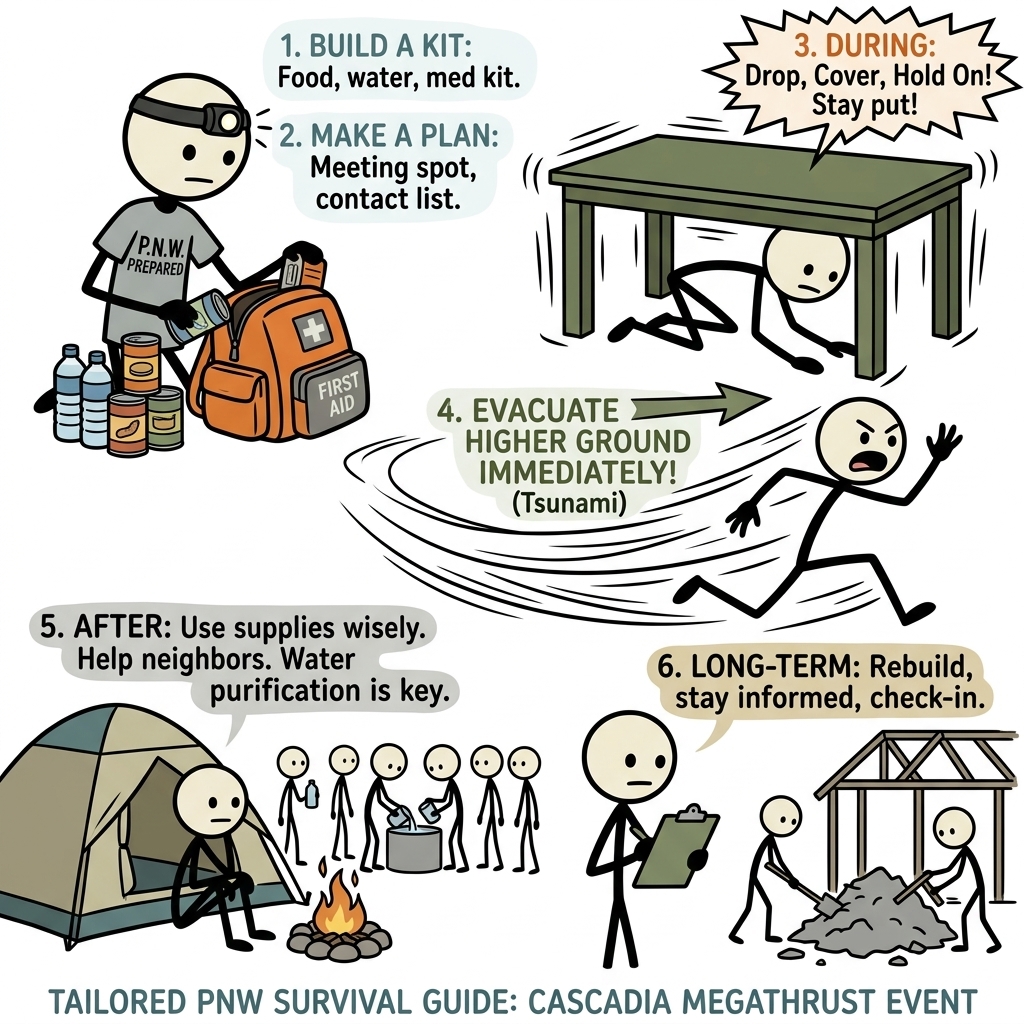
Understanding the Cascadia Subduction Zone (The Science of the Threat)
To prepare effectively, you must understand the unique physics of a subduction zone earthquake. Unlike crustal earthquakes, such as the 2001 Nisqually earthquake in Washington, which occur on shallow faults within a single tectonic plate, subduction zone earthquakes occur at the plate boundary itself. The Juan de Fuca plate is moving northeastward at about 3 to 4 centimeters per year, shoving its way beneath the North American plate. Because the plates are locked, the edge of the North American plate is being compressed and warped upward. When the friction holding these plates together is finally overcome, the North American plate will snap back westward and downward, releasing centuries of accumulated elastic energy.
This release will manifest as a massive earthquake, potentially reaching a magnitude of 9.0 or greater if the entire fault ruptures from Cape Mendocino, California, to Vancouver Island, British Columbia. The shaking will not be a sudden, sharp jolt, but rather a rolling, violent motion that continues for up to six minutes. This extended duration is particularly destructive because it fatigues buildings, bridges, and infrastructure, causing structures that survived the first minute of shaking to collapse under the sustained stress of the subsequent minutes. Understanding this reality underscores the critical importance of proactive Cascadia Subduction Zone earthquake preparedness.
Furthermore, paleoseismic research led by Oregon State University and the USGS has mapped 41 major CSZ earthquakes over the last 10,000 years. The average recurrence interval for these events is roughly 246 years for the southern portion of the fault (from Florence, Oregon, southward) and about 500 years for a full-margin rupture. Because the last event occurred in 1700, the Pacific Northwest is well within the historical window for the next major slip. Recognizing this timeline is the first step in shifting your mindset from passive observation to active mitigation.
Structural Mitigation: Earthquake Retrofitting in Oregon and Washington
The structural integrity of your home is your primary line of defense. In the Pacific Northwest, residential building codes did not begin to adequately address subduction zone seismic hazards until the mid-to-late 1990s. If your home was constructed before 1994, it likely lacks the necessary lateral bracing and anchoring to survive minutes of violent shaking. Pursuing earthquake retrofitting in Oregon Washington is one of the most high-yield investments a homeowner can make to preserve both life and property.
Foundation Anchoring (Sill Plate Bolting)
In older homes, the wooden framing of the house simply sits on top of the concrete foundation, held in place only by gravity. Intense horizontal seismic forces can slide the house completely off its foundation, rupturing utility lines and causing catastrophic structural collapse. Foundation anchoring involves drilling through the wooden sill plate into the concrete foundation and installing heavy-duty expansion bolts or adhesive anchors at regular intervals (typically every 4 to 6 feet, and within 12 inches of the end of each plate). This creates a continuous load path, ensuring the house moves with the foundation rather than sliding off it.
Cripple Wall Bracing
A cripple wall is a short wooden wall that extends from the top of the concrete foundation to the underside of the first floor. If these walls are not braced, they can sway and collapse under seismic pressure, causing the house to drop a story. To mitigate this, you must brace the interior face of the cripple walls by installing structural plywood sheathing (typically 1/2-inch CDX plywood) nailed securely to the studs and sill plates. This transforms a flexible, weak wall into a rigid shear wall capable of resisting lateral forces. Additionally, installing framing anchors (A35 clips) to connect the top plate of the cripple wall to the floor joists completes the structural connection.
Securing Non-Structural Hazards
While structural retrofitting keeps the roof over your head, non-structural mitigation keeps the contents of your home from injuring you. During a major earthquake, heavy appliances, furniture, and utilities become dangerous projectiles. Focus on these critical areas:
- The Water Heater: A standard water heater contains 40 to 80 gallons of pristine drinking water—a vital resource post-earthquake. If it topples, it will rupture gas and water lines, creating an immediate fire hazard and destroying your Water Calculator. Secure your water heater using heavy-duty, California-approved metal strapping kits anchored directly into the wall studs at both the top and bottom thirds of the tank. Use flexible corrugated stainless steel connectors for both gas and water lines.
- Tall Furniture and Electronics: Anchor bookshelves, armoires, filing cabinets, and large televisions to wall studs using nylon straps, L-brackets, or steel cables. Place heavier items on lower shelves to keep the center of gravity low.
- Cabinet Latches: Install heavy-duty safety latches (such as magnetic or mechanical latches) on kitchen and bathroom cabinets. This prevents glassware, heavy canned goods, and chemicals from spilling onto floors and blocking evacuation routes.
- Flexible Utility Connections: Ensure all gas-powered appliances (dryers, stoves, furnaces) are connected using flexible yellow-jacketed gas lines rather than rigid black iron pipe. Consider installing a seismic auto-shutoff valve on your main gas line, which automatically cuts off the gas supply when it detects seismic vibrations of a specific magnitude.
The "Two Weeks Ready" Standard: Building Your Emergency Kit
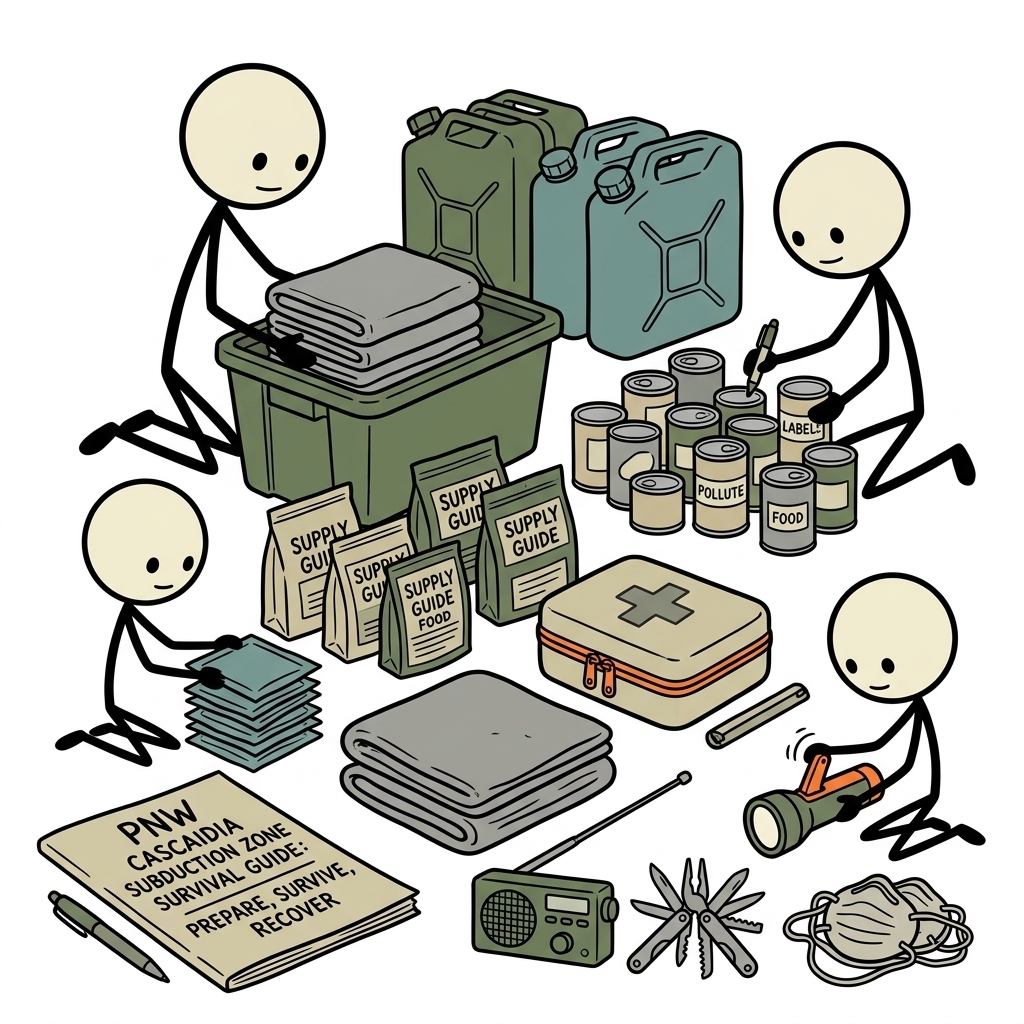
For decades, emergency planners recommended a 72-hour survival kit. However, the geographic scale of a Cascadia event means that coastal communities will be isolated by landslides, bridges along the Interstate 5 corridor will be impassable, and deep-water ports will be offline. The Oregon Office of Emergency Management and the Washington Emergency Management Division warn that federal and state aid may take up to two weeks to reach impacted neighborhood preparedness networks. Consequently, you must build an emergency kit PNW residents can rely on for a minimum of 14 days of total self-sufficiency.
Water: The Foundation of Survival
Water is your most immediate physiological need. In a major seismic event, municipal water systems will lose pressure, pipes will shear, and treatment facilities will lose power. You must store a minimum of 1 gallon of water per person per day (0.5 gallons for drinking, 0.5 gallons for sanitation and food prep). For a family of four, a 14-day supply equals 56 gallons. To achieve this, implement a multi-tiered water strategy:
- Primary Storage: Keep dedicated, food-grade, BPA-free water storage containers in a cool, dark place. Heavy-duty 5-gallon or 7-gallon jugs are highly portable. For larger volumes, a 55-gallon water drum treated with a water preservative (such as sodium hypochlorite or chlorine dioxide) will keep water safe for up to five years.
- Filtration and Purification: You cannot rely solely on stored water. Equip your kit with high-capacity microfiltration systems, such as hollow-fiber membrane filters (e.g., Sawyer Squeeze or Katadyn pocket filters) capable of removing bacteria and protozoa down to 0.1 microns. Additionally, stock household bleach (unscented, 5.25% to 8.25% sodium hypochlorite) or chlorine dioxide tablets to neutralize viral pathogens. Add 8 drops of regular bleach per gallon of clear water, stir, and let sit for 30 minutes before drinking.
- Alternative Sources: Know how to access alternative water sources within your home, such as your secured water heater tank or the gravity-fed water stored in your toilet's upper tank (provided no chemical cleaners are present).
Food and Nutrition
During the high-stress recovery phase, your body will require dense caloric intake. Focus on non-perishable, shelf-stable foods that do not require cooking, water addition, or refrigeration. Your emergency food storage guide should include:
- Canned meats (tuna, chicken, salmon) and canned beans, vegetables, and fruits.
- High-calorie energy bars, protein bars, and nuts.
- Nut butters, dried fruits, and trail mixes.
- Ready-to-Eat meals (MREs) or freeze-dried meals (if you have sufficient surplus water to rehydrate them).
- A manual can opener (keep multiple heavy-duty steel options in your kit).
- Comfort foods (chocolate, coffee, tea) to maintain psychological morale, particularly for children.
Sanitation and Hygiene (Preventing Disease Outbreaks)
When the sewer system fails, improper waste management can rapidly lead to outbreaks of cholera, dysentery, and other waterborne illnesses. You must plan for off-grid sanitation. The most effective solution is the "Twin-Bucket" system recommended by emergency management agencies:
- Bucket 1 (Liquid Waste): Dedicate one 5-gallon bucket lined with a heavy-duty contractor bag for urine. Urine is sterile unless contaminated by feces. Keep this separate to minimize volume and odor. It can be diluted with water and disposed of on soil away from water sources.
- Bucket 2 (Solid Waste): Dedicate a second 5-gallon bucket lined with a contractor bag for feces. After each use, cover the waste with a layer of carbon-rich material such as sawdust, peat moss, shredded paper, or kitty litter. This keeps the waste dry, suppressing odors and flies.
- Sanitizing Supplies: Stockpile heavy-duty trash bags, zip-ties to seal bags, toilet paper, wet wipes, and large quantities of hand sanitizer. Keep a spray bottle filled with a 1:10 bleach-to-water solution to disinfect the bucket seat and surrounding areas.
First Aid and Medical Supplies
A Cascadia earthquake will overwhelm emergency medical services instantly. You must be prepared to act as your own first responder, managing everything from minor lacerations to severe trauma. Your first aid kit should go far beyond basic adhesive bandages:
- Trauma Gear: Stock tactical tourniquets (CAT or SOFTT-W), hemostatic agents (QuikClot gauze) to stop arterial bleeding, chest seals for puncture wounds, and pressure dressings (Israeli bandages).
- Splints and Bandages: Include moldable aluminum splints (SAM splints), elastic bandages, triangular bandages for slings, and sterile burn dressings.
- Prescription Medications: Maintain at least a 14-to-30-day supply of all critical daily medications (insulin, heart medication, inhalers). Work with your physician to secure an emergency prescription buffer.
- Over-the-Counter Drugs: Include broad-spectrum antibiotics (if prescribed by a doctor for emergency use), pain relievers (ibuprofen, acetaminophen), antihistamines, anti-diarrheal medications, and rehydration salts.
Surviving the Shake: What to Do During the Earthquakes
When the Cascadia fault ruptures, you will have seconds to react before the shaking becomes violent enough to throw you to the ground. Your immediate physical response will determine your survival. Forget outdated advice; modern seismic safety is built on empirical data from global subduction zone events.
Drop, Cover, and Hold On
The gold standard of seismic survival, endorsed by the Federal Emergency Management Agency (FEMA) and the American Red Cross, is Drop, Cover, and Hold On:
- DROP down onto your hands and knees. This position protects you from being knocked over and allows you to remain mobile enough to crawl short distances to shelter.
- COVER your head and neck under a sturdy table, desk, or workbench. If no shelter is nearby, crawl next to an interior wall (away from windows) and cover your head and neck with your arms.
- HOLD ON to your shelter with one hand, and use your other arm to protect your head and neck. If the shelter shifts during shaking, move with it.
Do not attempt to run out of a building during the shaking. The exterior facade, architectural details, and glass windows of buildings are the first components to fail, showering the street below with lethal debris. Additionally, debunk the "Triangle of Life" theory, which falsely claims you should stand next to large objects rather than under them; this theory is based on structural assumptions that do not apply to modern building standards and has been proven dangerous. Similarly, do not stand in a doorway; in modern homes, doorways are no stronger than any other part of the structure, and the swinging door can cause severe injury.
Context-Specific Actions
Your physical environment dictates your immediate response:
- If in Bed: Stay in bed. Turn face down, and cover your head and neck with a pillow. Running across a dark, shaking room increases your risk of stepping on broken glass or being struck by falling furniture.
- If Driving: Pull over to the shoulder of the road, away from overpasses, bridges, power lines, and large trees. Set the parking brake. Stay inside the vehicle until the shaking stops. The car's suspension will absorb much of the violent movement, and the metal roof provides protection from falling debris.
- If Outdoors: Move immediately to an open area clear of buildings, power lines, streetlights, and sinkholes. Drop to the ground and protect your head.
Coastal Hazards: Escaping the Tsunami
If you are on the Oregon or Washington coast, the earthquake is not your only threat—it is your warning. A full-margin Cascadia Subduction Zone rupture will displace billions of gallons of seawater, generating a series of massive, high-velocity tsunami waves that will strike the coast within 15 to 30 minutes of the shaking stopping.
The Immediate Evacuation Mandate
Do not wait for an official tsunami warning, siren, or smartphone alert. The earthquake itself is your natural warning. The moment the shaking subsides to a level where you can stand, you must immediately begin moving inland and to high ground. If you are in a low-lying coastal zone, you have a critical window of 15 to 20 minutes before the first wave crests.
Evacuation Logistics
Success during a tsunami evacuation depends on speed, route knowledge, and self-reliance:
- Evacuate on Foot: Do not attempt to drive. Coastal roads will be fractured, blocked by fallen trees, downed utility poles, and gridlocked by abandoned vehicles. Walking or running is the only reliable method of escape. Keep a pair of sturdy, slip-resistant shoes near your bed or in your vehicle at all times.
- Follow Evacuation Routes: Familiarize yourself with local tsunami evacuation maps before a disaster. Look for the highly visible blue-and-white signs featuring a wave and an arrow pointing uphill. Memorize your route from your home, workplace, or vacation rental.
- Seek Vertical Elevation: Your target is a minimum of 50 to 100 feet above sea level. If you cannot move inland due to geography, identify reinforced concrete structures of three stories or higher for vertical evacuation. Only use this as a last resort if horizontal evacuation is physically impossible.
- Stay There: Tsunami waves are not a single event; they are a train of waves that can continue for 12 to 24 hours. The first wave is rarely the largest. Do not return to low-lying areas until local authorities have issued an official "All Clear."
Post-Earthquake Recovery: Navigating the Aftermath
Once the shaking stops and immediate threats like tsunamis are mitigated, you enter the post-earthquake recovery phase. The decisions you make in the first 72 hours will dictate your long-term safety, health, and resilience.
Immediate Safety Checks and Utility Management
Your first priority after the shaking stops is to assess your immediate surroundings for life-threatening hazards:
- Check for Injuries: Assess yourself and those nearby. Apply immediate trauma care to control bleeding and stabilize fractures. Do not move seriously injured individuals unless they are in immediate danger of fire or structural collapse.
- Inspect for Fire: Fire is the single greatest secondary hazard following a major earthquake. Locate and extinguish small fires immediately using dry chemical fire extinguishers. If a fire cannot be controlled, evacuate the area.
- Manage Gas Utilities: Do not automatically shut off your main gas valve unless you smell gas, hear a hissing sound, or see the dials on your gas meter spinning rapidly. If you turn off the gas, only a certified utility professional can safely turn it back on, and it may take weeks or months for utility workers to reach your home. Keep a dedicated gas shutoff wrench chained directly to your gas meter so it is immediately accessible when needed.
- Manage Electrical Utilities: If you suspect damage to your home's electrical wiring (such as sparks, burning smells, or frayed wires), shut off the main electrical breaker to prevent fires once power is restored.
Communication Strategies in a Downed Network
Following a M9.0 earthquake, cellular towers will be overloaded, damaged, or dark due to power outages. Standard voice calls will likely fail. To communicate with loved ones and stay informed, use these resilient emergency communication plan protocols:
- Text, Don't Call: SMS text messages require significantly less bandwidth than voice calls and are designed to queue and transmit once a momentary network connection becomes available. Keep voice lines clear for emergency responders.
- Out-of-State Contact: Establish an out-of-state contact person before the earthquake. Local network traffic may block in-region communication, but long-distance routing often remains functional. Instruct all family members to send a text to this single contact with their status and location.
- Emergency Radio: Keep a battery-powered or hand-crank NOAA Weather Radio in your emergency kit. This will be your primary source for official emergency broadcasts, shelter locations, and supply distribution updates.
Community-Level Resilience
No household is an island. In a catastrophic Cascadia fault Survival Scenarios, your immediate neighbors will be your primary rescue team. Formalizing Protocol Survival community through programs like "Map Your Neighborhood" (MYN) can save lives. This process involves working with your immediate neighbors to:
- Identify which homes have vulnerable residents (elderly, infants, those with medical dependencies).
-
Frequently Asked Questions
What is the Cascadia Subduction Zone (CSZ)?
The Cascadia Subduction Zone is a 600-mile-long fault stretching from northern Vancouver Island to northern California, capable of producing a massive magnitude 9.0+ megathrust earthquake.
How much emergency supplies should Pacific Northwest residents store?
Emergency management agencies recommend being self-sufficient for at least two weeks ('2 Weeks Ready') because critical infrastructure, roads, and utilities will be severely damaged.
How much time will coastal residents have to evacuate before a tsunami hits?
A local Cascadia earthquake could trigger a tsunami reaching the coast in 15 to 30 minutes. You must immediately move inland or to high ground on foot as soon as shaking stops.
What is the recommended action to take during the shaking?
Drop, Cover, and Hold On. Drop to your hands and knees, cover your head and neck under a sturdy table or desk, and hold on until the shaking completely stops.
How can I prepare my home structurally for a major earthquake?
Secure heavy furniture, appliances, and water heaters to wall studs, install cabinet latches, and consult a professional to seismically retrofit and bolt older homes to their foundations.
Sources & Further Reading