⚡ Key Facts
- The First Responder Gap: In a major regional disaster, emergency services (police, fire, EMS) can take hours or even days to reach impacted neighborhood preparedness networks due to blocked roads, severed emergency communication plans, and overwhelmed resources.
- FEMA-Backed Initiative: The Community real-world Survival Scenarioss guide Team (CERT) program is a nationally recognized initiative administered by the Federal Emergency Management Agency (FEMA) to train citizens in basic disaster response skills.
- Critical Training Hours: Standard CERT training consists of approximately 20 to 30 hours of classroom instruction and hands-on practical exercises covering medical triage, light search and rescue, and fire suppression.
- The "Golden Hour" Impact: Up to 90% of disaster victims are rescued or stabilized by everyday citizens who are already on the scene before professional emergency personnel arrive.
- National Footprint: There are over 2,700 active local CERT programs across the United States, representing hundreds of thousands of trained citizen responders ready to protect their communities.
Imagine a major earthquake strikes your region, a Category 4 hurricane makes landfall, or an EF-4 tornado rips through your county. In the immediate aftermath, you pick up your phone to dial 911, only to hear a busy signal, or worse, realize the cellular towers are completely offline. Roads are choked with debris, power lines are down, and water mains are ruptured. According to FEMA and the American Red Cross, during large-scale catastrophes, professional first responders are quickly overwhelmed and must prioritize critical infrastructure and high-density incidents first. This means your neighborhood is on its own for the first 12, 48, or even 72 hours. In these critical moments, survival is not a matter of luck; it is a matter of organization, training, and hyper-local resilience. This is where a trained Community Emergency Response Team (CERT) steps in to bridge the gap between disaster and professional rescue.
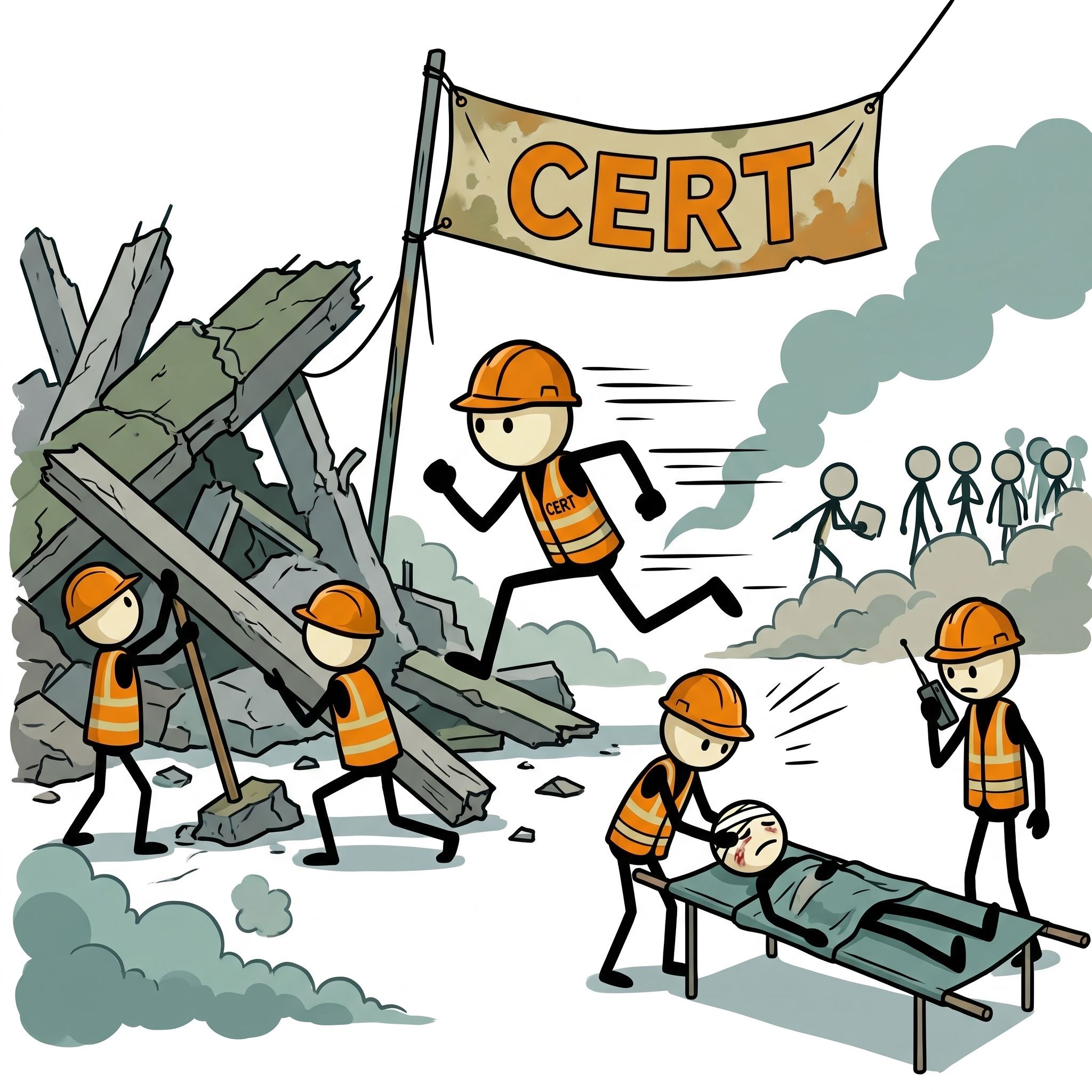
What is a Community Emergency Response Team (CERT)?
A Community Emergency Response Team is a structured group of volunteer citizens who undergo specialized disaster preparedness training to assist their families, neighbors, and co-workers in the immediate aftermath of an emergency. The CERT concept was pioneered by the Los Angeles Fire Department (LAFD) in 1985. Recognizing that spontaneous, untrained volunteers often put themselves in danger during disasters—such as the devastating 1985 Mexico City earthquake—the LAFD realized the need to train citizens to operate safely and effectively. In 1993, FEMA recognized the immense value of this program and expanded it nationwide, creating a standardized curriculum that is now utilized across all 50 states and several U.S. territories.
The core philosophy of any local CERT program is simple: "Do the greatest good for the greatest number of people." When a disaster strikes, CERT members are not meant to replace professional first responders. Instead, they act as a force multiplier. They are trained to assess damage, extinguish small fires, turn off compromised utilities, administer basic first aid, perform light search and rescue, and establish order out of chaos until municipal emergency services can access the area.
Importantly, CERT operations are highly organized. They utilize the Incident Command System (ICS), which is the exact same management framework used by federal, state, and local emergency agencies. This shared organizational language allows CERT volunteers to seamlessly integrate with professional fire departments, emergency management agencies (EMAs), and law enforcement once they arrive on the scene. By handling minor emergencies and stabilizing victims locally, CERTs free up professional crews to tackle the most complex, life-threatening crises.
The Core Curriculum: What You Learn in CERT Training
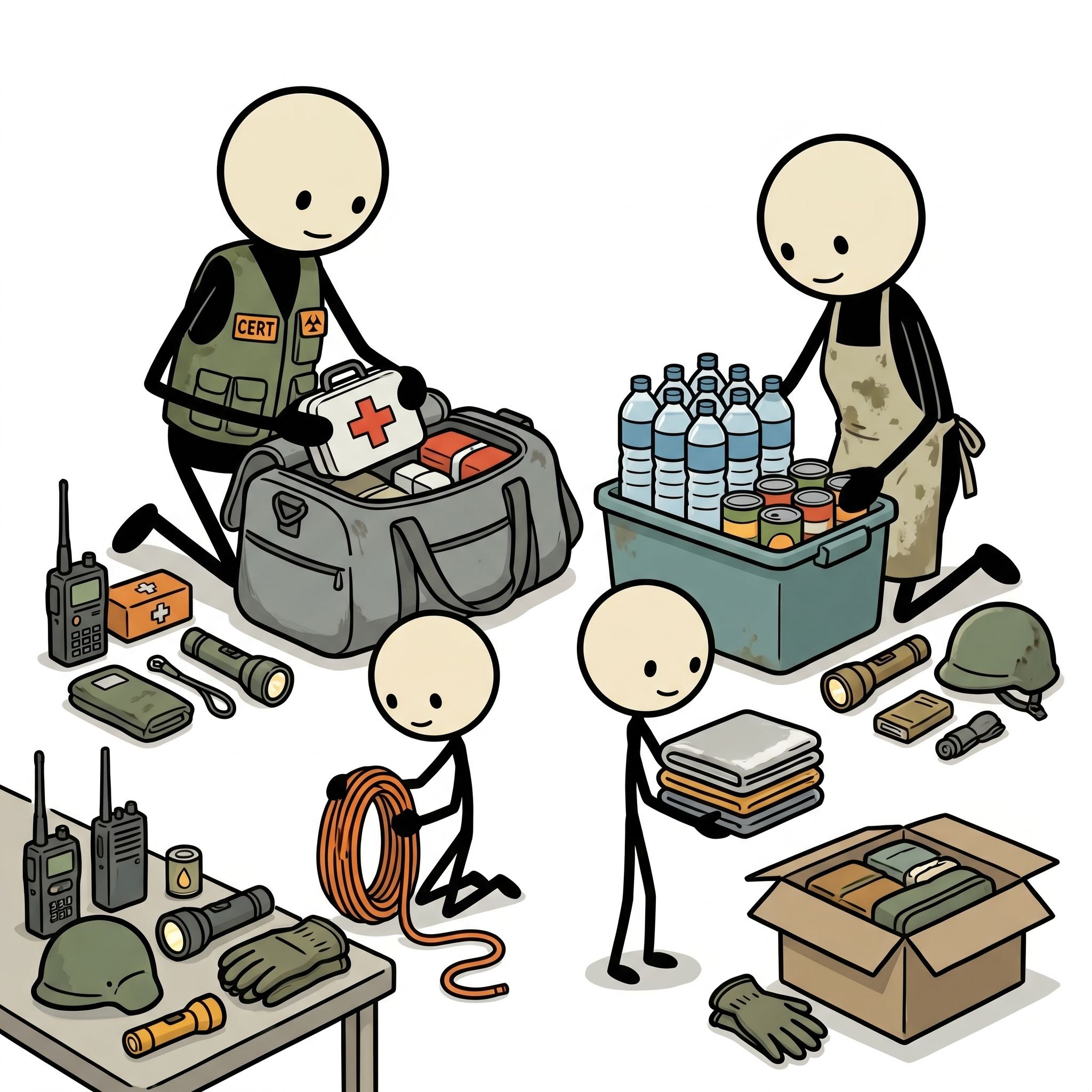
To become a credentialed CERT member, individuals must complete a standardized training program, typically sponsored by a local fire department, emergency management office, or community college. This comprehensive disaster preparedness training is divided into several modules, combining theoretical classroom learning with rigorous hands-on practice. Here is a detailed breakdown of the essential skills taught during the course:
1. Disaster Preparedness and Hazard Mitigation
Before you can help others, you must ensure your own household is secure. The first phase of CERT training focuses on personal, family, and workplace preparedness. Volunteers learn how to identify structural and non-structural hazards in their homes (such as unanchored water heaters or heavy bookshelves), assemble comprehensive disaster supply kits, and create family emergency plan communications plans. Additionally, trainees learn about the specific hazard profiles of their local regions—whether that involves earthquakes, hurricanes, wildfires, floods, or extreme weather events—and how to mitigate those risks before an event occurs.
2. Disaster Fire Suppression and Utility Controls
Small fires can quickly escalate into neighborhood-wide conflagrations if left unchecked, particularly when water pressure is lost. CERT volunteers are trained in basic fire chemistry (the "fire tetrahedron") and learn to identify different classes of fires (Class A, B, C, and D). Under the direct supervision of professional firefighters, students receive hands-on training in the proper selection and operation of fire extinguishers using the P.A.S.S. method (Pull, Aim, Squeeze, Sweep).
Crucially, volunteers are taught how to safely locate and shut off compromised municipal utilities, which are primary sources of post-disaster fires and explosions. This includes learning when and how to turn off residential natural gas valves (and why you should never turn them back on yourself), electrical circuit breakers, and main water valves.
3. Disaster Medical Operations (The "Three Killers")
In a disaster, life-threatening injuries must be treated immediately. CERT training focuses heavily on identifying and treating the "Three Killers" of bleeding control: airway obstruction, excessive bleeding, and shock. Volunteers learn practical, life-saving techniques, including: For a quick definition, see tourniquet.
- Airway Management: Utilizing the head-tilt/chin-lift maneuver to open blocked airways and placing unconscious victims in the recovery position to prevent suffocation.
- Bleeding Control: Applying direct pressure, elevation, pressure bandages, and the rapid deployment of commercial or improvised tourniquets to halt arterial bleeding. This aligns with the national "Stop the Bleed" campaign.
- Shock Management: Recognizing the signs of shock (rapid heart rate, pale/clammy skin, confusion) and treating it by elevating the legs, maintaining body temperature with space blankets, and keeping the victim calm.
4. Mass Casualty Triage
When faced with dozens of injured individuals, responders must prioritize treatment to save the maximum number of lives. CERT members are trained in the S.T.A.R.T. (Simple Triage and Rapid Treatment) method. This systematic protocol allows a responder to evaluate a victim's respiration, perfusion (circulation), and mental status (the "RPMs") in under 30 seconds. Victims are then tagged with color-coded ribbons or cards:
- RED (Immediate): Life-threatening injuries requiring immediate intervention (e.g., airway obstruction, severe bleeding).
- YELLOW (Delayed): Serious but non-life-threatening injuries (e.g., stable fractures, controlled bleeding).
- GREEN (Minor): The "walking wounded" who require minimal care and can often assist responders.
- BLACK (Deceased/Expectant): No signs of life, or injuries so severe that survival is highly unlikely given available resources.
5. Light Search and Rescue Operations
When buildings collapse or are damaged, victims may be trapped inside. CERT volunteers learn how to conduct safe, systematic search and rescue operations without becoming victims themselves. This training covers:
- Structural Size-Up: Evaluating damage levels (Light, Moderate, or Heavy) to determine if it is safe to enter a structure. CERT teams are strictly taught *never* to enter heavily damaged buildings.
- Search Patterns: Implementing systematic search techniques (such as the grid search or right-hand/left-hand wall-following methods) to ensure no areas are missed.
- Lifting and Cribbing: Utilizing basic physics, wooden cribbing blocks, and pry bars to safely lift heavy objects (such as concrete slabs or fallen beams) to free trapped victims.
- Victim Carries and Drags: Executing safe extraction techniques (such as the blanket drag, pack-strap carry, or two-person carry) to move victims without causing further injury to them or the rescuers.
6. Disaster Psychology and Team Organization
Disasters take an immense emotional toll on both victims and rescuers. CERT training teaches volunteers how to identify signs of psychological trauma, such as hyperventilation, cognitive confusion, or extreme withdrawal. Responders learn to practice "Psychological First Aid" by active listening, offering clear and honest information, and providing physical comfort. Additionally, volunteers are trained to monitor their own mental health and that of their teammates, recognizing signs of vicarious trauma and burnout.
Finally, this module teaches the organizational structure of CERT. It details how to establish a Command Post, assign roles (such as Operations Section Chief, Logistics Section Chief, and Safety Officer), and document operations to ensure clear communication with arriving emergency services.
The Power of Neighborhood Emergency Response
While individual preparedness is vital, true resilience is built through collaborative, neighborhood emergency response networks. When a crisis occurs, a highly organized team of neighbors working together is infinitely more effective than a collection of isolated households. By organizing a local CERT program at the neighborhood level, residents can proactively map their community's unique vulnerabilities and assets before a disaster strikes.
For example, a neighborhood CERT can conduct a pre-disaster assessment to identify:
- Vulnerable Residents: Elderly individuals living alone, families with infants, individuals requiring specialized medical equipment (like oxygen concentrators), or those with mobility challenges.
- Critical Assets: Residents who own heavy equipment (such as chainsaws, tractors, or 4x4 vehicles), those with medical training (nurses, EMTs, veterinarians), and locations of emergency water sources or generators.
- Hazard Zones: Areas prone to localized flooding, unstable hillsides susceptible to mudslides, or overhead power lines likely to block key evacuation routes.
When a disaster occurs, the neighborhood CERT activates. Rather than wandering aimlessly, trained volunteers assemble at a pre-designated meeting point (such as a local park, school, or community center) and establish their Command Post. They dispatch reconnaissance teams to survey the neighborhood, block by block. These teams identify hazards, check on vulnerable residents, and report back to the Command Post. Because they are already on-site, they can initiate life-saving medical triage, suppress utility fires, and clear primary roadways hours before external help arrives. This rapid, localized mobilization is what saves lives during the critical "Golden Hour" of disaster response.
Real-World Impact: How CERTs Save Lives
The efficacy of CERT programs is not merely theoretical; it has been proven time and again during real-world crises. These volunteer teams have repeatedly demonstrated their value to local emergency management agencies across the United States.
Superstorm Sandy (2012)
When Superstorm Sandy battered the East Coast, municipal emergency services in New York and New Jersey were inundated with thousands of calls per hour. In many communities, local CERT programs stepped up to manage the crisis. In Nassau County, New York, and across various boroughs of NYC, CERT volunteers established and staffed emergency shelters, distributed thousands of meals and bottles of water, conducted wellness checks on thousands of high-rise residents who were trapped without power, and assisted with light debris removal to open critical roadways for emergency vehicles.
The Northridge Earthquake (1994)
Following the devastating magnitude 6.7 Northridge Earthquake in Southern California, LAFD CERT-trained volunteers immediately mobilized. They shut off hundreds of leaking natural gas lines, preventing catastrophic post-earthquake fires that historically destroy cities following major seismic events. They also conducted rapid search and rescue operations in moderately damaged apartment complexes, freeing trapped residents and administering basic first aid long before municipal rescue crews could navigate the fractured freeway system.
Wildfire Evacuations in the Western U.S.
In states like California, Colorado, and Oregon, wildfire seasons have become increasingly severe. Local CERT programs are frequently activated by sheriff's departments to assist with large-scale evacuations. CERT members go door-to-door to deliver evacuation notices, manage traffic control points to keep evacuation routes flowing smoothly, and staff animal shelters to care for displaced livestock and pets. Their assistance allows law enforcement officers to focus entirely on active evacuation operations and security in evacuated zones.
How to Join or Form a Local CERT Program
Building hyper-local resilience starts with individual action. Whether you want to join an existing team or establish a brand-new program in your community, the pathway is highly structured and supported by emergency management agencies.
Step 1: Locate an Existing Program
Most metropolitan areas and counties already have an established CERT program. You can locate your nearest team by visiting the official FEMA Citizen Corps directory online or by contacting your local city or county Emergency Management Agency (EMA), fire department, or sheriff's office. Many local programs offer the standard CERT training course several times a year, often free of charge or for a nominal fee to cover training materials and personal protective equipment (PPE).
Step 2: Complete the Training
Commit to attending the 20-to-30-hour training course. The curriculum is designed to be accessible to individuals of all backgrounds, ages (typically 18 and older, though some teen CERT programs exist), and physical abilities. Not every CERT role requires strenuous physical labor; volunteers are desperately needed to manage communications, log data at the Command Post, coordinate logistics, and provide psychological support.
Step 3: Obtain Your Gear
Upon graduation, many sponsoring agencies will provide you with a basic CERT starter kit. If not, or if you wish to build a more robust kit, a standard CERT deployment bag should include:
| Gear Category | Essential Items | Purpose |
|---|---|---|
| Personal Protection (PPE) | Hard hat, safety goggles, heavy leather work gloves, N95/KN95 masks, high-visibility reflective vest. | Protects the responder from falling debris, airborne particulates, and sharp objects during search and rescue. |
| Tools & Utility | Non-sparking gas shut-off wrench, multi-tool, pry bar, heavy-duty flashlight or headlamp (with extra batteries), chemical light sticks. | Used for turning off utilities, forcing open jammed doors, and illuminating dark search environments safely. |
| Medical Supplies | Trauma shears, tourniquets, pressure dressings, sterile gauze pads, triangular bandages, nitrile gloves, medical tape. | Enables rapid treatment of life-threatening bleeding and stabilization of musculoskeletal injuries. |
| Communications & Markings | Waterproof notepad and pen, permanent markers, lumber crayons, whistle, color-coded triage ribbons. | Used to mark searched structures, document victim counts, communicate via sound signals, and tag patients. |
Step 4: Form a New CERT Program
If your community does not currently have a CERT program, you can take the initiative to form one. This process requires coordination with local leadership and emergency services:
- Secure a Sponsoring Agency: A CERT must be sponsored by a local government entity, such as a fire department, police department, emergency management office, or municipal government. This agency will provide official oversight, liability coverage, and credentialing.
- Identify Program Leadership: Designate a CERT Coordinator (often a professional first responder from the sponsoring agency) and volunteer Team Leaders to manage administration, training schedules, and community outreach.
- Adopt the FEMA Curriculum: Utilize the free, standardized FEMA CERT training materials, instructor guides, and student manuals available through the Emergency Management Institute (EMI).
- Recruit Volunteers: Reach out to neighborhood watch groups, homeowners associations (HOAs), faith-based organizations, local businesses, and civic clubs to build a diverse and dedicated volunteer base.
- Establish a Funding Mechanism: While CERT programs are highly cost-effective, funding may be needed for training manuals, PPE, and equipment caches. Look into FEMA's Homeland Security Grant Program (HSGP), Emergency Management Performance Grants (EMPG), local corporate sponsorships, or community fundraising.
Step-by-Step Guide: Three Critical Skills Every Prepared Citizen Should Know
Even before you complete your formal CERT training, mastering several fundamental disaster response skills can significantly enhance your immediate survival capabilities. Below are step-by-step instructions for three high-impact emergency skills.
Skill 1: How to Safely Turn Off a Residential Gas Valve
Leaking natural gas is one of the greatest hazards following an earthquake or structural collapse. Knowing how to shut it off quickly can prevent devastating fires.
- Locate your gas meter: Typically found on the exterior of your home, along the side or front wall, or occasionally in a basement or utility closet.
- Identify the shut-off valve: Look for the main pipe running from the ground up into the meter. On that pipe, there is a rectangular valve (usually about 1 inch by 2 inches). When the gas is flowing, this valve is aligned parallel to the pipe.
- Use the correct tool: Keep a dedicated, non-sparking gas shut-off wrench or a large adjustable crescent wrench zip-tied directly to the gas meter or stored in an easily accessible emergency kit nearby.
- Turn the valve: Place the wrench on the valve and turn it one-quarter turn in either direction so that the valve is perpendicular (at a 90-degree angle) to the pipe. This stops the flow of gas.
- CRITICAL SAFETY RULE: Never attempt to turn the gas back on yourself. If you turn it off, it must be turned back on only by a licensed professional utility technician who can safely purge the lines and relight pilot lights.
Skill 2: How to Apply a Tourniquet to Control Severe Bleeding
A victim with a severed artery can bleed to death in less than three minutes. Immediate application of a tourniquet is the most effective way to save their life.
- Expose the wound: Quickly cut or tear away clothing over the wound to clearly identify the source of the bleeding.
- Position the tourniquet: Place the tourniquet high and tight on the injured limb—specifically, 2 to 3 inches above the wound. Never place a tourniquet directly over a joint (such as the knee or elbow); if the wound is below a joint, place the tourniquet above the joint on the upper arm or thigh.
- Tighten the strap: Pull the self-adhering band of the tourniquet as tight as possible through the buckle and secure it back on itself.
- Twist the windlass: Turn the windlass rod until the bleeding stops completely and the distal pulse (e.g., radial or pedal pulse) is no longer felt.
- Lock and document: Secure the windlass rod inside the clip to lock it in place. Write the exact time of application (e.g., "T: 14:32") on the white time strap of the tourniquet. This is vital information for the surgeons who will treat the victim later.
Skill 3: How to Build a Simple Box Cribbing System
When a heavy object has pinned a victim, you can use basic physics and wooden blocks to lift and stabilize the load, a process known as cribbing.
- Gather materials: Obtain several uniform pieces of construction-grade lumber, typically 4x4 or 2x4 wooden blocks, cut to lengths of 18 to 24 inches.
- Establish a pivot point: Place a heavy-duty pry bar or lever under the load, using a solid wooden block as a fulcrum.
- Lift the load slightly: Gently lift the load just enough to slide the first layer of cribbing blocks underneath. Remember the rule: "Lift an inch, crib an inch." Never put your hands or body under an unsecured load.
- Build the box: Lay two wooden blocks parallel to each other on a solid foundation beneath the load. Then, lay the next two blocks perpendicular on top of the first pair, creating a square box. Repeat this alternating pattern to build a stable tower.
- Secure the load: As you lift the load higher with your lever, continue adding layers to the cribbing tower. The weight of the load should rest squarely on the corners of the cribbing box, where the wood overlaps, ensuring maximum structural strength and preventing a sudden collapse.
Building a Resilient Future, Block by Block
True emergency preparedness is not about isolating oneself in a bunker with stockpiles of supplies; it is about reaching out to your neighbors and building a collective shield of safety. When a major disaster strikes, your community's greatest asset is not the gear in your garage, but the relationships, organization, and training of the people around you. By participating in a local CERT program, you transform from a passive bystander into an active, empowered lifesaver. You gain the skills, confidence, and organizational framework necessary to protect your family, stabilize your neighborhood, and support professional first responders when they need it most. Take the first step today: seek out your local CERT training program, equip yourself with the knowledge to lead, and help build a hyper-local network of resilience that can weather any storm.
Frequently Asked Questions
What is CERT training and what does it stand for?
CERT stands for Community Emergency Response Team. It is a national program that trains volunteers in basic disaster response skills so they can assist their families, neighbors, and co-workers during emergencies when professional responders are not immediately available.
What skills do you learn in a CERT training course?
CERT training covers essential disaster preparedness skills, including fire safety, light search and rescue, team organization, disaster medical operations (such as triage and basic first aid), and psychological first aid.
Who is eligible to join a Community Emergency Response Team?
Anyone who wants to help their community can join. CERT training is generally open to individuals aged 18 and older, though teenagers can often participate in specialized Teen CERT programs or with parental permission.
How long does it take to complete the basic CERT training?
The standard CERT basic training course takes approximately 20 to 30 hours to complete. It is typically delivered over several weeks in evening classes, or condensed into a few weekend sessions depending on the local sponsoring agency.
Is there a cost to participate in CERT training?
In most communities, the basic CERT training course is offered completely free of charge. Local sponsoring agencies (such as fire or police departments) typically cover the cost of instruction and basic training materials.