⚡ Key Facts
- High Baseline Vulnerability: According to the Centers for Disease Control and Prevention (CDC), 60% of American adults live with at least one chronic disease, and 40% manage two or more, making ongoing medical management the true frontline of disaster response. For the practical checklist side, use the community emergency preparedness guide.
- The Hidden Mortality Driver: Retrospective disaster analyses from events like Hurricane Maria and Superstorm Sandy revealed that the vast majority of excess casualties stemmed not from physical trauma, but from the collapse of critical care infrastructure—including interrupted dialysis, lost refrigerated medications, and unpowered medical devices. For the practical checklist side, use the neighborhood preparedness network.
- Grid Dependency: Data from the U.S. Department of Health and Human Services (HHS) emPOWER Program tracks more than 4.4 million Medicare beneficiaries who rely on electricity-dependent medical and assistive equipment to live independently in their communities. For the practical checklist side, use the family emergency planning guide.
- Supply Chain Fragility: The Federal Emergency Management Agency (FEMA) notes that standard commercial pharmacy operations are routinely disrupted for 7 to 14 days following major regional disruptions, leaving under-supplied individuals without access to life-sustaining maintenance prescriptions.
When catastrophic weather strikes or municipal grids collapse, the primary threat to life rarely arrives as a crashing wave or a falling timber. For millions of individuals, the real crisis begins quietly: an insulin vial warming to room temperature inside a dead refrigerator, an oxygen concentrator sputtering to a halt as backup batteries drain, or a peritoneal dialysis shipment blocked by washed-out access roads. Disaster epidemiology consistently demonstrates that post-event morbidity is heavily driven by decompensated chronic conditions. Surviving an emergency requires treating personal healthcare not as an afterthought tucked into a Go-Bag Builder, but as a complex, vulnerable life-support system requiring systematic redundancy. Building operational resilience means taking active ownership of your clinical supply chain before institutional systems fail under pressure.
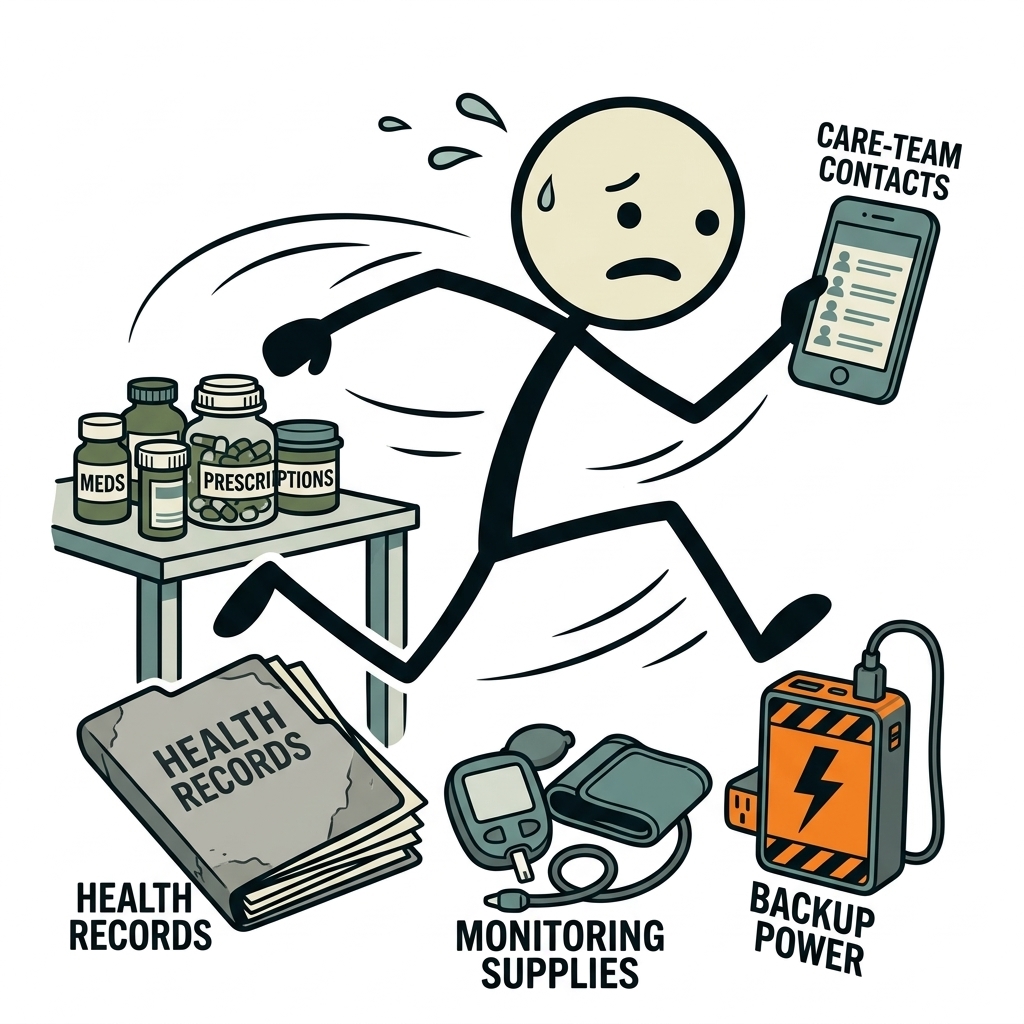
The Reality of Chronic Care in Austere Environments
Disaster response agencies are designed to manage acute stabilization: triage, hemorrhage control, search and rescue, and macro-level distribution of food and bulk water. They are fundamentally ill-equipped to manage precision medicine. If you rely on specialized biologics, targeted immunosuppressants, titrated cardiac drugs, or micro-dosed endocrine therapies, you cannot depend on a municipal evacuation shelter to fulfill your daily regimen. Field clinics run by humanitarian groups or the National Guard stock broad-spectrum antibiotics, basic analgesics, and rudimentary wound care supplies—not your specific brand-name beta-blocker or custom-fit tracheostomy tube.
Furthermore, when widespread displacement occurs, healthcare infrastructure experiences immediate structural degradation. Clinical clinics shutter as staff members deal with their own personal emergencies. Electronic health record (EHR) networks drop offline due to downed fiber trunks or server room power failures. Regional logistics hubs, such as FedEx and UPS sorting facilities, halt operations, freezing the home delivery networks that specialty pharmacies depend on. For patients navigating these operational realities, robust personal planning is the only viable safeguard against acute clinical decline.
Phase 1: Medication Resiliency – Sourcing, Rotation, and Cold-Chain Logistics
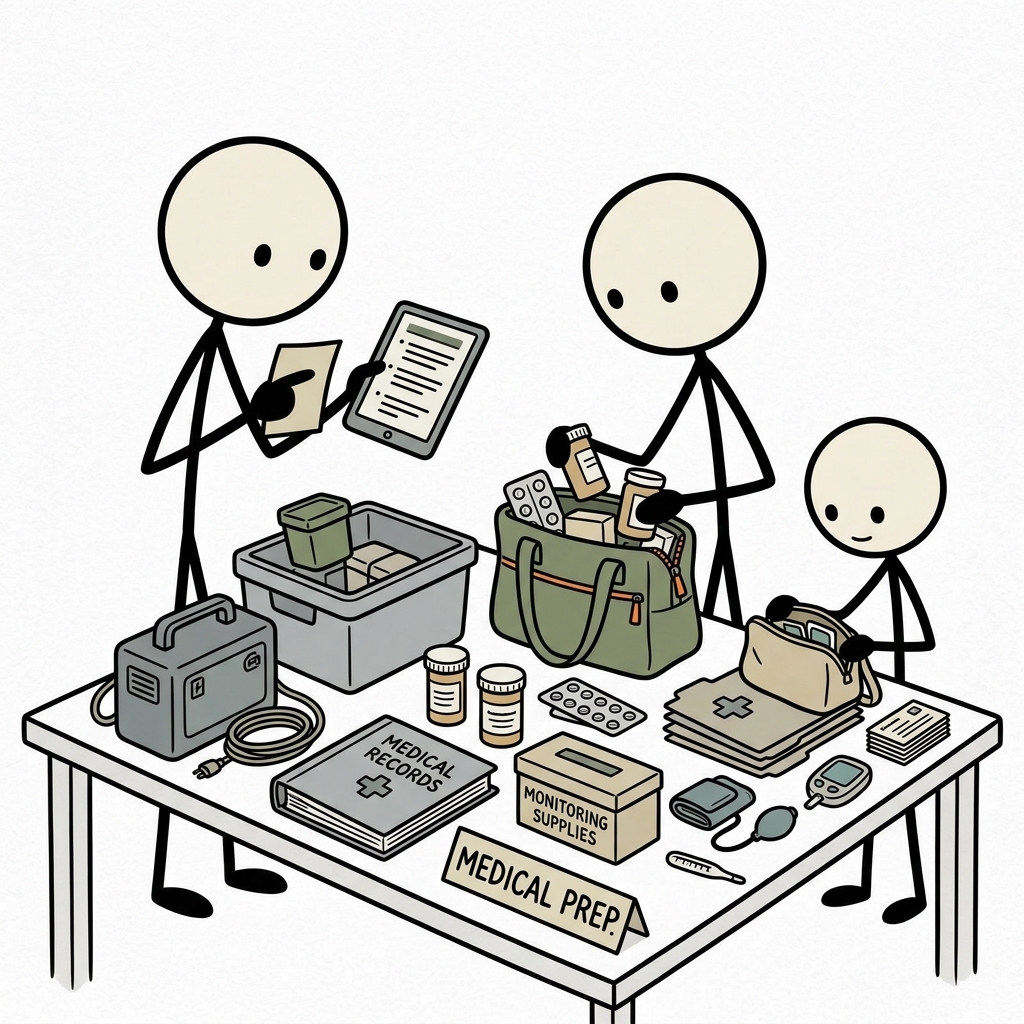
Maintaining a continuous supply of maintenance pharmaceuticals is the cornerstone of emergency preparedness for chronic illness. Standard institutional advice often recommends keeping a "three-day supply" of medications on hand. In an era of compounding climate disruptions, widespread cyber incidents, and fragile domestic supply lines, a 72-hour cushion is dangerously inadequate. Your baseline objective should be a rolling 30-day reserve of every critical maintenance drug, with an absolute hard minimum of 14 days.
Overcoming Insurance Barriers for Medication Reserves
Building an extra supply of prescription drugs is often complicated by insurance restrictions that enforce strict 30-day refill intervals. However, several legal, clinical, and regulatory pathways exist to help you establish a safe buffer:
- Vacation Overrides: Most commercial and Medicare Part D plans permit one to two "vacation overrides" per calendar year. By submitting a formal request through your prescriber, you can legally obtain an additional 30-to-90-day refill ahead of your scheduled renewal.
- Early Refill Windows: Many pharmacy benefit managers (PBMs) allow prescription refills when 75% to 80% of the current prescription duration has passed (typically day 22 to 24 of a 30-day fill). By consistently refilling prescriptions on the earliest permissible calendar day, you can accumulate a full 30-day buffer over the course of four to five months.
- Out-of-Pocket Bridge Purchasing: For generic, non-controlled maintenance medications (e.g., lisinopril, levothyroxine, metformin), the cash price using retail discount programs like GoodRx is often negligible. Ask your physician to write a separate 30-day paper or electronic prescription that you can purchase out-of-pocket, outside of your insurance ecosystem, to serve as a dedicated emergency cache.
- State Emergency Refill Laws: Familiarize yourself with state-specific legislation modeled after the Emergency Prescription Assistance Program (EPAP). Many jurisdictions have statutory mandates requiring insurers to waive early-refill restrictions the moment a governor or the federal government issues a formal state of emergency declaration.
Rigorous FIFO Inventory Management
Medications degrade when exposed to heat, humidity, and light, losing potency long before their stamped expiration dates. Storing an emergency stash in an untouched box under your bed guarantees that when an emergency arrives, you will be dosing yourself with degraded chemical compounds. Implement a strict "First-In, First-Out" (FIFO) rotation cycle:
Store your reserve medications directly behind your active supply. When you pick up a new monthly fill from the pharmacy, place that fresh bottle at the back of your storage container. Open and consume the older supply that was previously sitting in your emergency reserve. By cycling medications continuously through active use, your disaster cache remains fresh, potent, and safely within manufacturing potency tolerances.
Cold-Chain Integrity: Refrigerated Medications
For individuals dependent on temperature-sensitive pharmaceuticals—such as insulins, GLP-1 agonists, interferons, human growth hormones, and monoclonal antibodies—a power outage represents an immediate survival challenge. Most biologics must be maintained strictly between 36°F and 46°F (2°C to 8°C). While insulin can tolerate excursions up to 86°F (30°C) for up to 28 days, its structural degradation accelerates rapidly beyond that threshold, and it must never be allowed to freeze.
Relying on standard household ice cubes is dangerous; wet melting ice risks submerging medication vials, damaging labeling, introducing bacterial contamination, and causing localized sub-freezing contact that ruins the medication. Instead, invest in purpose-built cold-chain medical transport gear. Medical-grade travel coolers utilizing phase-change material (PCM) packs maintain a strict 2°C to 8°C environment for 48 to 72 hours without external power. For extended grid failure, integrate portable 12-volt compressor-based mini-fridges powered by small lithium iron phosphate (LiFePO4) solar generators.
Phase 2: Redundant Medical Documentation and Identification
In a mass-casualty or regional evacuation scenario, the clinicians treating you will not have access to your primary health system's electronic portal. They will not know that you have an anaphylactic allergy to cephalosporins, that you possess a mechanical heart valve requiring an exact therapeutic INR range, or that your baseline kidney function shows an elevated serum creatinine. If you are incapacitated, disoriented, or simply separated from your home, missing medical documentation can lead to catastrophic medical errors.
The Physical and Digital "Go-Binder"
Create a dual-layered documentation system that balances rapid visual access with deep diagnostic detail. Maintain physical, hard-copy documentation sealed inside heavy-duty waterproof bags (such as marine dry bags), backed up by an encrypted digital repository.
- The Physical Quick-Look Summary: A single-page laminated summary kept in your kit, pocket, and vehicle glovebox. It must list your primary diagnosis, critical allergies, baseline vitals, current medication list with exact generic names and dosages, blood type, and emergency contacts.
- Comprehensive Hard-Copy Records: Include your most recent baseline 12-lead electrocardiogram (ECG) printout, your latest comprehensive metabolic panel and complete blood count, specialized surgical operation notes (especially regarding implants, stents, or bypasses), and device programmer specification sheets.
- Encrypted Digital Storage: Store high-resolution PDFs of all clinical history, insurance cards, and state identification on an AES-256 hardware-encrypted USB flash drive kept on your person. Complement this with an offline-accessible local file folder on your smartphone—do not rely solely on cloud drives that require active cellular data or operational broadband.
Equipment Identifiers and Diagnostic Baselines
Document the precise make, model, serial number, and software firmware versions of any implantable or wearable medical technology you utilize. This includes pacemakers, implantable cardioverter-defibrillators (ICDs), continuous glucose monitors (CGMs), neurostimulators, and automated insulin delivery pods. Maintain physical wallet cards issued by manufacturers verifying these devices, as they are mandatory for security screening bypasses and critical for field clinicians evaluating sudden device malfunction.
Phase 3: Monitoring Supplies and Durable Medical Equipment (DME)
Modern chronic disease management is deeply integrated with digital telemetry and automated diagnostic hardware. However, delicate electronic monitoring devices are notoriously susceptible to the moisture, physical impacts, and logistical shortages inherent to disasters. A resilient plan builds a tiered operational bridge between high-tech daily management and low-tech analog alternatives.
High-Tech Reliance vs. Analog Redundancy
If you manage diabetes using a continuous glucose monitor (CGM) paired with an automated insulin pump, you are operating within a complex technological ecosystem. Sensors expire, Bluetooth connections drop, and transmitters can be ripped out during physical tasks. When designing your emergency preparedness for chronic illness checklist, you must incorporate complete manual failover kits.
For every high-tech diagnostic tool you utilize, carry a ruggedized, analog, or basic battery-powered backup:
- Pair your continuous glucose monitor with an independent, manual finger-stick blood glucose meter, complete with three times the test strips, lancets, and calibration fluid you normally burn through in a month.
- Pair automated digital oscillometric blood pressure cuffs with a high-quality manual aneroid sphygmomanometer and an acoustic stethoscope—and train yourself or a family member in manual auscultation.
- Ensure pulse oximeters run on universal, non-proprietary batteries (such as AAA cells), and carry extra alkaline or lithium batteries packed in waterproof cases.
Consumable Burn Rates
Durable medical equipment quickly becomes useless without a parallel supply of consumables. Calculate your daily consumption rate and establish a minimum 30-day disaster reserve for all critical disposable items:
- Respiratory Consumables: Extra CPAP/BiPAP masks, headgear, replacement filters, and corrugated tubing. For nebulizer users, stock multiple disposable jet nebulizer cups and T-mouthpieces, as these plastic components rapidly harbor bacterial growth if not properly sterilized.
- Enteral and Parenteral Nutrition: Syringes, feeding bags, extension sets, and secondary G-tube buttons.
- Urological and Ostomy Supplies: Catheters, collection bags, insertion lubrication, skin barrier wafers, adhesive paste, and disposal bags.
Sterile Water and Hygiene in Contaminated Field Conditions
Many chronic respiratory conditions require sterile or distilled water to operate equipment safely without introducing mineral scale or waterborne pathogens (such as Legionella pneumophila or non-tuberculous mycobacteria). Running municipal tap water, stream water, or improperly boiled floodwater through a CPAP humidifier or airway clearance device is an immediate route to life-threatening pulmonary infections.
Store several gallons of commercial distilled or medical-grade sterile irrigation water strictly designated for medical machinery. If you must evacuate, know how to bypass active humidification chambers on your devices to conserve your clinical water reserves. Carry high-level sanitizing solutions, including medical-grade isopropyl alcohol wipes, chlorhexidine gluconate swabs, and sodium hypochlorite wipes to maintain sterile fields when changing dressings, sensors, or infusion sets in shelter settings.
Phase 4: Power Independence for Life-Sustaining Equipment
When developing a baseline strategy for emergency preparedness for chronic illness, emergency preparedness professionals emphasize that electrical failure is the single point of failure that precipitates immediate physiological crisis. The HHS emPOWER map reveals that vast clusters of vulnerable Americans are plunged into immediate danger within just two hours of localized grid failure. You must treat power like oxygen: a non-negotiable physiological requirement that must be defended through active power management.
Conducting a Comprehensive Power Audit
To design an electrical backup architecture, you must determine your exact electrical load. Check the technical specification plate on the bottom or back of all your medical equipment. Look for the Voltage and Amperage ratings, and calculate the continuous running wattage using the basic electrical formula:
Watts (W) = Volts (V) × Amps (A)
Be aware that devices with motors, compressors, or pumps (such as stationary oxygen concentrators or mechanical lift chairs) have an initial "surge" or "peak" wattage requirement upon startup that can be two to three times higher than their continuous running wattage. Furthermore, heating elements—such as CPAP humidification tubes or heated dialysis fluid warmers—dramatically increase power draw. Turning off active humidification on a CPAP device can drop its power consumption from 80–100 Watts down to a modest 15–25 Watts, extending your battery reserves substantially.
| Medical Device | Average Draw (Watts) | 12-Hour Energy Need (Watt-Hours) | Recommended Backup Profile |
|---|---|---|---|
| CPAP/BiPAP (No Humidifier) | 15W – 30W | 180Wh – 360Wh | 500Wh LiFePO4 Power Station |
| CPAP/BiPAP (Heated Tube/Chamber) | 70W – 110W | 840Wh – 1,320Wh | 1,500Wh+ Power Station or Generator |
| Portable Oxygen Concentrator (POC) | 40W – 120W (Pulse vs Continuous) | 480Wh – 1,440Wh | External Swappable DC Packs + Solar |
| Home Dialysis Machine | 500W – 1,200W | Intermittent Run (Cycle dependent) | Dual-Fuel Inverter Generator (3,000W+) |
| Electric Wheelchair/Mobility Scooter | 120W – 300W (Recharge rate) | 400Wh – 800Wh per full charge | High-Capacity Portable Battery Hub |
Battery Geometries: Why LiFePO4 and Pure Sine Wave Inverters Matter
When selecting portable battery power stations, avoid older lead-acid designs or basic lithium-ion (NMC) packs. Specify Lithium Iron Phosphate (LiFePO4) chemistry. LiFePO4 units offer 3,000 to 5,000 discharge cycles before degrading, maintain safe thermal stability under harsh conditions, and do not pose thermal-runaway hazards inside living quarters.
Equally critical is the inverter type. Sensitive medical devices with delicate microprocessors, flow sensors, or brushless motors require a Pure Sine Wave inverter. Inexpensive utility inverters produce a "modified sine wave" or "square wave" current that produces electrical noise, induces overheating, and can permanently damage the sensitive internal motherboards of life-support gear.
Utility Coordination and Grid Vulnerability
Most regional electrical utilities maintain a "Critical Care" or "Medical Baseline" registry for households containing electricity-dependent residents. Contact your power provider immediately to secure the required medical certification forms, which must be signed by your attending physician.
A vital warning: Registration on a critical care utility list does not guarantee that your power will be restored first, nor does it mean the utility will deploy a field generator to your home during an outage. In major meteorological events, transmission corridors are restored according to structural utility logic (substations, water treatment facilities, major hospitals). The critical care registry primarily prevents routine administrative service shutoffs and serves as an automated data marker for municipal emergency managers. You must maintain complete personal self-sufficiency.
Phase 5: The Care-Team Communication and Evacuation Matrix
When a disaster develops, your primary care physician and regular clinical contacts will likely be overwhelmed or cut off from normal emergency communication plan channels. You must construct an extended operational network that spans beyond your immediate geographical vulnerability zone.
Constructing the Operational Contact Tree
Document contact information across multiple operational layers, recording primary phone lines, alternate cell numbers, direct clinical extensions, emergency patient-access lines, physical office addresses, and National Provider Identifier (NPI) numbers:
- Primary Tier: Your local primary care physician, local managing specialists (cardiologist, nephrologist, pulmonologist, endocrinologist), home health agency dispatcher, and the specific physical facility that services your durable medical equipment.
- Secondary Tier (Specialty Supply Hubs): The corporate emergency logistics desk for your DME provider (e.g., Lincare, Apria), your mail-order specialty pharmacy, and your clinical laboratory coordinator.
- Tertiary Tier (Out-of-Area Clinical Contacts): Identify tertiary hospital systems, specialty clinics, and medical supply depots located 50 to 100 miles outside your metropolitan footprint, along your primary evacuation routes. If you must evacuate, having pre-identified access points avoids dangerous diagnostic delays in unfamiliar locations.
Contingency Operations for Specialized Care
For patients requiring complex, clinic-based life support—most notably outpatient hemodialysis—disasters represent an acute existential timeline. Missed dialysis sessions trigger rapid potassium accumulation, pulmonary edema, cardiac arrhythmias, and metabolic acidosis within 48 to 72 hours.
Major dialysis networks (such as Fresenius Medical Care and DaVita) operate extensive corporate disaster networks. Obtain their nationwide emergency patient access hotlines before a crisis strikes. These hotlines track emergency facility openings, route patients to operating units with generator power and functional municipal water tie-ins, and manage emergency patient manifests. Furthermore, consult your nephrologist to obtain and store an emergency "dialysis delay diet" protocol—a restrictive nutritional and fluid management regimen designed to slow potassium and fluid buildup if treatments are unavoidably postponed.
Actionable Emergency Preparedness for Chronic Illness Checklist
Use this comprehensive emergency preparedness for chronic illness checklist to audit your baseline physical readiness, organize your operational go-kits, and identify blind spots in your clinical resilience strategy.
Tier 1: Pharmaceuticals & Cold-Chain
- [ ] Minimum 14-day (ideally 30-day) rolling reserve of all maintenance medications using a FIFO rotation schedule.
- [ ] Certified medical phase-change transport cooler with accurate digital thermometer probe.
- [ ] Backup paper prescriptions for all critical maintenance pharmaceuticals.
- [ ] Specialized rescue medications (e.g., glucagon kits, EpiPens, rapid-acting bronchodilators) stored in duplicate locations.
- [ ] Off-grid cold storage contingency: 12V portable DC compressor medical fridge integrated with backup battery capacity.
Tier 2: Documentation & Identification
- [ ] Heavy-duty waterproof document pouch containing physical hard copies of vital medical records.
- [ ] Up-to-date single-page "Quick-Look" clinical profile with baseline vitals, full medication roster, and ICD-10 diagnosis codes.
- [ ] Hard-copy baseline 12-lead diagnostic ECG strip (for cardiovascular patients).
- [ ] AES-256 hardware-encrypted USB flash drive with deep medical history, diagnostic imaging reports, and provider contacts.
- [ ] Medical alert ID bracelet, necklace, or digital tag worn continuously on your person.
Tier 3: Diagnostics, Consumables & DME
- [ ] Manual, analog diagnostic backups for every digital or sensor-driven telemetry tool used daily.
- [ ] 30-day reserve of medical disposables (catheters, tubing, sensors, infusion sets, lancets, testing strips).
- [ ] 3-to-5 gallons of medical-grade distilled or sterile irrigation water stored specifically for medical equipment.
- [ ] Sanitization field kit: sterile saline, chlorhexidine preparation pads, alcohol wipes, and medical-grade surface disinfectants.
- [ ] Rigid, puncture-resistant travel sharps disposal container.
Tier 4: Electrical Autonomy
- [ ] Documented electrical load audit detailing running wattage, surge wattage, and daily Watt-hour demands of all clinical hardware.
- [ ] Pure Sine Wave LiFePO4 battery power station sized to provide an absolute minimum of 48 hours of autonomous equipment operation.
- [ ] DC 12-volt direct adapters for respiratory and continuous monitoring machines to bypass inefficient inverter power drains.
- [ ] Solar photovoltaic recharging panels or dual-fuel inverter generator with stable, long-term stored fuel reserves.
- [ ] Formal enrollment verification in your municipal electrical utility's Critical Care / Medical Baseline program.
Tier 5: Communications & Evacuation Routing
- [ ] Comprehensive physical contact tree detailing primary physicians, specialists, DME dispatch, and home health supervisors.
- [ ] Pre-identified tertiary medical facilities and regional clinics mapped along primary and secondary evacuation corridors.
- [ ] Enrollment in nationwide emergency access registries for specialized clinical care (e.g., national dialysis disaster hotlines).
- [ ] Clear, practiced physical transit plan for heavy mobility equipment, ramps, and battery architecture in the event of rapid evacuation.
Ownership as the Ultimate Survival Asset
Managing an ongoing medical condition in an unstable world requires moving past the illusion of continuous institutional support. Disasters unmask the fragile nature of just-in-time pharmaceutical deliveries, regional power grids, and over-leveraged clinical systems. Real personal safety is built long before sirens sound—it is forged through detailed logistical planning, rigorous equipment redundancies, and uncompromising preparation. By systematically establishing rolling medication reserves, engineering independent power solutions, securing clinical documentation, and designing robust communication trees, you transform yourself from a passive, vulnerable dependent into an empowered manager of your own health and survival. Take command of your clinical security today; your health, stability, and life depend on the systems you put in place right now.
Frequently Asked Questions
What should a emergency preparedness for chronic illness plan include?
Start with the immediate safety steps, the supplies and records your household needs, a communication plan, and a regular review schedule. Follow local official guidance during an active emergency.
How often should I review emergency preparedness for chronic illness preparations?
Review them at least twice a year and whenever your household, medication, location, or local risks change. Replace expired supplies and practice key steps.
Where can I find reliable emergency guidance?
Use local emergency management alerts and established public-health or emergency-management agencies. A blog guide should support, not replace, official real-time instructions.