⚡ Key Facts
- The CDC Reports Over 400 Annual Fatalities: Unintentional, non-fire-related carbon monoxide poisoning claims more than 400 American lives each year and sends over 100,000 individuals to emergency rooms, according to the Centers for Disease Control and Prevention (CDC).
- Temporal-4 Pattern Signifies Immediate Danger: Under National Fire Protection Association (NFPA 72) standards, an active CO emergency sounds as a distinct "Temporal-4" pattern—four rapid beeps, followed by a five-second pause, repeating continuously at 85 decibels.
- A Single Chirp Is Never an Emergency Warning: A single, sharp chirp recurring once every 30 to 60 seconds indicates an operational issue—typically a depleted battery or end-of-life sensor warning—not an active carbon monoxide release.
- Cellular Hypoxia Occurs Silently: Carbon monoxide binds to hemoglobin with an affinity roughly 200 to 250 times greater than oxygen, meaning physical incapacitation and cognitive confusion can occur before a victim registers any physiological distress.
- Diagnostic Delay Is a Primary Fatality Driver: The Consumer Product Safety Commission (CPSC) emphasizes that attempting to troubleshoot carbon monoxide alarm hardware inside the home during an active Temporal-4 alarm sequence is one of the leading contributors to severe CO inhalation injuries.
At 2:15 AM on a sub-zero January morning, a sudden acoustic piercing shatters the silence of a suburban household. In that disoriented, sleep-deprived moment, human psychology reliably defaults to comfort: assuming a harmless hardware glitch, an irritating nuisance, or a dying battery. Homeowners routinely walk toward the sound, squinting at plastic casings in the dark, pressing buttons, or pulling batteries to silence the disturbance. When that acoustic signal represents actual gas buildup rather than an equipment maintenance notification, this instinctual delay becomes catastrophic. Carbon monoxide is an invisible, odorless, and non-irritating neurotoxin. Treating an auditory alert as an administrative inconvenience rather than an environmental threat costs vital minutes—time that marks the absolute boundary between conscious evacuation and permanent neurological collapse. For the practical checklist side, use the community emergency preparedness guide.
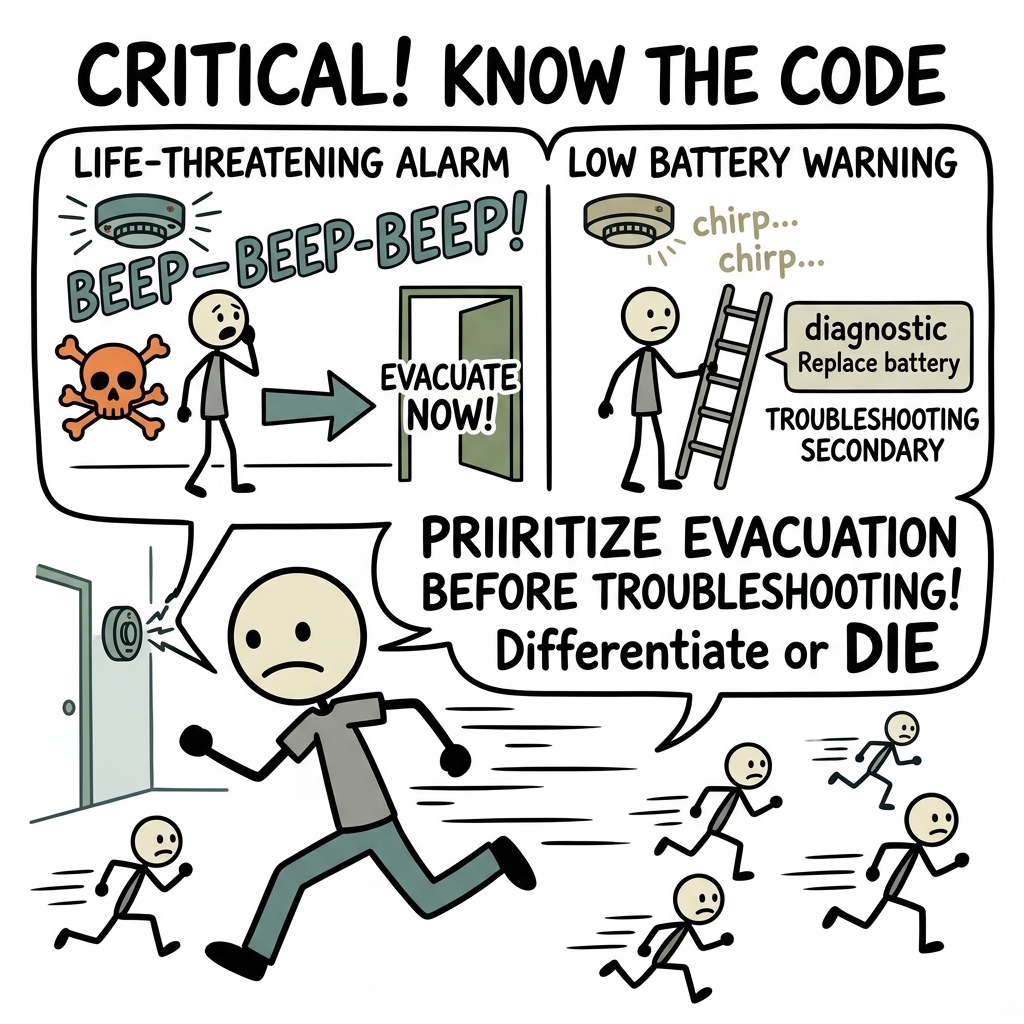
Understanding the Audio Code: Deciphering the Siren
Every modern life-safety device installed in residential architecture communicates through standardized acoustic profiles. The Consumer Product Safety Commission (CPSC) and the National Fire Protection Association (NFPA) have mandated distinct auditory signatures to eliminate ambiguity between an environmental crisis and an appliance fault. Understanding the functional difference in CO alarm vs low battery chirp audio profiles prevents life-threatening hesitation. For the practical checklist side, use the neighborhood preparedness network.
A life-safety crisis sounds radically different from an operational maintenance chirp. When carbon monoxide accumulates to dangerous concentrations, the detector activates an aggressive, unmistakable sequence engineered to wake individuals from deep REM sleep. It does not ping intermittently; it commands the physical space. For the practical checklist side, use the emergency communication plan.
The Temporal-4 Emergency Alert Sequence
The standard emergency alert follows an international code designated as the Temporal-4 (T4) pattern, codified under NFPA 72 guidelines. This cadence follows a strict timing protocol: For the practical checklist side, use the family emergency planning guide.
- Four Rapid Beeps: Four high-pitched (approximately 3 to 3.5 kHz), loud (85 decibels at 10 feet) tone bursts.
- A Five-Second Pause: A five-second drop into total silence while the sensor processes atmospheric readings.
- Continuous Repetition: The cycle immediately restarts—four beeps, pause, four beeps—and will not cease until either the ambient atmosphere clears below target parts-per-million (PPM) thresholds or the unit is manually disabled.
- Visual Confirmation: In units equipped with status LEDs, the Temporal-4 acoustic blast is accompanied by a rapidly flashing red light.
This sequence signals a validated environmental presence of toxic gas. Under UL 2034 manufacturing standards, this pattern triggers when ambient air reaches calibrated exposure thresholds: 70 PPM sustained for 60 to 240 minutes, 150 PPM sustained for 10 to 50 minutes, or 400 PPM sustained for 4 to 15 minutes. In the presence of a T4 pattern, there is zero ambiguity: gas is active, ambient air is compromised, and the living envelope is unsafe. For the practical checklist side, use the real-world emergency scenarios guide.
The Maintenance and Low-Battery Chirp
Conversely, a maintenance notification is functionally designed to register as an audible annoyance rather than a call to panic. It is characterized by minimalism:
- Single, Spaced Tone: One brief, metallic "chirp" or "click" sounding once every 30, 45, or 60 seconds.
- Absence of Urgency: The unit does not emit continuous, overlapping bursts of sound.
- Visual Indicators: The LED status light typically flashes amber or yellow alongside the chirp, though some legacy units flash an accompanying green or red pulse once per minute.
- End-of-Life Variants: When an electrochemical sensor reaches its manufacturer-dictated lifespan (commonly 7 to 10 years), the unit may emit a double-chirp every 30 seconds. This still sounds distinctly different from the sustained, rhythmic violence of the four-beep emergency alarm.
When you hear a carbon monoxide detector beeping, pause and count the rhythm before touching the device. If the cadence features four continuous alarms grouped together, your family is in immediate, active danger. If it is an isolated, solitary blip spaced out by long intervals of total quiet, your hardware requires logistical service.
A Side-by-Side Diagnostic Guide: Alarm vs. Chirp
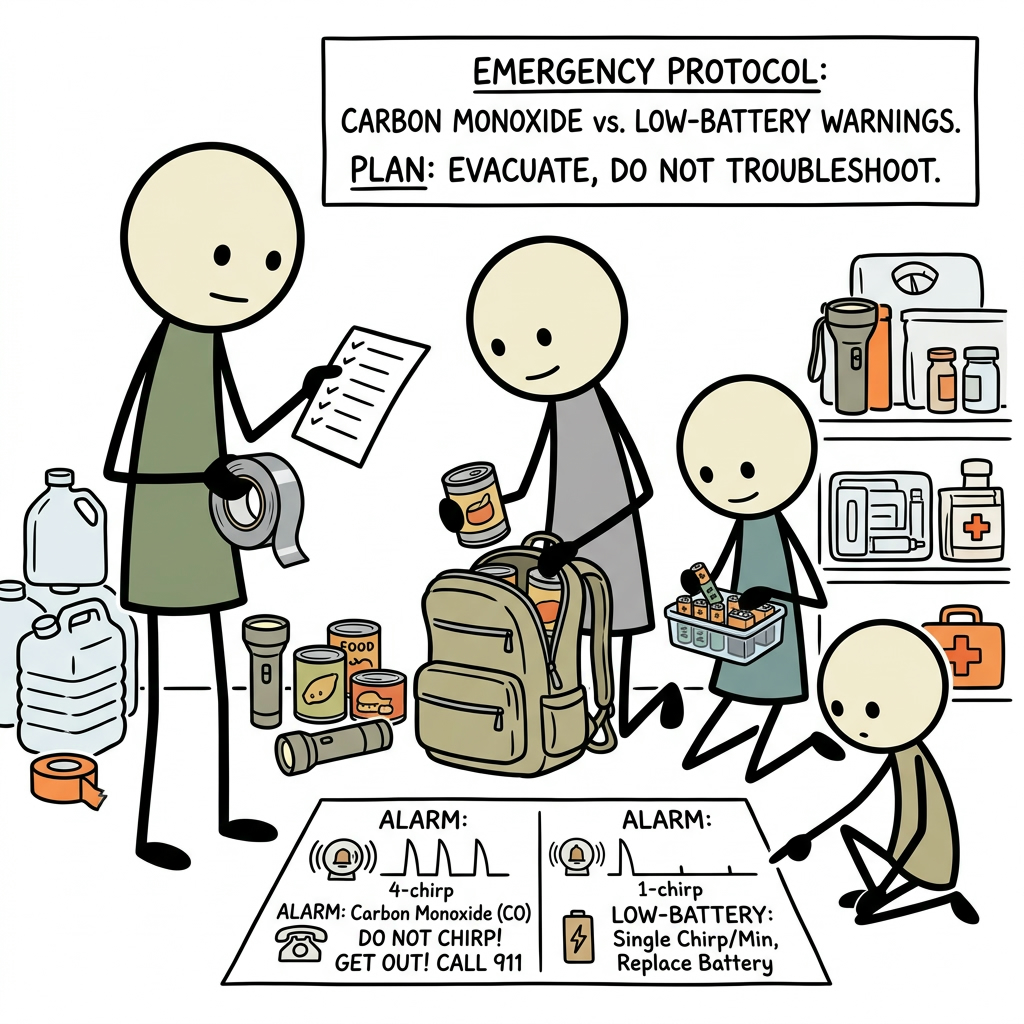
Navigating sensory data in the middle of an emergency can be difficult. Stress impairs cognitive processing, distorts time perception, and encourages risk-tolerant rationalizations. The diagnostic matrix below outlines the operational indicators to instantly differentiate between an actual hazard and an internal device fault.
| Operational Metric | Temporal-4 Carbon Monoxide Emergency | Low-Battery Warning | End-of-Life Sensor Notification |
|---|---|---|---|
| Auditory Cadence | 4 short beeps → 5-second silence → 4 short beeps. | 1 solitary chirp every 30 to 60 seconds. | 2 quick chirps every 30 to 60 seconds. |
| Acoustic Output | Piercing 85 decibels; commanding and room-filling. | Brief, moderate ping; annoying, non-piercing. | Brief, moderate ping; annoying, non-piercing. |
| LED Indicator | Continuous or pulse-synchronized bright red flashing. | Intermittent amber, yellow, or blinking red LED. | Double-flashing amber or yellow LED. |
| Immediate Risk | Imminent chemical asphyxiation; potential fatality. | None from gas; eventual loss of monitoring. | None from gas; device no longer protective. |
| Immediate Action | Evacuate structure instantly; dial 911 from outside. | Replace battery cells during waking hours. | Replace complete alarm hardware immediately. |
Understanding these acoustic patterns forms the baseline of functional carbon monoxide safety. Misinterpreting a four-beep T4 warning as a low-battery issue is one of the most fatal errors a homeowner can commit.
The Fatal Diagnostic Trap: Why Homeowners Hesitate
The greatest threat in a residential carbon monoxide scenario is rarely equipment failure. It is human behavior. Sociological and disaster-response research frequently documents the phenomenon known as "normalcy bias"—the psychological tendency to underestimate the possibility of disaster and its effects. When an alarm blares, our baseline instinct is not to run; it is to prove that running is unnecessary.
Residents consistently fall into what safety professionals term the "Diagnostic Trap." Instead of moving their bodies toward an exit, they step toward the threat. They stare at the device. They reach for the reset button. They sniff the air—an entirely useless gesture, given that pure carbon monoxide is completely odorless, tasteless, and invisible to human biology.
What makes this human instinct lethal is the physiological math of exposure. According to clinical data gathered by the federal Agency for Toxic Substances and Disease Registry (ATSDR), atmospheric carbon monoxide aggressively outcompetes oxygen for binding sites on the hemoglobin molecule inside your bloodstream. The affinity between carbon monoxide and human hemoglobin is approximately 200 to 250 times greater than that of oxygen. As a result, inhaling even fractional percentages of CO progressively converts normal oxyhemoglobin into carboxyhemoglobin (COHb).
Once COHb levels in your bloodstream climb above 10 to 20 percent, physical and neurological performance drops precipitously:
- Executive Function Deterioration: Your ability to analyze basic choices—such as locating a phone, turning a deadbolt, or gathering children—breaks down rapidly.
- Motor Skill Impairment: Fine and gross motor coordination erodes. Balance fails, turning stairwells into high-hazard zones.
- Systemic Muscle Weakness: Victims regularly experience profound physical fatigue in their legs, leaving them unable to crawl or walk even while remaining mentally conscious of the danger.
- Accelerated Incapacitation: Exertion increases respiration rates. Walking around the house to investigate furnace vents, water heaters, or garage thresholds rapidly draws more toxic molecules into the lungs, expediting collapse.
Every thirty seconds spent troubleshooting inside a contaminated space accelerates this physiological degradation. Diagnostic actions belong outside the structure, performed exclusively by municipal personnel equipped with structural personal protective equipment (PPE) and calibrated multi-gas detection instrumentation.
The Evacuation-First Life-Safety Protocol
When an alarm generates the Temporal-4 sequence, safety success hinges entirely on muscle memory and adherence to an established, systematic response plan. Eliminate all diagnostic guesswork. Adopt the standard municipal CO alarm response protocol built around immediate, non-negotiable egress.
Phase 1: Rapid Egress and Accountability
The moment a T4 alarm triggers, your sole tactical objective is the removal of biological assets from the contaminated building envelope. Do not attempt to locate the environmental leak, turn off the central furnace, shut down appliances, or open windows to ventilate the space.
Opening windows may dilute the air just enough to disable the detector's sensors while leaving the primary hazard active, all while exposing you to massive doses of poison. Keep the structure intact for the fire department to properly profile the baseline gas leak.
- Wake All Occupants Loudly: Shout commands clearly. Prioritize children, elderly relatives, and individuals requiring mobility assistance.
- Extract Household Pets if Readily Accessible: If a family dog or cat is immediately in your egress path, take them with you. Do not search under beds, inside basements, or through closets for hiding animals; your own physiological survival window is measured in minutes.
- Abandon Material Possessions: Do not grab computers, heirlooms, vehicle keys, or luggage. Dress only in whatever clothing is immediately within arm's reach as you clear the threshold.
- Exit and Secure: Proceed out the nearest unobstructed exterior door. Pull the door completely closed behind you to compartmentalize the internal atmosphere.
Phase 2: Establish the Outer Perimeter and Mobilize 911
Once across the exterior threshold, retreat to a predetermined muster location—such as the edge of the street, a mailbox, or a cross-street neighbor's front porch. Never remain on an attached porch or inside an open attached garage, as carbon monoxide easily migrates through structural soffits, roof lines, and unsealed shared walls.
Immediately dial 911 from a mobile phone or a neighbor's residence. Communicate clearly and objectively with emergency dispatch:
- State your exact physical address.
- Confirm: "My residential carbon monoxide alarm is actively sounding its four-beep emergency alarm."
- Confirm that the entire human population of the home has successfully evacuated to an outdoor muster station.
- Report whether any occupants are actively manifesting clinical symptoms: dull frontal headaches, nausea, spatial vertigo, sudden fatigue, vomiting, or confusion.
First responders will dispatch an engine company and an emergency medical unit under a hazardous materials response protocol. This guarantees that inbound responders bring both high-grade positive-pressure ventilation fans and life-saving supplemental oxygen therapy.
Phase 3: Scene Control and Prohibited Re-Entry
Do not re-enter the residence under any circumstances. Homeowners often step back inside to retrieve a coat or silence the blaring siren out of embarrassment. This specific behavior has repeatedly resulted in fatal second-wave exposures.
Wait at the muster point until the fire department arrives. When emergency personnel make scene contact, hand over custody of the structure. Firefighters will enter using self-contained breathing apparatus (SCBA) and calibrate the interior environment using industrial-grade photoionization or electrochemical multi-gas sniffers.
Only re-enter the home after the incident commander formally declares the atmosphere safe and gives verbal clearance. If an appliance malfunction is discovered, local utilities or certified HVAC contractors will formally lock and tag out the offending mechanical unit until repairs are completed.
Safe Post-Incident Operations: How to Troubleshoot Carbon Monoxide Alarm Hardware
Troubleshooting is a critical part of household maintenance, but it must be performed strictly within an established safety envelope. You should only attempt to troubleshoot carbon monoxide alarm systems under two explicit conditions: either the unit is emitting a single, documented maintenance chirp, or the fire department has entered, swept the structure, and officially issued an all-clear showing 0 PPM of ambient CO throughout the building.
Once you are certain the atmospheric envelope is completely safe, execute these diagnostic maintenance steps:
1. Identify the Age of the Unit
Electrochemical carbon monoxide sensors do not last indefinitely. While standard smoke ionization chambers may last ten years, the chemical substrate inside a CO monitor steadily degrades through atmospheric exposure. Unclip the unit from its mounting bracket and check the manufacturing or "Replace By" stamp on the rear plastic housing.
If the device is older than the manufacturer's operational threshold—typically 5, 7, or 10 years depending on the brand (such as Kidde, First Alert, or Google Nest)—the unit cannot be fixed. It has entered permanent end-of-life status. Discard the device and install a modern replacement immediately.
2. Execute Battery Replacements Correctly
If the unit is well within its operational lifespan and emitting a solitary chirp every minute, open the internal battery compartment. Even hardwired, 120-volt AC detectors use an internal 9-volt or AA alkaline backup battery to maintain monitoring during utility power outages. Remove the expired cells, clean any minor surface corrosion off the contact terminals, and insert fresh, high-drain industrial alkaline or lithium cells. Avoid using depleted batteries taken from television remotes or other low-draw consumer electronics.
3. Manage Environmental Dust and Contaminants
Electrochemical sensors operate through ambient diffusion. If dust webs, pet dander, or aerosol residues build up over the protective sensor chamber, the unit's internal microprocessor may flag a hardware fault. Blow out the perimeter vents of the device casing with dry compressed air, wipe down the exterior with a dry microfiber cloth, and securely twist the device back into its wall or ceiling base plate.
4. Execute the Functional Test Sequence
Depress and hold the integrated "Test/Silence" button on the face of the unit for three to five continuous seconds. The unit should initiate a diagnostic sound cycle. Ensure the horn produces its full, ear-piercing decibel output and returns to an idle green flashing state.
Understand what this button actually tests: it validates the internal microcircuitry, the acoustic horn, and the battery voltage. It does not prove that the electrochemical sensor can still detect gas. If a unit repeatedly drops back into an unpredictable chirping loop after cleaning and battery renewal, replace it immediately.
Common Mechanical Culprits Behind Sudden CO Leaks
Carbon monoxide is the byproduct of incomplete combustion. Any hydrocarbon fuel source—including natural gas, propane, fuel oil, kerosene, coal, or seasoned firewood—produces carbon monoxide when oxygen levels are insufficient to achieve complete stoichiometric combustion into harmless carbon dioxide (CO2).
Understanding which household appliances can fail helps homeowners anticipate vulnerabilities, plan proactive mechanical inspections, and maintain a resilient home:
- Furnace Heat Exchanger Fractures: A primary cause of winter poisonings. The heat exchanger keeps toxic exhaust gases inside the flue while circulating pure thermal air through living spaces. Over decades of heating cycles, the metal expands and contracts, developing hairline fractures. These cracks push furnace exhaust directly into the primary supply ductwork, spreading toxic gas into every room.
- Blocked, Separated, or Corroded Flue Pipes: Vent piping on modern high-efficiency furnaces and gas water heaters must stay clear. Bird nests, ice dams, heavy snow blockages, or mechanical separations can push vented exhaust straight back into your living space.
- Improperly Vented Fireplaces and Wood Stoves: Closed dampers, cracked masonry flues, or negative pressure environments caused by tight home construction can reverse draft paths, pulling combustion exhaust backward down the chimney into basements and living rooms.
- Attached Garages and Engine Exhaust: Running an automobile, gas snowblower, or lawnmower inside an attached garage generates massive concentrations of carbon monoxide. Even with the large garage bay door fully open, air currents regularly force toxic fumes through service doors and shared walls into the home.
- Portable Generators Run Too Close to the Structure: The CDC and FEMA routinely issue warnings after severe weather: portable gas generators must operate a minimum of 20 feet away from any residential structure, with the exhaust pointed entirely away from windows, doors, and fresh air intake vents. Never run a generator inside a home, crawl space, shed, or garage.
Engineering a Resilient Household Early-Warning System
Surviving a carbon monoxide incident is not an accident; it is the natural outcome of engineering your living space correctly. An aging or poorly placed detector provides little more than a false sense of security. Implementing a proper life-safety baseline requires following professional installation and device guidelines.
Strategic Sensor Placement
Unlike smoke, which is buoyant and rises quickly due to the thermal lift of hot air, carbon monoxide has a molar mass of roughly 28.01 g/mol, making it nearly identical to ambient air (approximately 28.97 g/mol). CO diffuses evenly through interior spaces along normal airflow patterns.
To ensure optimal detection, follow the placement protocols established by the NFPA and the International Residential Code (IRC):
- Outside Every Sleeping Area: Alarms must sit within the immediate hallway outside master suites and bedrooms so the 85-decibel alarm can wake sleeping occupants through closed doors.
- Every Habitable Floor Level: Install at least one functioning detector on every story of the home, including finished basements and attics used as living spaces.
- Proper Distance from Combustion Equipment: Never mount a detector directly adjacent to a furnace, water heater, or fireplace. Installing an alarm within five feet of an appliance can cause regular nuisance alarms from trace startup emissions. Keep a buffer of roughly 15 to 20 feet away from fuel-burning appliances.
- Wall and Ceiling Clearance: Avoid dead-air pockets. Mount wall units at least six inches below the ceiling, or position ceiling units at least six inches away from any intersecting wall.
Device Technologies: Interconnection and Digital Displays
Relying exclusively on isolated, single-station battery units leaves significant safety blind spots. If a furnace heat exchanger cracks in a basement mechanical room at night, an isolated detector in the basement may sound for an hour without waking residents sleeping behind closed doors on the second floor.
Invest in interconnected units, using either direct hardwiring or modern secure wireless mesh networks. When one interconnected alarm detects an active gas build-up, every alarm throughout the entire home sounds simultaneously. This approach gives sleeping occupants the maximum possible time to react, wake their families, and escape safely.
Additionally, prioritize detectors equipped with digital PPM (Parts Per Million) readouts and peak-level memory capabilities. Standard units stay completely silent until ambient gas crosses high emergency thresholds for extended periods. A digital display lets you see lower, non-emergency accumulations (such as 25 to 45 PPM) that still indicate an appliance failure, venting issue, or worsening backdraft. This allows you to call a licensed technician for proactive repairs long before an issue escalates into an emergency.
Make Immediate Evacuation Your Household Reflex
When the piercing cadence of an alarm breaks the silence of your home, remember this fundamental rule: your family is an irreplaceable biological asset, while the equipment on your wall is just an inexpensive diagnostic tool. The auditory difference between a T4 emergency blast and a solitary low-battery ping is clear, objective, and mathematically designed to guide your immediate actions. Never waste valuable minutes standing beneath an alarm trying to troubleshoot strange sounds, sniffing the air for a poison you cannot smell, or worrying about a potential false alarm. Respect the noise, honor the science of human physiology, and clear your home immediately. Move your family outside into clean, safe air first—you will have all the time in the world to troubleshoot your appliances once everyone is out of harm's way.
Frequently Asked Questions
How do I tell the difference between a CO alarm and a low-battery chirp?
A full carbon monoxide alarm sounds as a continuous repeating sequence—typically four loud beeps followed by a brief pause—while a low-battery warning is usually a single, brief chirp repeated once every 30 to 60 seconds.
What should I do immediately if my CO detector sounds its full alarm?
Evacuate all household members and pets into fresh outdoor air immediately, call 911 or local emergency services from outside, and remain outside until emergency responders confirm the building is safe.
Can I investigate the detector or check the batteries before evacuating?
No. Because carbon monoxide is completely invisible and odorless, you cannot verify air quality by sight or smell; always treat any continuous alarm as a confirmed hazard and evacuate prior to troubleshooting.
What are the common symptoms of carbon monoxide poisoning?
Common symptoms include headache, dizziness, disorientation, nausea, vomiting, weakness, and chest pain, frequently described as flu-like symptoms without an accompanying fever.
How often should CO alarms be tested and replaced?
Test detectors monthly using the test button, replace replaceable batteries at least once annually, and replace the complete detector unit every 5 to 7 years according to manufacturer specifications.